
The Importance of Family Literacy in Public Libraries
The Importance of Family Literacy in Public Libraries Kelly Harkrader Nicole Bachmann Anita Shade Abbie Anderson Lauren Bianchi December 6, 2005
Background & History
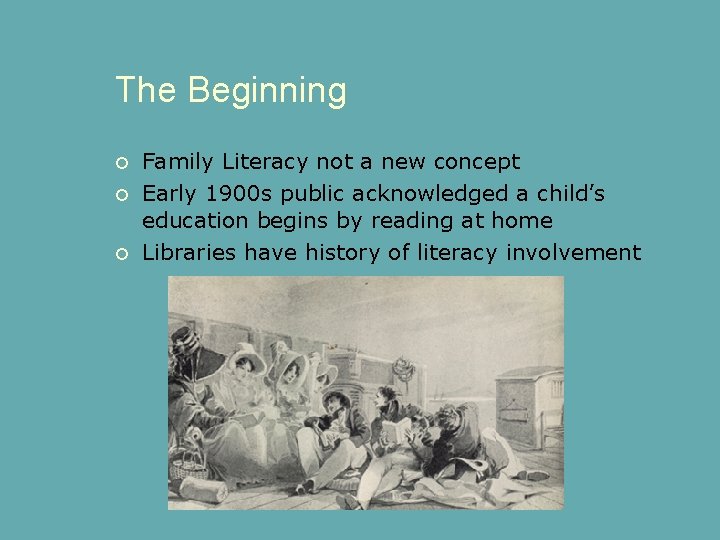
The Beginning Family Literacy not a new concept Early 1900 s public acknowledged a child’s education begins by reading at home Libraries have history of literacy involvement
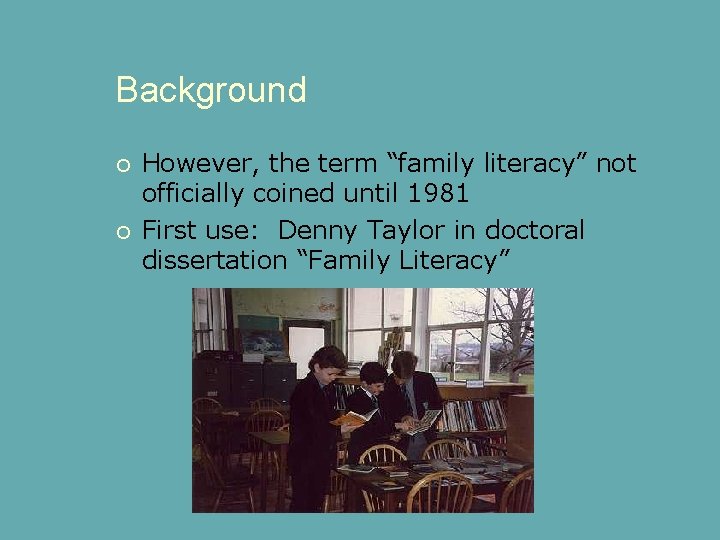
Background However, the term “family literacy” not officially coined until 1981 First use: Denny Taylor in doctoral dissertation “Family Literacy”
Expanding on an idea Taylor’s work used studies done in 1960’s and 1970’s Works examined role of families and parents in reading development & educational achievement of their children Other important publications: -Becoming a Nation of Readers (1985) -A Nation at Risk (1983)
Applying the Research During this time, more research was done Family literacy programs sprang up These were the first formal programs that sought to eradicate low literacy levels Initial Programs Include: 1984: Mother’s Reading Program 1985: PACE 1987: Motheread 1987: Parent’s Reading Program 1989: Even Start 1989: Barbara Bush Foundation for Family Literacy
PACE (1985) Founded by: KY legislation Focuses on: Parents: gain basic literacy skills to function in workplace/ achieve GED Parents & Children: read together Other states began to adopt this model One of the founders, Sharon Darling, became a founder of National Center for Family Literacy
Even Start Founded Goal: by: U. S. Department of Education help low income families break the cycle of poverty using family literacy
Moving forward Although the ball began rolling in 1980’s, family literacy movement really began to boom in 1990’s
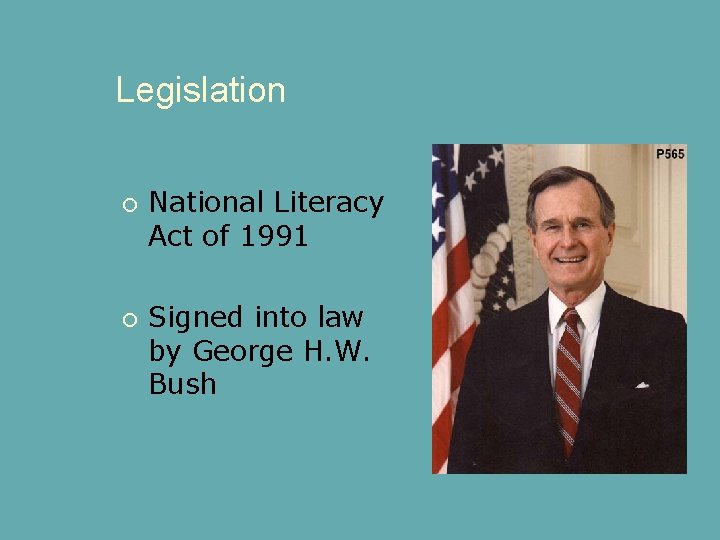
Legislation National Literacy Act of 1991 Signed into law by George H. W. Bush
National Literacy Act (1991) Focused on adult literacy & literacy needs of children Allowed for creation of programs through governmental funding Allotted more funds to support Even Start
Survey of Young Adult Literacy (1985) First wide-scale national literacy survey Surveyed ages 16 -25 on literacy proficiencies Sought to make literacy more complex issue than basic reading/writing Tested abilities to process written information in a variety of situations
National Adult Literacy Survey (1993) Broader than the first Results were not good
The Results Illiteracy was on the rise Literacy lower than the 1985 survey At least 35 million adults had problems with literacy related tasks Supported need for more attention to family literacy Got people’s attention
The Reaction Many family literacy programs developed on local, state, national levels Examples include: 1990: ALA/Bell Atlantic Family Literacy Project 1991: National Center for Family Literacy’s Toyota Families for Learning Program
Where did they go from here? New Programs and Partnerships
What is the illiteracy rate now? National Center for Literacy (2005): approximately 23 million illiterate -cannot fill out job applications -cannot read to their children U. S. Census Bureau (2000): -26% of some states like CA & FL born outside U. S. -11% or 31 million in U. S. born outside U. S.
English Language Learners (ELLs) Reasons why this group is hard to reach: -In many cities large immigrant populations form self sufficient communities -May lack transportation -Young children may never hear English at home -As kids get older, become translators for parents -As parents realize they can’t help with homework, they may ask for help -In some cultures, it is inappropriate to question educators
What makes up a family literacy program? 1. Literacy improvement for adults -GED - Job Applications -Shopping 1. - Homework help Emerging literacy activities for children -pre-k through elementary school age -reading skills -homework help -motor skills
What makes up a family literacy program? 1. (continued) Interactional/intergenerational activities for the entire family -parents read to children -play games -discuss books 1. Parenting skills/problem sharing -parenting classes -nutrition information -how to read books to kids
Who can you partner with? +Schools +Day Care Centers +Head Start +Even Start +Healthy Start +Universities +Prisons/Jails/Detention Centers +Homeless Shelters +Rehabilitation Programs +Health Care Providers
Current/Past Partners ~Toyota ~Metlife ~Bank of America ~Mc. Donald’s ~Prime. Time ~Bell Atlantic ~ALA ~Local/State/Federal Government ~Cargill ~Library of Congress Center for the Book ~Starbucks ~National Center for Literacy ~Barbara Bush Foundation ~Wells Fargo ~Motheread ~Wallace Foundation ~Community Centers ~Families For Literacy ~Verizon ~Reading Empowers All People (REAP)
So What are Some of these Programs? 6 examples
Prime. Time (1991 -today) http: //www. leh. org/primetime/PThomepage. htm Founded by: Louisiana Endowment for the Humanities Purpose: show families that TV is not the only fun family activity University professors, public libraries, families of 6 -10 year olds/ pre-k 3 -4 year olds
Prime. Time What it does: (continued) -5 states give 4 programs -a humanities professor, story teller, library coordinator, preschool coordinator -lead a 90 minute session for 6 -8 weeks on selected award-winning children’s books
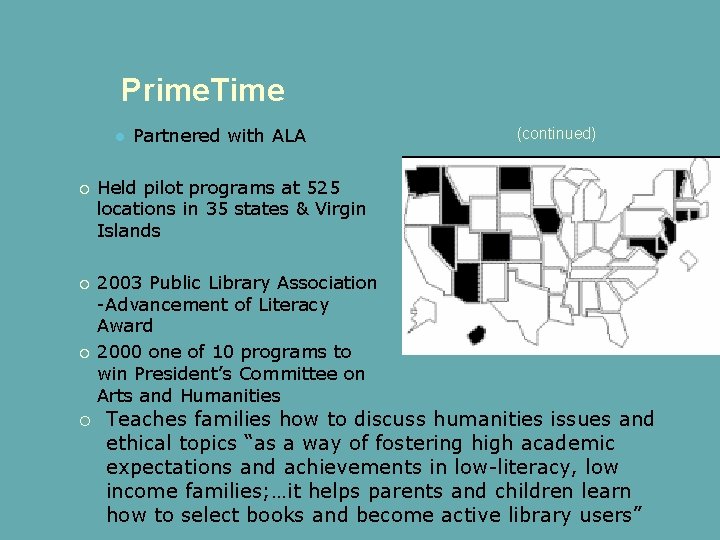
Prime. Time Partnered with ALA (continued) Held pilot programs at 525 locations in 35 states & Virgin Islands 2003 Public Library Association -Advancement of Literacy Award 2000 one of 10 programs to win President’s Committee on Arts and Humanities Teaches families how to discuss humanities issues and ethical topics “as a way of fostering high academic expectations and achievements in low-literacy, low income families; …it helps parents and children learn how to select books and become active library users”
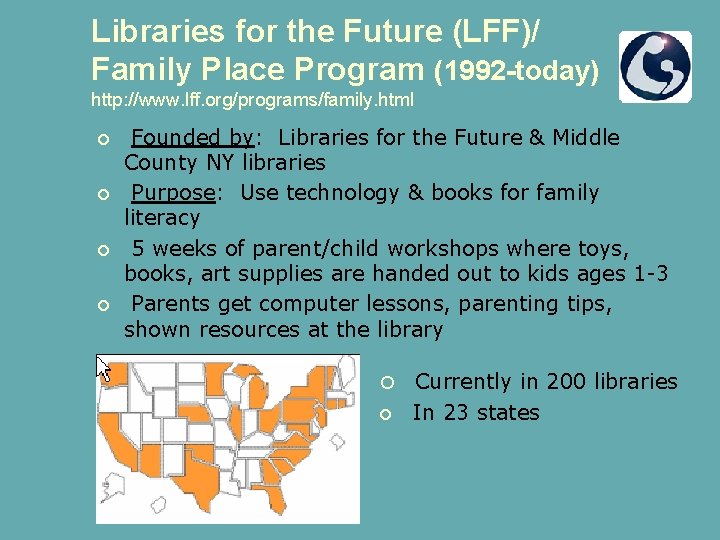
Libraries for the Future (LFF)/ Family Place Program (1992 -today) http: //www. lff. org/programs/family. html Founded by: Libraries for the Future & Middle County NY libraries Purpose: Use technology & books for family literacy 5 weeks of parent/child workshops where toys, books, art supplies are handed out to kids ages 1 -3 Parents get computer lessons, parenting tips, shown resources at the library Currently in 200 libraries In 23 states
Connecting Libraries and Schools Project (CLASP) in NYC (1991 -today) http: //www. nypl. org Founded by: NYPL grant from Dewitt Wallace-Reader’s Digest Fund Purpose: Support collaboration public schools/libraries Initially worked with 3 school districts, 23 public library branches, 107 schools 1994 brought to all 5 boroughs 1999 city funded
Connecting Libraries and Schools Project (CLASP) (continued) What makes this program so special? -puts one person in charge of making class visits, making sure students have library cards, attending faculty/PTA meetings -visits school media center to collaborate -recognizes schedule differences and works with them -strategize with schools, assess community needs -program evaluation
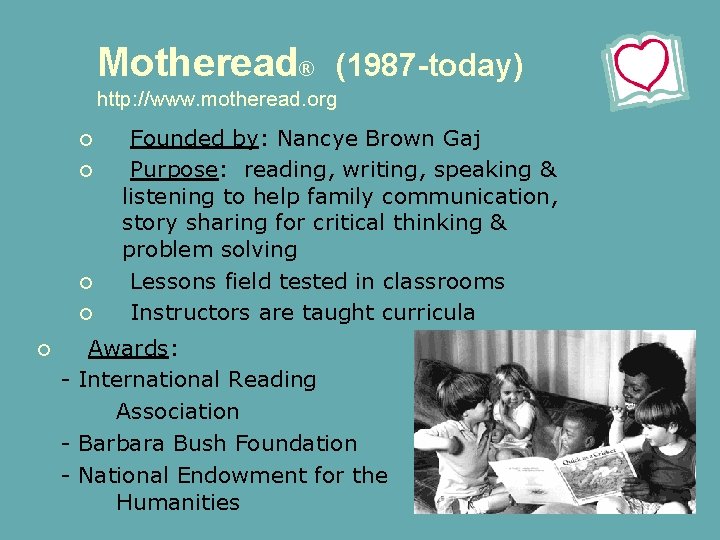
Motheread® (1987 -today) http: //www. motheread. org Founded by: Nancye Brown Gaj Purpose: reading, writing, speaking & listening to help family communication, story sharing for critical thinking & problem solving Lessons field tested in classrooms Instructors are taught curricula Awards: - International Reading Association - Barbara Bush Foundation - National Endowment for the Humanities
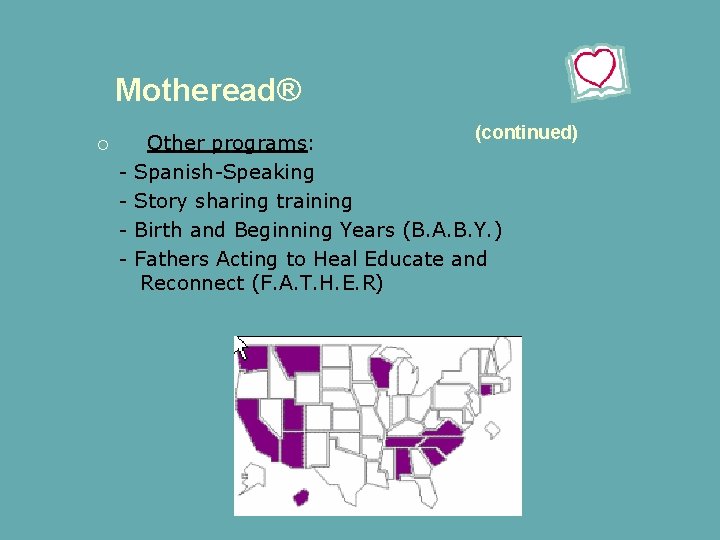
Motheread® (continued) - Other programs: Spanish-Speaking Story sharing training Birth and Beginning Years (B. A. B. Y. ) Fathers Acting to Heal Educate and Reconnect (F. A. T. H. E. R)
Raising a Reader® (1999 -today) http: //www. pcf. org/raising_reader/program. html Founded by: Peninsula Community Foundation Purpose: parent-child bonding pre-k kids & teaches story telling Gives a bag of picture books to bring home to read to kids Tested in Head Start, 33% increase in parent/child bonding time Spanish speaking families use of public services up 56%
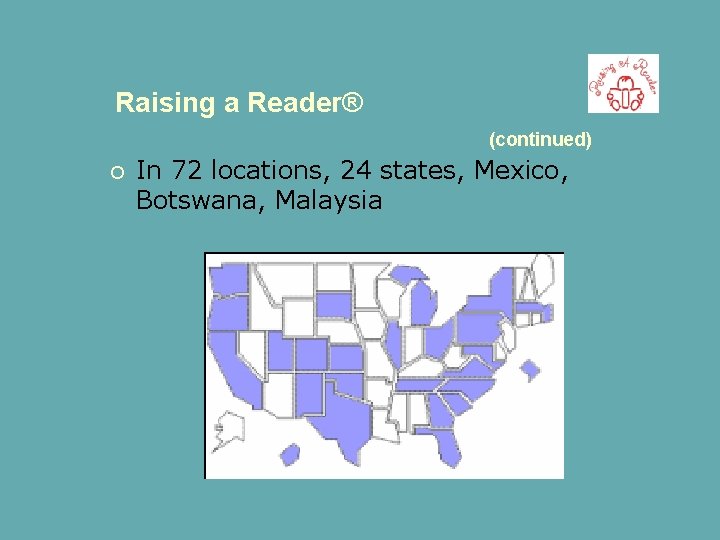
Raising a Reader® (continued) In 72 locations, 24 states, Mexico, Botswana, Malaysia
Reading Empowers All People (1999 -today) http: //www. dekalb. public. lib. ga. us/ Founded By: Dekalb County Public Library in GA from an anonymous 100, 000 grant. Costs low due to partnerships. Purpose: to support ELL families in learning English GA has a 53% increase in immigrant population 1990 -1999 Children’s librarians teach the kids for an hour Parents taught by community college instructors Families reunite to color, play games, talk about nutrition
The Benefits and Critiques of Family Literacy Programs and the Public Library
Libraries already provide many components of Family Literacy: Adult Literacy English as a Second Language Instruction Special Collections and Programming for Children Parenting Support and Programming
Organizations American Library Association Supports Family Literacy Initiatives Doesn’t Endorse a Particular Program Association of Library Services to Children and Public Library Association Every Child Ready to Read
Questions about Family Literacy “Libraries and the American Library Association stand tall for intellectual freedom issues. Why not literacy? ALA has the Freedom to Read Foundation. Do we really mean it? ” “A literate public demands good libraries; good libraries create a literate public. It makes sense. ” Peggy Barber
Critiques Of Family Literacy Programs Of Library Involvement Of Individual Programs
The Compensatory Model: Lack of Education Lack of English Fluency Lack of Stable Employment and Adequate Income Lack of Parent-Child Interaction Lack of “Correct” Family Morals
The One-Child, One-Mother Model The Most Common Family Literacy Model Overlooks Other Members of the Family who could also Benefit
The Lack of Adequate Adult or Interactive Literacy Practice No Consensus on what High-Quality Parenting Practices Involve Same is True for Adult Education/Job Training No Guarantee that Improved Literacy will lead to Better Employment Many Programs Shortchange Parent-Child Interaction Time
The Instability of Family Literacy Funding Although Passion is still high, could face cuts in future Programs Seen as Adjunct or Extra
Family Literacy in the Public Libraries 100 -150 hours of instruction required to advance one grade level Current average is 70 hours
Changes in Student Participation and Achievement Average Participation was Well Short of Level Required for Advancement Standardized Tests Showed No Correlation between Participation and Advancement
Challenges in Implementation Strategies most in line with current library practice were implemented easily Most programs reluctant to develop social services capacity Emphasis on programs over social services limited the potential to improve persistence
Pathways to Persistence Offer Realistic Social Supports Develop a System of Referral to Social Services and other Education Providers Adapt and Add to Programs Aspects to Aid Persistence
Critiques of Individual Programs Even Start: School-community based program Strict requirements on who can participate
Critiques of Individual Programs Prime. Time Family Reading Time: Claims to be Public Library Program Doesn’t Provide Intensity and Duration Necessary for Lasting Change
Critiques of Individual Programs CLASP (Connecting Libraries and Schools) Good Example of what Libraries Can Do Involved Major Effort on Part of Library to be Successful
Call and Response: Out Standing in the Field
Here in Monroe County: CAPE (since 2001: “Monroe County Children Matter!”) http: //www. monroe-countycape. org/Initiative 2/Family. Literacy. html Family Resource Centers in schools and community centers are staffed by Family Literacy Coordinators No formal library involvement Extensive informal partnerships with various community institutions Success depends largely on the strengths and networking abilities (and luck) of the individual FLCs MCPL-Main has benefited greatly from FRC programs held at the library (“Say It in Spanish”, etc. ) MCPL-Ellettsville has done the opposite, holding many library programs at the FRC Some schools were left out of CAPE; others lost their FRCs in the current phase of the program Keep your fingers crossed for sustaining the program once the final phase of Lilly support ends in 2008.
The Questions What we asked the NIFL Family Literacy discussion list: (http: //www. nifl. gov/mailman/listinfo/Familyliteracy) 1. Do you partner with public libraries/librarians? 2. If so, what is the extent of the library’s involvement with your program? 3. How do you make use of the public library with the families you serve? 4. In your experience, what are the pros and cons (strengths and weaknesses) of working with libraries/librarians? 5. How many of you are librarians?
Some Answers: The Good, the Bad… Literacy Program Developer, LIFT-Missouri (“Missouri’s Literacy Resource Center”) http: //lift-missouri. org “I have seen many responses to the families in these programs. Many librarians do not want those {crinkle your nose and look over your glasses} families in their libraries. ” “Then there are other librarians who arrange special story hours specifically for our families and collect books related to theme that the program is working on—both for the children and for the adults. ”
Some Answers: The Good, the Bad… Civics and Technology Coordinator, Rhode Island Family Literacy Initiative (RIFLI) “We have been working in the past year to refocus our efforts at engaging librarians in our program (we were beginning to be seen as outsiders) as well as integrating the library resources into our curriculum. ” “I would say that in a program like ours, we have to be very proactive in voicing our mission and needs to the librarians so that our common goals are understood. ”
Some Answers: The Good, the Bad… Literacy Program Manager, Illinois State Library Literacy Office, Family Literacy Grant Program “Libraries can offer a powerful welcome to the reading world. On the other hand, there may be a cultural disconnect between many highly educated librarians and library patrons and the socioeconomic level of family literacy participants. ” “…the family literacy program may just be one more responsibility loaded onto an already overworked librarian. ” “In the successful programs, the learning is a two-way street and the library staff is enthusiastic and willing. ”
What about the unsuccessful programs?
Some Answers: The Ugly Coordinator, White Earth Even Start Program “We’ve had very unsuccessful results in our family literacy program’s efforts to collaborate with our local library” “After several negative experiences in the library, we’ve decided to boycott the library and our families began a letter writing campaign to the main branch of the library department. ” The White Earth Even Start Program has received a grant to support its own “READmobile” on the reservation.
In Sum Family Literacy Faculty, Adult Basic Education Department, Edmonds Community College (Washington) “I believe the local library is one of the best and least utilized resources in many communities. ” “Librarians are not alone in their lack of preparedness to understand or address the social welfare issues related to intergenerational poverty or the challenges facing newcomers to our country. It seems to be a common condition nationwide. ” “As a professional in the field, I heartily agree with you about the partnership barriers of both habit and territory. ”
Family Literacy and Public Libraries… “I appreciate you bringing these issues to light; perhaps just the mention of them may jiggle the status quo mind set just a bit. ” Status quo mind set: jiggled?
- Slides: 60