
The Importance of Decision Analytic Modelling in Evaluating
- Slides: 10
The Importance of Decision Analytic Modelling in Evaluating Health Care Interventions Mark Sculpher Professor of Health Economics Centre for Health Economics University of York, UK
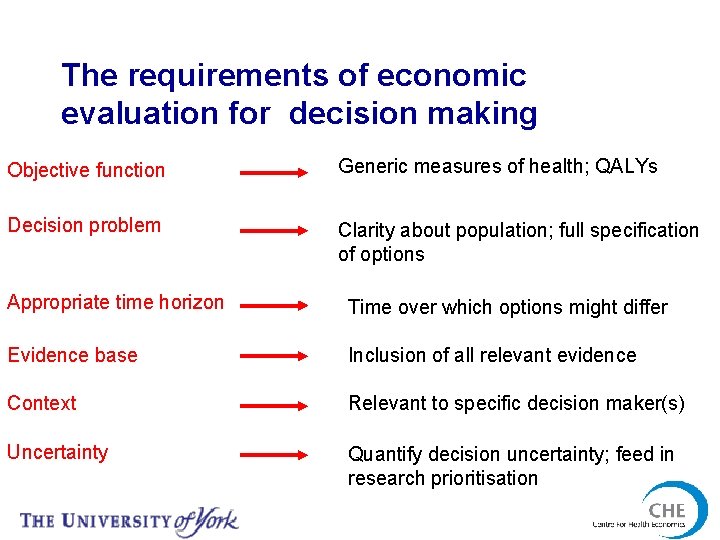
The requirements of economic evaluation for decision making Objective function Generic measures of health; QALYs Decision problem Clarity about population; full specification of options Appropriate time horizon Time over which options might differ Evidence base Inclusion of all relevant evidence Context Relevant to specific decision maker(s) Uncertainty Quantify decision uncertainty; feed in research prioritisation
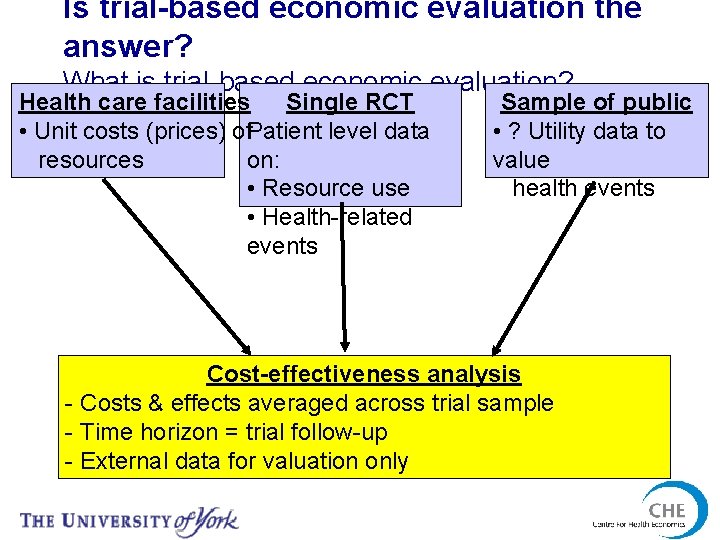
Is trial-based economic evaluation the answer? What is trial-based economic evaluation? Health care facilities Single RCT • Unit costs (prices) of. Patient level data resources on: • Resource use • Health-related events Sample of public • ? Utility data to value health events Cost-effectiveness analysis - Costs & effects averaged across trial sample - Time horizon = trial follow-up - External data for valuation only
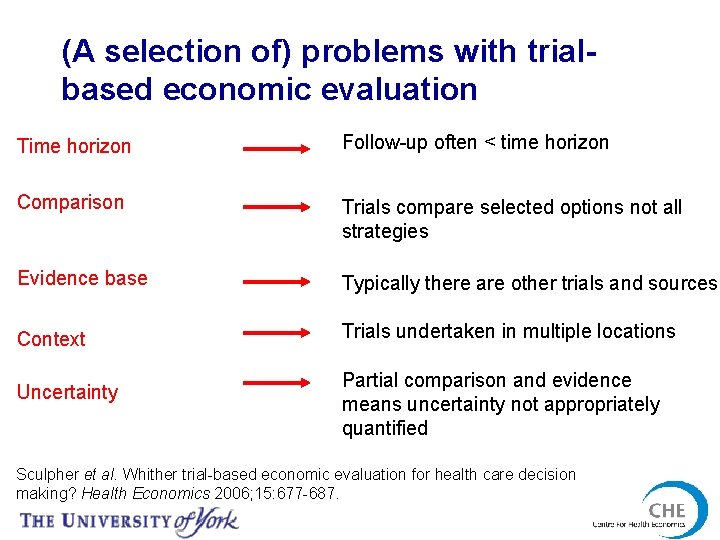
(A selection of) problems with trialbased economic evaluation Time horizon Follow-up often < time horizon Comparison Trials compare selected options not all strategies Evidence base Typically there are other trials and sources Context Trials undertaken in multiple locations Uncertainty Partial comparison and evidence means uncertainty not appropriately quantified Sculpher et al. Whither trial-based economic evaluation for health care decision making? Health Economics 2006; 15: 677 -687.
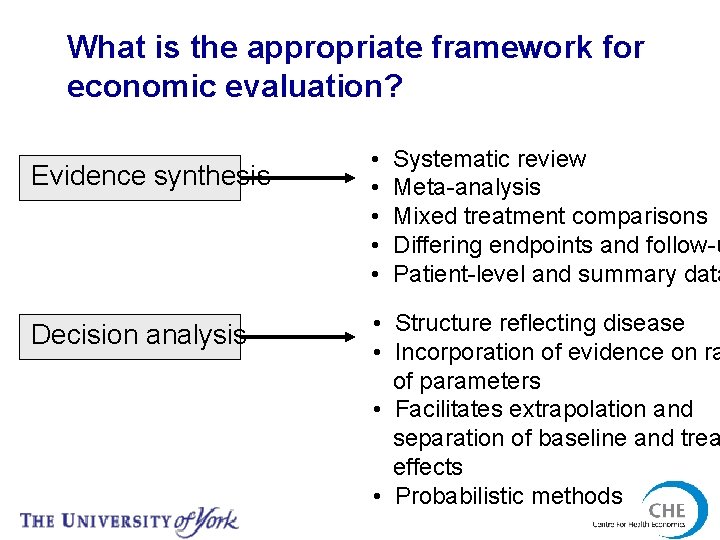
What is the appropriate framework for economic evaluation? Evidence synthesis Decision analysis • • • Systematic review Meta-analysis Mixed treatment comparisons Differing endpoints and follow-u Patient-level and summary data • Structure reflecting disease • Incorporation of evidence on ra of parameters • Facilitates extrapolation and separation of baseline and trea effects • Probabilistic methods
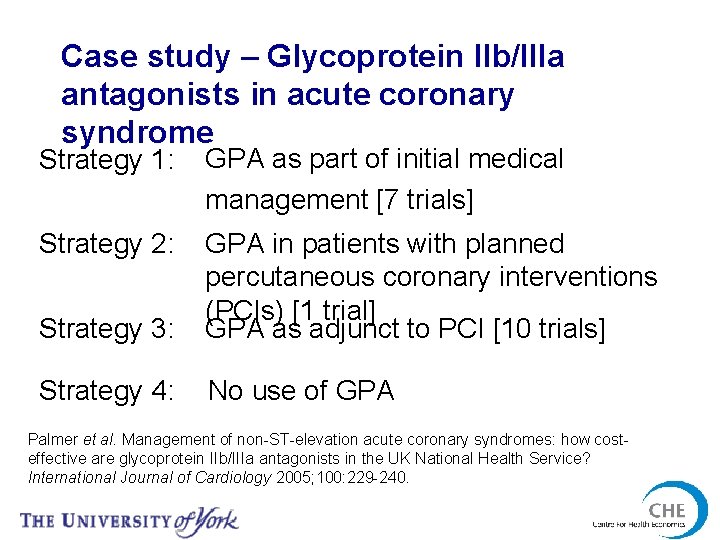
Case study – Glycoprotein IIb/IIIa antagonists in acute coronary syndrome Strategy 1: GPA as part of initial medical management [7 trials] Strategy 2: Strategy 3: GPA in patients with planned percutaneous coronary interventions (PCIs) [1 trial] GPA as adjunct to PCI [10 trials] Strategy 4: No use of GPA Palmer et al. Management of non-ST-elevation acute coronary syndromes: how costeffective are glycoprotein IIb/IIIa antagonists in the UK National Health Service? International Journal of Cardiology 2005; 100: 229 -240.
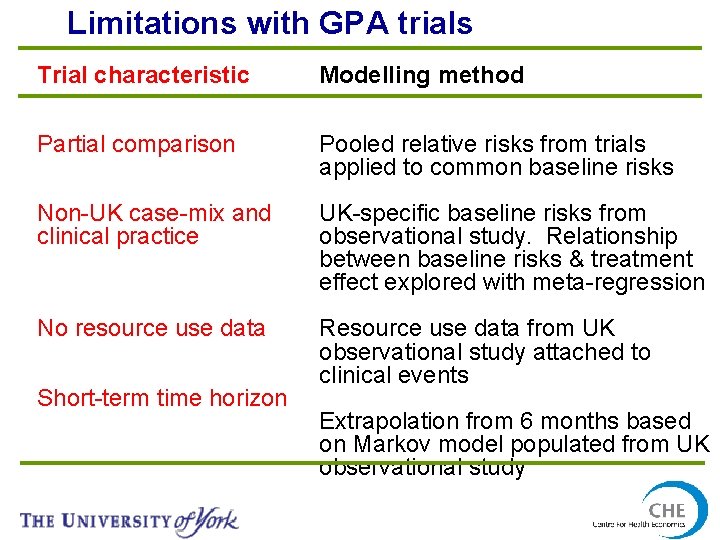
Limitations with GPA trials Trial characteristic Modelling method Partial comparison Pooled relative risks from trials applied to common baseline risks Non-UK case-mix and clinical practice UK-specific baseline risks from observational study. Relationship between baseline risks & treatment effect explored with meta-regression No resource use data Resource use data from UK observational study attached to clinical events Short-term time horizon Extrapolation from 6 months based on Markov model populated from UK observational study
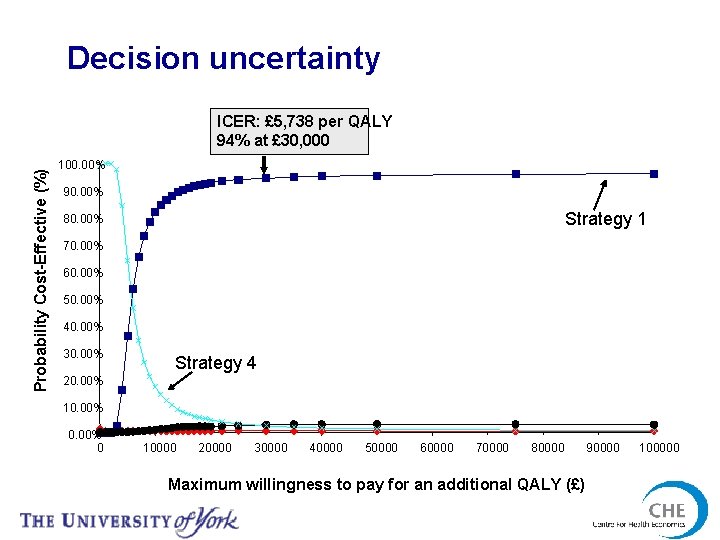
Decision uncertainty Probability Cost-Effective (%) ICER: £ 5, 738 per QALY 94% at £ 30, 000 100. 00% 90. 00% Strategy 1 80. 00% 70. 00% 60. 00% 50. 00% 40. 00% 30. 00% Strategy 4 20. 00% 10. 00% 0 10000 20000 30000 40000 50000 60000 70000 80000 Maximum willingness to pay for an additional QALY (£) 90000 100000
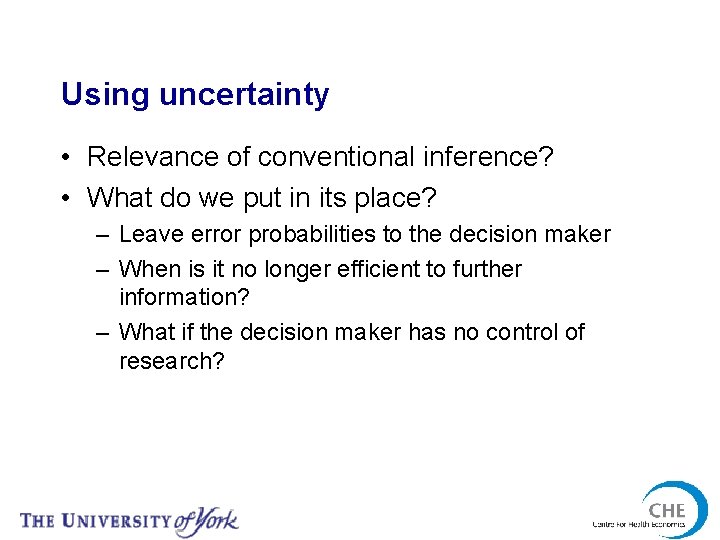
Using uncertainty • Relevance of conventional inference? • What do we put in its place? – Leave error probabilities to the decision maker – When is it no longer efficient to further information? – What if the decision maker has no control of research?
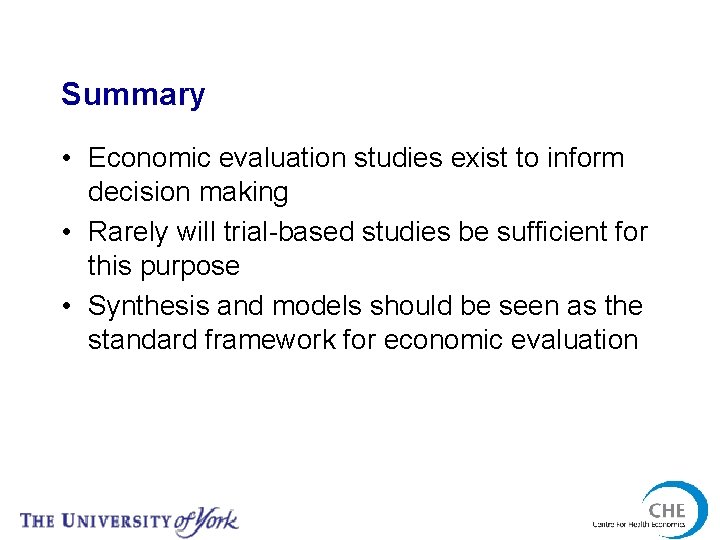
Summary • Economic evaluation studies exist to inform decision making • Rarely will trial-based studies be sufficient for this purpose • Synthesis and models should be seen as the standard framework for economic evaluation