
The Implications of Second Order Effects of Practical
- Slides: 1
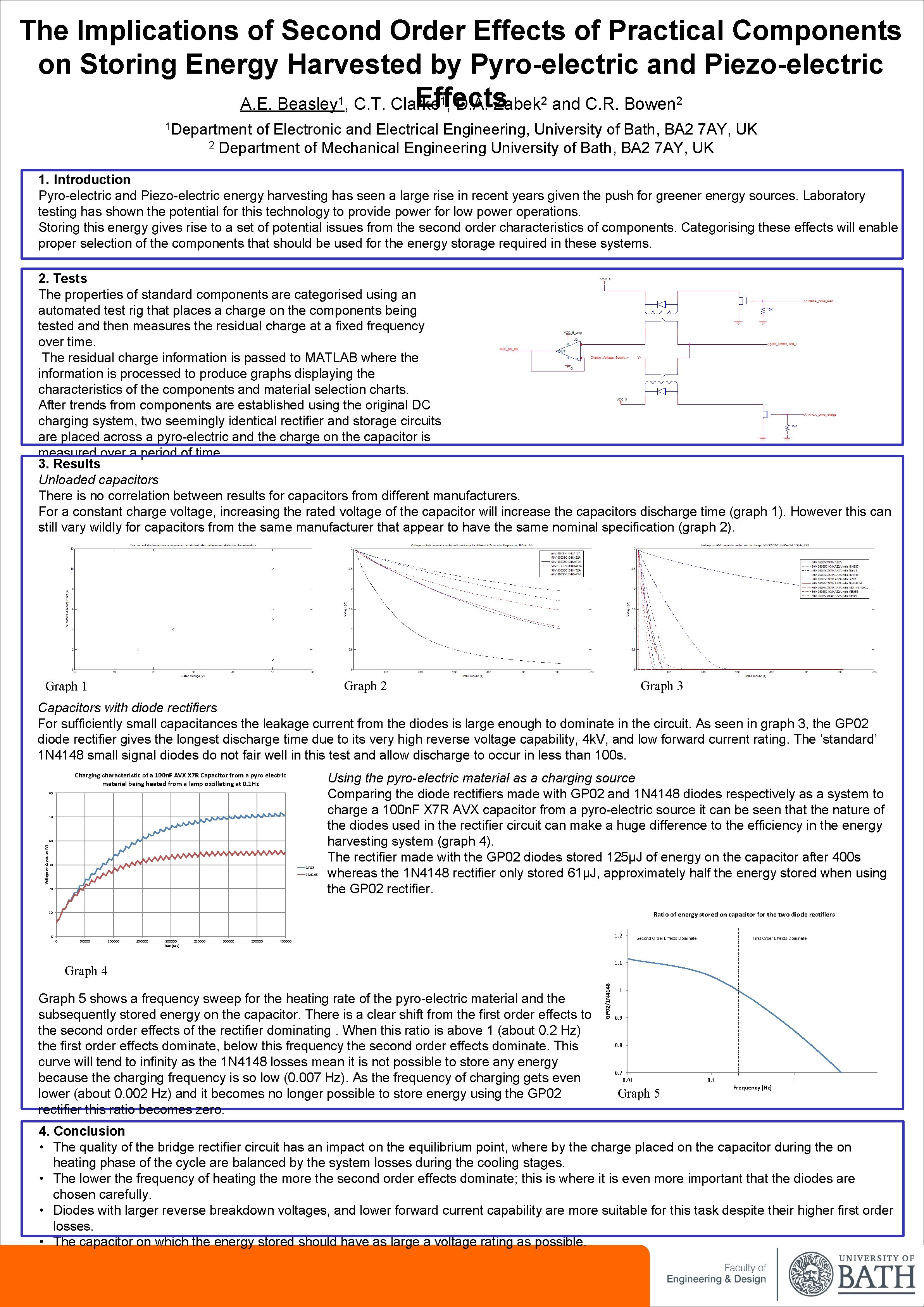
The Implications of Second Order Effects of Practical Components on Storing Energy Harvested by Pyro-electric and Piezo-electric 1, D. A. Zabek 2 and C. R. Bowen 2 Effects A. E. Beasley 1, C. T. Clarke 1 Department of Electronic and Electrical Engineering, University of Bath, BA 2 7 AY, UK 2 Department of Mechanical Engineering University of Bath, BA 2 7 AY, UK 1. Introduction Pyro-electric and Piezo-electric energy harvesting has seen a large rise in recent years given the push for greenergy sources. Laboratory testing has shown the potential for this technology to provide power for low power operations. Storing this energy gives rise to a set of potential issues from the second order characteristics of components. Categorising these effects will enable proper selection of the components that should be used for the energy storage required in these systems. 2. Tests The properties of standard components are categorised using an automated test rig that places a charge on the components being tested and then measures the residual charge at a fixed frequency over time. The residual charge information is passed to MATLAB where the information is processed to produce graphs displaying the characteristics of the components and material selection charts. After trends from components are established using the original DC charging system, two seemingly identical rectifier and storage circuits are placed across a pyro-electric and the charge on the capacitor is measured over a period of time. 3. Results Unloaded capacitors There is no correlation between results for capacitors from different manufacturers. For a constant charge voltage, increasing the rated voltage of the capacitor will increase the capacitors discharge time (graph 1). However this can still vary wildly for capacitors from the same manufacturer that appear to have the same nominal specification (graph 2). Graph 3 Graph 2 Graph 1 Capacitors with diode rectifiers For sufficiently small capacitances the leakage current from the diodes is large enough to dominate in the circuit. As seen in graph 3, the GP 02 diode rectifier gives the longest discharge time due to its very high reverse voltage capability, 4 k. V, and low forward current rating. The ‘standard’ 1 N 4148 small signal diodes do not fair well in this test and allow discharge to occur in less than 100 s. Charging characteristic of a 100 n. F AVX X 7 R Capacitor from a pyro electric material being heated from a lamp oscillating at 0. 1 Hz 60 50 Voltage on Capacitor (V) 40 30 GP 02 1 N 4148 20 Using the pyro-electric material as a charging source Comparing the diode rectifiers made with GP 02 and 1 N 4148 diodes respectively as a system to charge a 100 n. F X 7 R AVX capacitor from a pyro-electric source it can be seen that the nature of the diodes used in the rectifier circuit can make a huge difference to the efficiency in the energy harvesting system (graph 4). The rectifier made with the GP 02 diodes stored 125µJ of energy on the capacitor after 400 s whereas the 1 N 4148 rectifier only stored 61µJ, approximately half the energy stored when using the GP 02 rectifier. Ratio of energy stored on capacitor for the two diode rectifiers 10 1. 2 0 0 50000 100000 150000 200000 Time (ms) 250000 300000 350000 Second Order Effects Dominate 400000 1. 1 GP 02/1 N 4148 Graph 4 Graph 5 shows a frequency sweep for the heating rate of the pyro-electric material and the subsequently stored energy on the capacitor. There is a clear shift from the first order effects to the second order effects of the rectifier dominating. When this ratio is above 1 (about 0. 2 Hz) the first order effects dominate, below this frequency the second order effects dominate. This curve will tend to infinity as the 1 N 4148 losses mean it is not possible to store any energy because the charging frequency is so low (0. 007 Hz). As the frequency of charging gets even lower (about 0. 002 Hz) and it becomes no longer possible to store energy using the GP 02 rectifier this ratio becomes zero. First Order Effects Dominate 1 0. 9 0. 8 0. 7 0. 01 Graph 5 0. 1 Frequency [Hz] 1 4. Conclusion • The quality of the bridge rectifier circuit has an impact on the equilibrium point, where by the charge placed on the capacitor during the on heating phase of the cycle are balanced by the system losses during the cooling stages. • The lower the frequency of heating the more the second order effects dominate; this is where it is even more important that the diodes are chosen carefully. • Diodes with larger reverse breakdown voltages, and lower forward current capability are more suitable for this task despite their higher first order losses. • The capacitor on which the energy stored should have as large a voltage rating as possible.