
The Implementation of National Educational Standards in Austria


- Slides: 45
The Implementation of National Educational Standards in Austria Michael Bruneforth BIFIE - Austrian Federal Institute for Education Research, Innovation and Development of the Austrian School System EURASIAN EDUCATIONAL DIALOGUE 17. -19. April, Yaroslavl The Implementation of National Educational Standards in Austria, 18/05/2013 © BIFIE Salzburg
BIFIE - Austrian Federal Institute for Education Research, Innovation and Development of the Austrian School System Areas of work § International Studies (PISA, TIMSS, PIRLS, TALIS) § Implementation of national education standards § Formative and summative Evaluation of standards § Central examination for upper secondary education preparing for tertiary education § National Education Reports The Implementation of National Educational Standards in Austria, 18/05/2013 © BIFIE Salzburg
Spotlight on Austrian education Very rich country (4 th highest GDP per Capita in EU) High expenditure per student (140% of EU Average) in primary and secondary education Low student teacher ratio and class size But PISA shock in 2003 and 2009: § Very low PISA results in reading (470, similar to Russia 459), no EU country scores less § Strong relation between education outcomes and family background The Implementation of National Educational Standards in Austria, 18/05/2013 © BIFIE Salzburg
Changing in paradigm in educational governance Since more than a decade there is a change in governance of schools and education in German speaking countries from input oriented control to evidence based output oriented governance and extension of school autonomy In Austria at the centre is shift towards competence oriented teaching based on the definition of nationwide compulsory education standards and a mechanism of formative and summative evaluation The Implementation of National Educational Standards in Austria, 18/05/2013 © BIFIE Salzburg
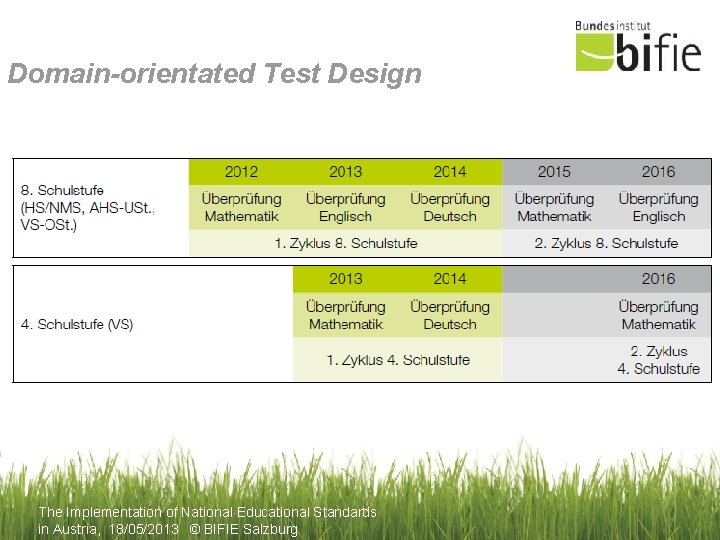
Legal Basis and Conditions From 2004: pilot phase with selected pilot schools 2008: alteration of the law of teaching in schools to allow for introduction of educational standards 2009: educational standards become compulsory for German, Math and English 2009 (grade 8) and 2010 (grade 4): baseline-tests in samples of about 10. 000 students each From 2012 onwards yearly assessment of national standards (one subject per year) The Implementation of National Educational Standards in Austria, 18/05/2013 © BIFIE Salzburg
Annex of the legal regulation Competency Models and descriptors are formulated as Can-Do-Statements Competency Models and descriptors are legally established Educational Standards can be interpreted as mandatory and agreed upon social objectives of instruction Educational Standards are derived from national curricula and clearly define learning outcome. The Implementation of National Educational Standards in Austria, 18/05/2013 © BIFIE Salzburg
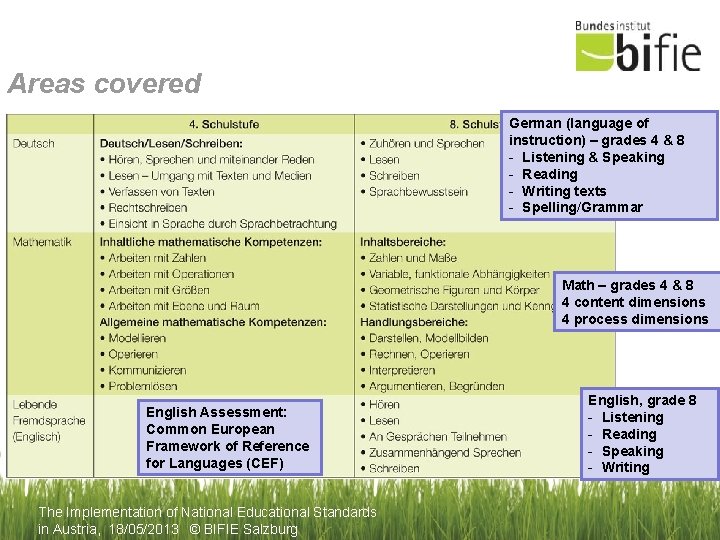
Areas covered German (language of instruction) – grades 4 & 8 - Listening & Speaking - Reading - Writing texts - Spelling/Grammar Math – grades 4 & 8 4 content dimensions 4 process dimensions English Assessment: Common European Framework of Reference for Languages (CEF) The Implementation of National Educational Standards in Austria, 18/05/2013 © BIFIE Salzburg English, grade 8 - Listening - Reading - Speaking - Writing
Competencies are … „fashionable term with a vague meaning“ (Weinert 2001) „cognitive prerequisites to coping with a specific range of situations“ (Klieme, Hartig & Rauch, 2008) „cognitive abilities and skills available to/acquired by individuals that enable them to solve specific problems, as well as the related motivational, volitional and social readiness and skills to utilize the solutions successfully and responsibly in variable situations“ (Weinert, 2002) BIFIE use: subject (domain) specific competency models, focusing on cognitive skills and proficiencies The Implementation of National Educational Standards in Austria, 18/05/2013 © BIFIE Salzburg
Competency Models of competence structures § Dimensions of competence: E. g. TIMSS, grade 8: 4 content domains (number, algebra, geometry, data and chance); 3 cognitive domains (knowing, applying, reasoning) Models of competence levels § Describe specific skills and proficiencies usually shown by individuals located at specific points of the ability continuum § Used to provide a criterion-referenced interpretation of measurement results The Implementation of National Educational Standards in Austria, 18/05/2013 © BIFIE Salzburg
Competency Models of competence structures Models of competence levels Development models Models describing the acquisition of skills and proficiencies May be linked to neurological/psychological theories of development Only a few exist Would be great to have a theoretical foundation for tests in different grades! (IKM – BIST) The Implementation of National Educational Standards in Austria, 18/05/2013 © BIFIE Salzburg
EXAMPLE MATHEMATICS, GRADE 8 The Implementation of National Educational Standards in Austria, 18/05/2013 © BIFIE Salzburg
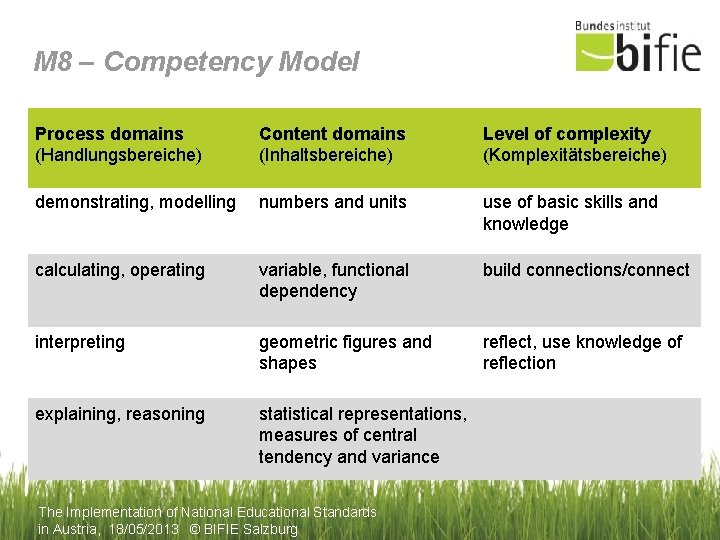
M 8 – Competency Model Process domains (Handlungsbereiche) Content domains (Inhaltsbereiche) Level of complexity (Komplexitätsbereiche) demonstrating, modelling numbers and units use of basic skills and knowledge calculating, operating variable, functional dependency build connections/connect interpreting geometric figures and shapes reflect, use knowledge of reflection explaining, reasoning statistical representations, measures of central tendency and variance The Implementation of National Educational Standards in Austria, 18/05/2013 © BIFIE Salzburg
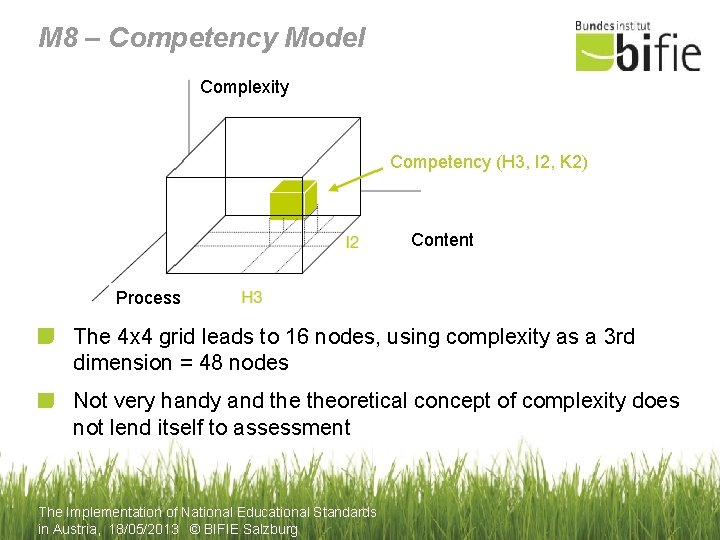
M 8 – Competency Model Complexity Competency (H 3, I 2, K 2) Content Process The 4 x 4 grid leads to 16 nodes, using complexity as a 3 rd dimension = 48 nodes Not very handy and theoretical concept of complexity does not lend itself to assessment The Implementation of National Educational Standards in Austria, 18/05/2013 © BIFIE Salzburg
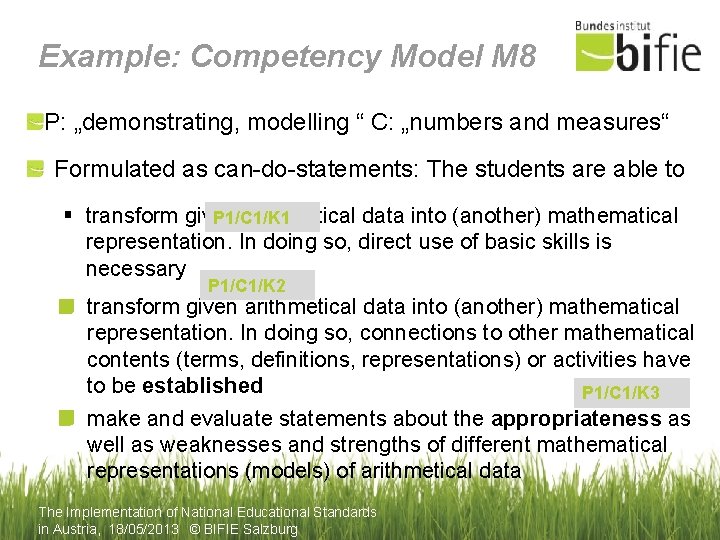
Example: Competency Model M 8 P: „demonstrating, modelling “ C: „numbers and measures“ Formulated as can-do-statements: The students are able to § transform given arithmetical data into (another) mathematical P 1/C 1/K 1 representation. In doing so, direct use of basic skills is necessary P 1/C 1/K 2 transform given arithmetical data into (another) mathematical representation. In doing so, connections to other mathematical contents (terms, definitions, representations) or activities have to be established P 1/C 1/K 3 make and evaluate statements about the appropriateness as well as weaknesses and strengths of different mathematical representations (models) of arithmetical data The Implementation of National Educational Standards in Austria, 18/05/2013 © BIFIE Salzburg
Educational Standards – The Austrian Version Three areas of activities § Implementation of standards at school and capacity building for teacher: Support of teachers and school heads in implementation § Formative evaluation to support teachers diagnostic: On-line evaluation system to be used by teachers § Census to monitor and summative evaluation at system, subsystem, school and classroom level The Implementation of National Educational Standards in Austria, 18/05/2013 © BIFIE Salzburg
Educational Standards – The Austrian Version School-specific development of instruction § Mandatory educational standards § Census-survey of all students and schools § Feedback to all students, teachers, schools § Feedback moderation („Rückmeldemoderation“) § Stimulation of quality development and support by Mo. E § Strong linkage of monitoring and practical school and instructional development § Strengthening of schools, school management and regional quality development The Implementation of National Educational Standards in Austria, 18/05/2013 © BIFIE Salzburg
Main functions of standards according to the legal regulation Output orientation: Sustainable output orientation in planning and implementation of instruction Promotion („Förderfunktion“): Diagnosis and specific individual remediation and challenge Evaluation: reliable information about the output of instruction, schools and education system The Implementation of National Educational Standards in Austria, 18/05/2013 © BIFIE Salzburg
Implementation of Standards Supporting materials for instruction § Praxishandbücher § Themenhefte § Aufgabenbeispiele, Interaktive Beispiele § Best-Practice-Beispiele Integration with teacher training institutions § In-service teacher training (partially mandatory) § Pre-Service teacher trainin § Research and development work by members of teacher training institutions The Implementation of National Educational Standards in Austria, 18/05/2013 © BIFIE Salzburg
Diagnosis tool for Informal Monitoring of Competencies Teacher administered on-line system Grade 3 and 7, one year before Assessment All Areas of standards Only teachers themselves have access to results The Implementation of National Educational Standards in Austria, 18/05/2013 © BIFIE Salzburg
Assessment of Educational Standards Legal assessment cycle: three (school) years In each cycle, the whole target population has to be assessed in all prescribed competency subdomains § Grade 4: German, Mathematics § Grade 8: German, Mathematics, English Students, teachers, schools and regional education authorities must get feedback about the results (to be used for quality improvement) The Implementation of National Educational Standards in Austria, 18/05/2013 © BIFIE Salzburg
Domain-orientated Test Design The Implementation of National Educational Standards in Austria, 18/05/2013 © BIFIE Salzburg
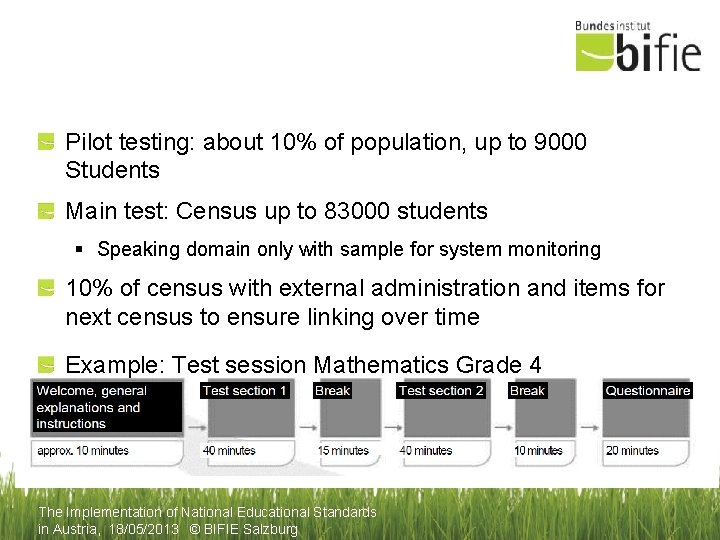
Pilot testing: about 10% of population, up to 9000 Students Main test: Census up to 83000 students § Speaking domain only with sample for system monitoring 10% of census with external administration and items for next census to ensure linking over time Example: Test session Mathematics Grade 4 The Implementation of National Educational Standards in Austria, 18/05/2013 © BIFIE Salzburg
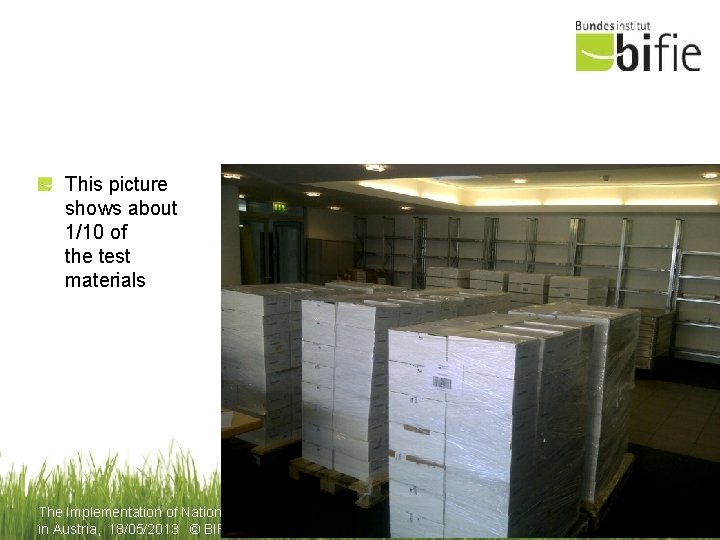
This picture shows about 1/10 of the test materials The Implementation of National Educational Standards in Austria, 18/05/2013 © BIFIE Salzburg
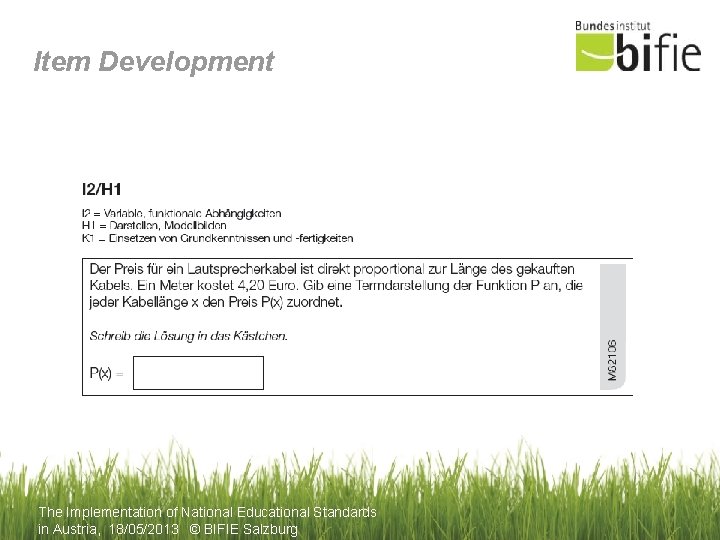
Item Development Items are developed to measure sub-competencies or domains, eg. Content = numbers and units and process = demonstrating Dimension „complexity“ is not used as such, since it can‘t be measured empirically We have 16 nodes, upon which an item should fall. We strive for unidimensional items, i. e. items that can be classified as belonging to one specific node only The Implementation of National Educational Standards in Austria, 18/05/2013 © BIFIE Salzburg
Item Development Items are developed to measure sub-competencies or domains, eg. Content = numbers and units and process = demonstrating Dimension „complexity“ is not used as such, since it can‘t be measured empirically We have 16 nodes, upon which an item should fall. We strive for unidimensional items, i. e. items that can be classified as belonging to one specific node only The Implementation of National Educational Standards in Austria, 18/05/2013 © BIFIE Salzburg
Item Development The Implementation of National Educational Standards in Austria, 18/05/2013 © BIFIE Salzburg
Item Development Test blueprint specified the items to be developed: § Mathematical node § Item format: Multiple Choice, Constructed response, … § Estimated difficulty of item Further requirements: § adequat for age group, § no biased towards gender, race, religion, also taking into account rural/urban differences. § does not require other knowledge than maths contents. § Items should be uni-dimensional The Implementation of National Educational Standards in Austria, 18/05/2013 © BIFIE Salzburg
Validation In order to secure validity of the test items, they were … § written by school and university teachers § reviewed by teachers (peer review and outsider review) § trialled on a sample of grade 8 students – each item was answered by at least 200 students § item properties were reviewed by a team of psychometricians and school teachers § items with less than desirable or surprising properties were retired and not used in the main test The Implementation of National Educational Standards in Austria, 18/05/2013 © BIFIE Salzburg
Test Design Multiple matrix sampling Two-step approach for the test design § Allocation of „empty“ blocks to forms that satify several global prerequisites for the design: • positional and contextual balance, item security (S 90 vs. S 10), longitudinal link (BL and BIST-UE 2015) § Allocation of items to blocks that satisfy several local prerequisites: • Balanced difficulty, format, representative for the competence construct, dependency (enemy items), test motivation • Test information, especially along cutoff-scores The Implementation of National Educational Standards in Austria, 18/05/2013 © BIFIE Salzburg
Scaling Using Rasch model Allows to express difficulties of items and students ability on one common scale Allows to match test cycles over time Allows for complex test design The Implementation of National Educational Standards in Austria, 18/05/2013 © BIFIE Salzburg
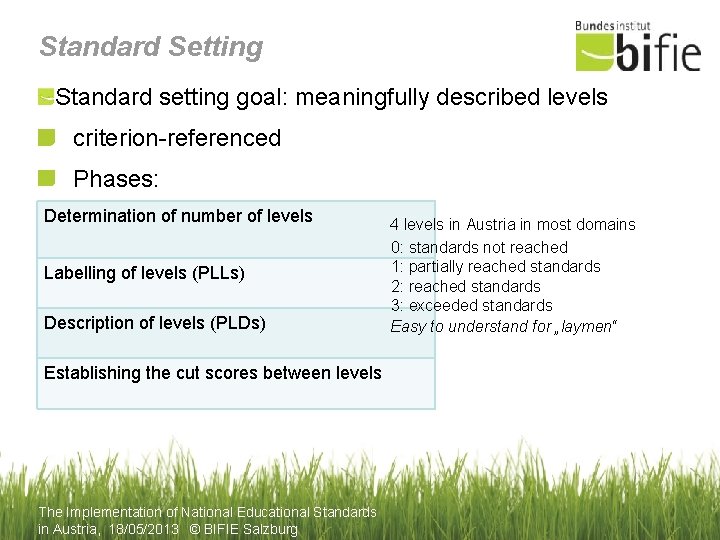
Standard Setting Standard setting goal: meaningfully described levels criterion-referenced Phases: Determination of number of levels Labelling of levels (PLLs) Description of levels (PLDs) Establishing the cut scores between levels The Implementation of National Educational Standards in Austria, 18/05/2013 © BIFIE Salzburg 4 levels in Austria in most domains 0: standards not reached 1: partially reached standards 2: reached standards 3: exceeded standards Easy to understand for „laymen“
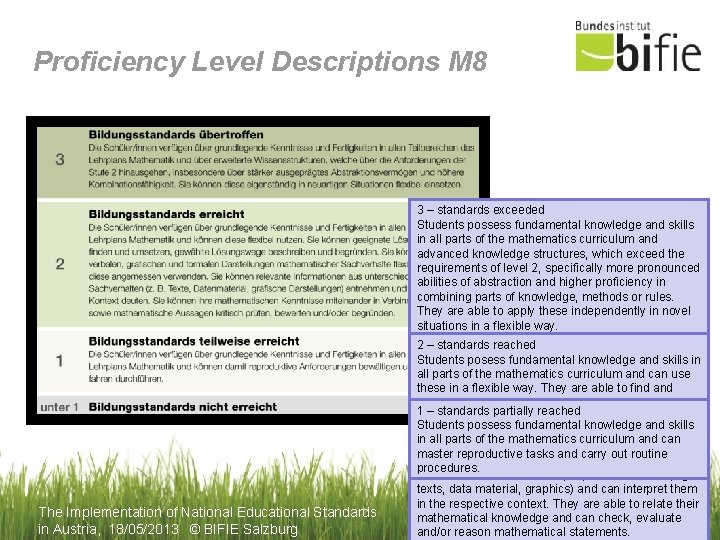
Proficiency Level Descriptions M 8 3 – standards exceeded Students possess fundamental knowledge and skills in all parts of the mathematics curriculum and advanced knowledge structures, which exceed the requirements of level 2, specifically more pronounced abilities of abstraction and higher proficiency in combining parts of knowledge, methods or rules. They are able to apply these independently in novel situations in a flexible way. The Implementation of National Educational Standards in Austria, 18/05/2013 © BIFIE Salzburg 2 – standards reached Students posess fundamental knowledge and skills in all parts of the mathematics curriculum and can use these in a flexible way. They are able to find apply problem solving strategies, to describe and 1 – standards partially reached reason an approach. They are able to handle verbal, Students possess fundamental knowledge and skills graphical and formal representations of mathematical in all parts of the mathematics curriculum and can facts in a flexible way and can apply these master reproductive tasks and carry out routine appropriately. Theay are able to extract relevant procedures. information from a differently represented facts (e. g. texts, data material, graphics) and can interpret them in the respective context. They are able to relate their mathematical knowledge and can check, evaluate and/or reason mathematical statements.
Standard Setting „ A standard setting method is a mechanism for helping panelists translate their intentions to the score scale. “ (Reckase, 2006) Goal: Match predetermined descriptors of competency levels to an empiric scale defined by test items Determine cut scores between levels of competence Bifie invited a group of stakeholders to set the cut scores: teachers (lower and upper secondary), teachers of didactics of math; representatives of parents associations; representatives of the Mo. E; representatives of chamber of commerce; bifie staff Method used: Item descriptor matching method The Implementation of National Educational Standards in Austria, 18/05/2013 © BIFIE Salzburg
(Modified) Item descriptor matching method Item-descriptor matches Difficult Item Level 3 Level 2 Level 1 Difficulty-ordered items Easy Item Ordered Item Booklet Cut Score 1 Cut Score 2 Freunberger & Yanagida, in press. The Implementation of National Educational Standards in Austria, 18/05/2013 © BIFIE Salzburg
Standard Setting Standard setting is more about finding a societal consensus than finding a constant The goal should be clear before test development etc starts The Implementation of National Educational Standards in Austria, 18/05/2013 © BIFIE Salzburg
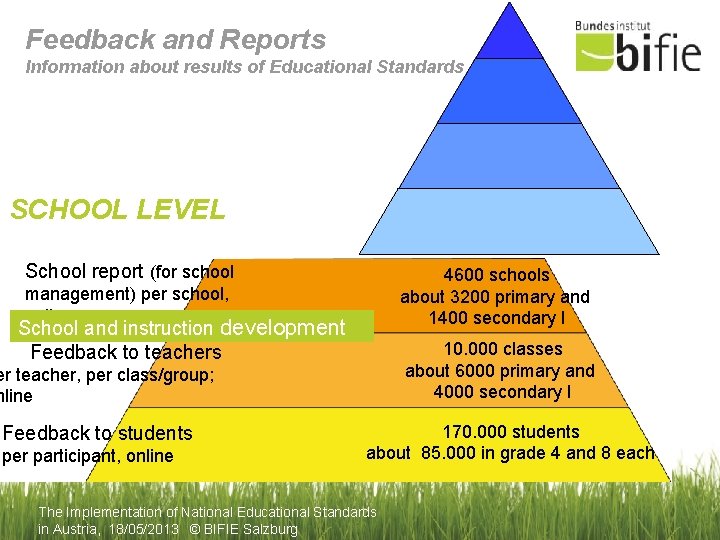
Feedback and Reports Information about results of Educational Standards SCHOOL LEVEL School report (for school 4600 schools about 3200 primary and 1400 secondary I management) per school, online School and instruction development Feedback to teachers 10. 000 classes about 6000 primary and 4000 secondary I er teacher, per class/group; nline Feedback to students per participant, online 170. 000 students about 85. 000 in grade 4 and 8 each The Implementation of National Educational Standards in Austria, 18/05/2013 © BIFIE Salzburg
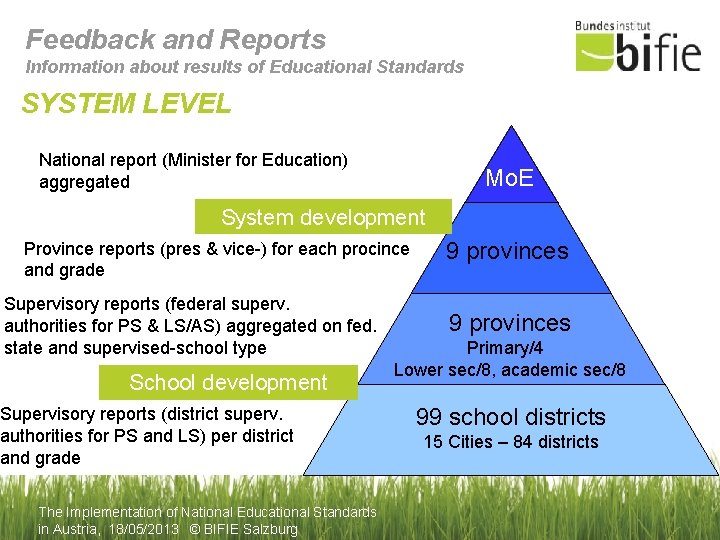
Feedback and Reports Information about results of Educational Standards SYSTEM LEVEL National report (Minister for Education) aggregated Mo. E System development Province reports (pres & vice-) for each procince and grade Supervisory reports (federal superv. authorities for PS & LS/AS) aggregated on fed. state and supervised-school type School development Supervisory reports (district superv. authorities for PS and LS) per district and grade The Implementation of National Educational Standards in Austria, 18/05/2013 © BIFIE Salzburg 9 provinces Primary/4 Lower sec/8, academic sec/8 99 school districts 15 Cities – 84 districts
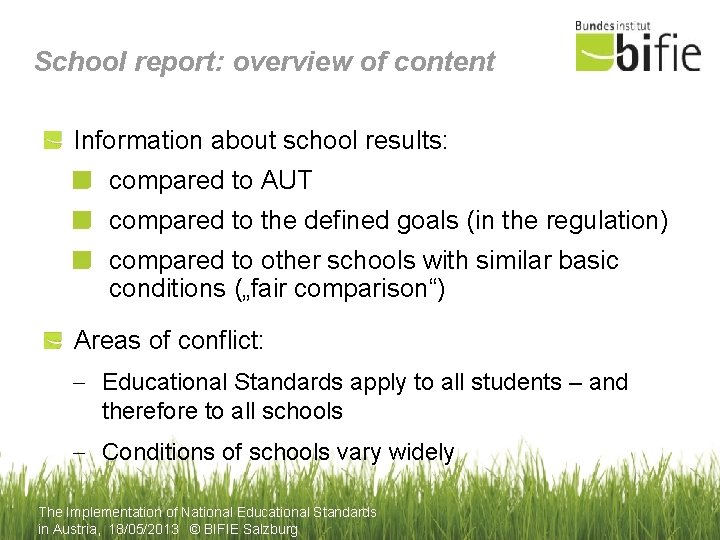
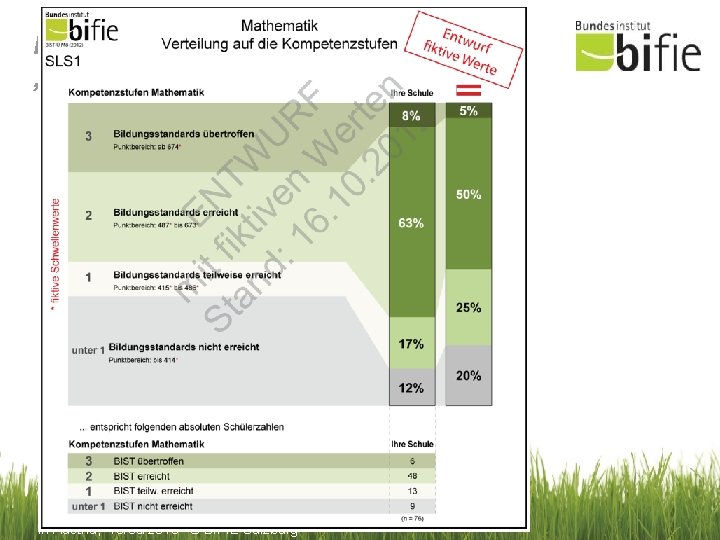
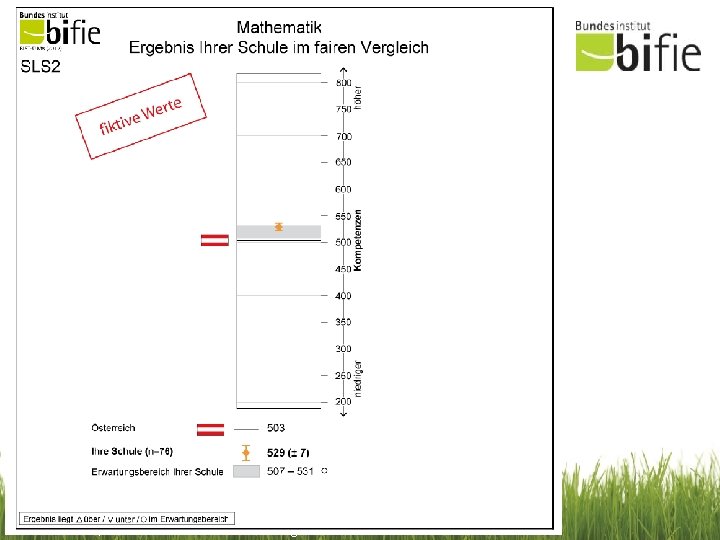
School report: overview of content Information about school results: compared to AUT compared to the defined goals (in the regulation) compared to other schools with similar basic conditions („fair comparison“) Areas of conflict: - Educational Standards apply to all students – and therefore to all schools - Conditions of schools vary widely The Implementation of National Educational Standards in Austria, 18/05/2013 © BIFIE Salzburg
FEEDBACK The school takes centre stage The Implementation of National Educational Standards in Austria, 18/05/2013 © BIFIE Salzburg
Feedback – example (school report) „Competency levels“ The Implementation of National Educational Standards in Austria, 18/05/2013 © BIFIE Salzburg
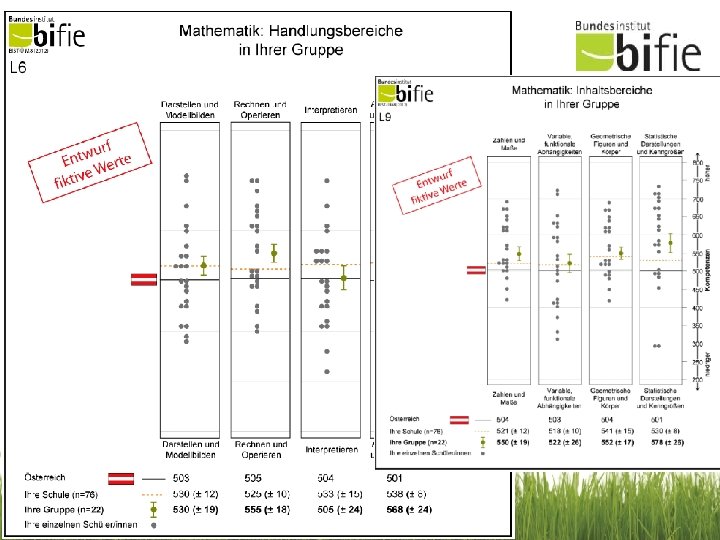
Feedback – example (teacher feedback) The Implementation of National Educational Standards in Austria, 18/05/2013 © BIFIE Salzburg
Feedback – example (school report) The Implementation of National Educational Standards in Austria, 18/05/2013 © BIFIE Salzburg
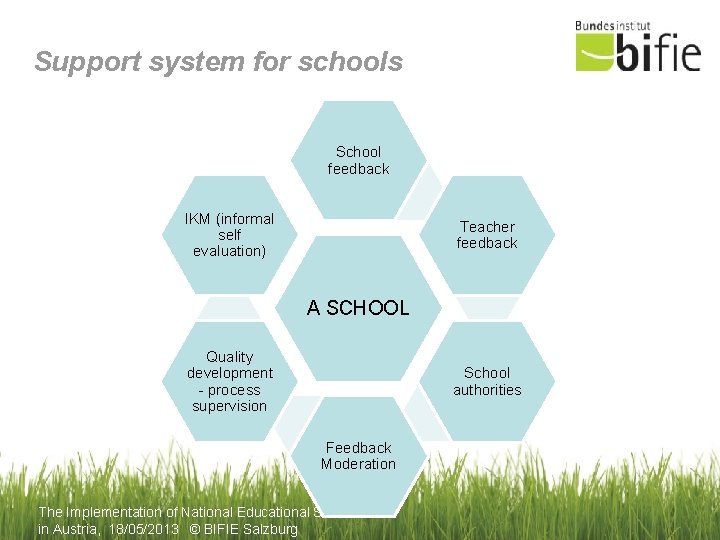
Support system for schools School feedback IKM (informal self evaluation) Teacher feedback A SCHOOL Quality development - process supervision School authorities Feedback Moderation The Implementation of National Educational Standards in Austria, 18/05/2013 © BIFIE Salzburg
Outlook Bringing IKM (grade(s) before BIST) and BIST assessments closer together. Using items in both assessments could lead towards a better understanding of learning Backwash from doing the assessments towards research in the areas of item development, standard setting, feedback … through evaluation of results Outcomes of the assessments should not only allow us to give feedback to schools, teachers and students but also to improve the competence models we use for the assessment Prepare for computer based testing Open databases for external researchers and improve system level monitoring The Implementation of National Educational Standards in Austria, 18/05/2013 © BIFIE Salzburg
Thank you for your attention! Michae. I Bruneforth m. bruneforth@bifie. at Bundesinstitut BIFIE Salzburg | Zentrum für Bildungsmonitoring & Bildungsstandards www. bifie. at The Implementation of National Educational Standards in Austria, 18/05/2013 © BIFIE Salzburg