
The impacts of climate change on the productivity

![Probability of yield gain from CA in current condition Area ratio Mean PB [mm]](https://slidetodoc.com/presentation_image_h/0a4ef908acf96a0c252c1cd1288b55ad/image-10.jpg "Probability of yield gain from CA in current condition Area ratio Mean PB [mm]")


- Slides: 17
The impacts of climate change on the productivity of conservation agriculture Yang Su UMR-Eco. Sys INRAE/Agro. Paris. Tech 08/05/2020
What is conservation agriculture (CA) CA is a resource-saving agriculture concept that aims to: • Achieve acceptable profits with sustained production levels • Conserving the environment It has three principles: • Minimum soil disturbance (no tillage) • Permanent soil cover (crop residue retention or live mulch) • Species diversification (crop rotation and/or intercropping) 2
Evidences of environmental benefits from CA It is believed that CA can bring a lot of environmental benefits comparing with conventional tillage system (CT): • • Reduce soil degradation and erosion Improve soil quality Reduce surface runoff Increase carbon sequestration Enhance biodiversity Reduce fossil fuel usage Etc. 3
Uncertain effect of CA on crop yields • Field experiments show that effect of CA on yield depends on local climate conditions • Impact of climate change on the productive performance of CA vs CT is unknown 4
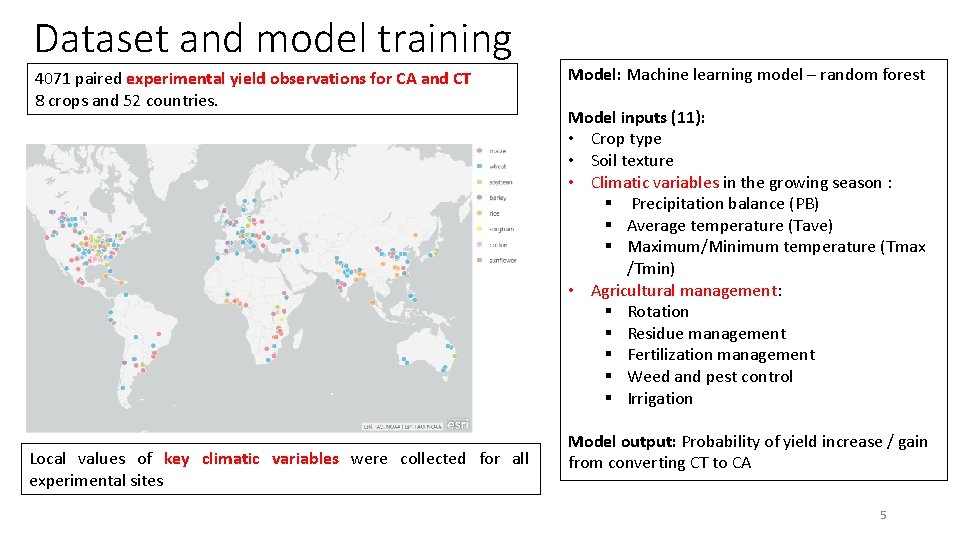
Dataset and model training 4071 paired experimental yield observations for CA and CT 8 crops and 52 countries. Local values of key climatic variables were collected for all experimental sites Model: Machine learning model – random forest Model inputs (11): • Crop type • Soil texture • Climatic variables in the growing season : § Precipitation balance (PB) § Average temperature (Tave) § Maximum/Minimum temperature (Tmax /Tmin) • Agricultural management: § Rotation § Residue management § Fertilization management § Weed and pest control § Irrigation Model output: Probability of yield increase / gain from converting CT to CA 5
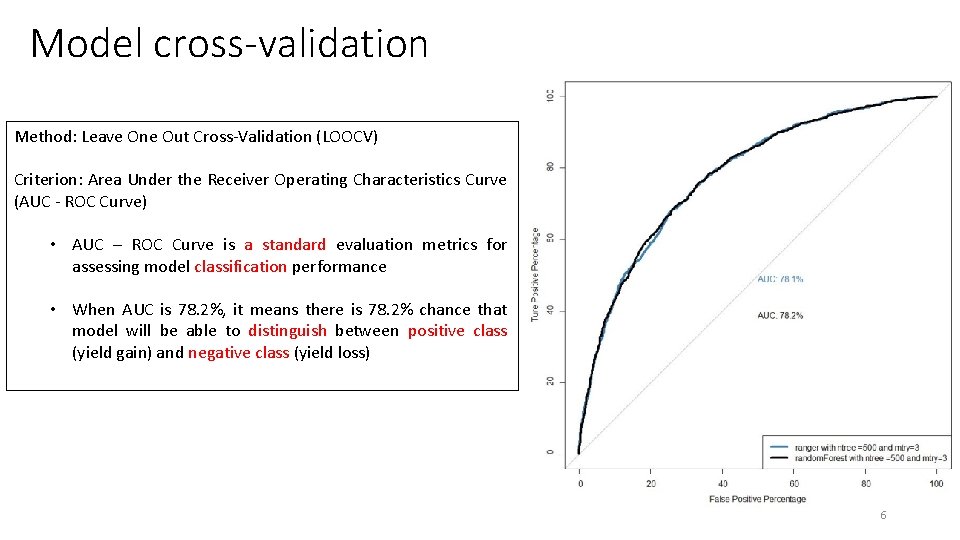
Model cross-validation Method: Leave One Out Cross-Validation (LOOCV) Criterion: Area Under the Receiver Operating Characteristics Curve (AUC - ROC Curve) • AUC – ROC Curve is a standard evaluation metrics for assessing model classification performance • When AUC is 78. 2%, it means there is 78. 2% chance that model will be able to distinguish between positive class (yield gain) and negative class (yield loss) 6
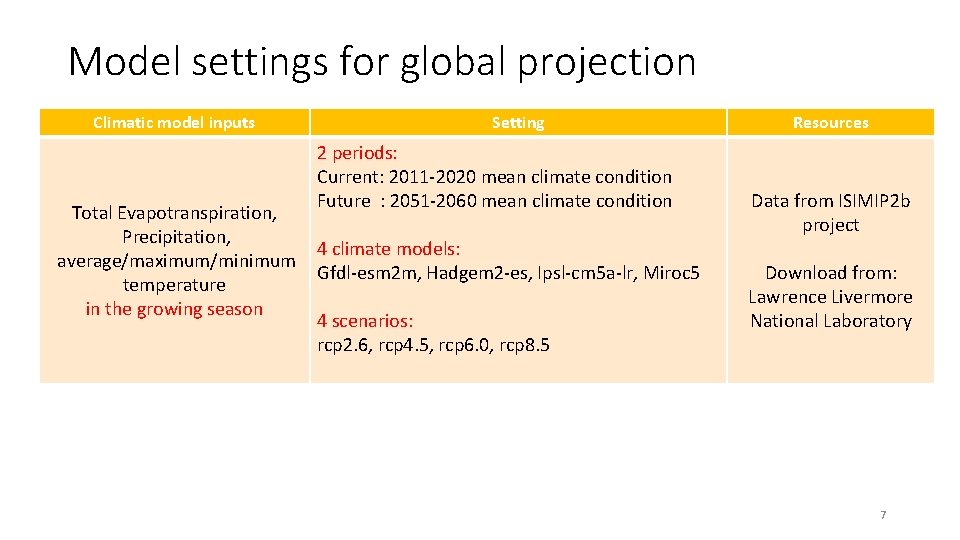
Model settings for global projection Climatic model inputs Total Evapotranspiration, Precipitation, average/maximum/minimum temperature in the growing season Setting 2 periods: Current: 2011 -2020 mean climate condition Future : 2051 -2060 mean climate condition 4 climate models: Gfdl-esm 2 m, Hadgem 2 -es, Ipsl-cm 5 a-lr, Miroc 5 4 scenarios: rcp 2. 6, rcp 4. 5, rcp 6. 0, rcp 8. 5 Resources Data from ISIMIP 2 b project Download from: Lawrence Livermore National Laboratory 7
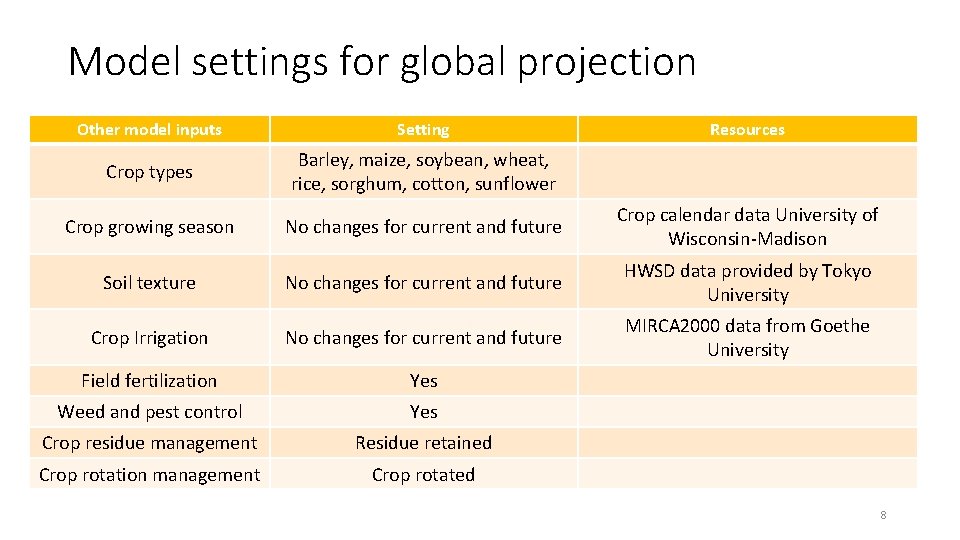
Model settings for global projection Other model inputs Setting Resources Crop types Barley, maize, soybean, wheat, rice, sorghum, cotton, sunflower Crop growing season No changes for current and future Crop calendar data University of Wisconsin-Madison Soil texture No changes for current and future HWSD data provided by Tokyo University Crop Irrigation No changes for current and future MIRCA 2000 data from Goethe University Field fertilization Yes Weed and pest control Yes Crop residue management Residue retained Crop rotation management Crop rotated 8
CA productivity in current and future Result example: • Climate model: Gfdl-esm 2 m • RCP Scenario: rcp 4. 5 • Crop: wheat 9
Probability of yield gain from CA in current condition Area ratio Mean PB [mm] Mean Tave [Deg. C] Prob. > 0. 6 High chance of yield gain 0. 0963 -10. 29 3. 63 Prob. > 0. 5 0. 485 73. 67 8. 78 Prob. <= 0. 515 91. 66 16. 89 Prob. <= 0. 4 High chance of yield loss 0. 139 105. 19 18. 88 Probability of yield increase • Promising regions for CA implementation: Mainly in Northern part of North America, Europe and Northern Asia • Non-favorable regions for CA implementation: Mainly in Southern part of North America, Southern China • The mean PB and Tave in the regions with “high chance of yield gain” are lower than the regions with “high chance of yield loss”, indicates that CA has a better performance in dryer and cooler conditions 10
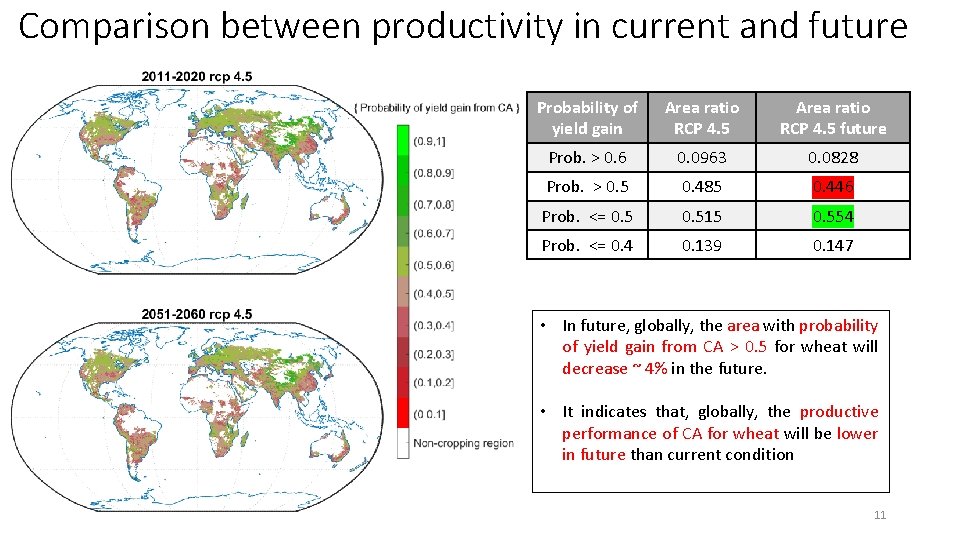
Comparison between productivity in current and future Probability of yield gain Area ratio RCP 4. 5 future Prob. > 0. 6 0. 0963 0. 0828 Prob. > 0. 5 0. 485 0. 446 Prob. <= 0. 515 0. 554 Prob. <= 0. 4 0. 139 0. 147 • In future, globally, the area with probability of yield gain from CA > 0. 5 for wheat will decrease ~ 4% in the future. • It indicates that, globally, the productive performance of CA for wheat will be lower in future than current condition 11
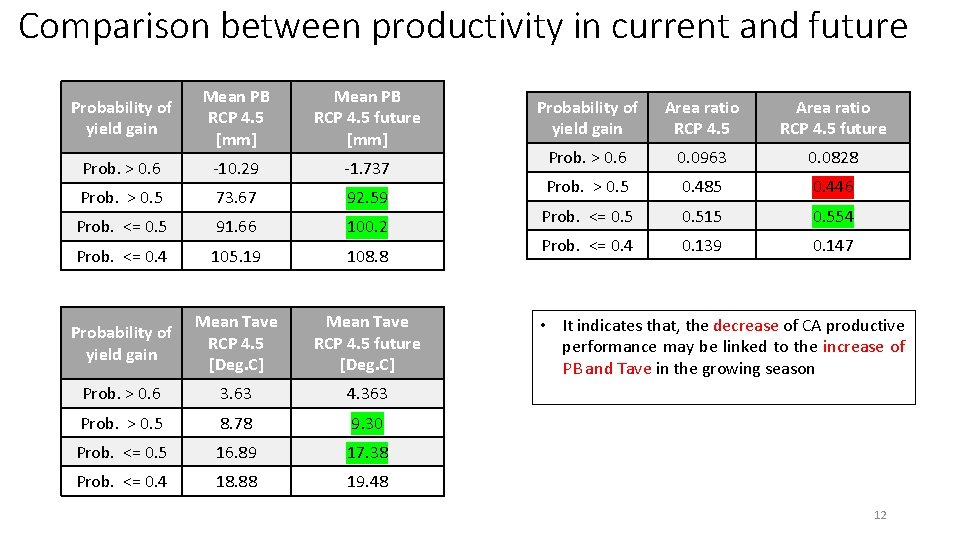
Comparison between productivity in current and future Probability of yield gain Mean PB RCP 4. 5 [mm] Mean PB RCP 4. 5 future [mm] Prob. > 0. 6 -10. 29 -1. 737 Prob. > 0. 5 73. 67 92. 59 Prob. <= 0. 5 91. 66 100. 2 Prob. <= 0. 4 105. 19 108. 8 Probability of yield gain Mean Tave RCP 4. 5 [Deg. C] Mean Tave RCP 4. 5 future [Deg. C] Prob. > 0. 6 3. 63 4. 363 Prob. > 0. 5 8. 78 9. 30 Prob. <= 0. 5 16. 89 17. 38 Prob. <= 0. 4 18. 88 19. 48 Probability of yield gain Area ratio RCP 4. 5 future Prob. > 0. 6 0. 0963 0. 0828 Prob. > 0. 5 0. 485 0. 446 Prob. <= 0. 515 0. 554 Prob. <= 0. 4 0. 139 0. 147 • It indicates that, the decrease of CA productive performance may be linked to the increase of PB and Tave in the growing season 12
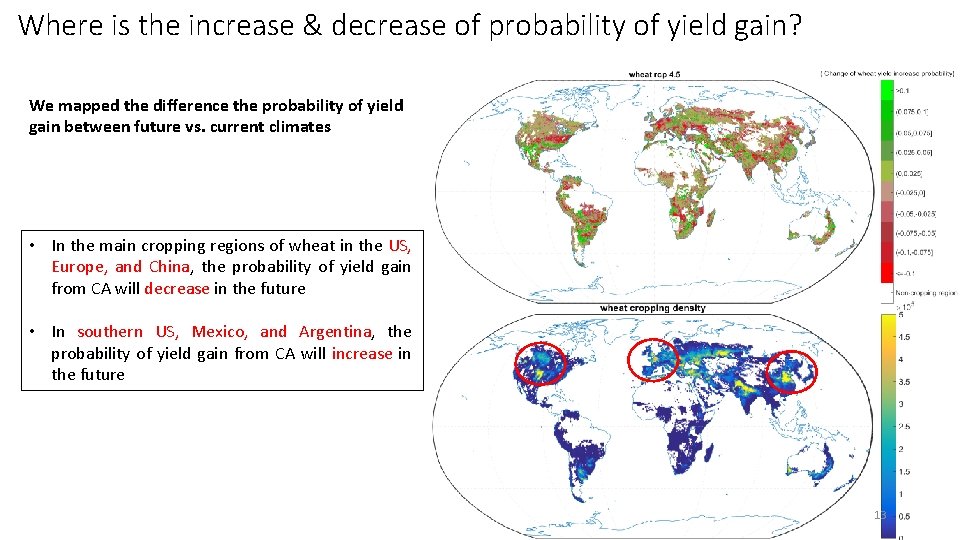
Where is the increase & decrease of probability of yield gain? We mapped the difference the probability of yield gain between future vs. current climates • In the main cropping regions of wheat in the US, Europe, and China, the probability of yield gain from CA will decrease in the future • In southern US, Mexico, and Argentina, the probability of yield gain from CA will increase in the future 13
Differences between climate models & RCP scenarios 14
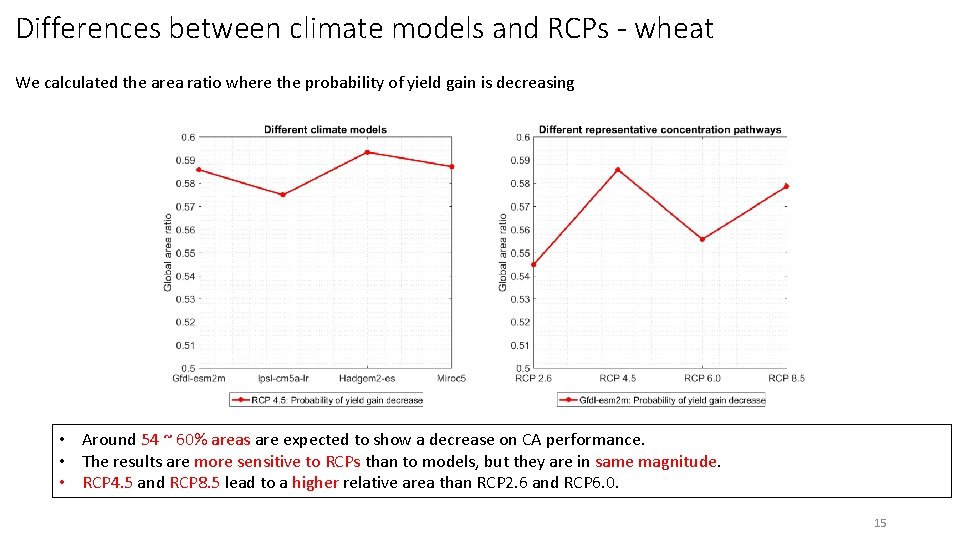
Differences between climate models and RCPs - wheat We calculated the area ratio where the probability of yield gain is decreasing • Around 54 ~ 60% areas are expected to show a decrease on CA performance. • The results are more sensitive to RCPs than to models, but they are in same magnitude. • RCP 4. 5 and RCP 8. 5 lead to a higher relative area than RCP 2. 6 and RCP 6. 0. 15
Conclusion • CA has a better performance in dryer and cooler conditions. • Globally, the area with probability of yield gain from CA > 0. 5 for wheat will decrease ~ 4% in the future. • In the main cropping regions of wheat in the US, Europe, and China, the probability of yield gain from CA will decrease in the future. While in southern US, Mexico, and Argentina, the probability of yield gain from CA will increase in the future. • The results are more sensitive to RCPs than to models, but they are in same magnitude. 16
Yang SU Thank you for your attention yang. su@inra. fr 17