
The Impact of the Medicare Prescription Drug Legislation

- Slides: 26
The Impact of the Medicare Prescription Drug Legislation on Pharmaceutical Revenues Presented By: Jack Rodgers Pricewaterhouse. Coopers February 27, 2004 Pw. C
Overview of Recent Medicare Act • On December 8, 2003, President Bush signed legislation that affects almost every aspect of Medicare (including prices for most medical services, Part B drugs, and Medicare managed care) as well as non-Medicare issues such as health savings accounts and reimportation of drugs. • The Act will provide $400 B of prescription drug benefits over the next 10 years (and up to $2 trillion over the next decade). • The Act, which affects 43% of pharmaceutical sales, will have major effects on prescription drug coverage, utilization, and prices. Pricewaterhouse. Coopers
Impact of Medicare Rx Legislation: Pricewaterhouse. Coopers
Impact on Pharmaceutical Companies Revenues Pw. C
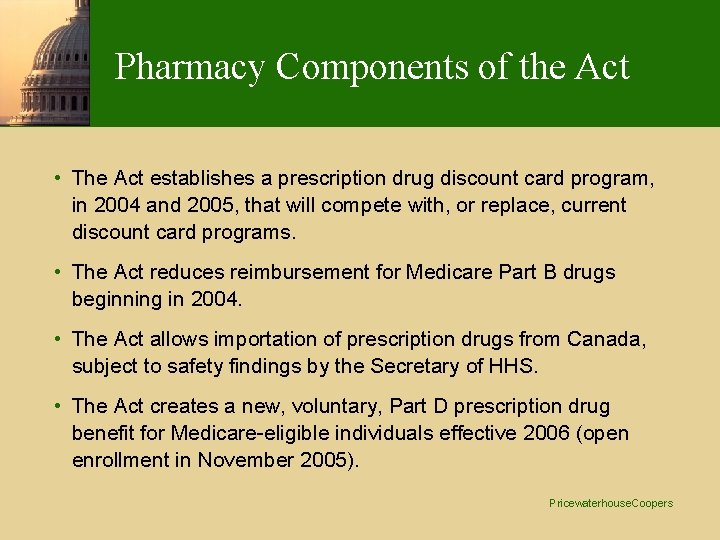
Pharmacy Components of the Act • The Act establishes a prescription drug discount card program, in 2004 and 2005, that will compete with, or replace, current discount card programs. • The Act reduces reimbursement for Medicare Part B drugs beginning in 2004. • The Act allows importation of prescription drugs from Canada, subject to safety findings by the Secretary of HHS. • The Act creates a new, voluntary, Part D prescription drug benefit for Medicare-eligible individuals effective 2006 (open enrollment in November 2005). Pricewaterhouse. Coopers
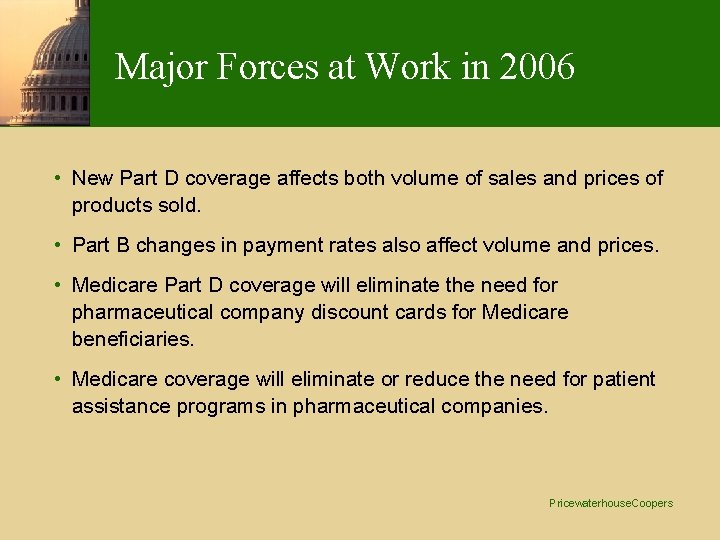
Major Forces at Work in 2006 • New Part D coverage affects both volume of sales and prices of products sold. • Part B changes in payment rates also affect volume and prices. • Medicare Part D coverage will eliminate the need for pharmaceutical company discount cards for Medicare beneficiaries. • Medicare coverage will eliminate or reduce the need for patient assistance programs in pharmaceutical companies. Pricewaterhouse. Coopers
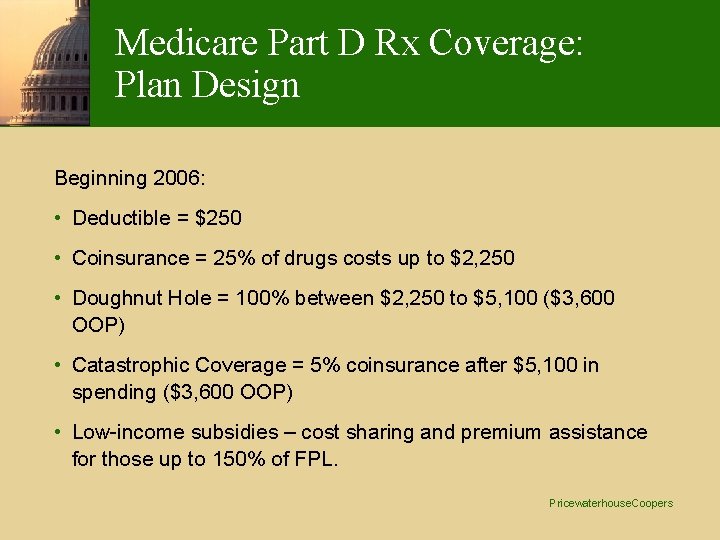
Medicare Part D Rx Coverage: Plan Design Beginning 2006: • Deductible = $250 • Coinsurance = 25% of drugs costs up to $2, 250 • Doughnut Hole = 100% between $2, 250 to $5, 100 ($3, 600 OOP) • Catastrophic Coverage = 5% coinsurance after $5, 100 in spending ($3, 600 OOP) • Low-income subsidies – cost sharing and premium assistance for those up to 150% of FPL. Pricewaterhouse. Coopers
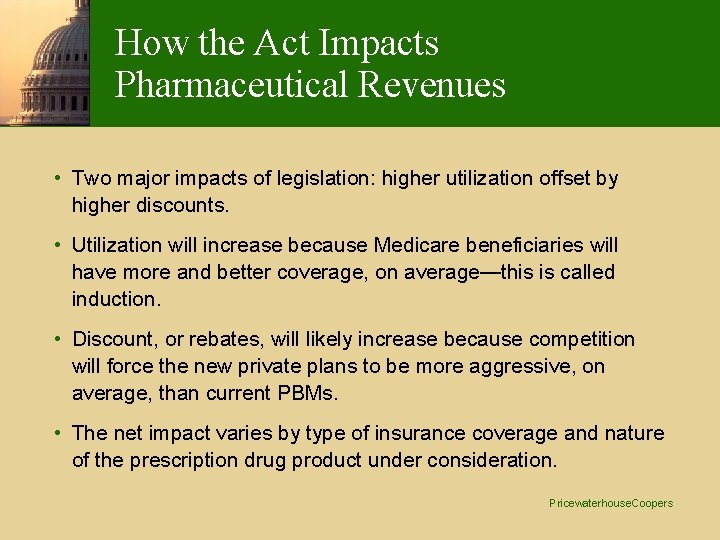
How the Act Impacts Pharmaceutical Revenues • Two major impacts of legislation: higher utilization offset by higher discounts. • Utilization will increase because Medicare beneficiaries will have more and better coverage, on average—this is called induction. • Discount, or rebates, will likely increase because competition will force the new private plans to be more aggressive, on average, than current PBMs. • The net impact varies by type of insurance coverage and nature of the prescription drug product under consideration. Pricewaterhouse. Coopers
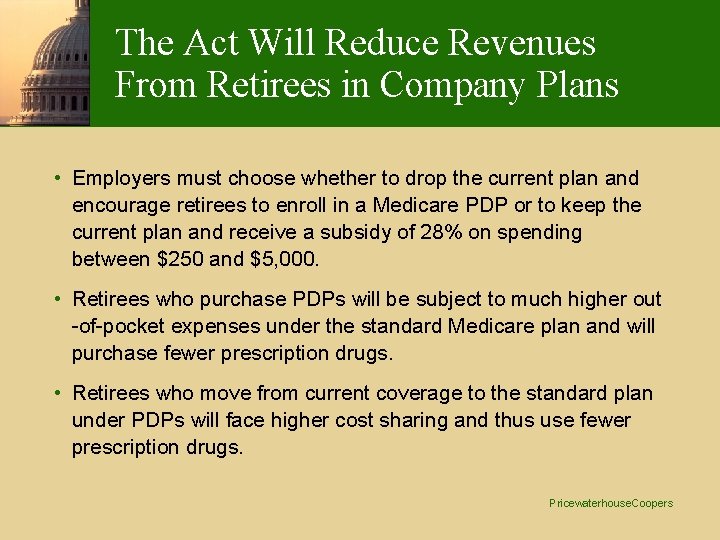
The Act Will Reduce Revenues From Retirees in Company Plans • Employers must choose whether to drop the current plan and encourage retirees to enroll in a Medicare PDP or to keep the current plan and receive a subsidy of 28% on spending between $250 and $5, 000. • Retirees who purchase PDPs will be subject to much higher out -of-pocket expenses under the standard Medicare plan and will purchase fewer prescription drugs. • Retirees who move from current coverage to the standard plan under PDPs will face higher cost sharing and thus use fewer prescription drugs. Pricewaterhouse. Coopers
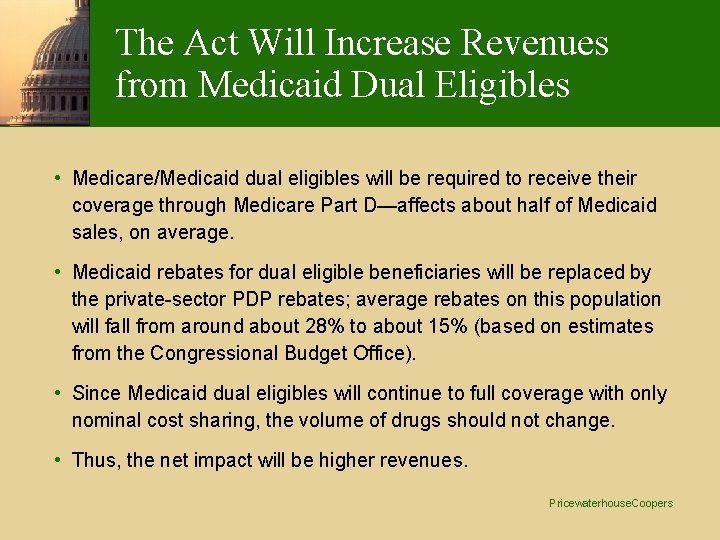
The Act Will Increase Revenues from Medicaid Dual Eligibles • Medicare/Medicaid dual eligibles will be required to receive their coverage through Medicare Part D—affects about half of Medicaid sales, on average. • Medicaid rebates for dual eligible beneficiaries will be replaced by the private-sector PDP rebates; average rebates on this population will fall from around about 28% to about 15% (based on estimates from the Congressional Budget Office). • Since Medicaid dual eligibles will continue to full coverage with only nominal cost sharing, the volume of drugs should not change. • Thus, the net impact will be higher revenues. Pricewaterhouse. Coopers
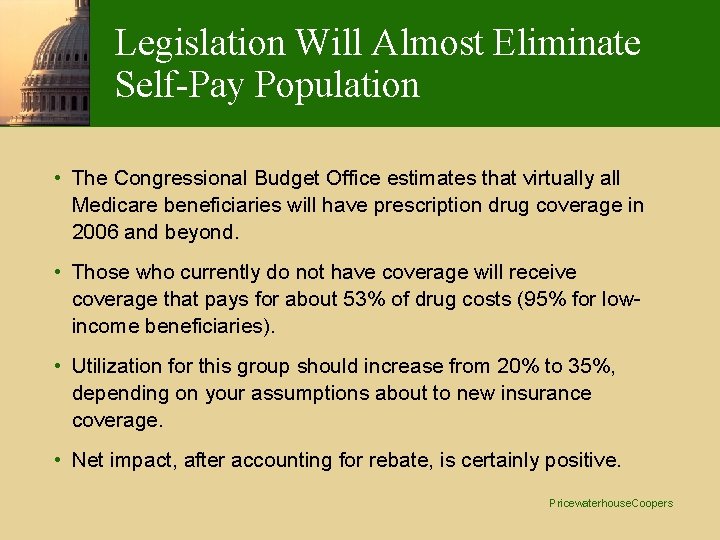
Legislation Will Almost Eliminate Self-Pay Population • The Congressional Budget Office estimates that virtually all Medicare beneficiaries will have prescription drug coverage in 2006 and beyond. • Those who currently do not have coverage will receive coverage that pays for about 53% of drug costs (95% for lowincome beneficiaries). • Utilization for this group should increase from 20% to 35%, depending on your assumptions about to new insurance coverage. • Net impact, after accounting for rebate, is certainly positive. Pricewaterhouse. Coopers
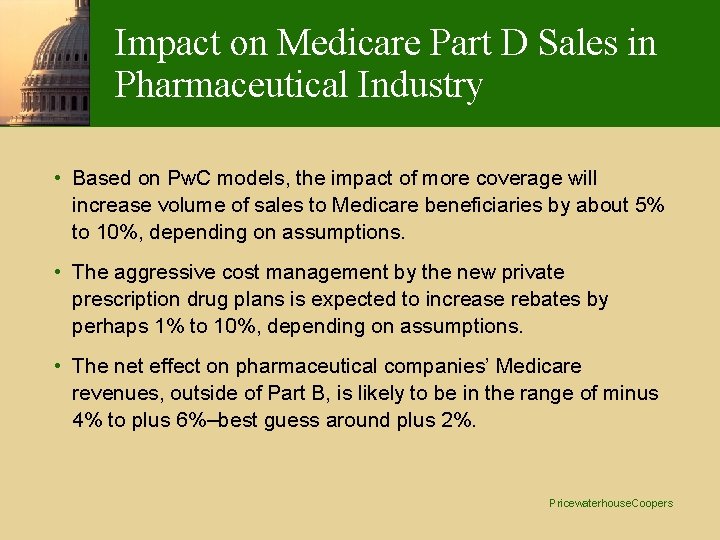
Impact on Medicare Part D Sales in Pharmaceutical Industry • Based on Pw. C models, the impact of more coverage will increase volume of sales to Medicare beneficiaries by about 5% to 10%, depending on assumptions. • The aggressive cost management by the new private prescription drug plans is expected to increase rebates by perhaps 1% to 10%, depending on assumptions. • The net effect on pharmaceutical companies’ Medicare revenues, outside of Part B, is likely to be in the range of minus 4% to plus 6%–best guess around plus 2%. Pricewaterhouse. Coopers
Impact of the Act on Sales of Drug Covered under Medicare Part B • The previous calculations did not account for the impact of the Act on Part B. • The impact on some drugs, especially those administered by physicians, will be negative because incentives to prescribe and deliver Part B drugs will be reduced. • Pw. C estimates that Part B sales will potentially fall by 5%. • Since only 5% to 10% of Medicare sales are typically paid by Part B, the impact, if spread across all Medicare, would be about a reduction of less than one percent. Pricewaterhouse. Coopers
Other Legislative Changes Must Also Be Taken Into Account • Revenues should be increased when the company discount cards disappear in 2006. • Revenues should also be increased when patience assistant programs disappear in 2006. (There may be some small need for patient assistance for Medicare patients. ) • The increase from lower patient assistance and discount cards may be large enough to offset any net loss under Part B and Part D coverage. • The impact, however, will vary by company and by product. Pricewaterhouse. Coopers
How to Assess The Impact on Your Company Pw. C
How to Assess the Impact of the Act on Your Company • Quick and dirty approach—assume your company is like all the others—impact will be 1% to 2% of Medicare sales. • Medium-level approach—estimate impact on sales based on current sources of payment and level of Medicare revenues. • Most informative approach is to estimate the impact on your company, drug by drug, based on characteristics of each drug, sources of payment for that drug, and percentage of sales to Medicare beneficiaries for that drug. • Companies can use drug-specific estimates not only evaluate impact on overall revenues but to analyze specific products and make decisions about future R&D investments. Pricewaterhouse. Coopers
Overall Impact According to the Following Factors • Sources of Payments: Impact will be negative for drugs that are used primarily by retirees with employer coverage and positive for drugs used by Medicaid programs. • Impact on Rebates: Drugs that have few competitors may not have to increase rebates under the new law. • Importance of Catastrophic Coverage: Utilization of especially expensive drugs are expected to increase dramatically under the new law due to catastrophic coverage. • Part B Issues: The new legislation should reduce the competitiveness advantage of drugs with Part B coverage and help their competitors. Pricewaterhouse. Coopers
Summary and Conclusions • The Act will affect a large part of pharmaceutical company sales. • Pharmaceutical industry “customers” will shift significantly with many fewer Medicaid and self-pay sales and an entire new PDP marketplace. • The net impact on revenues, after accounting for Part D, Part B, and changes in patient assistance, is positive but may be less than one percent relative to total sales. • The impact will vary by company and by drug. Pricewaterhouse. Coopers
Appendix The Medicare Prescription Drug, Improvement, and Modernization Act of 2003 Pw. C
Medicare Prescription Drug Discount Cards in June 2004 • Beginning in June 2004, Medicare beneficiaries will be able to enroll in private prescription drug discount card programs. • Companies issuing cards may charge enrollment fees up to $30 annually for each card. • $600 in cash benefits will be provided to low-income enrollees who sign up for cards. • Potential sponsors of discount cards must notify CMS of their non-binding intent to bid by January 7, 2004. Pricewaterhouse. Coopers
Reductions in Reimbursement Rates for Medicare Part B Drugs • Current rate, 95% AWP, will be reduced to about 85% for brand name drugs. • No direct impact on manufacturers price but likelihood is that revenues will fall due to lower volume. • Prescription drugs administered by physicians are likely to be affected the most because Medicare price will include no profit margin for dispensing physicians. • Impact on sales is likely to be small for drugs that are sold directly to patients because 85% AWP is comparable to typical PBM prices. Pricewaterhouse. Coopers
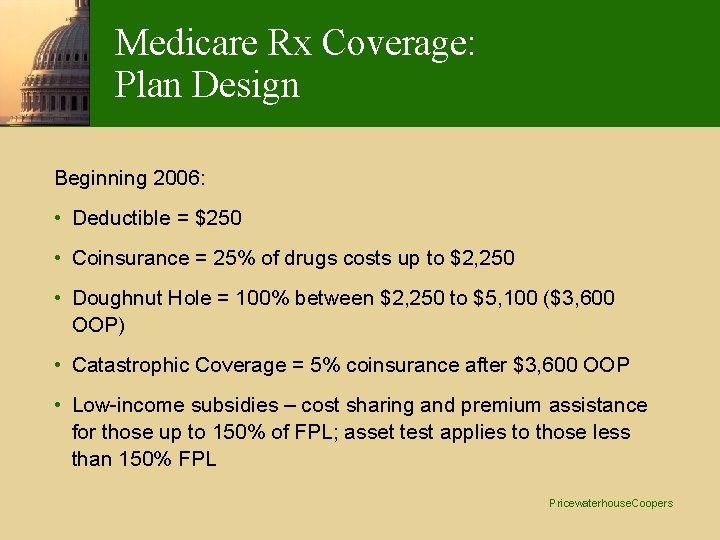
Medicare Rx Coverage: Plan Design Beginning 2006: • Deductible = $250 • Coinsurance = 25% of drugs costs up to $2, 250 • Doughnut Hole = 100% between $2, 250 to $5, 100 ($3, 600 OOP) • Catastrophic Coverage = 5% coinsurance after $3, 600 OOP • Low-income subsidies – cost sharing and premium assistance for those up to 150% of FPL; asset test applies to those less than 150% FPL Pricewaterhouse. Coopers
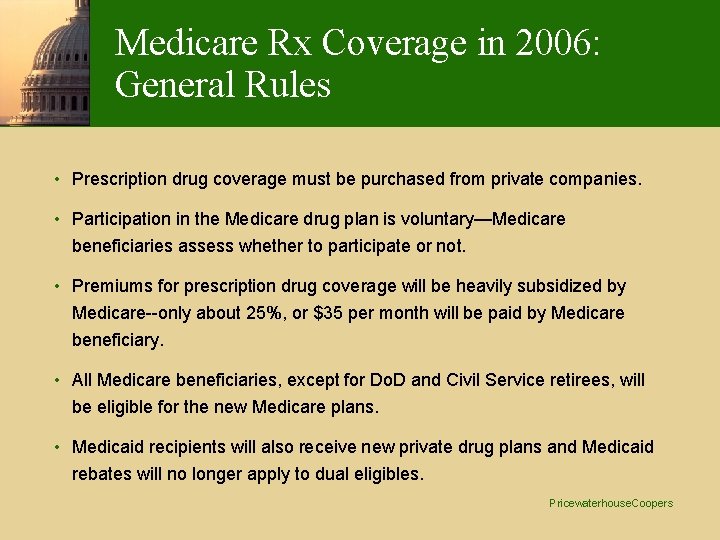
Medicare Rx Coverage in 2006: General Rules • Prescription drug coverage must be purchased from private companies. • Participation in the Medicare drug plan is voluntary—Medicare beneficiaries assess whether to participate or not. • Premiums for prescription drug coverage will be heavily subsidized by Medicare--only about 25%, or $35 per month will be paid by Medicare beneficiary. • All Medicare beneficiaries, except for Do. D and Civil Service retirees, will be eligible for the new Medicare plans. • Medicaid recipients will also receive new private drug plans and Medicaid rebates will no longer apply to dual eligibles. Pricewaterhouse. Coopers
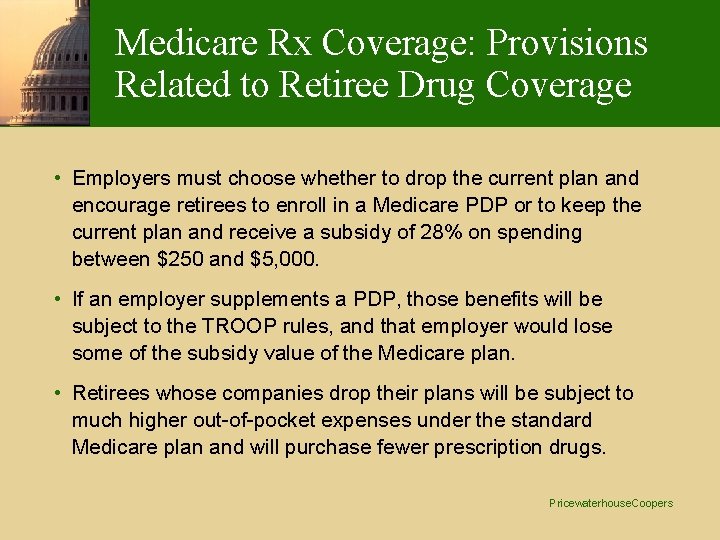
Medicare Rx Coverage: Provisions Related to Retiree Drug Coverage • Employers must choose whether to drop the current plan and encourage retirees to enroll in a Medicare PDP or to keep the current plan and receive a subsidy of 28% on spending between $250 and $5, 000. • If an employer supplements a PDP, those benefits will be subject to the TROOP rules, and that employer would lose some of the subsidy value of the Medicare plan. • Retirees whose companies drop their plans will be subject to much higher out-of-pocket expenses under the standard Medicare plan and will purchase fewer prescription drugs. Pricewaterhouse. Coopers
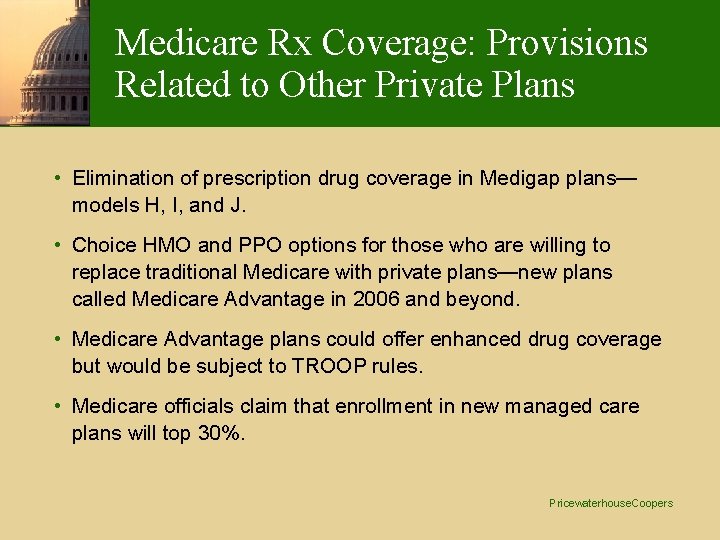
Medicare Rx Coverage: Provisions Related to Other Private Plans • Elimination of prescription drug coverage in Medigap plans— models H, I, and J. • Choice HMO and PPO options for those who are willing to replace traditional Medicare with private plans—new plans called Medicare Advantage in 2006 and beyond. • Medicare Advantage plans could offer enhanced drug coverage but would be subject to TROOP rules. • Medicare officials claim that enrollment in new managed care plans will top 30%. Pricewaterhouse. Coopers
Who to Contact at Pw. C for More Information Jack Rodgers, Director Health Policy Economics Group Jack. Rodgers@us. pwc. com 202 -414 -1646 Pricewaterhouse. Coopers