
THE IMPACT OF SOCIETAL PERCEPTIONS ON THE CAREER





- Slides: 18
THE IMPACT OF SOCIETAL PERCEPTIONS ON THE CAREER EXPERIENCES FOR MALES IN EARLY CHILDHOOD EDUCATION Suzanne West University of South Florida ECW 6696
INTRODUCTION • As a director of an early childhood program, I am often asked to collect data on the number of males enrolled in my courses • Most of the male students choose other careers, despite their love and passion for teaching young children, frequently because of the disapproval of their family and peers for choosing what is considered “woman’s work. ” • My daughter was assigned to a kindergarten class with a male teacher • This also led me to consider the current impact of societal views on the career of my daughter’s kindergarten teacher.
ABSTRACT Research shows that males have a positive impact on students in the early grades (pre-kindergarten to third grade) (Browder & Bryan, 2013). However, there are very few males in early childhood education. Societal perceptions of males in nurturing roles are quite ambiguous. Even though society wants more nurturing males to care for our children and provide a good role model, these males are simultaneously rejected as doing “women’s work. ” This research explores the realities are of the perceptions from society on men in early childhood occupations and how the experiences of males in these positions align with societal perceptions.
• As men become more involved in the emotional care of their own children, it may lead to more participation in “caring professions. ” IM PLICA TIO NS OF MALE EARLY CHILDHOOD TEACHERS • Research reveals more males are needed in early childhood (Browder & Bryan, 2013) • Male teachers can serve as role models and positively impact both behavioral and academic expectations for students of both genders. • An increase in male preschool teachers will also encourage fathers to assume a larger role in the education of their children
• Society has perceptions on genderspecific occupations, thus rejection of a traditional “man’s job” violates the community’s expectation of his masculinity. B ARRIE RS AG AINST MALE EARLY CHILDHOOD TEACHERS • Sexuality is questioned because of the nurturing role he chooses as his career • Decision to work with children becomes suspect • Hyper-visibility (Browder & Bryan, 2013) • Ascription of competency (Browder & Bryan, 2013)
RESEARCH QUESTION What are the realities of the perceptions from society on men as early childhood education teachers?
MIXED METHOD APPROACH • 5 question survey disseminated through survey monkey of a small sample of society to determine perceptions • Interview with a male kindergarten teacher on his experiences in his career
DATA ANALYSIS STRATEGY • The data from the survey results will be pulled directly from the survey tool (survey monkey). • The interview results will be compared to the data to find parallels. • All of these results will also be compared to the literature review.
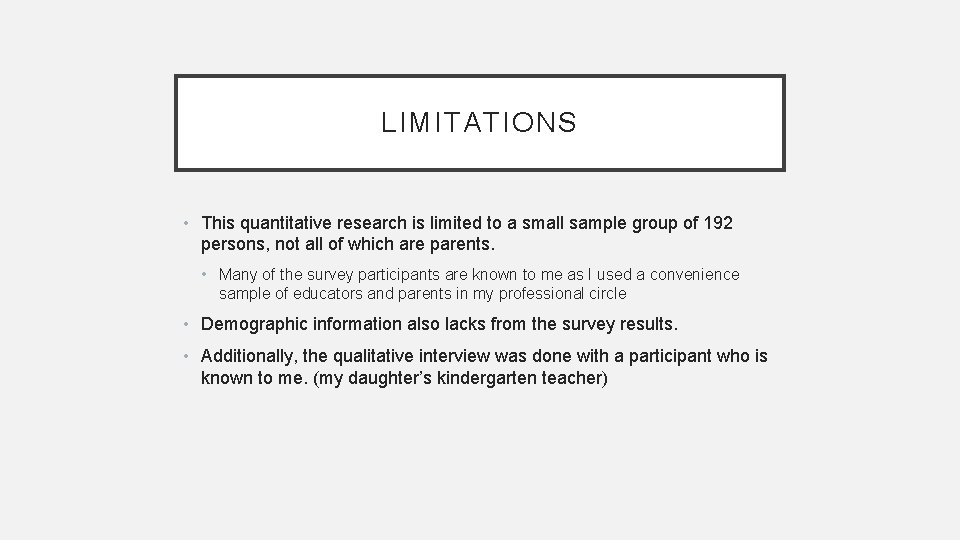
LIMITATIONS • This quantitative research is limited to a small sample group of 192 persons, not all of which are parents. • Many of the survey participants are known to me as I used a convenience sample of educators and parents in my professional circle • Demographic information also lacks from the survey results. • Additionally, the qualitative interview was done with a participant who is known to me. (my daughter’s kindergarten teacher)
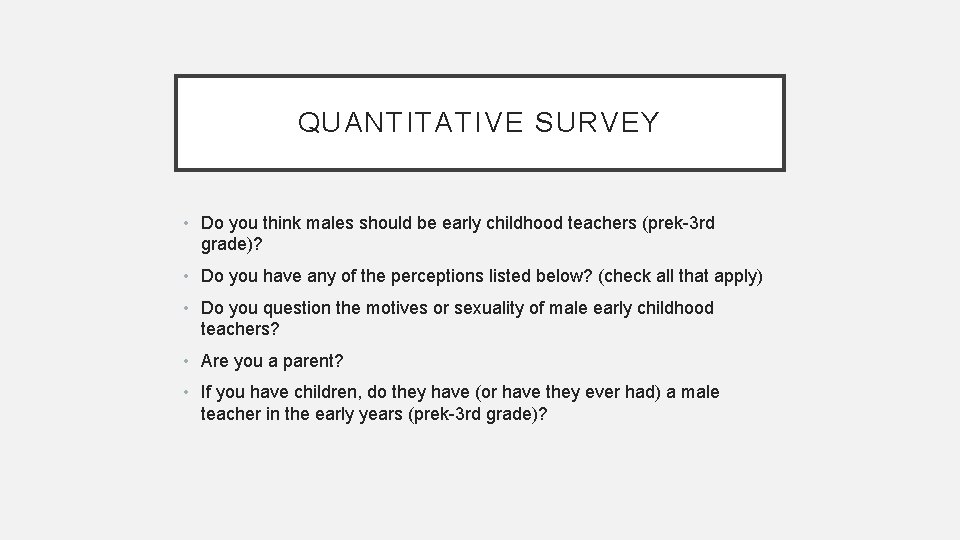
QUANTITATIVE SURVEY • Do you think males should be early childhood teachers (prek-3 rd grade)? • Do you have any of the perceptions listed below? (check all that apply) • Do you question the motives or sexuality of male early childhood teachers? • Are you a parent? • If you have children, do they have (or have they ever had) a male teacher in the early years (prek-3 rd grade)?
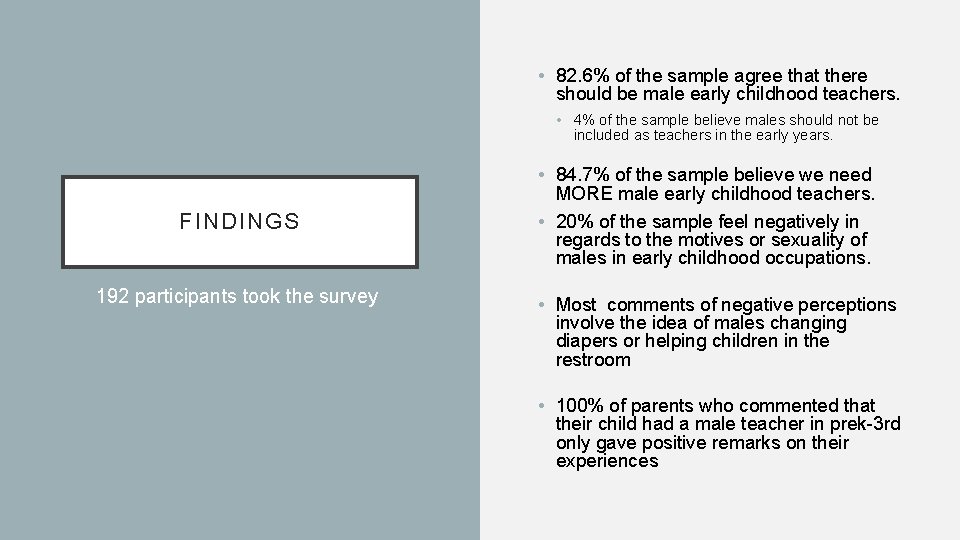
• 82. 6% of the sample agree that there should be male early childhood teachers. • 4% of the sample believe males should not be included as teachers in the early years. FINDINGS 192 participants took the survey • 84. 7% of the sample believe we need MORE male early childhood teachers. • 20% of the sample feel negatively in regards to the motives or sexuality of males in early childhood occupations. • Most comments of negative perceptions involve the idea of males changing diapers or helping children in the restroom • 100% of parents who commented that their child had a male teacher in prek-3 rd only gave positive remarks on their experiences
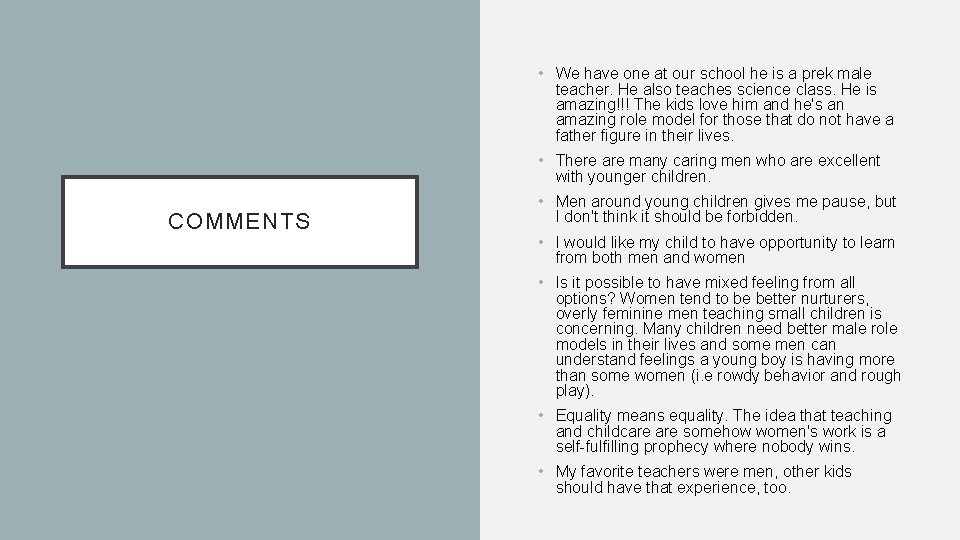
• We have one at our school he is a prek male teacher. He also teaches science class. He is amazing!!! The kids love him and he's an amazing role model for those that do not have a father figure in their lives. • There are many caring men who are excellent with younger children. COMMENTS • Men around young children gives me pause, but I don't think it should be forbidden. • I would like my child to have opportunity to learn from both men and women • Is it possible to have mixed feeling from all options? Women tend to be better nurturers, overly feminine men teaching small children is concerning. Many children need better male role models in their lives and some men can understand feelings a young boy is having more than some women (i. e rowdy behavior and rough play). • Equality means equality. The idea that teaching and childcare somehow women's work is a self-fulfilling prophecy where nobody wins. • My favorite teachers were men, other kids should have that experience, too.
EXPERIENCES OF A MALE KINDERGARTEN TEACHER • John is a Hispanic male in his mid-forties and has been teaching kindergarten at the same school since 2001. • His undergraduate studies are in psychology and his graduate degree is in elementary education. • He chose to teach young children because he wanted to mold kids quickly to get them excited about school and thus be successful enough to stay in school. • Initially, he thought he would be a school counselor, but later switched to elementary education after being a teacher assistant in a preschool and having a positive experience.
QUALITATIVE INTERVIEW INSTRUMENT • Short Bio: Education background, years teaching, grades taught, plus any other information you may feel is relevant. • What are the top reasons you chose to become a kindergarten teacher? Did you always know this was your career path? Is this your first chosen career or did you transition from a prior career path? • What is your overall experience teaching kindergarten as a male? Do you think it is different from your female counterparts? • Have you felt the burden of prejudice from this career choice? What are some of these prejudices? • Have you ever felt you may need to switch careers because of your experiences in teaching kindergarten? • From your perspective, what are the commonly held opinions of males as early childhood teachers? • Do you feel there is a shift in the perceptions of accepting male teachers in early childhood? Why or why not?
“STRANGE” INCIDENTS • Often left out of lesson planning with the other female teachers in his school that teach kindergarten. He states that they are secretive about their planning and aren’t freely willing to share with him their ideas. • The other teachers are also “cliquey” and tend to leave him out of after school social events as well. • Once administration tried to move into a room that was completely enclosed without windows and that he himself brought up the fact that it would probably not be in the best interest to put him in that room, as a male kindergarten teacher.
UNDERSTOOD PERCEPTIONS • John understands that there are perceptions that men who teach young children are predators or abusers. • He has also heard that people may think male teachers are not as nurturing and will be stricter, perhaps not offer the child many chances to improve.
• While there are negative perceptions still out there, the families that encounter a male early childhood teacher tend to have a positive outcome. CONCLUSIONS • The experience of a male kindergarten teacher aligns with the general themes outlined by Browder & Bryan (2013) in regards to Hypervisibility and ascriptions of competency. The experiences of John prove that his gender poses some events in his career that may not occur with his female counterparts. • Greater efforts need to be made to dispel the obstacles in gender-biased occupations • When more families have positive exposure to male early childhood teachers, the bias against males as not being nurturers will be dismantled • The only way to get males interested in teaching young children, as well as retain them in the field, is to dispel the cultural views on societies perceptions of men in these positions.
REFERENCES Akman, B. , Cortu, F. , Okyay, O. , Ozden, Z. , & Taskin, N. (2014, January). Parents' views on the appointment of male teachers in pre-schools. Education As Change, 18(1), 21 -32. Browder, J. , & Bryan, N. (2013). “Are you sure you know what you are doing? ”— The Lived Experiences of an African American Male Kindergarten Teacher. Interdisciplinary Journal of Teaching and Learning, 3(3), 142 -158. Sumison, J. (1999). Critical Reflections on the Experiences of a Male Early Childhood. Gender and Education, 11(4), 455 -468.