
THE IMPACT OF SOCIAL CASH TRANSFERS IN ZAMBIA
THE IMPACT OF SOCIAL CASH TRANSFERS IN ZAMBIA 2017 Social Protection Week
The Child Grant Program-CGP - Started in 2010 - Households with a child under 3 enrolled - Unconditional - 55 Kwacha per month (increased over time) - No differentiation by household size
Randomisation • Giving an equal chance of beneficiaries being on the programme and to enhance acceptability. • Removed biasness/ inclusion and exclusion errors. • Sensitisation of stakeholders. • The Cabinet Minister, District leadership, Traditional leaders were involved and a coin was tossed to select the districts. • Randomisation by the evaluators.
The Multiple Category Targeted Program - MCTG - Started in 2011 - Widow headed w/orphans; Elderly headed w/orphans; Disabled members - Unconditional - 60 Kwacha per month (increased over time) - No differentiation by household size
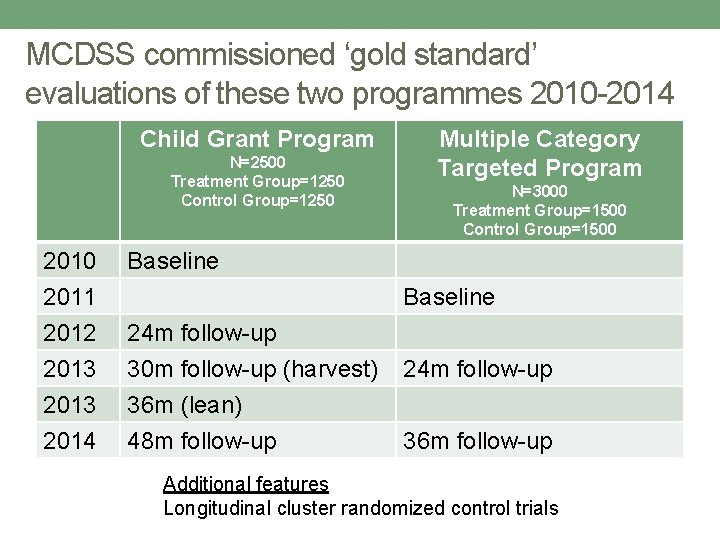
MCDSS commissioned ‘gold standard’ evaluations of these two programmes 2010 -2014 Child Grant Program N=2500 Treatment Group=1250 Control Group=1250 2011 2012 2013 2014 Multiple Category Targeted Program N=3000 Treatment Group=1500 Control Group=1500 Baseline 24 m follow-up 30 m follow-up (harvest) 36 m (lean) 48 m follow-up 24 m follow-up 36 m follow-up Additional features Longitudinal cluster randomized control trials
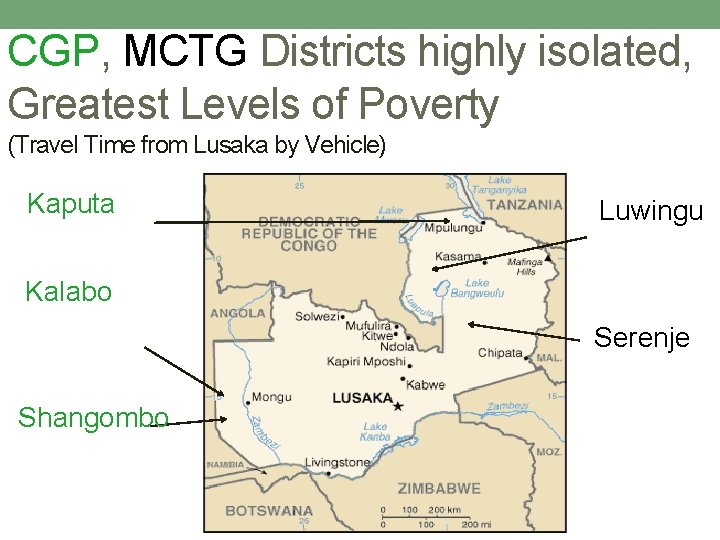
CGP, MCTG Districts highly isolated, Greatest Levels of Poverty (Travel Time from Lusaka by Vehicle) Kaputa Luwingu Kalabo Serenje Shangombo
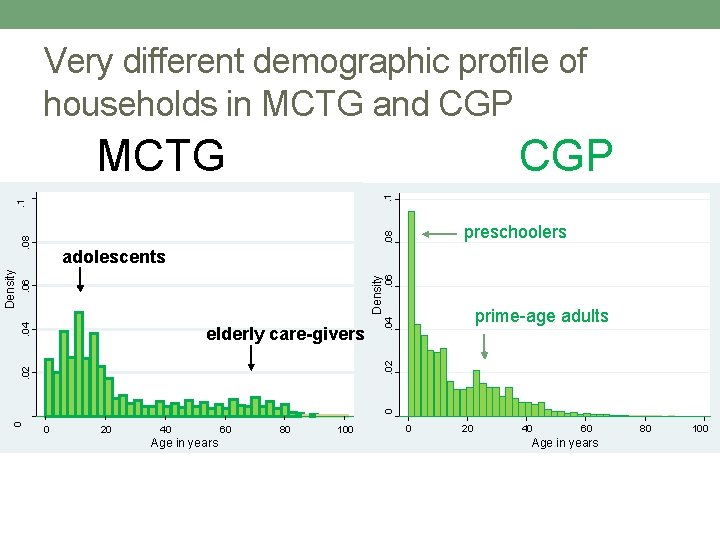
Very different demographic profile of households in MCTG and CGP . 08 0 0 . 02 elderly care-givers prime-age adults . 04 . 06 Density . 06 adolescents . 04 Density preschoolers . 08 . 1 MCTG 0 20 40 Age in years 60 80 100 0 20 40 60 Age in years 80 100
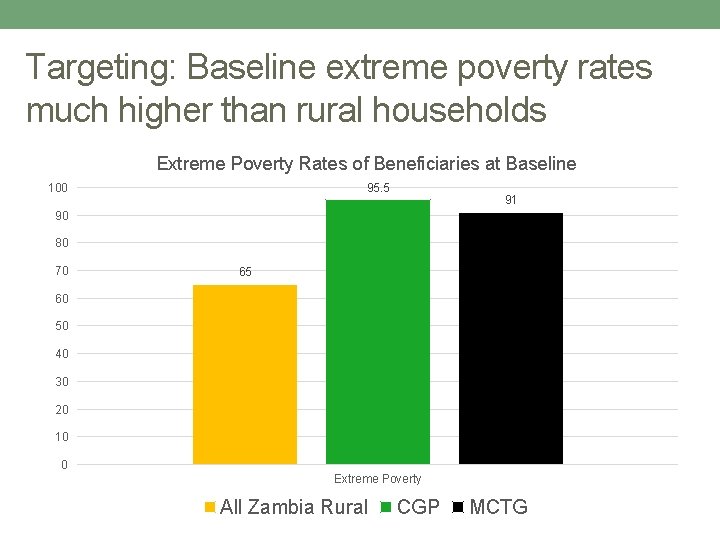
Targeting: Baseline extreme poverty rates much higher than rural households Extreme Poverty Rates of Beneficiaries at Baseline 95. 5 100 91 90 80 70 65 60 50 40 30 20 10 0 Extreme Poverty All Zambia Rural CGP MCTG
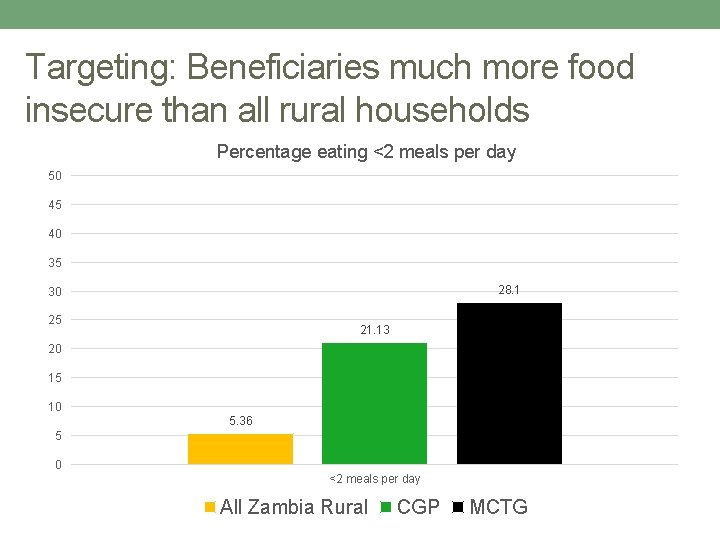
Targeting: Beneficiaries much more food insecure than all rural households Percentage eating <2 meals per day 50 45 40 35 28. 1 30 25 21. 13 20 15 10 5. 36 5 0 <2 meals per day All Zambia Rural CGP MCTG
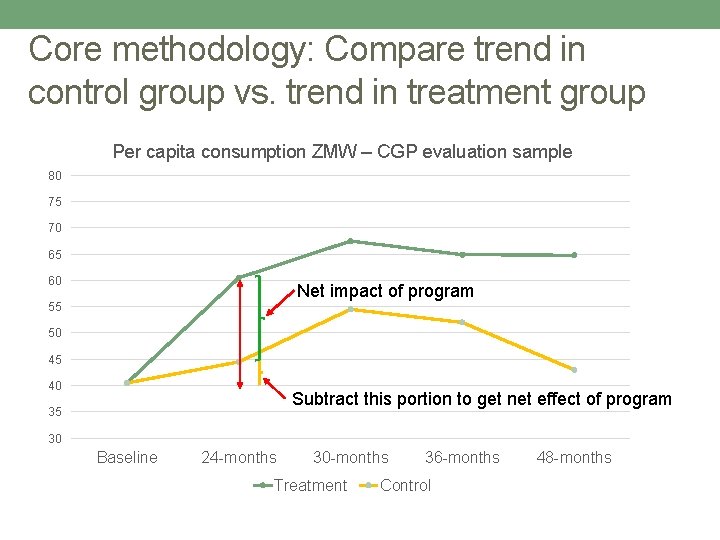
Core methodology: Compare trend in control group vs. trend in treatment group Per capita consumption ZMW – CGP evaluation sample 80 75 70 65 60 Net impact of program 55 50 45 40 Subtract this portion to get net effect of program 35 30 Baseline 24 -months 30 -months Treatment 36 -months Control 48 -months
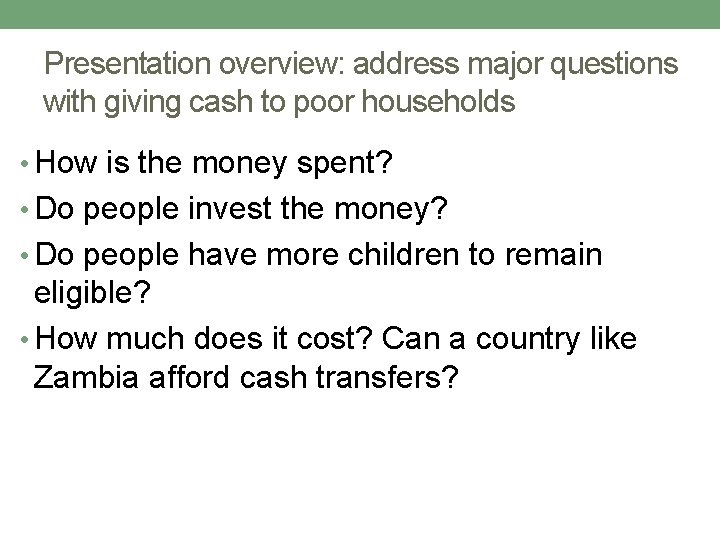
Presentation overview: address major questions with giving cash to poor households • How is the money spent? • Do people invest the money? • Do people have more children to remain eligible? • How much does it cost? Can a country like Zambia afford cash transfers?
How is the money spent? Spent on necessities? Or Wasted on alcohol and tobacco?
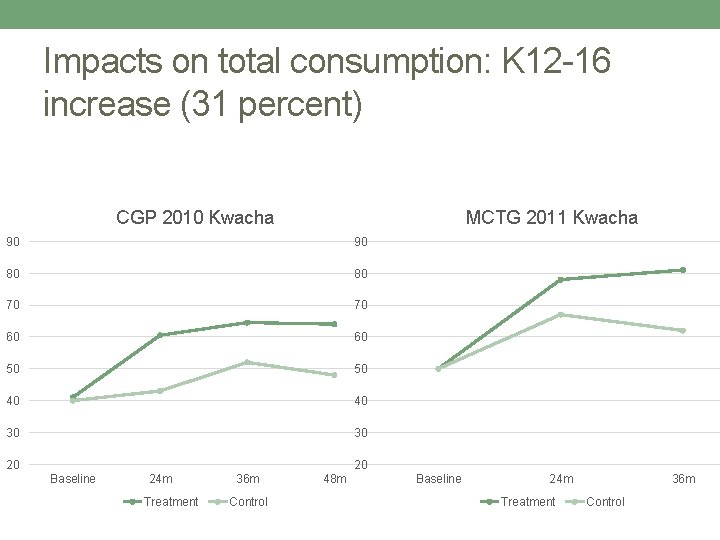
Impacts on total consumption: K 12 -16 increase (31 percent) CGP 2010 Kwacha MCTG 2011 Kwacha 90 90 80 80 70 70 60 60 50 50 40 40 30 30 20 20 Baseline 24 m Treatment 36 m Control 48 m Baseline 24 m Treatment 36 m Control
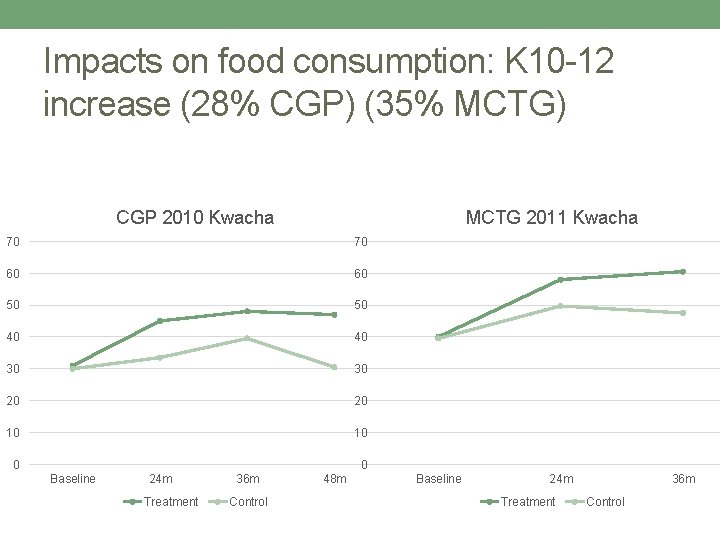
Impacts on food consumption: K 10 -12 increase (28% CGP) (35% MCTG) CGP 2010 Kwacha MCTG 2011 Kwacha 70 70 60 60 50 50 40 40 30 30 20 20 10 10 0 0 Baseline 24 m Treatment 36 m Control 48 m Baseline 24 m Treatment 36 m Control
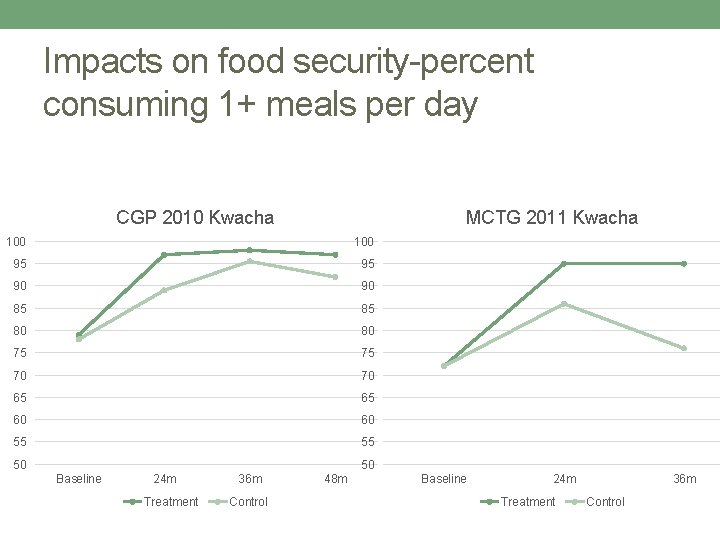
Impacts on food security-percent consuming 1+ meals per day CGP 2010 Kwacha MCTG 2011 Kwacha 100 95 95 90 90 85 85 80 80 75 75 70 70 65 65 60 60 55 55 50 50 Baseline 24 m Treatment 36 m Control 48 m Baseline 24 m Treatment 36 m Control
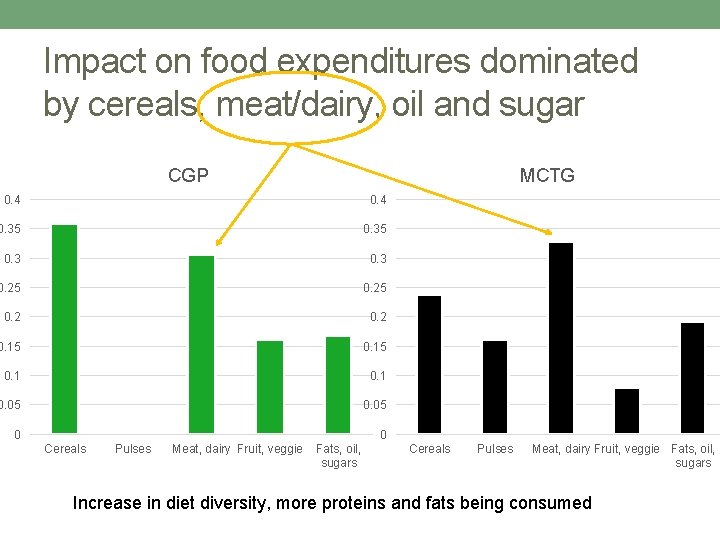
Impact on food expenditures dominated by cereals, meat/dairy, oil and sugar CGP MCTG 0. 4 0. 35 0. 3 0. 25 0. 2 0. 15 0. 1 0. 05 0 0 Cereals Pulses Meat, dairy Fruit, veggie Fats, oil, sugars Increase in diet diversity, more proteins and fats being consumed
No evidence cash is ‘wasted’ on alcohol & tobacco § Alcohol/tobacco represent 1% of budget share § No positive impacts found on alcohol/tobacco: § Data comes from detailed consumption module covering over 200 individual items, so hard to lie on just these items § Alternative measurement approaches yield same result: § “Has alcohol consumption increased in this community over the last year? ” § “Is alcohol consumption a problem in your community? ” § No differences between Treatment and Control group on these responses
Productivity Do People Invest the Money? Or Treat Money as a Handout?
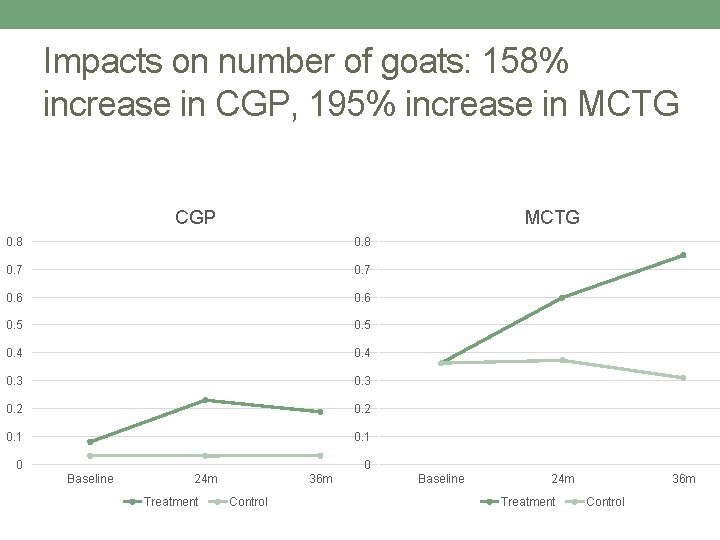
Impacts on number of goats: 158% increase in CGP, 195% increase in MCTG CGP MCTG 0. 8 0. 7 0. 6 0. 5 0. 4 0. 3 0. 2 0. 1 0 0 Baseline 24 m Treatment 36 m Control
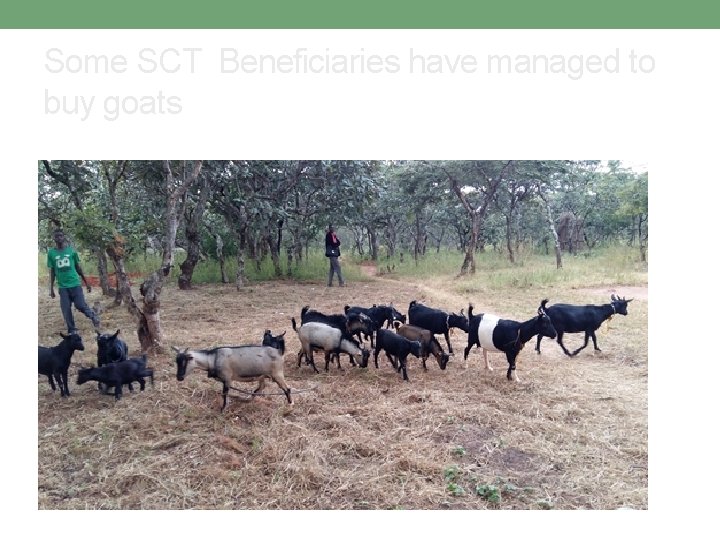
Some SCT Beneficiaries have managed to buy goats
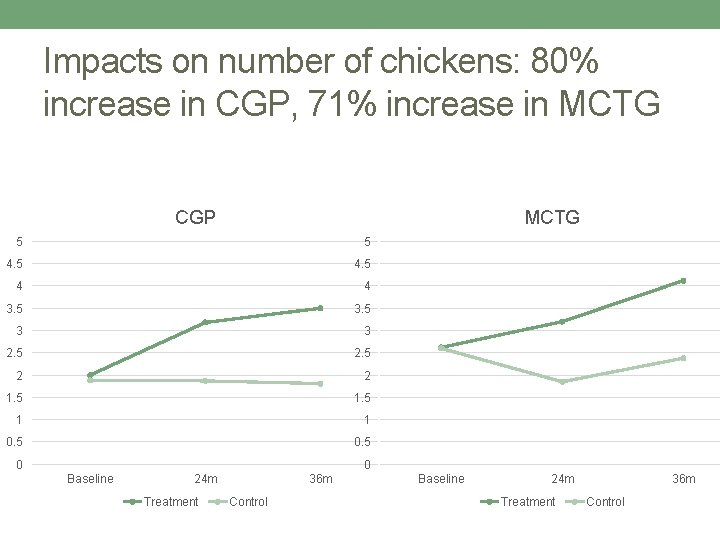
Impacts on number of chickens: 80% increase in CGP, 71% increase in MCTG CGP MCTG 5 5 4 4 3. 5 3 3 2. 5 2 2 1. 5 1 1 0. 5 0 0 Baseline 24 m Treatment 36 m Control
Other economic impacts… • Value of harvest increased significantly for both programs • CGP: More time devoted to own-farm, more crop sold • MCTG: More hired labor • Non-farm enterprise increased significantly for both programs • CGP: Much larger impacts (+12 pp), mostly women-operated businesses • MCTG: Smaller impacts (+4 pp) • Pattern of effects consistent with household type • CGP more prime-age workers • MCTG labor constrained so hired labor to work farm
Positive impacts on school enrollment among secondary age children • By 36 -months beneficiary children age 11+ more likely to be enrolled in school
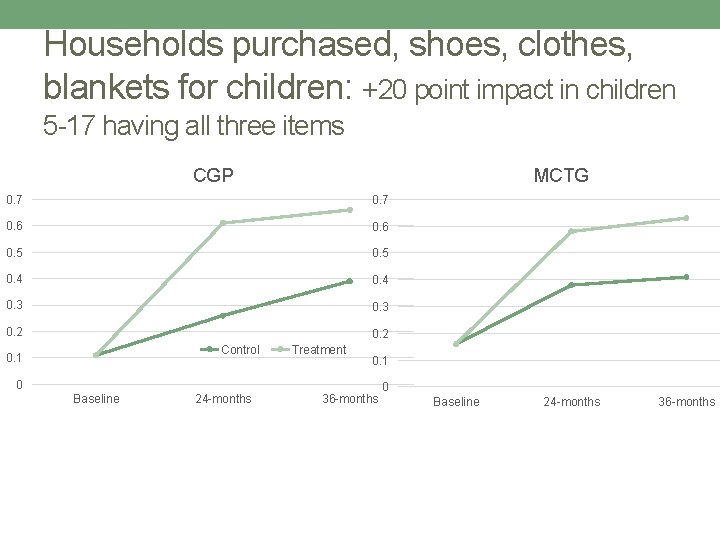
Households purchased, shoes, clothes, blankets for children: +20 point impact in children 5 -17 having all three items CGP MCTG 0. 7 0. 6 0. 5 0. 4 0. 3 0. 2 Control 0. 1 Treatment 0. 1 0 Baseline 24 -months 36 -months
How Do the Programs Compare? • Same transfer size • Different demographics • Same time-frame
Despite the different target groups, overall impacts are surprisingly similar • Key common characteristic is that households are ultra-poor
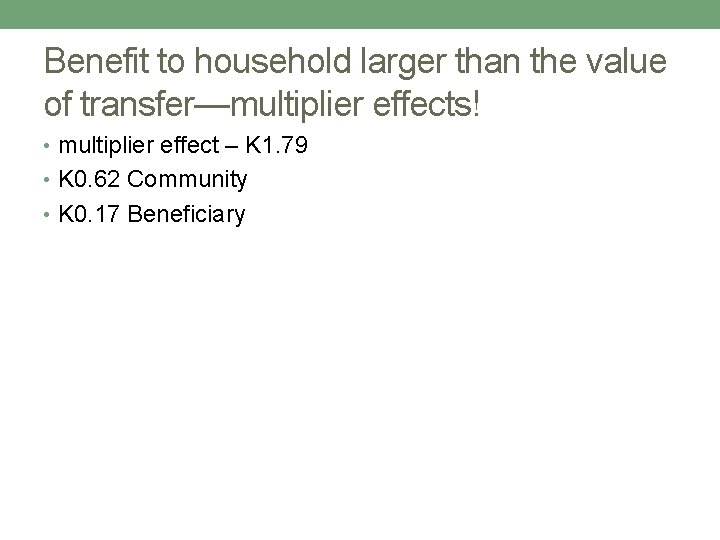
Benefit to household larger than the value of transfer—multiplier effects! • multiplier effect – K 1. 79 • K 0. 62 Community • K 0. 17 Beneficiary
Not a Handout = Does NOT Create Dependency • Increased Productive Activity • No Evidence of Increased Fertility • No Impact on Alcohol Consumption • Improved Standard of Living • Children in school, materially better off • Cash creates multipliers, allows the poorest to raise their income • Can these impacts be enhanced? How? With what other services?
Importance of evidence • Without evidence the programme was viewed as a hand out. • Enhanced the communication strategy. • Helped to scale up the programme because the policy makers were able to buy in. • Acceptability of the programme. • Enhanced cash plus programming. • Other linkages eg SCT/HIV, nutrition, SCALE Project, KGS.
On Going and Planned Studies • 7 year follow-up on CGP. • Following the same families. Children are now between 9 and 11 years old. • Insights into long-term impact. One of the first long-impact studies of this kind in Africa! • Children are entering adolescents, another critical area for additional evidence. • Planned: Urban Cash Transfer Impact Evaluation • This year the SCT went full board with urban coverage. • Impact may differ from rural areas. For example productivity gains may translate into labour market participation instead of farming activities. • In planning: Cash plus Care • Developing a comprehensive case-management system that links cash “plus”, to care and basic services to determine the best combinations for maximum impact. • Quick wins, what information do we have and what can we collect to strengthen the implementation.
Is SCT social protection? • SCT is only a component of Social Protection
- Slides: 31