
The Impact of Sampling Techniques on Application Level
- Slides: 1
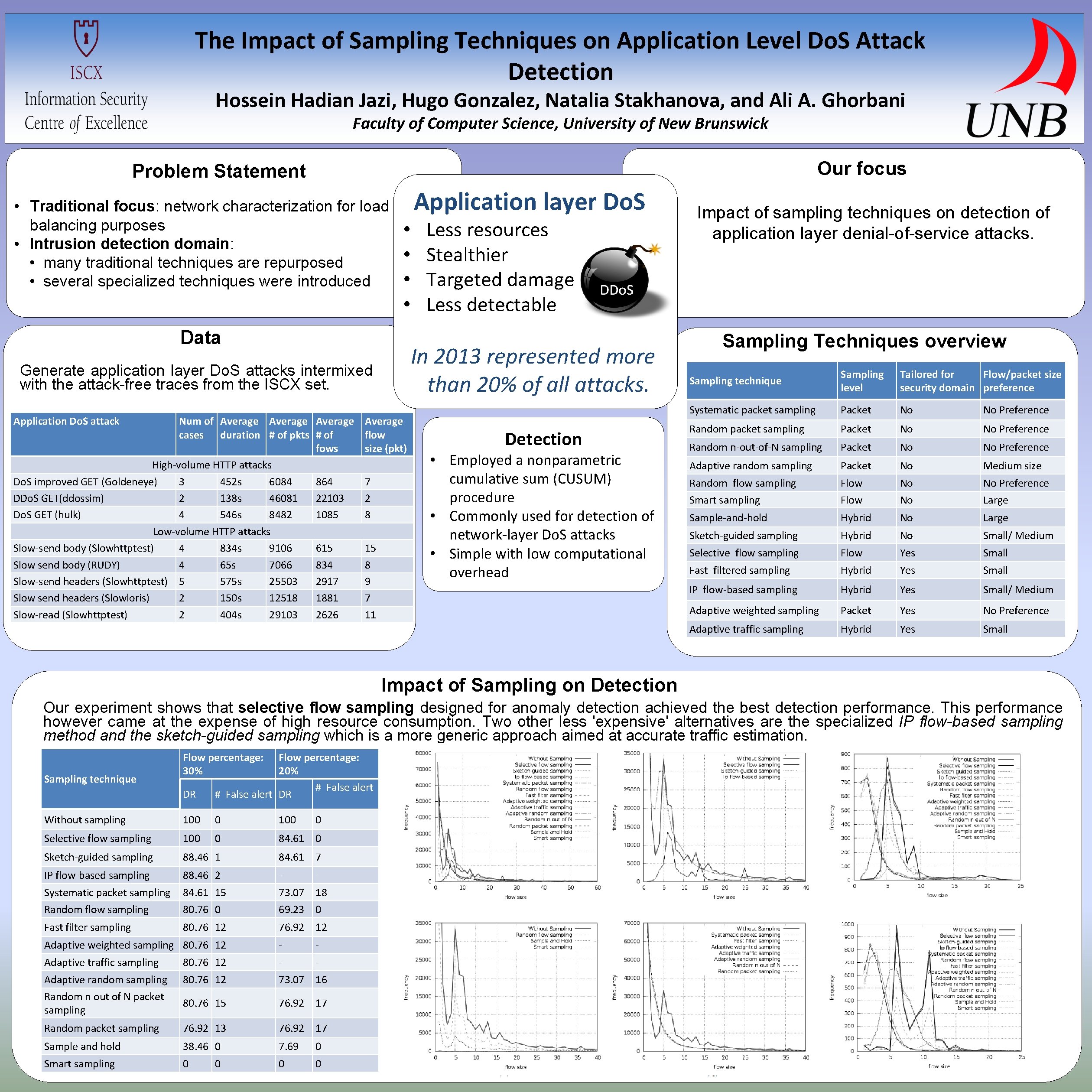
The Impact of Sampling Techniques on Application Level Do. S Attack Detection Hossein Hadian Jazi, Hugo Gonzalez, Natalia Stakhanova, and Ali A. Ghorbani Faculty of Computer Science, University of New Brunswick Our focus Problem Statement • Traditional focus: network characterization for load balancing purposes • Intrusion detection domain: • many traditional techniques are repurposed • several specialized techniques were introduced Application layer Do. S • • Data In 2013 represented more than 20% of all attacks. Generate application layer Do. S attacks intermixed with the attack-free traces from the ISCX set. Application Do. S attack Less resources Stealthier Targeted damage Less detectable Num of Average cases duration # of pkts # of flow fows size (pkt) High-volume HTTP attacks Do. S improved GET (Goldeneye) 3 452 s 6084 864 7 DDo. S GET(ddossim) 2 138 s 46081 22103 2 Do. S GET (hulk) 4 546 s 8482 1085 8 Low-volume HTTP attacks Slow-send body (Slowhttptest) 4 834 s 9106 615 15 Slow send body (RUDY) 4 65 s 7066 834 8 Slow-send headers (Slowhttptest) 5 575 s 25503 2917 9 Slow send headers (Slowloris) 2 150 s 12518 1881 7 Slow-read (Slowhttptest) 2 404 s 29103 2626 11 Detection • Employed a nonparametric cumulative sum (CUSUM) procedure • Commonly used for detection of network-layer Do. S attacks • Simple with low computational overhead Impact of sampling techniques on detection of application layer denial-of-service attacks. Sampling Techniques overview Sampling technique Sampling level Tailored for Flow/packet size security domain preference Systematic packet sampling Packet No No Preference Random n-out-of-N sampling Packet No No Preference Adaptive random sampling Packet No Medium size Random flow sampling Flow No No Preference Smart sampling Flow No Large Sample-and-hold Hybrid No Large Sketch-guided sampling Hybrid No Small/ Medium Selective flow sampling Flow Yes Small Fast filtered sampling Hybrid Yes Small IP flow-based sampling Hybrid Yes Small/ Medium Adaptive weighted sampling Packet Yes No Preference Adaptive traffic sampling Hybrid Yes Small Impact of Sampling on Detection Our experiment shows that selective flow sampling designed for anomaly detection achieved the best detection performance. This performance however came at the expense of high resource consumption. Two other less 'expensive' alternatives are the specialized IP flow-based sampling method and the sketch-guided sampling which is a more generic approach aimed at accurate traffic estimation. DR Flow percentage: 20% # False alert DR Without sampling 100 0 100 Selective flow sampling 100 0 84. 61 0 Sketch-guided sampling 88. 46 1 84. 61 7 IP flow-based sampling 88. 46 2 - Systematic packet sampling 84. 61 15 73. 07 18 Random flow sampling 80. 76 0 69. 23 0 Fast filter sampling 80. 76 12 76. 92 12 Sampling technique Flow percentage: 30% 0 - Adaptive weighted sampling 80. 76 12 - - Adaptive traffic sampling 80. 76 12 - - Adaptive random sampling 80. 76 12 73. 07 16 Random n out of N packet sampling 80. 76 15 76. 92 17 Random packet sampling 76. 92 13 76. 92 17 Sample and hold 38. 46 0 7. 69 0 Smart sampling 0 0