
The Impact of Puberty on Your Childs Cognitive
The Impact of Puberty on Your Child's Cognitive, Emotional, and Social Development Presenters: • Angelica Greiner • Baylis Scott
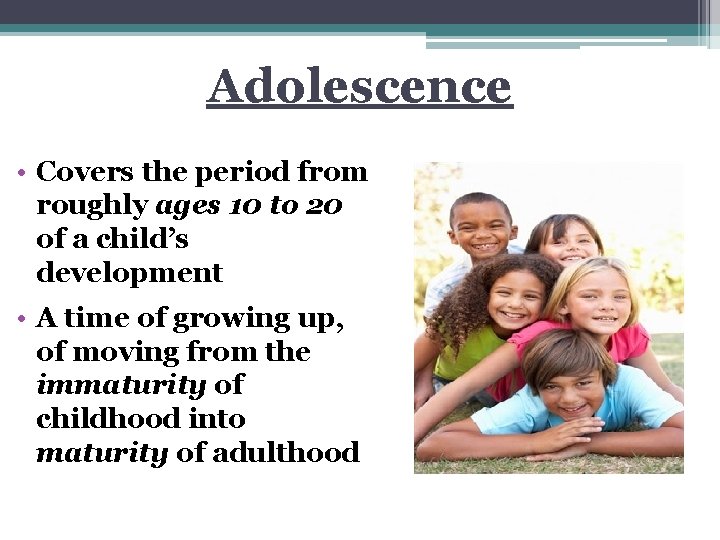
Adolescence • Covers the period from roughly ages 10 to 20 of a child’s development • A time of growing up, of moving from the immaturity of childhood into maturity of adulthood
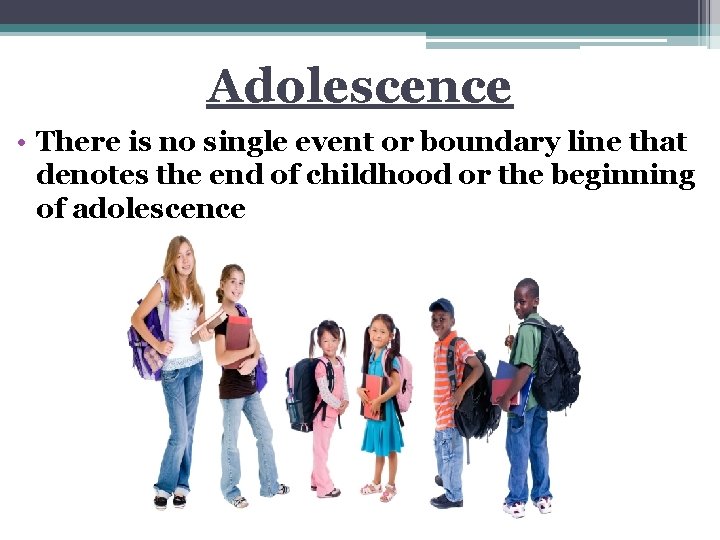
Adolescence • There is no single event or boundary line that denotes the end of childhood or the beginning of adolescence
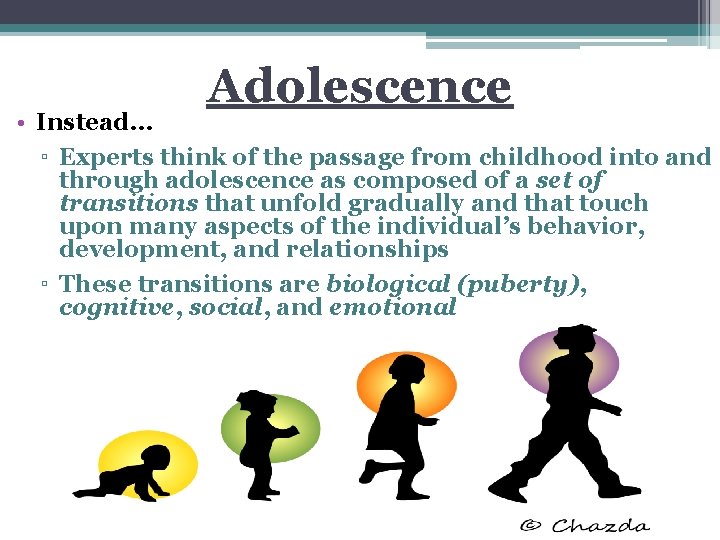
Adolescence • Instead… ▫ Experts think of the passage from childhood into and through adolescence as composed of a set of transitions that unfold gradually and that touch upon many aspects of the individual’s behavior, development, and relationships ▫ These transitions are biological (puberty), cognitive, social, and emotional

Biological Transition • The most salient sign that adolescence has begun • Refers to the physical changes the occur in the growing girl/boy as the individual passes from childhood into adulthood • The physical changes of puberty are triggered by hormones—chemical substances in the body that act on specific organs and tissues
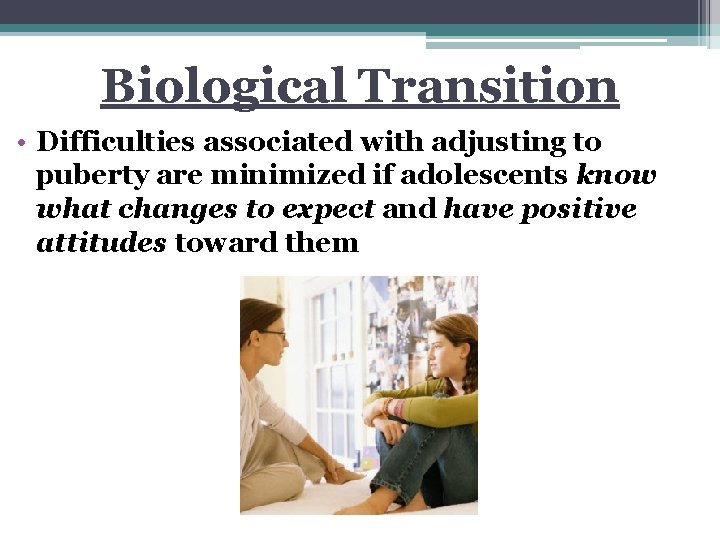
Biological Transition • Difficulties associated with adjusting to puberty are minimized if adolescents know what changes to expect and have positive attitudes toward them

Biological Transition • Although the immediate impact of puberty on your child’s self-image and mood may be very modest, the timing of physical maturation does affect your child’s social and emotional development…

Biological Transition • Early-maturing boys tend to have a more positive self-concept and be more self-assured than their later-maturing peers • Early-maturing girls may feel awkward and self-conscious
Cognitive Transition • A second element of the passage through adolescence is a cognitive transition • Compared to children, adolescents think in way that are more advanced, more efficient, and generally more complex

Cognitive Transition • The cognitive transition can be seen in 5 ways: 1. Better able to think about what is possible, instead of limiting their thoughts to what is real

Cognitive Transition • The cognitive transition can be seen in 5 ways: 2. They are better able to think about abstract ideas

Cognitive Transition • The cognitive transition can be seen in 5 ways: 3. They begin to think more often about the process of thinking itself (metacognition)
Cognitive Transition • The cognitive transition can be seen in 5 ways: 4. Their thinking tends to become multidimensional, rather than limited to a single issue
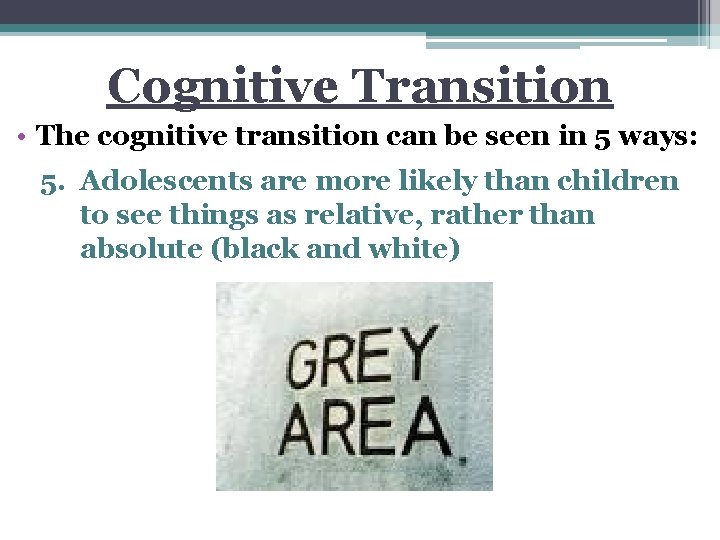
Cognitive Transition • The cognitive transition can be seen in 5 ways: 5. Adolescents are more likely than children to see things as relative, rather than absolute (black and white)
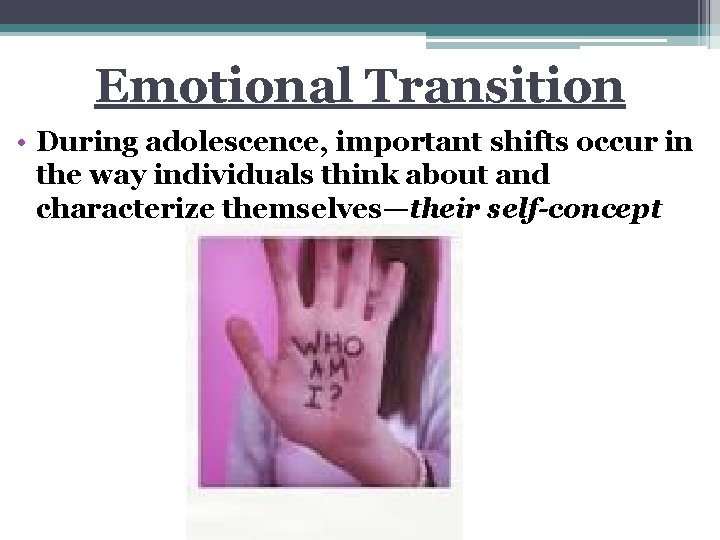
Emotional Transition • During adolescence, important shifts occur in the way individuals think about and characterize themselves—their self-concept

Emotional Transition • As adolescents mature intellectually and undergo cognitive transitions, they come to perceive themselves in more sophisticate and differentiated ways ▫ Children – describe themselves in relatively simple, concrete terms ▫ Adolescents – likely to employ complex, abstract, and psychological selfcharacterizations
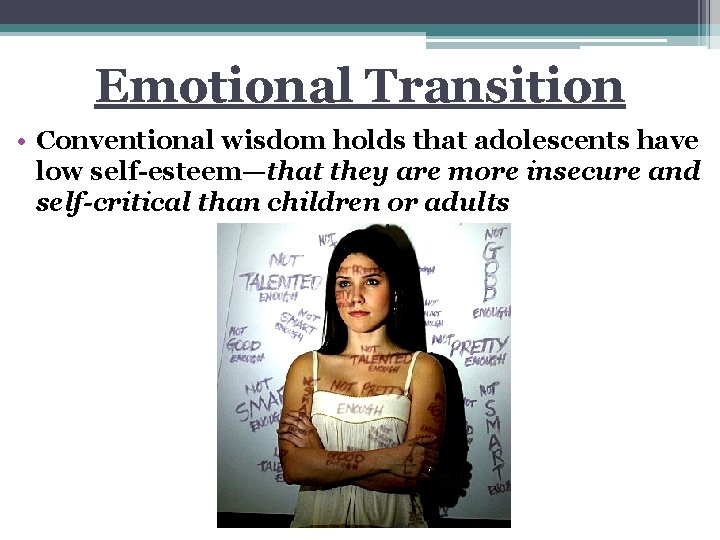
Emotional Transition • Conventional wisdom holds that adolescents have low self-esteem—that they are more insecure and self-critical than children or adults
Emotional Transition • However, most research indicates otherwise… ▫ Although adolescents’ feelings about themselves may fluctuate, their selfesteem remains fairly stable from about age 13 on ▫ Researchers believes that self-esteem is multidimensional—young people evaluate themselves along several different dimensions
Emotional Transition • Erikson theorized that the establishment of a coherent sense of identity is the chief psychosocial task of adolescence ▫ Adolescent may experiment with different roles and identities ▫ This experimentation involves trying on different personalities and ways of behaving ▫ Sometimes parents describe their teenage children as going through “phases”—much of this behavior is actually experimentations with roles and personalities
Emotional Transition • Establishing a sense of autonomy/independence is an important part of the emotional transition out of childhood
Emotional Transition • During adolescence, there is a movement away from the dependence typical of childhood toward autonomy typical of adulthood • This movement can be seen in several ways… ▫ Adolescents don’t rush to their parents whenever they are upset, worried, or need assistance ▫ They do not see their parents as all knowing or allpowerful ▫ Adolescents have a great deal of emotional energy wrapped up in relationships outside the family—may be more attached to a boyfriend/girlfriend than to their parents ▫ Older adolescents are able to see and interact with their parents as people—not just as their parents
Emotional Transition • The process of individuation begins during infancy and continues well into late adolescence • Individuation involves a gradual sharpening of one’s sense of self as autonomous, as competent, and as separate from one’s parents
Emotional Transition • The process of individuation does not necessarily involve stress and internal turmoil
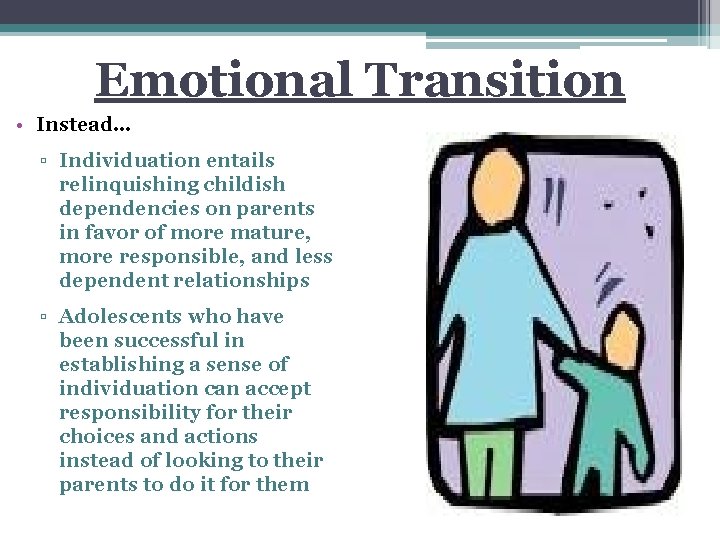
Emotional Transition • Instead… ▫ Individuation entails relinquishing childish dependencies on parents in favor of more mature, more responsible, and less dependent relationships ▫ Adolescents who have been successful in establishing a sense of individuation can accept responsibility for their choices and actions instead of looking to their parents to do it for them
Emotional Transition • Susceptibility to the influence of parents/peers changes with development ▫ Childhood—highly oriented toward parents/less oriented toward peers; peer pressure during the early elementary years is not especially strong ▫ Adolescence – less oriented toward their parents and more oriented toward their peers; peer pressure begins to escalate ▫ Early Adolescence– conformity to parents continues to decline and conformity to peers and peer pressure continues to rise ▫ Middle Adolescence – genuine behavioral independence emerges when conformity to parents and peers declines
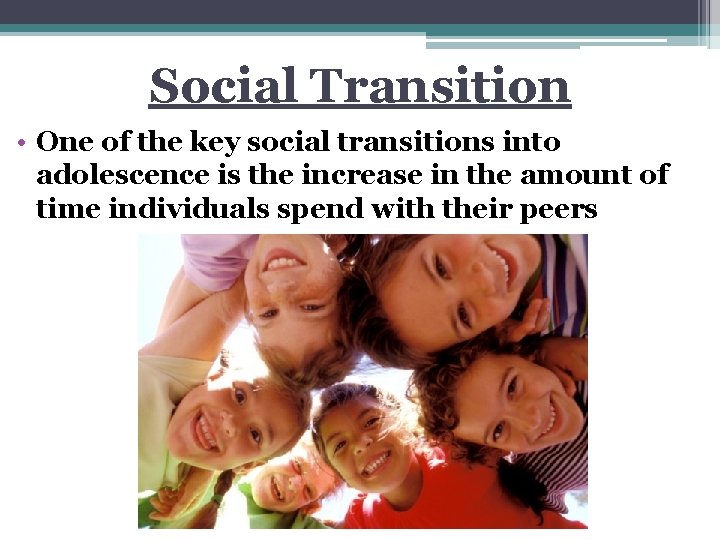
Social Transition • One of the key social transitions into adolescence is the increase in the amount of time individuals spend with their peers
Social Transition • Specific developments… ▫ Sharp increase in the amount of time adolescents spend with their peers and in the relative time they spend in the company of peers versus adults ▫ Peer groups function much more often without adult supervision than they do during childhood ▫ More contact with peers of the opposite-sex friends ▫ Whereas children’s peer relationships are limited mainly to pairs of friends/relatively small groups, adolescence marks the emergence of larger groups of peers (i. e. band, athletics, drama, etc. )
Social Transition • The importance of peers during early adolescence coincides with changes in individuals’ needs for intimacy • As children begin to share secrets with their friends, a new sense of loyalty and commitment grows—a belief that friends can trust each other • During adolescence, the search for intimacy intensifies and self-disclosure between friends becomes important • Teenagers spend hours discussing their innermost thoughts and feelings, trying to understand one another • The discovery that they tend to think and feel the same as someone else becomes another important basis of friendship
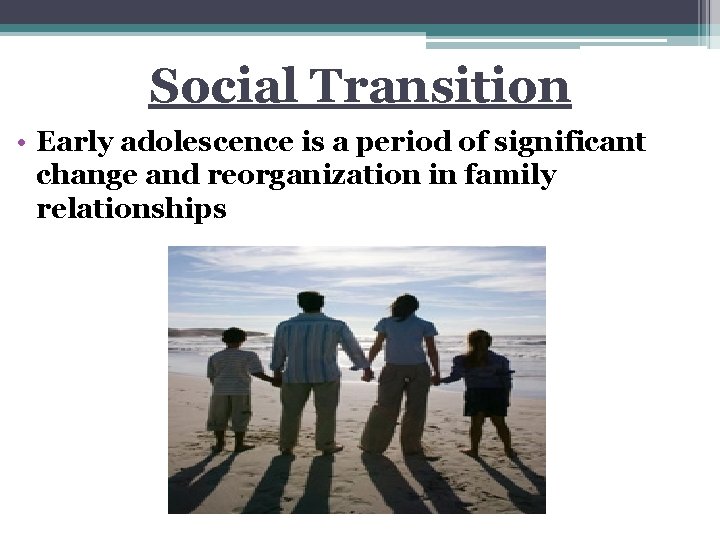
Social Transition • Early adolescence is a period of significant change and reorganization in family relationships
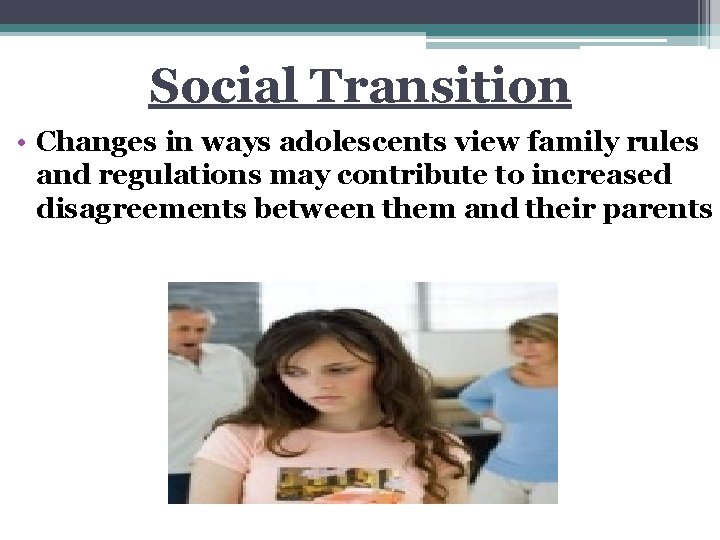
Social Transition • Changes in ways adolescents view family rules and regulations may contribute to increased disagreements between them and their parents

Wrap Up • Research indicates that most young people are able to negotiate the biological, cognitive, emotional, and social transitions of adolescence successfully! • Questions/Comments
- Slides: 31