
The Impact of Police Officer Age on Leadership
- Slides: 24
The Impact of Police Officer Age on Leadership and Workplace Preferences Abigail H. Lauer Olivet Nazarene University April 18, 2020
Problem Statement ● Challenge facing managers today (Lester, Standifer, Schultz, & Windsor, 2012) ○ Strength and opportunity or stress and conflict (Sanders & Stefaniak, 2008) ● Law enforcement recruitment and retention ○ Retirement rates (United States Office of Personnel Management) ● Retain and motivate older employees, remain attractive to less experienced younger employees, foster desirable work opportunities ○ Lack of research and missing information about workplace preferences (Bright, 2010) ● Generational stereotypes commonly accepted ○ Empirical evidence relatively sparse (Twenge, Campbell, Hoffman, & Lance, 2010) ● Accepting stereotypes without empirical support ○ More research on the differences between generations in workforce is needed. (Becton, Walker, & Farmer-Jones, 2014)
Purpose • The purpose of the current study was to investigate the preferences of police officers of different ages toward leadership behaviors, trust in leadership, organizational commitment, and job satisfaction in order to recommend strategies for recruitment, retention, and leadership of police officers.
Review of Literature ● “Age is a matter of feeling, not of years” (Curtis, 1856) ● Technology and society - different for each generation (Boomer & Wiley, 2018) ○ Millennials have the most trouble finding a work-life balance ● Law enforcement and technology (Gasior, 2017) ● Internal stressors ● Police and the media ○ Scrutiny and cell phones ○ Ferguson effect (Wolfe & Nix, 2015) ● How does law enforcement move forward? ○ Different opinions based on age & experience
Review of Literature • Four generations in the workplace (Lester et al. , 2012, Kasasa. com, 2019) ○ ○ Baby Boomers: born 1944 -1964 Generation X: born 1965 -1979 Generation Y: born 1980 -1994 Generation Z: born 1995 -2015 ○ ○ Classical Transactional Visionary Organic • Leadership paradigms (Avery, 2013) • Public sector has challenges that require targeted leadership skills Center for Creative Leadership (Ferguson, Ronayne, & Rybacki, 2014)
Research Questions RQ 1: • What is the relationship between the age of police officers and their preferences towards ideal leadership behaviors in various domains (demand reconciliation, persuasiveness, initiation of structure, tolerance and freedom, consideration, production emphasis, and integration) controlling for gender and race? RQ 2: • What is the relationship between the age of police officers and their attitudes of trust in current leadership in the workplace, controlling for gender and race? RQ 3: • What is the relationship between police officer organizational commitment and intrinsic, extrinsic and general job satisfaction controlling for police officer age, gender and race?
Significance & Research Design ● Understand different generations of police officers better ○ Leadership, job satisfaction, ○ Organizational commitment, ○ Trust in leadership ● Make recommendations ○ Recruitment ○ Management ○ Retention ● Generational differences ○ Investigated ○ Understood ● Quantitative: 116 Likert-scale questions from 4 survey instruments ● Qualitative: Two open-ended questions: ● ● How can law enforcement management better learn and understand the needs and workplace preferences of rank and file police officers? If you were a supervisor in your law enforcement agency, what would you do to improve the motivation, morale, and job satisfaction of the rank and file police officers?
Data Collection & Participants • Online survey through SURVS® ○ January 2019 - March 2019 ○ Participants entered into drawing for 2 - $50 gift cards • Survey and cover letter emailed to 22 police departments ○ Purposive sampling used ○ Approximately 800 officers reached by survey ● 160 police officers from 22 police departments in a suburban county of a large Midwestern city ○ 20% response rate • • 84% male 16% female ○ Age range: 23 -66 years old ○ Average age: 39 years old • • • 50% - Millennial 43% - Generation X 5% - Baby Boomer
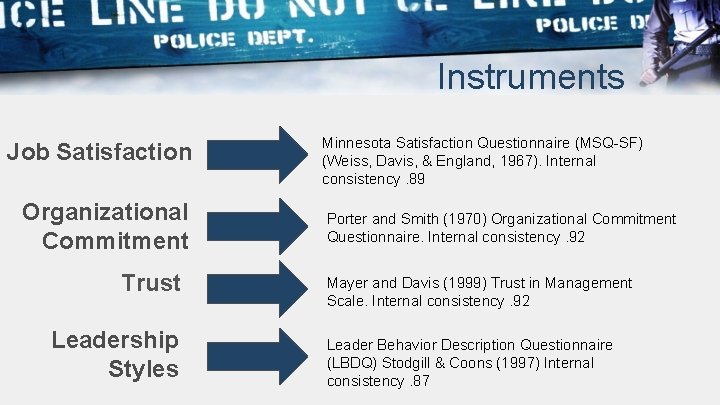
Instruments Job Satisfaction Organizational Commitment Trust Leadership Styles Minnesota Satisfaction Questionnaire (MSQ-SF) (Weiss, Davis, & England, 1967). Internal consistency. 89 Porter and Smith (1970) Organizational Commitment Questionnaire. Internal consistency. 92 Mayer and Davis (1999) Trust in Management Scale. Internal consistency. 92 Leader Behavior Description Questionnaire (LBDQ) Stodgill & Coons (1997) Internal consistency. 87
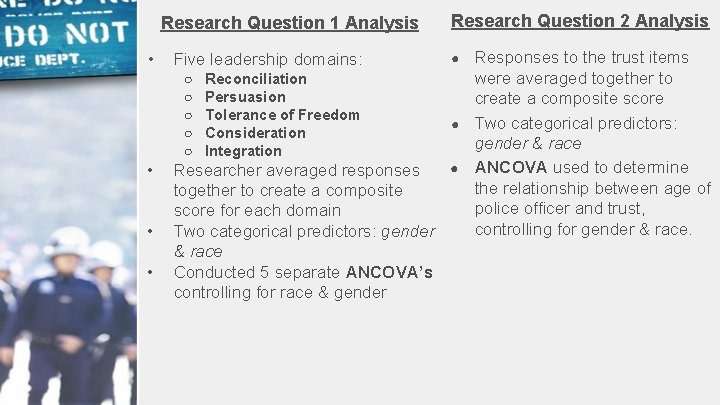
Research Question 1 Analysis • • Research Question 2 Analysis Responses to the trust items ○ Reconciliation were averaged together to ○ Persuasion create a composite score ○ Tolerance of Freedom ● Two categorical predictors: ○ Consideration gender & race ○ Integration ● ANCOVA used to determine Researcher averaged responses the relationship between age of together to create a composite police officer and trust, score for each domain controlling for gender & race. Two categorical predictors: gender & race Conducted 5 separate ANCOVA’s controlling for race & gender Five leadership domains: ●
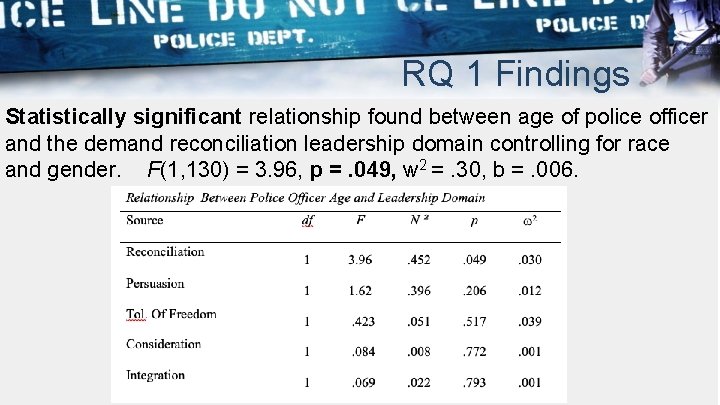
RQ 1 Findings Statistically significant relationship found between age of police officer and the demand reconciliation leadership domain controlling for race and gender. F(1, 130) = 3. 96, p =. 049, w 2 =. 30, b =. 006.
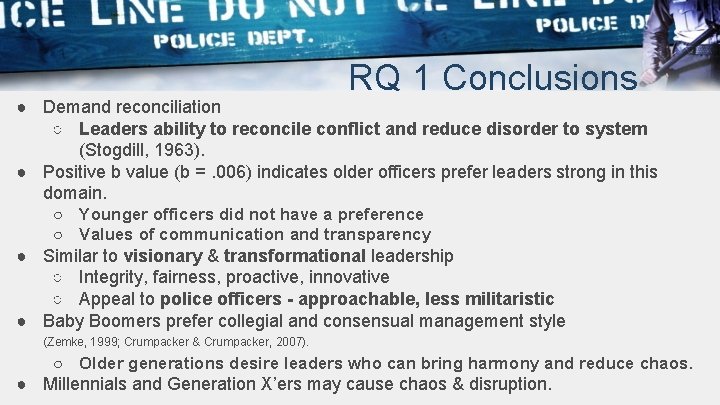
RQ 1 Conclusions ● Demand reconciliation ○ Leaders ability to reconcile conflict and reduce disorder to system (Stogdill, 1963). ● Positive b value (b =. 006) indicates older officers prefer leaders strong in this domain. ○ Younger officers did not have a preference ○ Values of communication and transparency ● Similar to visionary & transformational leadership ○ Integrity, fairness, proactive, innovative ○ Appeal to police officers - approachable, less militaristic ● Baby Boomers prefer collegial and consensual management style (Zemke, 1999; Crumpacker & Crumpacker, 2007). ○ Older generations desire leaders who can bring harmony and reduce chaos. ● Millennials and Generation X’ers may cause chaos & disruption.
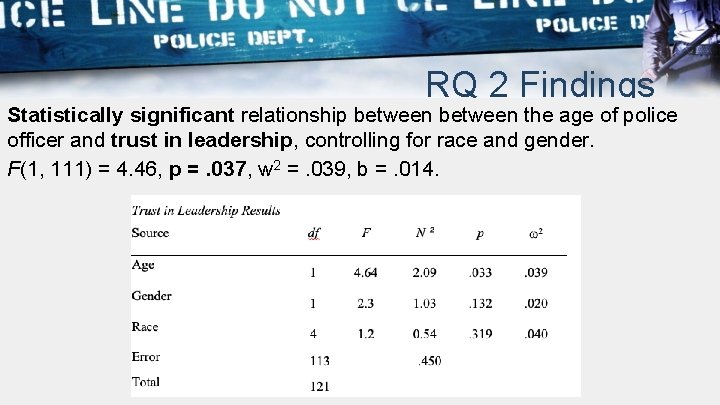
RQ 2 Findings Statistically significant relationship between the age of police officer and trust in leadership, controlling for race and gender. F(1, 111) = 4. 46, p =. 037, w 2 =. 039, b =. 014.
RQ 2 Conclusions ● Findings revealed that older officers have greater trust in leadership than younger officers (b =. 014) ○ Younger officers more skeptical, new to organization ● Individual questions analyzed by response: ○ “my needs and desires are very important to top management”. • F(1, 118) = 6. 12, p =. 015, w 2 =. 052, b = 9. 34. • Significant & older officers agreed ○ “I really wish I had a good way to keep an eye on top management”. • F(1, 118) = 4. 29, p =. 041, w 2 =. 037, b = -. 023. • Significant & younger officers show lack of trust
RQ 2 Conclusions ● Current study reinforced research ○ Younger officers exhibit a different level of trust (Zemke, 2000) ○ Millennials rebuke supervisors (Piper, 2011) ● Baby Boomers prioritize work and loyalty to management (Crampton & Hodge, 2007) ● Police departments ○ Lack of trust causes serious internal and external conflict • (Trautman, 2015) ○ Develop mission/purpose and informal leaders ● Leaders gain trust of Millennials by ○ Valuing their input ○ Creating informal leaders
Research Question 3 Analysis ● Researcher re-coded the negatively scored items on the organizational commitment questionnaire. ● Responses averaged to create four composite scores: ○ Organizational Commitment ○ Extrinsic Satisfaction ○ Intrinsic Satisfaction ○ General Satisfaction ● ANCOVA to examine the relationship between job satisfaction and organizational commitment, controlling for age, gender, and race.
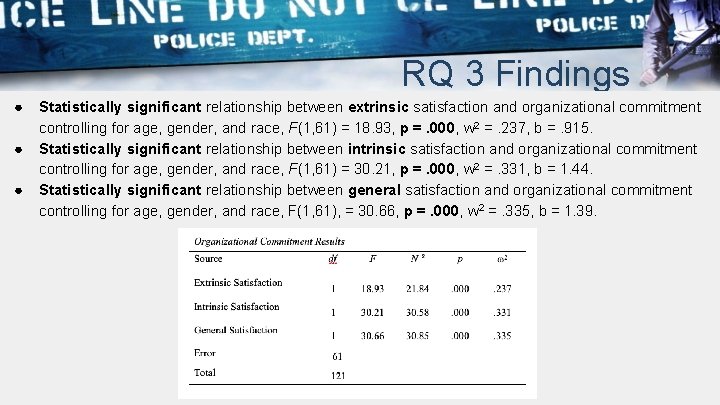
RQ 3 Findings ● ● ● Statistically significant relationship between extrinsic satisfaction and organizational commitment controlling for age, gender, and race, F(1, 61) = 18. 93, p =. 000, w 2 =. 237, b =. 915. Statistically significant relationship between intrinsic satisfaction and organizational commitment controlling for age, gender, and race, F(1, 61) = 30. 21, p =. 000, w 2 =. 331, b = 1. 44. Statistically significant relationship between general satisfaction and organizational commitment controlling for age, gender, and race, F(1, 61), = 30. 66, p =. 000, w 2 =. 335, b = 1. 39.
RQ 3 Conclusions ● Statistical significance across all types of job satisfaction ○ Researcher found that age of police officer did not have statistically significant impact on organizational commitment. • Older officers had more commitment (b = 9. 02) ● Lower levels of organizational commitment by young officers may indicate: ○ Management weak in encouraging teamwork, supporting personal development, feedback, listening, and communication (Metcalfe & Dick, 2000) ● Correlation with RQ 2 results ○ Older officers have greater trust in management & more organizational commitment than younger
RQ 3 Conclusions ● Transformational leaders and organizational commitment ○ Officers level of commitment affected by: • Social relations with supervisors • Organizational atmosphere (Shim, 2015) • Leader impacts organizational commitment ○ Transformational leadership significantly predicts police commitment (Swid, 2014) Intrinsic = younger officers (b = -. 006) Intrinsic: working alone, personal advancement, freedom to use judgment, praise, accomplishment Characteristic of Millennial and Generation X (Ferri-Reed, 2010) Most patrol officers are younger generations Street cop culture is more flexible in contrast with management in policing which is based on formal control (Ianni, 1983)
Open-Ended Questions & Findings Q 1: How can law enforcement management better learn and understand the needs and workplace preferences of the rank and file police officers? 86 Responses Q 1 Results: 27% - Listen, 16. 3% - Survey along with Ask, Communicate, Meet, Have Meetings. Q 2: If you were a supervisor in your law enforcement agency what would you do to improve the motivation, morale, and job satisfaction of the rank and file police officers? 88 Responses Q 2 Results: 15% - Thank, Reward, Praise, 13% - Listen, 13% - Motivate, Encourage
Implications 1. Transformational Leadership 2. Develop trust between younger officers and management ○ Transparency 3. Increase organizational commitment in younger officers ○ Extrinsic satisfaction in younger officers ○ Turnover rates and salary “Police morale is becoming a nationwide crisis, especially in big cities, and that has the potential of leaving these agencies with extreme shortages of officers” (Griffith, 2019)
Study Limitations & Recommendations ● Instructions for non-supervisory level officers to take: ○ Unknown if management took survey ● Interpretation of instructions ○ Leader Behavior Description Questionnaire ● Honesty of respondents ○ Fear of department learning responses ○ Took survey for gift card prize only ● Length of survey ● Ages of respondents ● Administer survey in person ● Leadership tool ● Shorten survey ● Seek out officers of different age groups ○ Equally represented
General Recommendations ● ● Transformational leadership training Implement meetings and surveys with officers Praise & gratitude from management Future studies ○ ○ ○ Management survey Work-life balance & job performance Workplace motivation
References Amabile, T. M. , Hill, K. G. , Hennessey, B. A. , Tighe, E. M. (1994). The work preference inventory: Assessing intrinsic and extrinsic motivational orientations. Journal of Personality and Social Psychology. 66(5), 950 -967. Avery, G. (2013). Understanding leadership. London, England: SAGE Publications. Becton, J. B. , Walker, H. J. , & Jones-Farmer, A. (2014). Generational differences in workplace behavior. Journal of Applied Social Psychology. 44, 175 -189. doi: 10. 111/jasp. 12208 Bright, L. (2010). Why age matter in the work preferences of public employees: A comparison of three age-related explanations. Public Personnel Management. 39, 1 -14. Craig, S. C. , & Bennett, S. E. (1997). After the bonus: The politics of Generation X. Lanham, MD: Rowman & Littlefield. Crumpacker, M. , & Crumpacker, J. (2007). Succession planning and generational stereotypes: Should HR consider age-based values and attitudes a relevant factor or a passing fad? Public Personnel Management, 36(4), 349 -369. Curtis, G. W. , (1856). Prue and I. Ferri-Reed, J. (2010). The keys to engaging Millennials. The Journal for Quality and Participation, (33)1, 31 -33. Ferguson, J. , Ronayne, P. , Rybacki, M. (2014). Public sector leadership challenges: Are they different and does it matter? Center for Creative Leadership. Retrieved from https: //www. ccl. org/wp-content/uploads/2016/09/public-sector-leadershipchallenges-center-for-creative-leadership. pdf Gasior, M. (2017, September 26). New technology in law enforcement. Retrieved from https: //www. powerdms. com/blog/new-technology-in-law-enforcement/ Jurkiewicz, E. E. , & Brown, R. G. (1998). Gen. Xers vs. Boomers vs. Matures: Generational comparisons of public employee motivation. Review of Public Personnel Administration, 18 -37. Kasasa. (2019). Boomers, Gen X, Gen Y, and Gen Z explained. Retrieved from https: //www. kasasa. com/articles/generations/gen-x-gen-y-gen-z Leedy, P. D. , & Ormrod, J. E. , (2016). Practical research: Planning and design (11 th ed. ). Boston: MA: Pearson. Lester, S. W. , Standifer, R. L. , Schultz, N. J. , & Windsor, J. M. (2012). Actual versus perceived generational differences at work: An empirical examination. Journal of Leadership & Organizational Studies. 19(3), 341 -354. doi: 10. 1177/1548051812442747 Piper, B. (2011). Authority, authoritarianism, and the Millennial generation. Retrieved From: https: //barnabaspiper. com/2011/10/authority-authoritarianism-and-the Millennial-generation. html Porter, L. W. , Crampon, W. J. , Smith, F. J. (1976). Organizational commitment and managerial turnover: A longitudinal study. Organizational Behavior and Human Performance. 15(1), 87 -98. Sanders, D. , & Stefaniak, A. , (2008). To protect and serve: What generation Y brings to law enforcement and how police agencies can benefit. Policy Perspectives. Shim, H. S. , Jo, Y. , & Hoover, L. T. (2015). Police transformational leadership and organizational commitment. Policing: An International Journal of Police Strategies and Management, 38(4), 754 -774. doi: 10. 1108/PIJPSM-05 -2015 -0066 Stodgill, R. M. , & Coons, A. E. (1957). Leader behavior: Its description and measurement. The Ohio State University: Columbus, OH. Swid, A. (2014). Police members perceptions of their leaders’ leadership style and its implications. Policing: An International Journal of Police Strategies & Management, 37 (3), 579 -595. Trautman, N. (2015). 7 keys for police leaders to improve trust with subordinates. Police. One. Retrieved from https: //www. policeone. com/leadership/articles/7 -keys-for-police-leaders-to-improve-trust-with-subordinates-5 VL 7 e 3 I 41 q 9 y. UB 17/ Twenge, J. M. , Campbell, S. M. , Hoffman, B. J. , & Lance, C. E. (2010). Generational differences in work values: Leisure and extrinsic values increasing, social and intrinsic values decreasing. Journal of Management. 36, 1117 -1142. doi: 10. 1177/0149206309352246 United States Office of Personnel Management. Retirement Statistics: Fiscal Years 2005 -2014. https: //www. opm. gov/policy-data-oversight/data-analysis-documentation/federalemployment-reports/reports-publications/executive-branch-retirement-statistics-fy 2005 -2014. pdf Weiss, D. J. , Dawis, R. V. , & England, G. W. (1967). Manual for the Minnesota satisfaction questionnaire. Minnesota Studies in Vocational Rehabilitation, 22, 120. Wolfe, S. , & Nix, J. (2015). The alleged Ferguson effect and police willingness to engage in community partnership. Law and Human Behavior, 40(1), 1 -10. doi: 10. 1037/lhb 0000164 Zemke, R. , Raines, C. , & Filipczak, B. (1999). Generations at work: Managing the crash of Veterans, Boomers, Xers, and Nexters in you workplace. New York, NY: Amacom.