
The Impact of Mathematics Anxiety on Students Performance
- Slides: 17
The Impact of Mathematics Anxiety on Students Performance: A Case Study of Lyari Schools Abdul Karim Suhag Lecturer, Department of Education, Sindh Madressatul Islam University, Karachi Mah-e-Noor Aasim BS Scholar, Department of Education, Sindh Madressatul Islam University, Karachi Ushaque Ahmed MS Scholar, Department of Education, SZABIST Karachi Campus
Table of Contents Introduction Research Objectives Research Hypotheses Scope of the Study Research Methodology Population & Sampling Data Collection & Data Analysis Conclusion Recommendations
Introduction Mathematics is one of the compulsory and demanding subjects and it is taught in all level of schools Mathematic anxiety has discovered as common problem among students at different level of schooling, due to having weak base subject Mathematics anxiety refers to the feeling of anxiety, fear and pressure which interrupt the ability to perform mathematical operations (Zakaria & Nordin, 2008)
Introduction According to (Mutodi, 2014) mathematics anxiety is feeling of restless, helpless and fear from mathematical numbers and shape which effect the capability to solve mathematical problems When mathematic anxiety reached at severe level, it converts in to math-phobia It causes low achievement among students due to having high anxiety level (Pletzer, Kronbichler & Nuerk, 2015)
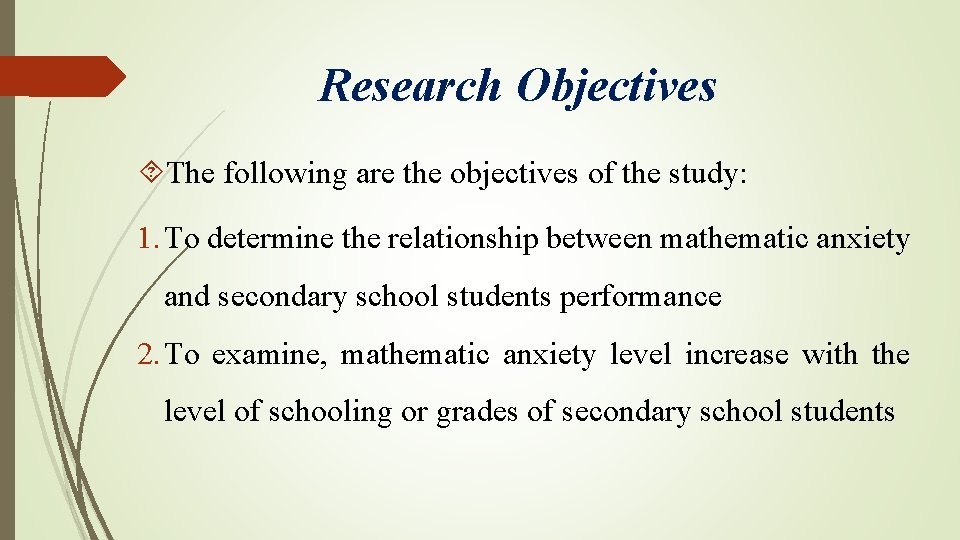
Research Objectives The following are the objectives of the study: 1. To determine the relationship between mathematic anxiety and secondary school students performance 2. To examine, mathematic anxiety level increase with the level of schooling or grades of secondary school students
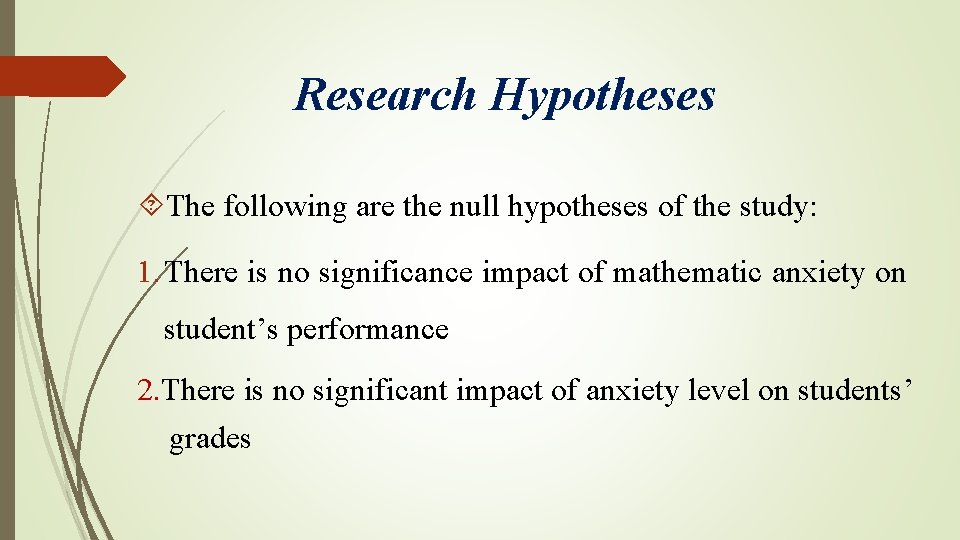
Research Hypotheses The following are the null hypotheses of the study: 1. There is no significance impact of mathematic anxiety on student’s performance 2. There is no significant impact of anxiety level on students’ grades
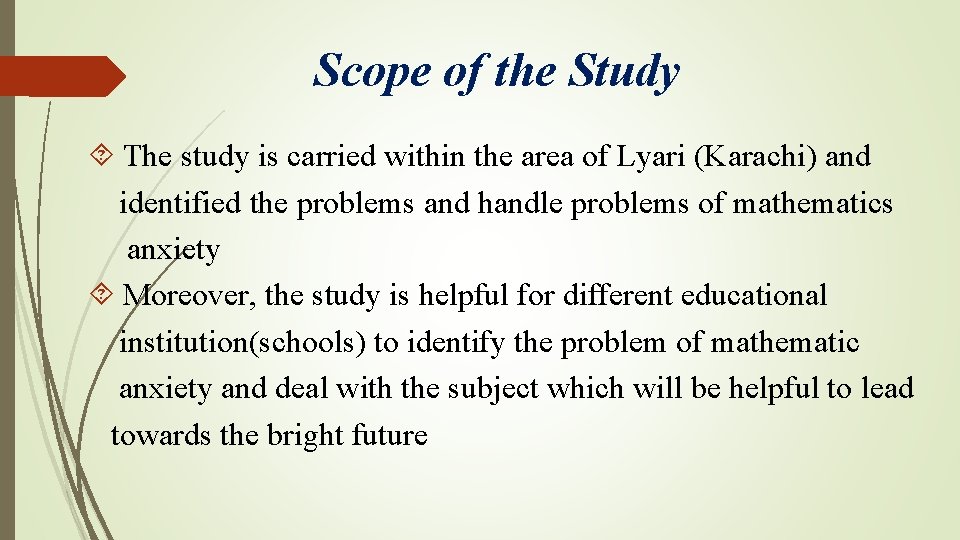
Scope of the Study The study is carried within the area of Lyari (Karachi) and identified the problems and handle problems of mathematics anxiety Moreover, the study is helpful for different educational institution(schools) to identify the problem of mathematic anxiety and deal with the subject which will be helpful to lead towards the bright future
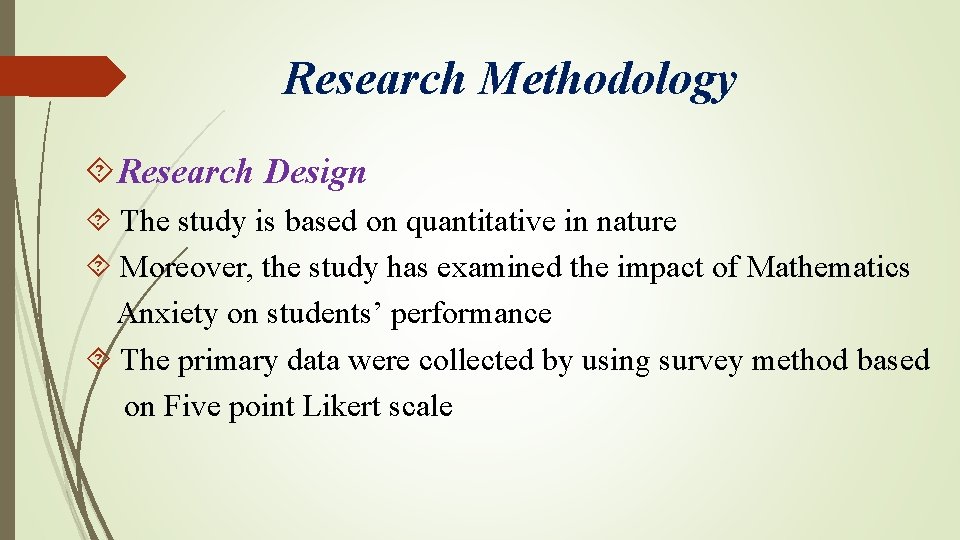
Research Methodology Research Design The study is based on quantitative in nature Moreover, the study has examined the impact of Mathematics Anxiety on students’ performance The primary data were collected by using survey method based on Five point Likert scale
Population & Sampling The population of the study was students of X class from public secondary schools of Lyari (Karachi) region The study was carried by convenient sampling, and through convenience sampling data were easily collected The sample size of the study was 70 students of public secondary schools of X class The sample size was equally divided in to 35 boys and 35 girls’ students of different schools
Data Collection The data was collected by using questionnaire Questionnaire was designed and piloted for reliability and validity Samples used for piloting were 10 and was not included with the sample population Reliability was calculated through Cronbach Alpha (. 78), and validity was through expert opinion
Data Analysis Questionnaire tool was used for collecting data, students questionnaire was used as instrument for the collection of data, and student questionnaire adapted from Likert Scale The data was analyzed by using SPSS by applying Regression and percentage on collected data in order to draw an appropriate information based on authentic conclusion on Mathematics Anxiety and its impact on Students’ Performance
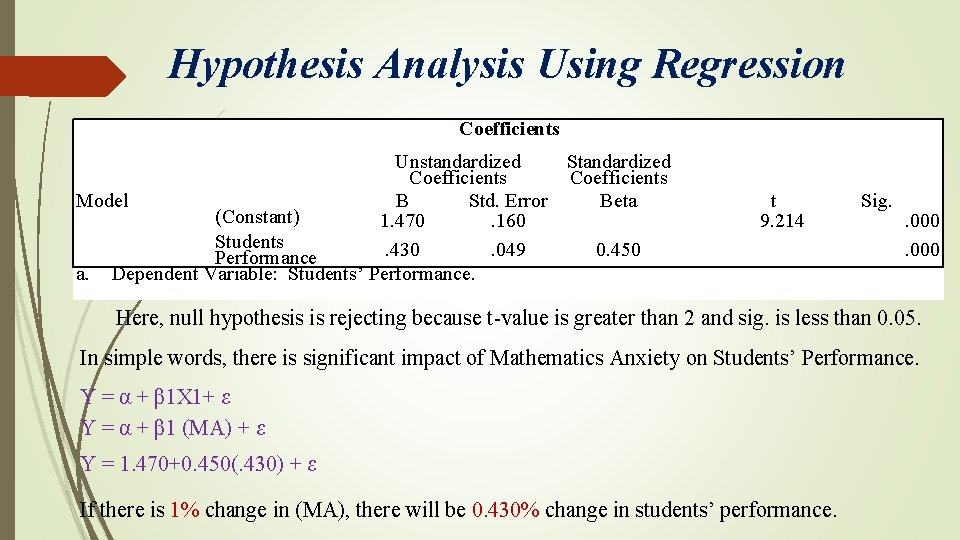
Hypothesis Analysis Using Regression Coefficients Unstandardized Standardized Coefficients Model B Std. Error Beta (Constant) 1. 470. 160 Students. 430. 049 0. 450 Performance a. Dependent Variable: Students’ Performance. t 9. 214 Sig. . 000 Here, null hypothesis is rejecting because t-value is greater than 2 and sig. is less than 0. 05. In simple words, there is significant impact of Mathematics Anxiety on Students’ Performance. Y = α + β 1 X 1+ ε Y = α + β 1 (MA) + ε Y = 1. 470+0. 450(. 430) + ε If there is 1% change in (MA), there will be 0. 430% change in students’ performance.
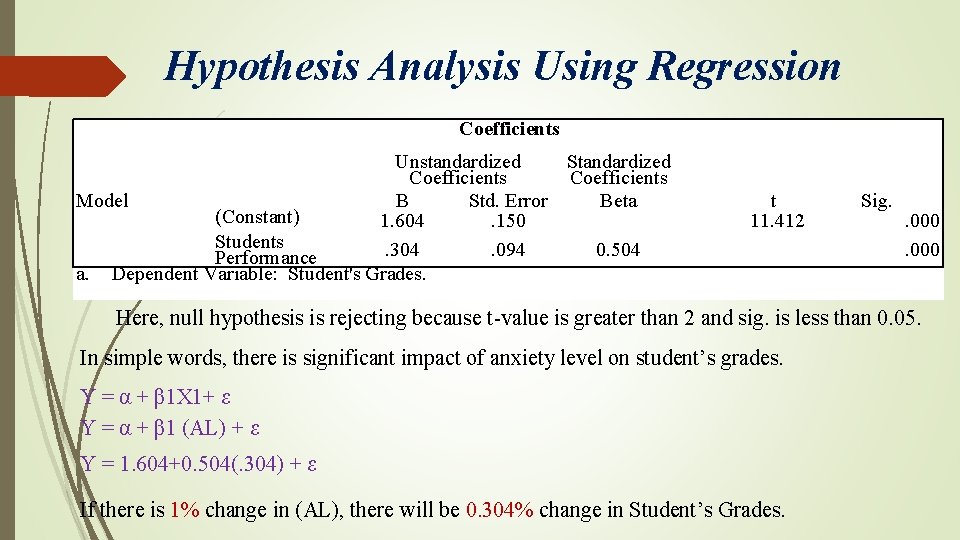
Hypothesis Analysis Using Regression Coefficients Unstandardized Standardized Coefficients Model B Std. Error Beta (Constant) 1. 604. 150 Students. 304. 094 0. 504 Performance a. Dependent Variable: Student's Grades. t 11. 412 Sig. . 000 Here, null hypothesis is rejecting because t-value is greater than 2 and sig. is less than 0. 05. In simple words, there is significant impact of anxiety level on student’s grades. Y = α + β 1 X 1+ ε Y = α + β 1 (AL) + ε Y = 1. 604+0. 504(. 304) + ε If there is 1% change in (AL), there will be 0. 304% change in Student’s Grades.
Conclusion Mathematics anxiety depletes or reduce mathematics related performance or achievement of students In other words, mathematics anxious individuals are unable to perform well in mathematics On the other hand, it is further concluded that mathematics anxiety increase with progress of students into another class level and there will be effect on progress of grade/class of students due to mathematics anxiety
Conclusion Whereas, it was tried to highlight the causes behind mathematics anxiety, it can be predicted that students were unable to agree or come up with single statement as there was high ration of students’ disagreement on approximately every statement But yet the most agreed cause by the student was “burden of assignment and test create anxiety and fear of mathematics”
Recommendations Teachers are advised to identify the symptoms of mathematics anxiety such as fear of anxiety, failed in development of confidence and failure in knowledge and understanding, bodily symptoms such as fast heartbeat, shivering in whole body, fainting etc. Teachers are advised to use Positive reinforcement and problem-based learning strategies are considered best strategies to control the negative behavior of the students towards mathematics
References • Mutodi, P. (2014). Exploring Mathematics Anxiety: Mathematics Students’ Experiences, 5(1), 283– 294. https: //doi. org/10. 5901/mjss. 2014. v 5 n 1 p 283 • Pletzer, B. , Kronbichler, M. , & Nuerk, H. (2015). Mathematics anxiety reduces default mode network deactivation in response to numerical tasks, 9(April), 1– 12. https: //doi. org/10. 3389/fnhum. 2015. 00202 • Zakaria, E. , & Nordin, N. M. (2008). The effects of mathematics anxiety on matriculation students as related to motivation and achievement. Eurasia Journal of Mathematics, Science and Technology Education, 4(1), 27– 30. https: //doi. org/10. 12973/ejmste/75303