
The Impact of EU Economic Partnership Agreements EPAs











- Slides: 46
The Impact of EU Economic Partnership Agreements (EPAs) on the African regional integration agenda A Time for reality check in the Eastern and Southern African region. by Charles Edward Minega Eduardo Mondlane University (UEM) Saint‐Denis, 28 th September 2018
Conférence Internationale Pluridisciplinaire Les Accords de Partenariat Economique (APEs) dans l’Océan Indien THE ECONOMIC PARTNERSHIP AGREEMENTS (EPAs) IN THE INDIAN OCEAN Saint Denis, Réunion 27 – 28 September 2018
Presentation Outline Introduction The landscape of RI in Eastern and Southern Africa (ESA) The Importance of EPAs for ESA Economies Mapping the gaps in EPAs for African Development Harnessing EPAs Benefits for Deeper RI in ESA Region Conclusion
“It has become quite clear from our frank discussions that the two years of regional negotiations have generated very little tangible outputs particularly as related to the two areas of critical interest to the ACP regions and countries, namely the development dimension of EPAs and the support for regional integration processes”’ John Kaputin, ACP Secretary General
“EPAs must grant an appropriate degree, timing and pacing of market opening for the ACP States. This is necessary to attenuate the costs of liberalization that would otherwise be substantial, given the level of current tariffs, importance of the EU as a major trading partner, and the significance of tariffs as a source of government revenue and instrument for industrial development, for many of the ACP States”. ACP - Khartoum Declaration - Issued by the 5 th Summit of ACP Heads of State and Government
“EPAs make concessions to Europe more than we are making to the rest of the world in the WTO Doha Round. To make poverty history, you have to also make EPAs history. ” Dr Mukhisa Kituyi, Secretary general UNCTAD (and Former Kenyan Trade Minister)
Introduction
Introduction ‐ Context ‐ The economic growth and development of ACP states is heavily dependent upon their enhanced, effective and more qualitative integration into the global trading system, i. e. beyond their access to EU market. ‐ Their main formidable challenges entail the current marginalization of ACP States in the global trade. ‐ Most ACP States are faced with inherent structural and infrastructural constraints, most depend on commodity exports and to traditional trading partners. ‐ ACP countries are convinced that their development promise and new trade opportunities of WTO Doha Round have dissipated with uncertainties unfolding from the EPAs implementation. Industrialization has become an issue.
Introduction ‐ Background ‐ For the purpose of EPAs negotiations, the 5 African regional groups are organized as follows: (1) West Africa (ECOWAS), (2) Central Africa, (3) East African Community (EAC), (4) Eastern and Southern Africa (ESA), and (5) Southern African Development Community (SADC). ‐ As per negotiations rules, each EPA requires the signature of all the contracting parties in each region before it can be ratified. Without the endorsement of all the parties to an EPA, it is, legally, effectively “dead” as it won’t enter into force. This has a critical impact on the RI agenda.
Introduction - Key Issues ‐ Key Issues in the ACP / Africa ‐ EU partnership: ‐ The Shifting strategic approaches and interests: the gradual enlargement of the EU and admission of new members has drastically changed the EU attitude towards the ACP countries (emerging competing powers). ‐ While the reality of the outcome from EU ‐ British ongoing on BREXIT negotiations sets in, the probability of EPAs renegotiation process becomes a heated debate. ‐ As the fourth industrialization becomes a key mantra for the future trade partnerships worldwide, African LDCs countries appear more interested in new innovative global relations which can recognize the value of natural assets and development ‐ based economic partnerships.
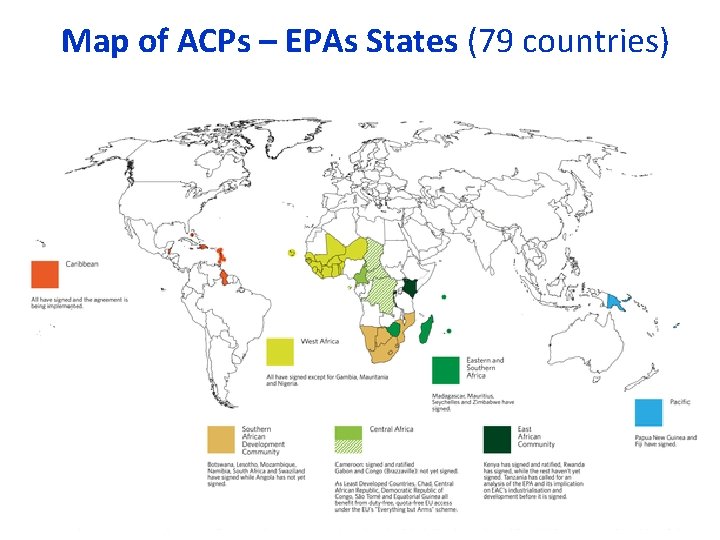
Map of ACPs – EPAs States (79 countries)
The Landscape of Regional Integration in Eastern and Southern Africa (ESA)
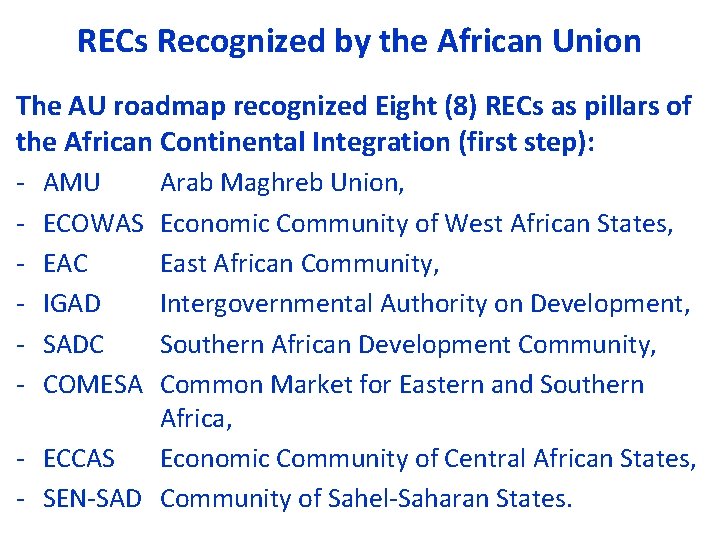
RECs Recognized by the African Union The AU roadmap recognized Eight (8) RECs as pillars of the African Continental Integration (first step): ‐ ‐ ‐ AMU ECOWAS EAC IGAD SADC COMESA Arab Maghreb Union, Economic Community of West African States, East African Community, Intergovernmental Authority on Development, Southern African Development Community, Common Market for Eastern and Southern Africa, ‐ ECCAS Economic Community of Central African States, ‐ SEN‐SAD Community of Sahel‐Saharan States.
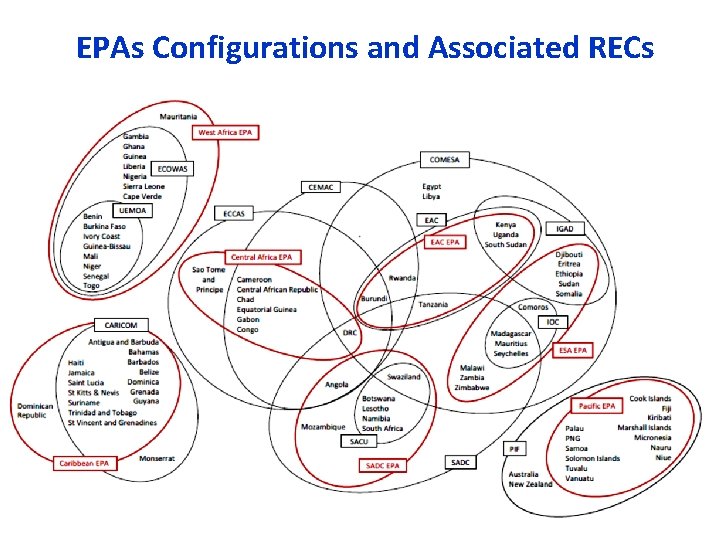
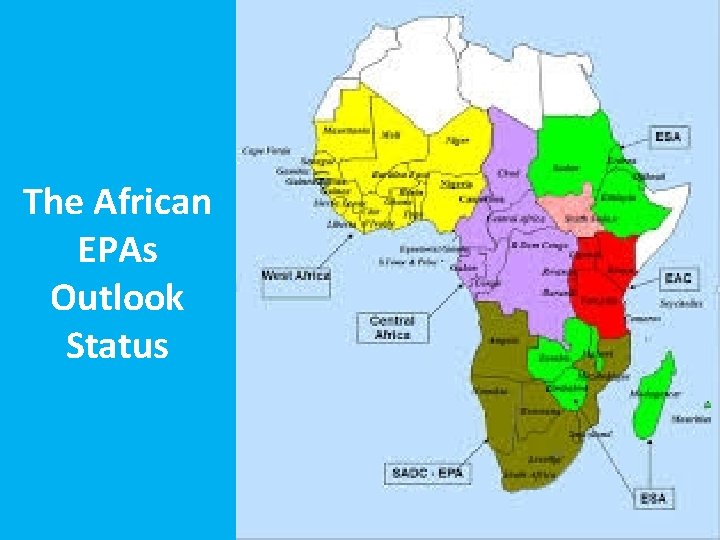
EPAs Configurations and Associated RECs
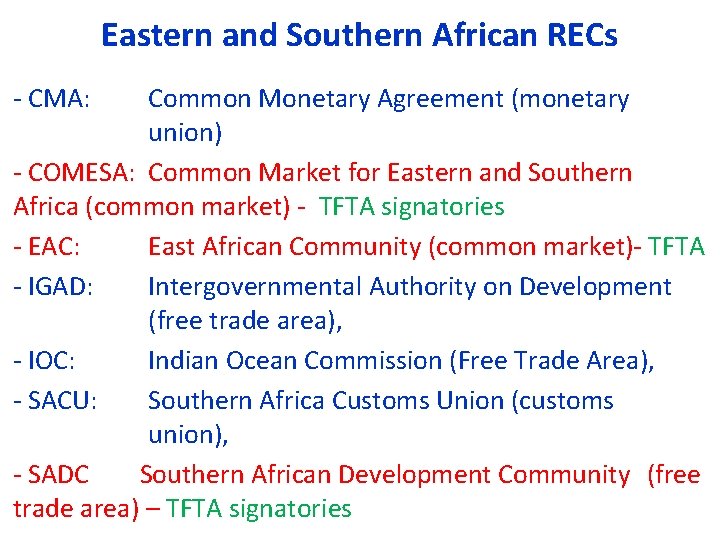
Eastern and Southern African RECs ‐ CMA: Common Monetary Agreement (monetary union) ‐ COMESA: Common Market for Eastern and Southern Africa (common market) ‐ TFTA signatories ‐ EAC: East African Community (common market)‐ TFTA ‐ IGAD: Intergovernmental Authority on Development (free trade area), ‐ IOC: Indian Ocean Commission (Free Trade Area), ‐ SACU: Southern Africa Customs Union (customs union), ‐ SADC Southern African Development Community (free trade area) – TFTA signatories
The EPAs Outlook is a Mismatch of RECs ‐ The current EPAs negotiations have led to a deep mismatch as compared with the existing AU recognized RECs, thus leading to a disruption of the RI Agenda. ‐ Diverging interests amongst EPAs countries LDCs and non ‐LDCs) on key priorities cannot enable a development‐led agenda to achieve the expectations as per the current multilateral based and WTO‐led order. ‐ African countries in the Eastern and Southern African region have expressed strong concerns which are not being fulfilled by the current EPAs outcomes; the resulting vacuum is a recipe for glare failures if not addressed during the final negotiations of the EPAs frameworks; the BREXIT process might even deepen this.
The African EPAs Outlook Status
The Importance of EPAs for Eastern and Southern African Economies
Objectives of the EPAs ‐ From the EU’s perspective, the EPAs’ overarching objective is to provide a means for continued duty‐free quota‐free (DFQF) market access into the EU to the African, Caribbean and Pacific (ACP) groups of countries, consistent with the parties’ obligations under the rules of the World Trade Organization (WTO).
Importance of the EPAs for ESA Countries ‐ Although least developed countries (LDCs) currently obtain DF ‐ QF access consistent with WTO rules, the EU contends that the only way to continue to provide such access to developing countries, like Kenya (which are not “least developed ‐ LDCs”), is to enter into the reciprocal EPAs, where both parties undertake to liberalize and reduce their import tariffs under GATT Article XXIV.
The Parties to the EPAs ‐ The Preamble of the EPA lists the 28 EU member states individually, and the EU itself as signatories to the EPA agreement. ‐ The territorial application clause clarifies that the EPA agreement shall apply only to the territories where the Treaty on the European Union (TEU) and Treaty on the Functioning of European Union (TFEU) apply. ‐ Therefore, when the UK ceases to be a member of the EU, the TEU and TFEU will no longer apply to the UK, and, consequently, the EU‐ACPs EPAs will no longer be applicable to the territory of the UK.
The Parties to the EPAs ‐ The Preamble of the EPA lists the other contracting parties as the members of the regional block signatories to the EPAs (i. e. EAC, ESA and SADC regions). ‐ A close reading of the preamble suggests that the EAC and SADC (or COMESA) in their institutional capacity are not signatories to the EPAs. Instead each individual EAC /SADC and ESA block Partner State is a signatory. ‐ Any party can withdraw from the EPA agreement anytime even after ratification of the EPA.
Mapping the gaps in EPAs Frameworks for African Development
Strong Mismatch between EPAs and RECs ₋ A common perception, as expressed by many countries, is that there is little coherence between the EPA agenda and the regional integration processes in Africa. ₋ One particular concern has been that countries in the same economic region might liberalise different baskets of products and so create new barriers to intra‐regional trade in order to avoid trade deflection. ₋ This concern has been vindicated by the interim EPAs that have been agreed.
African opposition to the Economic Partnership Agreements (EPAs) “Echec du Volet Développement et Integration Régionale des APEs” Mr. Bruno Millot (Les Conseillers du Comerce Exterieur de la France-CCEF)
Brexit and the “Trojan Horse Syndrome” ₋ African opposition to the EPAs with the EU has been based on the perceived overall negative impact of the EPAs on the development prospects of the continent ₋ A key objective of the EUpartnersip agreements as identified in the Cotonou Agreement of 2000, is to help Africa’s development efforts. ₋ The ongoing EPAs negotiations have failed to sustain the regional and continental integration agenda and specific expectations (e. g. The IOC countries: Réunion, Mauritius and Madagascar)
Reluctance to the “Pacta Sunt Servanda” ₋ Only in the case of EAC have all members joined the EPA and accepted identical liberalization schedules. If these are implemented fully and in a timely way economic integration will have been reinforced in that sub‐region. ₋ Those Eastern and Southern Africa (ESA) countries and the five Southern Africa Development Community sub‐group (SADC‐minus) states that have initialled, have done so to single agreements, but there is considerable dissimilarity in the country liberalization schedules and exclusion baskets (e. g. SA, BNLS and Mozambique)
Uncertainty over the Brexit negotiations outcome and subsequent consultations / Eventual Renegotiations
Brexit and the “Trojan Horse Syndrome” ₋ The UK Referendum on EU of June 2016 and the subsequent Brexit negotiations came as a reminder of the old “trojan horse” allegations from the old “Gaullist” suspicions. ₋ Britain became a member of the EEC through a Treaty of accession signed in Brussels on 22 January 1972 and came into force in January 1973, ₋ The Treaty’s Protocol 22 allowed commonwealth LDCs territories to come in as “associables” into preferential access to EEC, pushing further for the creation of the ACP group.
Harnessing EPAs Benefits for Deeper Integration in the Eastern and Southern African Region
EU - EPAs Entail real benefits ₋ Preferential Market (DF ‐ QF) access, ₋ Better and clear Rules of origin provisions ₋ Progressive liberalization and removal of trade barriers within reasonable timelines: benefit under the WTO “enabling clause”, ₋ Safeguard measures / provisions, ₋ Access to EDF Funding for specific projects, ₋ Potential for enhanced EU ‐ ACP trade exchanges, ₋ Preferential Treatment for LDCs and nascent, industries within ACP ‐ EPA states,
Key priority sectors ₋ Building Capacity for national institutions, regional and continental integration (CFTA) and the African Union vision towards 2060, ₋ Promote regional and continental investment / industrialization master plans, ₋ Financing mechanisms to link Research, Technology and Innovation (Tech ‐ Hubs) in RECs; ₋ Emphasis on Public /Private Investments in Industrial Revolution services Infrastructures; ₋ Enhance support for Entrepreneurship and Local Innovation within economic operators.
Key priority sectors ₋ Promote regional Tech – Hubs for the implementation of intra‐regional trade and export based industries (agriculture, fisheries, manufacture, etc. ) ₋ Investments in blue economy development, ₋ Transfer of technology and know how from EU developed countries to African ACPs, ₋ Enhance support for Entrepreneurship and Local Innovation / community based Support Services, ₋ Priority support for the African CFTA and TFTA
Conclusion
Concluding Remarks ‐ The EU‐ACP relations cannot effectively advance the notion of global free trade if the concept is not coupled with the requirements of human development and social responsibility. ‐ The European model combines market economy and social responsibility: the trade agenda encompassing the EU and the ACP States need to keep this basic values to gain legitimacy through the recognition of human and social development. ‐ Private market actors are the key drivers of free trade and policy frameworks and regulatory mechanisms need to ensure human dignity and social cohesion.
Concluding Remarks ‐ In the modern knowledge‐based and globalized economy, innovation and technology are main key contributing factors to economic development, ‐ Innovation and technology led societies create more jobs, attract foreign currencies, investment and are able to build new infrastructure. ‐ The EU‐ACP frameworks need to emphasize more this innovation and technology dimensions, to support and enhance research focused industry‐academic partnerships and the development of Intellectual Property rights for trade development in African ACP beneficiaries states.
Building a New Trade Relationship ‐ The EU and African ACP trade partnerships need to go beyond the WTO norms (WTO+) to promote inclusive multilateral solutions for the development of free trade agreements, unblock barriers and trade prejudices among industrial and LDCs emerging economies. ‐ The EU‐African ACP should step out of the shadow of the old fashioned colonial era paranoia over Cotonou Agreement and Economic Partnership Agreements (EPAs) and embrace a new era of partnership paving the way for long term perspective which can end the obsession of political actors and civil society.
Building a New EU - Africa Trade Relationship Framework ‐ The way Forward ‐ The new EU‐Africa ACP States partnership should be based on a shifting paradigm over a long term perspective towards the 2060 AU vision in a multipolar world trade environment and mature into a fully fledged multi ‐ regional association based on a comprehensive, innovative and attractive agenda encompassing development.
Promoting Innovative solutions and Industrial development ‐ As the African Countries prepare to embrace the fourth industrial revolution, the EU‐Africa ACP States partnership need to focus on innovation and activate existing potential in the transformation of natural resources, the engagement with business communities and be instrumental in promoting investments, technology transfer solutions such as the futurist “reverse innovation” concepts.
Recommendations The EU‐ACP negotiations should base the new partnerships on existing / effective RECs ‐ introduce more flexibility Promote industrial and technology ‐ based partnerships Provide adequate support for development solutions Involve industrial ‐ based investment and private actors Harnessing Innovative Research for Development IP/ Patents Establish practical mechanisms for “reverse technology”
References ‐ Babarinde, F. , 2008. Regionalism and Economic Development in Nnadozie, Emman‐uel 2008, African Economic Development, Emerald. ‐ Bilal S. and Stevens C. (Editors). 2009. The Interim Economic Partnership Agreements between the EU and African States: Contents, challenges and prospects (ECDPM Policy Management Report 17). Maastricht, ECDPM. ‐ Centre for Conflict Resolution CCR. 2014. Region‐Building and Regional Integration in Africa, Policy Research Seminar Report, Cape Town, South Africa, October 2014. ‐ Kühnhardt Ludger. 2014. Africa Consensus: New Interests, Initiatives and Partners, Baltimore, Johns Hopkins University Press.
References ‐ Kühnhardt Ludger. 2016. Maturing beyond Cotonou: An EU‐ACP Association Treaty for Development. A Proposal for Reinventing EU relations with the African, Caribbean and Pacific (ACP) Group of States, ZEI Discussion Paper C 235, Bonn. ‐ Mevel, S, Valensisi G. and Karingi S. 2015. The Economic Partnership Agreements and Africa’s integration and transformation agenda: the cases of West Africa and Eastern and Southern Africa regions, Presentation at the 18 th Annual Conference on Global Economic Analysis, Melbourne, Australia, 17‐ 19 June, 2015.
References ‐ Milner, Morrissey and Mc. Kay, 2007, Some Simple Analytics of the Trade and Welfare effects of Economic Partnership Agreements", Journal of African economies, Volume 14, No. 3, pp. 327‐ 358. ‐ Scollay, R. 2002. Impact assessment of possible Economic Partnership Agreements with the EU”, Report for ACP secretariat and the ACP Pacific states, draft. ‐ Tekere, M. and Ndlela, D. 2003. Impact assessment of Economic Partnership Agreements on Southern African Development Community and Preliminary Adjustment Scenarios, Final Report”, Trade and Development Studies Centre, Harare, Zimbabwe.
References ‐ United Nations Economic Commission for Africa UNECA. 2015. “Economic Report on Africa 2015: Industrializing through trade”, United Nations Economic Commission for Africa. Addis Ababa, ECA. ‐ United Nations Economic Commission for Africa UNECA. 2016. “Africa’s potential costs of not signing the Economic Partnership Agreements with the European Union”. Addis Ababa, ECA. ‐ United Nations Economic Commission for Africa ‐ UNECA. 2017. Assessing Regional Integration in Africa VIII ‐ Bringing the Continental Free Trade Area About, Addis Ababa. ECA.
Thank you for your attention. Merci ! Obrigado ! Asante Sana !
Centre of Studies on Regional Integration CEDIR Eduardo Mondlane University (UEM) Contact: +258 ‐ 849615543 / +258 ‐ 874658372 +258 ‐ 821427880 Email: charles. minega@gmail. com / charles. minega@uem. mz