
The Impact of Cooperative Grouping Exercises on Content
- Slides: 55
The Impact of Cooperative Grouping Exercises on Content Writing of 7 th Grade Life Science Students Action Research Presentation Prepared by Alexandra Sloane
Elkridge Landing Middle School Description � School › Elkridge Landing Middle School › 662 student capacity � Community Context › Located in Elkridge, MD in eastern Howard County › Residential with some commercial concentrations nearby along Washington Blvd (Rte. 1) › Median household income: $77, 000 � Academic Achievement › 2008: Met AYP in all areas.
Elkridge Landing Middle School Important School Characteristics � � ● � Strong Extracurricular Activities including band, chorus, orchestra, theater, dance and art Active Intramural program Strong Related Arts Program including family and consumer sciences, technology education, physical education, Spanish, French, art, health and music PBIS Gold School STEM (Science, Technology, Engineering, Math) School Professional Development Partnership with JHU
Elkridge Landing Middle School Important School Characteristics Educational Partnerships: Giant, Target, Pizza Hut, Safeway, T-Bonze Grille and Pub, Outback Steakhouse, and Wheels Skating Center � Health and Wellness Policy for School Lunches � Large Media Center including laptops, mobile labs, and desktops � Strong PTSA � Active School Improvement Plan � Green School Initiative �
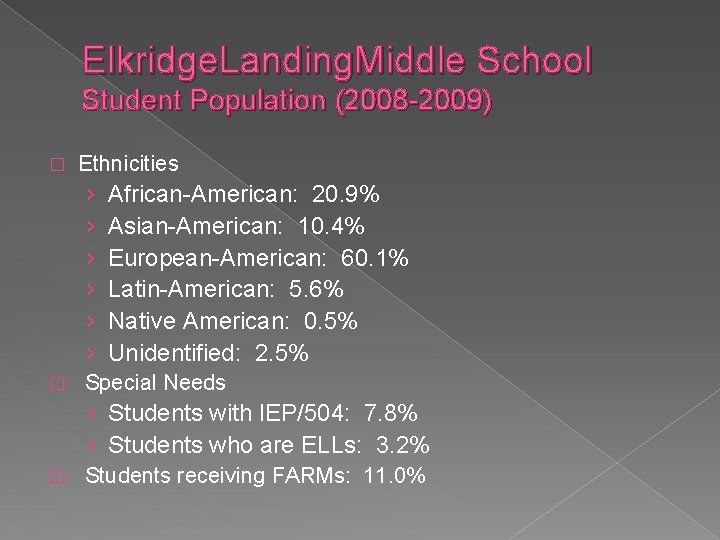
Elkridge. Landing. Middle School Student Population (2008 -2009) � Ethnicities › › › � African-American: 20. 9% Asian-American: 10. 4% European-American: 60. 1% Latin-American: 5. 6% Native American: 0. 5% Unidentified: 2. 5% Special Needs › Students with IEP/504: 7. 8% › Students who are ELLs: 3. 2% � Students receiving FARMs: 11. 0%
Student Participants � The students participating in this action research project are 7 th graders at Elkridge Landing Middle School � Students are participating through general education life science class � 3 of the 5 classes are inclusion classes � Students in all sections will benefit from integration of positive cooperative learning strategies
Rationale for Study � Middle school is a crucial time for the development of peer interaction skills � Success in science class requires effective, collaborative group work in laboratory and classwork activities � Students who successfully work well in groups will be able to gain a stronger understanding of the content material presented in class and labs
Rationale for Study � Prior to the intervention students were permitted to work with a partner of their choosing during classwork and labs. They were also free to work by themselves. � As a result, the reviewer has noted a rise in off task behaviors (disruptive, socializing, not following directions) during group activities. � Classwork and laboratory grades have not meet expectations.
This Study � Students ability to write meaningful constructed responses about content area does not meet grade level standards. � Positive cooperative grouping experiences may improve the quality of written work produced in classwork and labs.
Needs Assessment Cooperative grouping has been shown to be effective for many types of students. Effective grouping strategies help students develop social skills as well as gain a stronger understanding of content knowledge. � All classes consist of learners who are below grade level, on level, and a few students who are above level. � Cooperative grouping can benefit all groups of students, especially our high percentage of students with special needs. �
School Improvement Goals The School Improvement Plan States that All Students will perform on or above grade level in all content areas. This action research initiative will encourage students to improve their science content knowledge. This Action Research program will help prepare students for the MSA in science. It will also help raise the AYP scores for all students, particularly those of students receiving special education services.
Hypothesis How will the implementation of cooperative grouping strategies improve students’ ability to write more meaningful expressions of content knowledge? � I Hypothesize that cooperative learning activities will improve all content classwork activities. However, I expect the greatest impact will be in laboratory reports and classwork � Cooperative group should have the strongest positive impact on students with special needs and lower achieving students �
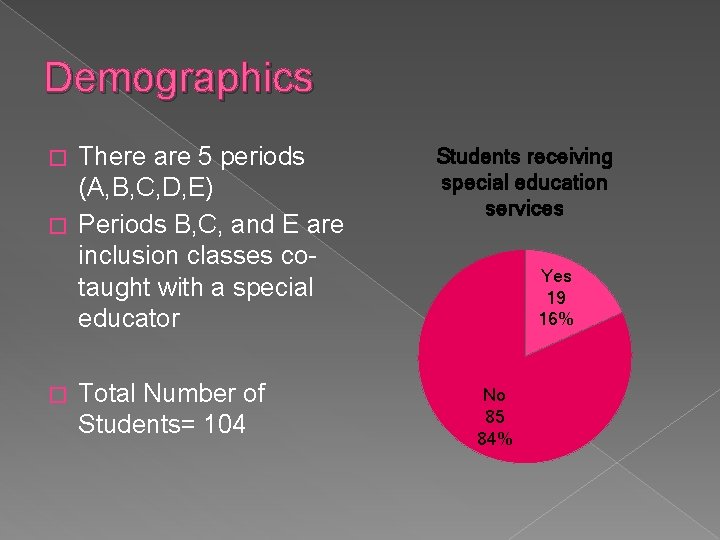
Demographics There are 5 periods (A, B, C, D, E) � Periods B, C, and E are inclusion classes cotaught with a special educator � � Total Number of Students= 104 Students receiving special education services Yes 19 16% No 85 84%
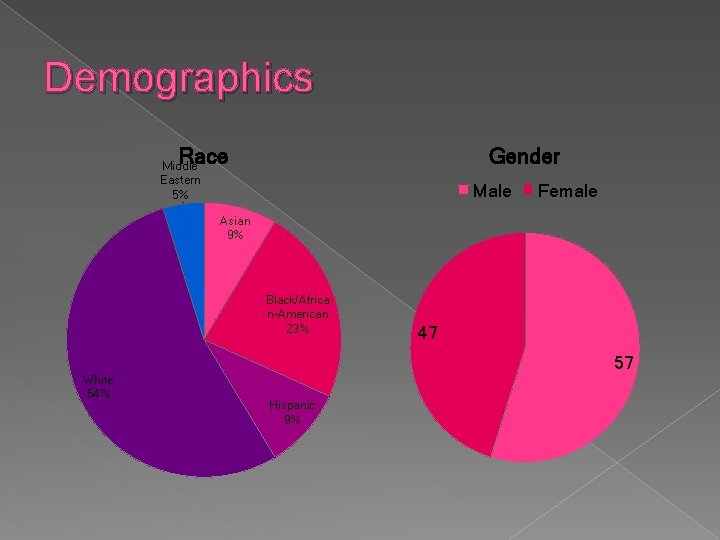
Demographics Race Gender Middle Eastern 5% Male Female Asian 9% Black/Africa n-American 23% White 54% 47 57 Hispanic 9%
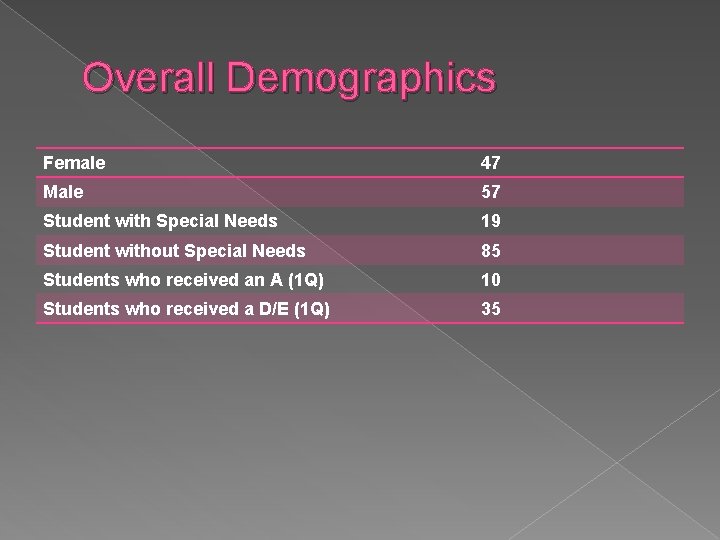
Overall Demographics Female 47 Male 57 Student with Special Needs 19 Student without Special Needs 85 Students who received an A (1 Q) 10 Students who received a D/E (1 Q) 35
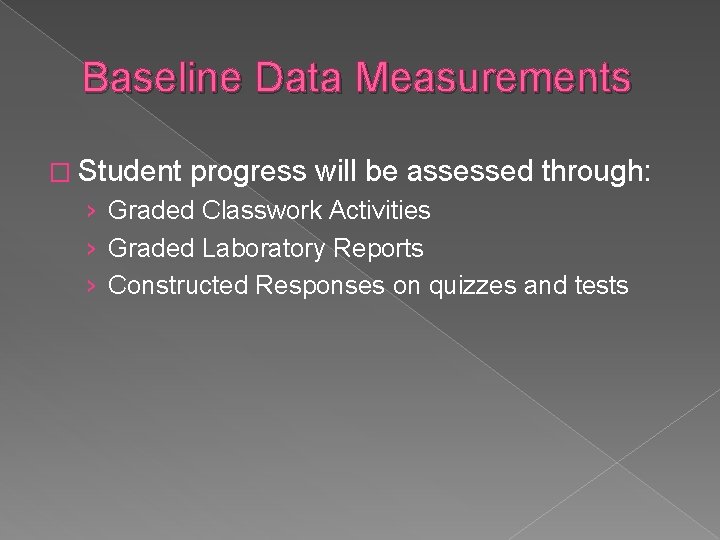
Baseline Data Measurements � Student progress will be assessed through: › Graded Classwork Activities › Graded Laboratory Reports › Constructed Responses on quizzes and tests
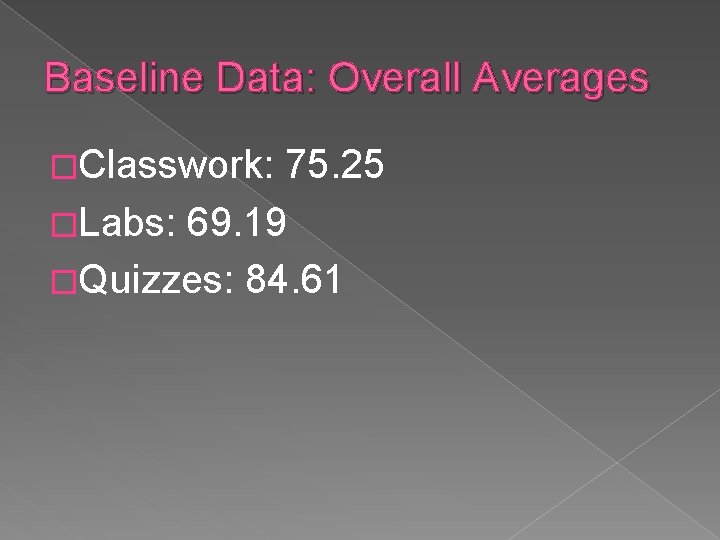
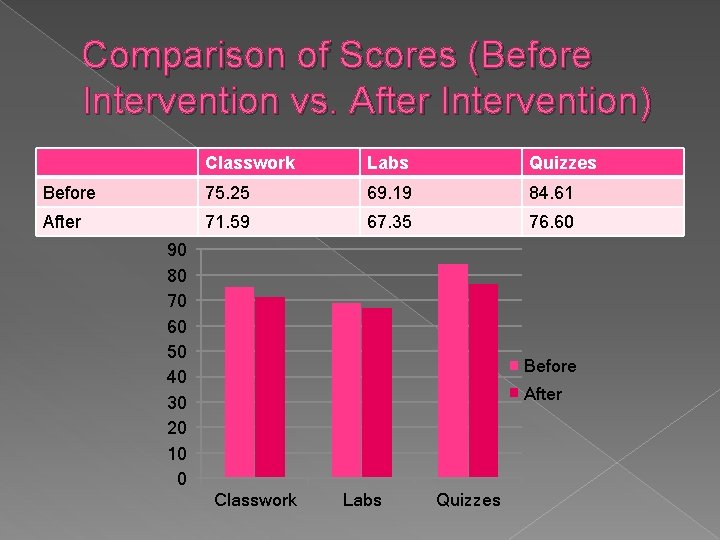
Baseline Data: Overall Averages �Classwork: 75. 25 �Labs: 69. 19 �Quizzes: 84. 61
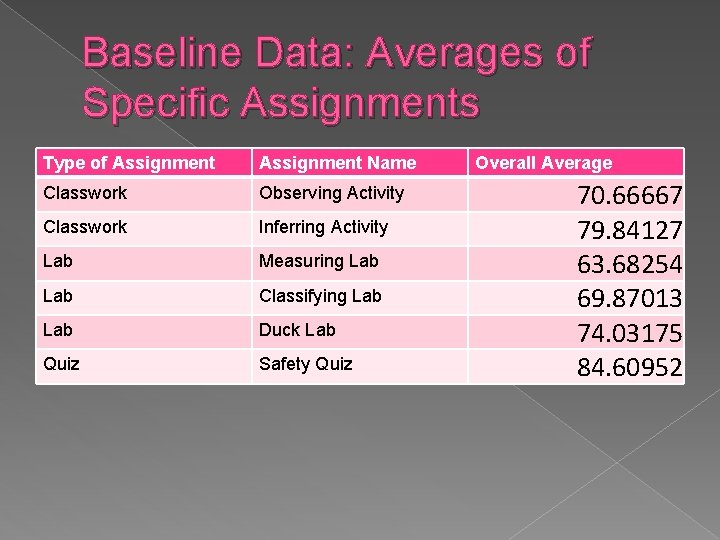
Baseline Data: Averages of Specific Assignments Type of Assignment Name Classwork Observing Activity Classwork Inferring Activity Lab Measuring Lab Classifying Lab Duck Lab Quiz Safety Quiz Overall Average 70. 66667 79. 84127 63. 68254 69. 87013 74. 03175 84. 60952
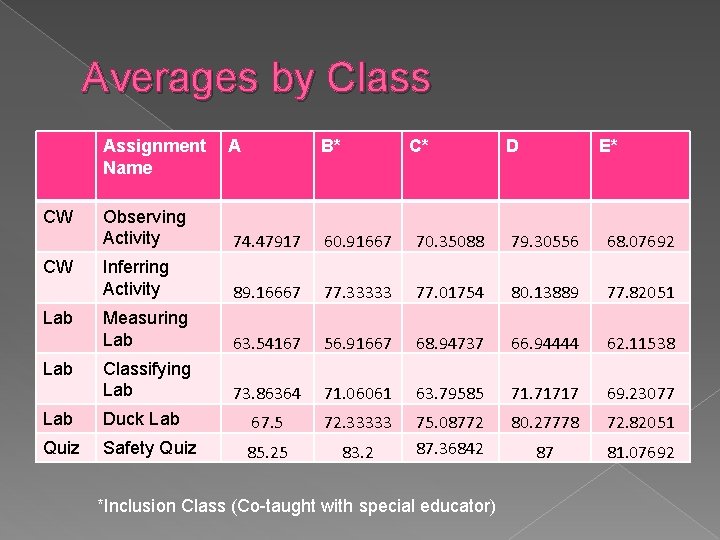
Averages by Class Assignment Name CW CW Lab A B* C* Observing Activity 74. 47917 60. 91667 70. 35088 79. 30556 68. 07692 Inferring Activity 89. 16667 77. 33333 77. 01754 80. 13889 77. 82051 Measuring Lab 63. 54167 56. 91667 68. 94737 66. 94444 62. 11538 Classifying Lab 73. 86364 71. 06061 63. 79585 71. 71717 69. 23077 75. 08772 87. 36842 80. 27778 72. 82051 87 81. 07692 Lab Duck Lab 67. 5 72. 33333 Quiz Safety Quiz 85. 25 83. 2 *Inclusion Class (Co-taught with special educator) D E*
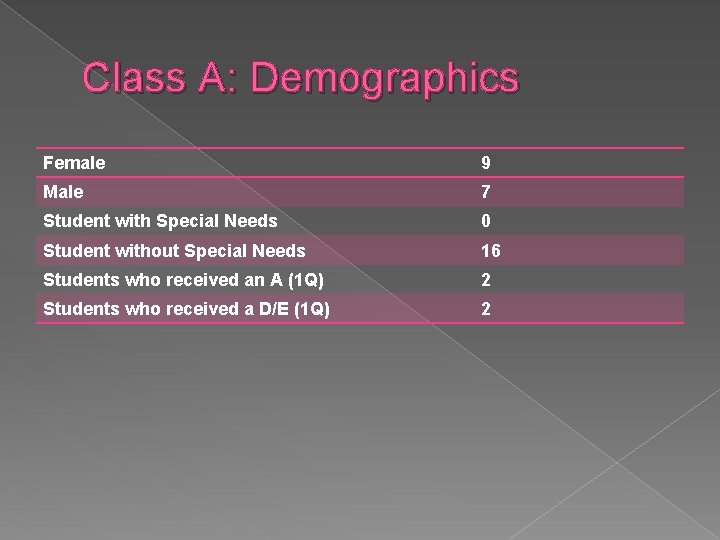
Class A: Demographics Female 9 Male 7 Student with Special Needs 0 Student without Special Needs 16 Students who received an A (1 Q) 2 Students who received a D/E (1 Q) 2
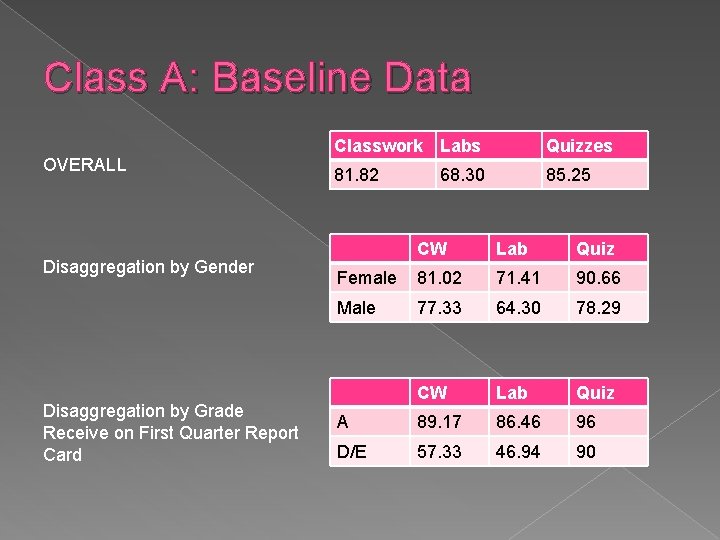
Class A: Baseline Data OVERALL Disaggregation by Gender Disaggregation by Grade Receive on First Quarter Report Card Classwork Labs Quizzes 81. 82 85. 25 68. 30 CW Lab Quiz Female 81. 02 71. 41 90. 66 Male 77. 33 64. 30 78. 29 CW Lab Quiz A 89. 17 86. 46 96 D/E 57. 33 46. 94 90
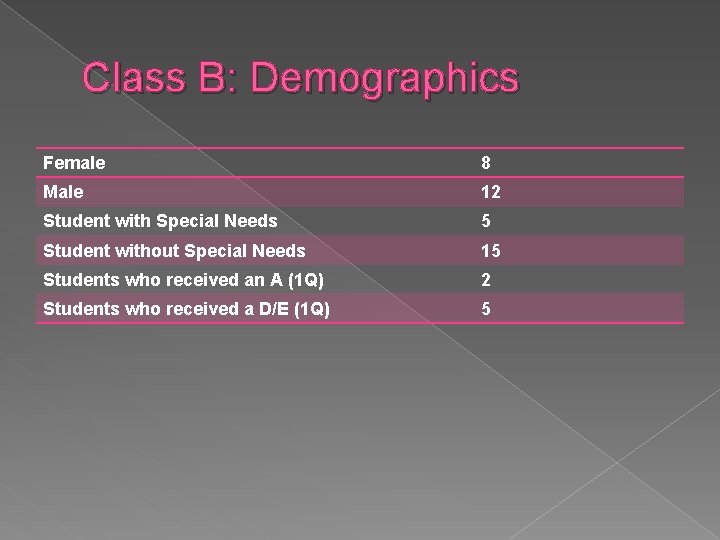
Class B: Demographics Female 8 Male 12 Student with Special Needs 5 Student without Special Needs 15 Students who received an A (1 Q) 2 Students who received a D/E (1 Q) 5
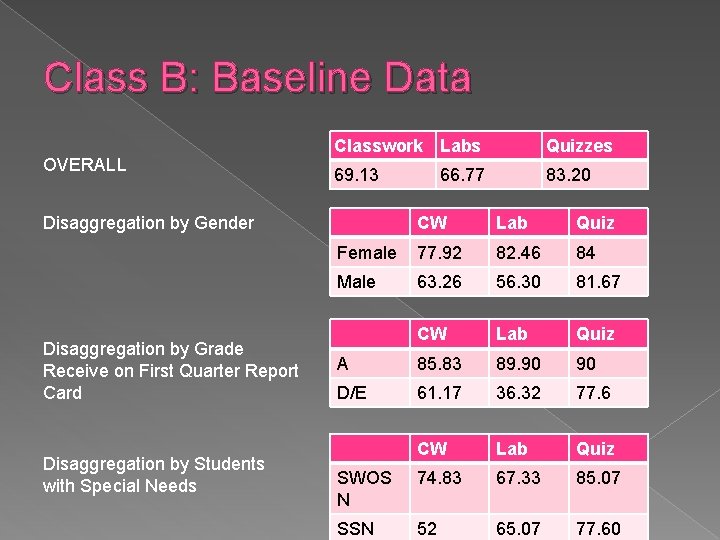
Class B: Baseline Data OVERALL Classwork Labs Quizzes 69. 13 83. 20 CW Lab Quiz Female 77. 92 82. 46 84 Male 63. 26 56. 30 81. 67 CW Lab Quiz A 85. 83 89. 90 90 D/E 61. 17 36. 32 77. 6 CW Lab Quiz SWOS N 74. 83 67. 33 85. 07 SSN 52 65. 07 77. 60 Disaggregation by Gender Disaggregation by Grade Receive on First Quarter Report Card Disaggregation by Students with Special Needs 66. 77
Support for Intervention Academic Support: Research based interventions
Mc. Cracken, P. (2005). Cooperative Learning as a Classroom Management Strategy. Momentum, 36(4), 10 -12. � Cooperative learning encourages students to emphasize their best rather than the best. Working together in groups helps provide active engagement and peer support while promoting achievement, critical thinking and creativity. Cooperative learning is crucial for developing positive peer communication skills. This can help improve students’ relationships and reduce conflict. To be effective, students should be placed in heterogeneous groups with equal opportunities to participate and individual accountability to the group. Rules and expectations should be clearly established.
Parr, R. (2007). Improving science instruction through effective group interactions. Science Scope, 31(1), 21 -23. � Cooperative grouping can be successful by establishing functional student groups. Students will remain with groups for 6 -9 weeks before being placed with a new group of peers. Expectations should be established (everyone participates, considerate behavior, etc. ) and they should be revisited regularly. Allowing students the responsibility to assign roles within their group will give them greater “buy into the process. ” The teacher should regularly promote the ideas of collaborate, agree, and record. This gives students the opportunity to discuss, work to reach agreement, and produce a product of their work. The teacher should help model these processes. Students should reflect on the process of cooperative grouping
Wood, B. S. (2009). Learning science while constructing learning teams. Journal of College Science Teaching, 38(5), 28 -32. � The author advocates incorporating cooperative grouping at all levels (including post secondary). In the author’s classroom, cooperative groups are established immediately upon entering the class for the first time. Groups are randomly assigned by a word on the back of the syllabus which introduces the content students will be learning in the class. For example, students who have words such as, Neuron, Spinal Cord, Brain, Nervous System, would have to find each other and determine that they are in a group together. Once the students have established groups, a cooperative learning activity immediately follows. This helps reinforce the bond among the group that will continue throughout the semester.
Intervention Implementation of Action Research Intervention Description of Cooperative Learning Lesson Plan
Description of Intervention � Students were placed into new seating arrangements based on their future cooperative partner/group. � We are allowing 2 weeks to account for any changes that must be made. � Students will be introduced to the need for stronger group work.
Intervention � � � I will present a 20 minute lesson on the effectiveness of working in a group including the steps: Collaborate, Agree, Record Students will be given the opportunity to establish expectations for group work as well as acceptable consequence for not meeting said expectations We will model appropriate behaviors during group work Students will be aware of the specific goal of improving their writing ability through peer work as well increasing their content knowledge understanding Students will reflect each well about their progress as a group We will review the group process throughout the intervention
Intervention � The intervention will address students with special needs as well as English Language Learners through working with groups of peers. � Students will participate in a lab activity in groups of 2 -3 immediately following the initial lesson
Intervention �A variety of grouping strategies will be used for group activities throughout the 6 week intervention. � Student behavior during activities will be qualitatively assessed and student writing will be assessed regularly quantitatively.
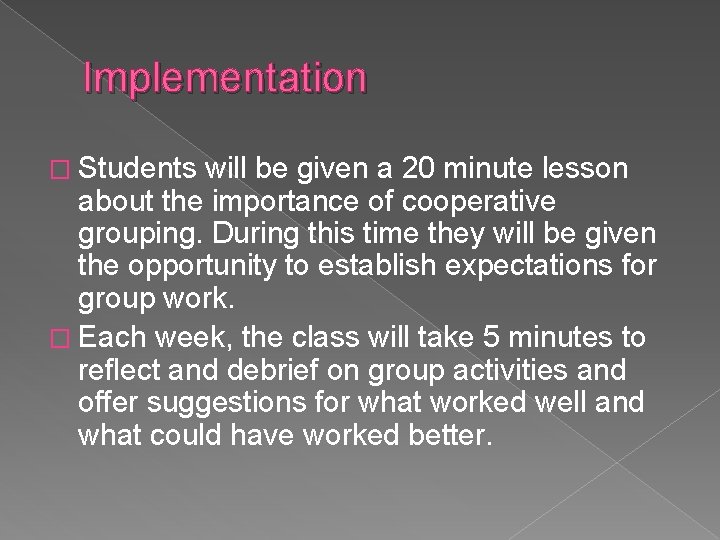
Implementation � Students will be given a 20 minute lesson about the importance of cooperative grouping. During this time they will be given the opportunity to establish expectations for group work. � Each week, the class will take 5 minutes to reflect and debrief on group activities and offer suggestions for what worked well and what could have worked better.
Data Post Intervention Data Collection Disaggregation of Data -Gender - Special Needs -Grade for First Quarter
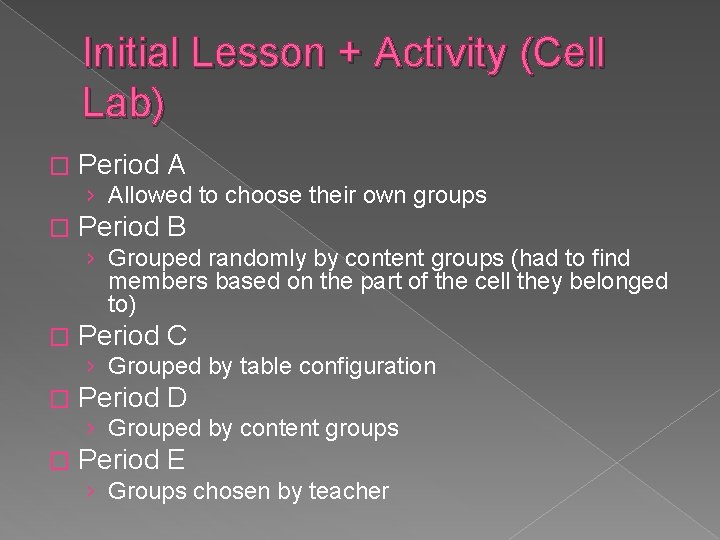
Initial Lesson + Activity (Cell Lab) � Period A › Allowed to choose their own groups � Period B › Grouped randomly by content groups (had to find members based on the part of the cell they belonged to) � Period C › Grouped by table configuration � Period D › Grouped by content groups � Period E › Groups chosen by teacher
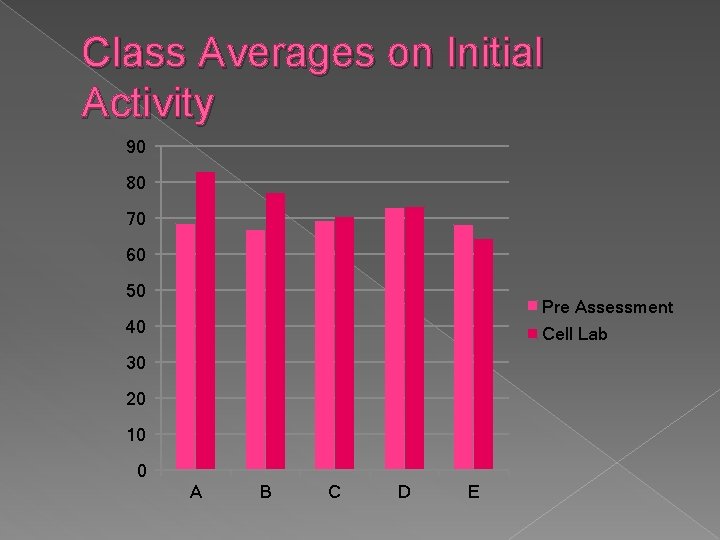
Class Averages on Initial Activity 90 80 70 60 50 Pre Assessment 40 Cell Lab 30 20 10 0 A B C D E
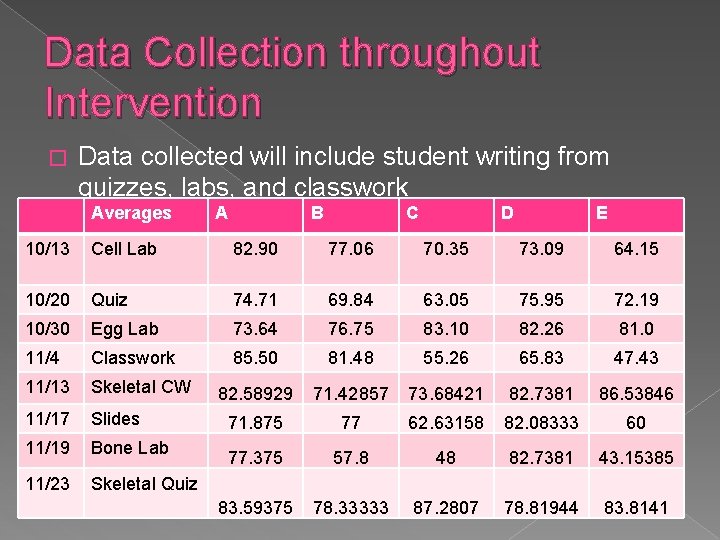
Data Collection throughout Intervention � Data collected will include student writing from quizzes, labs, and classwork Averages A B C D E 10/13 Cell Lab 82. 90 77. 06 70. 35 73. 09 64. 15 10/20 Quiz 74. 71 69. 84 63. 05 75. 95 72. 19 10/30 Egg Lab 73. 64 76. 75 83. 10 82. 26 81. 0 11/4 Classwork 85. 50 81. 48 55. 26 65. 83 47. 43 11/13 Skeletal CW 82. 58929 71. 42857 73. 68421 82. 7381 86. 53846 11/17 Slides 71. 875 77 62. 63158 82. 08333 60 11/19 Bone Lab 77. 375 57. 8 48 82. 7381 43. 15385 11/23 Skeletal Quiz 83. 59375 78. 33333 87. 2807 78. 81944 83. 8141
Comparison of Scores (Before Intervention vs. After Intervention) Classwork Labs Quizzes Before 75. 25 69. 19 84. 61 After 71. 59 67. 35 76. 60 90 80 70 60 50 40 30 20 10 0 Before After Classwork Labs Quizzes
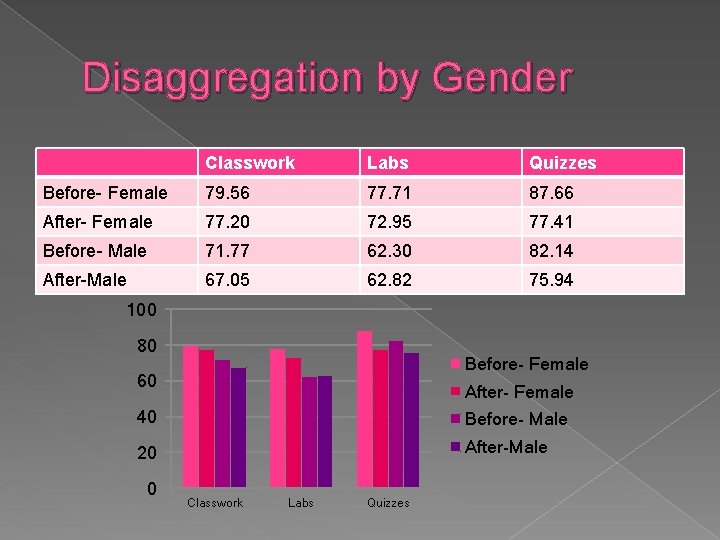
Disaggregation by Gender Classwork Labs Quizzes Before- Female 79. 56 77. 71 87. 66 After- Female 77. 20 72. 95 77. 41 Before- Male 71. 77 62. 30 82. 14 After-Male 67. 05 62. 82 75. 94 100 80 Before- Female 60 After- Female 40 Before- Male 20 After-Male 0 Classwork Labs Quizzes
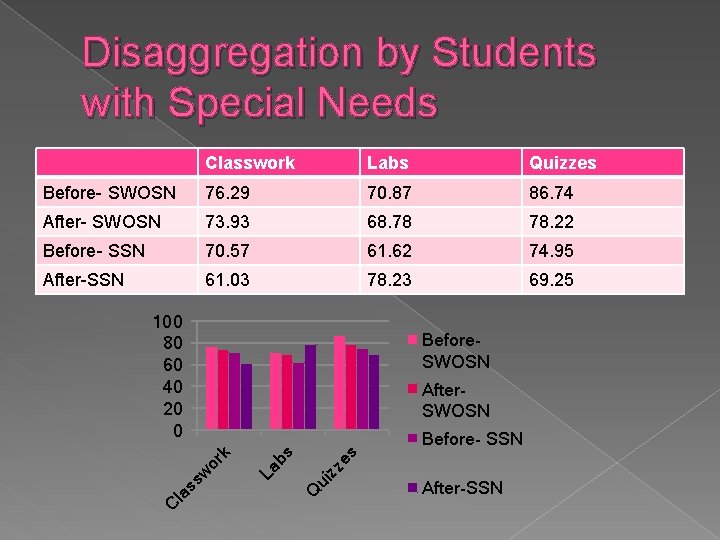
Disaggregation by Students with Special Needs Classwork Labs Quizzes Before- SWOSN 76. 29 70. 87 86. 74 After- SWOSN 73. 93 68. 78 78. 22 Before- SSN 70. 57 61. 62 74. 95 After-SSN 61. 03 78. 23 69. 25 100 80 60 40 20 0 Before. SWOSN After. SWOSN s ui zz e Q bs La C la ss w or k Before- SSN After-SSN
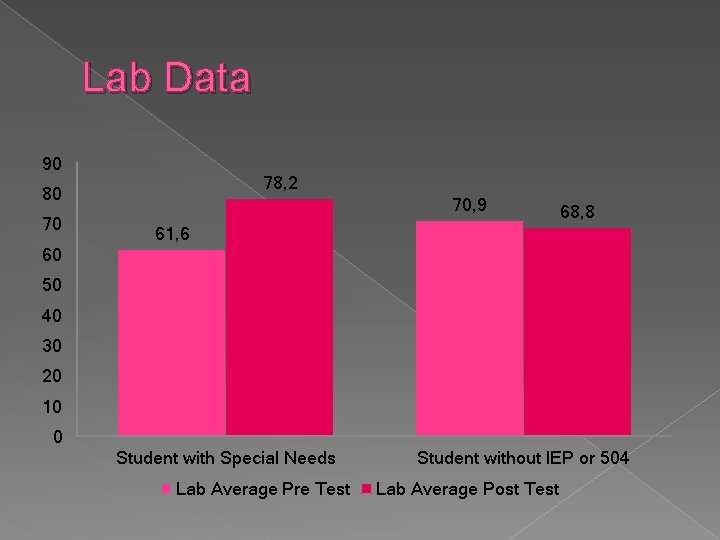
Lab Data 90 78, 2 80 70 70, 9 68, 8 61, 6 60 50 40 30 20 10 0 Student with Special Needs Lab Average Pre Test Student without IEP or 504 Lab Average Post Test
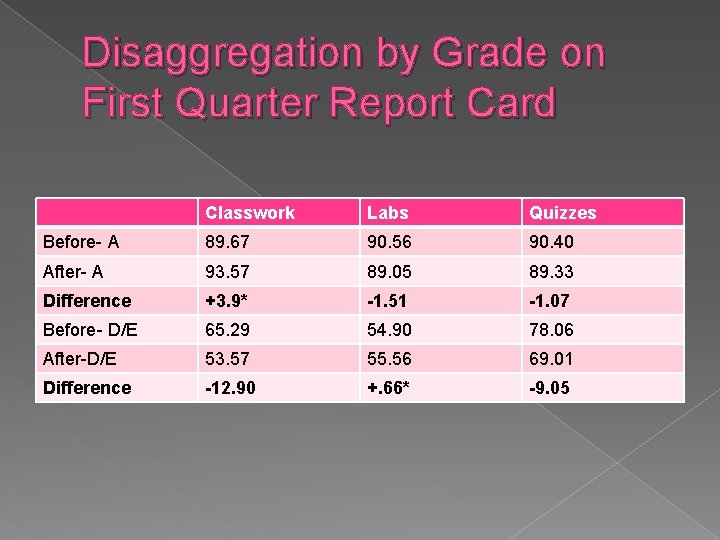
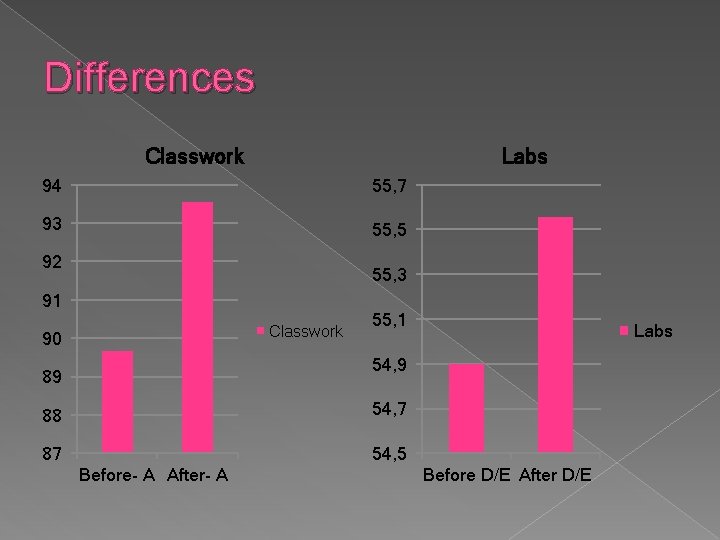
Disaggregation by Grade on First Quarter Report Card Classwork Labs Quizzes Before- A 89. 67 90. 56 90. 40 After- A 93. 57 89. 05 89. 33 Difference +3. 9* -1. 51 -1. 07 Before- D/E 65. 29 54. 90 78. 06 After-D/E 53. 57 55. 56 69. 01 Difference -12. 90 +. 66* -9. 05
Differences Classwork Labs 94 55, 7 93 55, 5 92 55, 3 91 Classwork 90 55, 1 Labs 54, 9 89 88 54, 7 87 54, 5 Before- A After- A Before D/E After D/E
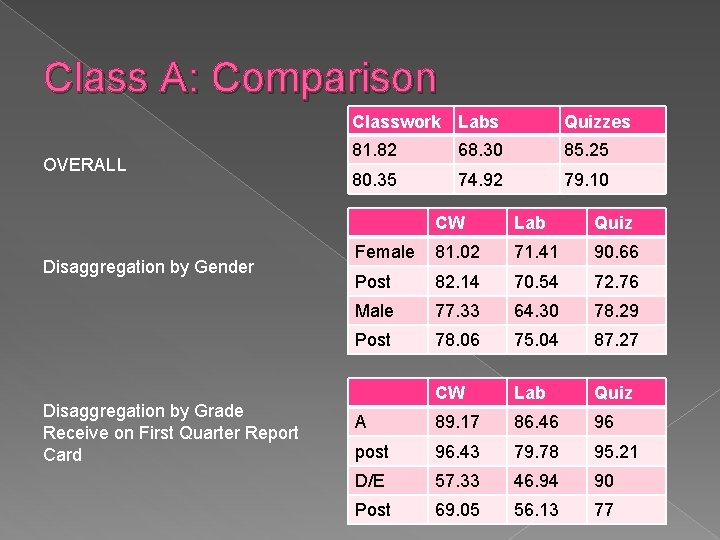
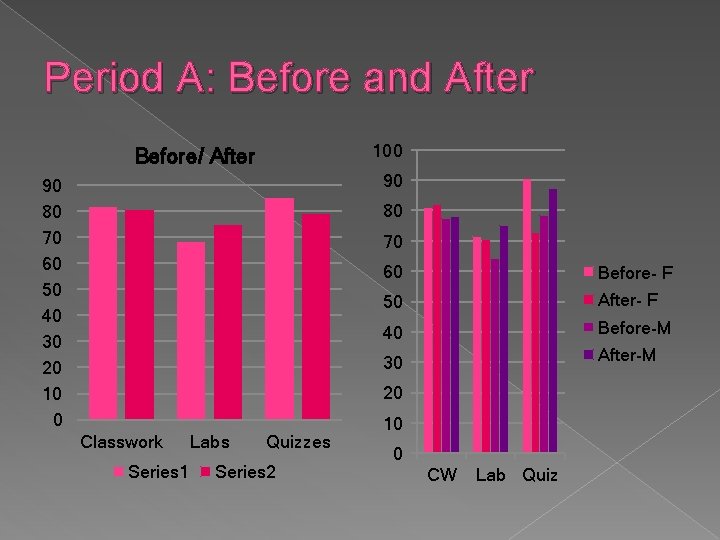
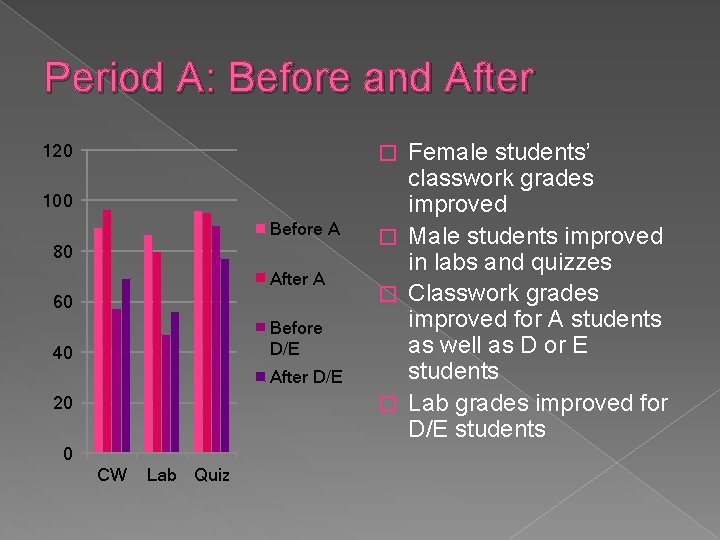
Class A: Comparison OVERALL Disaggregation by Gender Disaggregation by Grade Receive on First Quarter Report Card Classwork Labs Quizzes 81. 82 68. 30 85. 25 80. 35 74. 92 79. 10 CW Lab Quiz Female 81. 02 71. 41 90. 66 Post 82. 14 70. 54 72. 76 Male 77. 33 64. 30 78. 29 Post 78. 06 75. 04 87. 27 CW Lab Quiz A 89. 17 86. 46 96 post 96. 43 79. 78 95. 21 D/E 57. 33 46. 94 90 Post 69. 05 56. 13 77
Period A: Before and After 100 Before/ After 90 90 80 70 60 50 40 30 20 10 0 80 70 60 Before- F 50 After- F 40 Before-M 30 After-M 20 Classwork Series 1 Labs Quizzes Series 2 10 0 CW Lab Quiz
Period A: Before and After 120 Female students’ classwork grades improved � Male students improved in labs and quizzes � Classwork grades improved for A students as well as D or E students � Lab grades improved for D/E students � 100 Before A 80 After A 60 Before D/E 40 After D/E 20 0 CW Lab Quiz
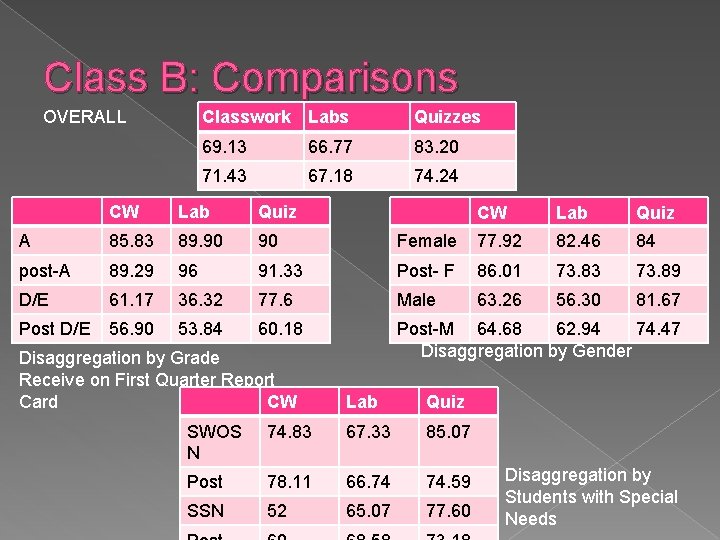
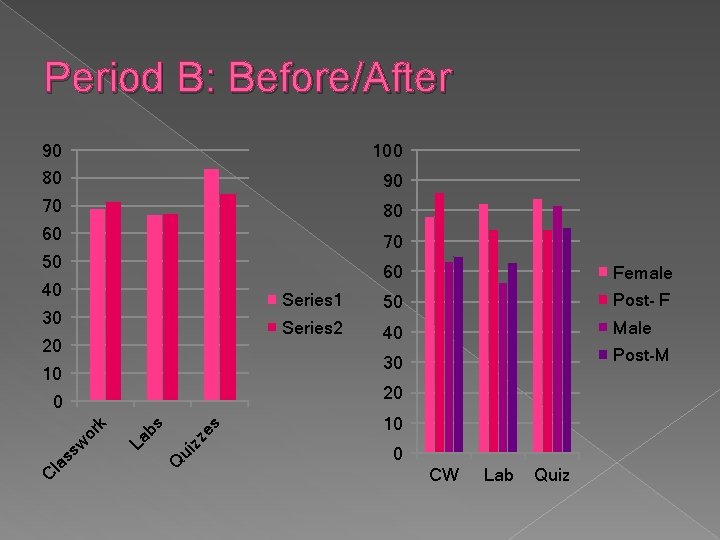
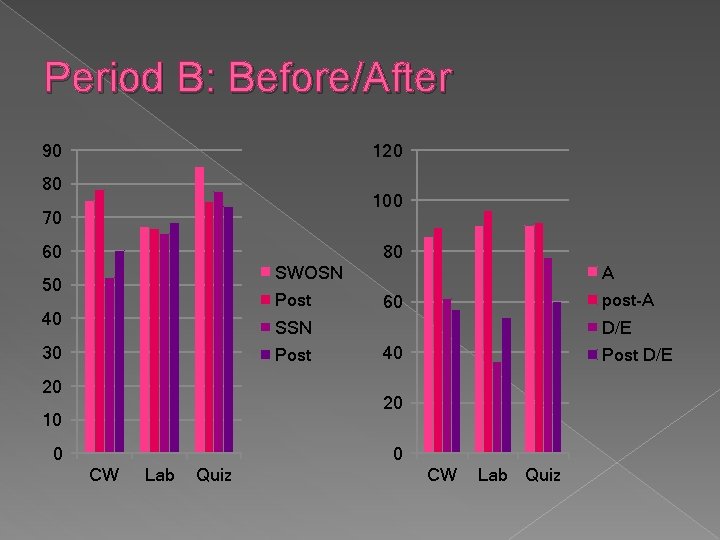
Class B: Comparisons OVERALL Classwork Labs Quizzes 69. 13 66. 77 83. 20 71. 43 67. 18 74. 24 CW Lab Quiz A 85. 83 89. 90 90 post-A 89. 29 96 D/E 61. 17 Post D/E 56. 90 CW Lab Quiz Female 77. 92 82. 46 84 91. 33 Post- F 86. 01 73. 83 73. 89 36. 32 77. 6 Male 63. 26 56. 30 81. 67 53. 84 60. 18 Post-M 64. 68 62. 94 74. 47 Disaggregation by Gender Disaggregation by Grade Receive on First Quarter Report Card CW Lab Quiz SWOS N 74. 83 67. 33 85. 07 Post 78. 11 66. 74 74. 59 SSN 52 65. 07 77. 60 Disaggregation by Students with Special Needs
Period B: Before/After 90 100 80 90 70 80 60 70 50 40 30 20 10 60 Female Series 1 50 Post- F Series 2 40 Male 30 Post-M 20 s zz e ui La bs Q C la ss w or k 0 10 0 CW Lab Quiz
Period B: Before/After 90 120 80 100 70 60 80 SWOSN 50 Post 40 A post-A 60 SSN 30 Post 20 D/E 40 Post D/E 20 10 0 0 CW Lab Quiz
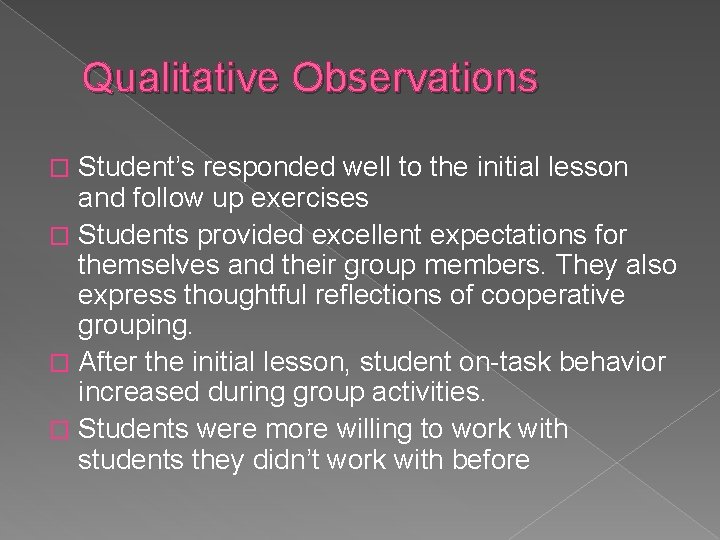
Qualitative Observations Student’s responded well to the initial lesson and follow up exercises � Students provided excellent expectations for themselves and their group members. They also express thoughtful reflections of cooperative grouping. � After the initial lesson, student on-task behavior increased during group activities. � Students were more willing to work with students they didn’t work with before �
Conclusions about Action Research Project Limitations of Study Next Steps
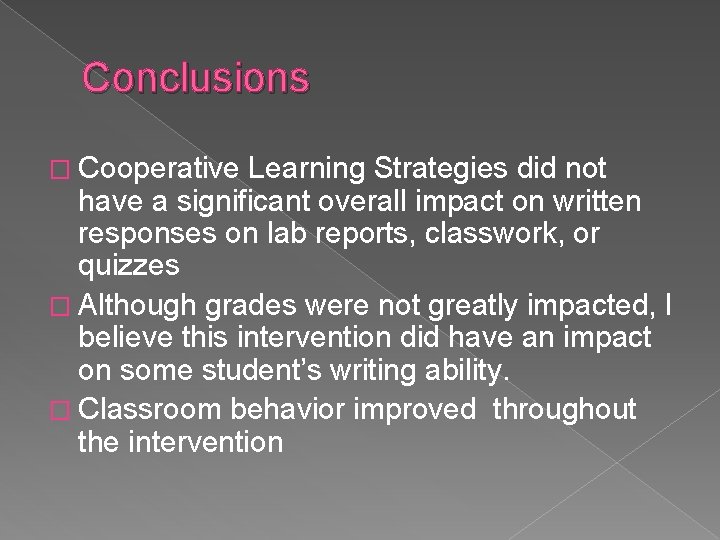
Conclusions � Cooperative Learning Strategies did not have a significant overall impact on written responses on lab reports, classwork, or quizzes � Although grades were not greatly impacted, I believe this intervention did have an impact on some student’s writing ability. � Classroom behavior improved throughout the intervention
Conclusions I saw great improvements after the initial lesson The intervention appeared have the greatest impact on lab reports � Students with special needs benefited the most from this intervention � Other Quantitative Improvement varied by class. Some classes saw Classwork or Lab improvements. � Male Students and Lower Achieving students also saw some grade improvements on classwork � �
Limitations of Study � The content of the course got substantially more difficult after the implementation of the intervention � The level of difficulty of assignments increased � There was a high rate of absences during the intervention � Many students did not turn in post test assignments (impacted data)
Next Steps! Further research could focus on improving one particular aspect of content writing or one specific classroom exercise. � Further research could present a more structured and uniform assignment data collection. My assessments were very different in style and content. � Further research could investigate the impact of more explicit skill training on cooperative learning and content writing � I would explore different methods of cooperative grouping in the science classroom. �