
The Impact of Addiction on the Family System
- Slides: 1
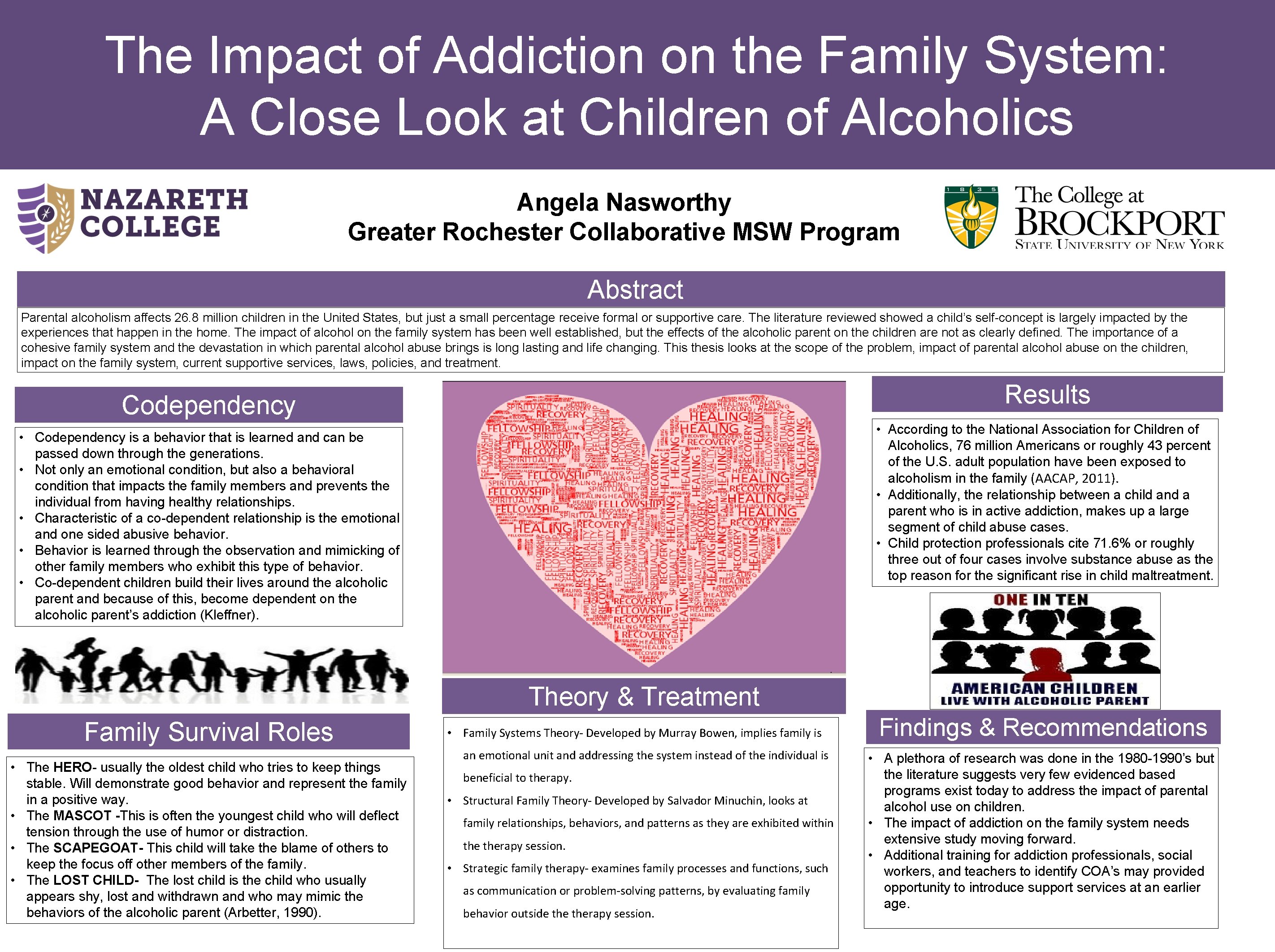
The Impact of Addiction on the Family System: A Close Look at Children of Alcoholics Angela Nasworthy Greater Rochester Collaborative MSW Program Abstract Parental alcoholism affects 26. 8 million children in the United States, but just a small percentage receive formal or supportive care. The literature reviewed showed a child’s self-concept is largely impacted by the experiences that happen in the home. The impact of alcohol on the family system has been well established, but the effects of the alcoholic parent on the children are not as clearly defined. The importance of a cohesive family system and the devastation in which parental alcohol abuse brings is long lasting and life changing. This thesis looks at the scope of the problem, impact of parental alcohol abuse on the children, impact on the family system, current supportive services, laws, policies, and treatment. Results Codependency • According to the National Association for Children of Alcoholics, 76 million Americans or roughly 43 percent of the U. S. adult population have been exposed to alcoholism in the family (AACAP, 2011). • Additionally, the relationship between a child and a parent who is in active addiction, makes up a large segment of child abuse cases. • Child protection professionals cite 71. 6% or roughly three out of four cases involve substance abuse as the top reason for the significant rise in child maltreatment. • Codependency is a behavior that is learned and can be passed down through the generations. • Not only an emotional condition, but also a behavioral condition that impacts the family members and prevents the individual from having healthy relationships. • Characteristic of a co-dependent relationship is the emotional and one sided abusive behavior. • Behavior is learned through the observation and mimicking of other family members who exhibit this type of behavior. • Co-dependent children build their lives around the alcoholic parent and because of this, become dependent on the alcoholic parent’s addiction (Kleffner). Theory & Treatment Family Survival Roles • The HERO- usually the oldest child who tries to keep things stable. Will demonstrate good behavior and represent the family in a positive way. • The MASCOT -This is often the youngest child who will deflect tension through the use of humor or distraction. • The SCAPEGOAT- This child will take the blame of others to keep the focus off other members of the family. • The LOST CHILD- The lost child is the child who usually appears shy, lost and withdrawn and who may mimic the behaviors of the alcoholic parent (Arbetter, 1990). • Family Systems Theory- Developed by Murray Bowen, implies family is an emotional unit and addressing the system instead of the individual is beneficial to therapy. • Structural Family Theory- Developed by Salvador Minuchin, looks at family relationships, behaviors, and patterns as they are exhibited within therapy session. • Strategic family therapy- examines family processes and functions, such as communication or problem-solving patterns, by evaluating family behavior outside therapy session. Findings & Recommendations • A plethora of research was done in the 1980 -1990’s but the literature suggests very few evidenced based programs exist today to address the impact of parental alcohol use on children. • The impact of addiction on the family system needs extensive study moving forward. • Additional training for addiction professionals, social workers, and teachers to identify COA’s may provided opportunity to introduce support services at an earlier age.