
The Immune System the Human Battle against the
The Immune System the Human Battle against the Microbe World
Questions: b We all get sick sometimes. . . but then we get better. b What happens when we get sick? b Why do we get better?
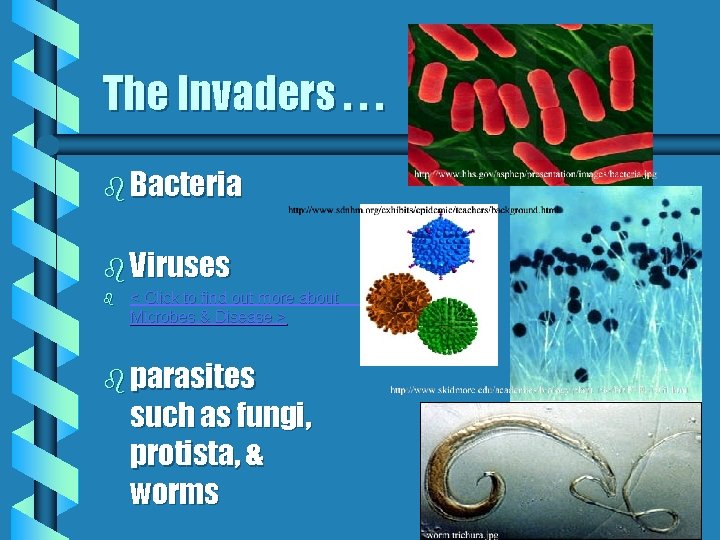
The Invaders. . . b Bacteria b Viruses b < Click to find out more about Microbes & Disease > b parasites such as fungi, protista, & worms
Our 1 st Line of Defense. . . b The Integumentary System… • Skin • Mucous membranes • Mucous b provides a physical barrier preventing microbial access
Other mechanisms of Defense. . . b Physiological variables • p. H of our environment • temperature of our environment b chemical defenses • nitric oxide, enzymes, proteins, complement b AND the IMMUNE SYSTEM…
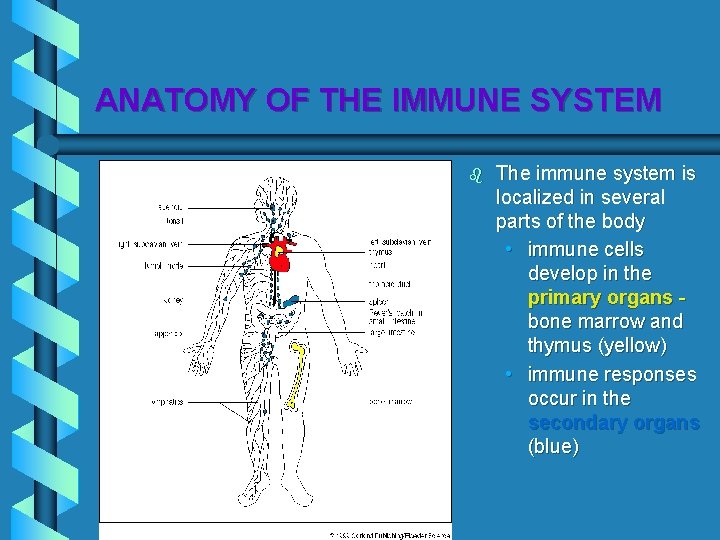
ANATOMY OF THE IMMUNE SYSTEM b The immune system is localized in several parts of the body • immune cells develop in the primary organs bone marrow and thymus (yellow) • immune responses occur in the secondary organs (blue)
ANATOMY OF THE IMMUNE SYSTEM b b Thymus – glandular organ near the heart – where T cells learn their jobs Bone marrow – blood-producing tissue located inside certain bones • blood stem cells give rise to all of the different types of blood cells b Spleen – serves as a filter for the blood • removes old and damaged red blood cells • removes infectious agents and uses them to activate cells called lymphocytes b b Lymph nodes – small organs that filter out dead cells, antigens, and other “stuff” to present to lymphocytes Lymphatic vessels – collect fluid (lymph) that has “leaked” out from the blood into the tissues and returns it to circulation
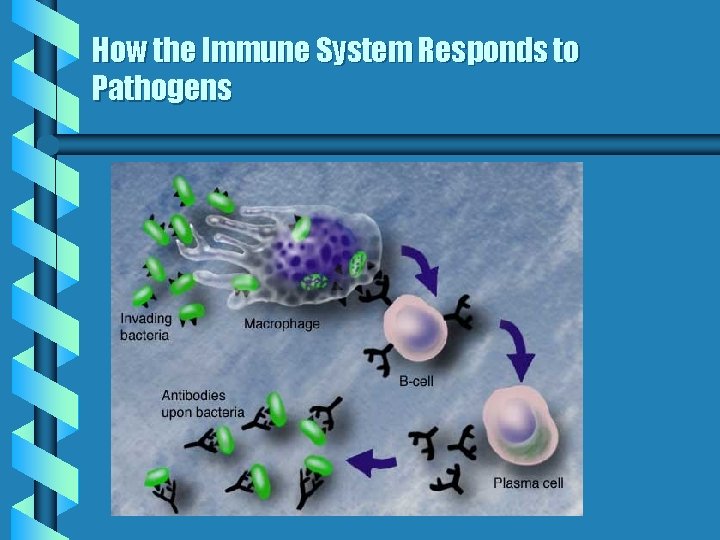
How the Immune System Responds to Pathogens

Inflammatory reaction
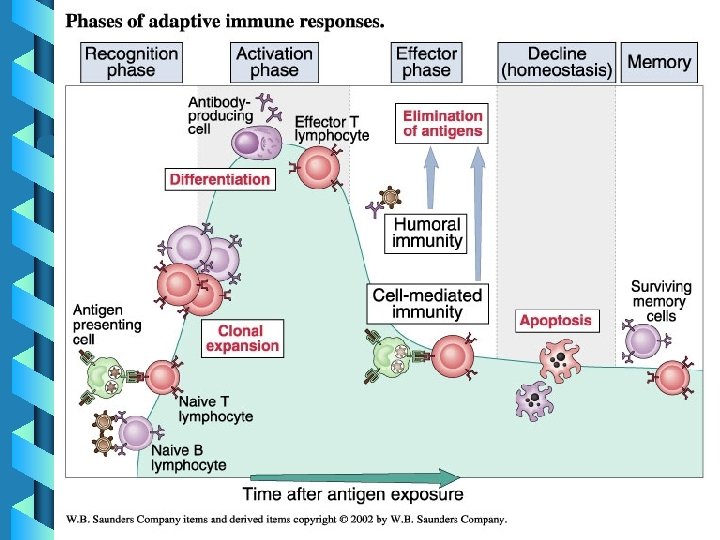
Immune System : 2 branches b The Innate Immune system = • a general response to anything other than recognized “self cells” b The Adaptive Immune System = • a specific counter-assault against a “known foreign” invader [previously recognized]
Major Concepts b What Happens during an infection ? b How can immune cells distinguish foreign invaders from our own cells ? b How can we make 100, 000 different antibodies with only 30, 000 genes ?
What Happens during an infection? b. Innate Immunity - the troops are called to battle… • injury & infection • macrophages slip between cells [extravasation] to arrive • cytokine chemicals attract other “troops” [chemotaxis] • histamine chemicals dilate blood vessels for easier access to injury [vasodilation] • < Click on link to view Movie of inflammation > • http: //www. muhealth. org/~pharm 204/inflammation. mov
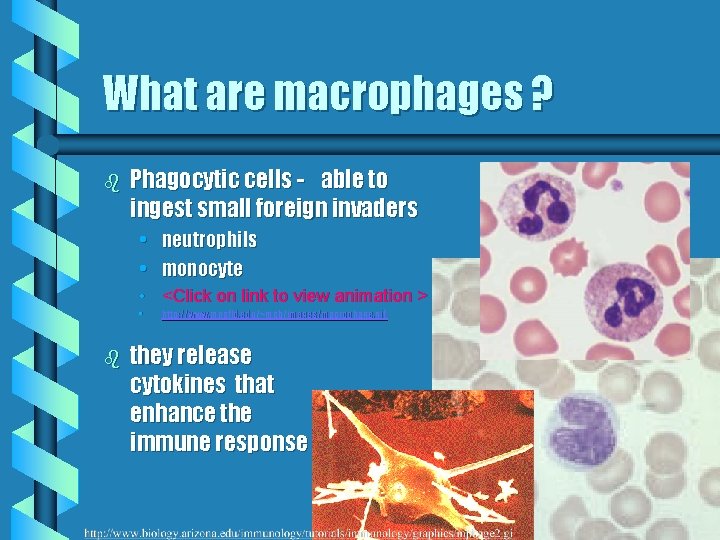
What are macrophages ? b Phagocytic cells - able to ingest small foreign invaders • neutrophils • monocyte • <Click on link to view animation > • b http: //www. mnsfld. edu/~mcb/images/macrophage. gif they release cytokines that enhance the immune response
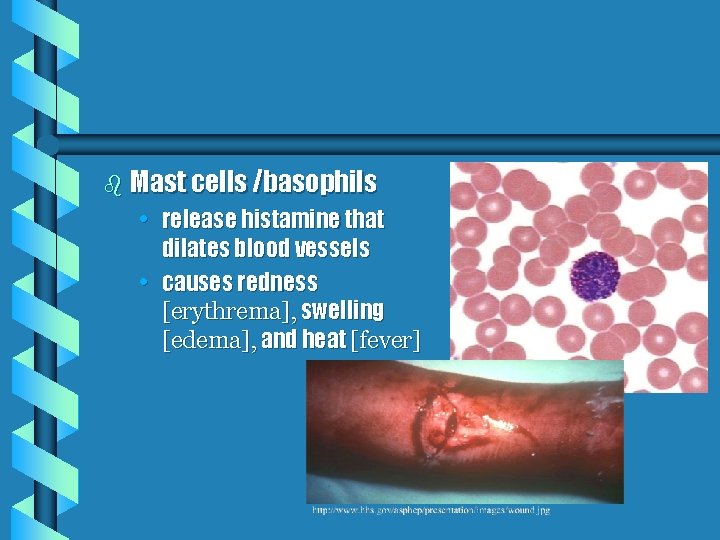
b Mast cells /basophils • release histamine that dilates blood vessels • causes redness [erythrema], swelling [edema], and heat [fever]
Your Challenge. . . b You are a macrophage in the following game… b your mission is to phagocytize the mumps viruses b use your mouse on the arrows or b HINT: antigens are specialized proteins on cell surfaces that provide I. D. recognition b http: //www. pbs. org/wgbh/nova/aids/immunewave. html
Summary: b Macrophages are able to launch the first strike… b more help is needed to overcome rapidly reproducing invaders… b Help from the ADAPTIVE IMMUNE System results in a coordinated successful defense ! b Major players. . . the B lymphocytes
How can antibodies distinguish our self from foreign invaders? b Adaptive Immune System - function b There are 2 types of lymphocytes: • T lymphocytes [ T - Helper cells ] - help signal immune cells into action • B lymphocytes [ B cells ] - make special proteins called antibodies
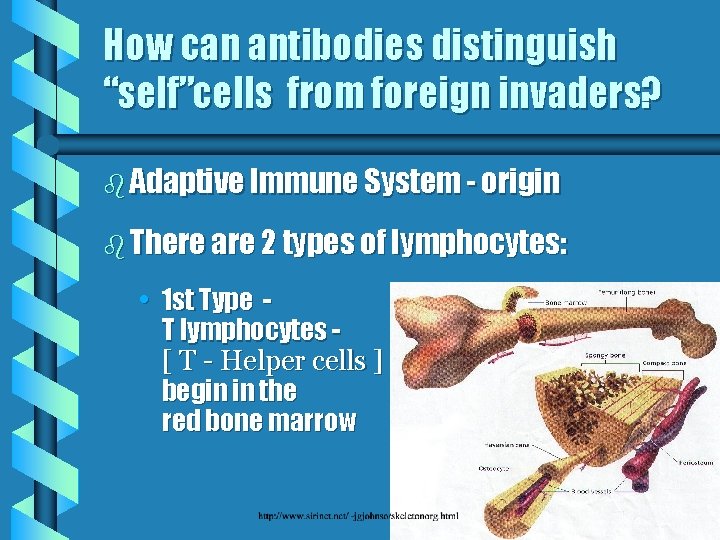
How can antibodies distinguish “self”cells from foreign invaders? b Adaptive Immune System - origin b There are 2 types of lymphocytes: • 1 st Type T lymphocytes [ T - Helper cells ] begin in the red bone marrow
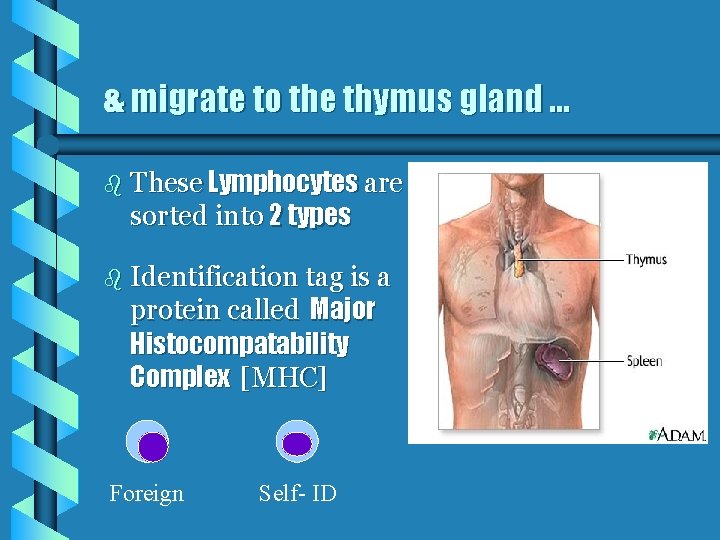
& migrate to the thymus gland. . . b These Lymphocytes are sorted into 2 types b Identification tag is a protein called Major Histocompatability Complex [MHC] Foreign Self- ID
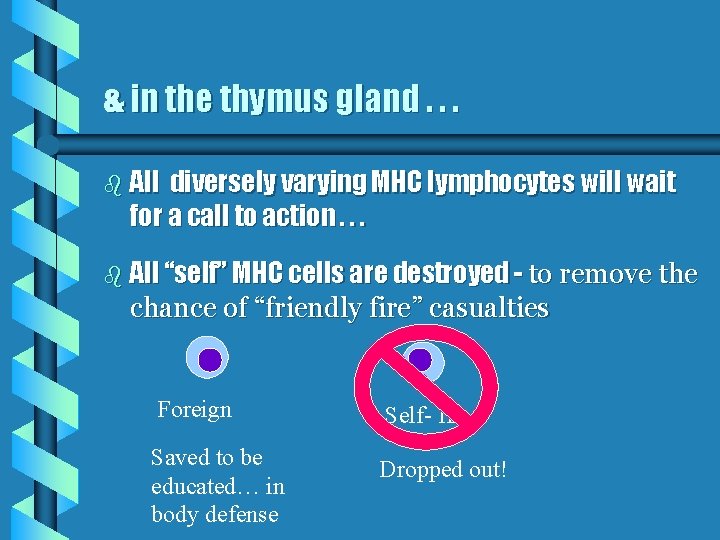
& in the thymus gland. . . b All diversely varying MHC lymphocytes will wait for a call to action. . . b All “self” MHC cells are destroyed - to remove the chance of “friendly fire” casualties Foreign Self- ID Saved to be educated… in body defense Dropped out!
b These Lymphocytes will mature into T-Helper cells b They function to stimulate B cells to activate their attack against the invaders
Adaptive Immune System b The 2 nd type of lymphocyte is: • B lymphocytes [ B cells] - start in the bone marrow and circulate through the body • they are called into action when stimulated by a foreign antigen. . . [ usually a protein from the invader]
When an invader attacks. . . b An antigen is phagocytized by the B cell b is broken into non-infective pieces b & attached to the cell’s MHC when processed through the cell’s machinery b MHC-antigen complex is placed on the cell membrane surface b where it is recognized by the T Helper cell b <Click on Link to see Antigen Expression process > b http: //www. nature. com/nrm/journal/v 2/n 3/animation/nrm 0301_179 a_swf_MEDIA 1. html
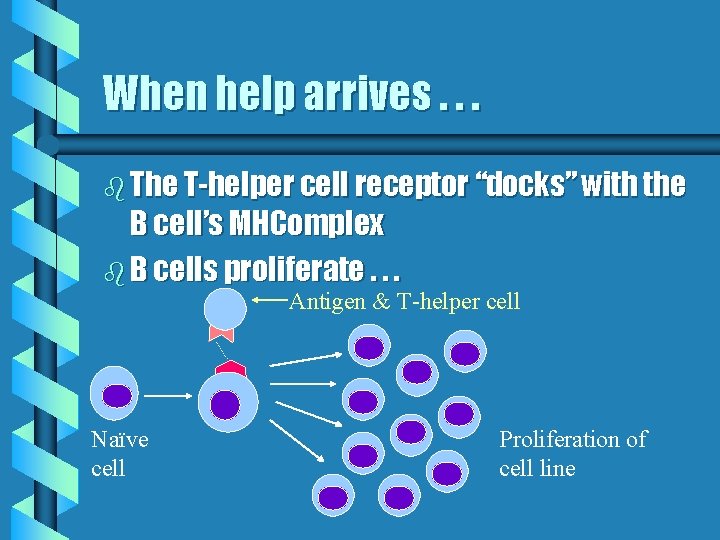
When help arrives. . . b The T-helper cell receptor “docks” with the B cell’s MHComplex b B cells proliferate. . . Antigen & T-helper cell Naïve cell Proliferation of cell line
![B cells differentiate into. . . • Antibody producing cells [attack mode] • Memory](http://slidetodoc.com/presentation_image_h2/225b84cee68e8113276a20b1b6f8d373/image-25.jpg "B cells differentiate into. . . • Antibody producing cells [attack mode] • Memory")
B cells differentiate into. . . • Antibody producing cells [attack mode] • Memory cells [remembers & future protection] Antigen & T-helper cell antibodies memory
The RESULT. . . b The Antibody producing B cells mounts a successful attack against the invader b the memory B cells save the “recognition ID” for many years in preparation for future invasion
How can we make 100, 000 different antibodies with only 30, 000 genes? b Problem: • microorganisms easily out-number the total number of genes on the human genome • if only one gene was responsible for coding for one antibody, there still wouldn’t be enough information to use b Question: • How can such a small amount of information be used for successful antibody diversity ?
Consider the following. . . What is true about the different cells of the body? b Which Statement is most correct ? a All cells in the body are the same and function the same way b All cells are the same, but function differently because they are located in different places c All cells have the same genetic material, but different cells use different active genes to make them function differently b Does this same principle apply to
The correct answer is. . . <Click for Answer> c All cells have the same genetic material, but different cells use different active genes to make them function differently < Click on Animation Link to learn how gene segments are combined to produce a large number of diverse antibodies >
Summary b What Happens during an infection ? • The immune system activates a multitude of characters to defend the body in a variety of ways. • Several players work together, feedback systems enhance or suppress functions as changes occur
Summary b How can immune cells distinguish foreign invaders from our own cells ? • By using the invader’s own antigen, immune cells can be produced for specific organisms & used to enhance the defense effort • [ as long as the invading organism is the only target ! ]
Summary b How can we make 100, 000 different antibodies with only 30, 000 genes ? • Mixing & matching pieces of genetic material produce huge numbers of antibody, as well as very specific antibody b The immune system is well equiped to defend the human body against the daily onslaught of microorganisms. . . If everything goes as planned. . .
For further information. . . b Immunology Project Resources – b Understanding Autoimmune Disease http: //www. niaid. nih. gov/publications/autoimmune/work. htm b b b b Antibody descriptions [Ig. G, Ig. M, Ig. A] http: //sprojects. mmi. mcgill. ca/immunology/Ig_text. htm Immunology Hyperlinked History & Molecular Movies http: //www. bio. davidson. edu/courses/Immunology/Bio 307. html Nature Magazine & Immunology http: //www. nature. com/nature/view/030102. html NCBI Genome Database http: //www. ncbi. nlm. nih. gov// NCBI Genome Base http: //www. ncbi. nlm. nih. gov/entrez/query. fcgi? cmd =Retrieve&db=pubmed&dopt= =Abstract&list_uids=158979 http: //www. ncbi. nlm. nih. gov/entrez/query. fcgi? cmd=Retrieve&db= Abstract&list_uids=158979 6 Immune System Animation Links through Anatomy & Physiology Groups http: //science. nhmccd. edu/biol/ap 2 int. htm Pier, G. , Lyczak, J. , Wetzler, L; Immunology, Infection, and Immunity; American Society for Microbiology Press, 2004, p. 12.

b Thank you!
- Slides: 35