
THE IMMUNE SYSTEM Pathogens Defense against disease causing
- Slides: 3
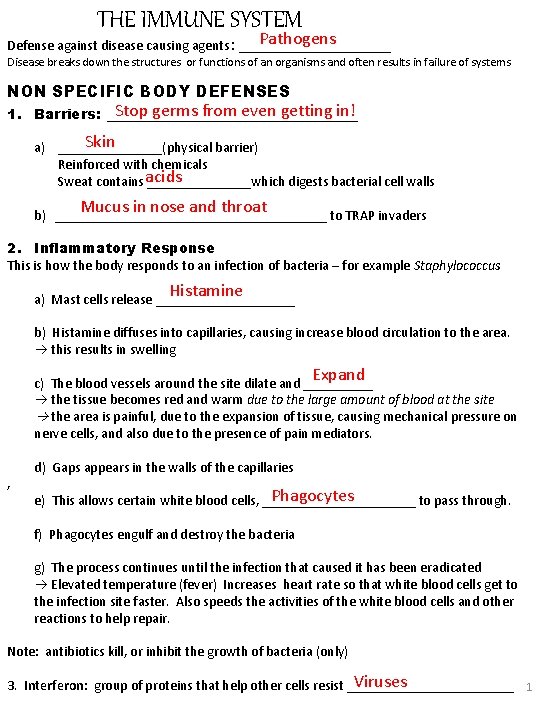
THE IMMUNE SYSTEM Pathogens Defense against disease causing agents: _________ Disease breaks down the structures or functions of an organisms and often results in failure of systems NON SPECIFIC BODY DEFENSES Stop germs from even getting in! 1. Barriers: __________________ Skin a) ________(physical barrier) Reinforced with chemicals Sweat contains acids ________which digests bacterial cell walls Mucus in nose and throat b) ____________________ to TRAP invaders 2. Inflammatory Response This is how the body responds to an infection of bacteria – for example Staphylococcus Histamine a) Mast cells release __________ b) Histamine diffuses into capillaries, causing increase blood circulation to the area. this results in swelling Expand c) The blood vessels around the site dilate and _____ the tissue becomes red and warm due to the large amount of blood at the site the area is painful, due to the expansion of tissue, causing mechanical pressure on nerve cells, and also due to the presence of pain mediators. , d) Gaps appears in the walls of the capillaries Phagocytes e) This allows certain white blood cells, ___________ to pass through. f) Phagocytes engulf and destroy the bacteria g) The process continues until the infection that caused it has been eradicated Elevated temperature (fever) Increases heart rate so that white blood cells get to the infection site faster. Also speeds the activities of the white blood cells and other reactions to help repair. Note: antibiotics kill, or inhibit the growth of bacteria (only) Viruses 3. Interferon: group of proteins that help other cells resist ____________ 1
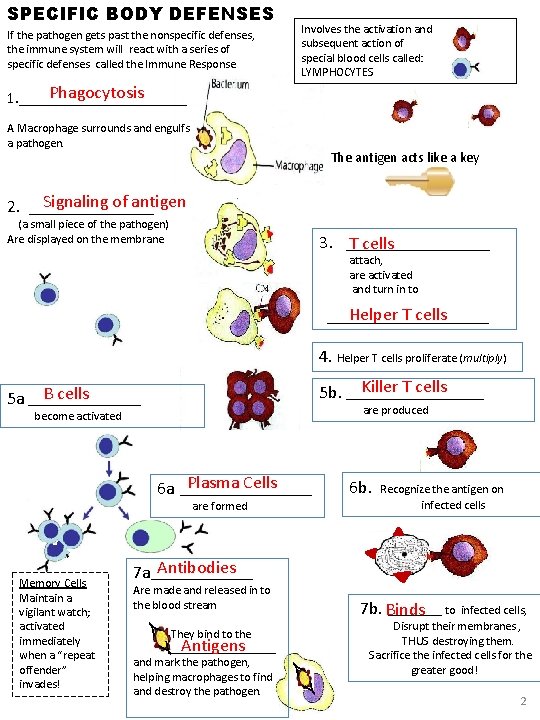
SPECIFIC BODY DEFENSES Involves the activation and subsequent action of special blood cells called: LYMPHOCYTES If the pathogen gets past the nonspecific defenses, the immune system will react with a series of specific defenses called the Immune Response Phagocytosis 1. ___________ A Macrophage surrounds and engulfs a pathogen. The antigen acts like a key Signaling of antigen 2. _______ (a small piece of the pathogen) Are displayed on the membrane 3. ________ T cells attach, are activated and turn in to Helper T cells ______________ 4. Helper T cells proliferate (multiply) Killer T cells 5 b. ____________ B cells 5 a __________ are produced become activated Plasma Cells 6 a ___________ are formed Recognize the antigen on infected cells Antibodies 7 a_________ Are made and released in to the blood stream 7 b. Binds _____ to infected cells, Disrupt their membranes , THUS destroying them. Sacrifice the infected cells for the greater good! Y They bind to the Antigens _________ Y and mark the pathogen, helping macrophages to find and destroy the pathogen. Y Memory Cells Maintain a vigilant watch; activated immediately when a “repeat offender” invades! 6 b. Y 2
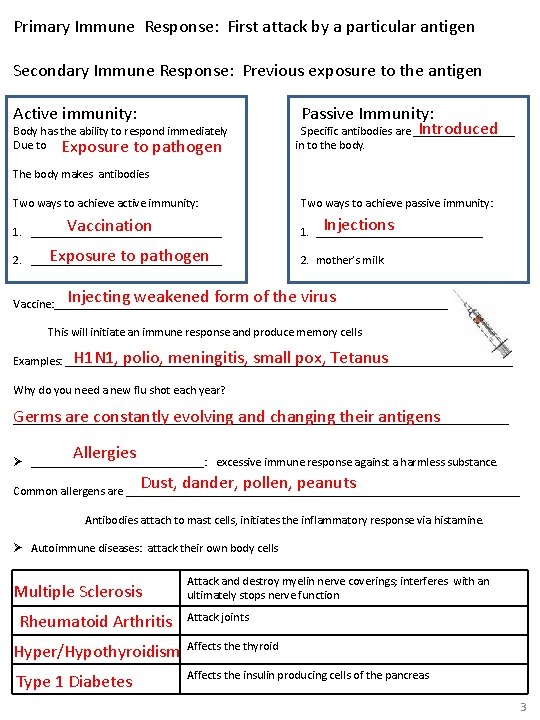
Primary Immune Response: First attack by a particular antigen Secondary Immune Response: Previous exposure to the antigen Active immunity: Body has the ability to respond immediately Due to Exposure to pathogen Passive Immunity: Introduced Specific antibodies are _________ in to the body. The body makes antibodies Two ways to achieve active immunity: Two ways to achieve passive immunity: Vaccination 1. ________________ Injections 1. ______________ Exposure to pathogen 2. ________________ 2. mother’s milk Injecting weakened form of the virus Vaccine: _________________________________ This will initiate an immune response and produce memory cells H 1 N 1, polio, meningitis, small pox, Tetanus Examples: ______________________________________ Why do you need a new flu shot each year? Germs are constantly evolving and changing their antigens __________________________________________ Allergies Ø _______________: excessive immune response against a harmless substance. Dust, dander, pollen, peanuts Common allergens are _________________________________ Antibodies attach to mast cells, initiates the inflammatory response via histamine. Ø Autoimmune diseases: attack their own body cells Multiple Sclerosis Rheumatoid Arthritis Attack and destroy myelin nerve coverings; interferes with an ultimately stops nerve function Attack joints Hyper/Hypothyroidism Affects the thyroid Type 1 Diabetes Affects the insulin producing cells of the pancreas 3