
The Immune response Lesson 1 The NonSpecific Response
- Slides: 2
The Immune response – Lesson 1
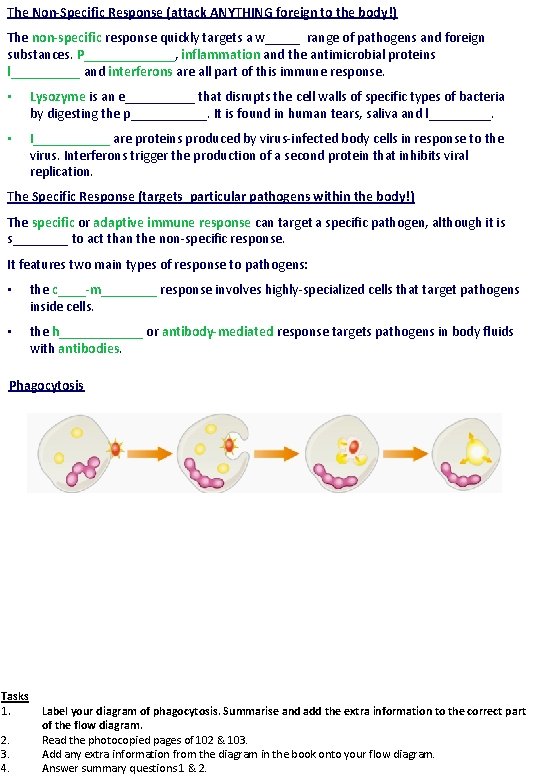
The Non-Specific Response (attack ANYTHING foreign to the body!) The non-specific response quickly targets a w_____ range of pathogens and foreign substances. P_______, inflammation and the antimicrobial proteins l_____ and interferons are all part of this immune response. • Lysozyme is an e_____ that disrupts the cell walls of specific types of bacteria by digesting the p______. It is found in human tears, saliva and l_____. • I______ are proteins produced by virus-infected body cells in response to the virus. Interferons trigger the production of a second protein that inhibits viral replication. The Specific Response (targets particular pathogens within the body!) The specific or adaptive immune response can target a specific pathogen, although it is s____ to act than the non-specific response. It features two main types of response to pathogens: • the c____-m____ response involves highly-specialized cells that target pathogens inside cells. • the h______ or antibody-mediated response targets pathogens in body fluids with antibodies. Phagocytosis Tasks 1. 2. 3. 4. Label your diagram of phagocytosis. Summarise and add the extra information to the correct part of the flow diagram. Read the photocopied pages of 102 & 103. Add any extra information from the diagram in the book onto your flow diagram. Answer summary questions 1 & 2.