
The Image of the Hero and the Macho

- Slides: 17
The Image of the Hero and the “Macho” in the Mexican Ballads during the Mexican Revolution Antonio Gómez-Zavala Advisors: Dr. Donaldo Urioste & Dr. Rafael Gómez S
Overview S The Mexican Ballad S The Mexican Revolution S “Machismo”/Manhood S The image of the Hero and the “Macho” S Mexican Ballads of Heroism and “Machismo” in 3 Stages S Conclusion
Research Questions S How machismo manifest itself in Mexican ballads (known as Corridos) in the late 19 th century and early 20 th century? S How do Mexican ballads narrate stories of heroism and “machismo”/manhood? S How much of this stories is true and how it is reflected in the culture?
The Mexican Ballad Genre S Epic-lyric S Derived from the Spanish romance Structure S Starts by describing the date & place where the event took place/happened S Verses of 16 syllables divided into hemistiches of 8 syllables S Assonance and consonant rhymes S Repetition of lyrical forms at the end A-ño-de- mil- o-cho- cien-tos no-ven-ta- y seis- del- co-rrien. Conte, sonant murió don Demetrio Jáuregui (Corrido de Demetrio Jáuregui, Custodio, 1975: 144 -146) que era un gallo muy valiente. <<and with this I say good bye…>> <<fly, fly little dove…>>
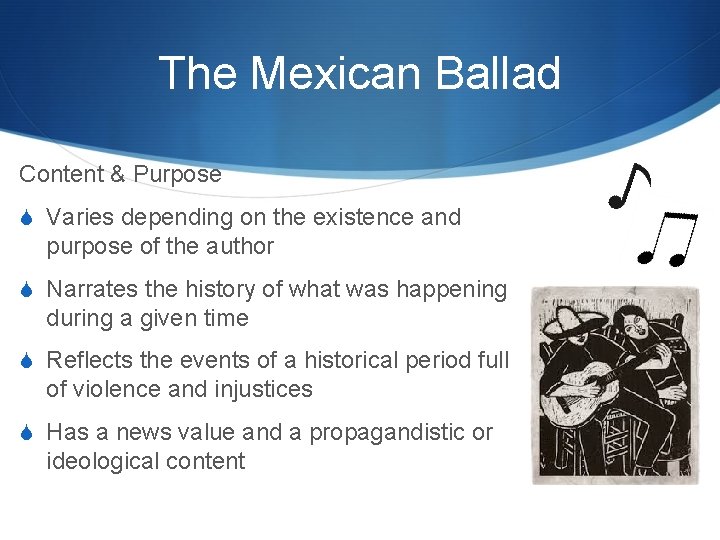
The Mexican Ballad Content & Purpose S Varies depending on the existence and purpose of the author S Narrates the history of what was happening during a given time S Reflects the events of a historical period full of violence and injustices S Has a news value and a propagandistic or ideological content
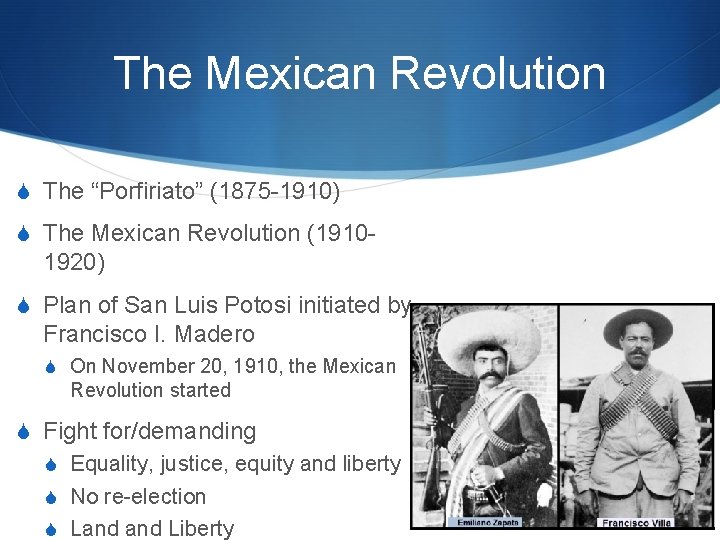
The Mexican Revolution S The “Porfiriato” (1875 -1910) S The Mexican Revolution (1910 - 1920) S Plan of San Luis Potosi initiated by Francisco I. Madero S On November 20, 1910, the Mexican Revolution started S Fight for/demanding S Equality, justice, equity and liberty S No re-election S Land Liberty
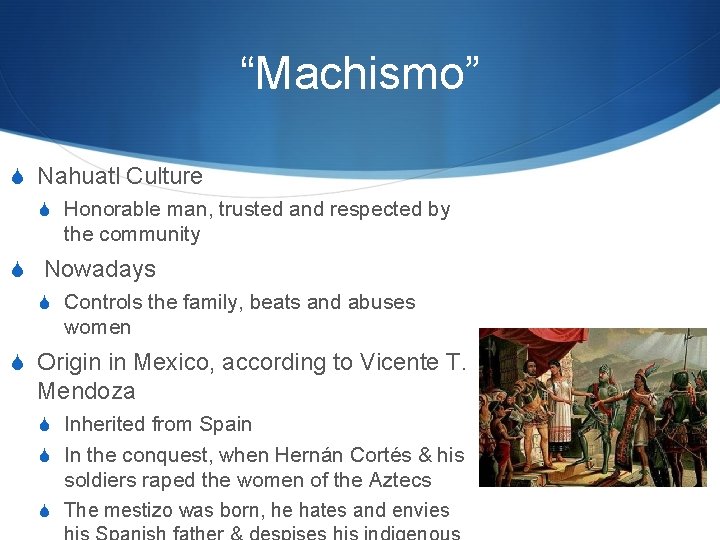
“Machismo” S Nahuatl Culture S Honorable man, trusted and respected by the community S Nowadays S Controls the family, beats and abuses women S Origin in Mexico, according to Vicente T. Mendoza S Inherited from Spain S In the conquest, when Hernán Cortés & his soldiers raped the women of the Aztecs S The mestizo was born, he hates and envies
Machismo: The Image of the Macho Authentic Machismo/Masculinity S Real courage, generosity, heroism, bravery, religiosity to death, eagerness to fight, challenges the dangerous situations…and audacity proven S Is just the courage and the heroic ideal False Machismo/Masculinity S Something only of appearance, that hides cowardice and fear, hidden with shoutings, that doesn’t correspond to reality because in front of the danger shrinks and before death frightens S Super masculinity that covers a complex of inferiority
Heroism: The Image of the Hero The Hero S Defined by its religiosity, bravery/courage, loyalty, relation with the father and mother, generosity, amorous, machismo/masculinity, likes alcohol, revenge, cruelty, pride, etc. S Has to be a brave man that risks himself in any situation and is fearless S Courage is the most important characterization, without it, one can not be hero
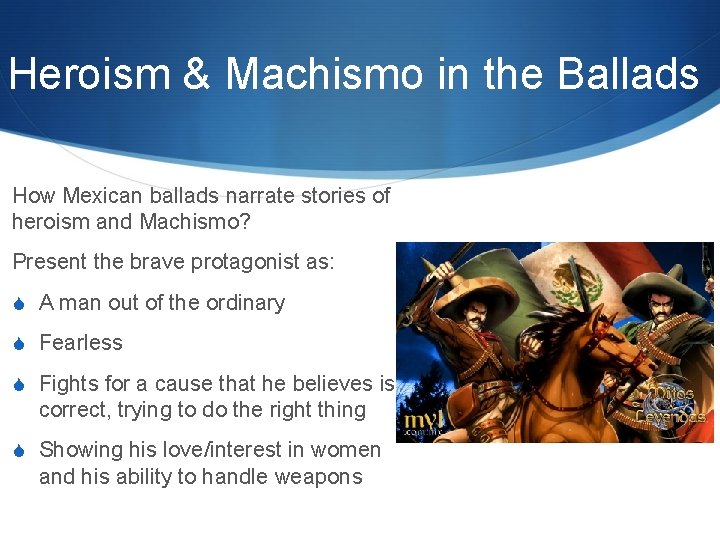
Heroism & Machismo in the Ballads How Mexican ballads narrate stories of heroism and Machismo? Present the brave protagonist as: S A man out of the ordinary S Fearless S Fights for a cause that he believes is correct, trying to do the right thing S Showing his love/interest in women and his ability to handle weapons
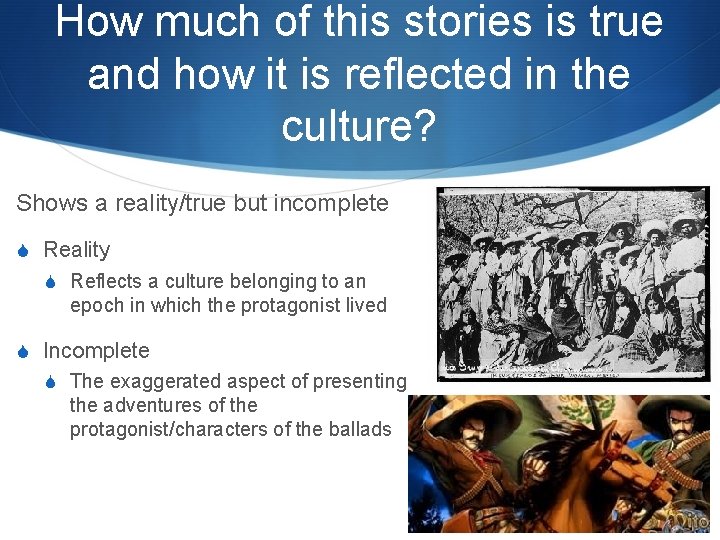
How much of this stories is true and how it is reflected in the culture? Shows a reality/true but incomplete S Reality S Reflects a culture belonging to an epoch in which the protagonist lived S Incomplete S The exaggerated aspect of presenting the adventures of the protagonist/characters of the ballads
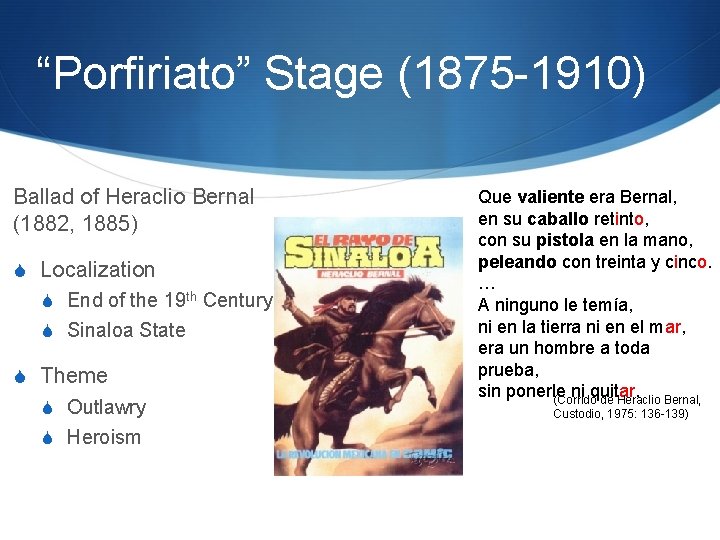
“Porfiriato” Stage (1875 -1910) Ballad of Heraclio Bernal (1882, 1885) S Localization S End of the 19 th Century S Sinaloa State S Theme S Outlawry S Heroism Que valiente era Bernal, en su caballo retinto, con su pistola en la mano, peleando con treinta y cinco. … A ninguno le temía, ni en la tierra ni en el mar, era un hombre a toda prueba, sin ponerle ni quitar. (Corrido de Heraclio Bernal, Custodio, 1975: 136 -139)
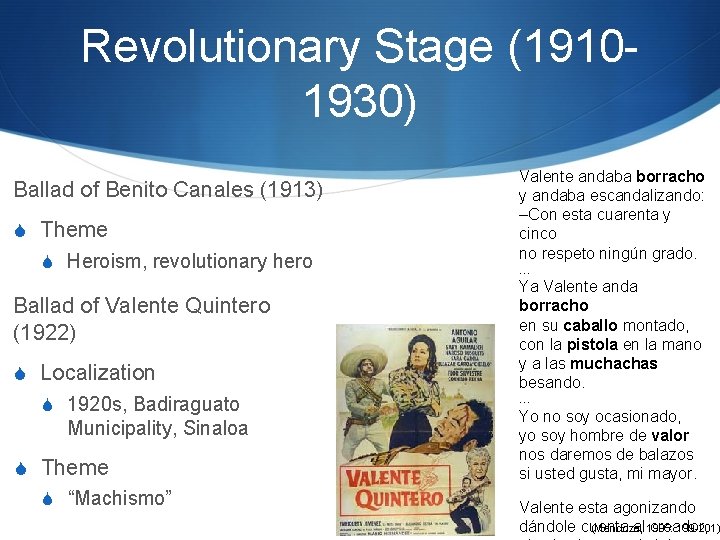
Revolutionary Stage (19101930) Ballad of Benito Canales (1913) S Theme S Heroism, revolutionary hero Ballad of Valente Quintero (1922) S Localization S 1920 s, Badiraguato Municipality, Sinaloa S Theme S “Machismo” Valente andaba borracho y andaba escandalizando: –Con esta cuarenta y cinco no respeto ningún grado. … Ya Valente anda borracho en su caballo montado, con la pistola en la mano y a las muchachas besando. … Yo no soy ocasionado, yo soy hombre de valor nos daremos de balazos si usted gusta, mi mayor. Valente esta agonizando (Mendoza, 1995: 199 -201) dándole cuenta al creador,
Subsequent Stage (1930 -) The use of the word “macho” in the ballads S Association with various factors S The figure of the gunman who runs over/walks over the citizens S WWII S Presidency of Manuel Avila Camacho (1940 -1946) ¡Viva el pueblo siempre macho! Agustín el general y ¡Viva Ávila Camacho As cited in Américo Paredes, 1967: y la vida sindical! 69
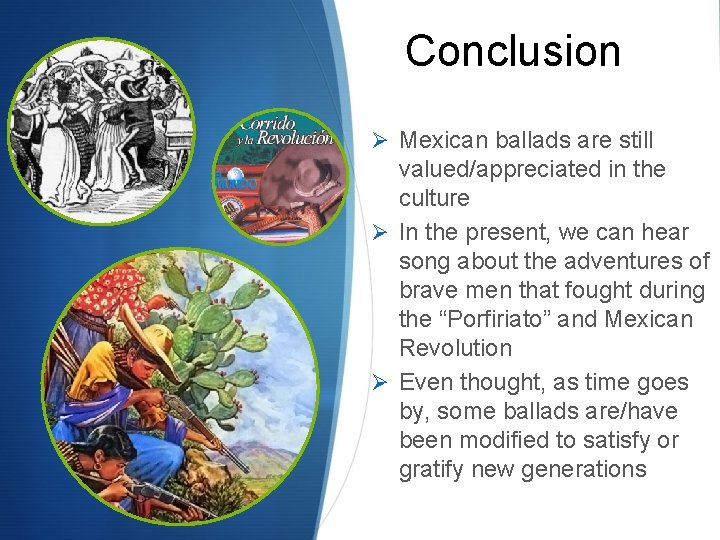
Conclusion Ø Mexican ballads are still valued/appreciated in the culture Ø In the present, we can hear song about the adventures of brave men that fought during the “Porfiriato” and Mexican Revolution Ø Even thought, as time goes by, some ballads are/have been modified to satisfy or gratify new generations
Questions/Comments
Bibliography S Custodio, Álvaro. El Corrido Popular Mexicano: Su Historia, Sus Temas, Sus Interpretes. 1. ed. Madrid: Ediciones Jucar, 1975. Print. S Eguiarte Bendímez, Enrique A. "El Corrido Mexicano: Elementos Literarios Y Culturales. " RILCE: Revista De Filología Hispánica, 16. 1 (2000): 77 -92. S Garza-Ramos, María del Carmen. “Fisonomía del Héroe en el Corrido Mexicano. ” Dialogos: Artes, Letras, Ciencias Humanas, 4. 6 (1968): 12 -16. S González, Aurelio. "Caracterización De Los Héroes En Los Corridos Mexicanos. " Cahiers Du Monde Hispanique Et Luso. Brésilien/Caravelle, 72 (1999): 83 -97. S González, Aurelio. "¿Como Vive el Corrido Mexicano? ¿Quien Canta Corridos? ¿Quienes Cantaron Corridos? . " Cahiers Du Monde Hispanique Et Luso-Brésilien/Caravelle, 51 (1998): 23 -30. S González, Aurelio. “Literatura Tradicional y Literatura Popular. Romance y Corrido en México. ” Caravelle, 65 (1995): 143 -157. S González, Aurelio. “Descriptividad en el Corrido Tradicional. ” Caravelle, 76/77 (December 2001): 495 -505. S González, Aurelio. "El Corrido: Expresión Popular Y Tradicional De La Balada Hispánica. " Olivar: Revista De Literatura Y Cultura Españolas, 12. 15 (2011): 11 -36. S Mendoza, Vicente T. . El Corrido Mexicano. 3 a. ed. México: Fondo de Cultura Económica, 1976. Print. S Paredes, Américo. "Estados Unidos, México Y El Machismo. " Journal of Inter-American Studies, 9. 1 (1967): 65 -84. S Parra, Max. “Pancho Villa y el Corrido de la Revolución. ” Caravelle, 88 (2007): 139 -149. S Ramírez-Barradas, Herlinda F. “La Transformación de un Héroe de Corrido a través del Tiempo. ” Hispania, 83 (Mayo, 2000): 189 -197. S Román, Carmen. “Machismo y Marianismo: Nuevos Modelos para Viejos Patrones. ” Time 2 Track, LLC, (2012). Retrieved 23 April 2014 from: http: //time 2 track. com/machismo-marianismo S Rodríguez, Roberto & Gonzales, Patrisia. “Deconstructing Machismo. ” Retrieved 23 April 2014 from Latino Spectrum: http: //www. mexica. net/literat/macho. php (National Hispanic Univ. edu/ Chrinicle features, San Francisco released date (june 20, 1997)