
The ILC Reference Design Report the next steps


- Slides: 28
The ILC Reference Design Report & the next steps Brian Foster (Oxford & GDE) Joint EPS/ECFA Meeting Manchester B. Foster - EPS/ECFA 07/07 Global Design Effort 1
Overview h • This talk really divided into two parts: • Yesterday – Summary of progress on RDR – Brief summary of future • Today – Very brief summary of RDR – Details of future plans/timelines • Apologies if you missed yesterday & the full details of the RDR. B. Foster - EPS/ECFA 07/07 Global Design Effort 2
ILC Parameters • Ecm adjustable from 200 – 500 Ge. V • Luminosity ∫Ldt = 500 fb-1 in 4 years (corresponds to 2*1034 cm-2 s-1 ) • Ability to scan between 200 and 500 Ge. V • Energy stability and precision below 0. 1% • Electron polarization of at least 80% • The machine must be upgradeable to 1 Te. V B. Foster - EPS/ECFA 07/07 Global Design Effort 3
ILC Reference Design Report ~700 Contributors from 84 Institutes The RDR is not a full engineering design - it is conceptual; some aspects require R&D. Forms reliable basis for detailed engineering design & costing. B. Foster - EPS/ECFA 07/07 Global Design Effort 4
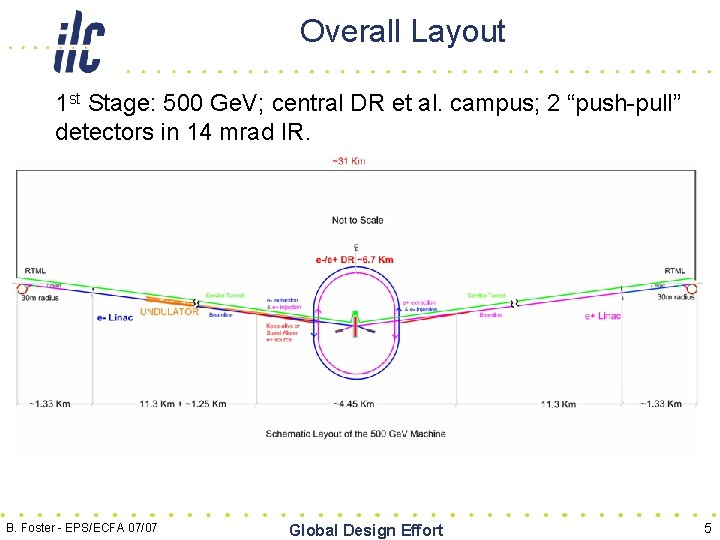
Overall Layout 1 st Stage: 500 Ge. V; central DR et al. campus; 2 “push-pull” detectors in 14 mrad IR. B. Foster - EPS/ECFA 07/07 Global Design Effort 5
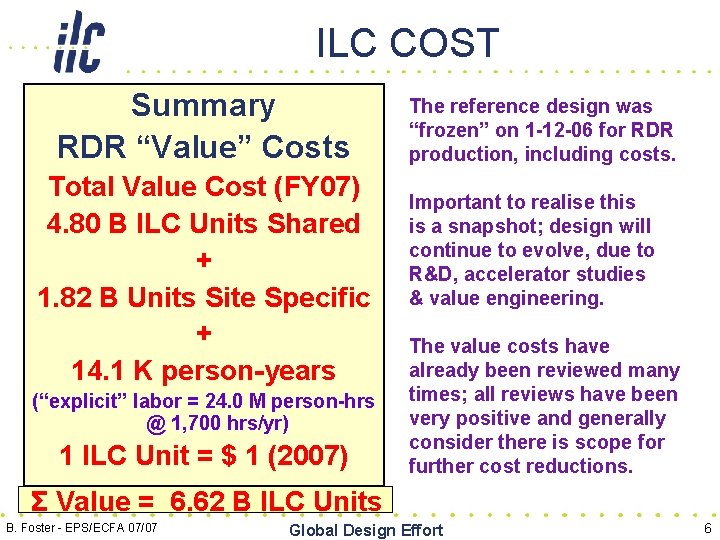
ILC COST Summary RDR “Value” Costs Total Value Cost (FY 07) 4. 80 B ILC Units Shared + 1. 82 B Units Site Specific + 14. 1 K person-years (“explicit” labor = 24. 0 M person-hrs @ 1, 700 hrs/yr) 1 ILC Unit = $ 1 (2007) The reference design was “frozen” on 1 -12 -06 for RDR production, including costs. Important to realise this is a snapshot; design will continue to evolve, due to R&D, accelerator studies & value engineering. The value costs have already been reviewed many times; all reviews have been very positive and generally consider there is scope for further cost reductions. Σ Value = 6. 62 B ILC Units B. Foster - EPS/ECFA 07/07 Global Design Effort 6
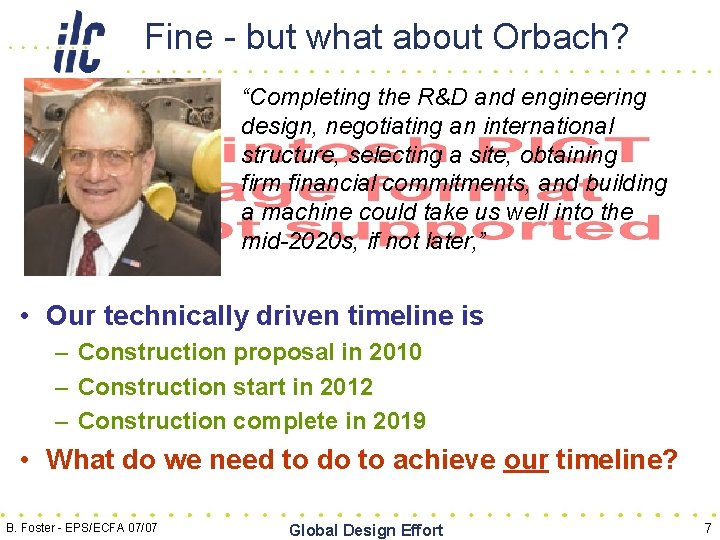
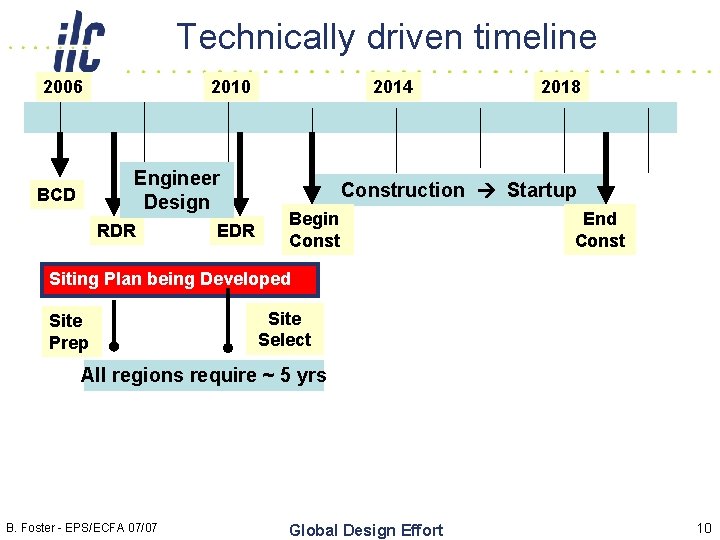
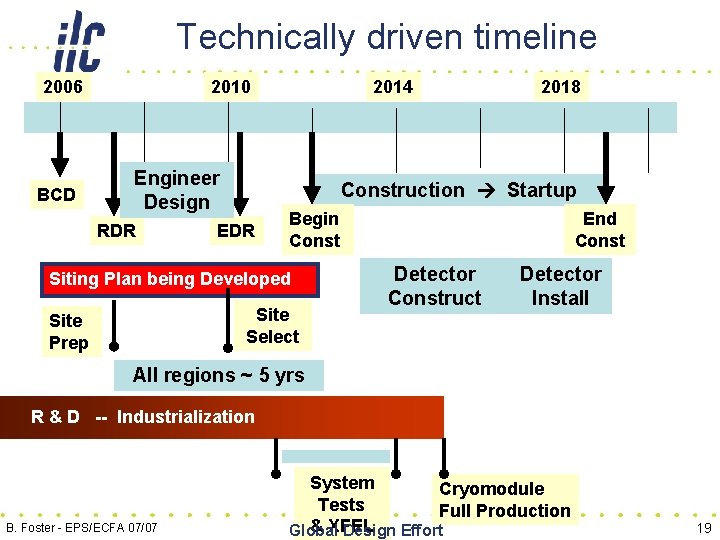
Fine - but what about Orbach? “Completing the R&D and engineering design, negotiating an international structure, selecting a site, obtaining firm financial commitments, and building a machine could take us well into the mid-2020 s, if not later, ” • Our technically driven timeline is – Construction proposal in 2010 – Construction start in 2012 – Construction complete in 2019 • What do we need to do to achieve our timeline? B. Foster - EPS/ECFA 07/07 Global Design Effort 7
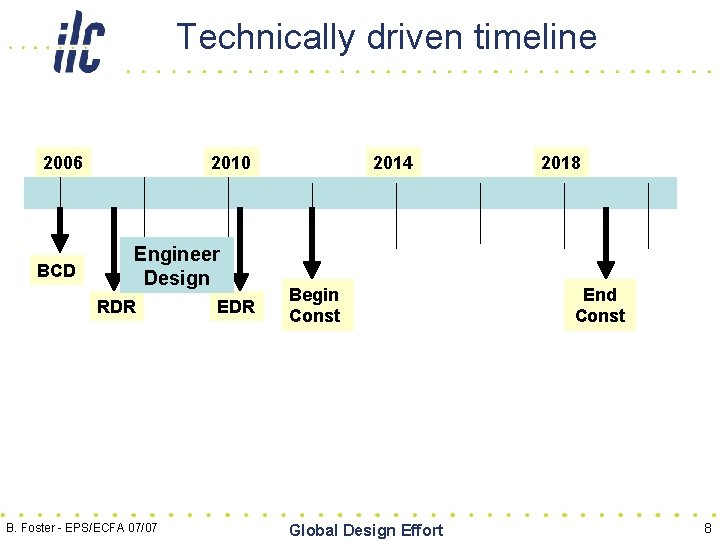
Technically driven timeline 2006 BCD 2010 Engineer Design RDR B. Foster - EPS/ECFA 07/07 EDR 2014 Begin Const Global Design Effort 2018 End Const 8
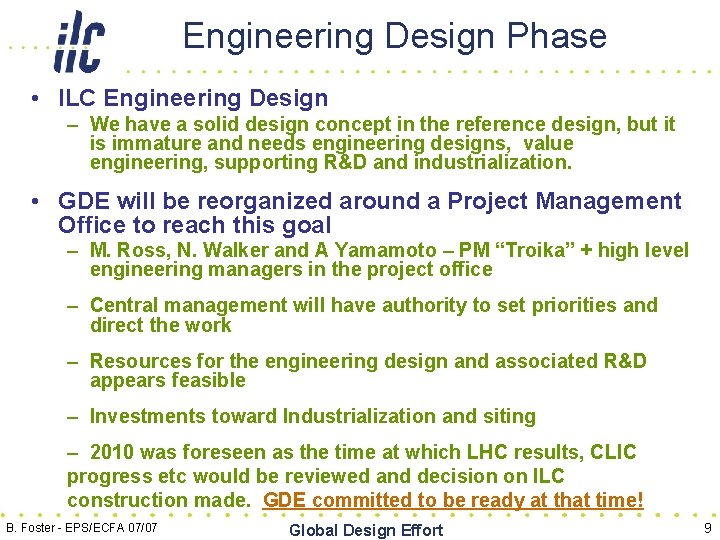
Engineering Design Phase • ILC Engineering Design – We have a solid design concept in the reference design, but it is immature and needs engineering designs, value engineering, supporting R&D and industrialization. • GDE will be reorganized around a Project Management Office to reach this goal – M. Ross, N. Walker and A Yamamoto – PM “Troika” + high level engineering managers in the project office – Central management will have authority to set priorities and direct the work – Resources for the engineering design and associated R&D appears feasible – Investments toward Industrialization and siting – 2010 was foreseen as the time at which LHC results, CLIC progress etc would be reviewed and decision on ILC construction made. GDE committed to be ready at that time! B. Foster - EPS/ECFA 07/07 Global Design Effort 9
Technically driven timeline 2006 2010 Engineer Design BCD RDR EDR 2014 2018 Construction Startup Begin Const End Const Siting Plan being Developed Site Prep Site Select All regions require ~ 5 yrs August B. Foster - EPS/ECFA 07/07 Global Design Effort 10
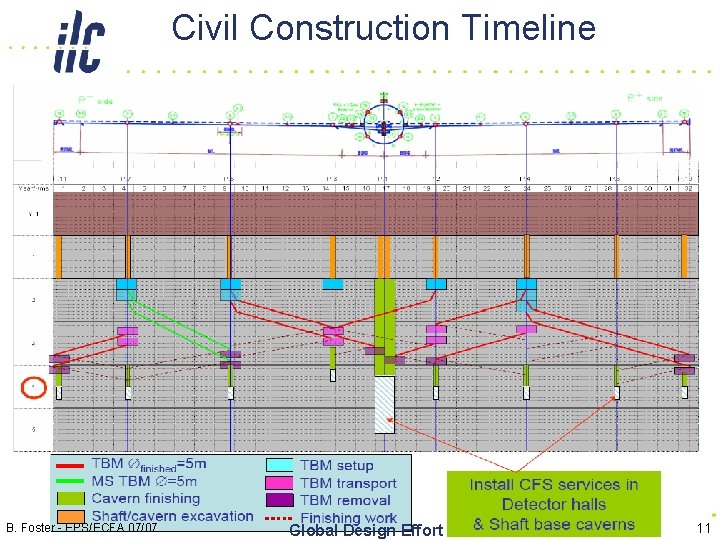
Civil Construction Timeline B. Foster - EPS/ECFA 07/07 Global Design Effort 11
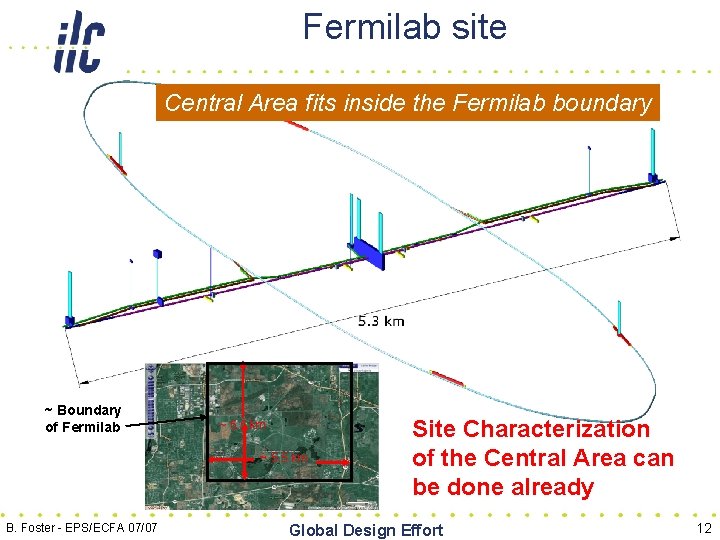
Fermilab site Central Area fits inside the Fermilab boundary ~ Boundary of Fermilab ~ 5. 5 km B. Foster - EPS/ECFA 07/07 Site Characterization of the Central Area can be done already Global Design Effort 12
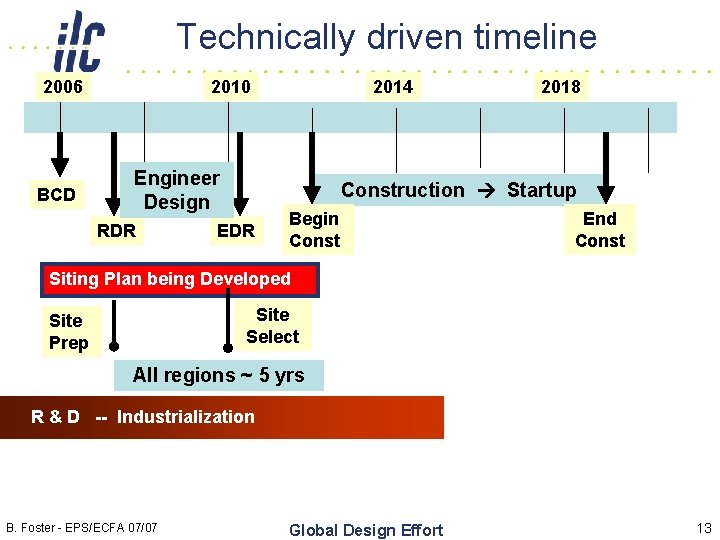
Technically driven timeline 2006 BCD 2010 Engineer Design RDR 2014 2018 Construction Startup EDR Begin Const End Const Siting Plan being Developed Site Select Site Prep All regions ~ 5 yrs R & D -- Industrialization August B. Foster - EPS/ECFA 07/07 Global Design Effort 13
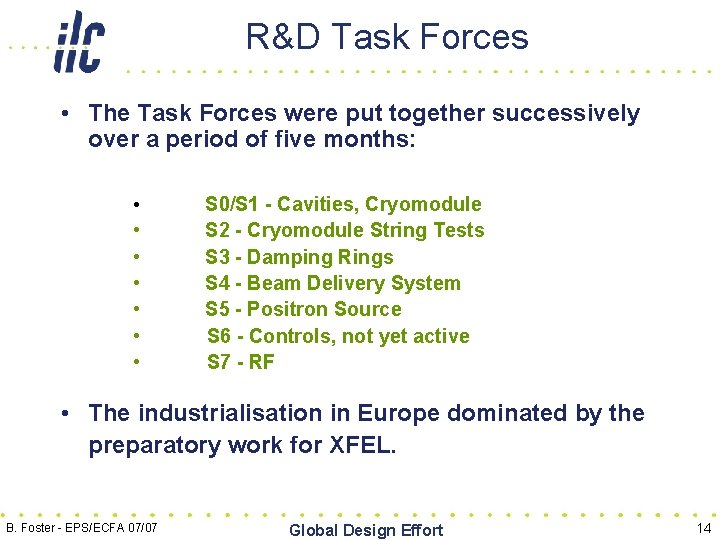
R&D Task Forces • The Task Forces were put together successively over a period of five months: • • S 0/S 1 - Cavities, Cryomodule S 2 - Cryomodule String Tests S 3 - Damping Rings S 4 - Beam Delivery System S 5 - Positron Source S 6 - Controls, not yet active S 7 - RF • The industrialisation in Europe dominated by the preparatory work for XFEL. B. Foster - EPS/ECFA 07/07 Global Design Effort 14
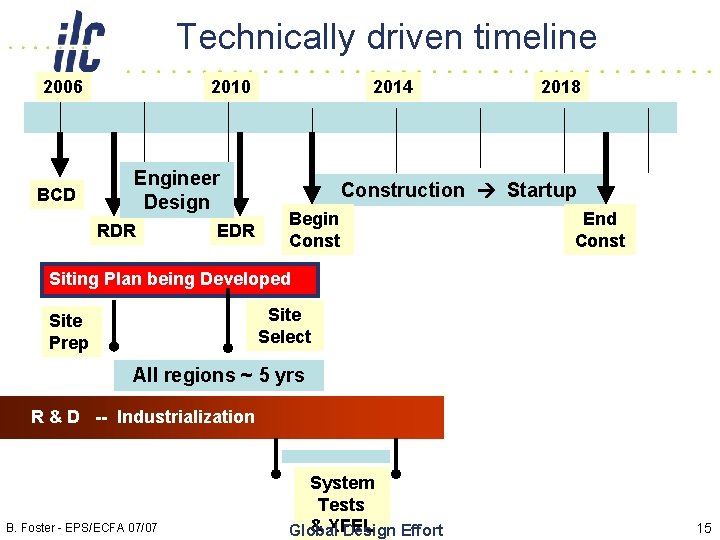
Technically driven timeline 2006 BCD 2010 Engineer Design RDR EDR 2014 2018 Construction Startup Begin Const End Const Siting Plan being Developed Site Select Site Prep All regions ~ 5 yrs R & D -- Industrialization B. Foster - EPS/ECFA 07/07 System Tests & XFEL Global Design Effort August 15
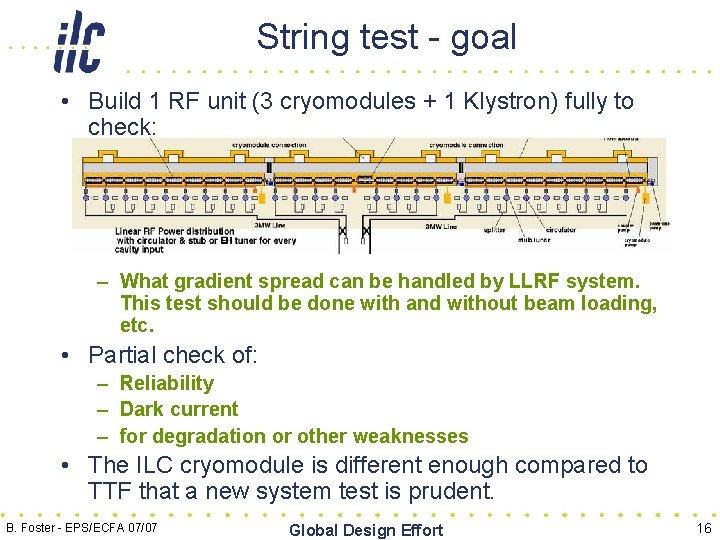
String test - goal • Build 1 RF unit (3 cryomodules + 1 Klystron) fully to check: – What gradient spread can be handled by LLRF system. This test should be done with and without beam loading, etc. • Partial check of: – Reliability – Dark current – for degradation or other weaknesses • The ILC cryomodule is different enough compared to TTF that a new system test is prudent. B. Foster - EPS/ECFA 07/07 Global Design Effort 16
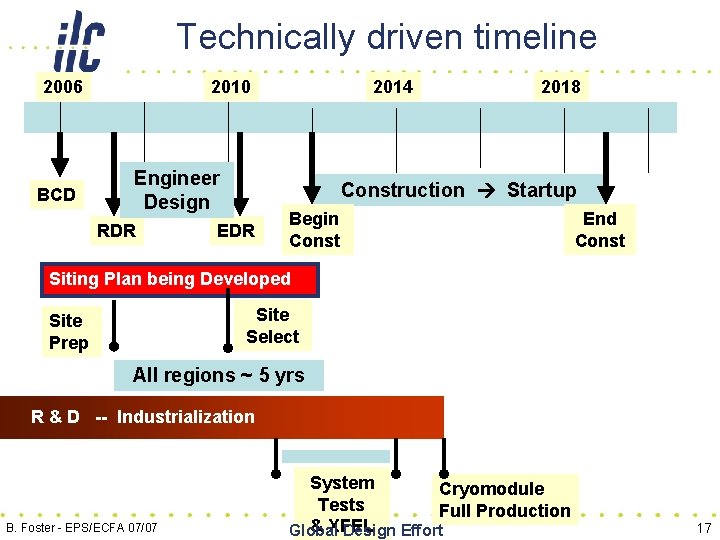
Technically driven timeline 2006 BCD 2010 Engineer Design RDR 2014 2018 Construction Startup EDR Begin Const End Const Siting Plan being Developed Site Select Site Prep All regions ~ 5 yrs R & D -- Industrialization B. Foster - EPS/ECFA 07/07 System Cryomodule Tests Full Production & XFEL Global Design Effort 17
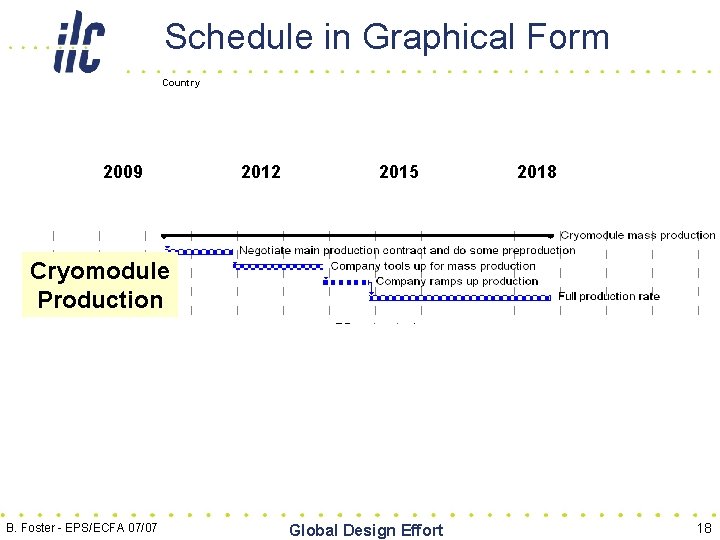
Schedule in Graphical Form Country 2009 2012 2015 2018 Cryomodule Production B. Foster - EPS/ECFA 07/07 Global Design Effort 18
Technically driven timeline 2006 BCD 2010 Engineer Design RDR 2014 Construction Startup EDR Begin Const Siting Plan being Developed Site Select Site Prep 2018 End Const Detector Construct Detector Install All regions ~ 5 yrs R & D -- Industrialization B. Foster - EPS/ECFA 07/07 System Cryomodule Tests August Full Production & XFEL Global Design Effort 19
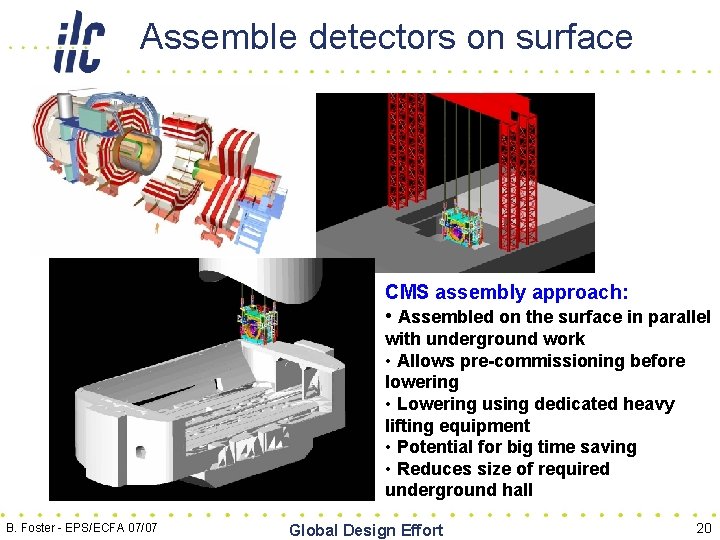
Assemble detectors on surface CMS assembly approach: • Assembled on the surface in parallel with underground work • Allows pre-commissioning before lowering • Lowering using dedicated heavy lifting equipment • Potential for big time saving • Reduces size of required underground hall B. Foster - EPS/ECFA 07/07 Global Design Effort 20
IR Hall for push-pull may be accessible during run detect or A detector B Platform for electronic and services (~10*8*8 m). Shielded (~0. 5 m of concrete) from five sides. Moves with detector. Also provide vibration isolation. B. Foster - EPS/ECFA 07/07 detect or A The concept is evolving and details being worked out detector B Global Design Effort accessible during run detect or A detector B 21
European situation • Europe has played a very important role in the ILC so far: – leadership within the GDE - BF & NW; – leadership within technical systems e. g. SCRF, BDS, e+ source, DR…. – leadership in industrialisation via XFEL activity. • This has been possible because of: – historical legacy from TESLA; – growing resources for accelerator R&D is some European countries; – strong support from EU; – synergy from XFEL. • Everything except the last point seems to be less favourable in future. B. Foster - EPS/ECFA 07/07 Global Design Effort 22
European situation • Analysis: – DESY resources into ILC specifically very small and hardly growing - HERA closure resources into XFEL and LHC experiments; – BUT REMEMBER XFEL SYNERGY! – resources inside European funding agencies flat or even decreasing; – resources inside EU FP 7 for accelerators also in general more constrained. B. Foster - EPS/ECFA 07/07 Global Design Effort 23
European situation • FP 7 calls: – “Preparatory phase” is intended for projects on the ESFRI Road map; scheme is meant to take mature projects over the final threshold to construction. ILC is eligible since it is on the European particle physics roadmap, which was assimilated into the ESFRI roadmap. The EU Commission ruled that only 2 projects were sufficiently advanced to be eligible for PP funding: the LHC upgrade, and ILC. Call last May; result expected imminently. Request ~ 7 MEuro - unlikely to get more than 50%. B. Foster - EPS/ECFA 07/07 Global Design Effort 24
European situation • Goals: – “Political”: prepare sites within Europe (including Russia) and explore with governments mechanisms for site proposal and selection; develop models for governance of an ILC laboratory - FALC Chair is a member of collaboration; develop outreach materials and strategies in many EU languages. – “Technical”: make 30 cavities integrated into ILC R&D programme; close interaction and synergy with XFEL facilities to build and test high-performance cavities and modules and to develop EU industrial capacity to produce substantial fraction of the ILC SC modules. B. Foster - EPS/ECFA 07/07 Global Design Effort 25
European situation • Further FP 7 calls: – Great deal of activity currently going on in ILC currently supported under Euro. Te. V. Some of this needs to continue under FP 7; but cannot be supported under PP because of restrictive nature of the call. – Communication between ESGARD and GDE has been very poor. This is improving now. Need to work closely with ESGARD to ensure that bids to IA call due in November contain the highest priority ILC R&D activities. Much scope here for cooperation and synergy with CLIC R&D. P. Burrows & E. Elsen coordinating this for GDE. B. Foster - EPS/ECFA 07/07 Global Design Effort 26
European situation • EDR phase: – In the next few months, WPs will be defined and negotiations to decide who does what concluded. Europe has to decide what resources it will devote to the EDR and which WPs it will deliver. Europe has played a very strong part until now. EDR phase requires increase in resources, particularly engineering. – At moment, such growth seems unlikely. CERN is the major European centre of expertise and engineering staff. The very small, and shrinking, involvement of CERN in the GDE is extremely regrettable. Europe has the capability to have great influence in the ILC with very small investment - we are at risk of loosing this. B. Foster - EPS/ECFA 07/07 Global Design Effort 27
Summary and Outlook • RDR Draft published in February 2007 • Final RDR to be published in August and presented to ILCSC - represents enormous effort over last 18 months. • Many R&D and engineering design issues still remain. – The next document will contain much more technical detail: Engineering Design Report due 2010. • Our job in the GDE is two-fold: - produce the EDR, a blueprint for ILC construction containing and hopefully reducing cost so that governments have to act. - mount political and scientific campaign to convince them and the general public that the ILC is a good investment. • We all had better do a good job the future health of world HEP depends on it. B. Foster - EPS/ECFA 07/07 Global Design Effort 28