
THE IFRS IMPLEMENTATION PROCESS IN THE EU Sophie
- Slides: 40
THE IFRS IMPLEMENTATION PROCESS IN THE EU Sophie BARANGER Chief Accountant - Autorité des Marchés Financiers CESR Representative at the European Accounting Regulatory Committee IOSCO representative at the International Financial Reporting Interpretation Committee IOSCO, Madrid - 16 th OCTOBER, 2007 1/1/2022 1
Table of contents 1. The European environment 2. CESR’s approach to the implementation of IFRS 3. AMF’s Accounting Division 4. Conclusion 1/1/2022 2
1. The European environment 2. CESR’s approach to the implementation of IFRS 3. AMF’s Accounting Division 4. Conclusion 1/1/2022 3
The European environment Consistency i. e Comparability? Absence of comparability imposes restatements by analysts / investors Restatement work is time consuming and increases cost of capital Ideal benchmark : direct comparability of financial information published by different issuers, from an investors’ perspective 1/1/2022 4
The European environment Consistency i. e Comparability? Different industries cannot be directly comparable – Specific industry accounting practices (e. g, revenue recognition) – Influence of other acounting frameworks e. g, US GAAP ltiterature) But comparability within an industry sector is highly desirable for investors (e. g, capitalisation of R&D expenses by automobile or pharmaceutical manufacturers; revenue recognition by software developpers…) Similar business transactions should be treated in the same way when the circumstances / business purposes are identical – Consolidation perimeter and methods – In rare cases, using judgment may lead to different conclusions (e. g, merger of equals) 1/1/2022 5
The European environment Objectives for the EU Consistent application of IFRS – High level of consistency • Means comparability between issuers throughout the EU • Only differences in management’s economic hypotheses, and minor flexibility in the choices made in the application of standards, is tolerable – Credibility for the investors and for US regulators • Ultimately, equivalence recognized by SEC and end to compulsory reconciliation to US GAAP « Light » implementation is not acceptable if the full benefits of harmonization are to be obtained – Level playing field between issuers – Market confidence in information Natural oversight role for regulators 1/1/2022 6
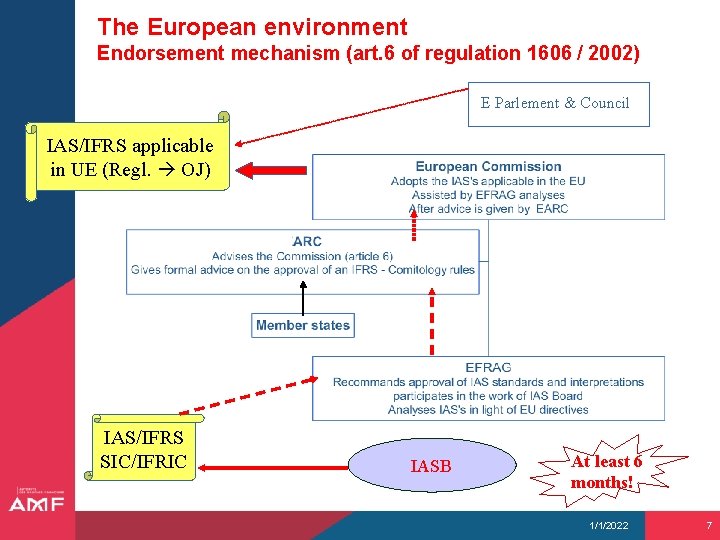
The European environment Endorsement mechanism (art. 6 of regulation 1606 / 2002) E Parlement & Council IAS/IFRS applicable in UE (Regl. OJ) IAS/IFRS SIC/IFRIC IASB At least 6 months! 1/1/2022 7
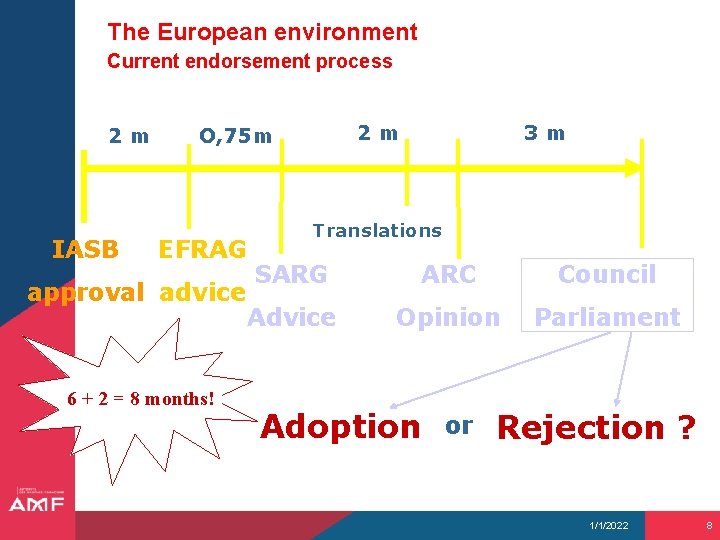
The European environment Current endorsement process 2 m IASB 2 m O, 75 m EFRAG approval advice 6 + 2 = 8 months! 3 m Translations SARG ARC Council Advice Opinion Parliament Adoption or Rejection ? 1/1/2022 8
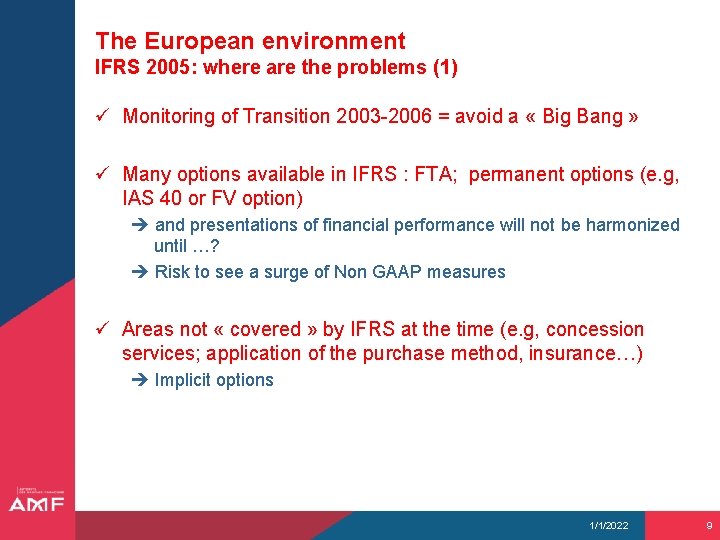
The European environment IFRS 2005: where are the problems (1) ü Monitoring of Transition 2003 -2006 = avoid a « Big Bang » ü Many options available in IFRS : FTA; permanent options (e. g, IAS 40 or FV option) and presentations of financial performance will not be harmonized until …? Risk to see a surge of Non GAAP measures ü Areas not « covered » by IFRS at the time (e. g, concession services; application of the purchase method, insurance…) Implicit options 1/1/2022 9
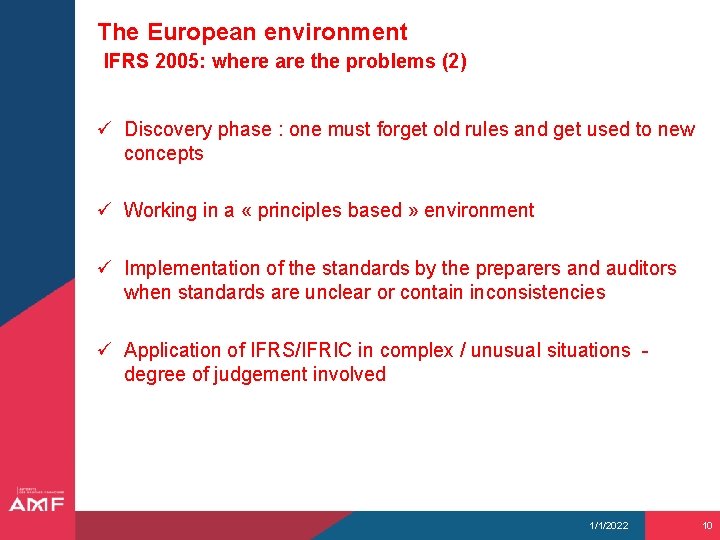
The European environment IFRS 2005: where are the problems (2) ü Discovery phase : one must forget old rules and get used to new concepts ü Working in a « principles based » environment ü Implementation of the standards by the preparers and auditors when standards are unclear or contain inconsistencies ü Application of IFRS/IFRIC in complex / unusual situations degree of judgement involved 1/1/2022 10
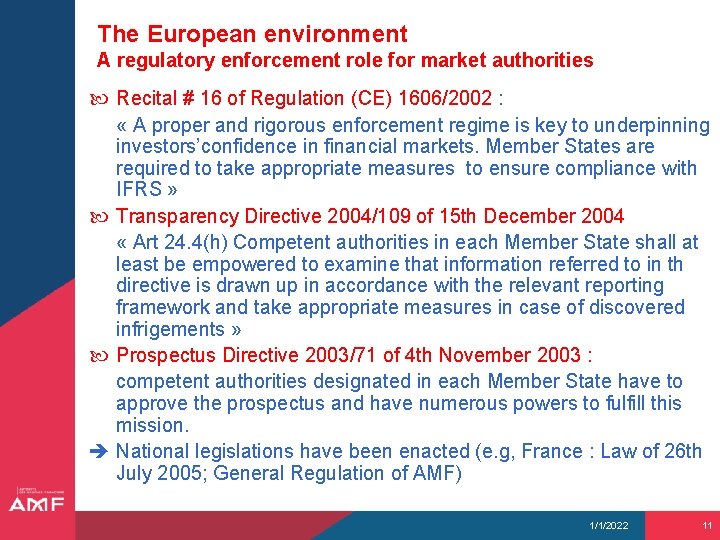
The European environment A regulatory enforcement role for market authorities Recital # 16 of Regulation (CE) 1606/2002 : « A proper and rigorous enforcement regime is key to underpinning investors’confidence in financial markets. Member States are required to take appropriate measures to ensure compliance with IFRS » Transparency Directive 2004/109 of 15 th December 2004 « Art 24. 4(h) Competent authorities in each Member State shall at least be empowered to examine that information referred to in th directive is drawn up in accordance with the relevant reporting framework and take appropriate measures in case of discovered infrigements » Prospectus Directive 2003/71 of 4 th November 2003 : competent authorities designated in each Member State have to approve the prospectus and have numerous powers to fulfill this mission. National legislations have been enacted (e. g, France : Law of 26 th July 2005; General Regulation of AMF) 1/1/2022 11
1. The European environment 2. CESR’s approach to IFRS 2005 3. AMF’s Accounting Division 4. Conclusion 1/1/2022 12
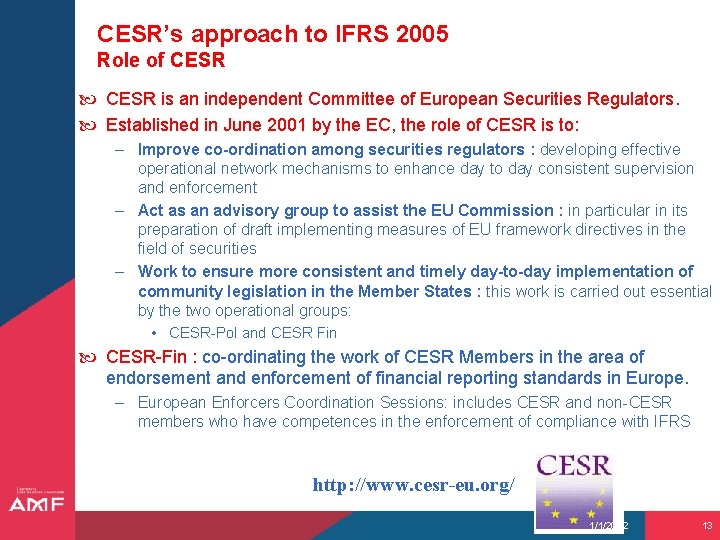
CESR’s approach to IFRS 2005 Role of CESR is an independent Committee of European Securities Regulators. Established in June 2001 by the EC, the role of CESR is to: – Improve co-ordination among securities regulators : developing effective operational network mechanisms to enhance day to day consistent supervision and enforcement – Act as an advisory group to assist the EU Commission : in particular in its preparation of draft implementing measures of EU framework directives in the field of securities – Work to ensure more consistent and timely day-to-day implementation of community legislation in the Member States : this work is carried out essential by the two operational groups: • CESR-Pol and CESR Fin CESR-Fin : co-ordinating the work of CESR Members in the area of endorsement and enforcement of financial reporting standards in Europe. – European Enforcers Coordination Sessions: includes CESR and non-CESR members who have competences in the enforcement of compliance with IFRS http: //www. cesr-eu. org/ 1/1/2022 13
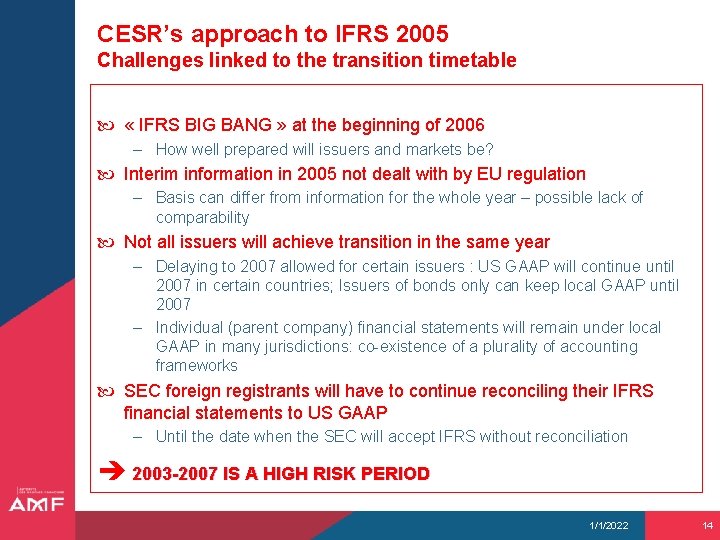
CESR’s approach to IFRS 2005 Challenges linked to the transition timetable « IFRS BIG BANG » at the beginning of 2006 – How well prepared will issuers and markets be? Interim information in 2005 not dealt with by EU regulation – Basis can differ from information for the whole year – possible lack of comparability Not all issuers will achieve transition in the same year – Delaying to 2007 allowed for certain issuers : US GAAP will continue until 2007 in certain countries; Issuers of bonds only can keep local GAAP until 2007 – Individual (parent company) financial statements will remain under local GAAP in many jurisdictions: co-existence of a plurality of accounting frameworks SEC foreign registrants will have to continue reconciling their IFRS financial statements to US GAAP – Until the date when the SEC will accept IFRS without reconciliation 2003 -2007 IS A HIGH RISK PERIOD 1/1/2022 14
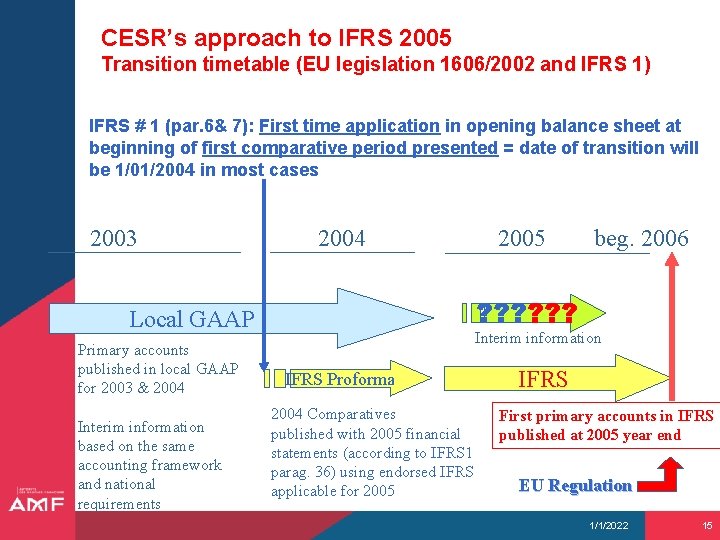
CESR’s approach to IFRS 2005 Transition timetable (EU legislation 1606/2002 and IFRS 1) IFRS # 1 (par. 6& 7): First time application in opening balance sheet at beginning of first comparative period presented = date of transition will be 1/01/2004 in most cases 2003 2004 Interim information based on the same accounting framework and national requirements beg. 2006 ? ? ? Local GAAP Primary accounts published in local GAAP for 2003 & 2004 2005 Interim information IFRS Proforma 2004 Comparatives published with 2005 financial statements (according to IFRS 1 parag. 36) using endorsed IFRS applicable for 2005 IFRS First primary accounts in IFRS published at 2005 year end EU Regulation 1/1/2022 15
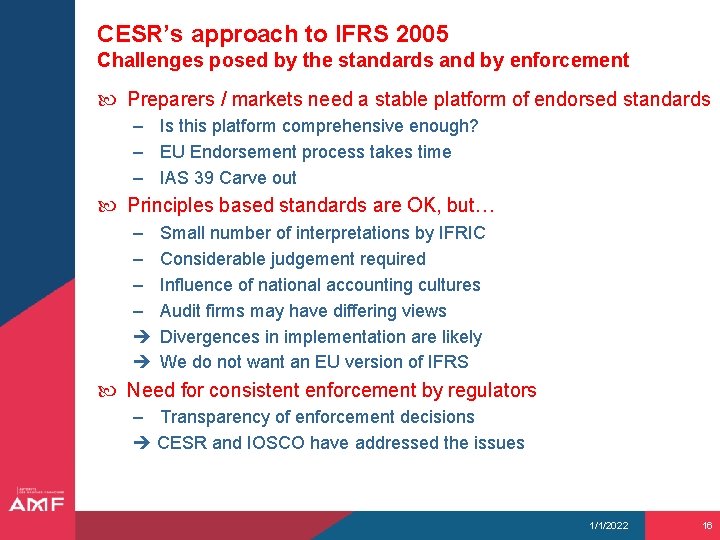
CESR’s approach to IFRS 2005 Challenges posed by the standards and by enforcement Preparers / markets need a stable platform of endorsed standards – Is this platform comprehensive enough? – EU Endorsement process takes time – IAS 39 Carve out Principles based standards are OK, but… – – Small number of interpretations by IFRIC Considerable judgement required Influence of national accounting cultures Audit firms may have differing views Divergences in implementation are likely We do not want an EU version of IFRS Need for consistent enforcement by regulators – Transparency of enforcement decisions CESR and IOSCO have addressed the issues 1/1/2022 16
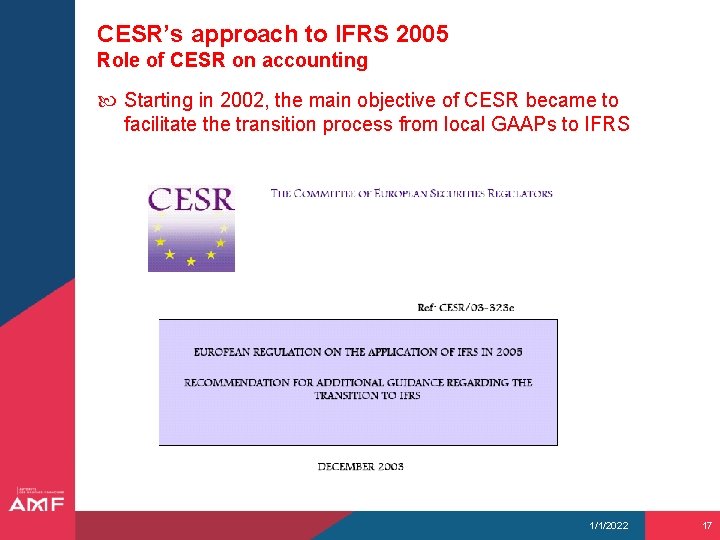
CESR’s approach to IFRS 2005 Role of CESR on accounting Starting in 2002, the main objective of CESR became to facilitate the transition process from local GAAPs to IFRS 1/1/2022 17
CESR’s approach to IFRS 2005 CESR’s response Provide for progressive information about IFRS in published documents – To prepare investors to the change in financial reporting language a 3 -step gradual and phased transition will help them understand the change, and will meet analysts’ demands for continuity – To encourage issuers to give early indications of their state of readiness with regards to their future reporting obligations Will allow to identify those who are not getting prepared in time Monitor progress made by issuers in preparing for the transition CESR members provide assistance to issuers when faced with complex situations Monitor auditors’ behaviour in reporting on published IFRS information during the transition phase 1/1/2022 18
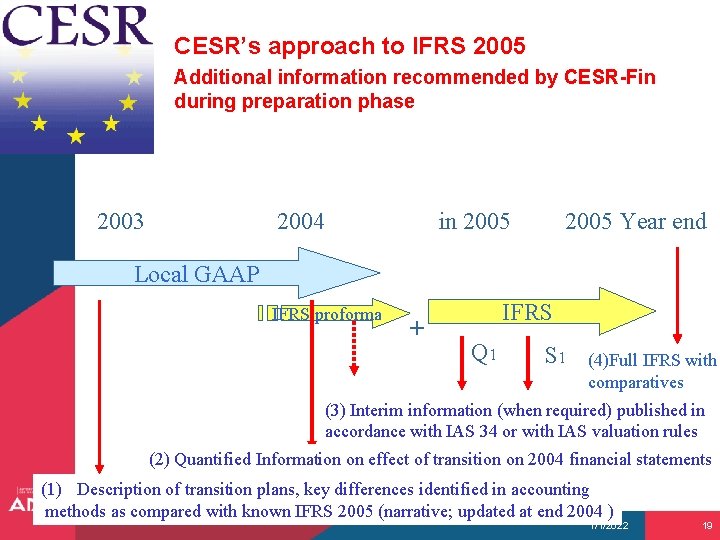
CESR’s approach to IFRS 2005 Additional information recommended by CESR-Fin during preparation phase 2003 2004 in 2005 Year end Local GAAP IFRS proforma + IFRS Q 1 S 1 (4)Full IFRS with comparatives (3) Interim information (when required) published in accordance with IAS 34 or with IAS valuation rules (2) Quantified Information on effect of transition on 2004 financial statements (1) Description of transition plans, key differences identified in accounting methods as compared with known IFRS 2005 (narrative; updated at end 2004 ) 1/1/2022 19
CESR’s approach to IFRS 2005 Consistency of enforcement European Enforcers’ Coordination Sessions (EECS): a forum for EU enforcers (CESR and non-CESR members) to exchange views and experiences related to complex situations and enforcement decisions taken Enforcement decisions are taken at the national level, but take into account precedents within the EU Standards n° 1 and 2 on: « Enforcement of standards on Financial Information in Europe » published by CESR Basis = Recital 16 of EU Regulation # 1606/2002 : “A proper and rigorous enforcement regime is key to underpinning investors' confidence in financial markets…/. . The Commission intends to liase with Member States, notably through the Committee of European Securities Regulators (CESR), to develop a common approach to enforcement. ” 1/1/2022 20
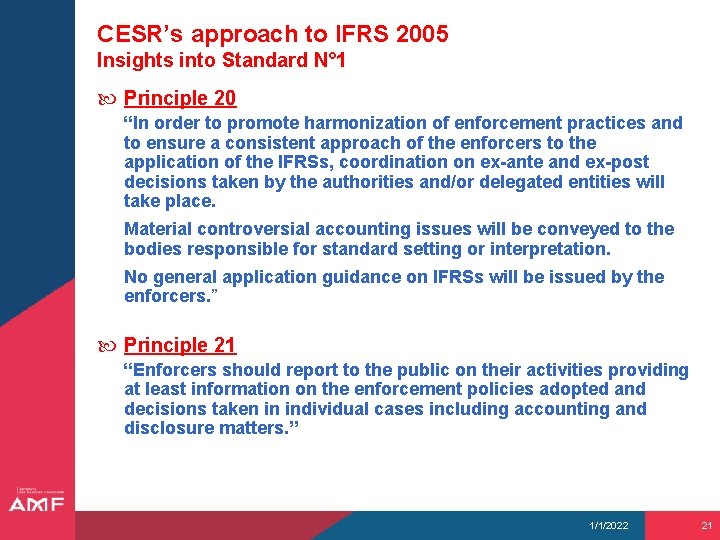
CESR’s approach to IFRS 2005 Insights into Standard N° 1 Principle 20 “In order to promote harmonization of enforcement practices and to ensure a consistent approach of the enforcers to the application of the IFRSs, coordination on ex-ante and ex-post decisions taken by the authorities and/or delegated entities will take place. Material controversial accounting issues will be conveyed to the bodies responsible for standard setting or interpretation. No general application guidance on IFRSs will be issued by the enforcers. ” Principle 21 “Enforcers should report to the public on their activities providing at least information on the enforcement policies adopted and decisions taken in individual cases including accounting and disclosure matters. ” 1/1/2022 21
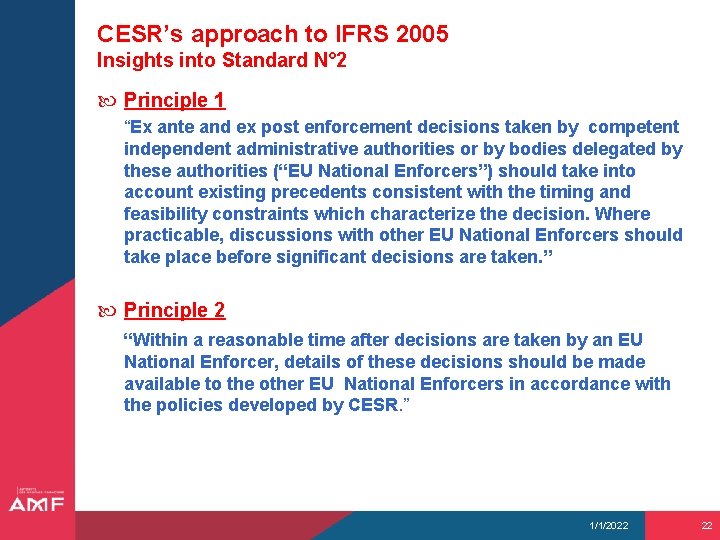
CESR’s approach to IFRS 2005 Insights into Standard N° 2 Principle 1 “Ex ante and ex post enforcement decisions taken by competent independent administrative authorities or by bodies delegated by these authorities (“EU National Enforcers”) should take into account existing precedents consistent with the timing and feasibility constraints which characterize the decision. Where practicable, discussions with other EU National Enforcers should take place before significant decisions are taken. ” Principle 2 “Within a reasonable time after decisions are taken by an EU National Enforcer, details of these decisions should be made available to the other EU National Enforcers in accordance with the policies developed by CESR. ” 1/1/2022 22
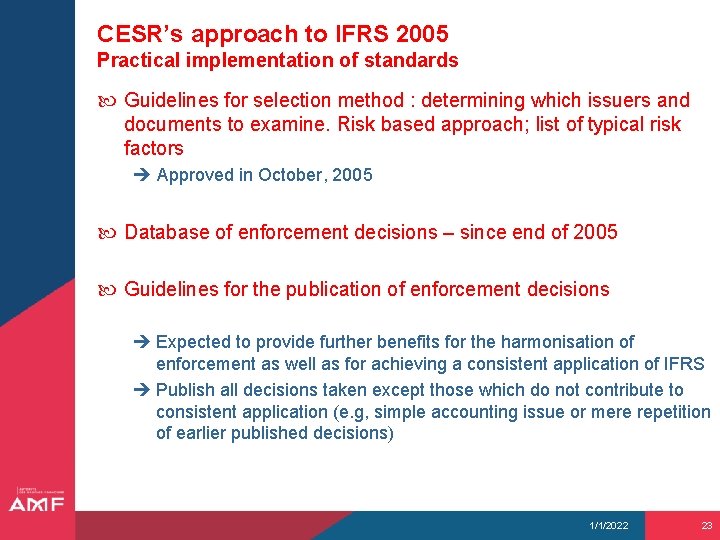
CESR’s approach to IFRS 2005 Practical implementation of standards Guidelines for selection method : determining which issuers and documents to examine. Risk based approach; list of typical risk factors Approved in October, 2005 Database of enforcement decisions – since end of 2005 Guidelines for the publication of enforcement decisions Expected to provide further benefits for the harmonisation of enforcement as well as for achieving a consistent application of IFRS Publish all decisions taken except those which do not contribute to consistent application (e. g, simple accounting issue or mere repetition of earlier published decisions) 1/1/2022 23
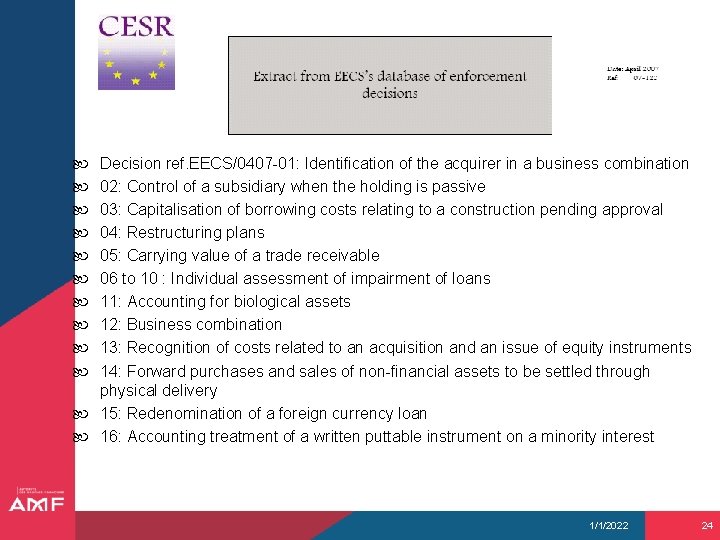
Decision ref. EECS/0407 -01: Identification of the acquirer in a business combination 02: Control of a subsidiary when the holding is passive 03: Capitalisation of borrowing costs relating to a construction pending approval 04: Restructuring plans 05: Carrying value of a trade receivable 06 to 10 : Individual assessment of impairment of loans 11: Accounting for biological assets 12: Business combination 13: Recognition of costs related to an acquisition and an issue of equity instruments 14: Forward purchases and sales of non-financial assets to be settled through physical delivery 15: Redenomination of a foreign currency loan 16: Accounting treatment of a written puttable instrument on a minority interest 1/1/2022 24
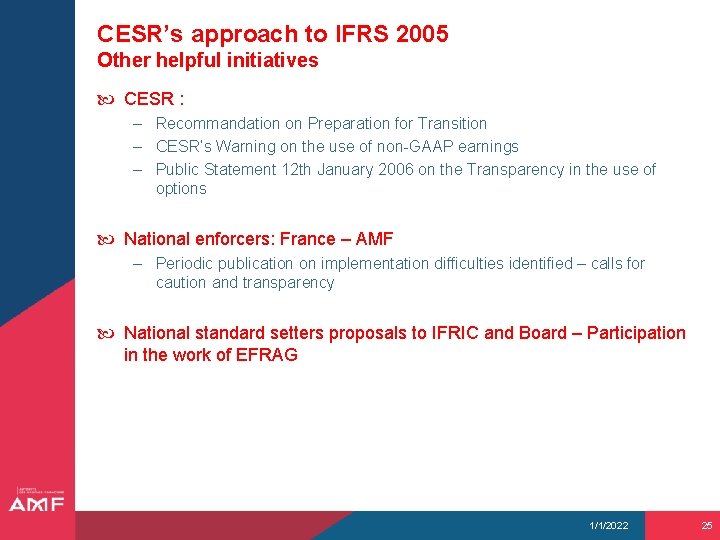
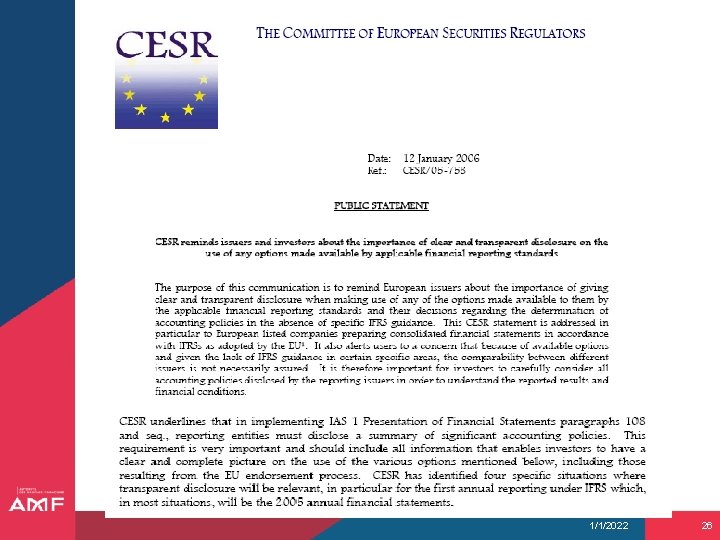
CESR’s approach to IFRS 2005 Other helpful initiatives CESR : – Recommandation on Preparation for Transition – CESR’s Warning on the use of non-GAAP earnings – Public Statement 12 th January 2006 on the Transparency in the use of options National enforcers: France – AMF – Periodic publication on implementation difficulties identified – calls for caution and transparency National standard setters proposals to IFRIC and Board – Participation in the work of EFRAG 1/1/2022 25
1/1/2022 26
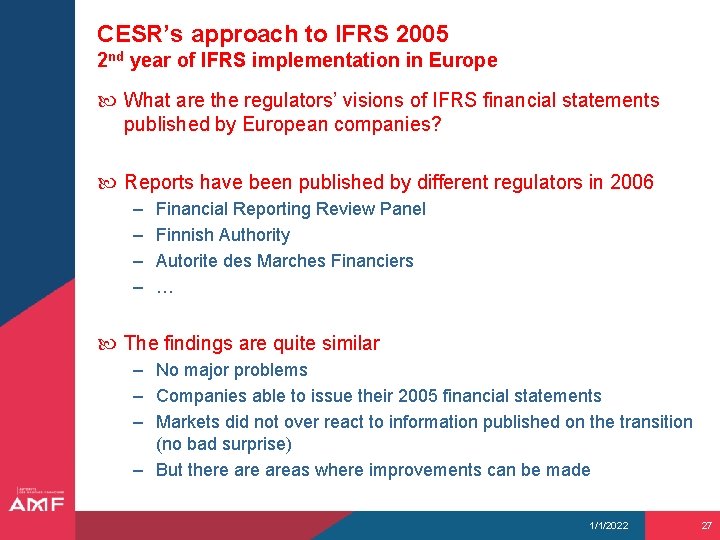
CESR’s approach to IFRS 2005 2 nd year of IFRS implementation in Europe What are the regulators’ visions of IFRS financial statements published by European companies? Reports have been published by different regulators in 2006 – – Financial Reporting Review Panel Finnish Authority Autorite des Marches Financiers … The findings are quite similar – No major problems – Companies able to issue their 2005 financial statements – Markets did not over react to information published on the transition (no bad surprise) – But there areas where improvements can be made 1/1/2022 27
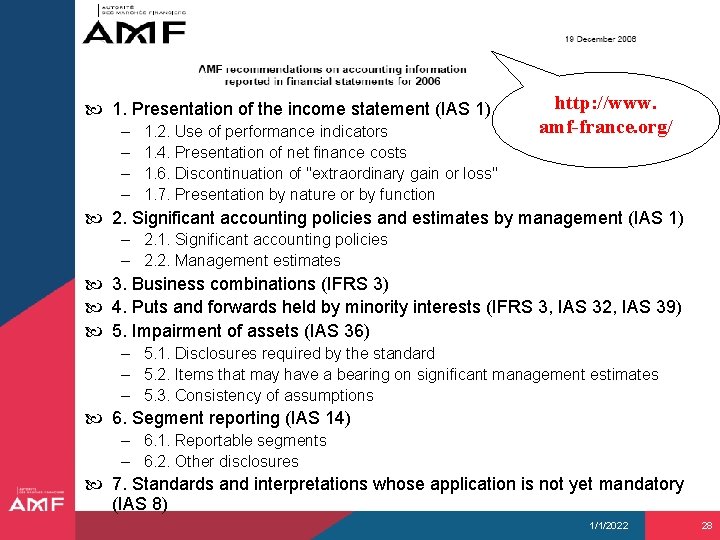
1. Presentation of the income statement (IAS 1) – – 1. 2. Use of performance indicators 1. 4. Presentation of net finance costs 1. 6. Discontinuation of "extraordinary gain or loss" 1. 7. Presentation by nature or by function http: //www. amf-france. org/ 2. Significant accounting policies and estimates by management (IAS 1) – 2. 1. Significant accounting policies – 2. 2. Management estimates 3. Business combinations (IFRS 3) 4. Puts and forwards held by minority interests (IFRS 3, IAS 32, IAS 39) 5. Impairment of assets (IAS 36) – 5. 1. Disclosures required by the standard – 5. 2. Items that may have a bearing on significant management estimates – 5. 3. Consistency of assumptions 6. Segment reporting (IAS 14) – 6. 1. Reportable segments – 6. 2. Other disclosures 7. Standards and interpretations whose application is not yet mandatory (IAS 8) 1/1/2022 28
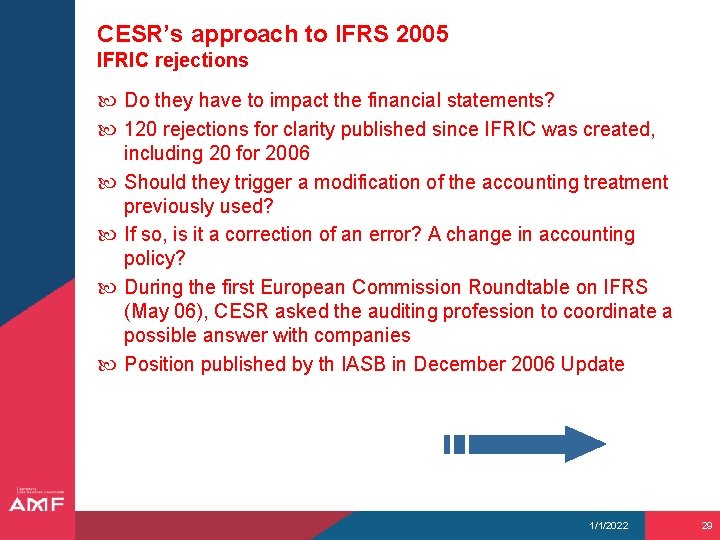
CESR’s approach to IFRS 2005 IFRIC rejections Do they have to impact the financial statements? 120 rejections for clarity published since IFRIC was created, including 20 for 2006 Should they trigger a modification of the accounting treatment previously used? If so, is it a correction of an error? A change in accounting policy? During the first European Commission Roundtable on IFRS (May 06), CESR asked the auditing profession to coordinate a possible answer with companies Position published by th IASB in December 2006 Update 1/1/2022 29
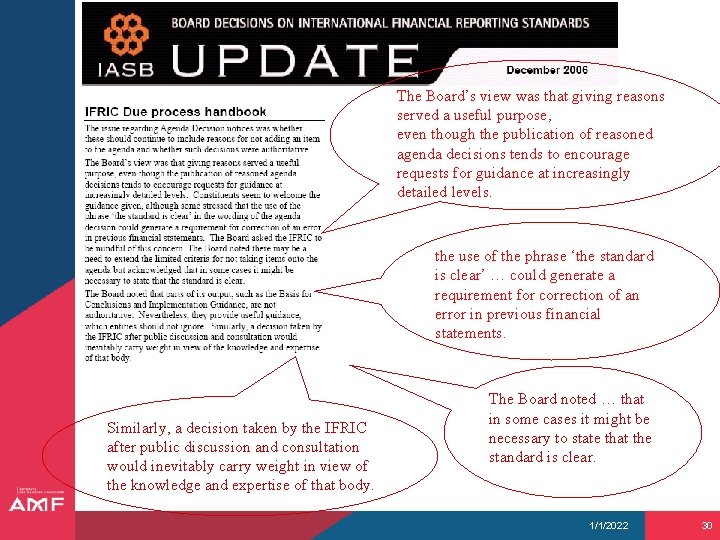
The Board’s view was that giving reasons served a useful purpose, even though the publication of reasoned agenda decisions tends to encourage requests for guidance at increasingly detailed levels. the use of the phrase ‘the standard is clear’ … could generate a requirement for correction of an error in previous financial statements. Similarly, a decision taken by the IFRIC after public discussion and consultation would inevitably carry weight in view of the knowledge and expertise of that body. The Board noted … that in some cases it might be necessary to state that the standard is clear. 1/1/2022 30
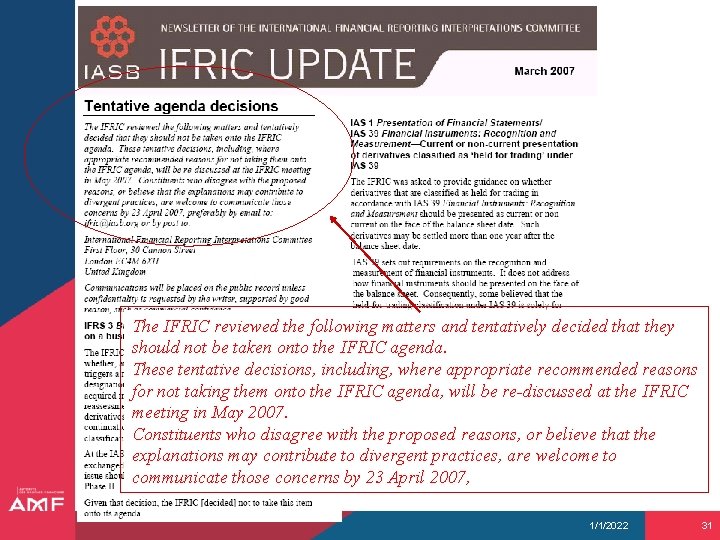
The IFRIC reviewed the following matters and tentatively decided that they should not be taken onto the IFRIC agenda. These tentative decisions, including, where appropriate recommended reasons for not taking them onto the IFRIC agenda, will be re-discussed at the IFRIC meeting in May 2007. Constituents who disagree with the proposed reasons, or believe that the explanations may contribute to divergent practices, are welcome to communicate those concerns by 23 April 2007, 1/1/2022 31
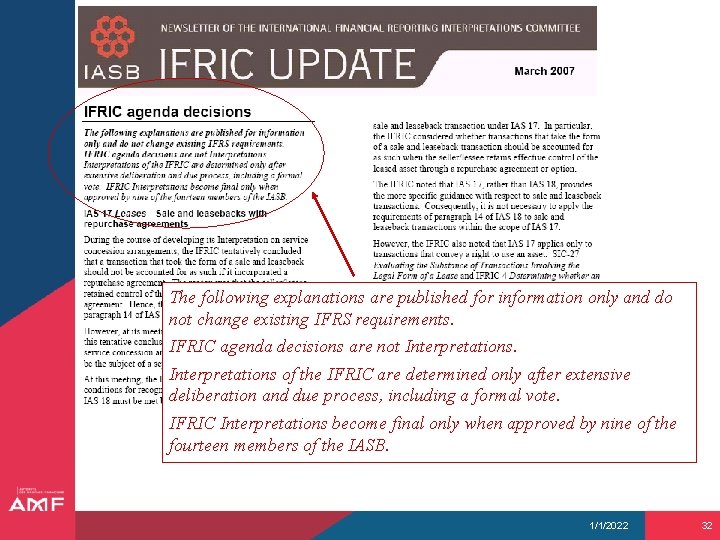
The following explanations are published for information only and do not change existing IFRS requirements. IFRIC agenda decisions are not Interpretations of the IFRIC are determined only after extensive deliberation and due process, including a formal vote. IFRIC Interpretations become final only when approved by nine of the fourteen members of the IASB. 1/1/2022 32
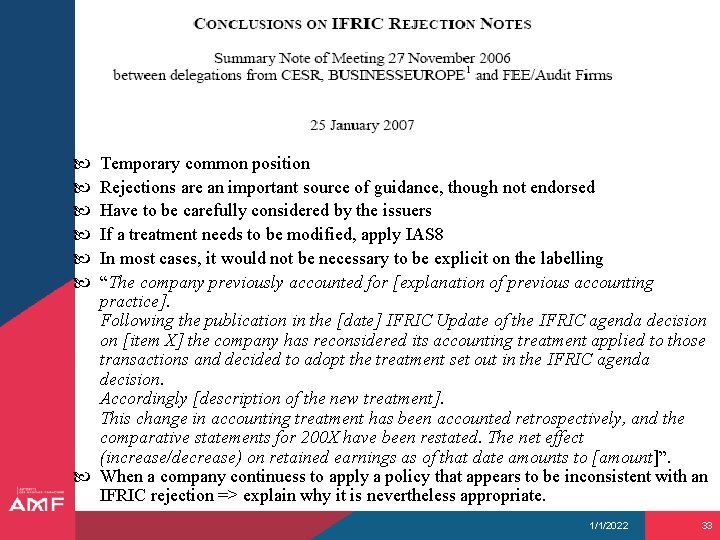
Temporary common position Rejections are an important source of guidance, though not endorsed Have to be carefully considered by the issuers If a treatment needs to be modified, apply IAS 8 In most cases, it would not be necessary to be explicit on the labelling “The company previously accounted for [explanation of previous accounting practice]. Following the publication in the [date] IFRIC Update of the IFRIC agenda decision on [item X] the company has reconsidered its accounting treatment applied to those transactions and decided to adopt the treatment set out in the IFRIC agenda decision. Accordingly [description of the new treatment]. This change in accounting treatment has been accounted retrospectively, and the comparative statements for 200 X have been restated. The net effect (increase/decrease) on retained earnings as of that date amounts to [amount]”. When a company continuess to apply a policy that appears to be inconsistent with an IFRIC rejection => explain why it is nevertheless appropriate. 1/1/2022 33
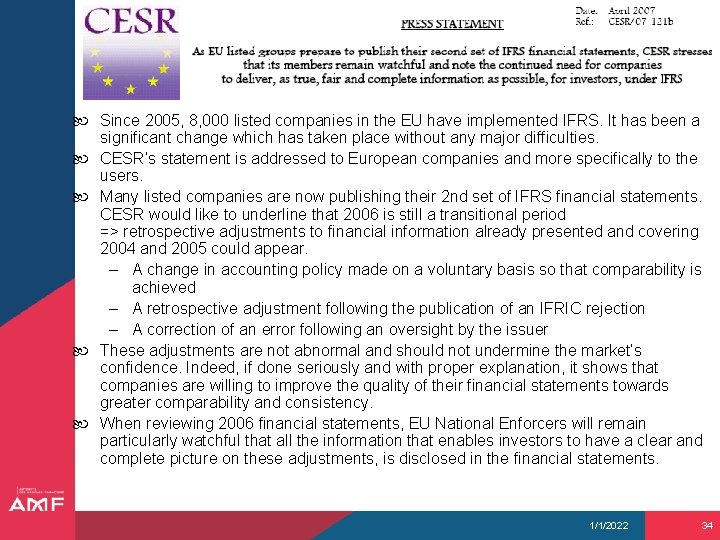
Since 2005, 8, 000 listed companies in the EU have implemented IFRS. It has been a significant change which has taken place without any major difficulties. CESR’s statement is addressed to European companies and more specifically to the users. Many listed companies are now publishing their 2 nd set of IFRS financial statements. CESR would like to underline that 2006 is still a transitional period => retrospective adjustments to financial information already presented and covering 2004 and 2005 could appear. – A change in accounting policy made on a voluntary basis so that comparability is achieved – A retrospective adjustment following the publication of an IFRIC rejection – A correction of an error following an oversight by the issuer These adjustments are not abnormal and should not undermine the market’s confidence. Indeed, if done seriously and with proper explanation, it shows that companies are willing to improve the quality of their financial statements towards greater comparability and consistency. When reviewing 2006 financial statements, EU National Enforcers will remain particularly watchful that all the information that enables investors to have a clear and complete picture on these adjustments, is disclosed in the financial statements. 1/1/2022 34
1. The European environment 2. CESR’s approach to the implementation of IFRS 3. AMF’s Accounting Division 4. Conclusion 1/1/2022 35
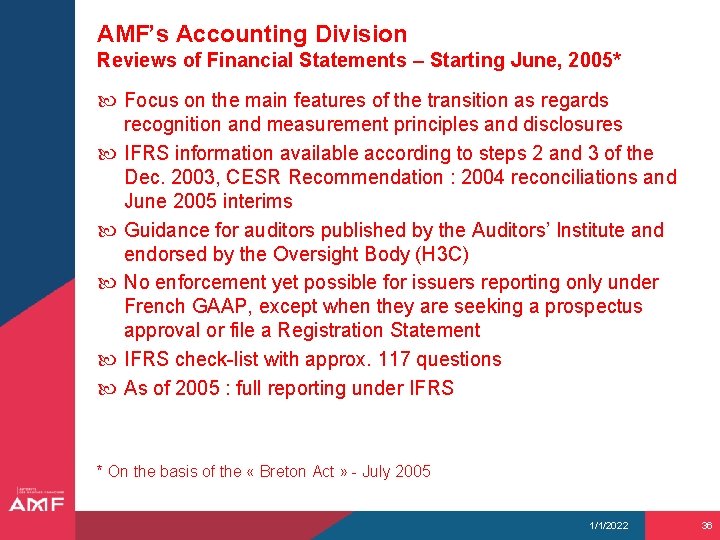
AMF’s Accounting Division Reviews of Financial Statements – Starting June, 2005* Focus on the main features of the transition as regards recognition and measurement principles and disclosures IFRS information available according to steps 2 and 3 of the Dec. 2003, CESR Recommendation : 2004 reconciliations and June 2005 interims Guidance for auditors published by the Auditors’ Institute and endorsed by the Oversight Body (H 3 C) No enforcement yet possible for issuers reporting only under French GAAP, except when they are seeking a prospectus approval or file a Registration Statement IFRS check-list with approx. 117 questions As of 2005 : full reporting under IFRS * On the basis of the « Breton Act » - July 2005 1/1/2022 36
AMF’s Accounting Division Relationship with auditors Auditors have a legal duty to communicate with the AMF (Section L 621 -22 of the French Financial and Monetary Code: – They can, without prejudice to their professional secrecy, ask questions to the AMF – They must answer questions from the AMF – They must file their reports to the AMF when going concern is questioned and when they intend to qualify their audit reports 1/1/2022 37
AMF’s Accounting Division Relationship with AOB and Audit Quality Control Audit Oversight Board (H 3 C) – The Chairman of the AMF is legally member of the oversight body – The DAC participates in the field work of the H 3 C Audit Quality Control – Quality control reviews are performed on an ongoing basis by the Auditors’ Institute – Since 2004, the H 3 C has ultimate responsibility for this program – Approx. 120 engagements related to listed companies are under review per year – The DAC participates in the summary meetings. This allows to collect information on the issuer, the ethics environment of the audit engagement and compliances with auditing standards – Outcomes : enforcement actions can be undertaken either by the profession (disciplinary) or the AMF (administrative), against the auditors and or the issuer. Inspections and investigations by AMF 1/1/2022 38
1. The European environment 2. CESR’s approach to the implementation of IFRS 3. AMF’s Accounting Division 4. Conclusion 1/1/2022 39
Tentative conclusions In the short term: costly and painful – «IFRS: No Pain, No Gain » ( Commissioner Mc Creevy) Obtaining full comparability will take several years – Impact of IFRS 1 options; persistance of unresolved technical issues; lack of guidance in certain areas/industries – 2005 -2007 transition due to options in the EU regulation IASB and IFRIC should devote sufficient resources to accompany difficulties and resolve the «bugs» – Help the constituents achieve consistent application of IFRS Longer-term benefits are real – Possible acceptance of IFRS as equivalent to US GAAP – Quality and comparability are greatly enhanced 1/1/2022 40