
The IEC UIC IEEE Train Communication Network for
- Slides: 31
The IEC / UIC / IEEE Train Communication Network for time-critical and safe on-board communication Pierre Zuber, Bombardier Transportation, Pittsburgh, USA Hubert Kirrmann, ABB Corporate Research, Baden, Switzerland • • • What is the Train Communication Network ? Wire Train Bus Multifunction Vehicle Bus Real-Time and Deterministic data transfer Message Services Available and Safe Architecture Standardization of Vehicle data ROSIN -Train. Com - ERRI projects Conclusion 2002 June 10, APTA, Baltimore, Zuber-Kirrmann 1
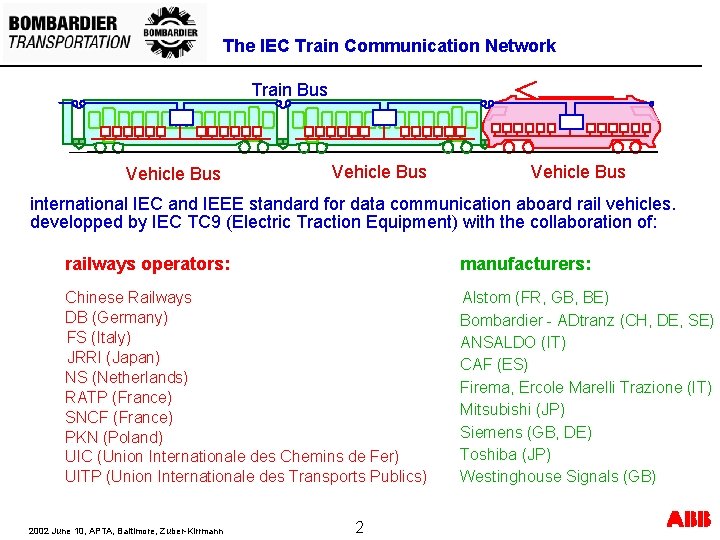
The IEC Train Communication Network Train Bus Vehicle Bus international IEC and IEEE standard for data communication aboard rail vehicles. developped by IEC TC 9 (Electric Traction Equipment) with the collaboration of: railways operators: manufacturers: Chinese Railways DB (Germany) FS (Italy) JRRI (Japan) NS (Netherlands) RATP (France) SNCF (France) PKN (Poland) UIC (Union Internationale des Chemins de Fer) UITP (Union Internationale des Transports Publics) Alstom (FR, GB, BE) Bombardier - ADtranz (CH, DE, SE) ANSALDO (IT) CAF (ES) Firema, Ercole Marelli Trazione (IT) Mitsubishi (JP) Siemens (GB, DE) Toshiba (JP) Westinghouse Signals (GB) 2002 June 10, APTA, Baltimore, Zuber-Kirrmann 2
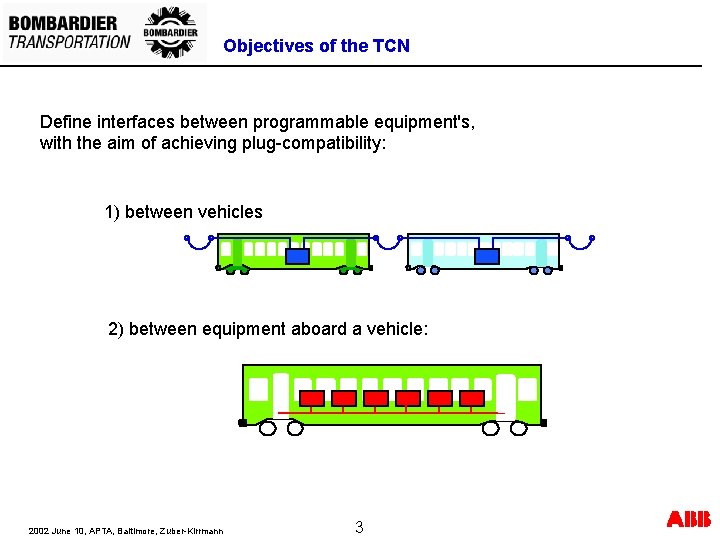
Objectives of the TCN Define interfaces between programmable equipment's, with the aim of achieving plug-compatibility: 1) between vehicles 2) between equipment aboard a vehicle: 2002 June 10, APTA, Baltimore, Zuber-Kirrmann 3
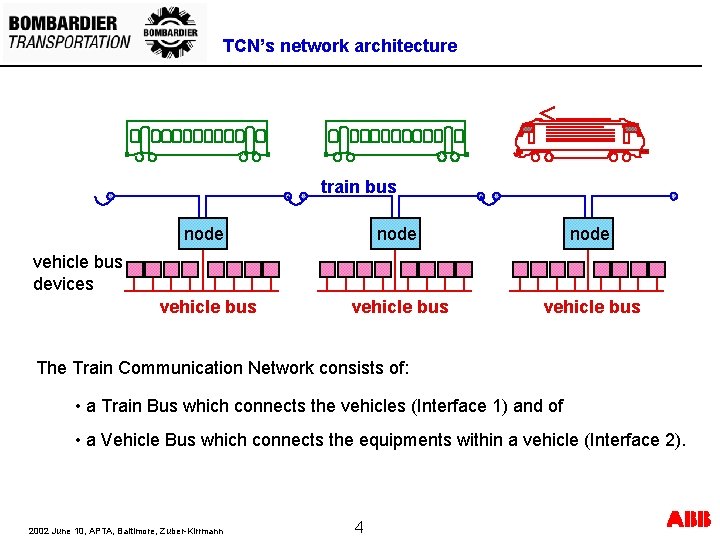
TCN’s network architecture train bus node vehicle bus devices The Train Communication Network consists of: • a Train Bus which connects the vehicles (Interface 1) and of • a Vehicle Bus which connects the equipments within a vehicle (Interface 2). 2002 June 10, APTA, Baltimore, Zuber-Kirrmann 4
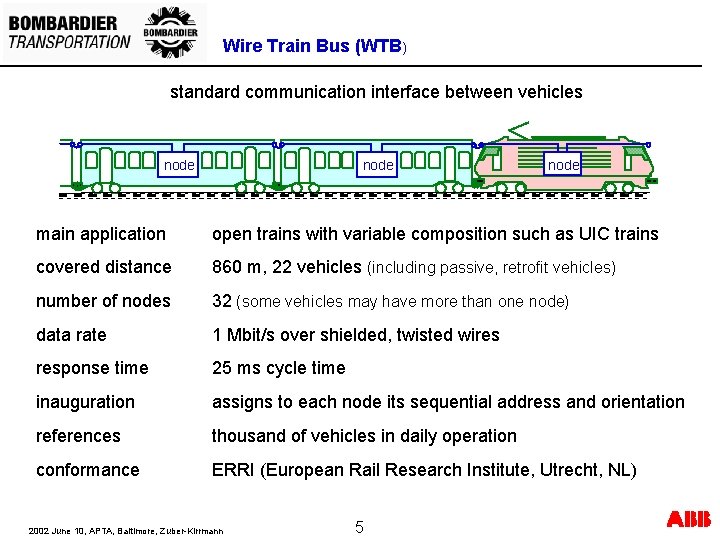
Wire Train Bus (WTB) standard communication interface between vehicles node main application open trains with variable composition such as UIC trains covered distance 860 m, 22 vehicles (including passive, retrofit vehicles) number of nodes 32 (some vehicles may have more than one node) data rate 1 Mbit/s over shielded, twisted wires response time 25 ms cycle time inauguration assigns to each node its sequential address and orientation references thousand of vehicles in daily operation conformance ERRI (European Rail Research Institute, Utrecht, NL) 2002 June 10, APTA, Baltimore, Zuber-Kirrmann 5
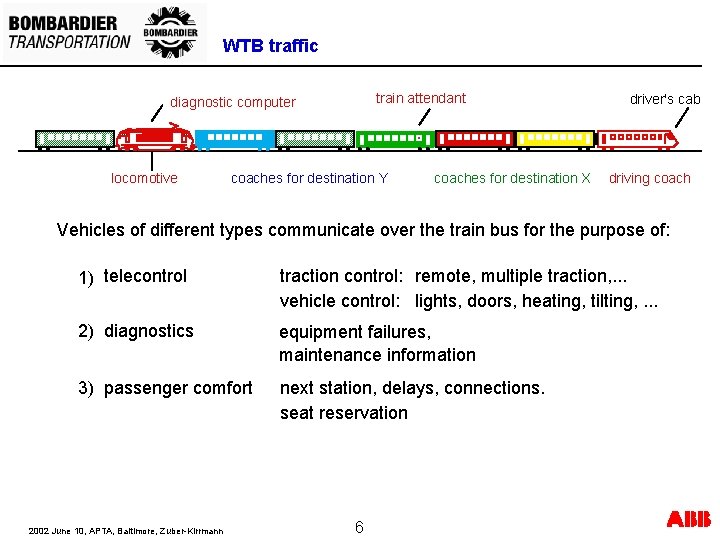
WTB traffic train attendant diagnostic computer locomotive coaches for destination Y coaches for destination X driver's cab driving coach Vehicles of different types communicate over the train bus for the purpose of: 1) telecontrol traction control: remote, multiple traction, . . . vehicle control: lights, doors, heating, tilting, . . . 2) diagnostics equipment failures, maintenance information 3) passenger comfort next station, delays, connections. seat reservation 2002 June 10, APTA, Baltimore, Zuber-Kirrmann 6
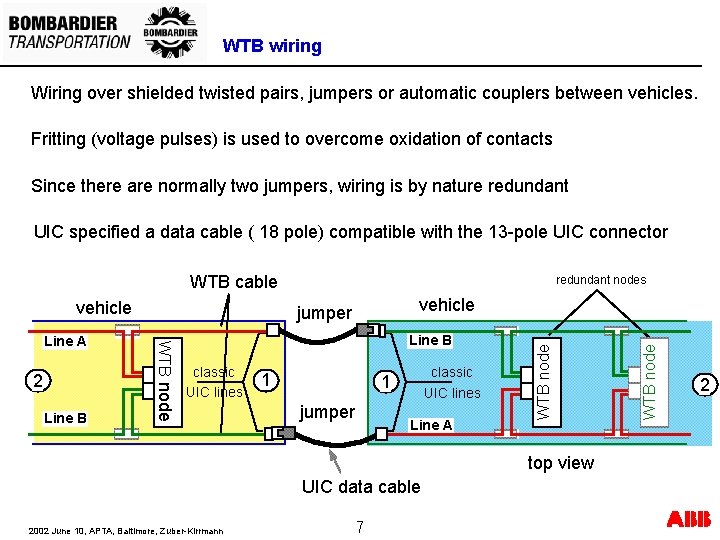
WTB wiring Wiring over shielded twisted pairs, jumpers or automatic couplers between vehicles. Fritting (voltage pulses) is used to overcome oxidation of contacts Since there are normally two jumpers, wiring is by nature redundant UIC specified a data cable ( 18 pole) compatible with the 13 -pole UIC connector WTB cable Line B classic UIC lines 1 jumper Line A top view UIC data cable 2002 June 10, APTA, Baltimore, Zuber-Kirrmann 7 WTB node 2 WTB node Line A vehicle jumper WTB node vehicle redundant nodes 2
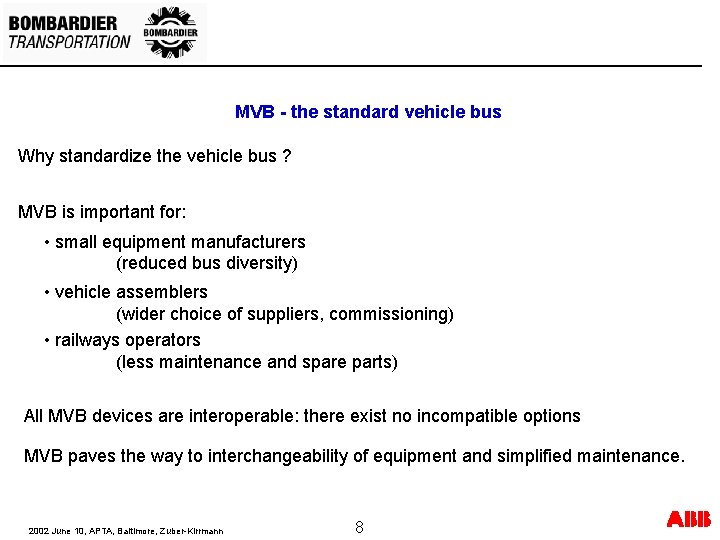
MVB - the standard vehicle bus Why standardize the vehicle bus ? MVB is important for: • small equipment manufacturers (reduced bus diversity) • vehicle assemblers (wider choice of suppliers, commissioning) • railways operators (less maintenance and spare parts) All MVB devices are interoperable: there exist no incompatible options MVB paves the way to interchangeability of equipment and simplified maintenance. 2002 June 10, APTA, Baltimore, Zuber-Kirrmann 8
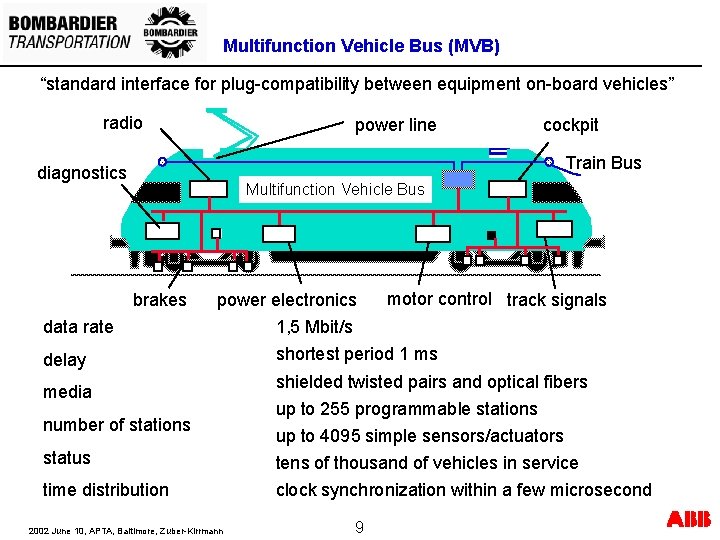
Multifunction Vehicle Bus (MVB) “standard interface for plug-compatibility between equipment on-board vehicles” radio power line cockpit Train Bus diagnostics Multifunction Vehicle Bus brakes data rate power electronics 1, 5 Mbit/s delay media number of stations motor control track signals shortest period 1 ms shielded twisted pairs and optical fibers up to 255 programmable stations up to 4095 simple sensors/actuators status tens of thousand of vehicles in service time distribution clock synchronization within a few microsecond 2002 June 10, APTA, Baltimore, Zuber-Kirrmann 9
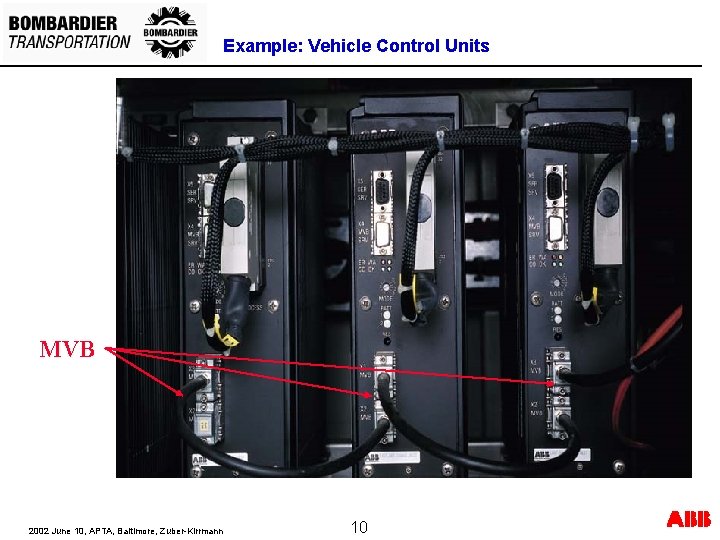
Example: Vehicle Control Units MVB 2002 June 10, APTA, Baltimore, Zuber-Kirrmann 10
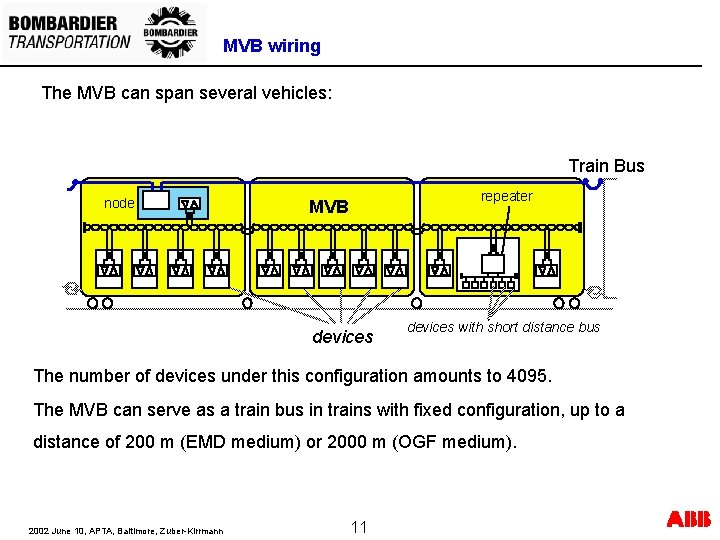
MVB wiring The MVB can span several vehicles: Train Bus node repeater MVB devices with short distance bus The number of devices under this configuration amounts to 4095. The MVB can serve as a train bus in trains with fixed configuration, up to a distance of 200 m (EMD medium) or 2000 m (OGF medium). 2002 June 10, APTA, Baltimore, Zuber-Kirrmann 11
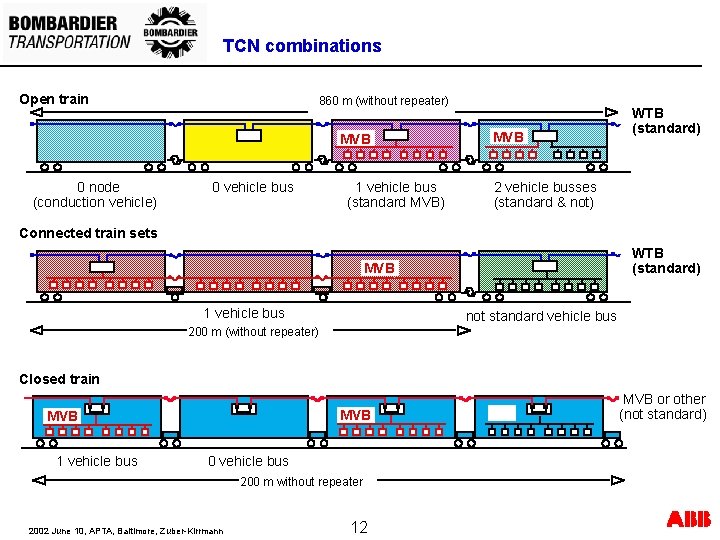
TCN combinations Open train 860 m (without repeater) MVB 0 node (conduction vehicle) 0 vehicle bus 1 vehicle bus (standard MVB) MVB WTB (standard) 2 vehicle busses (standard & not) Connected train sets WTB (standard) MVB 1 vehicle bus not standard vehicle bus 200 m (without repeater) Closed train MVB 1 vehicle bus 0 vehicle bus 200 m without repeater 2002 June 10, APTA, Baltimore, Zuber-Kirrmann 12 MVB or other (not standard)
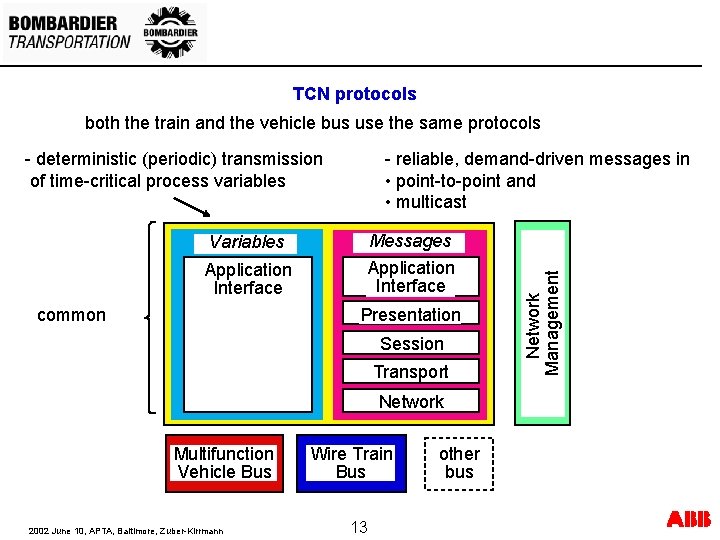
TCN protocols both the train and the vehicle bus use the same protocols - reliable, demand-driven messages in • point-to-point and • multicast Variables Messages Application Interface common Presentation Session Transport Network Multifunction Vehicle Bus 2002 June 10, APTA, Baltimore, Zuber-Kirrmann Wire Train Bus 13 other bus Network Management - deterministic (periodic) transmission of time-critical process variables
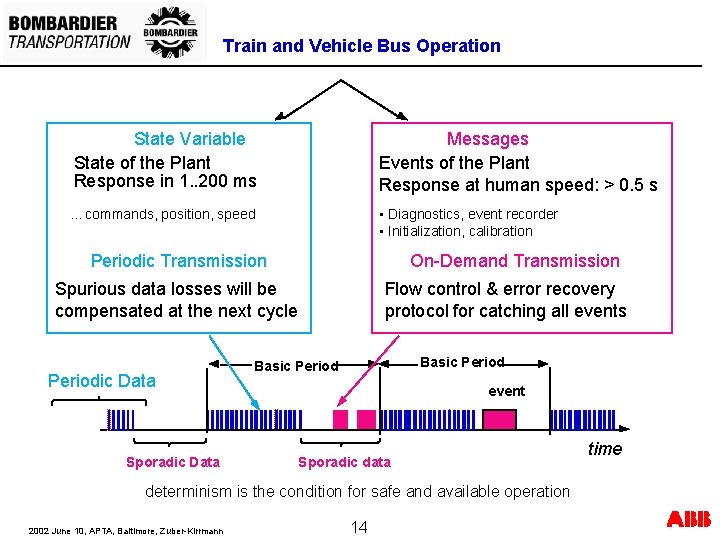
Train and Vehicle Bus Operation State Variable State of the Plant Response in 1. . 200 ms Messages Events of the Plant Response at human speed: > 0. 5 s . . . commands, position, speed • Diagnostics, event recorder • Initialization, calibration Periodic Transmission On-Demand Transmission Spurious data losses will be compensated at the next cycle Periodic Data Sporadic Data Flow control & error recovery protocol for catching all events Basic Period event Sporadic data determinism is the condition for safe and available operation 2002 June 10, APTA, Baltimore, Zuber-Kirrmann 14 time
WTB and MVB: Integrity and availability principles Both WTB and MVB comply with IEC 60870 -5 -1 integrity (HD = 4 on TWP, 8 on fiber) A study at Carnegie Mellon University fully confirmed TCN’s integrity. The TCN architecture allows to build a network without a single point of failure. Duplicated physical layer is the default, single line is also possible. 2002 June 10, APTA, Baltimore, Zuber-Kirrmann 15
Further standardization TCN laid the ground for standardization of data interchange not only between vehicles but also between vehicle and ground (signaling) and radio links 2002 June 10, APTA, Baltimore, Zuber-Kirrmann 16
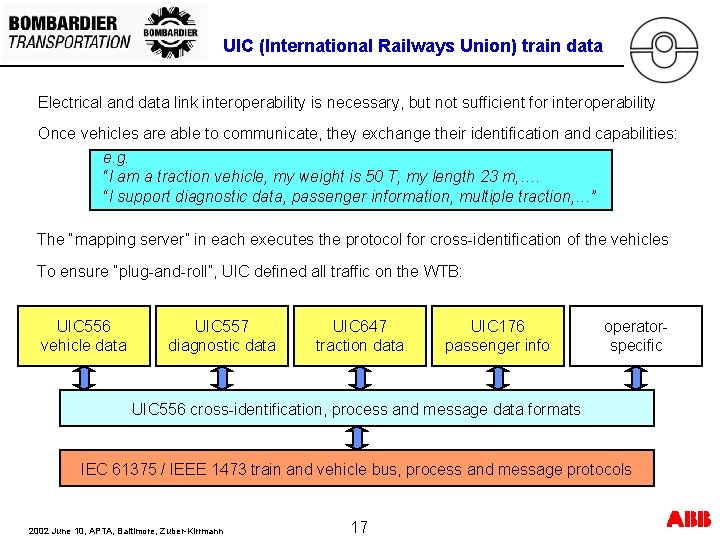
UIC (International Railways Union) train data Electrical and data link interoperability is necessary, but not sufficient for interoperability Once vehicles are able to communicate, they exchange their identification and capabilities: e. g. “I am a traction vehicle, my weight is 50 T, my length 23 m, …. “I support diagnostic data, passenger information, multiple traction, …” The “mapping server” in each executes the protocol for cross-identification of the vehicles To ensure “plug-and-roll”, UIC defined all traffic on the WTB: UIC 556 vehicle data UIC 557 diagnostic data UIC 647 traction data UIC 176 passenger info operatorspecific UIC 556 cross-identification, process and message data formats IEC 61375 / IEEE 1473 train and vehicle bus, process and message protocols 2002 June 10, APTA, Baltimore, Zuber-Kirrmann 17
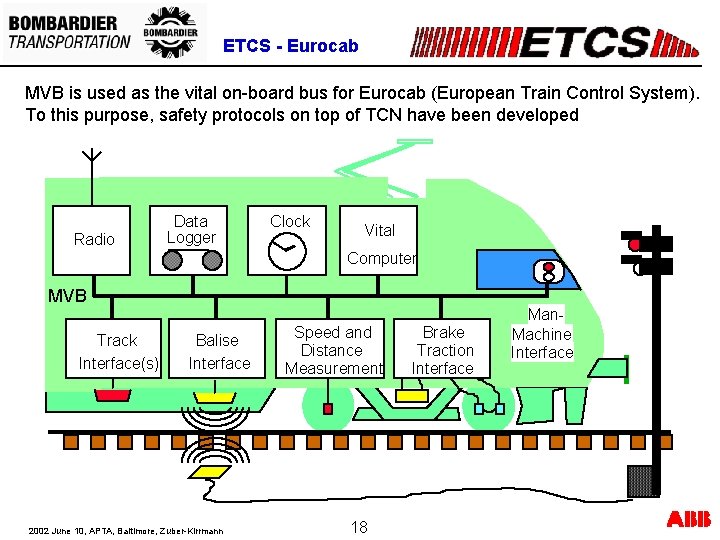
ETCS - Eurocab MVB is used as the vital on-board bus for Eurocab (European Train Control System). To this purpose, safety protocols on top of TCN have been developed Radio Data Logger Clock Vital Computer MVB Track Interface(s) Balise Interface 2002 June 10, APTA, Baltimore, Zuber-Kirrmann Speed and Distance Measurement 18 Brake Traction Interface Man. Machine Interface
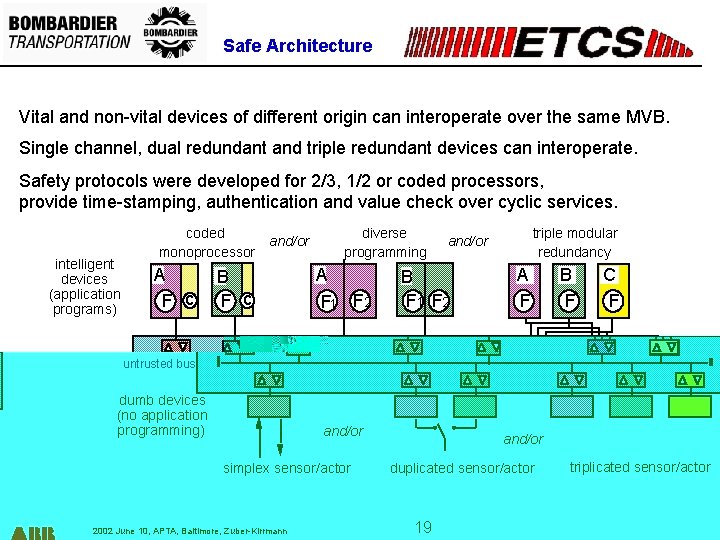
Safe Architecture Vital and non-vital devices of different origin can interoperate over the same MVB. Single channel, dual redundant and triple redundant devices can interoperate. Safety protocols were developed for 2/3, 1/2 or coded processors, provide time-stamping, authentication and value check over cyclic services. intelligent devices (application programs) coded monoprocessor A F c and/or diverse programming A F 1 F 2 B F c triple modular redundancy and/or B F 1 F 2 A F B F C F untrusted bus dumb devices (no application programming) and/or simplex sensor/actor 2002 June 10, APTA, Baltimore, Zuber-Kirrmann and/or duplicated sensor/actor 19 triplicated sensor/actor
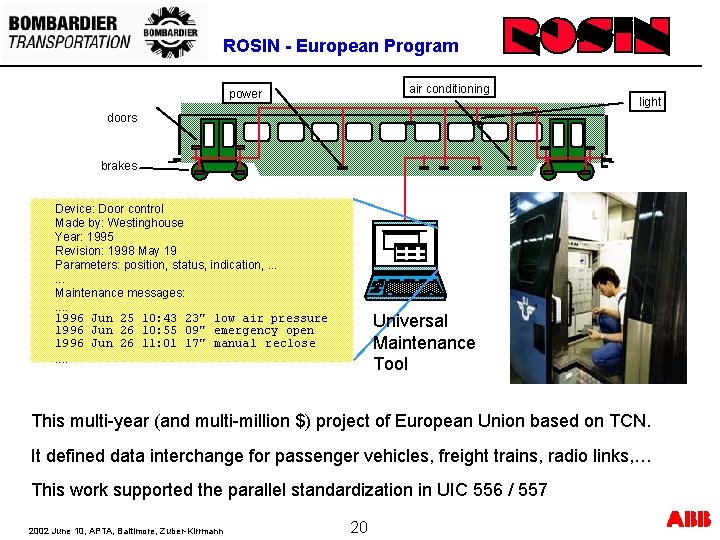
ROSIN - European Program air conditioning power light doors brakes Device: Door control Made by: Westinghouse Year: 1995 Revision: 1998 May 19 Parameters: position, status, indication, . . . Maintenance messages: . . 1996 Jun 25 10: 43 23" low air pressure 1996 Jun 26 10: 55 09" emergency open 1996 Jun 26 11: 01 17" manual reclose. . Universal Maintenance Tool This multi-year (and multi-million $) project of European Union based on TCN. It defined data interchange for passenger vehicles, freight trains, radio links, … This work supported the parallel standardization in UIC 556 / 557 2002 June 10, APTA, Baltimore, Zuber-Kirrmann 20
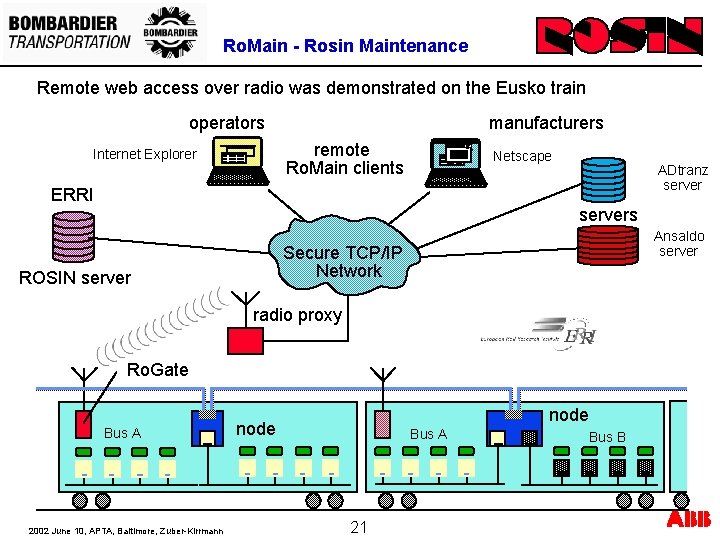
Ro. Main - Rosin Maintenance Remote web access over radio was demonstrated on the Eusko train operators manufacturers remote Ro. Main clients Internet Explorer Netscape ERRI ADtranz servers Ansaldo server Secure TCP/IP Network ROSIN server radio proxy Ro. Gate Bus A 2002 June 10, APTA, Baltimore, Zuber-Kirrmann node Bus A 21 Bus B
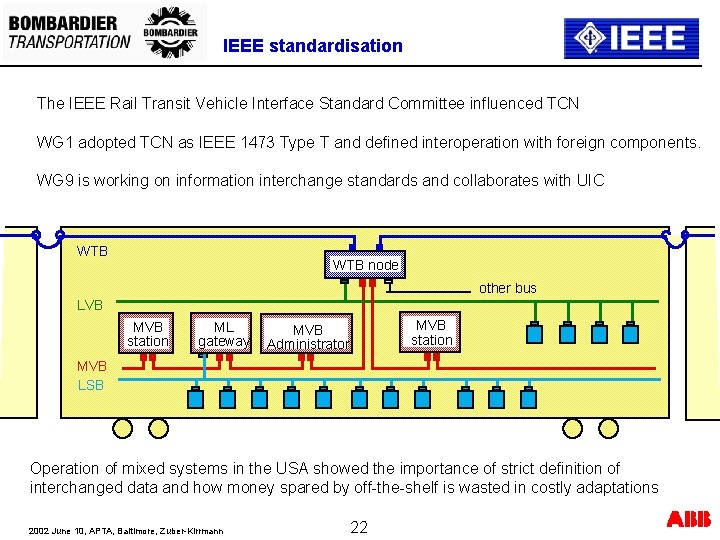
IEEE standardisation The IEEE Rail Transit Vehicle Interface Standard Committee influenced TCN WG 1 adopted TCN as IEEE 1473 Type T and defined interoperation with foreign components. WG 9 is working on information interchange standards and collaborates with UIC WTB node other bus LVB MVB station ML gateway MVB station MVB Administrator MVB LSB Operation of mixed systems in the USA showed the importance of strict definition of interchanged data and how money spared by off-the-shelf is wasted in costly adaptations 2002 June 10, APTA, Baltimore, Zuber-Kirrmann 22
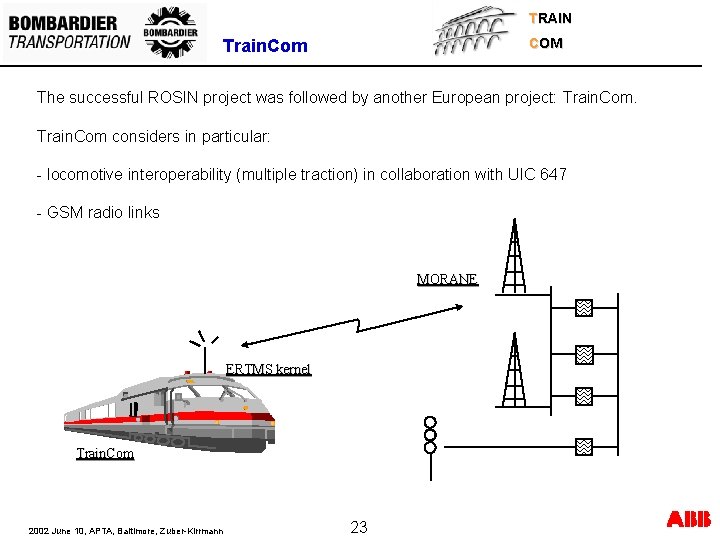
TRAIN Train. Com COM The successful ROSIN project was followed by another European project: Train. Com considers in particular: - locomotive interoperability (multiple traction) in collaboration with UIC 647 - GSM radio links MORANE ERTMS kernel Train. Com 2002 June 10, APTA, Baltimore, Zuber-Kirrmann 23
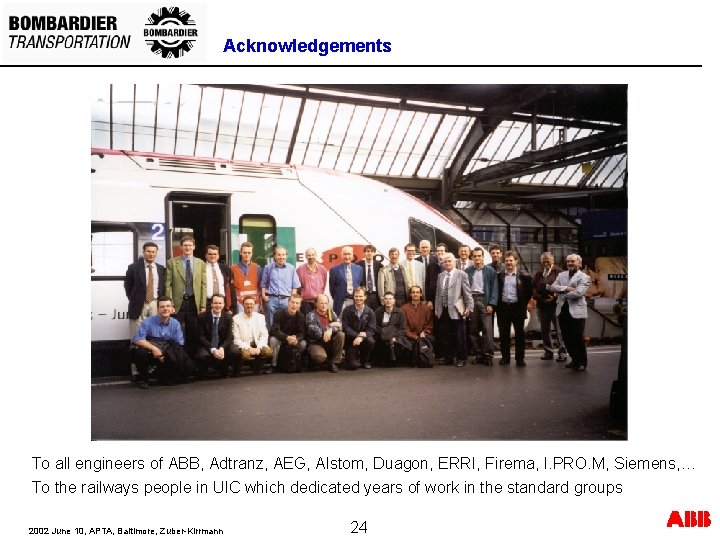
Acknowledgements To all engineers of ABB, Adtranz, AEG, Alstom, Duagon, ERRI, Firema, I. PRO. M, Siemens, … To the railways people in UIC which dedicated years of work in the standard groups 2002 June 10, APTA, Baltimore, Zuber-Kirrmann 24
Conclusion • TCN imposed itself as the standard communication network in railways • UIC did a great job in the definition of the application data, the industry could readily support this effort in the ROSIN and Train. Com projects. IEEE RTVISC WG 9 has adopted UIC 556 as the basis for IEEE 1473 -T train bus data communication. • TCN is a suite of communication and application protocols tailored for the railways, not just a field bus. • TCN is an open technology - there are no royalties, patents or copyrights. Anyone can build a TCN according to specs - chips are available. TCN source code is available on www. traincom. org • TCN (MVB) has been adopted in electrical substations and printing machines capitalizing on the work done by the railways community. • Work on TCN is not finished - UIC, Train. Com and IEEE RTVISC WG 9 are at work… 2002 June 10, APTA, Baltimore, Zuber-Kirrmann 25
Reserve slides 2002 June 10, APTA, Baltimore, Zuber-Kirrmann 26
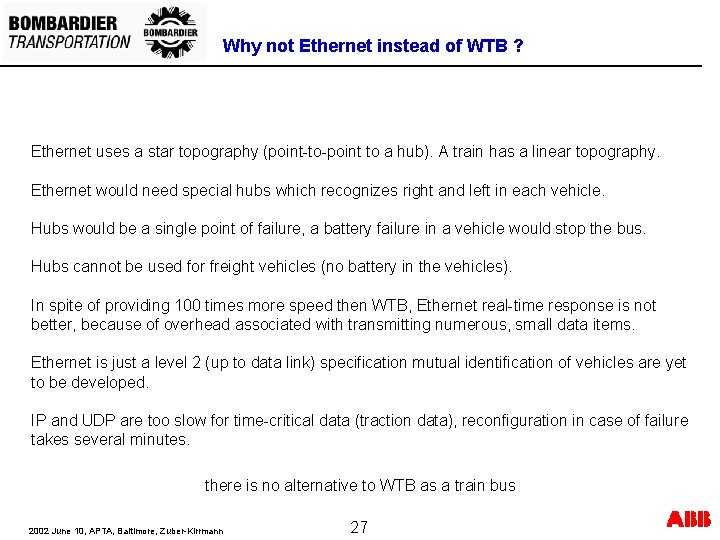
Why not Ethernet instead of WTB ? Ethernet uses a star topography (point-to-point to a hub). A train has a linear topography. Ethernet would need special hubs which recognizes right and left in each vehicle. Hubs would be a single point of failure, a battery failure in a vehicle would stop the bus. Hubs cannot be used for freight vehicles (no battery in the vehicles). In spite of providing 100 times more speed then WTB, Ethernet real-time response is not better, because of overhead associated with transmitting numerous, small data items. Ethernet is just a level 2 (up to data link) specification mutual identification of vehicles are yet to be developed. IP and UDP are too slow for time-critical data (traction data), reconfiguration in case of failure takes several minutes. there is no alternative to WTB as a train bus 2002 June 10, APTA, Baltimore, Zuber-Kirrmann 27
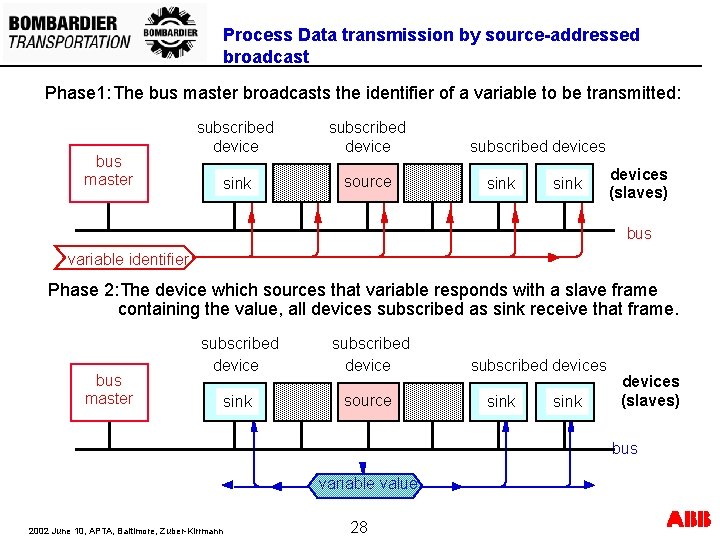
Process Data transmission by source-addressed broadcast Phase 1: The bus master broadcasts the identifier of a variable to be transmitted: bus master subscribed device sink source subscribed devices sink devices (slaves) bus variable identifier Phase 2: The device which sources that variable responds with a slave frame containing the value, all devices subscribed as sink receive that frame. bus master subscribed device sink source subscribed devices sink devices (slaves) bus variable value 2002 June 10, APTA, Baltimore, Zuber-Kirrmann 28
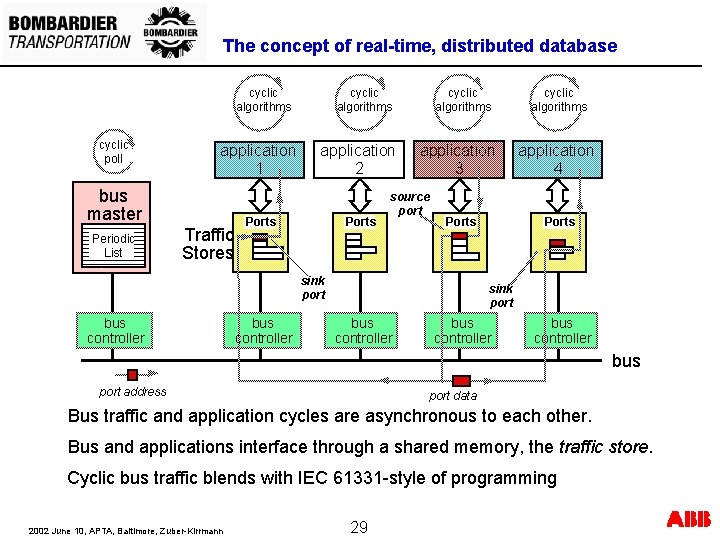
The concept of real-time, distributed database cyclic algorithms cyclic poll application 1 bus master Periodic List Traffic Stores cyclic algorithms application 2 Ports cyclic algorithms application 3 source port Ports sink port bus controller cyclic algorithms application 4 Ports sink port bus controller bus port address port data Bus traffic and application cycles are asynchronous to each other. Bus and applications interface through a shared memory, the traffic store. Cyclic bus traffic blends with IEC 61331 -style of programming 2002 June 10, APTA, Baltimore, Zuber-Kirrmann 29
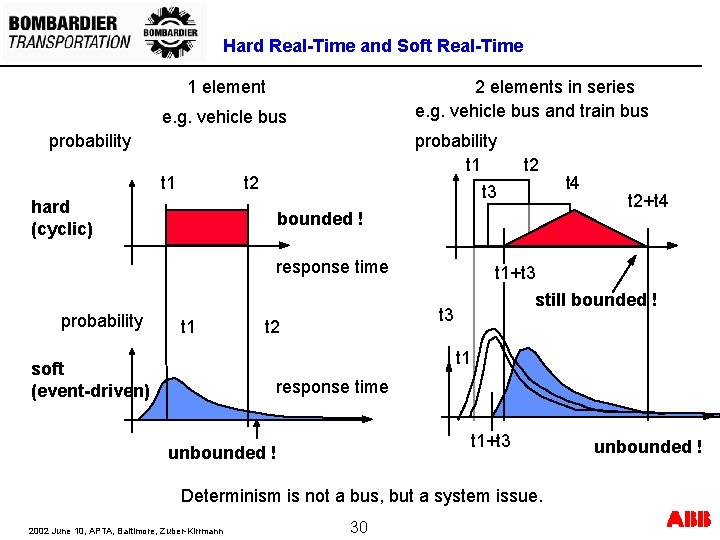
Hard Real-Time and Soft Real-Time 1 element 2 elements in series e. g. vehicle bus and train bus e. g. vehicle bus probability t 1 t 3 t 2 hard (cyclic) bounded ! response time probability t 2 t 1 t 2+t 4 t 1+t 3 still bounded ! t 3 t 2 t 4 t 1 soft (event-driven) response time t 1+t 3 unbounded ! Determinism is not a bus, but a system issue. 2002 June 10, APTA, Baltimore, Zuber-Kirrmann 30 unbounded !
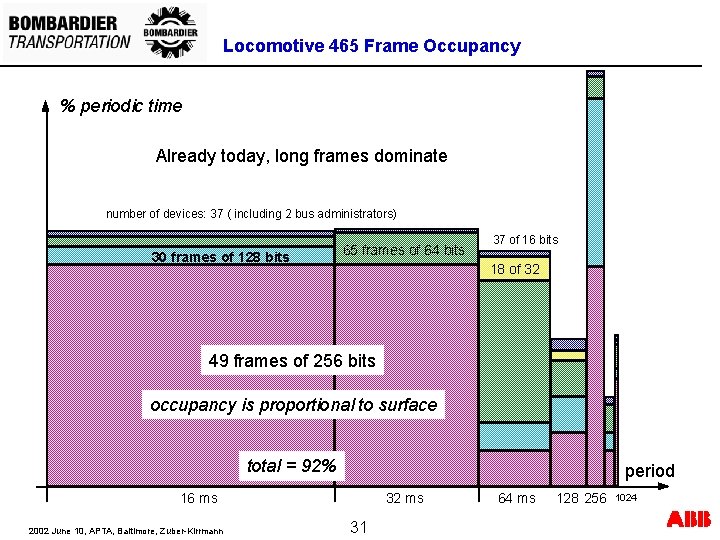
Locomotive 465 Frame Occupancy % periodic time Already today, long frames dominate number of devices: 37 ( including 2 bus administrators) 30 frames of 128 bits 65 frames of 64 bits 37 of 16 bits 18 of 32 49 frames of 256 bits occupancy is proportional to surface total = 92% period 16 ms 2002 June 10, APTA, Baltimore, Zuber-Kirrmann 32 ms 31 64 ms 128 256 1024