
The ICRP System of Radiological Protection and the

- Slides: 59
The ICRP System of Radiological Protection and the Human Dimension - Some Reflections about Chernobyl and Fukushima - Jacques LOCHARD Vice Chair of ICRP Director of CEPN - France 25 th Shinji Takahashi Memorial Lecture Annual Meeting of the Japanese Association of Medical Radiological Protection National Cancer Research Institute 12 December 2014, Tokyo, Japan This presentation has neither been approved nor endorsed by ICRP
The human dimension There is no standard definition of what is meant by the human dimension In my sense it is a broad notion that encompasses what individuals feel (their affects), what meaning they give to their existence and the moral consciousness they develop, which is the foundation of ethics (their spirituality), and what they do to achieve their aims in society (their actions) In my today’s presentation, I will focus among other issues on the ethical dimension and I will try to show that the system of radiological protection promoted by ICRP is rooted in universally shared ethical values 2
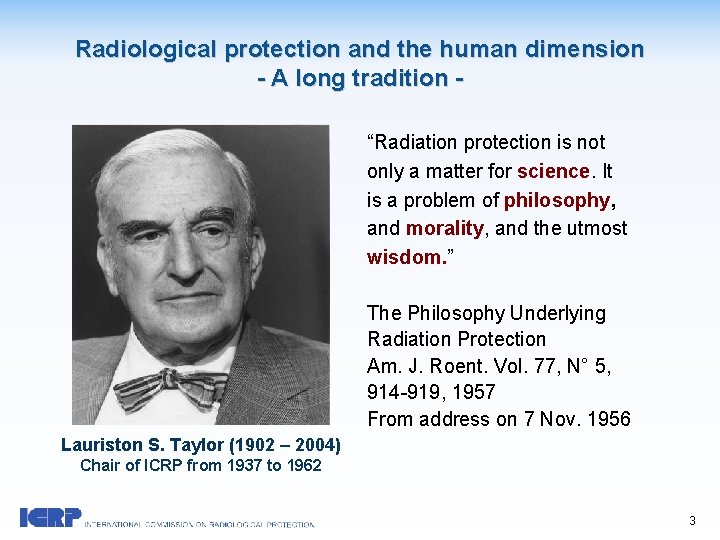
Radiological protection and the human dimension - A long tradition - “Radiation protection is not only a matter for science. It is a problem of philosophy, and morality, and the utmost wisdom. ” The Philosophy Underlying Radiation Protection Am. J. Roent. Vol. 77, N° 5, 914 -919, 1957 From address on 7 Nov. 1956 Lauriston S. Taylor (1902 – 2004) Chair of ICRP from 1937 to 1962 3
Wisdom • A basic definition of wisdom is the quality of having experience, knowledge, and good judgement (Oxford dictionary) • In its popular sense, wisdom is attributed to a person who takes reasonable decisions and act accordingly • As a virtue, wisdom is the disposition to behave and act with the highest degree of adequacy under any given circumstances often in line with an ethics combining self-awareness and that of others, temperance, prudence, sincerity and discernment based on reasoned knowledge 4
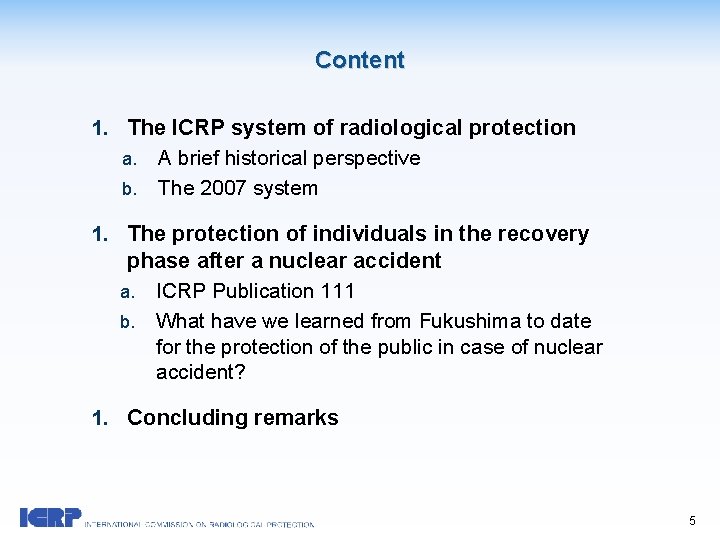
Content 1. The ICRP system of radiological protection a. A brief historical perspective b. The 2007 system 1. The protection of individuals in the recovery phase after a nuclear accident a. ICRP Publication 111 b. What have we learned from Fukushima to date for the protection of the public in case of nuclear accident? 1. Concluding remarks 5
Part 1 The ICRP system of radiological protection 6
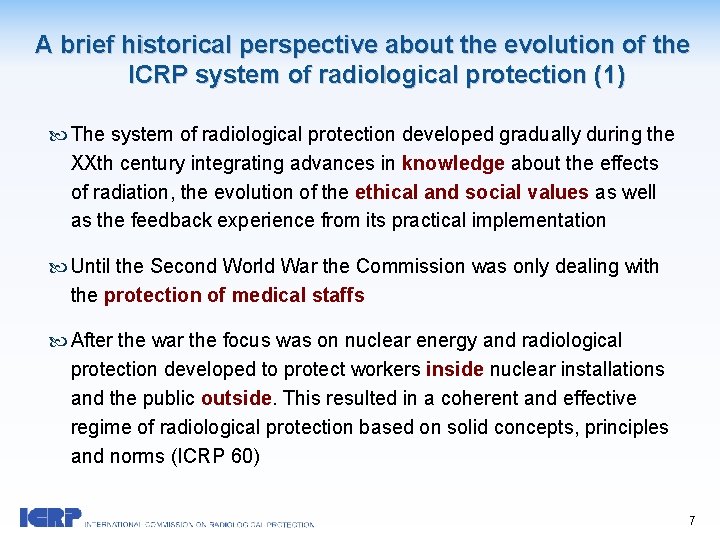
A brief historical perspective about the evolution of the ICRP system of radiological protection (1) The system of radiological protection developed gradually during the XXth century integrating advances in knowledge about the effects of radiation, the evolution of the ethical and social values as well as the feedback experience from its practical implementation Until the Second World War the Commission was only dealing with the protection of medical staffs After the war the focus was on nuclear energy and radiological protection developed to protect workers inside nuclear installations and the public outside. This resulted in a coherent and effective regime of radiological protection based on solid concepts, principles and norms (ICRP 60) 7
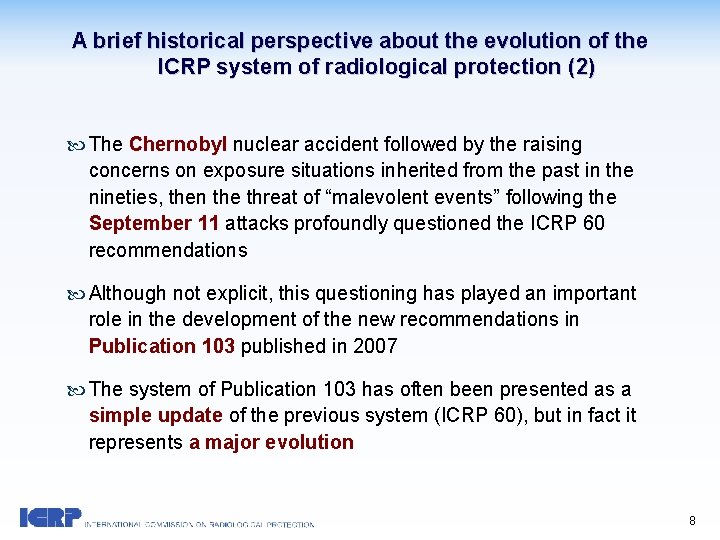
A brief historical perspective about the evolution of the ICRP system of radiological protection (2) The Chernobyl nuclear accident followed by the raising concerns on exposure situations inherited from the past in the nineties, then the threat of “malevolent events” following the September 11 attacks profoundly questioned the ICRP 60 recommendations Although not explicit, this questioning has played an important role in the development of the new recommendations in Publication 103 published in 2007 The system of Publication 103 has often been presented as a simple update of the previous system (ICRP 60), but in fact it represents a major evolution 8
A brief historical perspective about the evolution of the ICRP system of radiological protection (3) The two main evolutions of the system of protection in Pub. 103 are: The abandonment of the distinction between practices and intervention and the introduction instead of 3 types of exposure situations with the generalization of the optimisation principle in connection with individual dose restrictions to all controllable exposure situations The introduction for the first time in general recommendations of “the need to account for the views and concerns of stakeholders when optimising protection” 9
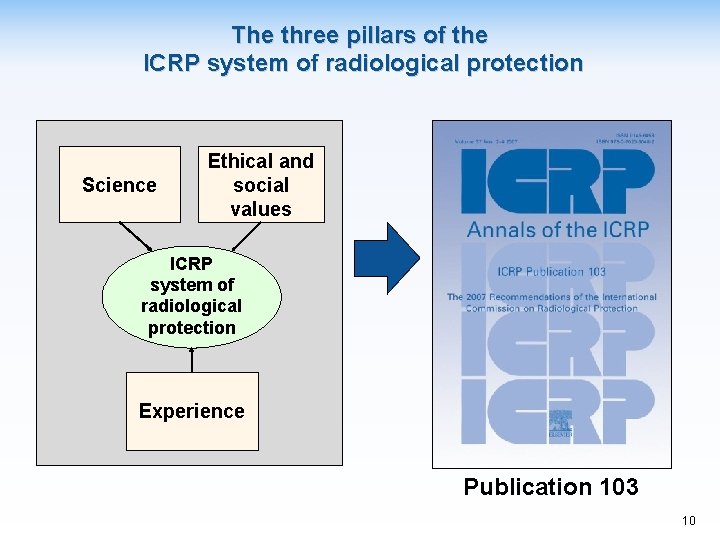
The three pillars of the ICRP system of radiological protection Science Ethical and social values ICRP system of radiological protection Experience Publication 103 10
The aims of the ICRP system of radiological protection � “… to contribute to an appropriate level of protection against the detrimental effects of ionising radiation exposure without unduly limiting the benefits associated with the use of radiation. ” ICRP 103, § 26 � “… to manage and control exposures to ionizing radiation so that deterministic effects are prevented, and the risks of stochastic effects are reduced to the extent reasonably achievable. ” ICRP 103, § 29 � Estimating and comparing benefits and risk of different options for actions is one of the most common ethical dilemmas in daily life 11
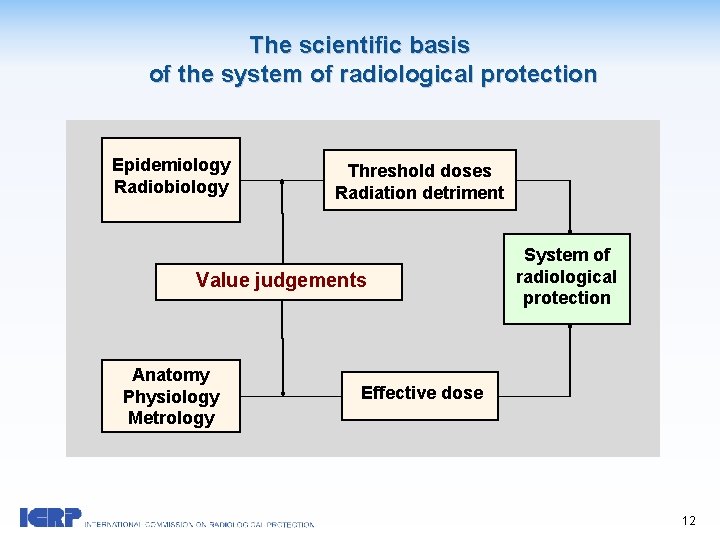
The scientific basis of the system of radiological protection Epidemiology Radiobiology Threshold doses Radiation detriment Value judgements Anatomy Physiology Metrology System of radiological protection Effective dose 12
A key ethical value: prudence « It is prudent to take uncertainties in the current estimates of thresholds for deterministic effects into account… Consequently, annual doses rising towards 100 m. Sv will almost always justify the introduction of protective actions » . ICRP 103, § 35 « At radiation doses below around 100 m. Sv in a year, the increase in the incidence of stochastic effects is assumed by the Commission to occur with a small probability and in proportion to the increase in radiation dose… The Commission considers that the LNT model remains a prudent basis for radiological protection at low doses and low dose rates. » ICRP 103, § 36 «There continues to be no direct evidence that exposure of parents to radiation leads to excess heritable disease in offspring. However, the Commission judges that there is compelling evidence that radiation causes heritable effects in experimental animals. Therefore, the Commission prudently continues to include the risk of heritable effects in its system of radiological protection. » ICRP 103, § 74 13
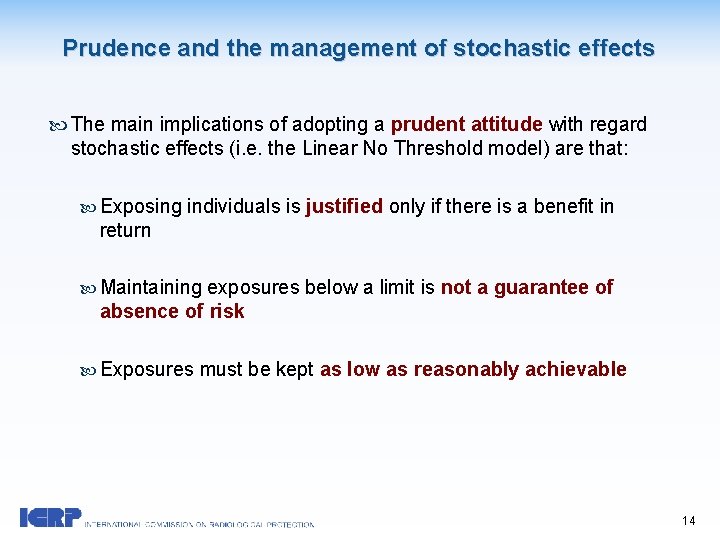
Prudence and the management of stochastic effects The main implications of adopting a prudent attitude with regard stochastic effects (i. e. the Linear No Threshold model) are that: Exposing individuals is justified only if there is a benefit in return Maintaining exposures below a limit is not a guarantee of absence of risk Exposures must be kept as low as reasonably achievable 14
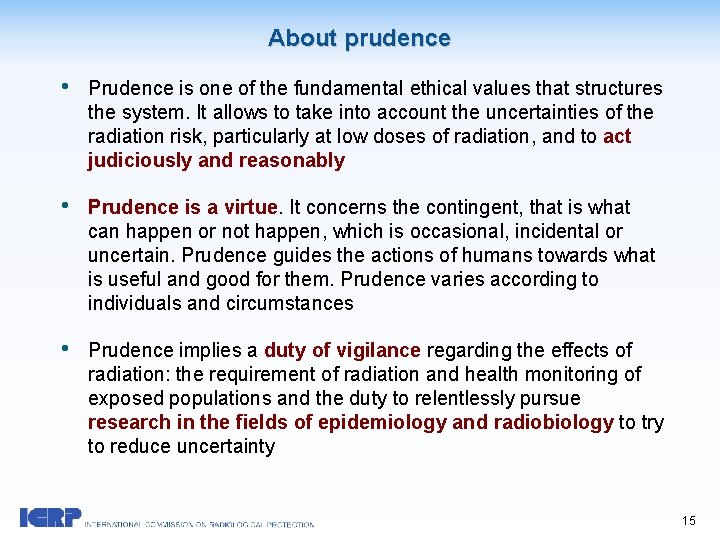
About prudence • Prudence is one of the fundamental ethical values that structures the system. It allows to take into account the uncertainties of the radiation risk, particularly at low doses of radiation, and to act judiciously and reasonably • Prudence is a virtue. It concerns the contingent, that is what can happen or not happen, which is occasional, incidental or uncertain. Prudence guides the actions of humans towards what is useful and good for them. Prudence varies according to individuals and circumstances • Prudence implies a duty of vigilance regarding the effects of radiation: the requirement of radiation and health monitoring of exposed populations and the duty to relentlessly pursue research in the fields of epidemiology and radiobiology to try to reduce uncertainty 15
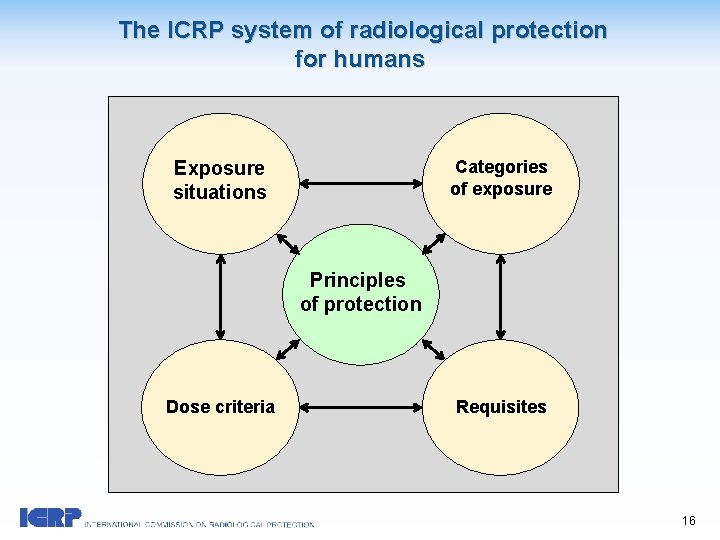
The ICRP system of radiological protection for humans Categories of exposure Exposure situations Principles of protection Dose criteria Requisites 16
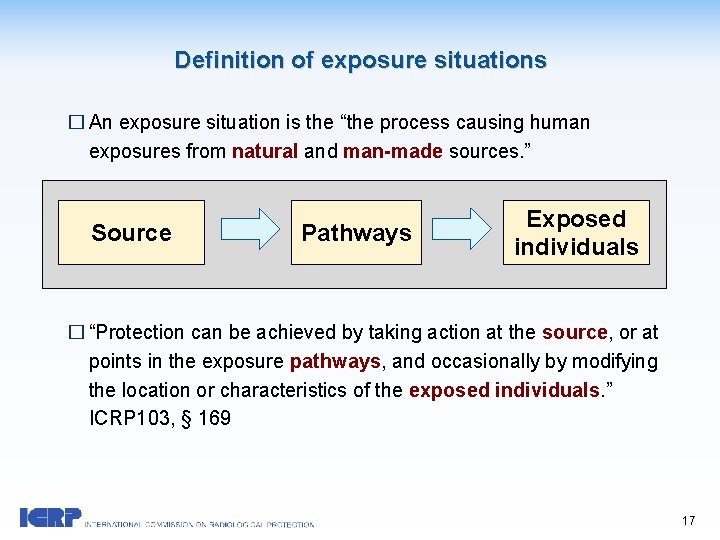
Definition of exposure situations � An exposure situation is the “the process causing human exposures from natural and man-made sources. ” Source Pathways Exposed individuals � “Protection can be achieved by taking action at the source, or at points in the exposure pathways, and occasionally by modifying the location or characteristics of the exposed individuals. ” ICRP 103, § 169 17
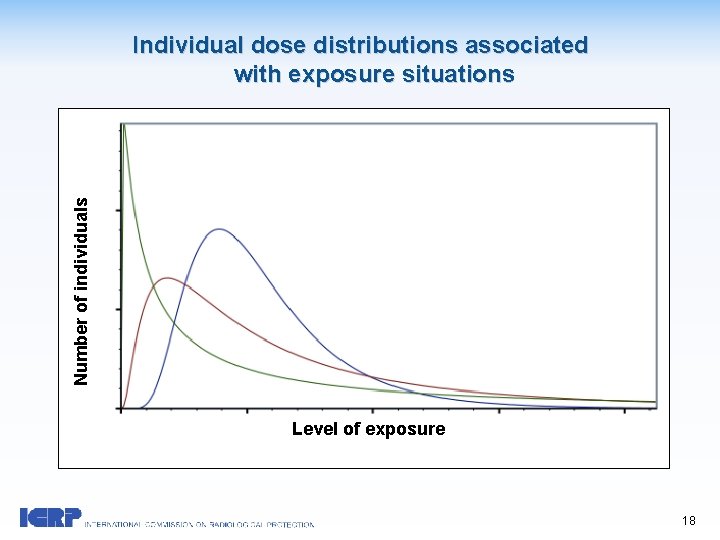
Number of individuals Individual dose distributions associated with exposure situations Level of exposure 18
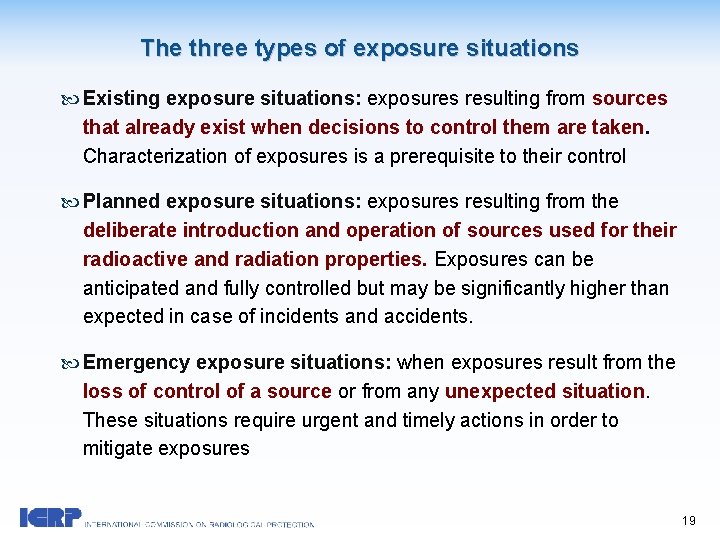
The three types of exposure situations Existing exposure situations: exposures resulting from sources that already exist when decisions to control them are taken. Characterization of exposures is a prerequisite to their control Planned exposure situations: exposures resulting from the deliberate introduction and operation of sources used for their radioactive and radiation properties. Exposures can be anticipated and fully controlled but may be significantly higher than expected in case of incidents and accidents. Emergency exposure situations: when exposures result from the loss of control of a source or from any unexpected situation. These situations require urgent and timely actions in order to mitigate exposures 19
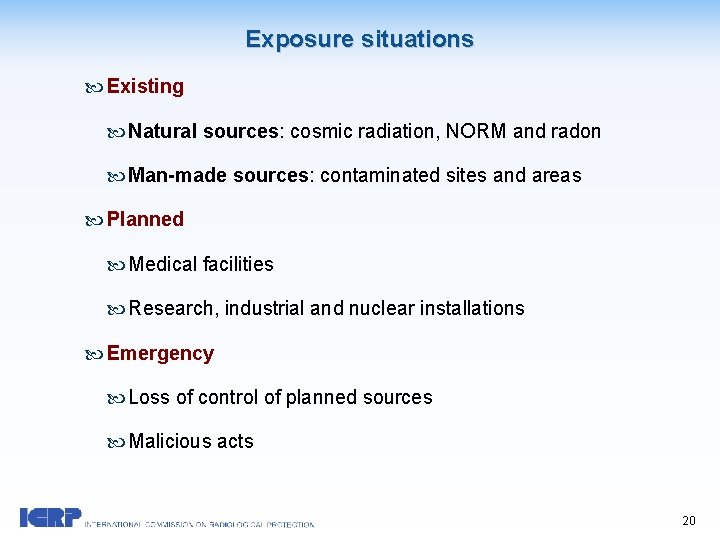
Exposure situations Existing Natural sources: cosmic radiation, NORM and radon Man-made sources: contaminated sites and areas Planned Medical facilities Research, industrial and nuclear installations Emergency Loss of control of planned sources Malicious acts 20
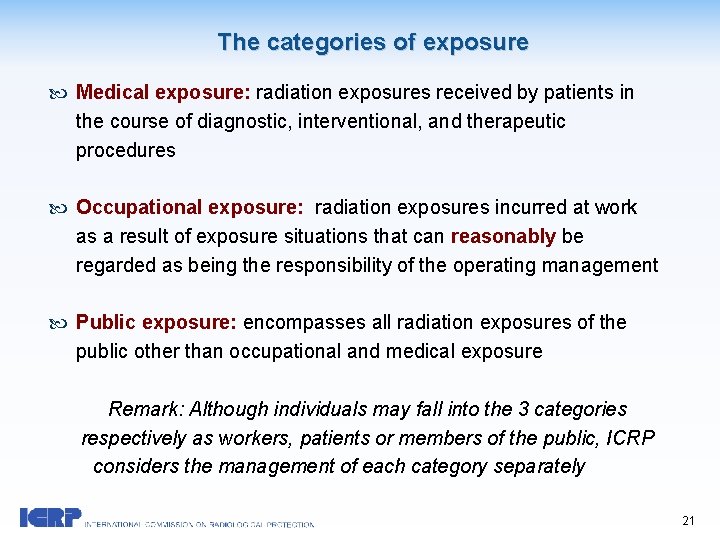
The categories of exposure Medical exposure: radiation exposures received by patients in the course of diagnostic, interventional, and therapeutic procedures Occupational exposure: radiation exposures incurred at work as a result of exposure situations that can reasonably be regarded as being the responsibility of the operating management Public exposure: encompasses all radiation exposures of the public other than occupational and medical exposure Remark: Although individuals may fall into the 3 categories respectively as workers, patients or members of the public, ICRP considers the management of each category separately 21
The principles of radiological protection The principle of justification: Any decision that alters the radiation exposure situation should do more good than harm In ethics actions taken to help prevent or remove harms are called beneficent actions and those taken to avoid to do harms are called non-maleficent The principle of optimisation of protection: All exposures should be kept as low as reasonably achievable This principle is a direct consequence of the prudent attitude adopted for managing stochastic effects The principle of application of dose limits: The total dose to any individual from regulated sources in planned exposure situations other than medical exposure of patients should not exceed the appropriate limits recommended by the Commission 22
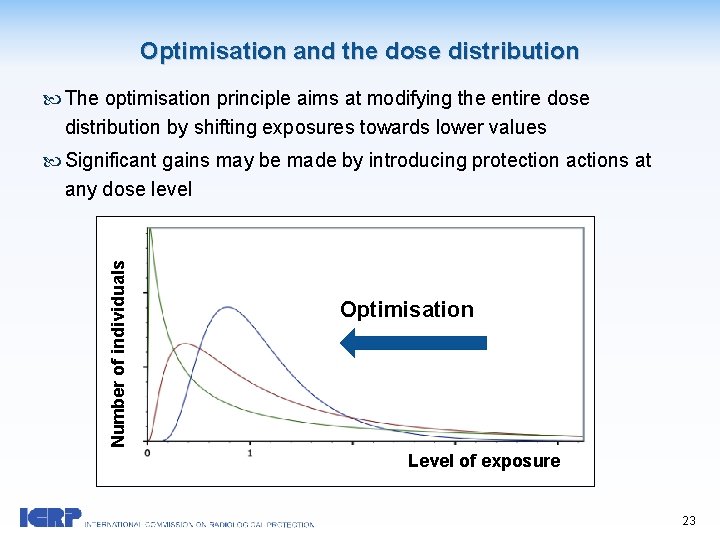
Optimisation and the dose distribution The optimisation principle aims at modifying the entire dose distribution by shifting exposures towards lower values Number of individuals Significant gains may be made by introducing protection actions at any dose level Optimisation Level of exposure 23
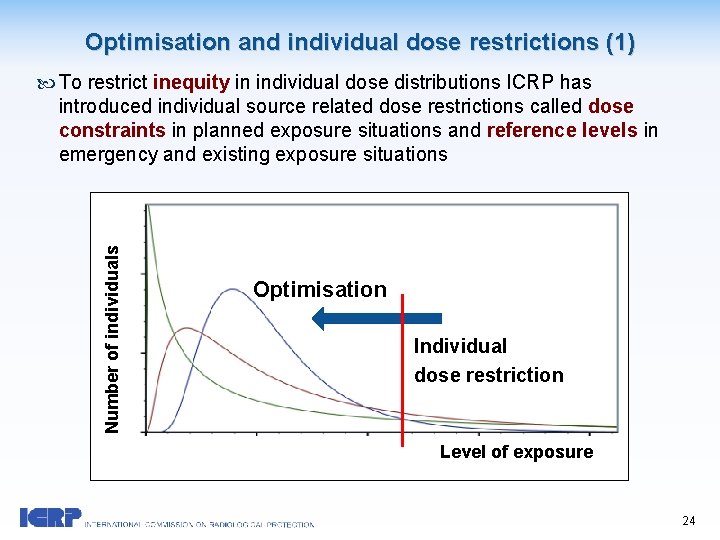
Optimisation and individual dose restrictions (1) To restrict inequity in individual dose distributions ICRP has introduced individual source related dose restrictions called dose constraints in planned exposure situations and reference levels in emergency and existing exposure situations Number of individuals Optimisation Individual dose restriction Level of exposure 24
Optimisation and individual dose restrictions For the selection of an appropriate value for the dose restrictions one should consider the relevant exposure situation in terms of the nature of the exposure, the benefits from the exposure situation to individuals and society, …, and the practicability of reducing or preventing the exposures (ICRP 103, § 242) “At doses higher than 100 m. Sv, there is an increased likelihood of deterministic effects and a significant risk of cancer. For this reason the Commission considers that the maximum value for a reference value is 100 m. Sv incurred either acutely or in a year. ” (ICRP 103, § 236) This statement needs some clarification about how to interpret the “acutely or in a year” in the context of emergency exposure situations 25
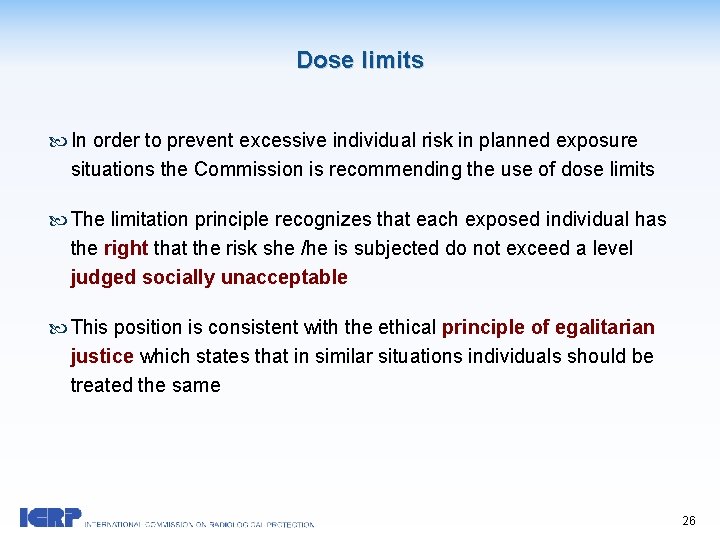
Dose limits In order to prevent excessive individual risk in planned exposure situations the Commission is recommending the use of dose limits The limitation principle recognizes that each exposed individual has the right that the risk she /he is subjected do not exceed a level judged socially unacceptable This position is consistent with the ethical principle of egalitarian justice which states that in similar situations individuals should be treated the same 26
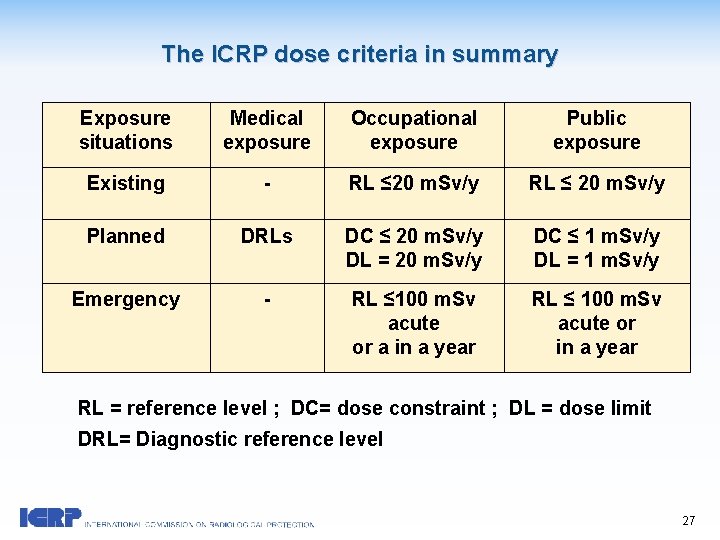
The ICRP dose criteria in summary Exposure situations Medical exposure Occupational exposure Public exposure Existing - RL ≤ 20 m. Sv/y Planned DRLs DC ≤ 20 m. Sv/y DL = 20 m. Sv/y DC ≤ 1 m. Sv/y DL = 1 m. Sv/y Emergency - RL ≤ 100 m. Sv acute or a in a year RL ≤ 100 m. Sv acute or in a year RL = reference level ; DC= dose constraint ; DL = dose limit DRL= Diagnostic reference level 27
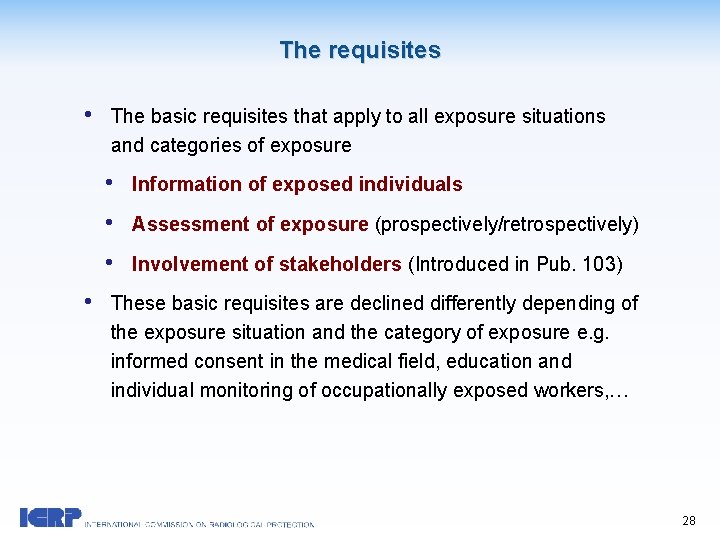
The requisites • The basic requisites that apply to all exposure situations and categories of exposure • • Information of exposed individuals Assessment of exposure (prospectively/retrospectively) Involvement of stakeholders (Introduced in Pub. 103) These basic requisites are declined differently depending of the exposure situation and the category of exposure e. g. informed consent in the medical field, education and individual monitoring of occupationally exposed workers, … 28
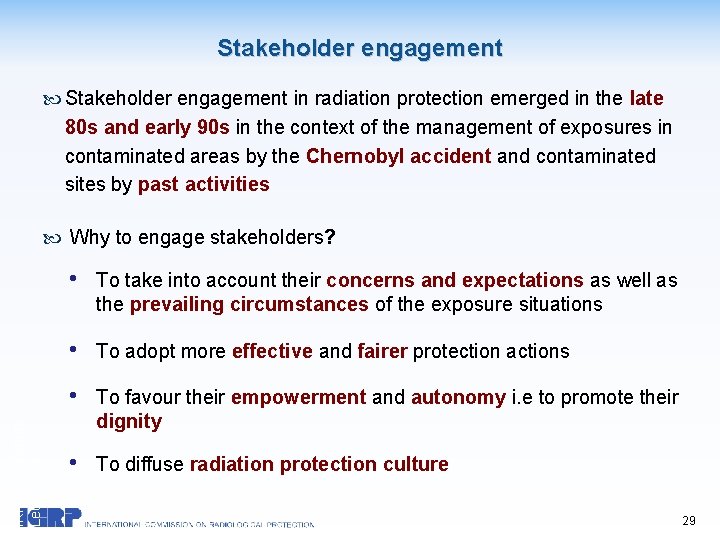
Stakeholder engagement in radiation protection emerged in the late 80 s and early 90 s in the context of the management of exposures in contaminated areas by the Chernobyl accident and contaminated sites by past activities IRPA 11 Keynote Lecture XX Why to engage stakeholders? • To take into account their concerns and expectations as well as the prevailing circumstances of the exposure situations • To adopt more effective and fairer protection actions • To favour their empowerment and autonomy i. e to promote their dignity • To diffuse radiation protection culture 29
To close the first part “Aside from our experienced scientists, trained in radiation protection, where do we look further for our supply of wisdom? Personally, I feel strongly that we must turn to the much larger group of citizens generally, most of whom have to be regarded as well-meaning and sincere, but rarely well-informed about the radiation problems that they have to deal with. Nevertheless, collectively or as individuals, they can be of great value … in developing our total radiation protection philosophy. ” Lauriston Taylor, Sievert Lecture, IRPA 5 Congress, Jerusalem, 1980 30
Part 2 The protection of individuals in the recovery phase after a nuclear accident 31
Publication 111 “Application of the Commission’s recommendations to the protection of people living in long-term contaminated areas after a nuclear accident or a radiation emergency” The first comprehensive ICRP Recommendations dealing with long-term recovery after a nuclear accident Previous ICRP Publications were confined to short and mediumterm actions but not addressing long-term recovery Published in 2009 after a long process of 10 years maturation because of the preparation of Publication 103 32
The background of ICRP Publication 111 Based on the experience of the Ethos project in Belarus but also of the Cumbria sheep farmers in UK and the Sami reindeer herders in Norway affected by the fallout of Chernobyl Taking into account the conclusions of the International symposium on the restoration of environments with radioactive residues held in Arlington, USA, November 1999, which emphasized: the role of involving stakeholders the difficulty to apply the” intervention approach” from ICRP 60 the wish of the public to be protected with the same level of protection as in normal situations 33
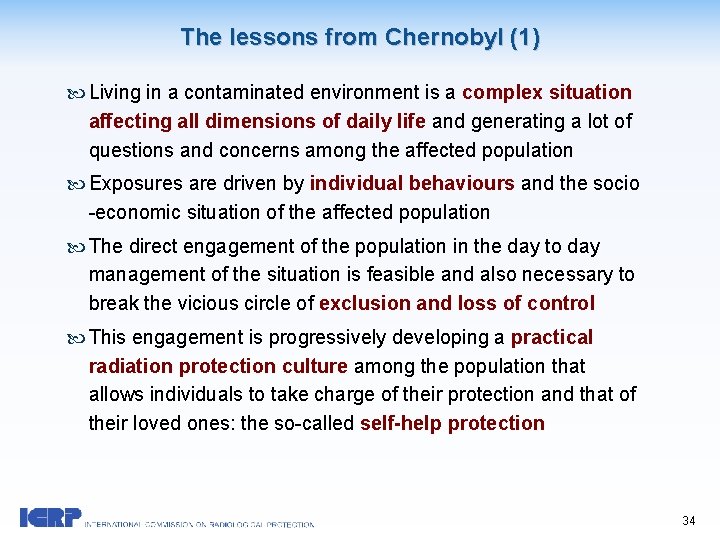
The lessons from Chernobyl (1) Living in a contaminated environment is a complex situation affecting all dimensions of daily life and generating a lot of questions and concerns among the affected population Exposures are driven by individual behaviours and the socio -economic situation of the affected population The direct engagement of the population in the day to day management of the situation is feasible and also necessary to break the vicious circle of exclusion and loss of control This engagement is progressively developing a practical radiation protection culture among the population that allows individuals to take charge of their protection and that of their loved ones: the so-called self-help protection 34
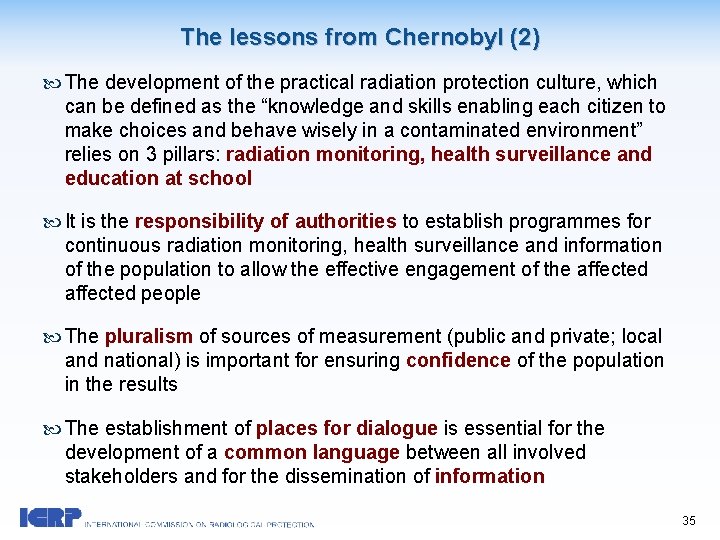
The lessons from Chernobyl (2) The development of the practical radiation protection culture, which can be defined as the “knowledge and skills enabling each citizen to make choices and behave wisely in a contaminated environment” relies on 3 pillars: radiation monitoring, health surveillance and education at school It is the responsibility of authorities to establish programmes for continuous radiation monitoring, health surveillance and information of the population to allow the effective engagement of the affected people The pluralism of sources of measurement (public and private; local and national) is important for ensuring confidence of the population in the results The establishment of places for dialogue is essential for the development of a common language between all involved stakeholders and for the dissemination of information 35
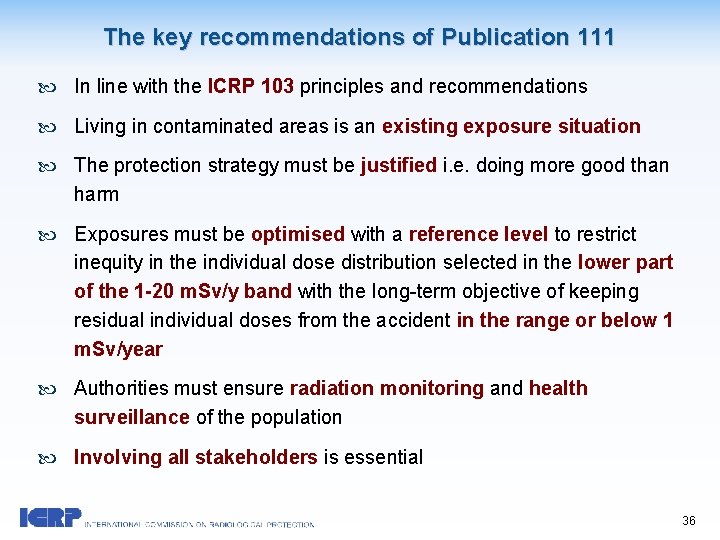
The key recommendations of Publication 111 In line with the ICRP 103 principles and recommendations Living in contaminated areas is an existing exposure situation The protection strategy must be justified i. e. doing more good than harm Exposures must be optimised with a reference level to restrict inequity in the individual dose distribution selected in the lower part of the 1 -20 m. Sv/y band with the long-term objective of keeping residual individual doses from the accident in the range or below 1 m. Sv/year Authorities must ensure radiation monitoring and health surveillance of the population Involving all stakeholders is essential 36
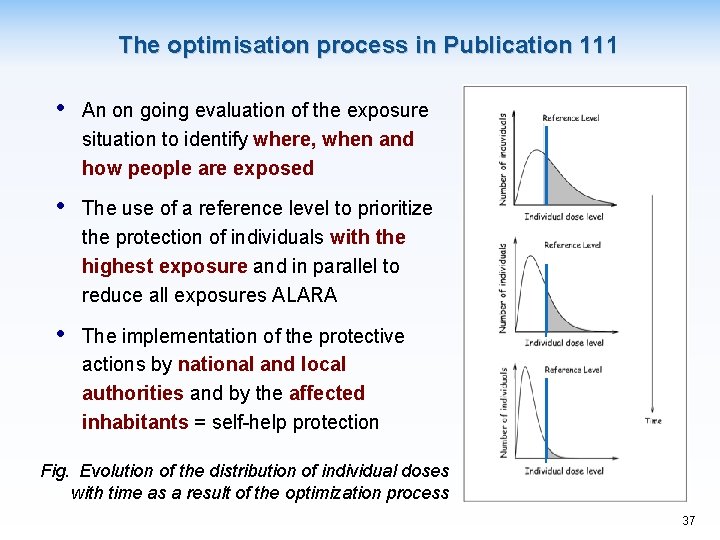
The optimisation process in Publication 111 • An on going evaluation of the exposure situation to identify where, when and how people are exposed • The use of a reference level to prioritize the protection of individuals with the highest exposure and in parallel to reduce all exposures ALARA • The implementation of the protective actions by national and local authorities and by the affected inhabitants = self-help protection Fig. Evolution of the distribution of individual doses with time as a result of the optimization process 37
ICRP and Fukushima Soon after the Fukushima accident ICRP took a series of initiatives: In March an open letter of the ICRP Chair to express sympathy to the Japanese population and a free access to Publication 111 on the ICRP web site Creation in April of Task Group 84 on the initial lessons learned from the accident vis-à-vis the ICRP system of radiological protection Visit of Japanese ICRP members in Belarus late September 2011 Launching in November 2011 of the ICRP Dialogue Initiative in Fukushima with Japanese, Belarus and Norwegian stakeholders to find ways to respond to the challenges of the long-term recovery in the affected areas Creation in September 2013 of Task Group 93 to update ICRP Publications 109 and 111 38
The Fukushima recovery phase The recovery phase started early 2012: December 2011: announcement of the stabilisation of the reactors January 2012: launching of the decontamination programme April 2012: new regulation on contaminated food products and rearrangement of the restricted areas From this period the situation can be considered as an existing exposure situation It is interesting to note that the Fukushima experience supports the position of Pub. 111, which states that the transition from the emergency to the existing exposure situation is the decision(s) of public authorities A key element is the characterization of the radiological situation in the affected areas to decide about their future. This characterization is not very well emphasized in Pub. 111 39
Some lessons from the ICRP Dialogue meetings (1) The human consequences of the accident are massive and will be lasting Expertise and support must be at the service of local citizens Individual monitoring (internal and external) and self-measurement of land food products are essential, and require outside support Radiation protection culture is at least as important as remediation to improve safety and a feeling of security Local communities must be engaged in developing improvement projects and in assessing progress Success depends on the combined action of authorities and self- help actions implemented by the affected population 40
Some lessons from the ICRP Dialogue meetings (2) The Fukushima experience confirms that the direct engagement of the affected people in the day-to-day management of a long-term contaminated territory is the condition for each individual to regain control on her/his radiological situation and also to restore her/his autonomy of decision After remaining a long time voiceless and awaiting actions of the authorities and experts, the people of Fukushima again take initiatives and narrate their lives and achievements since the accident The people of Fukushima who engaged in the rehabilitation of their living conditions with the support of voluntary experts feel more united than before the accident and also regained their dignity 41
About dignity • Dignity is enshrined in the Universal Declaration of Human Rights (1948): “All human beings are born free and equal in dignity and rights” (Art. 1) • Human dignity is not natural: it is a conquest over the inhuman. Dignity is cultural. This is an agreement between a culture and those who share it • Personal autonomy is the corollary of dignity. Dignity lies in the verbalization of affects. Science is developing a universal knowledge about man putting the subject aside, but through words the subject expresses her/his singular truth. Dignity is the affirmation of man as a subject in a world dominated by science that tends to reduce it to the status of object "Dignity is the soul of the scientific era" Jean-Michel Hirt 42
Two key lessons that we learned from Fukushima 1. The structuration of the optimization process for selfhelp protection actions 2. The need to revisit the tolerability of risk model 43
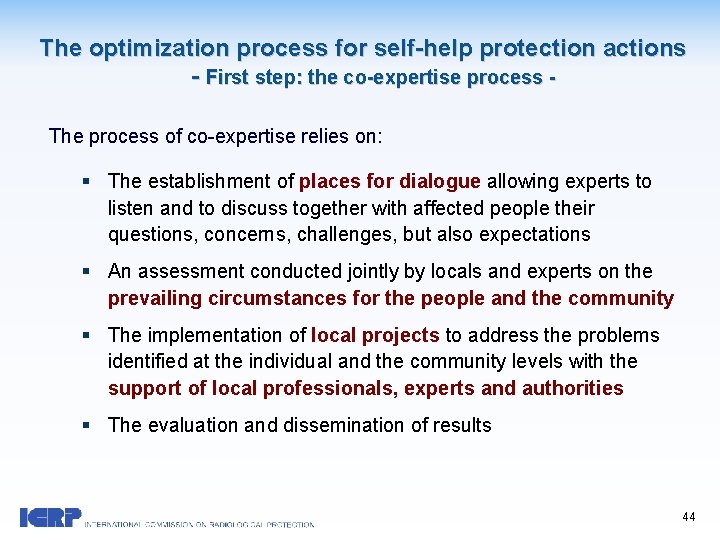
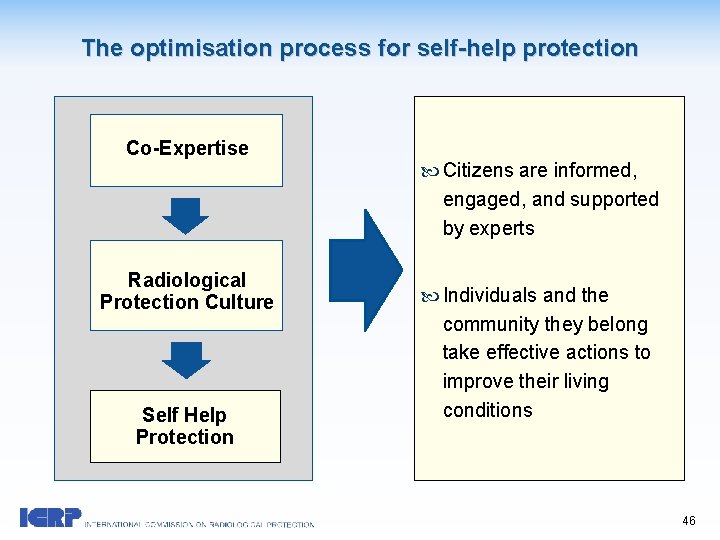
The optimization process for self-help protection actions - First step: the co-expertise process The process of co-expertise relies on: § The establishment of places for dialogue allowing experts to listen and to discuss together with affected people their questions, concerns, challenges, but also expectations § An assessment conducted jointly by locals and experts on the prevailing circumstances for the people and the community § The implementation of local projects to address the problems identified at the individual and the community levels with the support of local professionals, experts and authorities § The evaluation and dissemination of results 44
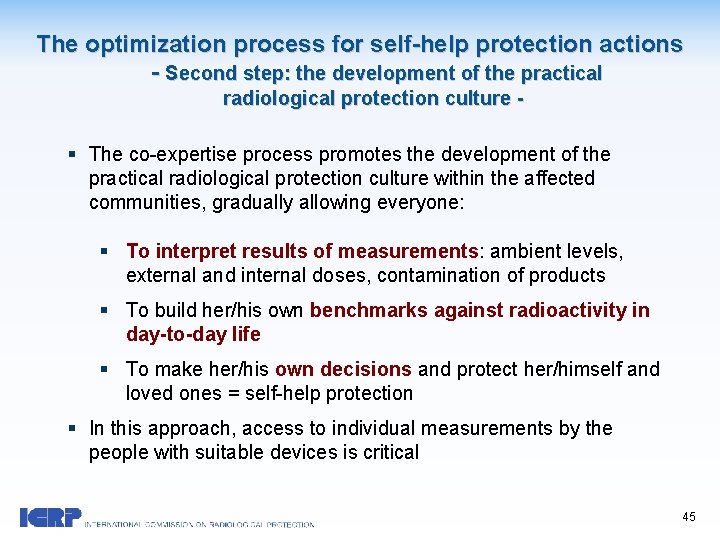
The optimization process for self-help protection actions - Second step: the development of the practical radiological protection culture § The co-expertise process promotes the development of the practical radiological protection culture within the affected communities, gradually allowing everyone: § To interpret results of measurements: ambient levels, external and internal doses, contamination of products § To build her/his own benchmarks against radioactivity in day-to-day life § To make her/his own decisions and protect her/himself and loved ones = self-help protection § In this approach, access to individual measurements by the people with suitable devices is critical 45
The optimisation process for self-help protection Co-Expertise Radiological Protection Culture Self Help Protection Citizens are informed, engaged, and supported by experts Individuals and the community they belong take effective actions to improve their living conditions 46
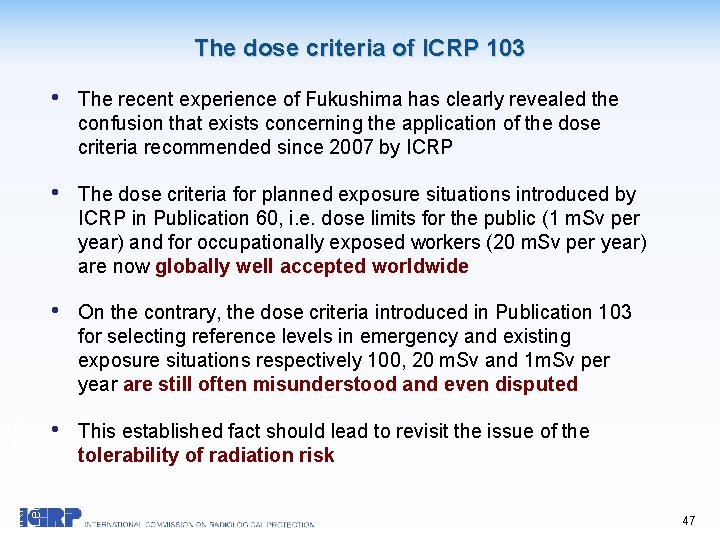
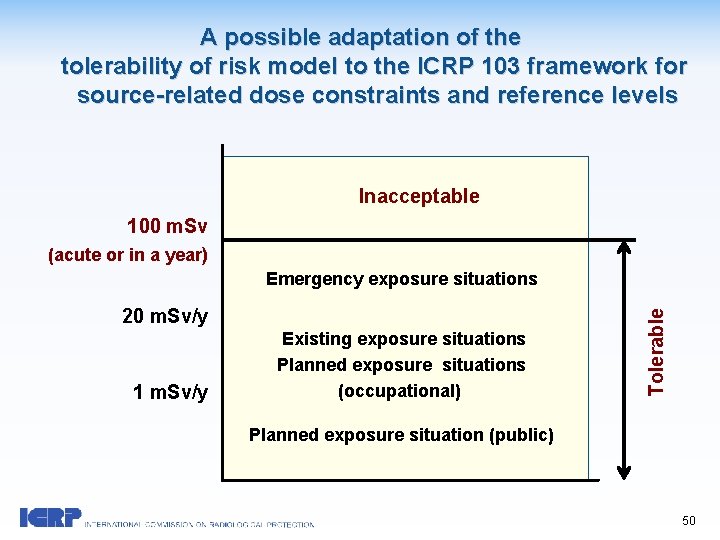
IRPA 11 Keynote Lecture XX The dose criteria of ICRP 103 • The recent experience of Fukushima has clearly revealed the confusion that exists concerning the application of the dose criteria recommended since 2007 by ICRP • The dose criteria for planned exposure situations introduced by ICRP in Publication 60, i. e. dose limits for the public (1 m. Sv per year) and for occupationally exposed workers (20 m. Sv per year) are now globally well accepted worldwide • On the contrary, the dose criteria introduced in Publication 103 for selecting reference levels in emergency and existing exposure situations respectively 100, 20 m. Sv and 1 m. Sv per year are still often misunderstood and even disputed • This established fact should lead to revisit the issue of the tolerability of radiation risk 47
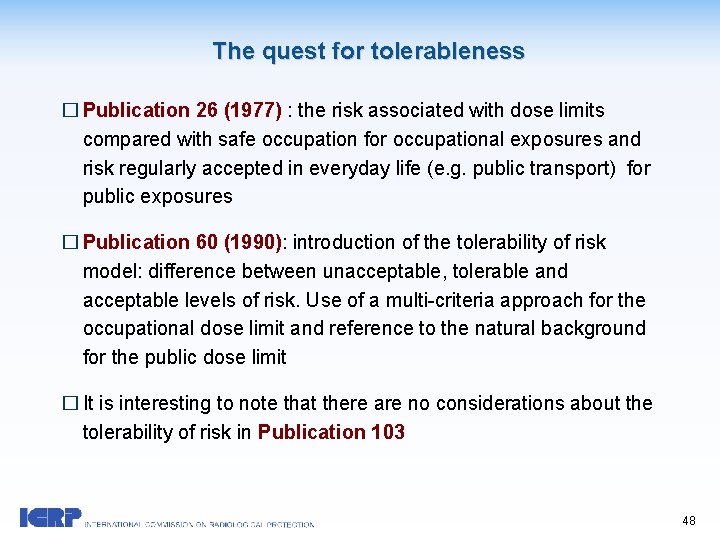
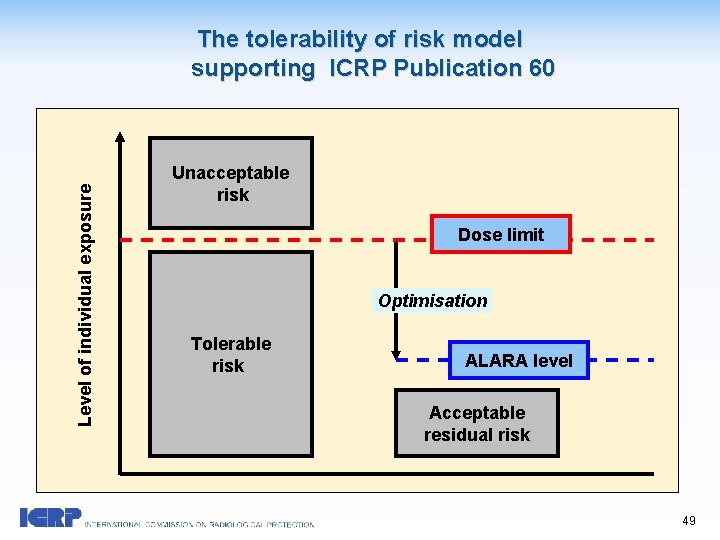
The quest for tolerableness � Publication 26 (1977) : the risk associated with dose limits compared with safe occupation for occupational exposures and risk regularly accepted in everyday life (e. g. public transport) for public exposures � Publication 60 (1990): introduction of the tolerability of risk model: difference between unacceptable, tolerable and acceptable levels of risk. Use of a multi-criteria approach for the occupational dose limit and reference to the natural background for the public dose limit � It is interesting to note that there are no considerations about the tolerability of risk in Publication 103 48
Level of individual exposure The tolerability of risk model supporting ICRP Publication 60 Unacceptable risk Dose limit Optimisation Tolerable risk ALARA level Acceptable residual risk 49
A possible adaptation of the tolerability of risk model to the ICRP 103 framework for source-related dose constraints and reference levels Inacceptable 100 m. Sv (acute or in a year) 20 m. Sv/y 1 m. Sv/y Existing exposure situations Planned exposure situations (occupational) Tolerable Emergency exposure situations Planned exposure situation (public) 50
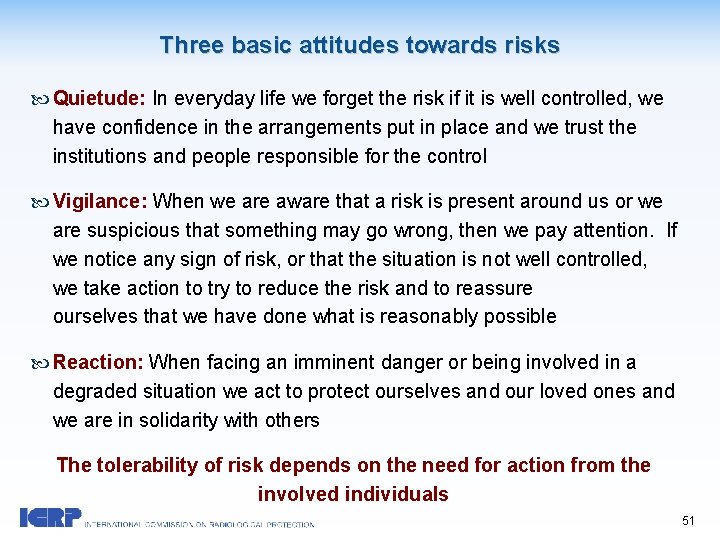
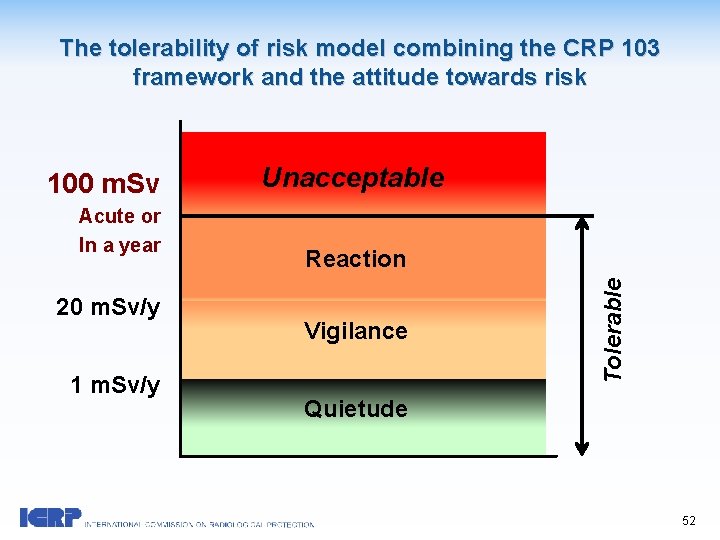
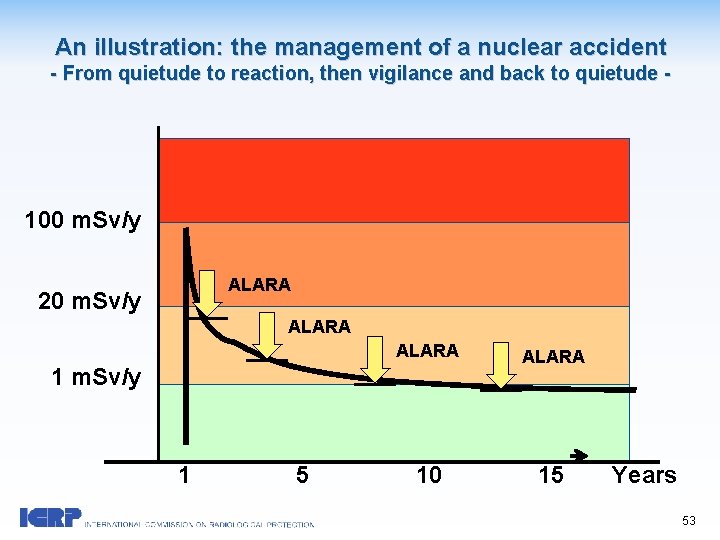
Three basic attitudes towards risks Quietude: In everyday life we forget the risk if it is well controlled, we have confidence in the arrangements put in place and we trust the institutions and people responsible for the control Vigilance: When we are aware that a risk is present around us or we are suspicious that something may go wrong, then we pay attention. If we notice any sign of risk, or that the situation is not well controlled, we take action to try to reduce the risk and to reassure ourselves that we have done what is reasonably possible Reaction: When facing an imminent danger or being involved in a degraded situation we act to protect ourselves and our loved ones and we are in solidarity with others The tolerability of risk depends on the need for action from the involved individuals 51
The tolerability of risk model combining the CRP 103 framework and the attitude towards risk Acute or In a year 20 m. Sv/y 1 m. Sv/y Unacceptable Reaction Vigilance Tolerable 100 m. Sv Quietude 52
An illustration: the management of a nuclear accident - From quietude to reaction, then vigilance and back to quietude - 100 m. Sv/y ALARA 20 m. Sv/y ALARA 1 m. Sv/y 1 5 10 ALARA 15 Years 53
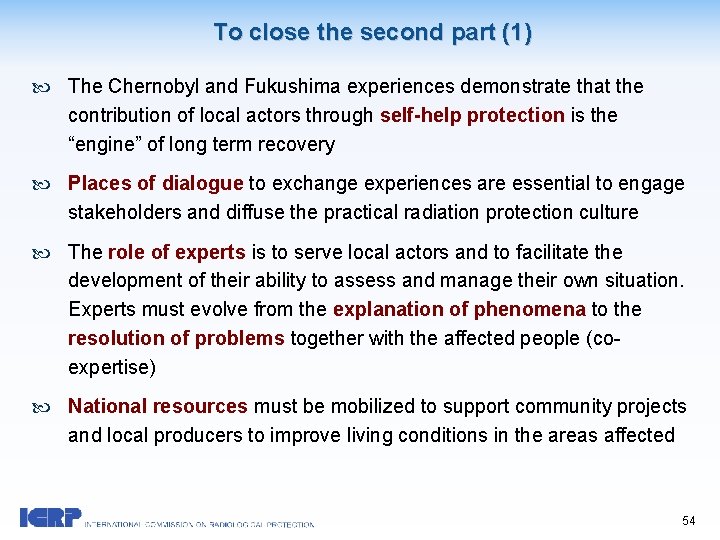
To close the second part (1) The Chernobyl and Fukushima experiences demonstrate that the contribution of local actors through self-help protection is the “engine” of long term recovery Places of dialogue to exchange experiences are essential to engage stakeholders and diffuse the practical radiation protection culture The role of experts is to serve local actors and to facilitate the development of their ability to assess and manage their own situation. Experts must evolve from the explanation of phenomena to the resolution of problems together with the affected people (coexpertise) National resources must be mobilized to support community projects and local producers to improve living conditions in the areas affected 54
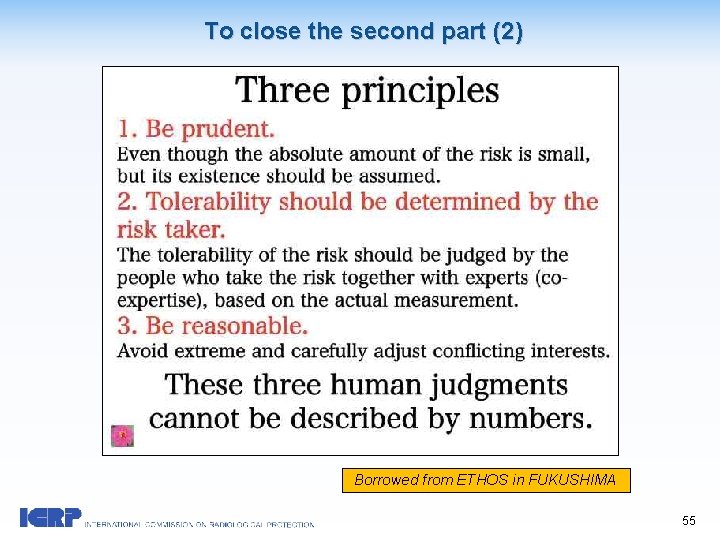
To close the second part (2) Borrowed from ETHOS in FUKUSHIMA 55
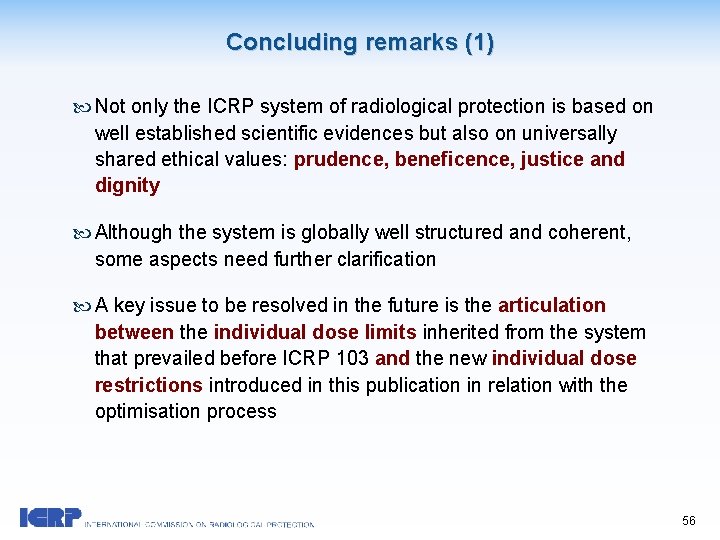
Concluding remarks (1) Not only the ICRP system of radiological protection is based on well established scientific evidences but also on universally shared ethical values: prudence, beneficence, justice and dignity Although the system is globally well structured and coherent, some aspects need further clarification A key issue to be resolved in the future is the articulation between the individual dose limits inherited from the system that prevailed before ICRP 103 and the new individual dose restrictions introduced in this publication in relation with the optimisation process 56
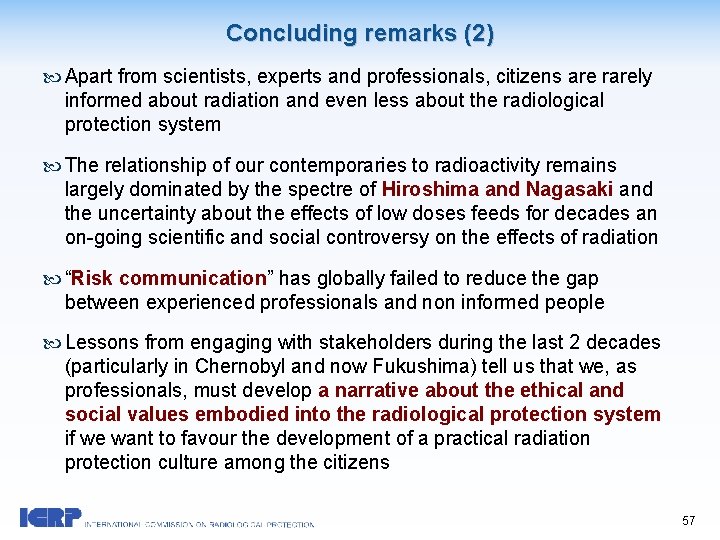
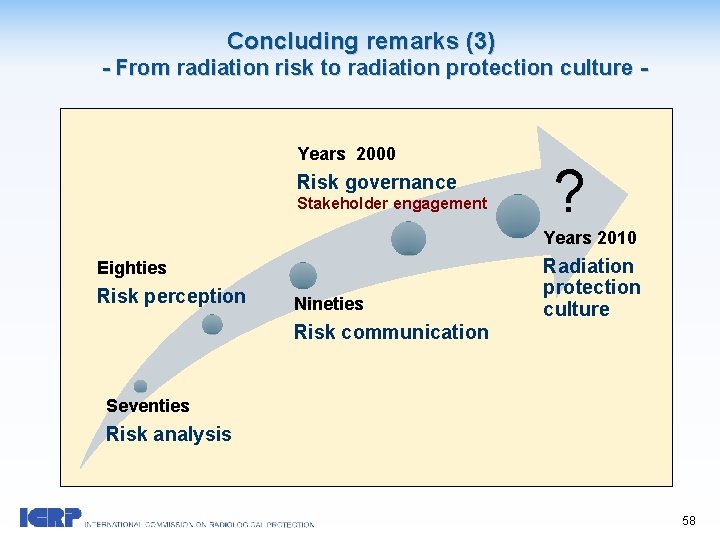
Concluding remarks (2) Apart from scientists, experts and professionals, citizens are rarely informed about radiation and even less about the radiological protection system The relationship of our contemporaries to radioactivity remains largely dominated by the spectre of Hiroshima and Nagasaki and the uncertainty about the effects of low doses feeds for decades an on-going scientific and social controversy on the effects of radiation “Risk communication” has globally failed to reduce the gap between experienced professionals and non informed people Lessons from engaging with stakeholders during the last 2 decades (particularly in Chernobyl and now Fukushima) tell us that we, as professionals, must develop a narrative about the ethical and social values embodied into the radiological protection system if we want to favour the development of a practical radiation protection culture among the citizens 57
Concluding remarks (3) - From radiation risk to radiation protection culture - Years 2000 Risk governance Stakeholder engagement ? Years 2010 Eighties Risk perception Nineties Radiation protection culture Risk communication Seventies Risk analysis 58
Thank you www. icrp. org