
The ICPS A taxonomy a classification an ontology
- Slides: 26
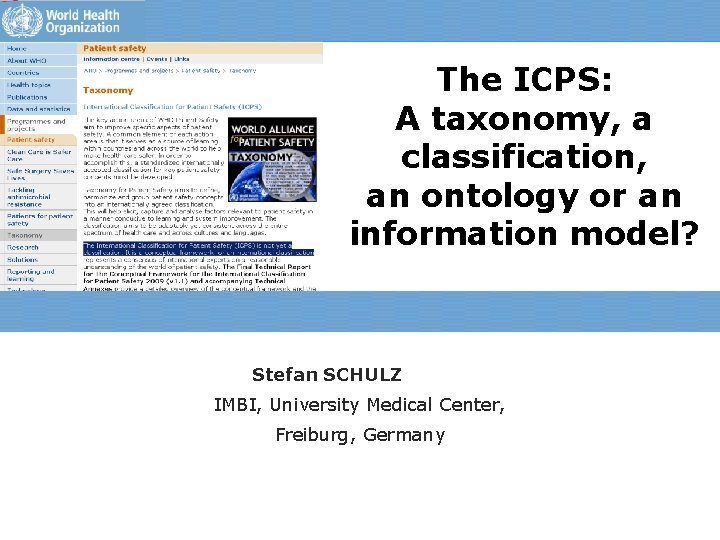
The ICPS: A taxonomy, a classification, an ontology or an information model? Stefan SCHULZ IMBI, University Medical Center, Freiburg, Germany
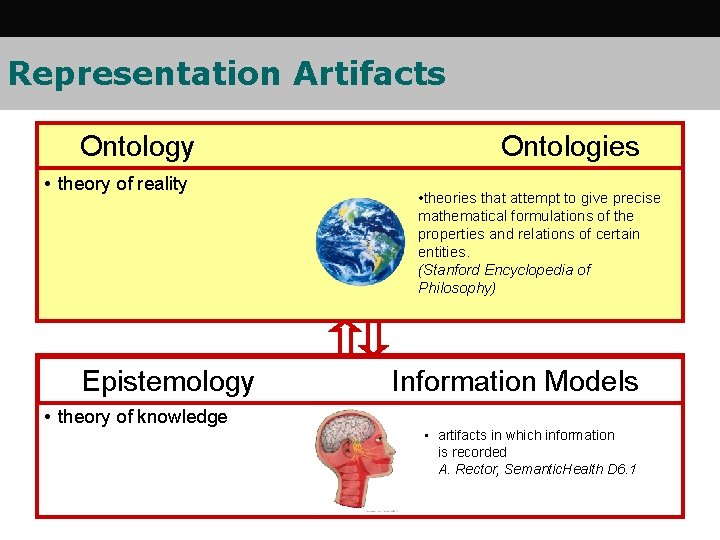
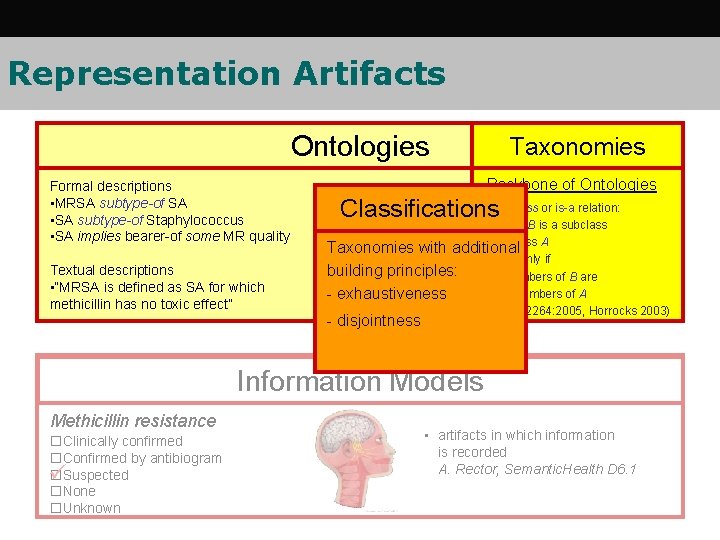
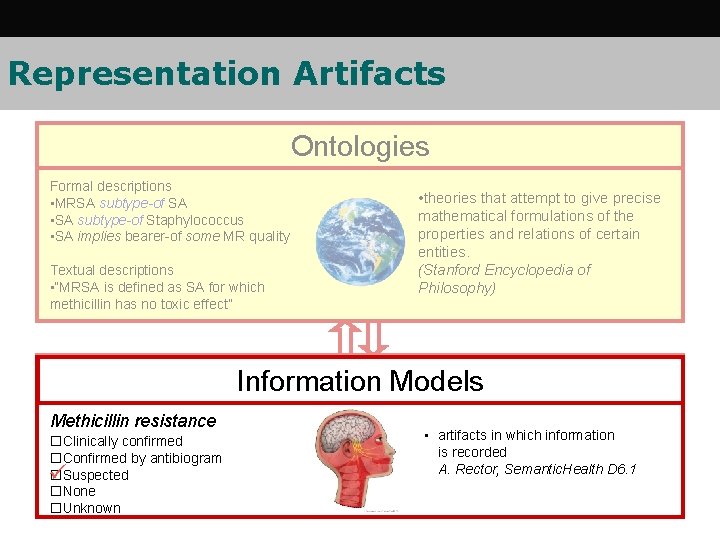
Representation Artifacts Ontology • theory of reality Epistemology Ontologies • theories that attempt to give precise mathematical formulations of the properties and relations of certain entities. (Stanford Encyclopedia of Philosophy) Information Models • theory of knowledge • artifacts in which information is recorded A. Rector, Semantic. Health D 6. 1
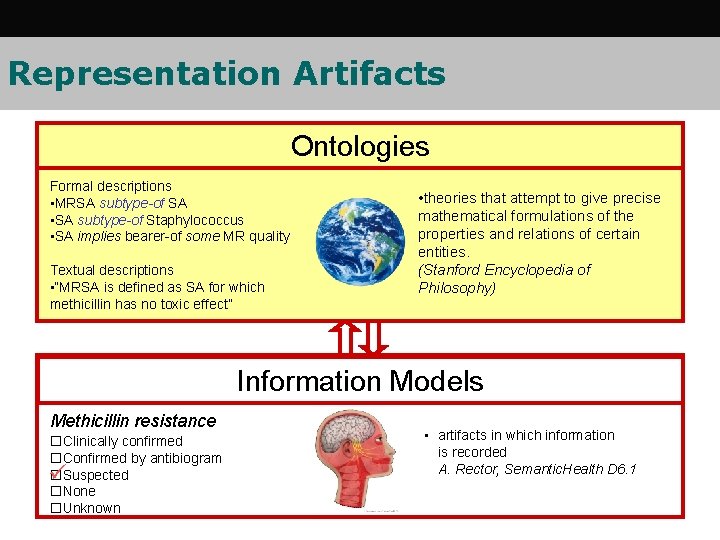
Representation Artifacts Ontologies Formal descriptions • MRSA subtype-of SA • SA subtype-of Staphylococcus • SA implies bearer-of some MR quality Textual descriptions • “MRSA is defined as SA for which methicillin has no toxic effect” • theories that attempt to give precise mathematical formulations of the properties and relations of certain entities. (Stanford Encyclopedia of Philosophy) Information Models Methicillin resistance o. Clinically confirmed o. Confirmed by antibiogram o. Suspected o. None o. Unknown • artifacts in which information is recorded A. Rector, Semantic. Health D 6. 1
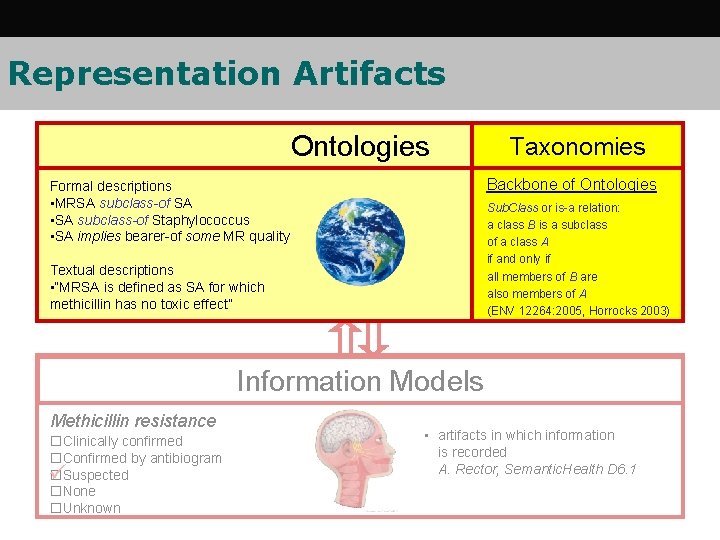
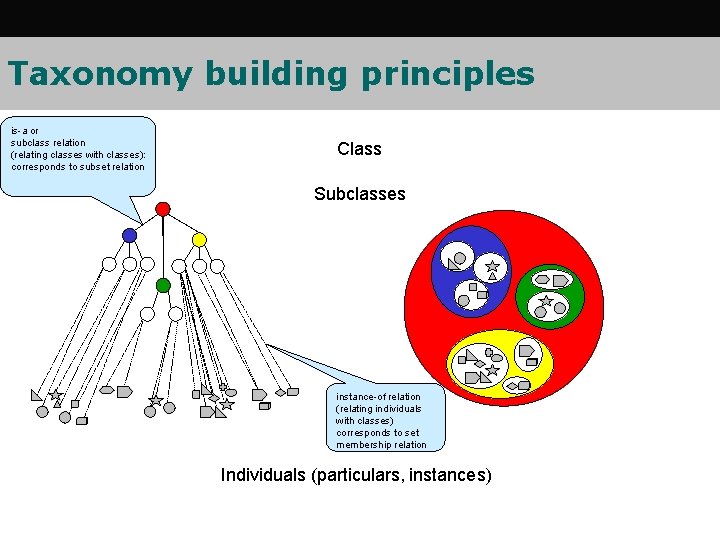
Representation Artifacts Ontologies Taxonomies Backbone of Ontologies Formal descriptions • MRSA subclass-of SA • SA subclass-of Staphylococcus • SA implies bearer-of some MR quality Sub. Class or is-a relation: a class B is a subclass of a class A if and only if all members of B are also members of A (ENV 12264: 2005, Horrocks 2003) Textual descriptions • “MRSA is defined as SA for which methicillin has no toxic effect” Information Models Methicillin resistance o. Clinically confirmed o. Confirmed by antibiogram o. Suspected o. None o. Unknown • artifacts in which information is recorded A. Rector, Semantic. Health D 6. 1
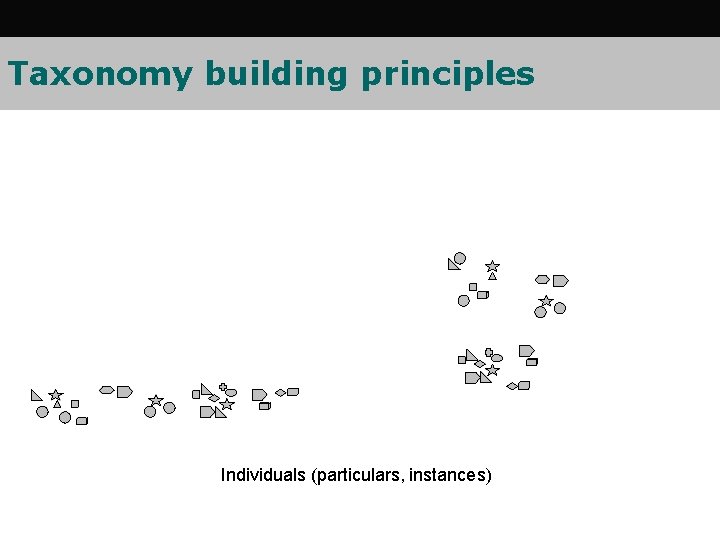
Taxonomy building principles Individuals (particulars, instances)
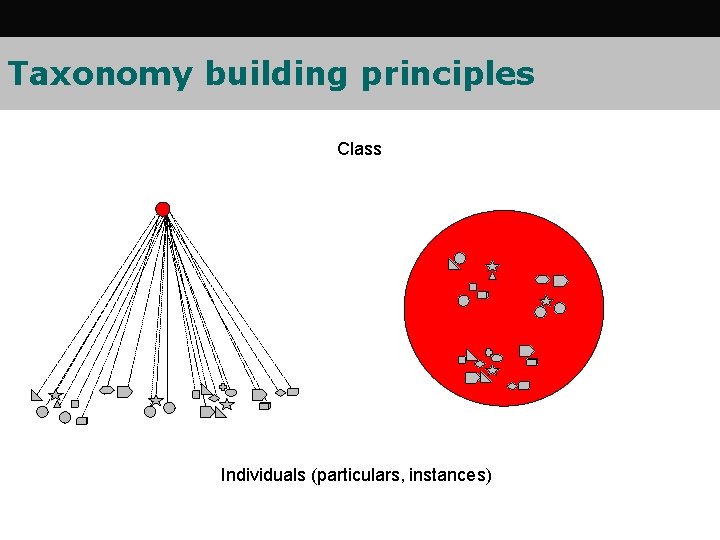
Taxonomy building principles Class Individuals (particulars, instances)
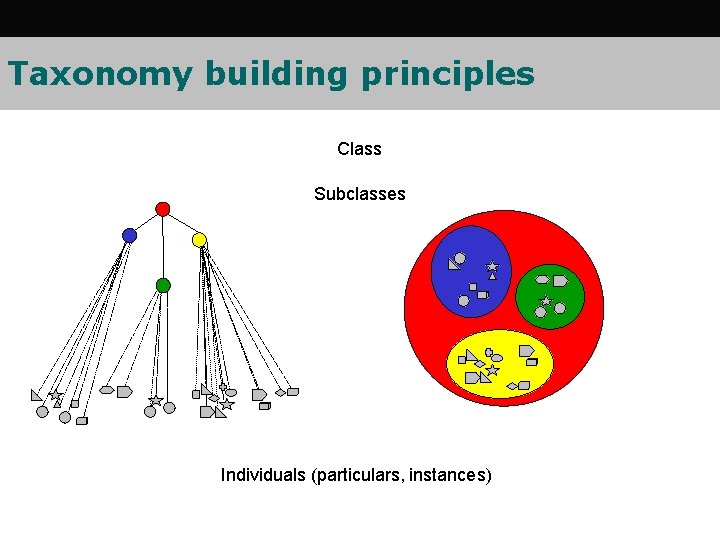
Taxonomy building principles Class Subclasses Individuals (particulars, instances)
Taxonomy building principles is-a or subclass relation (relating classes with classes): corresponds to subset relation Class Subclasses instance-of relation (relating individuals with classes) corresponds to set membership relation Individuals (particulars, instances)
Representation Artifacts Ontologies Formal descriptions • MRSA subtype-of SA • SA subtype-of Staphylococcus • SA implies bearer-of some MR quality Textual descriptions • “MRSA is defined as SA for which methicillin has no toxic effect” Taxonomies Backbone of Ontologies Sub. Class or is-a relation: Classifications a class B is a subclass of a class A Taxonomies with additional if and only if building principles: all members of B are also members of A - exhaustiveness (ENV 12264: 2005, Horrocks 2003) - disjointness Information Models Methicillin resistance o. Clinically confirmed o. Confirmed by antibiogram o. Suspected o. None o. Unknown • artifacts in which information is recorded A. Rector, Semantic. Health D 6. 1
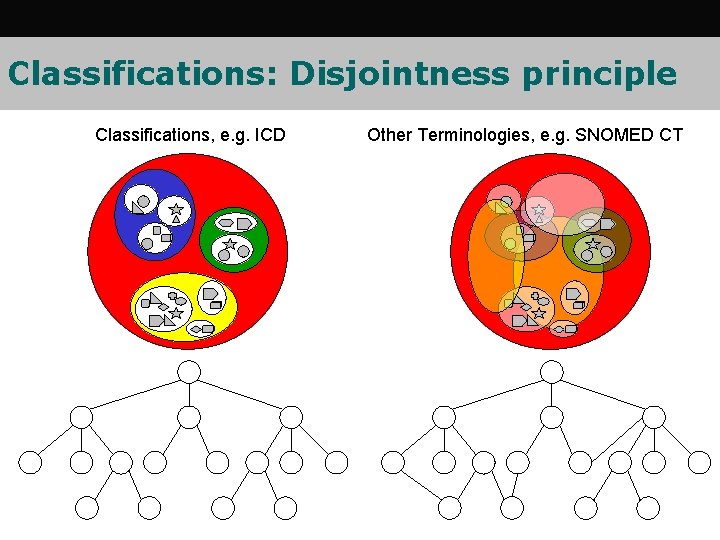
Classifications: Disjointness principle Classifications, e. g. ICD Other Terminologies, e. g. SNOMED CT
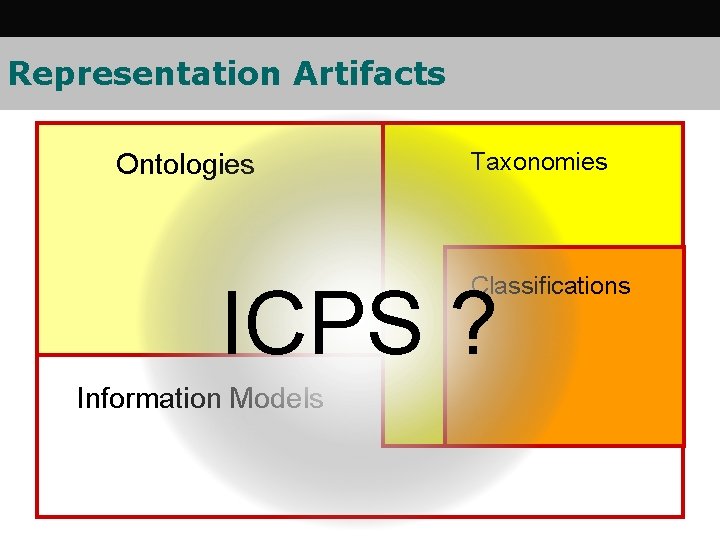
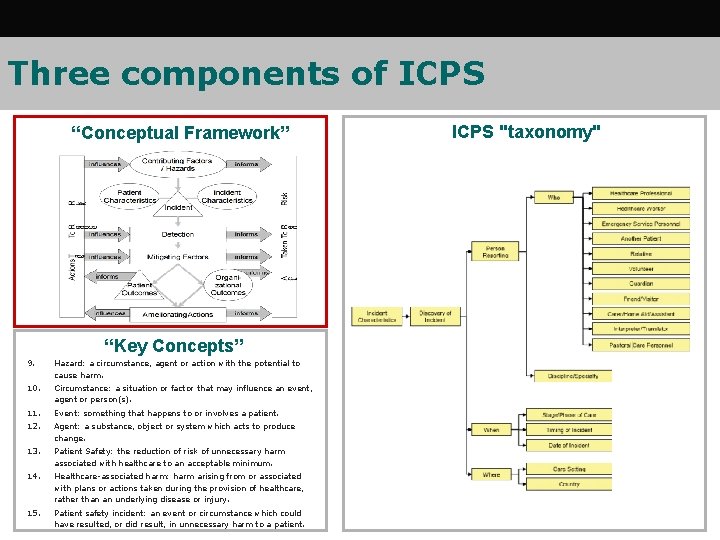
Representation Artifacts Ontologies Taxonomies Classifications ICPS ? Information Models
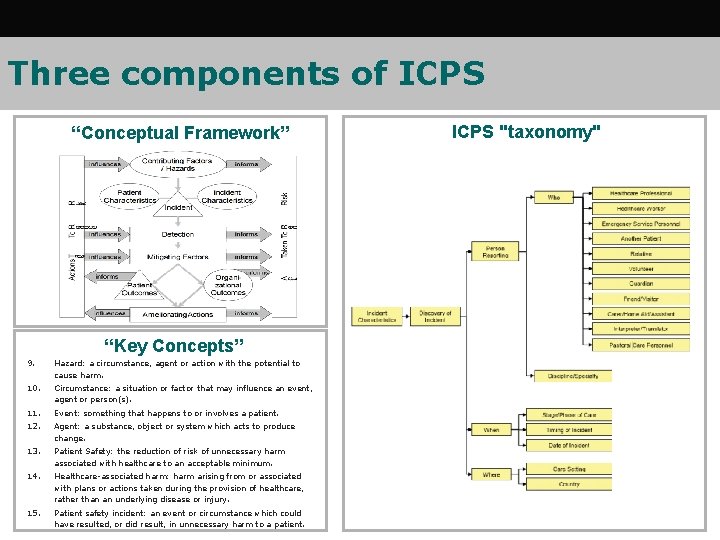
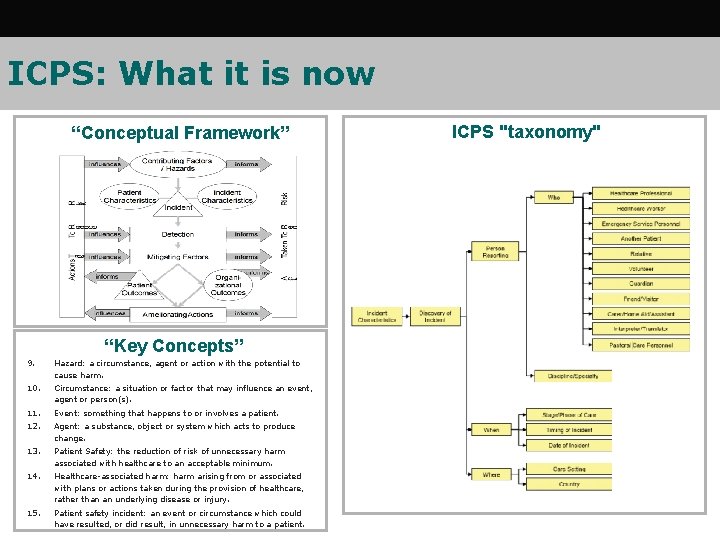
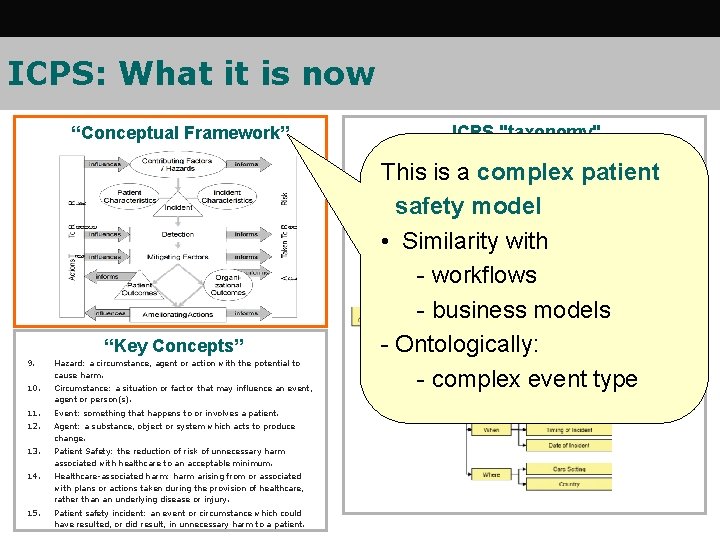
Three components of ICPS “Conceptual Framework” “Key Concepts” 9. Hazard: a circumstance, agent or action with the potential to cause harm. 10. Circumstance: a situation or factor that may influence an event, agent or person(s). 11. Event: something that happens to or involves a patient. 12. Agent: a substance, object or system which acts to produce change. 13. Patient Safety: the reduction of risk of unnecessary harm associated with healthcare to an acceptable minimum. 14. Healthcare-associated harm: harm arising from or associated with plans or actions taken during the provision of healthcare, rather than an underlying disease or injury. 15. Patient safety incident: an event or circumstance which could have resulted, or did result, in unnecessary harm to a patient. ICPS "taxonomy"
Three components of ICPS “Conceptual Framework” “Key Concepts” 9. Hazard: a circumstance, agent or action with the potential to cause harm. 10. Circumstance: a situation or factor that may influence an event, agent or person(s). 11. Event: something that happens to or involves a patient. 12. Agent: a substance, object or system which acts to produce change. 13. Patient Safety: the reduction of risk of unnecessary harm associated with healthcare to an acceptable minimum. 14. Healthcare-associated harm: harm arising from or associated with plans or actions taken during the provision of healthcare, rather than an underlying disease or injury. 15. Patient safety incident: an event or circumstance which could have resulted, or did result, in unnecessary harm to a patient. ICPS "taxonomy"
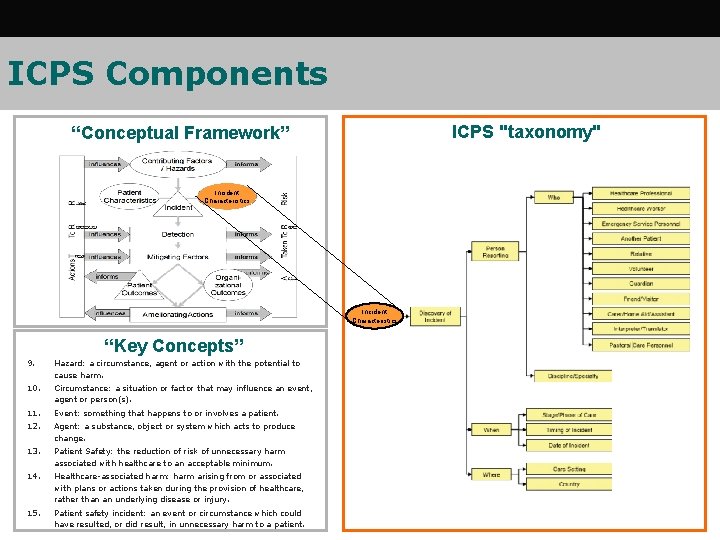
ICPS Components ICPS "taxonomy" “Conceptual Framework” Incident Characteristics “Key Concepts” 9. Hazard: a circumstance, agent or action with the potential to cause harm. 10. Circumstance: a situation or factor that may influence an event, agent or person(s). 11. Event: something that happens to or involves a patient. 12. Agent: a substance, object or system which acts to produce change. 13. Patient Safety: the reduction of risk of unnecessary harm associated with healthcare to an acceptable minimum. 14. Healthcare-associated harm: harm arising from or associated with plans or actions taken during the provision of healthcare, rather than an underlying disease or injury. 15. Patient safety incident: an event or circumstance which could have resulted, or did result, in unnecessary harm to a patient.
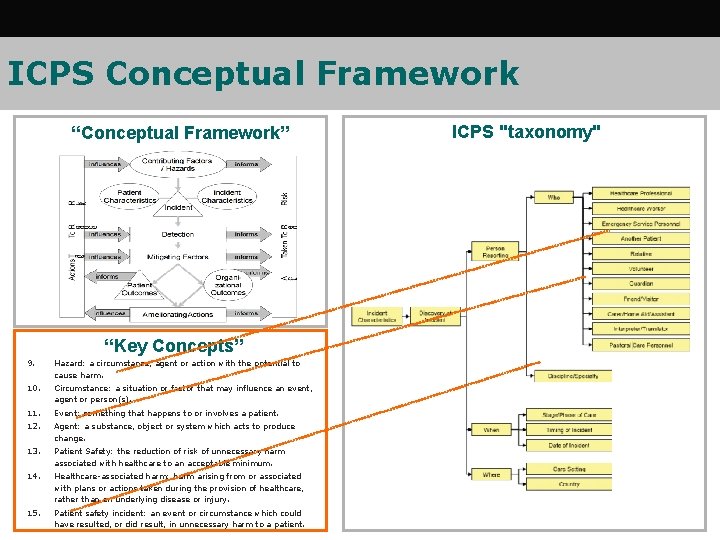
ICPS Conceptual Framework “Conceptual Framework” “Key Concepts” 9. Hazard: a circumstance, agent or action with the potential to cause harm. 10. Circumstance: a situation or factor that may influence an event, agent or person(s). 11. Event: something that happens to or involves a patient. 12. Agent: a substance, object or system which acts to produce change. 13. Patient Safety: the reduction of risk of unnecessary harm associated with healthcare to an acceptable minimum. 14. Healthcare-associated harm: harm arising from or associated with plans or actions taken during the provision of healthcare, rather than an underlying disease or injury. 15. Patient safety incident: an event or circumstance which could have resulted, or did result, in unnecessary harm to a patient. ICPS "taxonomy"
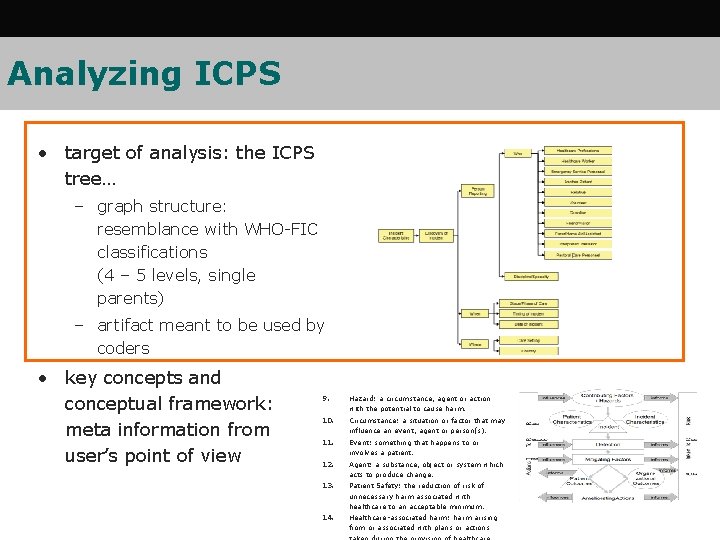
Analyzing ICPS • target of analysis: the ICPS tree… – graph structure: resemblance with WHO-FIC classifications (4 – 5 levels, single parents) – artifact meant to be used by coders • key concepts and conceptual framework: meta information from user’s point of view 9. Hazard: a circumstance, agent or action with the potential to cause harm. 10. Circumstance: a situation or factor that may influence an event, agent or person(s). 11. Event: something that happens to or involves a patient. 12. Agent: a substance, object or system which acts to produce change. 13. Patient Safety: the reduction of risk of unnecessary harm associated with healthcare to an acceptable minimum. 14. Healthcare-associated harm: harm arising from or associated with plans or actions
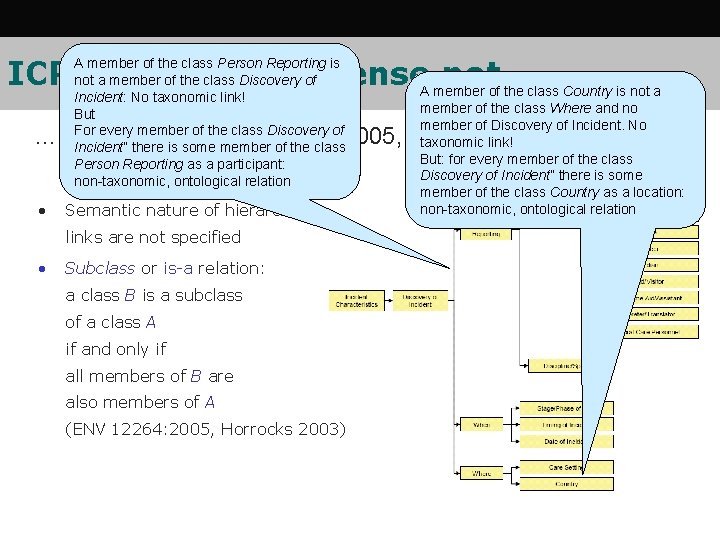
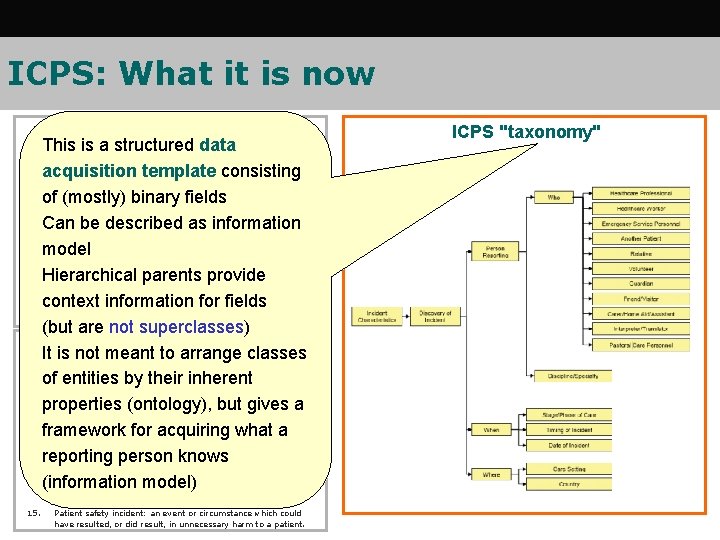
ICPS is in a strict sense. A member not… of the class Country is not a A member of the class Person Reporting is not a member of the class Discovery of Incident: No taxonomic link! But For every member of the class Discovery of Incident” there is some member of the class Person Reporting as a participant: non-taxonomic, ontological relation member of the class Where and no member of Discovery of Incident. No taxonomic link! But: for every member of the class Discovery of Incident” there is some member of the class Country as a location: non-taxonomic, ontological relation … a taxonomy (ENV 12264: 2005, Cornet 2006) • Semantic nature of hierarchic links are not specified • Subclass or is-a relation: a class B is a subclass of a class A if and only if all members of B are also members of A (ENV 12264: 2005, Horrocks 2003)
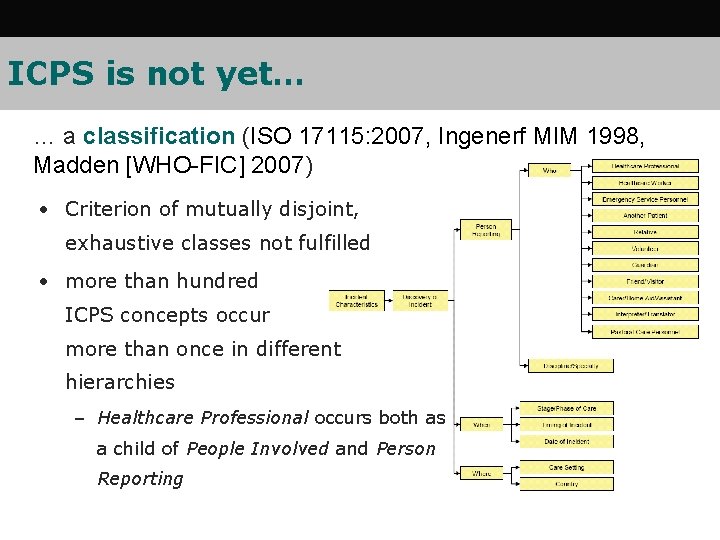
ICPS is not yet… … a classification (ISO 17115: 2007, Ingenerf MIM 1998, Madden [WHO-FIC] 2007) • Criterion of mutually disjoint, exhaustive classes not fulfilled • more than hundred ICPS concepts occur more than once in different hierarchies – Healthcare Professional occurs both as a child of People Involved and Person Reporting
ICPS: What it is now “Conceptual Framework” “Key Concepts” 9. Hazard: a circumstance, agent or action with the potential to cause harm. 10. Circumstance: a situation or factor that may influence an event, agent or person(s). 11. Event: something that happens to or involves a patient. 12. Agent: a substance, object or system which acts to produce change. 13. Patient Safety: the reduction of risk of unnecessary harm associated with healthcare to an acceptable minimum. 14. Healthcare-associated harm: harm arising from or associated with plans or actions taken during the provision of healthcare, rather than an underlying disease or injury. 15. Patient safety incident: an event or circumstance which could have resulted, or did result, in unnecessary harm to a patient. ICPS "taxonomy"
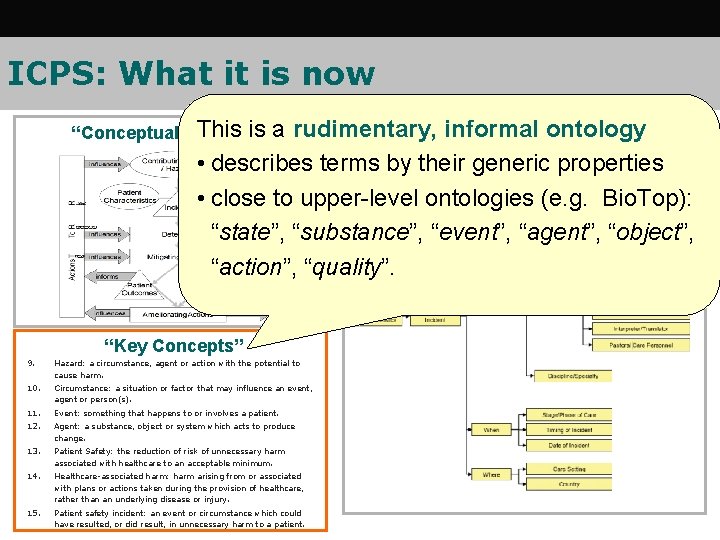
ICPS: What it is now This is a rudimentary, informal “Concepts ontology by Class” “Conceptual Framework” • describes terms by their generic properties • close to upper-level ontologies (e. g. Bio. Top): “state”, “substance”, “event”, “agent”, “object”, “action”, “quality”. “Key Concepts” 9. Hazard: a circumstance, agent or action with the potential to cause harm. 10. Circumstance: a situation or factor that may influence an event, agent or person(s). 11. Event: something that happens to or involves a patient. 12. Agent: a substance, object or system which acts to produce change. 13. Patient Safety: the reduction of risk of unnecessary harm associated with healthcare to an acceptable minimum. 14. Healthcare-associated harm: harm arising from or associated with plans or actions taken during the provision of healthcare, rather than an underlying disease or injury. 15. Patient safety incident: an event or circumstance which could have resulted, or did result, in unnecessary harm to a patient.
ICPS: What it is now “Conceptual Framework” “Key Concepts” 9. Hazard: a circumstance, agent or action with the potential to cause harm. 10. Circumstance: a situation or factor that may influence an event, agent or person(s). 11. Event: something that happens to or involves a patient. 12. Agent: a substance, object or system which acts to produce change. 13. Patient Safety: the reduction of risk of unnecessary harm associated with healthcare to an acceptable minimum. 14. Healthcare-associated harm: harm arising from or associated with plans or actions taken during the provision of healthcare, rather than an underlying disease or injury. 15. Patient safety incident: an event or circumstance which could have resulted, or did result, in unnecessary harm to a patient. ICPS "taxonomy" This is a complex patient safety model • Similarity with - workflows - business models - Ontologically: - complex event type
ICPS: What it is now “Conceptual Framework” This is a structured data acquisition template consisting of (mostly) binary fields Can be described as information model Hierarchical parents provide context information for fields (but are not superclasses) “Key It Hazard: is not meant. Concepts” to arrange classes 9. a circumstance, agent or action with the potential to harm. ofcause entities by their inherent 10. Circumstance: a situation or factor that may influence an event, agent or person(s). properties (ontology), but gives a 11. Event: something that happens to or involves a patient. 12. Agent: a substance, object or system which acts to produce framework for acquiring what a change. 13. Patient Safety: the reduction of risk of unnecessary harm reporting knows associated with person healthcare to an acceptable minimum. 14. Healthcare-associated harm: harm arising from or associated (information model) with plans or actions taken during the provision of healthcare, rather than an underlying disease or injury. 15. Patient safety incident: an event or circumstance which could have resulted, or did result, in unnecessary harm to a patient. ICPS "taxonomy"
Representation Artifacts Ontologies Formal descriptions • MRSA subtype-of SA • SA subtype-of Staphylococcus • SA implies bearer-of some MR quality Textual descriptions • “MRSA is defined as SA for which methicillin has no toxic effect” • theories that attempt to give precise mathematical formulations of the properties and relations of certain entities. (Stanford Encyclopedia of Philosophy) Information Models Methicillin resistance o. Clinically confirmed o. Confirmed by antibiogram o. Suspected o. None o. Unknown • artifacts in which information is recorded A. Rector, Semantic. Health D 6. 1
Structure of the Talk • ICPS: How does it look like? • ICPS: What it isn’t • ICPS: What it is now • ICPS: What it may be in the future
What ICPS may be in the future • After finishing, ICPS has the potential to be universally accepted as a reporting standard • The ICPS “key concepts” may become a fully-fledged formal ontology rooted in existing upper-level ontologies and using Semantic Web standards (OWL) and being linked to ontological / terminological standards like SNOMED CT • The ICPS “conceptual framework” can be enhanced by formal descriptions • The ICPS reporting template ("taxonomy") may then be fully described in terms of ICPS’s ontological core • but…
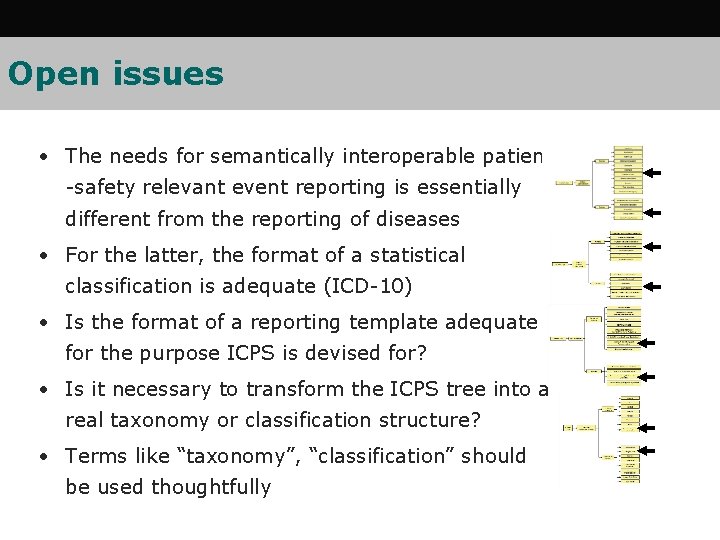
Open issues • The needs for semantically interoperable patient -safety relevant event reporting is essentially different from the reporting of diseases • For the latter, the format of a statistical classification is adequate (ICD-10) • Is the format of a reporting template adequate for the purpose ICPS is devised for? • Is it necessary to transform the ICPS tree into a real taxonomy or classification structure? • Terms like “taxonomy”, “classification” should be used thoughtfully