
The Hypodermis Aka Subcutaneous or superficial fascia Composed
The Hypodermis • Aka. Subcutaneous or superficial fascia • Composed of Adipose • Not really a part of the integument, but it is important in stabilizing the position of the skin in relation to underlying tissue • Reduces heat loss, acts as an energy reserve, shock absorber • Men accumulate – neck, arms, lower back, stomach, and butt • Women accumulate – breasts, butt, hips, and thighs.
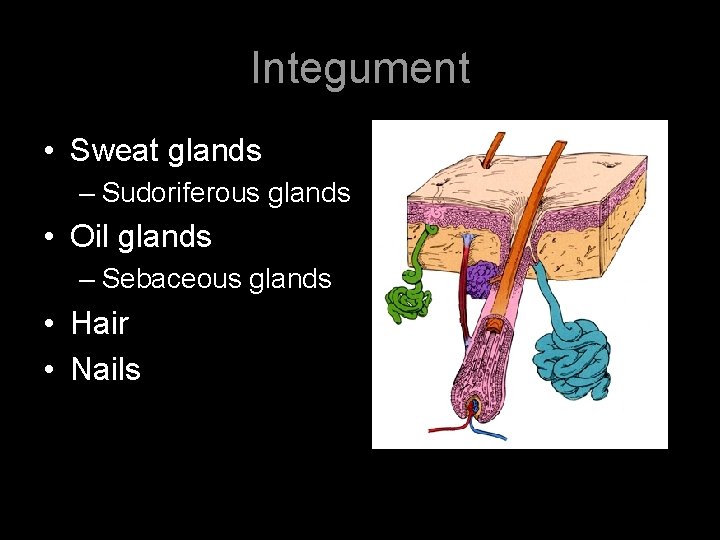
Integument • Sweat glands – Sudoriferous glands • Oil glands – Sebaceous glands • Hair • Nails
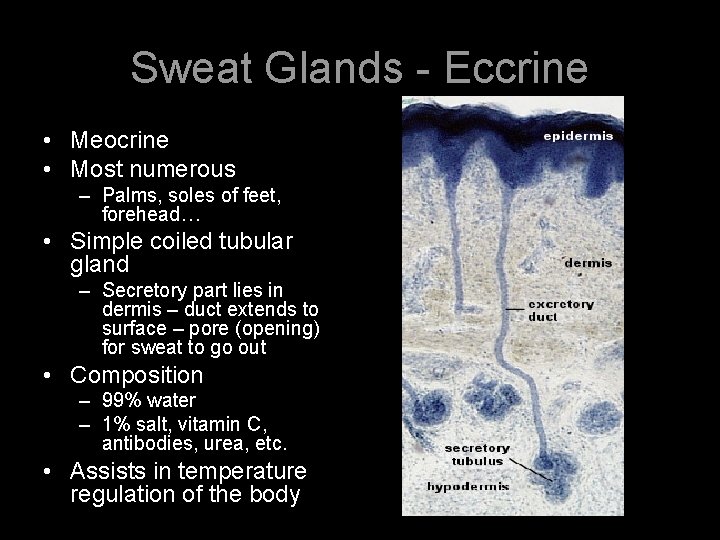
Sweat Glands - Eccrine • Meocrine • Most numerous – Palms, soles of feet, forehead… • Simple coiled tubular gland – Secretory part lies in dermis – duct extends to surface – pore (opening) for sweat to go out • Composition – 99% water – 1% salt, vitamin C, antibodies, urea, etc. • Assists in temperature regulation of the body
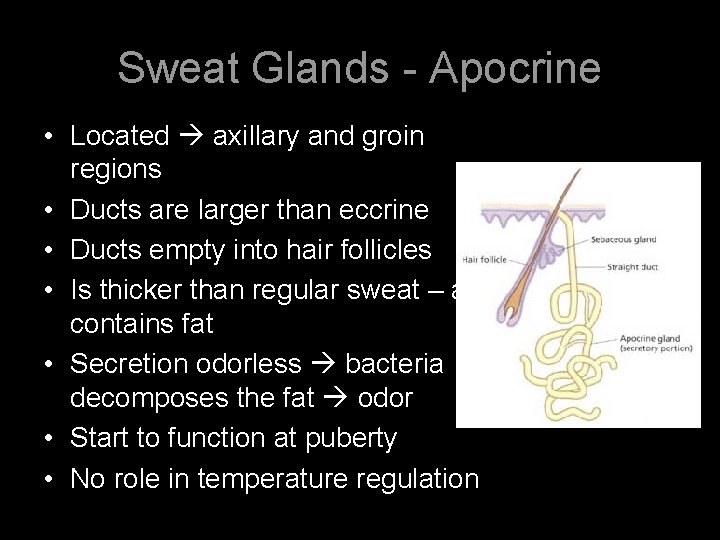
Sweat Glands - Apocrine • Located axillary and groin regions • Ducts are larger than eccrine • Ducts empty into hair follicles • Is thicker than regular sweat – also contains fat • Secretion odorless bacteria decomposes the fat odor • Start to function at puberty • No role in temperature regulation
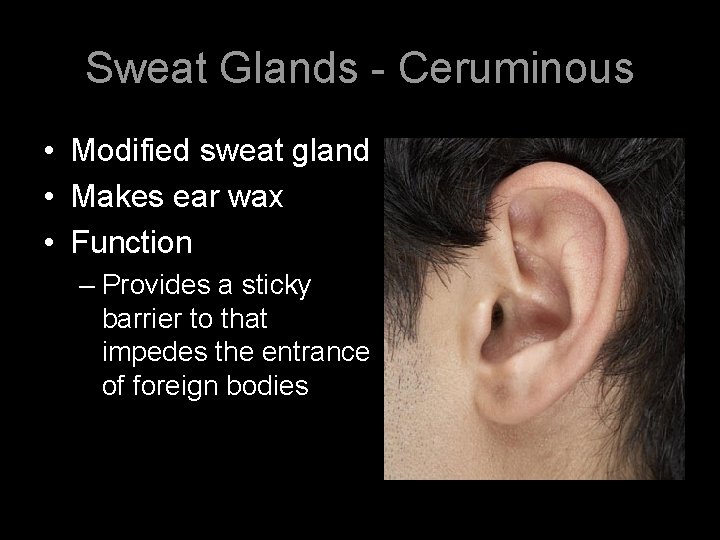
Sweat Glands - Ceruminous • Modified sweat gland • Makes ear wax • Function – Provides a sticky barrier to that impedes the entrance of foreign bodies
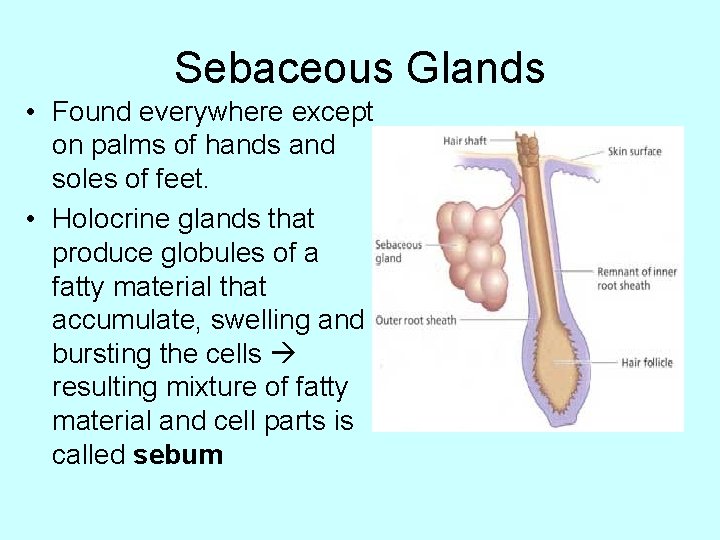
Sebaceous Glands • Found everywhere except on palms of hands and soles of feet. • Holocrine glands that produce globules of a fatty material that accumulate, swelling and bursting the cells resulting mixture of fatty material and cell parts is called sebum
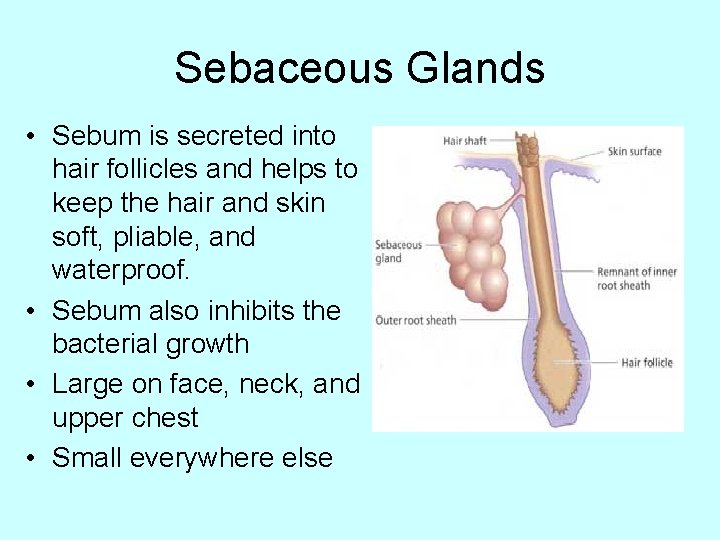
Sebaceous Glands • Sebum is secreted into hair follicles and helps to keep the hair and skin soft, pliable, and waterproof. • Sebum also inhibits the bacterial growth • Large on face, neck, and upper chest • Small everywhere else
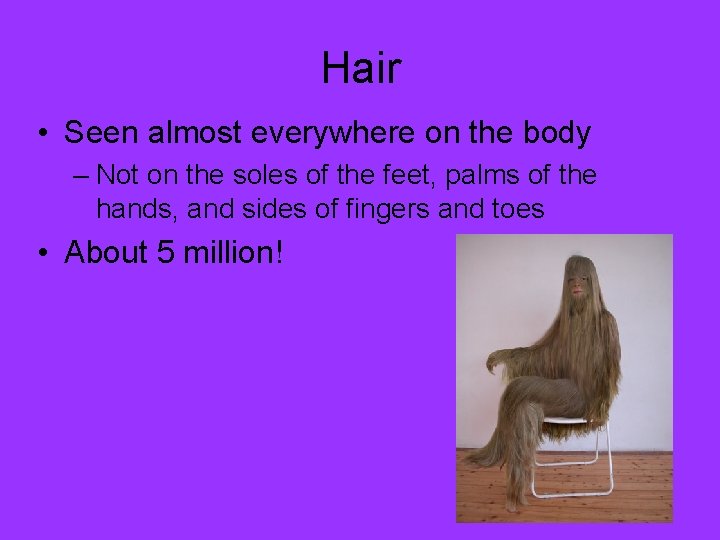
Hair • Seen almost everywhere on the body – Not on the soles of the feet, palms of the hands, and sides of fingers and toes • About 5 million!
Hair • Hair helps to keep mammals warm • Humans sparse hair – Ability to sense insects on the skin before they bite or sting – Scalp guards head against physical trauma, heat loss, sunlight – Eyebrows & Eyelashes shield eyes – Nose hairs filter large particles
Hair • Flexible strands produced by hair follicles and consist largely of dead, keratinized cells • Made up of hard keratin – Tougher and more durable – Individual cells don’t flake
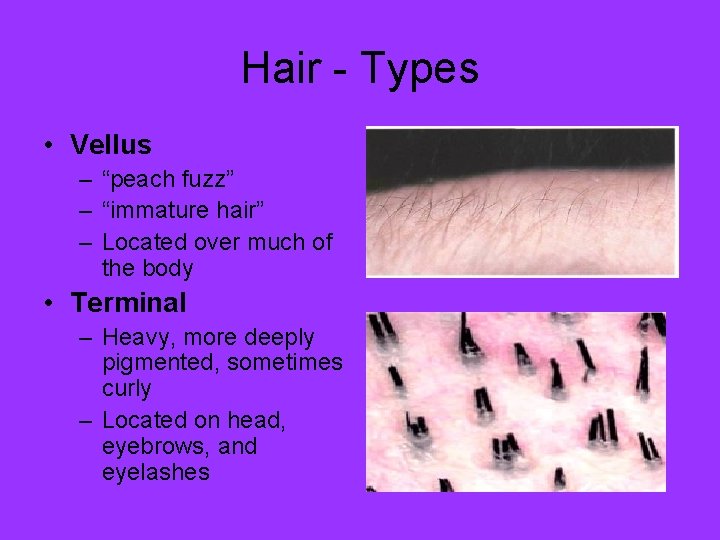
Hair - Types • Vellus – “peach fuzz” – “immature hair” – Located over much of the body • Terminal – Heavy, more deeply pigmented, sometimes curly – Located on head, eyebrows, and eyelashes
Major Hair Regions • Shaft – Projects from the skin • Root – Embedded in the skin – Penetrates into the dermis and sometimes hypodermis
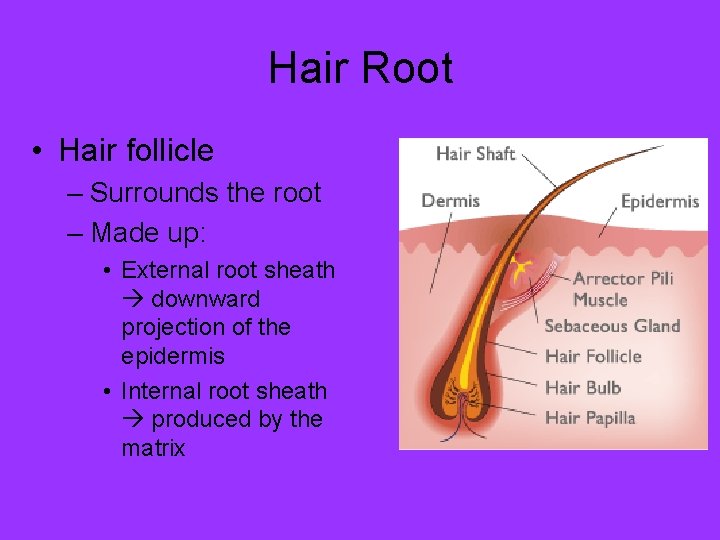
Hair Root • Hair follicle – Surrounds the root – Made up: • External root sheath downward projection of the epidermis • Internal root sheath produced by the matrix
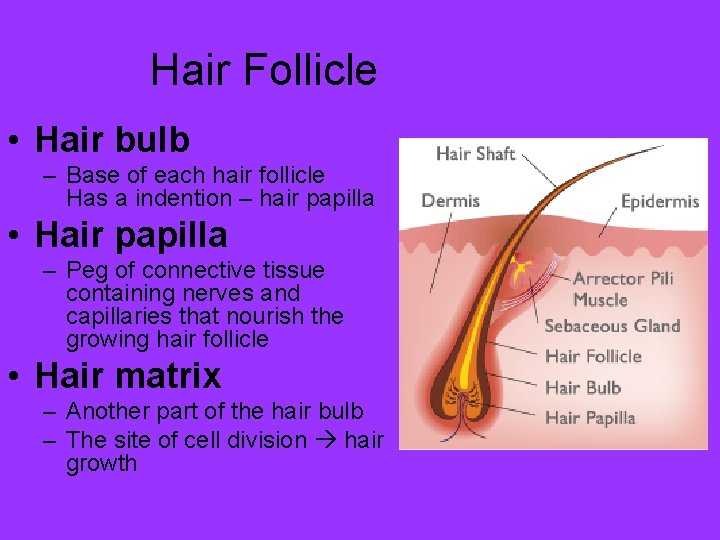
Hair Follicle • Hair bulb – Base of each hair follicle Has a indention – hair papilla • Hair papilla – Peg of connective tissue containing nerves and capillaries that nourish the growing hair follicle • Hair matrix – Another part of the hair bulb – The site of cell division hair growth
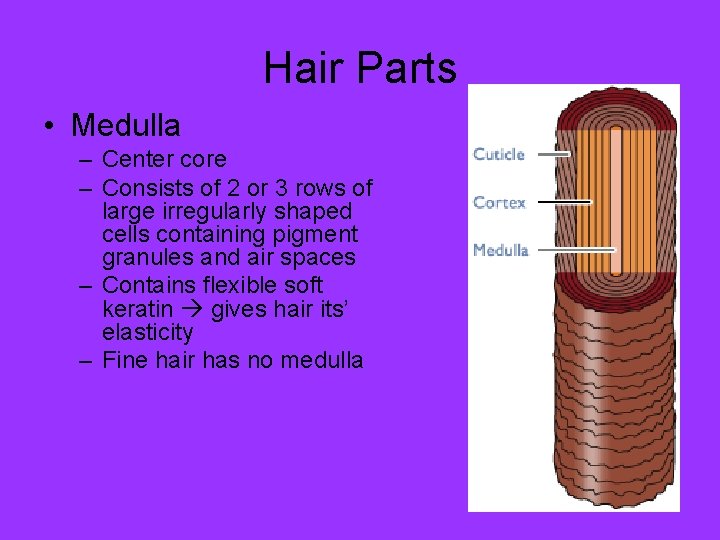
Hair Parts • Medulla – Center core – Consists of 2 or 3 rows of large irregularly shaped cells containing pigment granules and air spaces – Contains flexible soft keratin gives hair its’ elasticity – Fine hair has no medulla
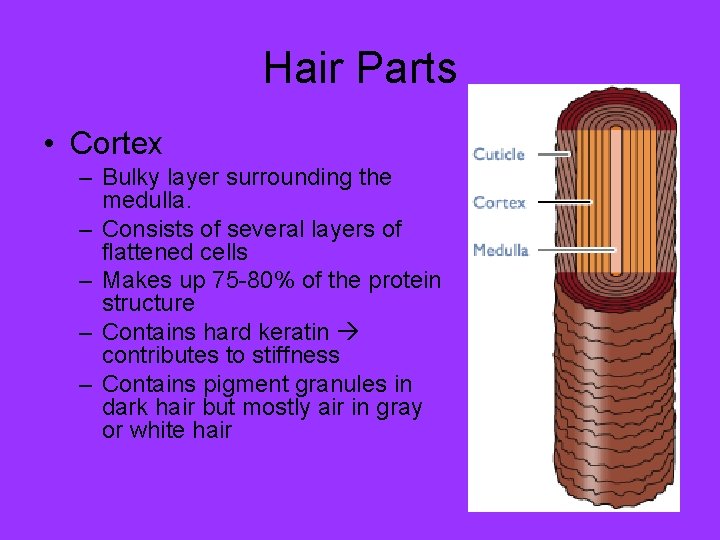
Hair Parts • Cortex – Bulky layer surrounding the medulla. – Consists of several layers of flattened cells – Makes up 75 -80% of the protein structure – Contains hard keratin contributes to stiffness – Contains pigment granules in dark hair but mostly air in gray or white hair
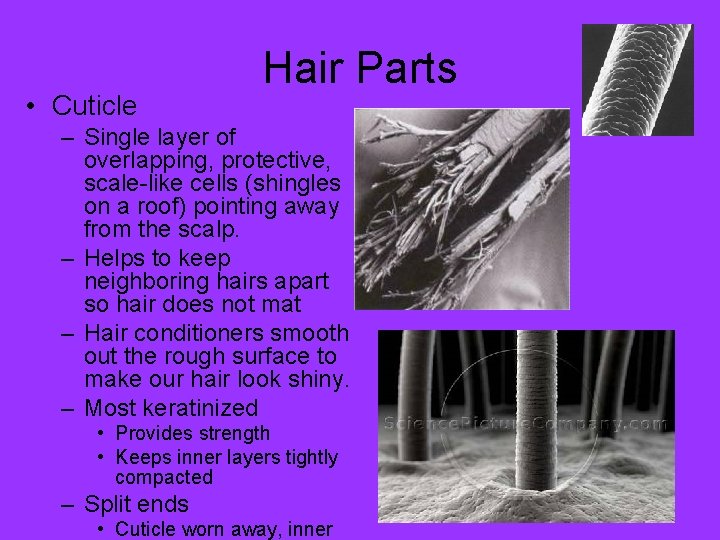
• Cuticle Hair Parts – Single layer of overlapping, protective, scale-like cells (shingles on a roof) pointing away from the scalp. – Helps to keep neighboring hairs apart so hair does not mat – Hair conditioners smooth out the rough surface to make our hair look shiny. – Most keratinized • Provides strength • Keeps inner layers tightly compacted – Split ends • Cuticle worn away, inner
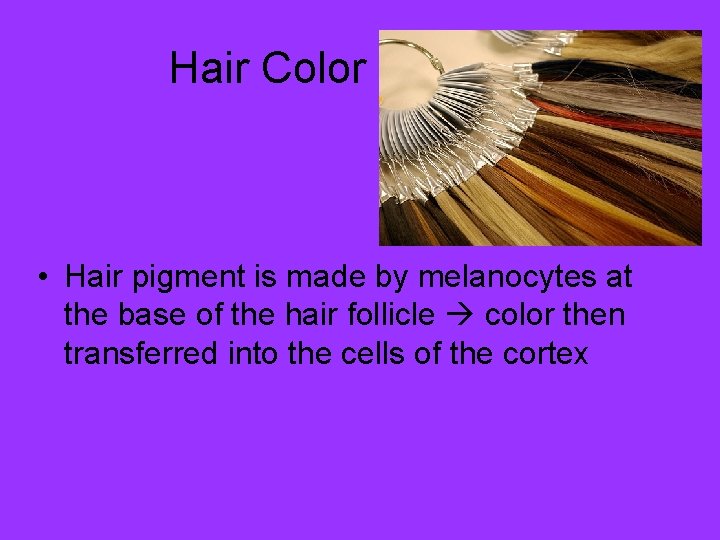
Hair Color • Hair pigment is made by melanocytes at the base of the hair follicle color then transferred into the cells of the cortex
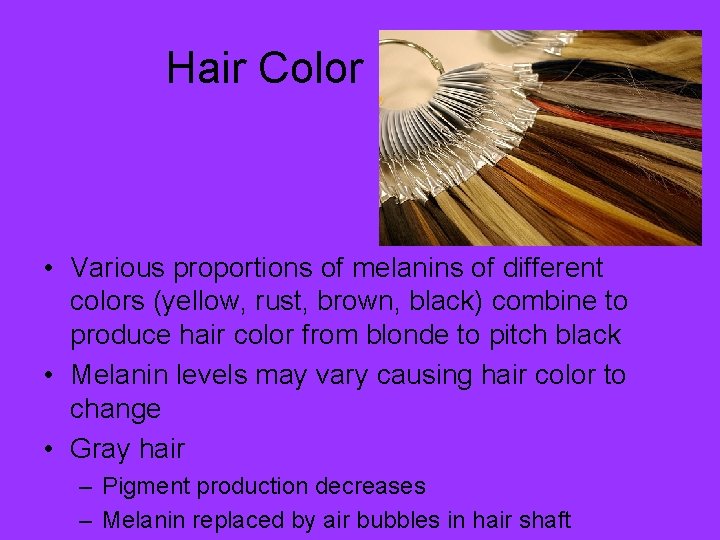
Hair Color • Various proportions of melanins of different colors (yellow, rust, brown, black) combine to produce hair color from blonde to pitch black • Melanin levels may vary causing hair color to change • Gray hair – Pigment production decreases – Melanin replaced by air bubbles in hair shaft
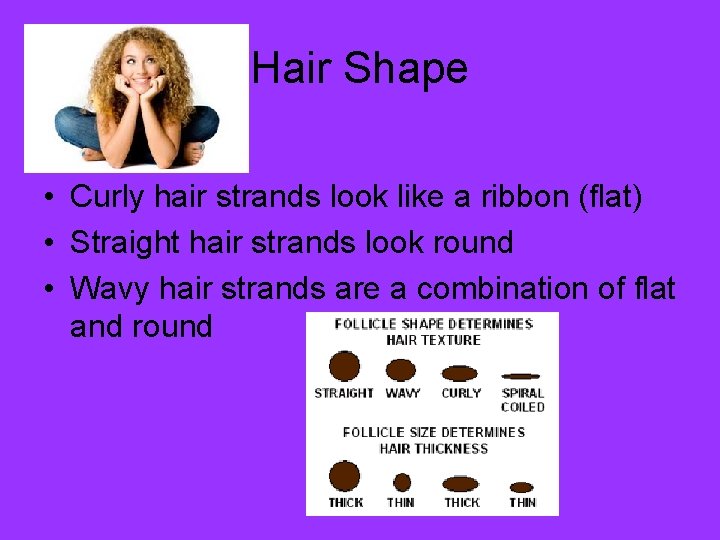
Hair Shape • Curly hair strands look like a ribbon (flat) • Straight hair strands look round • Wavy hair strands are a combination of flat and round
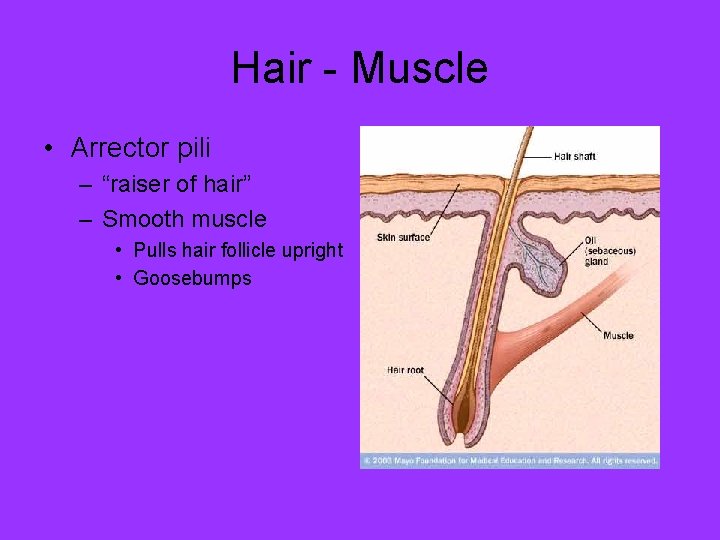
Hair - Muscle • Arrector pili – “raiser of hair” – Smooth muscle • Pulls hair follicle upright • Goosebumps
- Slides: 21