
The Hyogo Framework for Action and related international
- Slides: 13
The Hyogo Framework for Action and related international mechanisms for early warning governance and organisation Reid Basher, UN Secretariat of the ISDR, and Platform for Promotion of Early Warning The Hyogo Framework for Action 2005 -2015 and the ISDR System - a response to growing disasters q The global survey of EW systems - a global EW system? q Systematic, international, multi-hazard approaches needed Presentation to Symposium on Multi-Hazard Early Warning Systems for Integrated Disaster Risk Management, WMO HQ, q 1 Geneva, 23 -24 May 2006
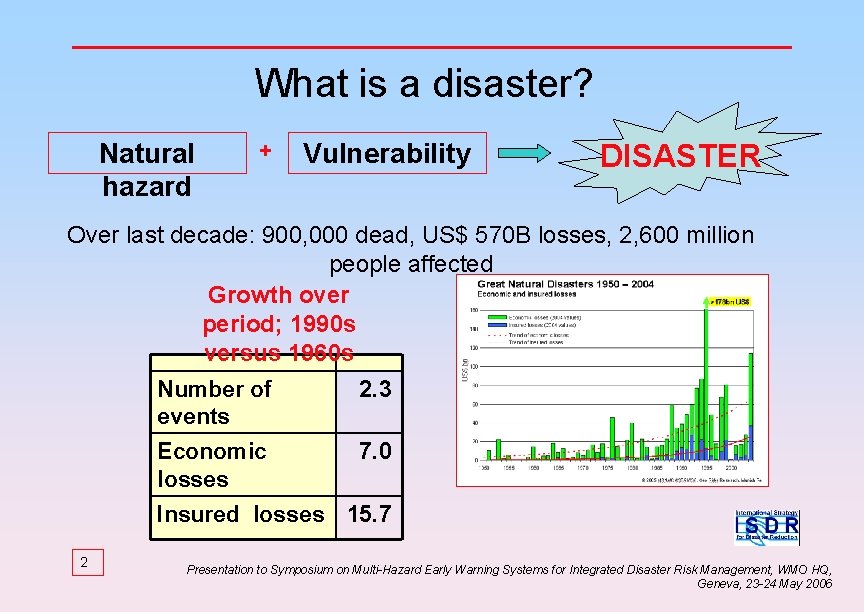
What is a disaster? Natural hazard + Vulnerability DISASTER Over last decade: 900, 000 dead, US$ 570 B losses, 2, 600 million people affected Growth over period; 1990 s versus 1960 s Number of events 2. 3 Economic losses 7. 0 Insured losses 15. 7 2 Presentation to Symposium on Multi-Hazard Early Warning Systems for Integrated Disaster Risk Management, WMO HQ, Geneva, 23 -24 May 2006
Hyogo Framework for Action 2005 -2015 Building the resilience of nations and communities to disasters Agreed through an open ended inter-governmental process concluded at the World Conference on Disaster Reduction, Kobe, Hyogo, Japan, 18 – 22 January, 2005 Strategic goals § Disaster reduction as part of sustainable development § Strengthen institutions (especially in communities) to build resilience § Build risk reduction into emergency management and recovery 3 Presentation to Symposium on Multi-Hazard Early Warning Systems for Integrated Disaster Risk Management, WMO HQ, Geneva, 23 -24 May 2006
Hyogo Framework for Action 2005 -2015 Building the resilience of nations and communities to disasters q q q q 4 Priorities for action Disaster risk reduction as a priority with strong institutional basis for action Identify, assess and monitor disaster risks and enhance early warning Knowledge, innovation, education for culture of safety and resilience Reduce the underlying and risk factors Implementation follow. Strengthen disaster preparedness for effective response UN Rolesup of states, international and regional organisations, secretariat Importance of monitoring and reporting, and indicators of progress in risk reduction Resources Presentation to Symposium on Multi-Hazard Early Warning Systems for Integrated Disaster Risk Management, WMO HQ, Geneva, 23 -24 May 2006
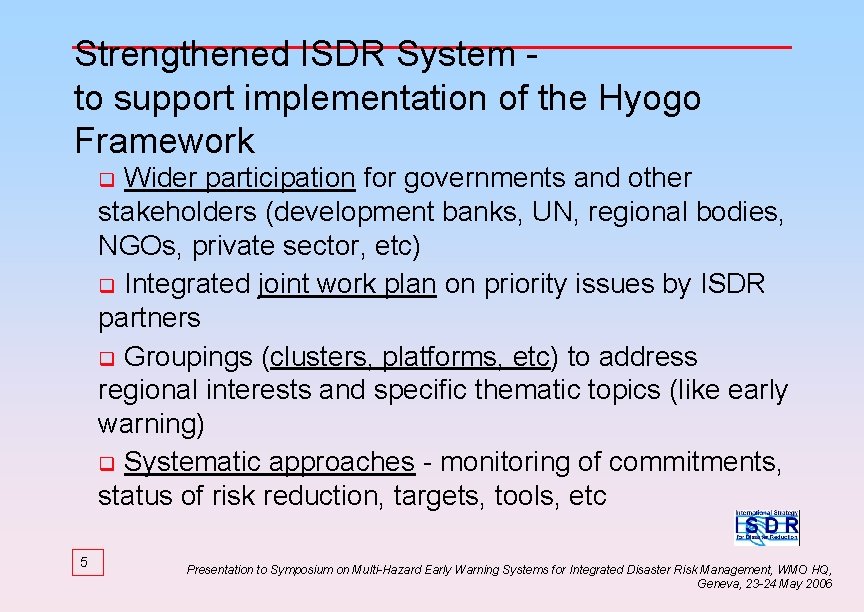
Strengthened ISDR System to support implementation of the Hyogo Framework Wider participation for governments and other stakeholders (development banks, UN, regional bodies, NGOs, private sector, etc) q Integrated joint work plan on priority issues by ISDR partners q Groupings (clusters, platforms, etc) to address regional interests and specific thematic topics (like early warning) q Systematic approaches - monitoring of commitments, status of risk reduction, targets, tools, etc q 5 Presentation to Symposium on Multi-Hazard Early Warning Systems for Integrated Disaster Risk Management, WMO HQ, Geneva, 23 -24 May 2006
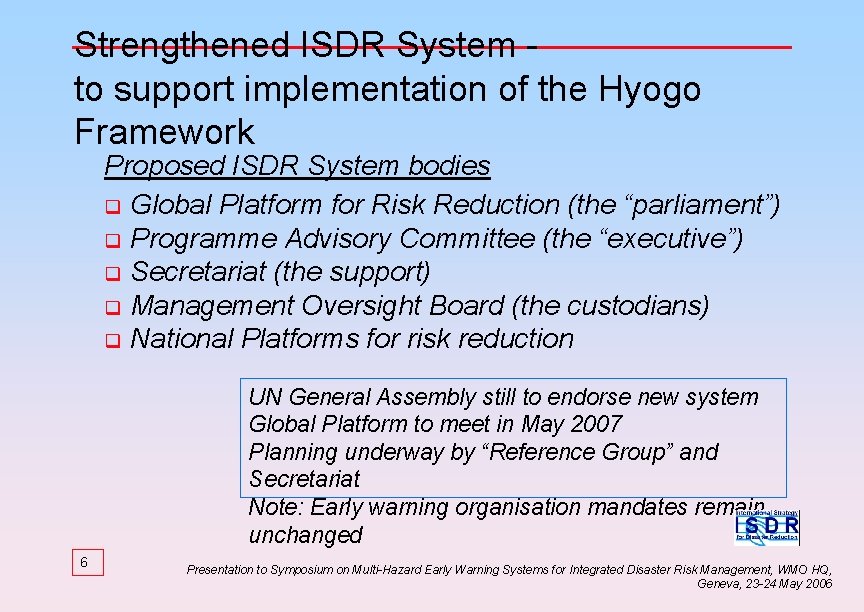
Strengthened ISDR System to support implementation of the Hyogo Framework Proposed ISDR System bodies q Global Platform for Risk Reduction (the “parliament”) q Programme Advisory Committee (the “executive”) q Secretariat (the support) q Management Oversight Board (the custodians) q National Platforms for risk reduction UN General Assembly still to endorse new system Global Platform to meet in May 2007 Planning underway by “Reference Group” and Secretariat Note: Early warning organisation mandates remain unchanged 6 Presentation to Symposium on Multi-Hazard Early Warning Systems for Integrated Disaster Risk Management, WMO HQ, Geneva, 23 -24 May 2006
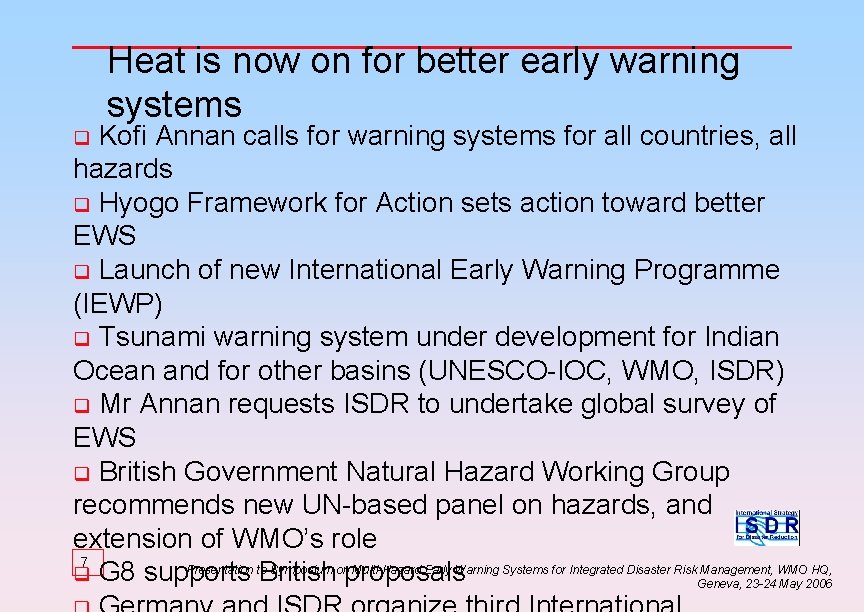
Heat is now on for better early warning systems Kofi Annan calls for warning systems for all countries, all hazards q Hyogo Framework for Action sets action toward better EWS q Launch of new International Early Warning Programme (IEWP) q Tsunami warning system under development for Indian Ocean and for other basins (UNESCO-IOC, WMO, ISDR) q Mr Annan requests ISDR to undertake global survey of EWS q British Government Natural Hazard Working Group recommends new UN-based panel on hazards, and extension of WMO’s role 7 Presentation to Symposium on Multi-Hazard Early Warning Systems for Integrated Disaster Risk Management, WMO HQ, q G 8 supports British proposals Geneva, 23 -24 May 2006 q
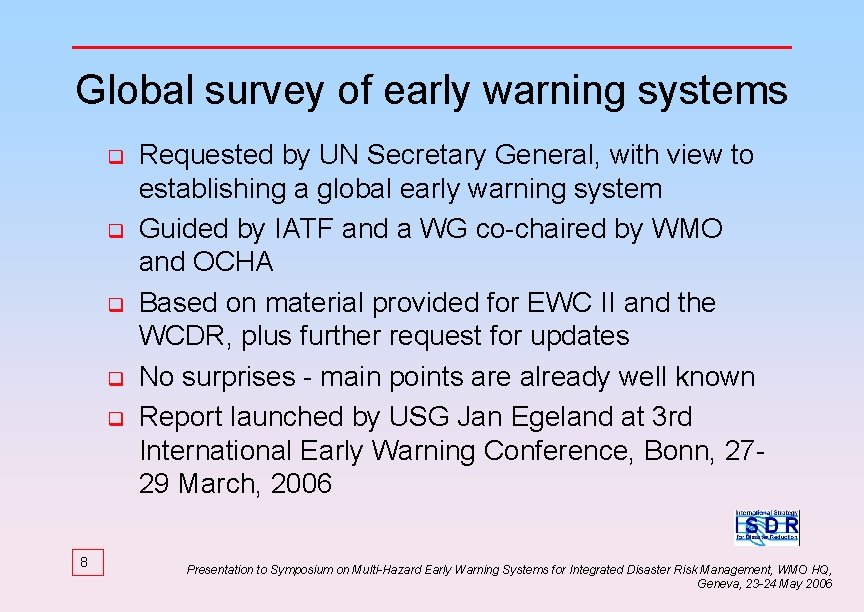
Global survey of early warning systems q q q 8 Requested by UN Secretary General, with view to establishing a global early warning system Guided by IATF and a WG co-chaired by WMO and OCHA Based on material provided for EWC II and the WCDR, plus further request for updates No surprises - main points are already well known Report launched by USG Jan Egeland at 3 rd International Early Warning Conference, Bonn, 2729 March, 2006 Presentation to Symposium on Multi-Hazard Early Warning Systems for Integrated Disaster Risk Management, WMO HQ, Geneva, 23 -24 May 2006
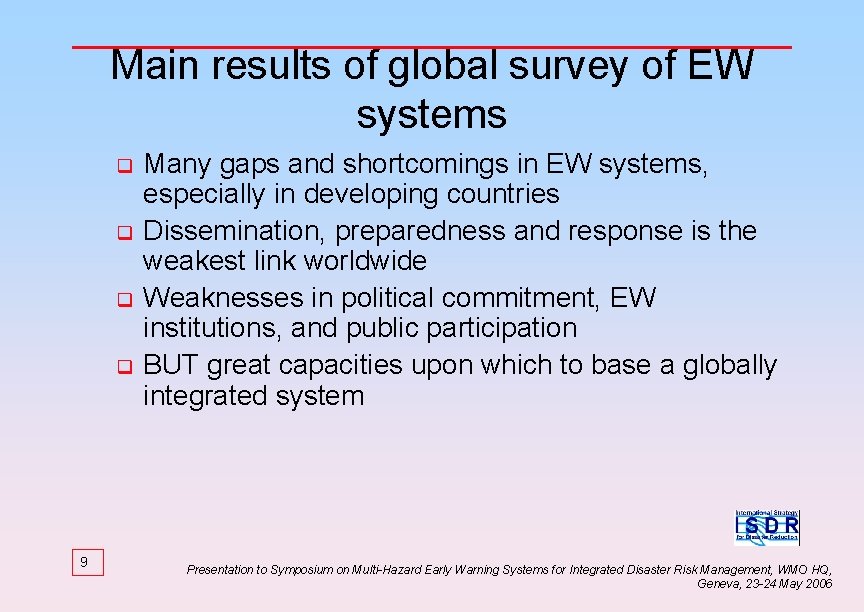
Main results of global survey of EW systems q q 9 Many gaps and shortcomings in EW systems, especially in developing countries Dissemination, preparedness and response is the weakest link worldwide Weaknesses in political commitment, EW institutions, and public participation BUT great capacities upon which to base a globally integrated system Presentation to Symposium on Multi-Hazard Early Warning Systems for Integrated Disaster Risk Management, WMO HQ, Geneva, 23 -24 May 2006
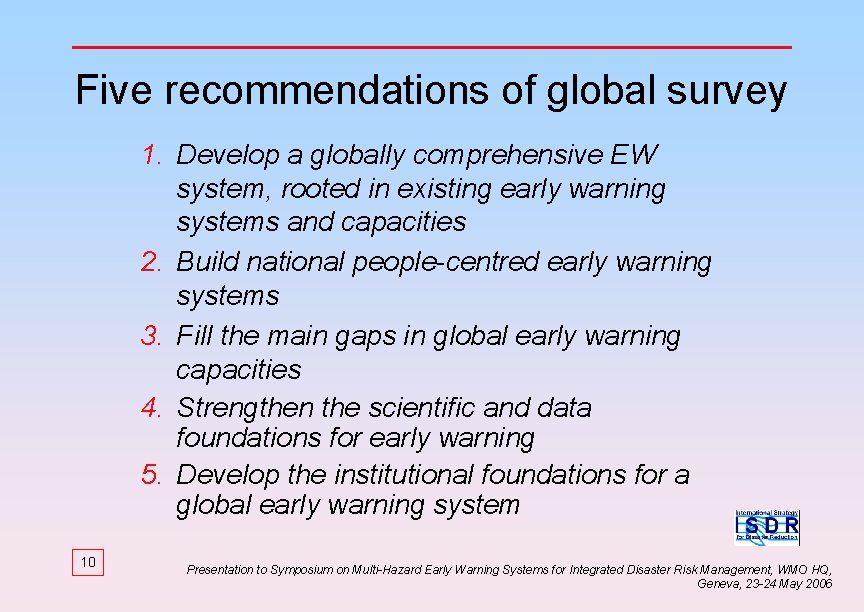
Five recommendations of global survey 1. Develop a globally comprehensive EW system, rooted in existing early warning systems and capacities 2. Build national people-centred early warning systems 3. Fill the main gaps in global early warning capacities 4. Strengthen the scientific and data foundations for early warning 5. Develop the institutional foundations for a global early warning system 10 Presentation to Symposium on Multi-Hazard Early Warning Systems for Integrated Disaster Risk Management, WMO HQ, Geneva, 23 -24 May 2006
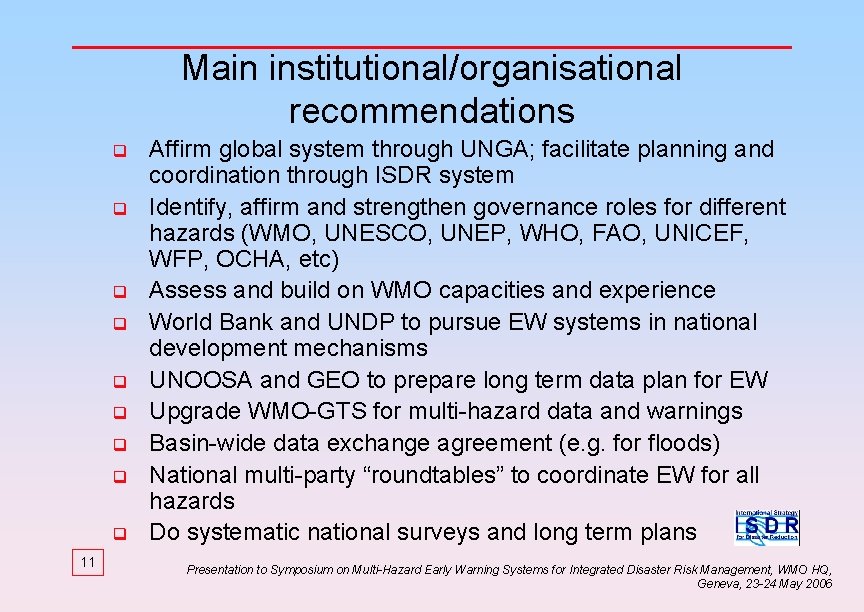
Main institutional/organisational recommendations q q q q q 11 Affirm global system through UNGA; facilitate planning and coordination through ISDR system Identify, affirm and strengthen governance roles for different hazards (WMO, UNESCO, UNEP, WHO, FAO, UNICEF, WFP, OCHA, etc) Assess and build on WMO capacities and experience World Bank and UNDP to pursue EW systems in national development mechanisms UNOOSA and GEO to prepare long term data plan for EW Upgrade WMO-GTS for multi-hazard data and warnings Basin-wide data exchange agreement (e. g. for floods) National multi-party “roundtables” to coordinate EW for all hazards Do systematic national surveys and long term plans Presentation to Symposium on Multi-Hazard Early Warning Systems for Integrated Disaster Risk Management, WMO HQ, Geneva, 23 -24 May 2006
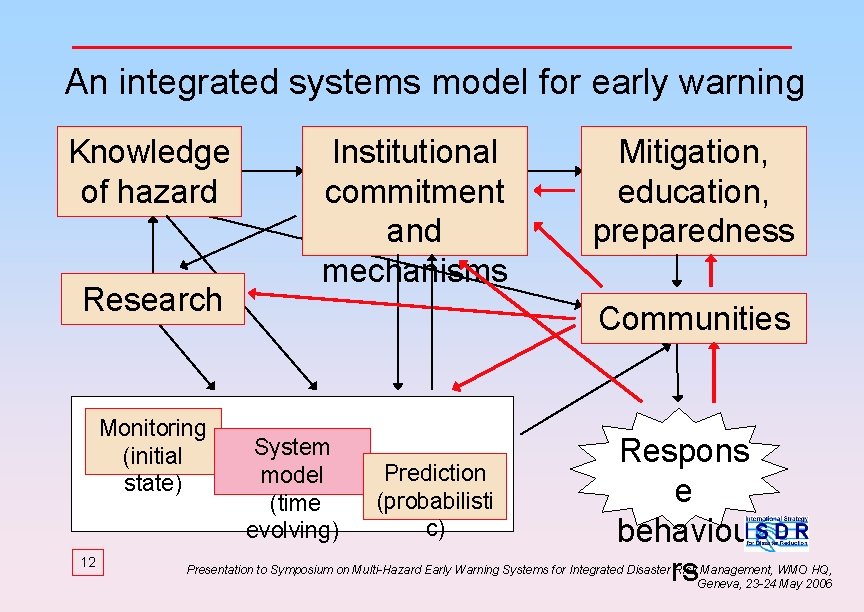
An integrated systems model for early warning Knowledge of hazard Research Monitoring (initial state) 12 Institutional commitment and mechanisms Mitigation, education, preparedness Communities System model (time evolving) Prediction (probabilisti c) Respons e behaviou rs Presentation to Symposium on Multi-Hazard Early Warning Systems for Integrated Disaster Risk Management, WMO HQ, Geneva, 23 -24 May 2006
www. unisdr. org 13 Presentation to Symposium on Multi-Hazard Early Warning Systems for Integrated Disaster Risk Management, WMO HQ, Geneva, 23 -24 May 2006