
The Hydrogen Atom Model The orbitals we know
The Hydrogen Atom
Model • The “orbitals” we know from general chemistry are wave functions of “hydrogen-like” atoms • Hydrogen-like: any atom, but it has only one electron • Atomic charge Z can be anything in other words • If we can understand atomic orbitals, we can use them to: • Build up molecules • Understand electronic spectroscopy
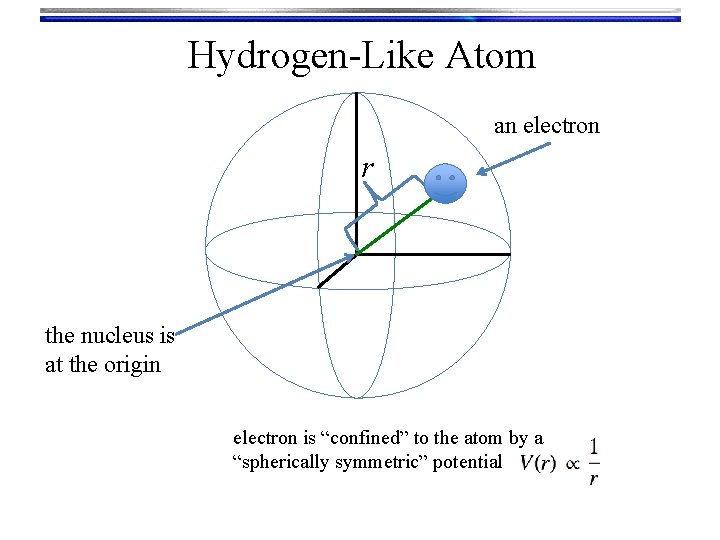
Hydrogen-Like Atom an electron r the nucleus is at the origin electron is “confined” to the atom by a “spherically symmetric” potential
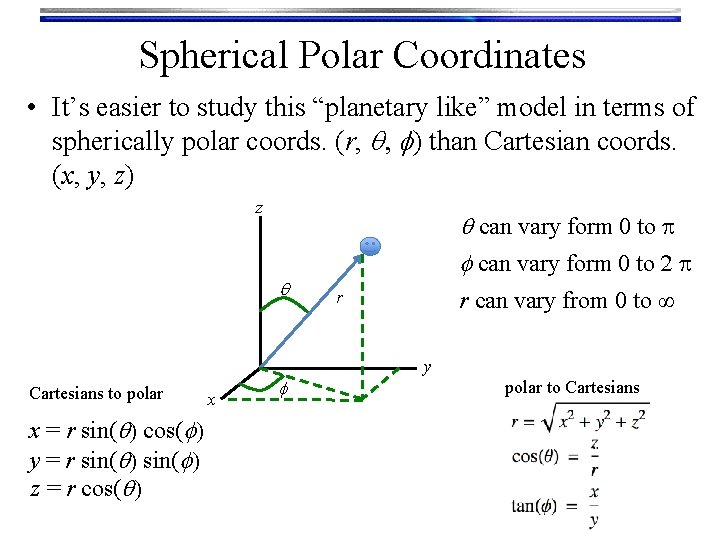
Spherical Polar Coordinates • It’s easier to study this “planetary like” model in terms of spherically polar coords. (r, q, f) than Cartesian coords. (x, y, z) z q Cartesians to polar x = r sin(q) cos(f) y = r sin(q) sin(f) z = r cos(q) x f q can vary form 0 to p f can vary form 0 to 2 p r can vary from 0 to ∞ r y polar to Cartesians
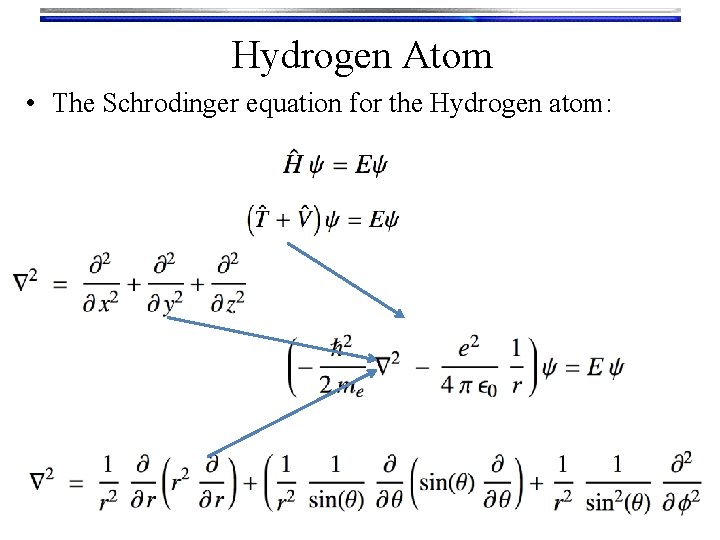
Hydrogen Atom • The Schrodinger equation for the Hydrogen atom:
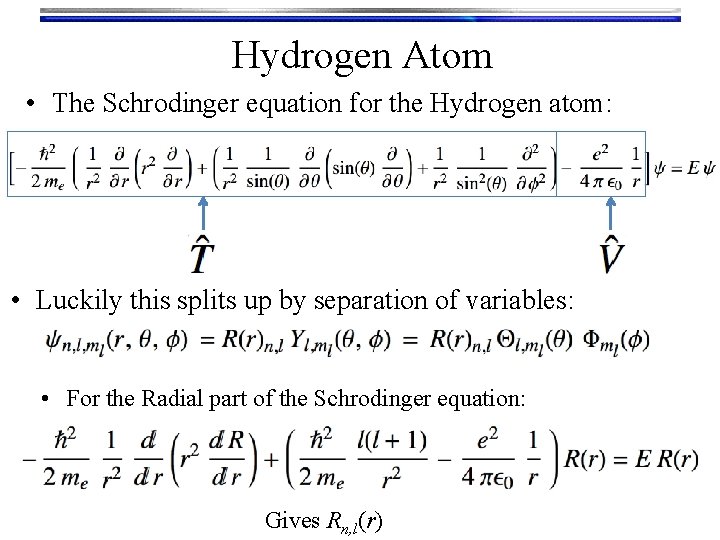
Hydrogen Atom • The Schrodinger equation for the Hydrogen atom: • Luckily this splits up by separation of variables: • For the Radial part of the Schrodinger equation: Gives Rn, l(r)
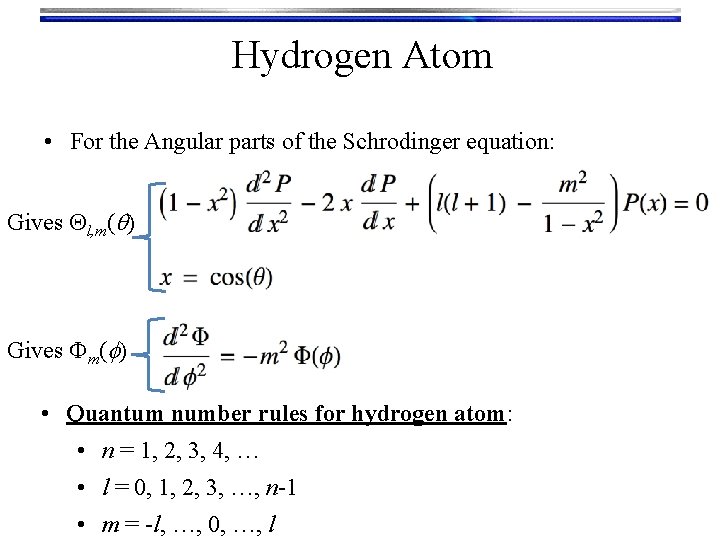
Hydrogen Atom • For the Angular parts of the Schrodinger equation: Gives Ql, m(q) Gives Fm(f) • Quantum number rules for hydrogen atom: • n = 1, 2, 3, 4, … • l = 0, 1, 2, 3, …, n-1 • m = -l, …, 0, …, l
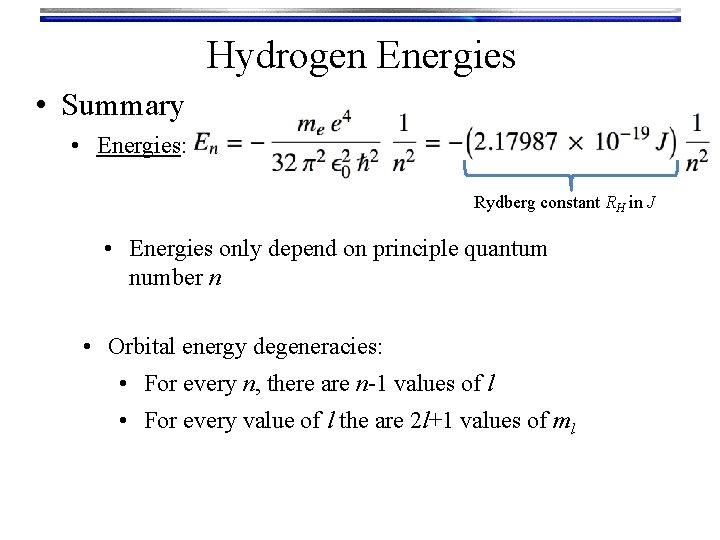
Hydrogen Energies • Summary • Energies: Rydberg constant RH in J • Energies only depend on principle quantum number n • Orbital energy degeneracies: • For every n, there are n-1 values of l • For every value of l the are 2 l+1 values of ml
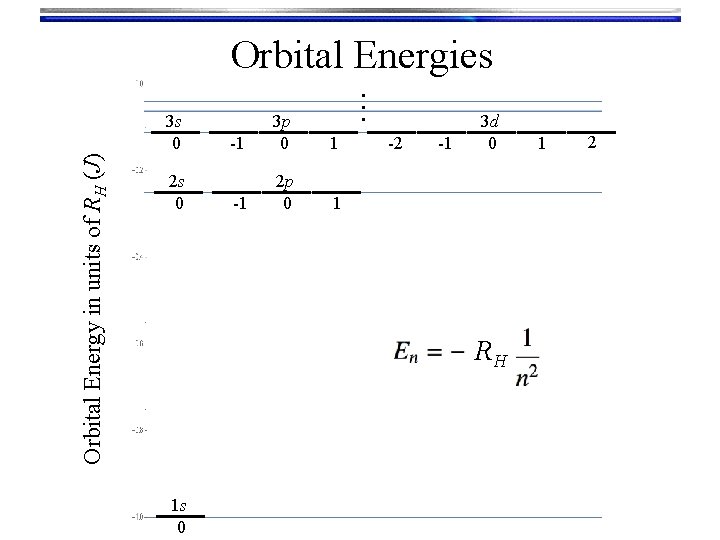
Orbital Energy in units of RH (J) 3 s 0 2 s 0 … Orbital Energies -1 3 p 0 1 -1 2 p 0 1 -2 -1 3 d 0 RH 1 s 0 1 2
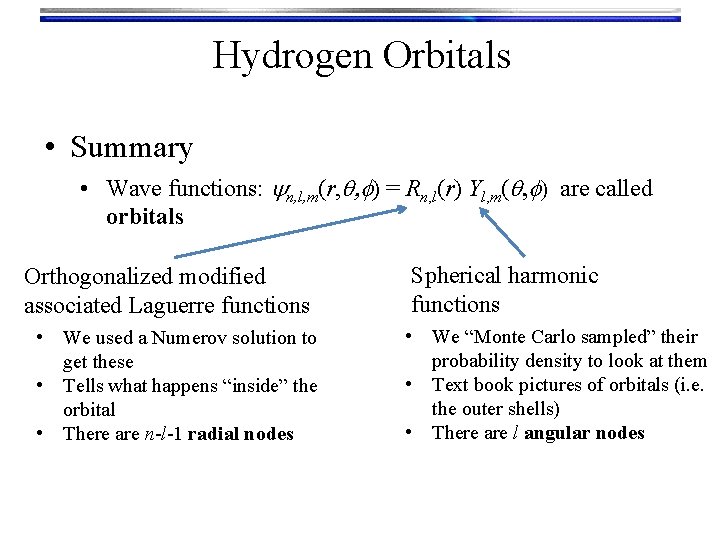
Hydrogen Orbitals • Summary • Wave functions: yn, l, m(r, q, f) = Rn, l(r) Yl, m(q, f) are called orbitals Orthogonalized modified associated Laguerre functions • We used a Numerov solution to get these • Tells what happens “inside” the orbital • There are n-l-1 radial nodes Spherical harmonic functions • We “Monte Carlo sampled” their probability density to look at them • Text book pictures of orbitals (i. e. the outer shells) • There are l angular nodes
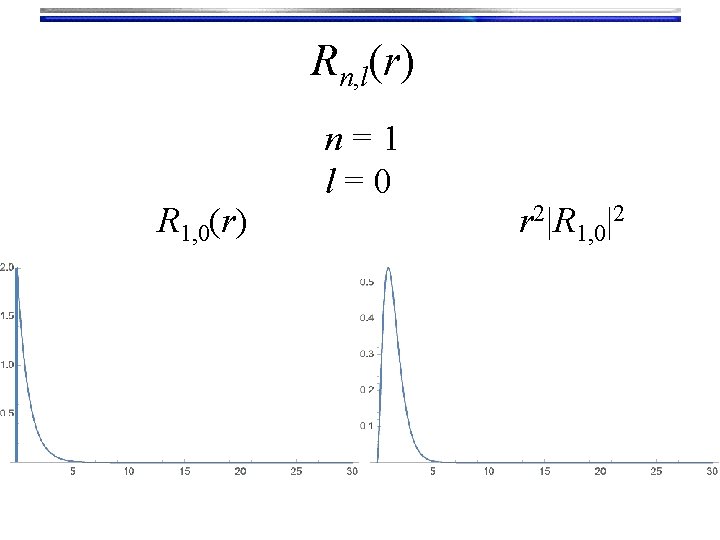
Rn, l(r) R 1, 0(r) n=1 l=0 r 2|R 1, 0|2
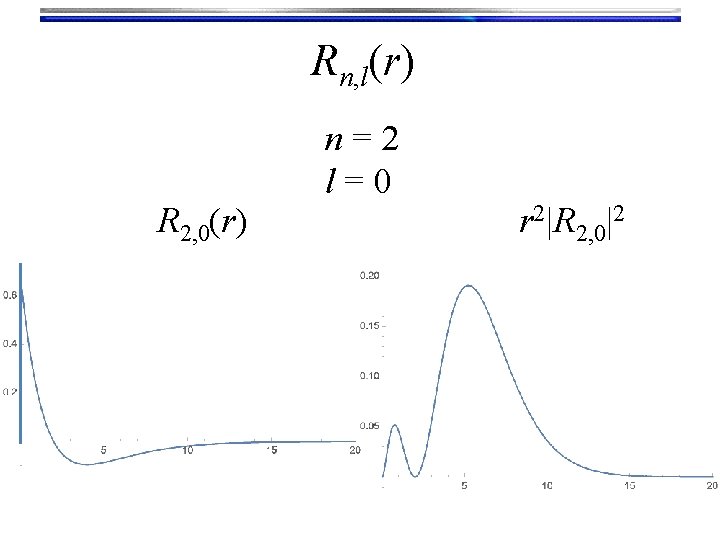
Rn, l(r) R 2, 0(r) n=2 l=0 r 2|R 2, 0|2
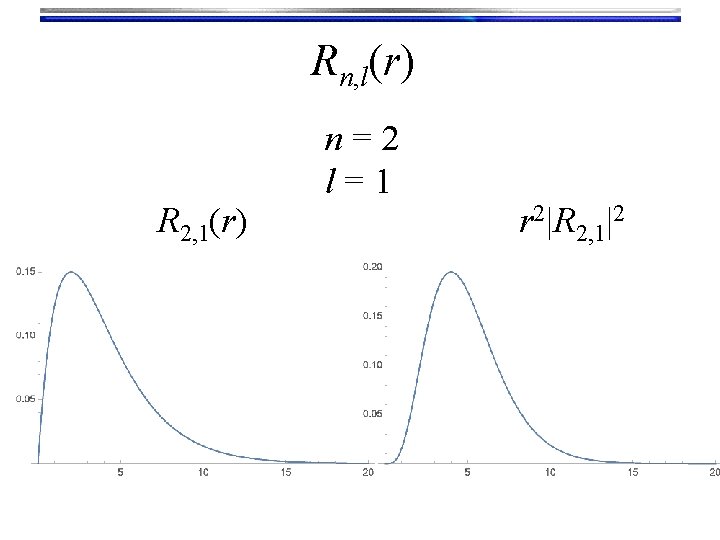
Rn, l(r) R 2, 1(r) n=2 l=1 r 2|R 2, 1|2
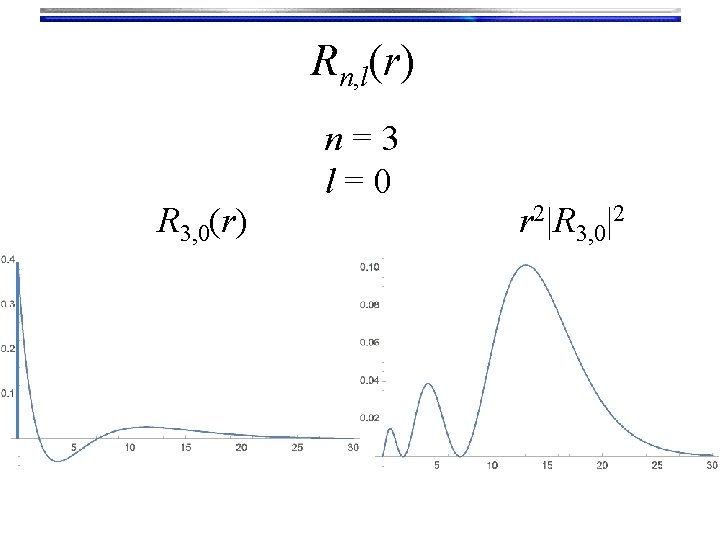
Rn, l(r) R 3, 0(r) n=3 l=0 r 2|R 3, 0|2
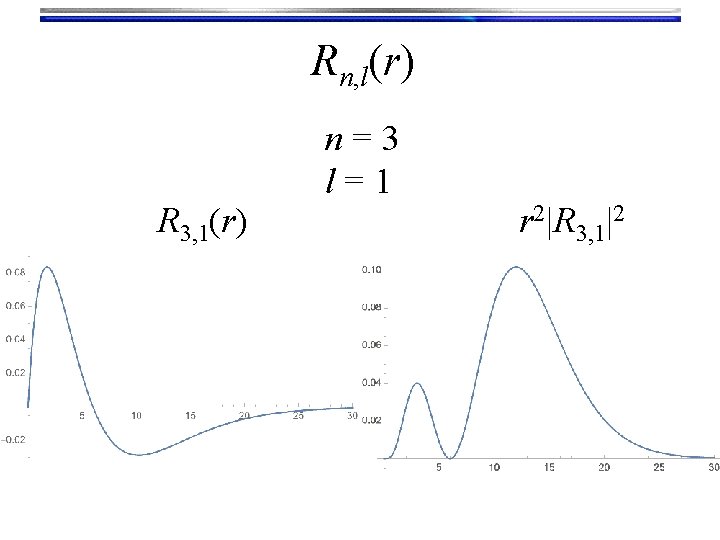
Rn, l(r) R 3, 1(r) n=3 l=1 r 2|R 3, 1|2
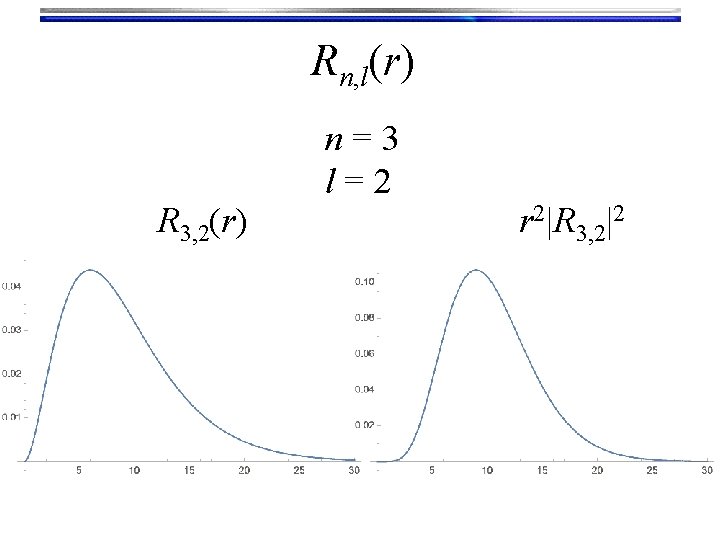
Rn, l(r) R 3, 2(r) n=3 l=2 r 2|R 3, 2|2
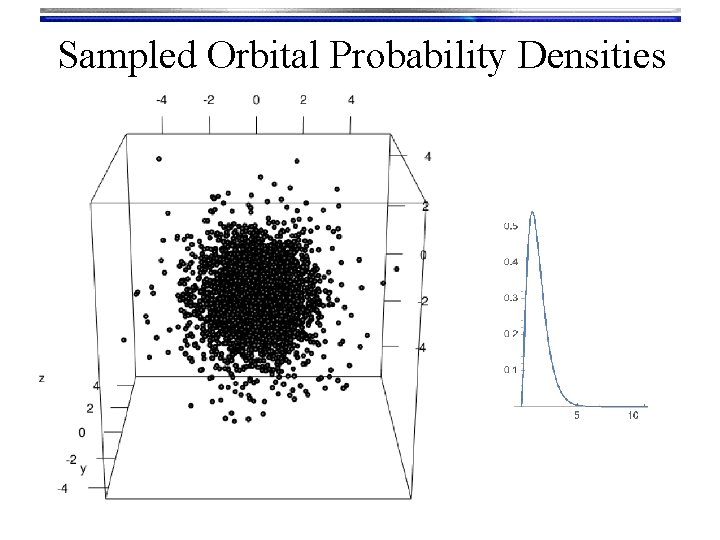
Sampled Orbital Probability Densities
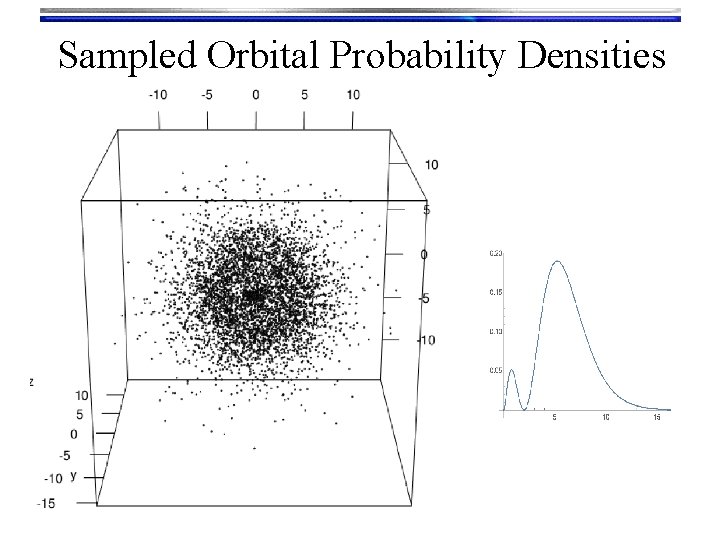
Sampled Orbital Probability Densities
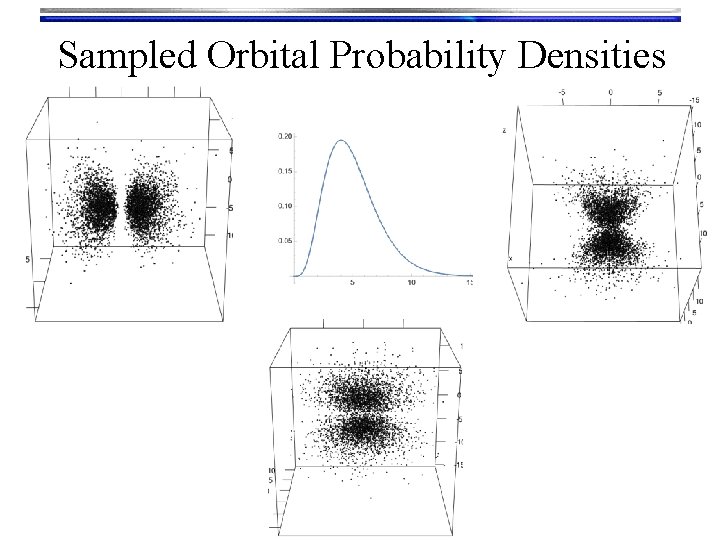
Sampled Orbital Probability Densities
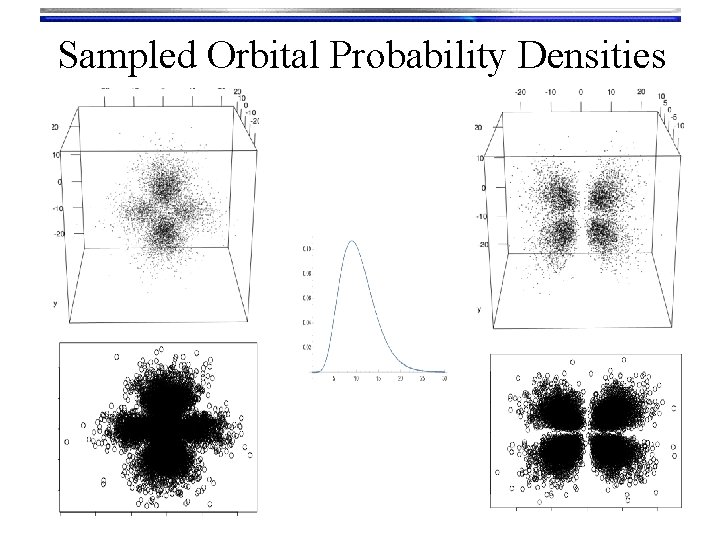
Sampled Orbital Probability Densities
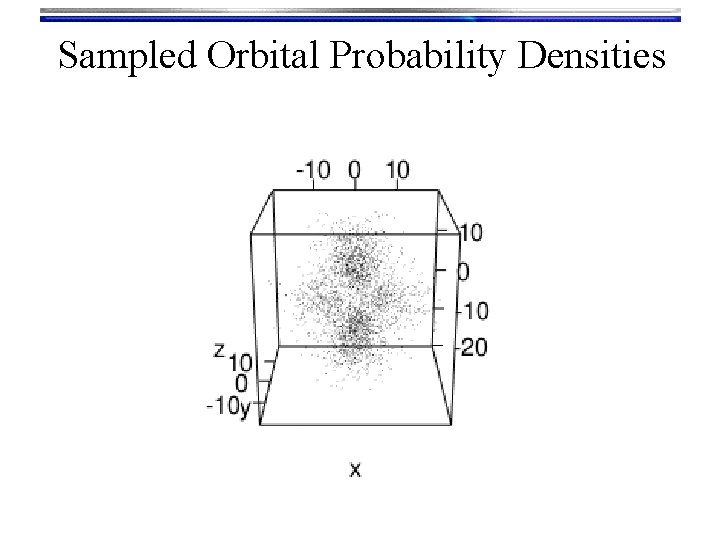
Sampled Orbital Probability Densities
- Slides: 21