
The Hunger Games An author revels a characters


- Slides: 18
The Hunger Games
An author revels a character's character traits through characterization. There are two ways an author can do this, direct and indirect characterization.
When an author directly states a character trait. Example: He was nice
When an author hints at a character trait. Example: He helped her (implies that he is nice).
A figurative comparison between two things. These comparison are not to be taken literally.
A comparison that uses "like" or "as" Example: She was as delicate as an angel.
A direct comparison that doesn't use "like or "as" Example: She was an angel.
A common saying that is understood in one language but cannot literally be translated into another language. It's figurative meaning is not the same as its literal meaning. Example: Before the actor went on stage, I told him to "break a leg. "
A descriptive language that appeals to one or more of the five senses: taste, touch, smell, hearing, sight.
Contradictions in which something that was supposed to happen is replaced with an unpredictable occurrence.
When the audience knows more than a stage character on stage.
When something happens that is completely different that the expected occurrence. Example: The fire station burns down.
When something is said that is then opposite of that is meant. Example: Your car is as clean as a trash can.
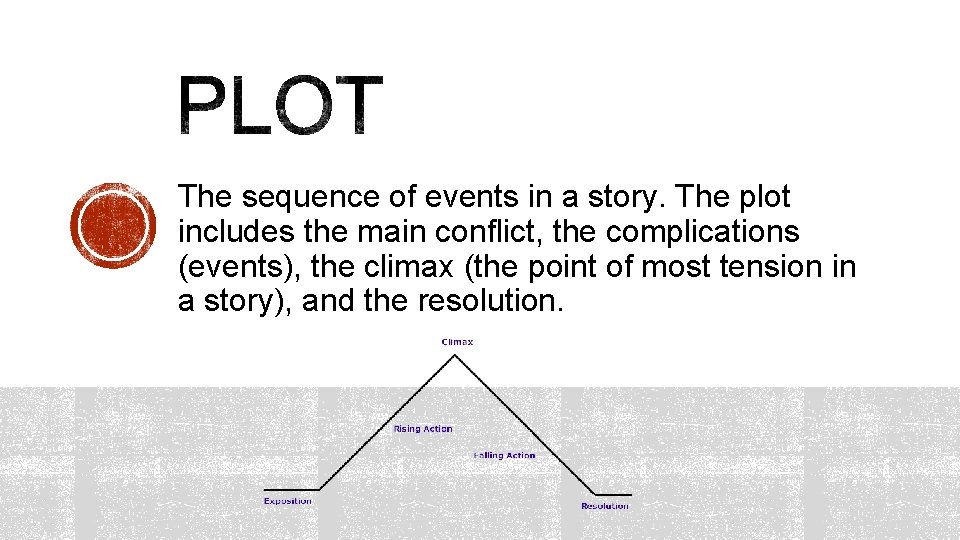
The sequence of events in a story. The plot includes the main conflict, the complications (events), the climax (the point of most tension in a story), and the resolution.
The perspective from which a story is told. The most common points of view are: • First Person (using I) • Third-Person (an observer of the events) • Third-Person Omniscient (and outside observer who knows everything)
A universal idea that is explored in a story. The message or moral a story is trying to teach us.
The emotional tome that write or narrator conveys in a story.
Objects or people that can represent more that their literal interpretation. Example: Dandelions for Katniss