
The Hungarian Crisis 1956 LO To identify the
- Slides: 12
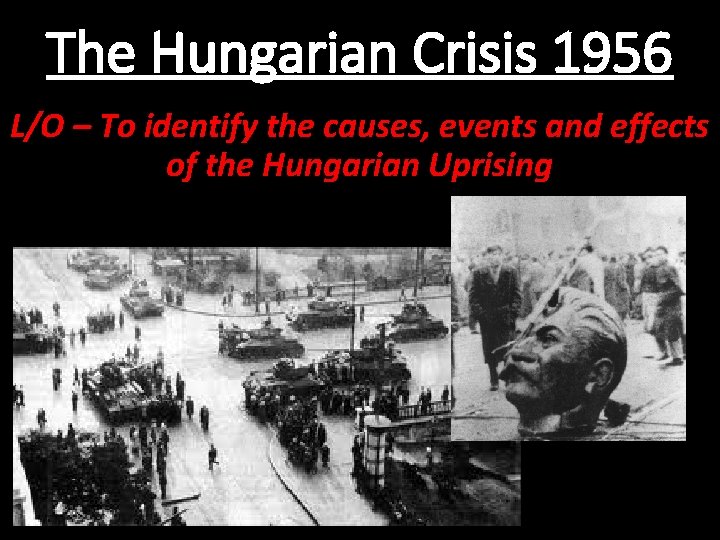
The Hungarian Crisis 1956 L/O – To identify the causes, events and effects of the Hungarian Uprising
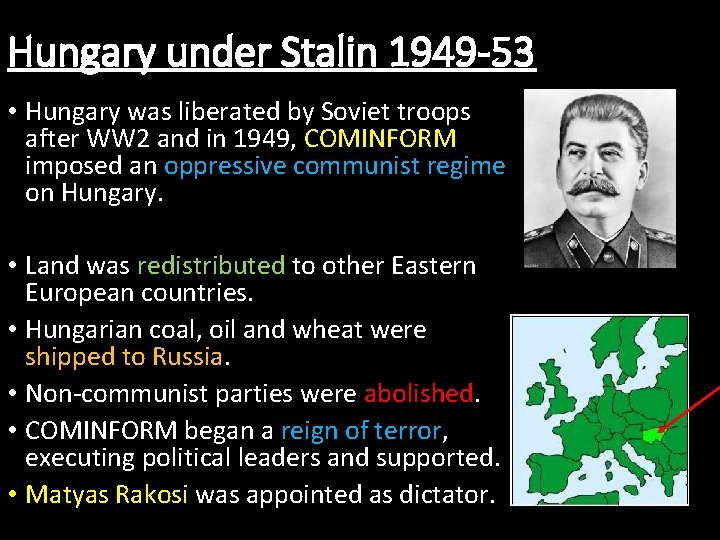
Hungary under Stalin 1949 -53 • Hungary was liberated by Soviet troops after WW 2 and in 1949, COMINFORM imposed an oppressive communist regime on Hungary. • Land was redistributed to other Eastern European countries. • Hungarian coal, oil and wheat were shipped to Russia. • Non-communist parties were abolished. • COMINFORM began a reign of terror, executing political leaders and supported. • Matyas Rakosi was appointed as dictator.
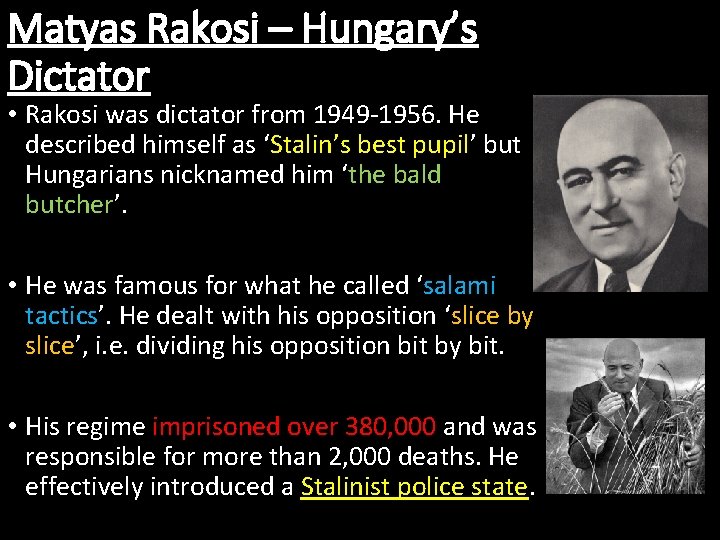
Matyas Rakosi – Hungary’s Dictator • Rakosi was dictator from 1949 -1956. He described himself as ‘Stalin’s best pupil’ but Hungarians nicknamed him ‘the bald butcher’. • He was famous for what he called ‘salami tactics’. He dealt with his opposition ‘slice by slice’, i. e. dividing his opposition bit by bit. • His regime imprisoned over 380, 000 and was responsible for more than 2, 000 deaths. He effectively introduced a Stalinist police state.
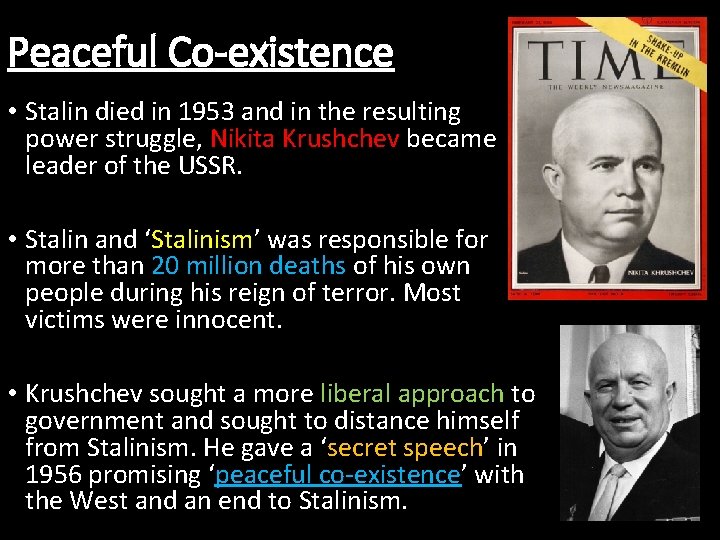
Peaceful Co-existence • Stalin died in 1953 and in the resulting power struggle, Nikita Krushchev became leader of the USSR. • Stalin and ‘Stalinism’ was responsible for more than 20 million deaths of his own people during his reign of terror. Most victims were innocent. • Krushchev sought a more liberal approach to government and sought to distance himself from Stalinism. He gave a ‘secret speech’ in 1956 promising ‘peaceful co-existence’ with the West and an end to Stalinism.
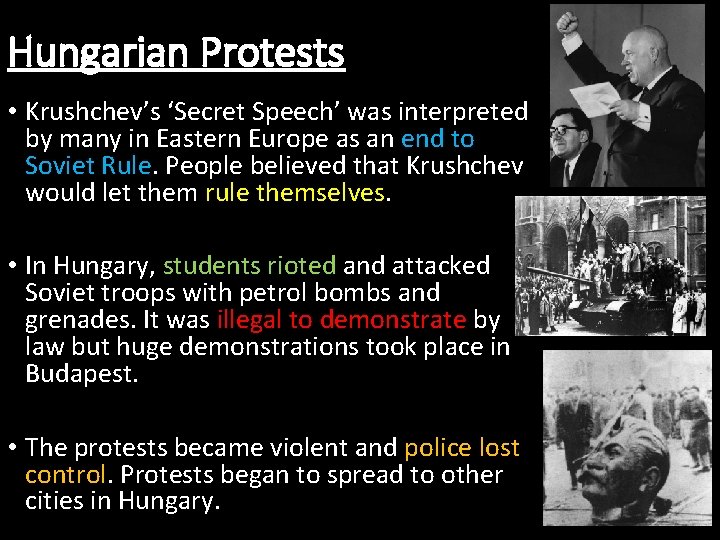
Hungarian Protests • Krushchev’s ‘Secret Speech’ was interpreted by many in Eastern Europe as an end to Soviet Rule. People believed that Krushchev would let them rule themselves. • In Hungary, students rioted and attacked Soviet troops with petrol bombs and grenades. It was illegal to demonstrate by law but huge demonstrations took place in Budapest. • The protests became violent and police lost control. Protests began to spread to other cities in Hungary.
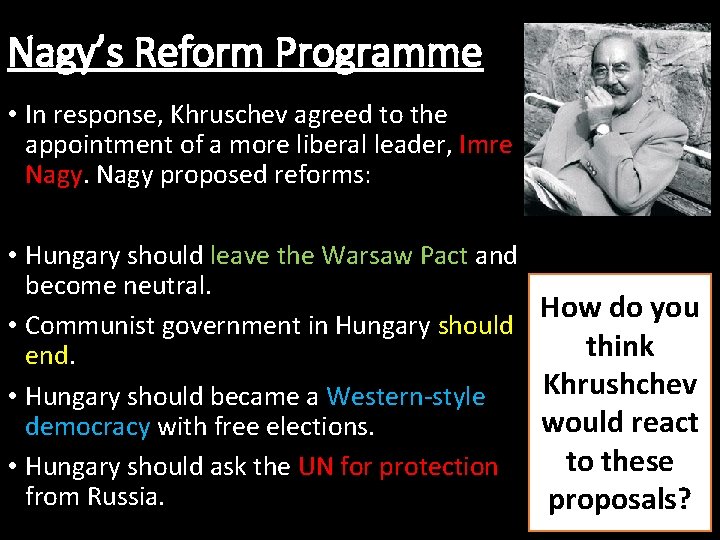
Nagy’s Reform Programme • In response, Khruschev agreed to the appointment of a more liberal leader, Imre Nagy proposed reforms: • Hungary should leave the Warsaw Pact and become neutral. How do you • Communist government in Hungary should think end. Khrushchev • Hungary should became a Western-style would react democracy with free elections. to these • Hungary should ask the UN for protection from Russia. proposals?
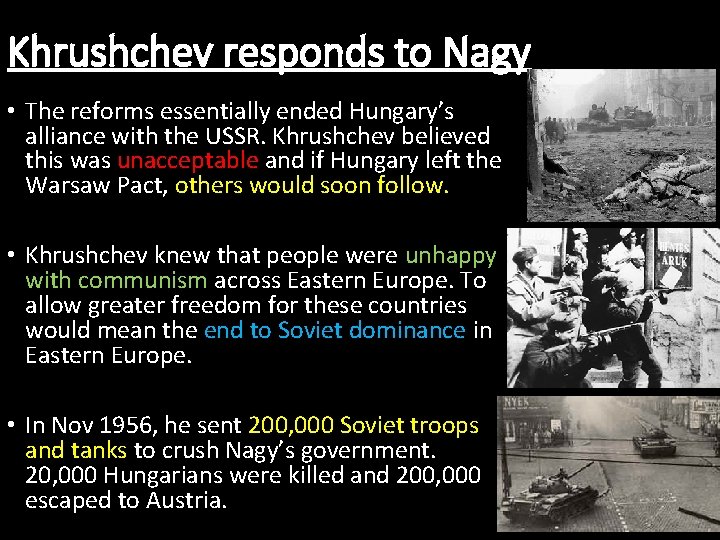
Khrushchev responds to Nagy • The reforms essentially ended Hungary’s alliance with the USSR. Khrushchev believed this was unacceptable and if Hungary left the Warsaw Pact, others would soon follow. • Khrushchev knew that people were unhappy with communism across Eastern Europe. To allow greater freedom for these countries would mean the end to Soviet dominance in Eastern Europe. • In Nov 1956, he sent 200, 000 Soviet troops and tanks to crush Nagy’s government. 20, 000 Hungarians were killed and 200, 000 escaped to Austria.
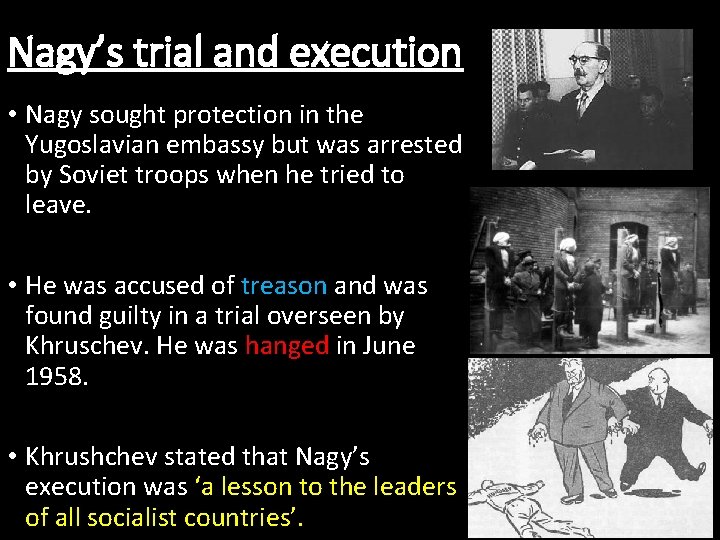
Nagy’s trial and execution • Nagy sought protection in the Yugoslavian embassy but was arrested by Soviet troops when he tried to leave. • He was accused of treason and was found guilty in a trial overseen by Khruschev. He was hanged in June 1958. • Khrushchev stated that Nagy’s execution was ‘a lesson to the leaders of all socialist countries’.
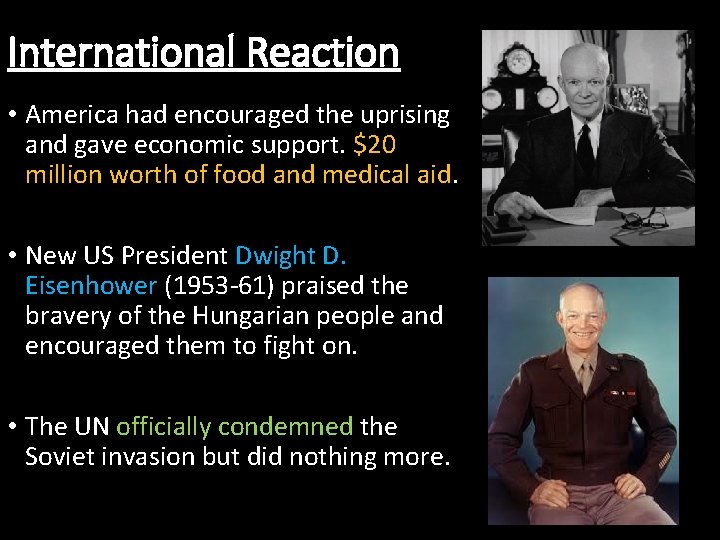
International Reaction • America had encouraged the uprising and gave economic support. $20 million worth of food and medical aid. • New US President Dwight D. Eisenhower (1953 -61) praised the bravery of the Hungarian people and encouraged them to fight on. • The UN officially condemned the Soviet invasion but did nothing more.
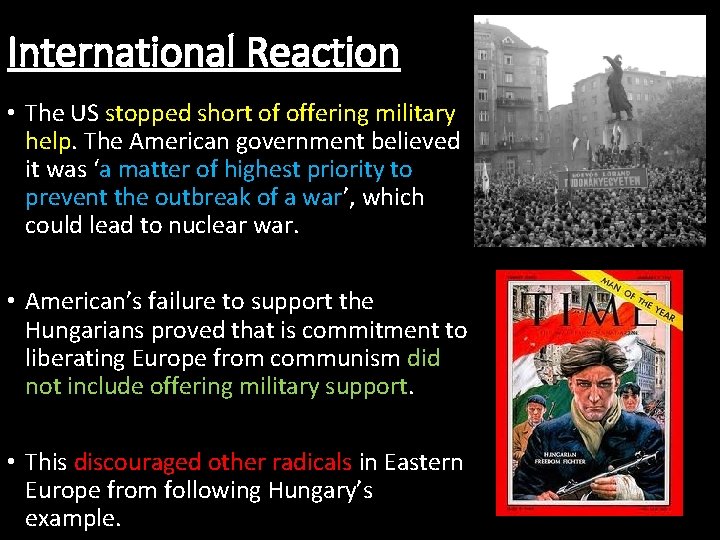
International Reaction • The US stopped short of offering military help. The American government believed it was ‘a matter of highest priority to prevent the outbreak of a war’, which could lead to nuclear war. • American’s failure to support the Hungarians proved that is commitment to liberating Europe from communism did not include offering military support. • This discouraged other radicals in Eastern Europe from following Hungary’s example.
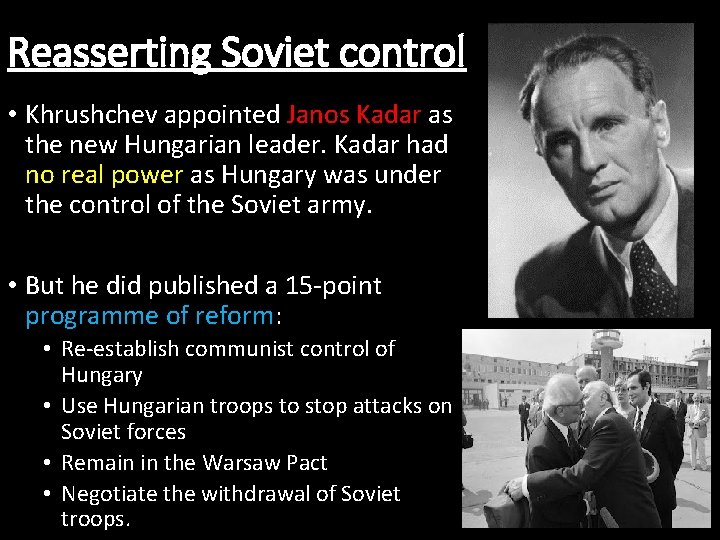
Reasserting Soviet control • Khrushchev appointed Janos Kadar as the new Hungarian leader. Kadar had no real power as Hungary was under the control of the Soviet army. • But he did published a 15 -point programme of reform: • Re-establish communist control of Hungary • Use Hungarian troops to stop attacks on Soviet forces • Remain in the Warsaw Pact • Negotiate the withdrawal of Soviet troops.