
The Hunchback in the Park By Dylan Thomas
The Hunchback in the Park By Dylan Thomas
Past lake and rockery The hunchback in the park A solitary mister Propped between trees and water From the opening of the garden lock That lets the trees and water enter Until the Sunday sombre bell at dark Eating bread from a newspaper Drinking water from the chained cup That the children filled with gravel In the fountain basin where I sailed my ship Slept at night in a dog kennel But nobody chained him up. Like the park birds he came early Like the water he sat down And Mister they called Hey mister The truant boys from the town Running when he had heard them clearly On out of sound Laughing when he shook his paper Hunchbacked in mockery Through the loud zoo of the willow groves Dodging the park keeper With his stick that picked up leaves. And the old dog sleeper Alone between nurses and swans While the boys among willows Made the tigers jump out of their eyes To roar on the rockery stones And the groves were blue with sailors Made all day until bell time A woman figure without fault Straight as a young elm Straight and tall from his crooked bones That she might stand in the night After the locks and chains All night in the unmade park After the railings and shrubberies The birds the grass the trees the lake And the wild boys innocent as strawberries Had followed the hunchback To his kennel in the dark.
And the park itself was a world within the world of the sea town. Quite near where I lived, so near that on summer evenings I could listen in my bed to the voices of older children playing ball on the sloping, paper-littered bank; the park was full of terrors and treasures. Though it was only a little park, it held within its borders of old tall trees, notched with our names and shabby from our climbing, as many secret places, caverns and forests, prairies and deserts, as a country somewhere at the end of the sea. And that park grew up with me. That small world widened as I learned its secrets and boundaries, as I discovered new refuges and ambushes in its woods and jungles, hidden homes and lairs for the multitudes of imagination, for cowboys and Indians and the tall, terrible half-people who rode on nightmares through my bedroom. We knew every regular visitor, every nursemaid, every gardener, every old man. The face of the old man who sat summer and winter on the bench looking over the reservoir. I can see clearly now and I wrote a poem long after I’d left the park and the sea-town called: ‘The Hunchback in the Park’. - Dylan Thomas remembers the tramp and the park from childhood. How does he express the child’s idea that the park only exists during the day? e. g. ‘. . . the opening of the garden lock/ lets the trees and water enter’.

• 7 x 6 line stanzas – each moves the poem along • There is little punctuation (only three full stops – can you find them? ) which adds to the sense of movement through the poem • The repetition of words throughout the poem echoes the repetition of the hunchback’s daily routine. • Repeated words: • ‘trees and water’ • ‘dark’ • ‘kennel’ • ‘lock’ ‘chained’ (repeated later as ‘locks and chains’) How do some of the repeated words contribute to the poem’s themes or ideas? (Find out later)
• ‘park’/ ‘dark’ rhyming couplet – opens and ends the poem. This adds to the cyclical nature of each day and night in the park • The poet uses contrasts throughout the poem – these set the hunchback apart from his surroundings (nature/ the boys) even as the rest of the poem makes connections between them • The poem is structured like a series of memories and observations from the narrator’s past. This gives it a dreamlike quality; these are visual snapshots not events

Contrast with the group of boys. The shortest line highlights his isolation. Alliteration; suggests seriousness of the world outside the park; contrast with the laughter of the boys Implication that these somehow sustain him/ hold him up The hunchback in the park A solitary mister Propped between trees and water From the opening of the garden lock That lets the trees and water enter Until the Sunday sombre bell at dark Personification – they enter like everyone else What picture does the second line of the poem suggest? How does the length of the line help create this image?
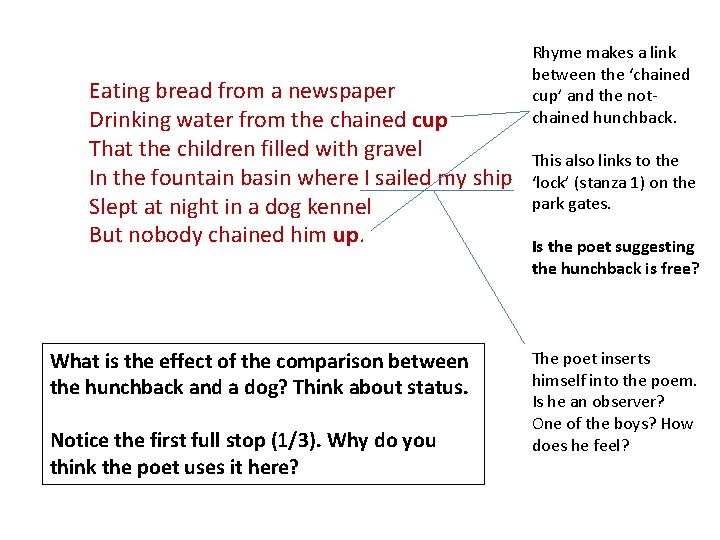
Eating bread from a newspaper Drinking water from the chained cup That the children filled with gravel In the fountain basin where I sailed my ship Slept at night in a dog kennel But nobody chained him up. What is the effect of the comparison between the hunchback and a dog? Think about status. Notice the first full stop (1/3). Why do you think the poet uses it here? Rhyme makes a link between the ‘chained cup’ and the notchained hunchback. This also links to the ‘lock’ (stanza 1) on the park gates. Is the poet suggesting the hunchback is free? The poet inserts himself into the poem. Is he an observer? One of the boys? How does he feel?
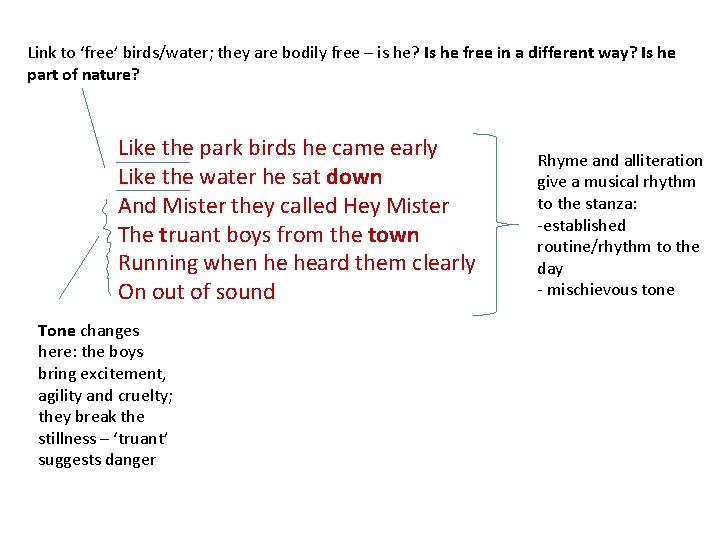
Link to ‘free’ birds/water; they are bodily free – is he? Is he free in a different way? Is he part of nature? Like the park birds he came early Like the water he sat down And Mister they called Hey Mister The truant boys from the town Running when he heard them clearly On out of sound Tone changes here: the boys bring excitement, agility and cruelty; they break the stillness – ‘truant’ suggests danger Rhyme and alliteration give a musical rhythm to the stanza: -established routine/rhythm to the day - mischievous tone
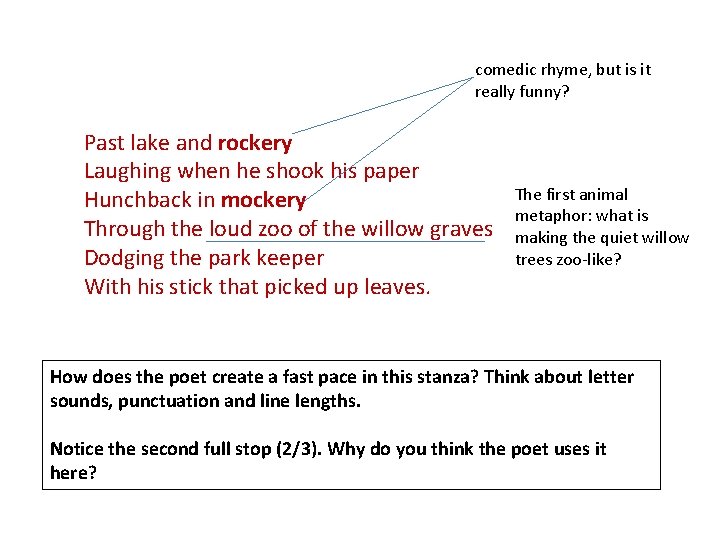
comedic rhyme, but is it really funny? Past lake and rockery Laughing when he shook his paper Hunchback in mockery Through the loud zoo of the willow graves Dodging the park keeper With his stick that picked up leaves. The first animal metaphor: what is making the quiet willow trees zoo-like? How does the poet create a fast pace in this stanza? Think about letter sounds, punctuation and line lengths. Notice the second full stop (2/3). Why do you think the poet uses it here?
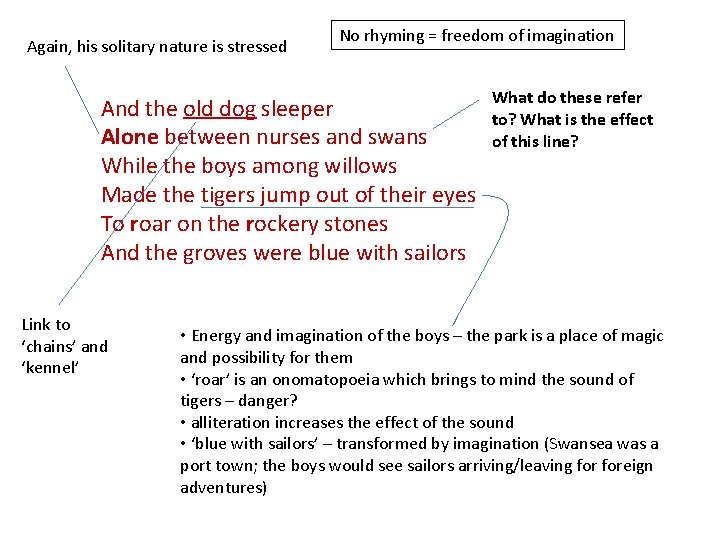
Again, his solitary nature is stressed No rhyming = freedom of imagination And the old dog sleeper Alone between nurses and swans While the boys among willows Made the tigers jump out of their eyes To roar on the rockery stones And the groves were blue with sailors Link to ‘chains’ and ‘kennel’ What do these refer to? What is the effect of this line? • Energy and imagination of the boys – the park is a place of magic and possibility for them • ‘roar’ is an onomatopoeia which brings to mind the sound of tigers – danger? • alliteration increases the effect of the sound • ‘blue with sailors’ – transformed by imagination (Swansea was a port town; the boys would see sailors arriving/leaving foreign adventures)
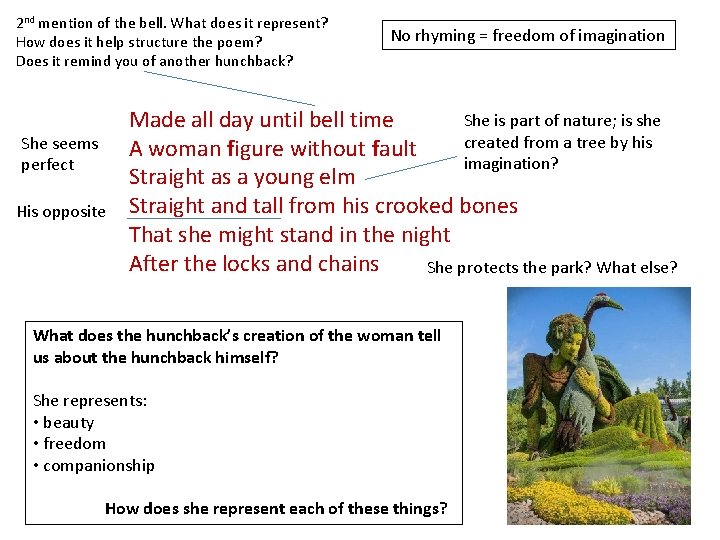
2 nd mention of the bell. What does it represent? How does it help structure the poem? Does it remind you of another hunchback? She seems perfect His opposite No rhyming = freedom of imagination She is part of nature; is she Made all day until bell time created from a tree by his A woman figure without fault imagination? Straight as a young elm Straight and tall from his crooked bones That she might stand in the night After the locks and chains She protects the park? What else? What does the hunchback’s creation of the woman tell us about the hunchback himself? She represents: • beauty • freedom • companionship How does she represent each of these things?
Again, the idea that the park doesn’t exist when unpopulated All the impressions the hunchback takes with him from the park are to do with beauty/space List; no commas: all the memories become one All night in the unmade park After the railings and shrubberies The birds the grass the trees the lake And the wild boys innocent as strawberries Had followed the hunchback Why do you think the To his kennel in the dark. poet describes the boys as ‘innocent as strawberries’? • harmless • childlike • part of nature The hunchback uses his imagination in the same way the boys used theirs. What does this serve to remind us? Notice third full stop (3/3). Why do you think the poet uses it here?
Look through the following list of words. Which would you use to describe the old man? friendly DESPISED neglected lonely self-pitying irritable poor ugly proud isolated familiar helpless imaginative frightening sad still humble Which details in the poem suggest them to you? Match the word(s) you have chosen with a brief quote.
The hunchback is compared to nature in the poem. This: • highlights his isolation from other humans • highlights his wildness • suggests he has more in common with animals • suggests he is a part of nature, just like the trees and birds • makes him seem unpredictable and odd Pick the statements you agree with out of the list above. Why do you agree with them?
Repeated words: • ‘trees and water’ • ‘dark’ • ‘kennel’ • ‘lock’ ‘chained’ (repeated later as ‘locks and chains’) How do some of the repeated words contribute to the poem’s themes or ideas?
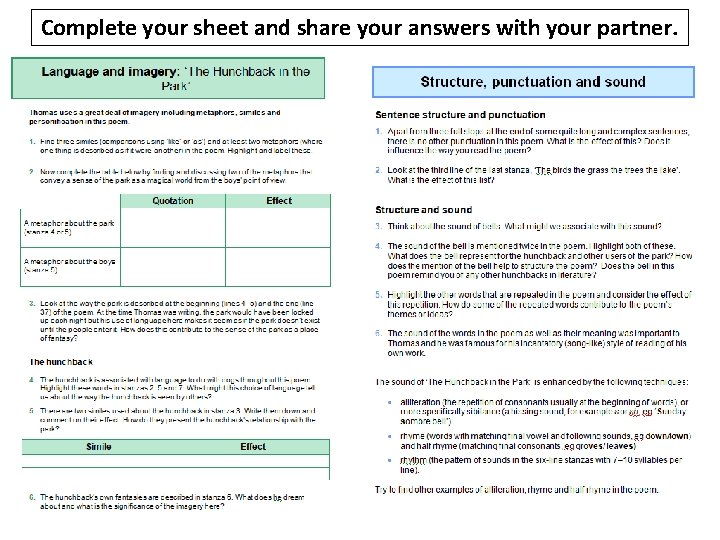
Complete your sheet and share your answers with your partner.
It’s time to summarise! We’re going to make a note of the poem’s VITALS.
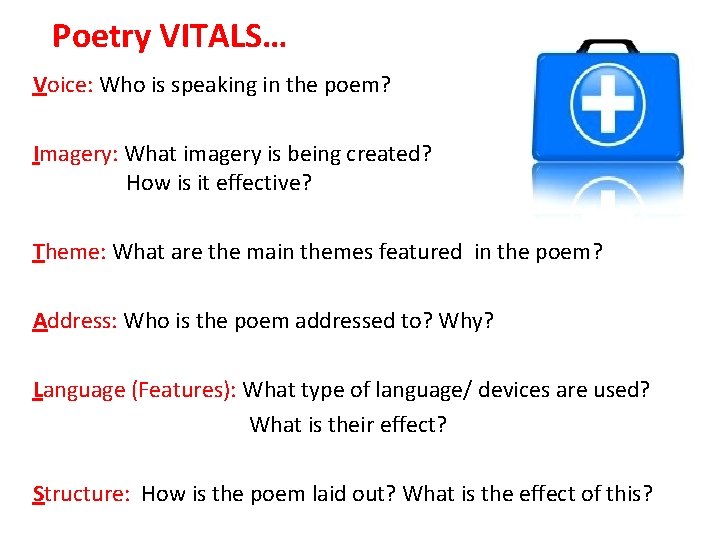
Poetry VITALS… Voice: Who is speaking in the poem? Imagery: What imagery is being created? How is it effective? Theme: What are the main themes featured in the poem? Address: Who is the poem addressed to? Why? Language (Features): What type of language/ devices are used? What is their effect? Structure: How is the poem laid out? What is the effect of this?
- Slides: 18