
The Humboldt Squid Animalia Mollusca Classification Cephalopoda Oegopsida
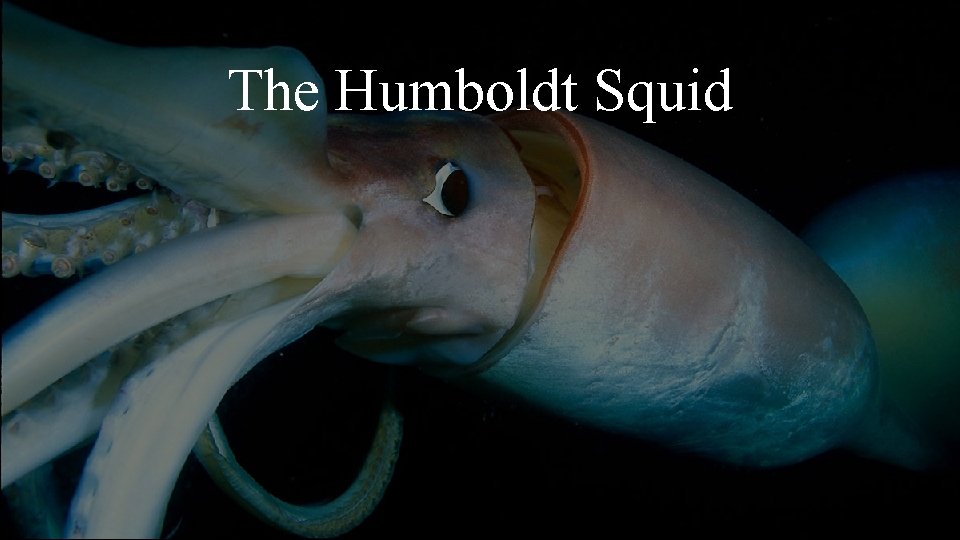
The Humboldt Squid
• Animalia • Mollusca Classification • Cephalopoda • Oegopsida • Ommastrephidae • Ommastrephinae • Dosidicus gigas

Evolution • One evolutionary trait that the Humboldt Squid has is "bioluminescent photophores" (like other organisms in the subfamily Ommastrephinae). • The photophores allow the Humboldt squid to quickly change colours, notably when they hunt, they flash red and white earning them the nickname "diablo rojo" which is Spanish for "red devil".
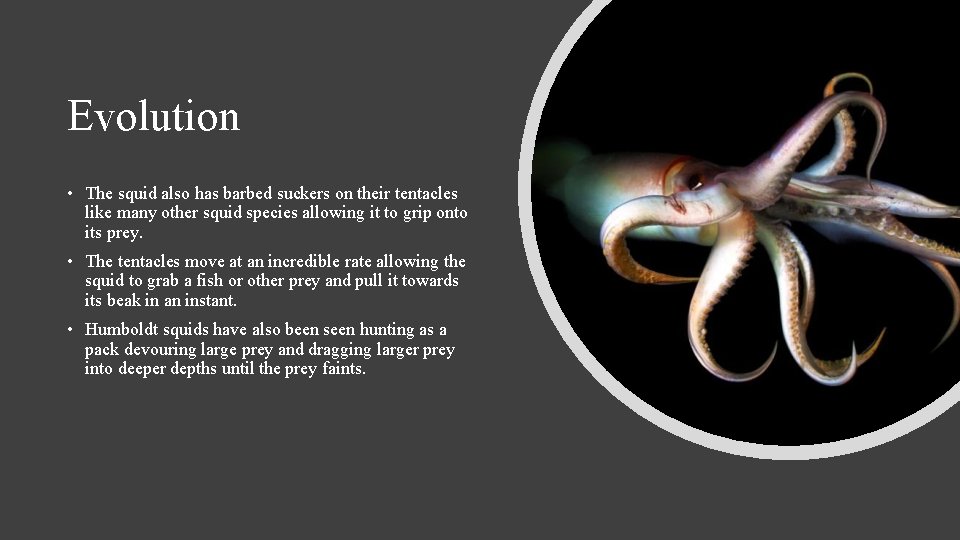
Evolution • The squid also has barbed suckers on their tentacles like many other squid species allowing it to grip onto its prey. • The tentacles move at an incredible rate allowing the squid to grab a fish or other prey and pull it towards its beak in an instant. • Humboldt squids have also been seen hunting as a pack devouring large prey and dragging larger prey into deeper depths until the prey faints.
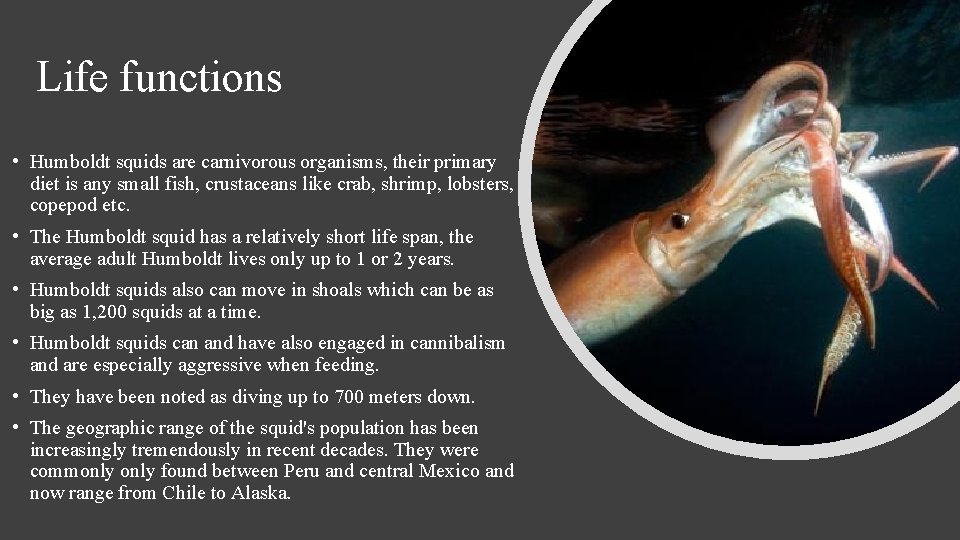
Life functions • Humboldt squids are carnivorous organisms, their primary diet is any small fish, crustaceans like crab, shrimp, lobsters, copepod etc. • The Humboldt squid has a relatively short life span, the average adult Humboldt lives only up to 1 or 2 years. • Humboldt squids also can move in shoals which can be as big as 1, 200 squids at a time. • Humboldt squids can and have also engaged in cannibalism and are especially aggressive when feeding. • They have been noted as diving up to 700 meters down. • The geographic range of the squid's population has been increasingly tremendously in recent decades. They were commonly found between Peru and central Mexico and now range from Chile to Alaska.

Life functions • Humboldt squids are common although their conservation status is currently unknown. • They can grow up to 50 kg and 110 lb. • Their mantles alone can reach up to 4 ft long. • Over the course of a female Humboldt squid's lifetime they can up to 20 million eggs (the most out of any known cephalopod). • The Humboldt squid reproduces with internal fertilization like many other cephalopods and animals. A Humboldt squid showcasing the deep red colour they can achieve with photophores.
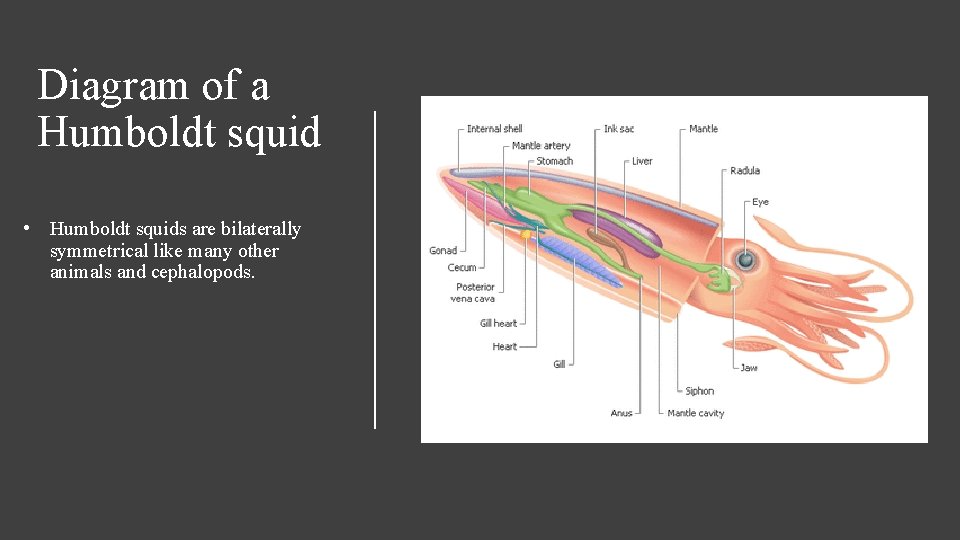
Diagram of a Humboldt squid • Humboldt squids are bilaterally symmetrical like many other animals and cephalopods.
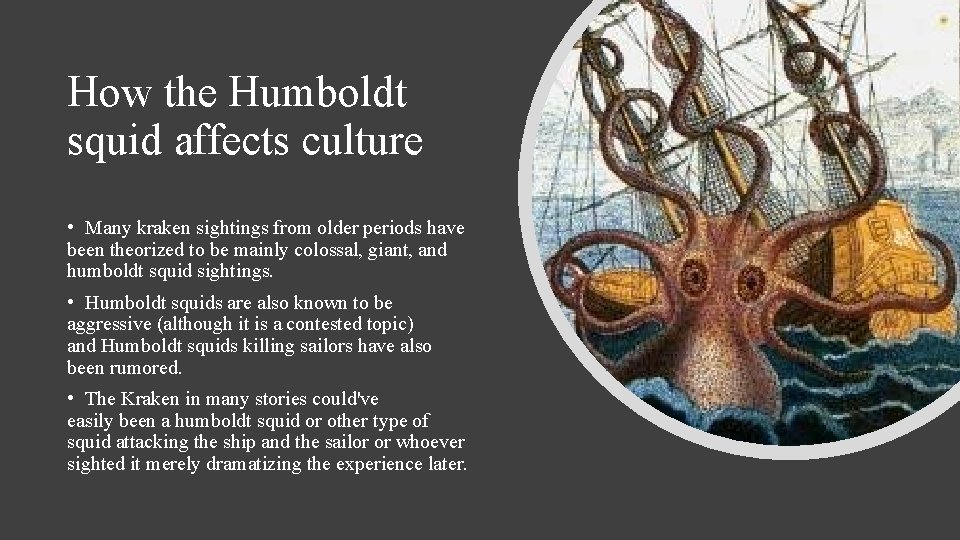
How the Humboldt squid affects culture • Many kraken sightings from older periods have been theorized to be mainly colossal, giant, and humboldt squid sightings. • Humboldt squids are also known to be aggressive (although it is a contested topic) and Humboldt squids killing sailors have also been rumored. • The Kraken in many stories could've easily been a humboldt squid or other type of squid attacking the ship and the sailor or whoever sighted it merely dramatizing the experience later.
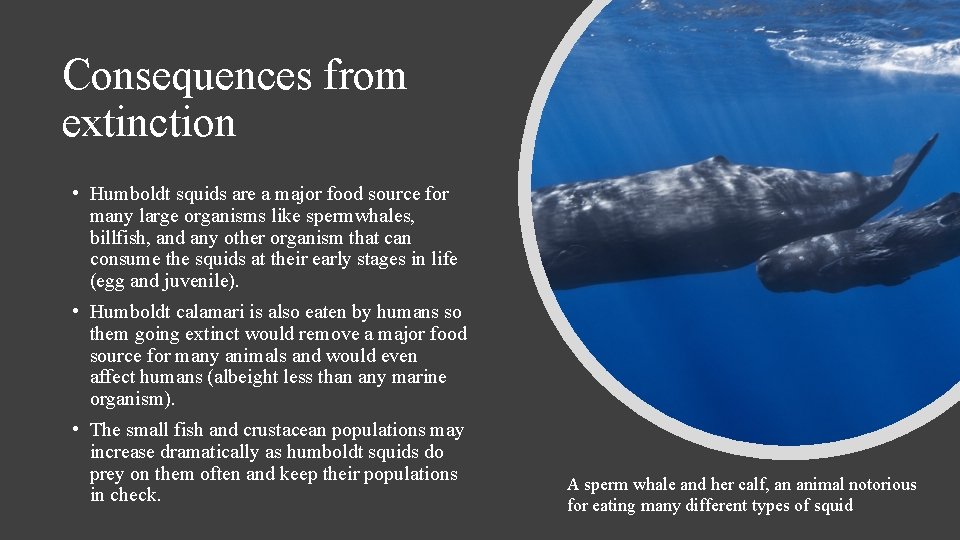
Consequences from extinction • Humboldt squids are a major food source for many large organisms like spermwhales, billfish, and any other organism that can consume the squids at their early stages in life (egg and juvenile). • Humboldt calamari is also eaten by humans so them going extinct would remove a major food source for many animals and would even affect humans (albeight less than any marine organism). • The small fish and crustacean populations may increase dramatically as humboldt squids do prey on them often and keep their populations in check. A sperm whale and her calf, an animal notorious for eating many different types of squid

Work Consulted / Sources • https: //oceana. org/marine-life/cephalopods-crustaceans-other-shellfish/humboldt-squid • https: //brianskerry. com/portfolio/squid/attachment/squid_11_19/ • http: //www. oceanfutures. org/humboldt-squid • https: //xray-mag. com/content/diving-humboldt-squid • http: //www. bbc. com/earth/story/20141212 -quest-for-the-real-life-kraken • https: //humboldtcalamari. weebly. com/biology. html • https: //en. wikipedia. org/wiki/Sperm_whale#/media/File: Mother_and_baby_sperm_whale. jpg • https: //en. wikipedia. org/wiki/Humboldt_squid • https: //en. wikipedia. org/wiki/Kraken
- Slides: 10