
The Human Visual System Part 2 Perception Imaging
- Slides: 27
The Human Visual System Part 2: Perception Imaging Science Fundamentals Chester F. Carlson Center for Imaging Science
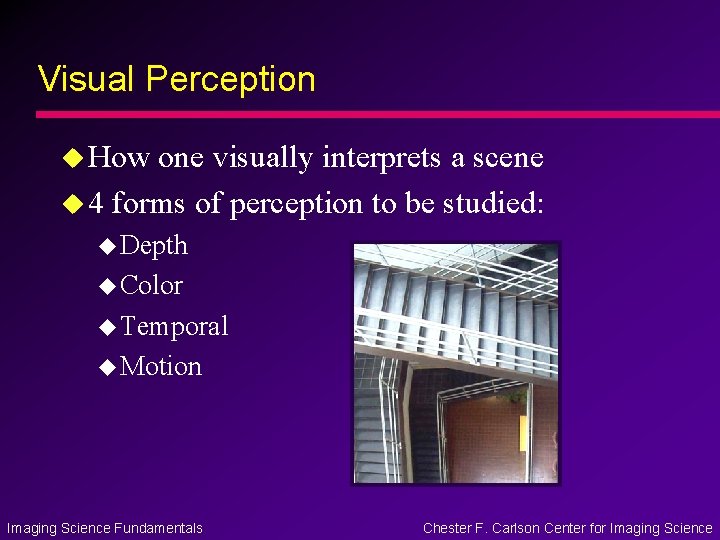
Visual Perception u How one visually interprets a scene u 4 forms of perception to be studied: u Depth u Color u Temporal u Motion Imaging Science Fundamentals Chester F. Carlson Center for Imaging Science
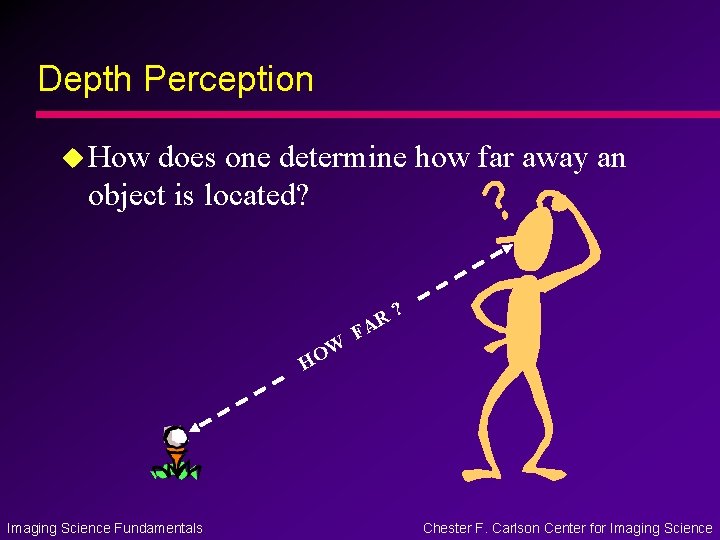
Depth Perception u How does one determine how far away an object is located? W O H Imaging Science Fundamentals ? R FA Chester F. Carlson Center for Imaging Science
Depth Perception u Monocular u Require Cues only 1 eye to perceive depth; Cyclops. http: //www. shag-art. com/cyclops. html Imaging Science Fundamentals Chester F. Carlson Center for Imaging Science
Depth Perception u Binocular u Require Imaging Science Fundamentals Cues 2 eyes to perceive depth. Chester F. Carlson Center for Imaging Science
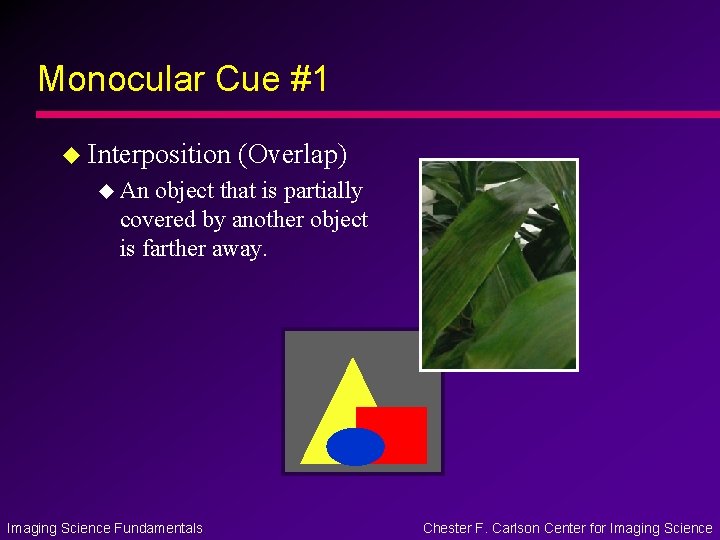
Monocular Cue #1 u Interposition (Overlap) u An object that is partially covered by another object is farther away. Imaging Science Fundamentals Chester F. Carlson Center for Imaging Science
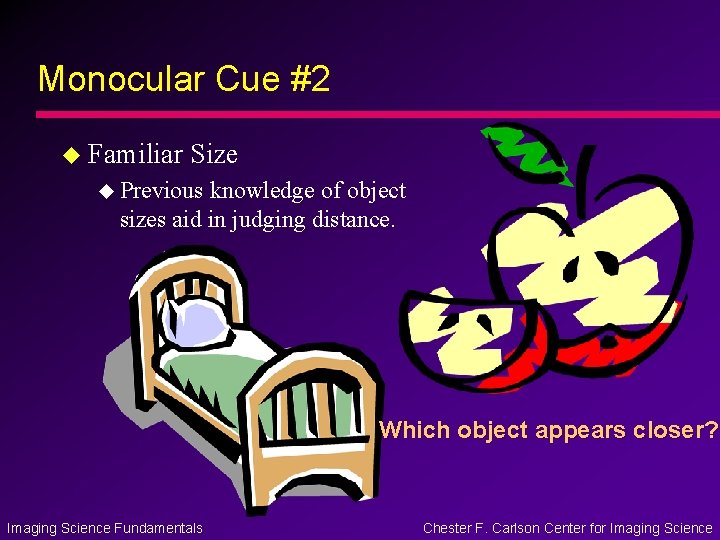
Monocular Cue #2 u Familiar Size u Previous knowledge of object sizes aid in judging distance. Which object appears closer? Imaging Science Fundamentals Chester F. Carlson Center for Imaging Science
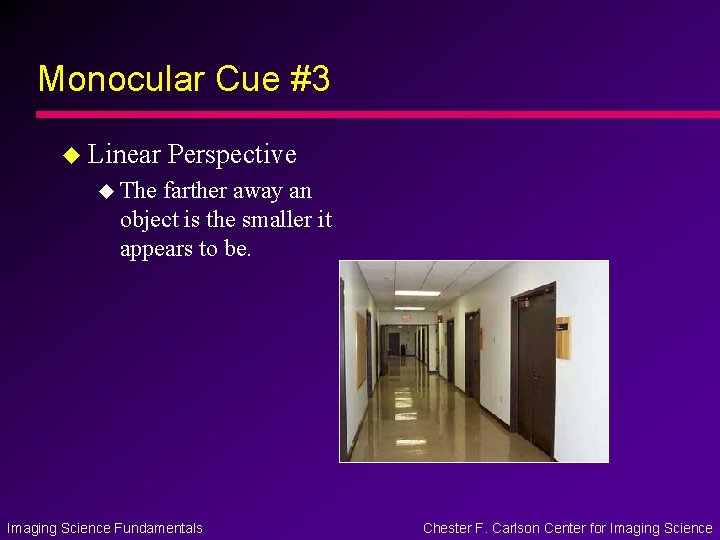
Monocular Cue #3 u Linear Perspective u The farther away an object is the smaller it appears to be. Imaging Science Fundamentals Chester F. Carlson Center for Imaging Science
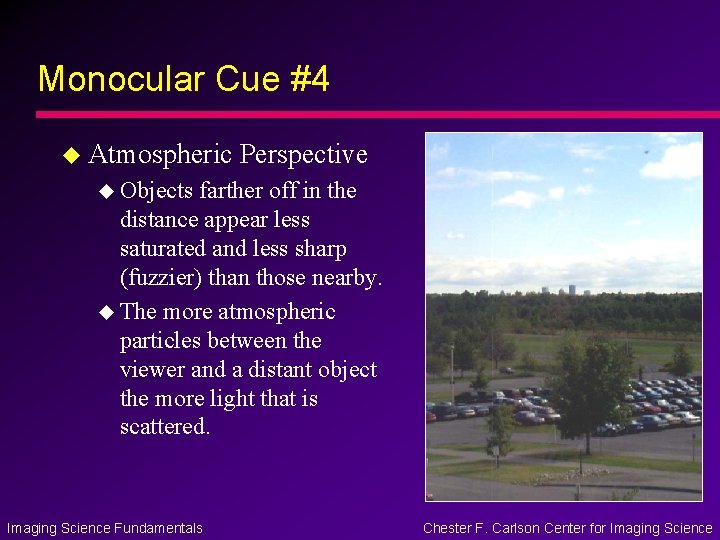
Monocular Cue #4 u Atmospheric Perspective u Objects farther off in the distance appear less saturated and less sharp (fuzzier) than those nearby. u The more atmospheric particles between the viewer and a distant object the more light that is scattered. Imaging Science Fundamentals Chester F. Carlson Center for Imaging Science
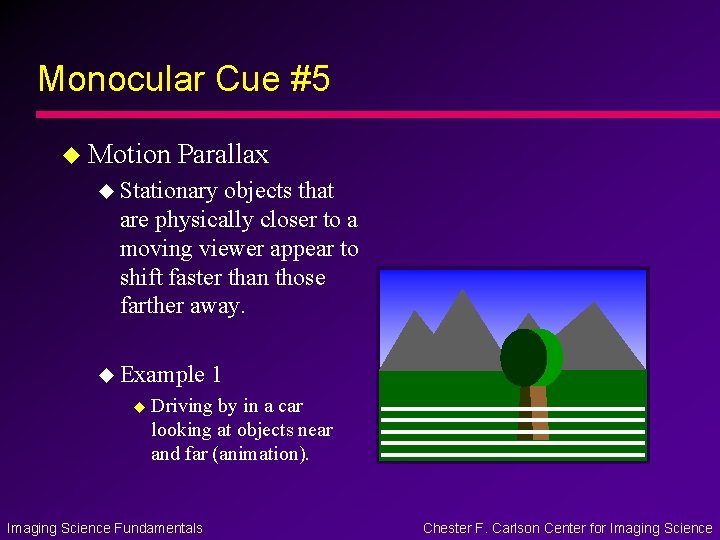
Monocular Cue #5 u Motion Parallax u Stationary objects that are physically closer to a moving viewer appear to shift faster than those farther away. u Example u 1 Driving by in a car looking at objects near and far (animation). Imaging Science Fundamentals Chester F. Carlson Center for Imaging Science
Monocular Cue #5 u Example 2 u u u Example 3 Close one eye. Hold your left thumb upward at arm’s length. Hold your right thumb upward at half arm’s length. u Position the thumbs so the right thumb blocks the left and move your head to one side. u Observe that the background did not move, but the thumbs appeared to move relative to each other and the background. Imaging Science Fundamentals u u Close one eye. Hold both index fingers pointing toward each other. Circle the fingers in a bike pedaling motion. Stop them at eye level and move them inward to make them meet forming a straight line. Try again, but this time move your head side-to-side to tell the distance between your index fingers. Chester F. Carlson Center for Imaging Science
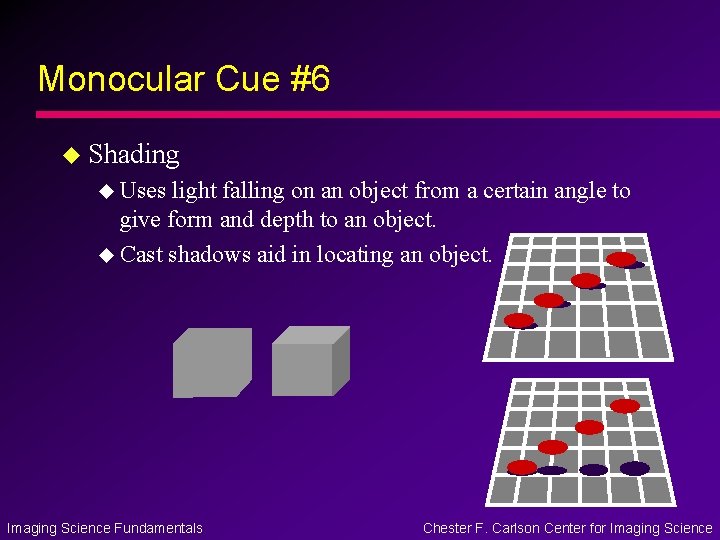
Monocular Cue #6 u Shading u Uses light falling on an object from a certain angle to give form and depth to an object. u Cast shadows aid in locating an object. Imaging Science Fundamentals Chester F. Carlson Center for Imaging Science
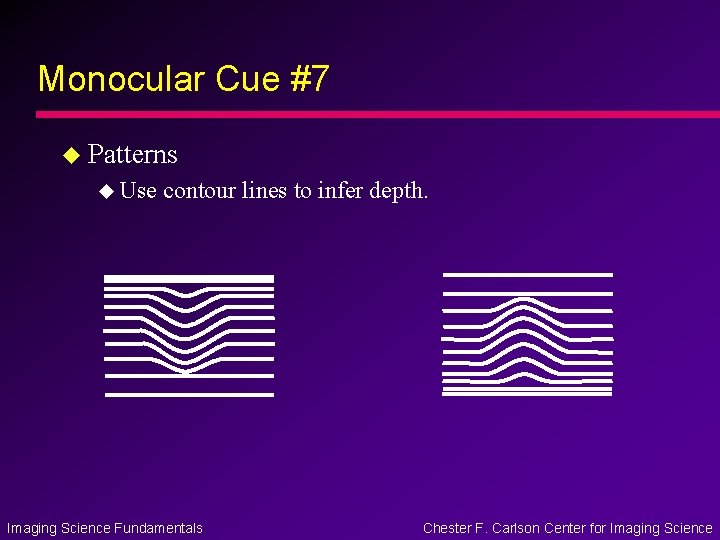
Monocular Cue #7 u Patterns u Use contour lines to infer depth. Imaging Science Fundamentals Chester F. Carlson Center for Imaging Science
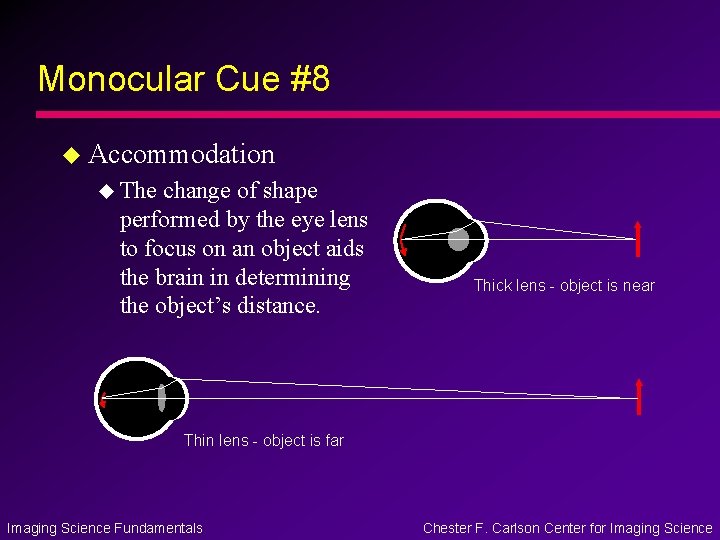
Monocular Cue #8 u Accommodation u The change of shape performed by the eye lens to focus on an object aids the brain in determining the object’s distance. Thick lens - object is near Thin lens - object is far Imaging Science Fundamentals Chester F. Carlson Center for Imaging Science
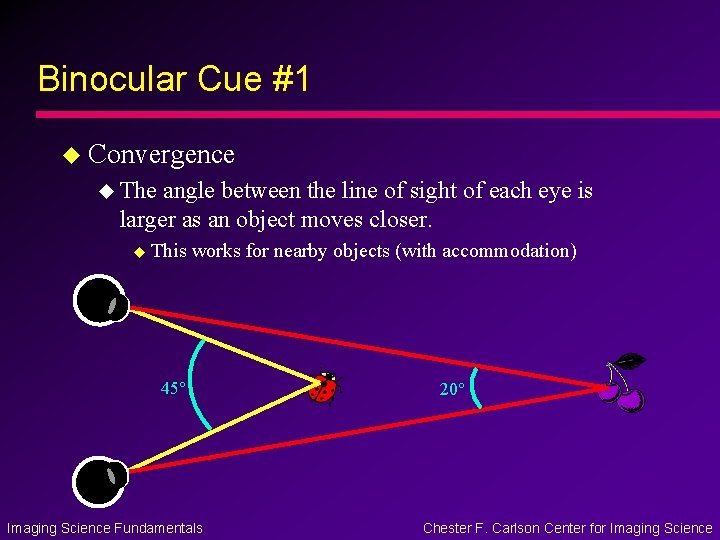
Binocular Cue #1 u Convergence u The angle between the line of sight of each eye is larger as an object moves closer. u This works for nearby objects (with accommodation) 45° Imaging Science Fundamentals 20° Chester F. Carlson Center for Imaging Science
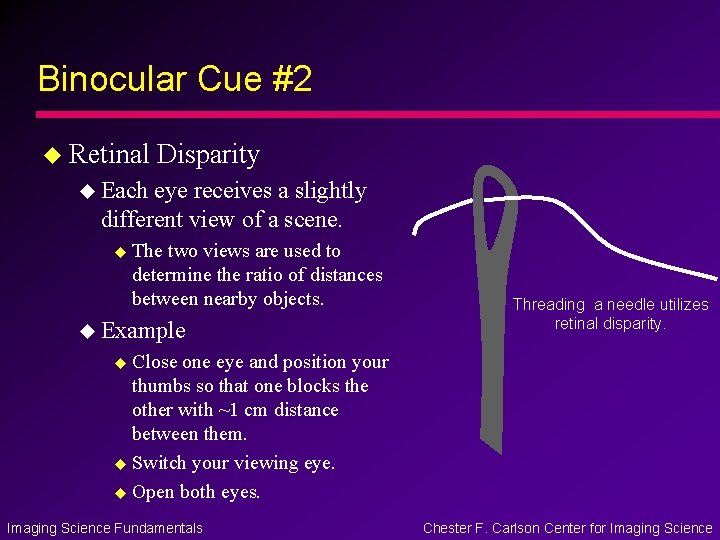
Binocular Cue #2 u Retinal Disparity u Each eye receives a slightly different view of a scene. u The two views are used to determine the ratio of distances between nearby objects. u Example Threading a needle utilizes retinal disparity. Close one eye and position your thumbs so that one blocks the other with ~1 cm distance between them. u Switch your viewing eye. u Open both eyes. u Imaging Science Fundamentals Chester F. Carlson Center for Imaging Science
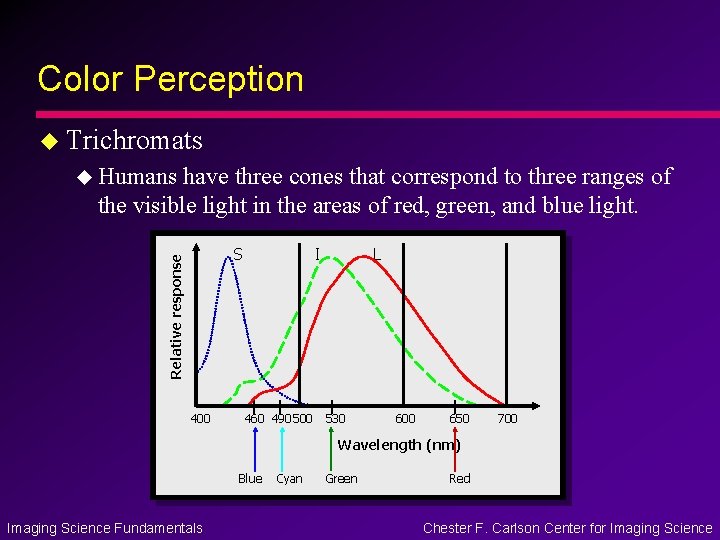
Color Perception u Trichromats u Humans have three cones that correspond to three ranges of the visible light in the areas of red, green, and blue light. Relative response S 400 I 460 490 500 L 530 600 650 700 Wavelength (nm) Blue Imaging Science Fundamentals Cyan Green Red Chester F. Carlson Center for Imaging Science
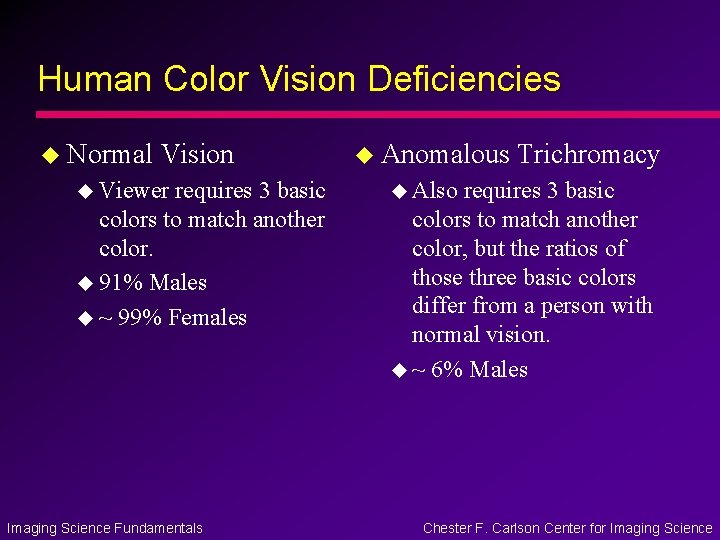
Human Color Vision Deficiencies u Normal Vision u Viewer requires 3 basic colors to match another color. u 91% Males u ~ 99% Females Imaging Science Fundamentals u Anomalous Trichromacy u Also requires 3 basic colors to match another color, but the ratios of those three basic colors differ from a person with normal vision. u ~ 6% Males Chester F. Carlson Center for Imaging Science
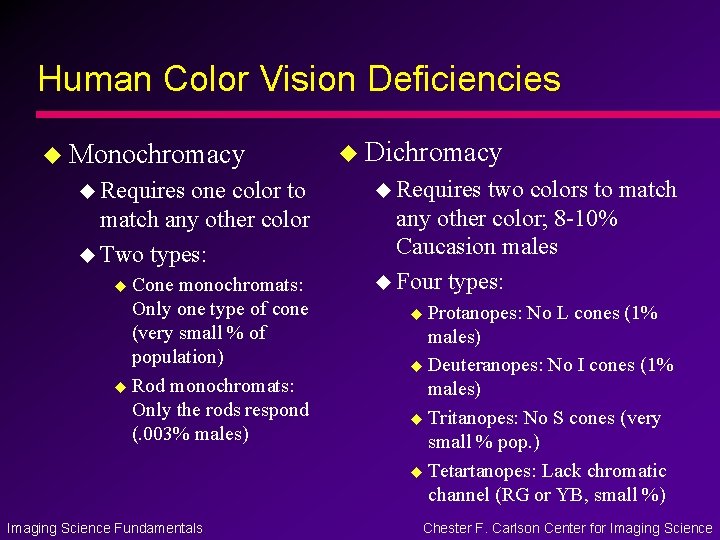
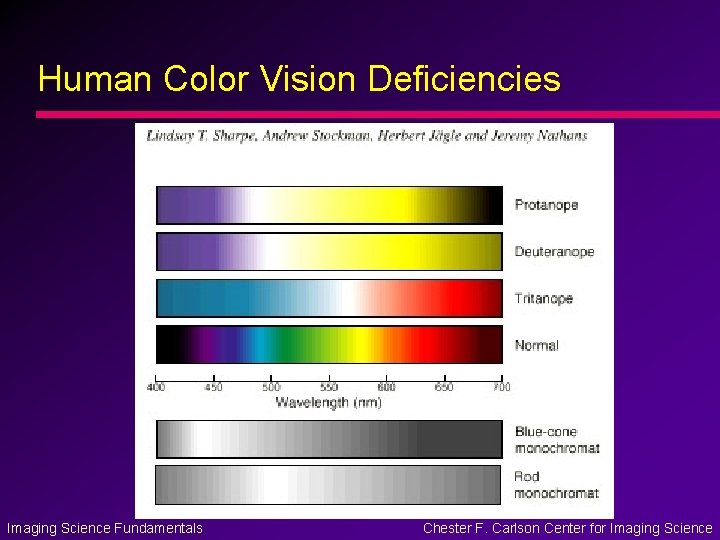
Human Color Vision Deficiencies u Monochromacy u Requires one color to match any other color u Two types: Cone monochromats: Only one type of cone (very small % of population) u Rod monochromats: Only the rods respond (. 003% males) u Imaging Science Fundamentals u Dichromacy u Requires two colors to match any other color; 8 -10% Caucasion males u Four types: Protanopes: No L cones (1% males) u Deuteranopes: No I cones (1% males) u Tritanopes: No S cones (very small % pop. ) u Tetartanopes: Lack chromatic channel (RG or YB, small %) u Chester F. Carlson Center for Imaging Science
Human Color Vision Deficiencies Imaging Science Fundamentals Chester F. Carlson Center for Imaging Science
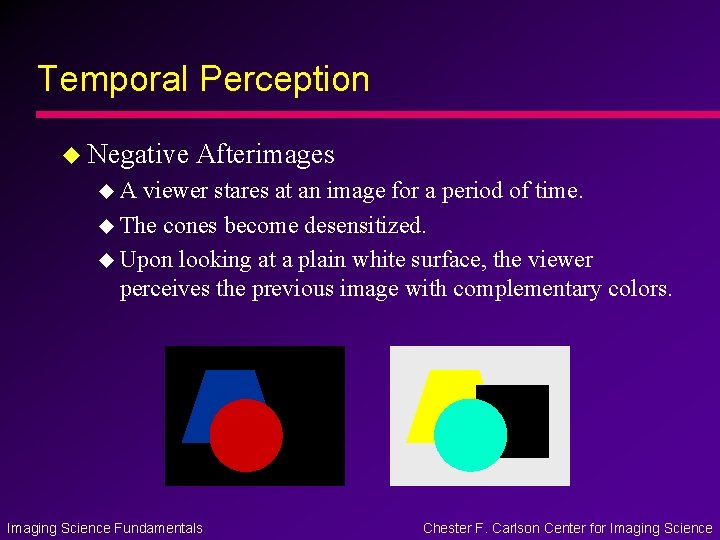
Temporal Perception u Negative Afterimages u. A viewer stares at an image for a period of time. u The cones become desensitized. u Upon looking at a plain white surface, the viewer perceives the previous image with complementary colors. Imaging Science Fundamentals Chester F. Carlson Center for Imaging Science
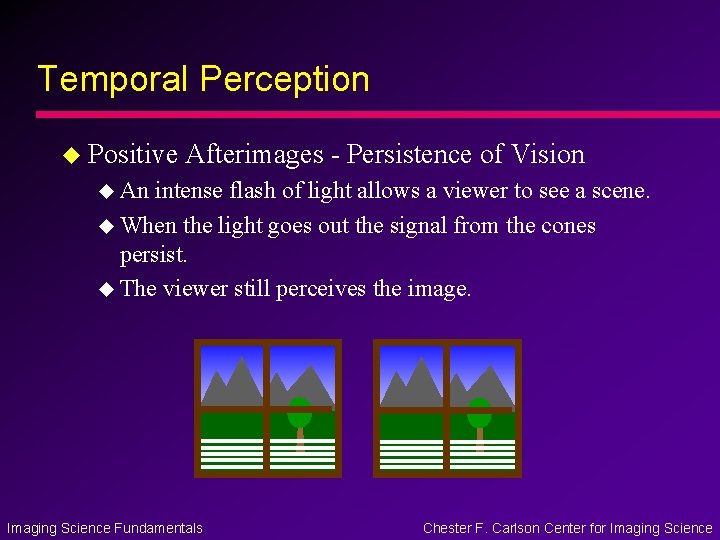
Temporal Perception u Positive Afterimages - Persistence of Vision u An intense flash of light allows a viewer to see a scene. u When the light goes out the signal from the cones persist. u The viewer still perceives the image. Imaging Science Fundamentals Chester F. Carlson Center for Imaging Science
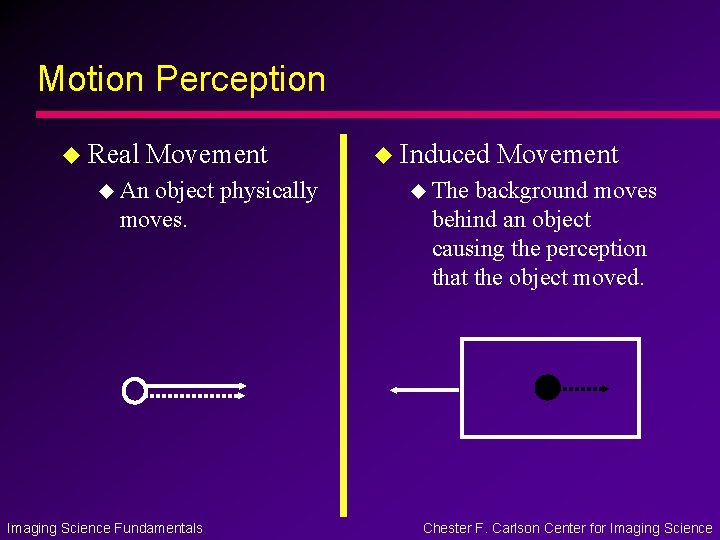
Motion Perception u Real Movement u An object physically moves. Imaging Science Fundamentals u Induced Movement u The background moves behind an object causing the perception that the object moved. Chester F. Carlson Center for Imaging Science
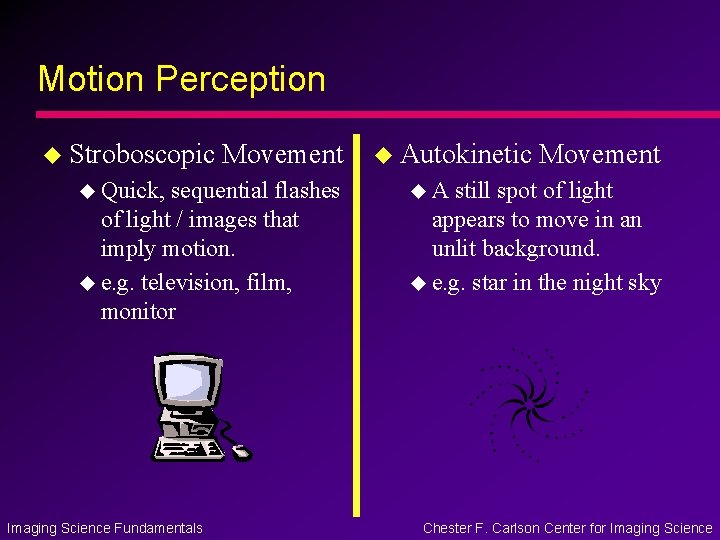
Motion Perception u Stroboscopic u Quick, Movement sequential flashes of light / images that imply motion. u e. g. television, film, monitor Imaging Science Fundamentals u Autokinetic Movement u. A still spot of light appears to move in an unlit background. u e. g. star in the night sky Chester F. Carlson Center for Imaging Science
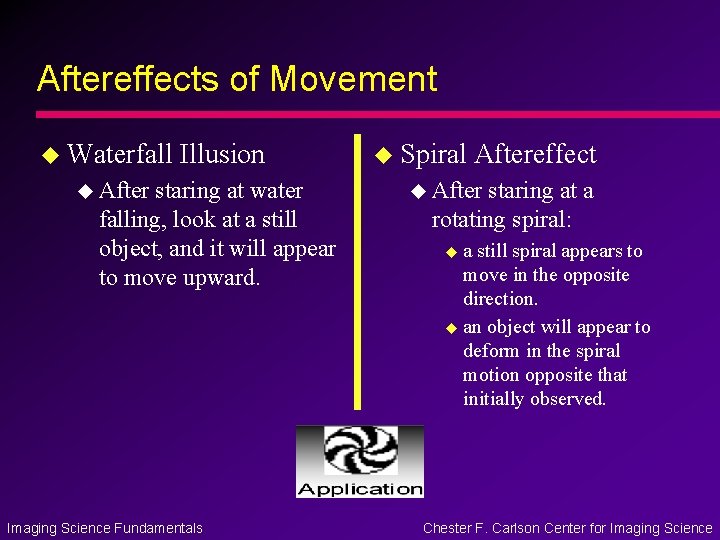
Aftereffects of Movement u Waterfall Illusion u After staring at water falling, look at a still object, and it will appear to move upward. Imaging Science Fundamentals u Spiral Aftereffect u After staring at a rotating spiral: a still spiral appears to move in the opposite direction. u an object will appear to deform in the spiral motion opposite that initially observed. u Chester F. Carlson Center for Imaging Science
Consequences of Movement u Perception of Causality u One event is seen after another, thus it may be interpreted that the 1 st event caused the 2 nd. u Personification u Human / animal characteristics given to inanimate objects. Imaging Science Fundamentals u Perception of Location u Object 1 is seen going behind object 2, thus causing the viewer to extrapolate the location of object 1. u Linking Successive Shots u e. g. television, film Chester F. Carlson Center for Imaging Science
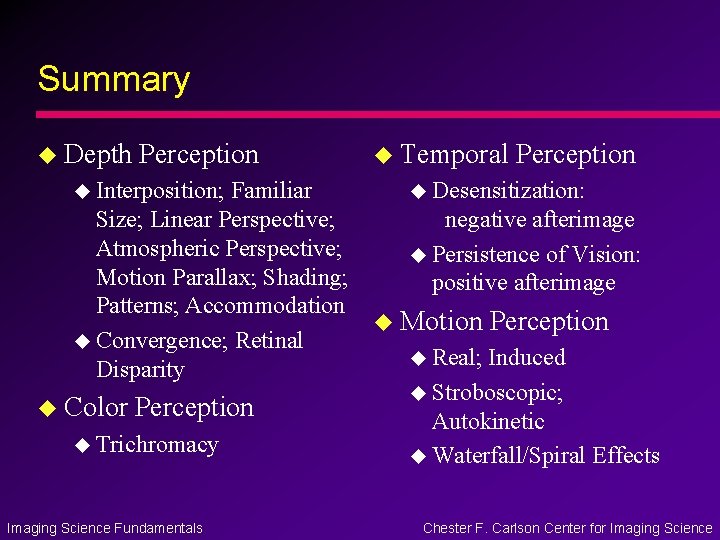
Summary u Depth Perception u Interposition; Familiar Size; Linear Perspective; Atmospheric Perspective; Motion Parallax; Shading; Patterns; Accommodation u Convergence; Retinal Disparity u Color Perception u Trichromacy Imaging Science Fundamentals u Temporal Perception u Desensitization: negative afterimage u Persistence of Vision: positive afterimage u Motion Perception u Real; Induced u Stroboscopic; Autokinetic u Waterfall/Spiral Effects Chester F. Carlson Center for Imaging Science