
The Human Tissue Act 2004 HTA key facts
- Slides: 27
The Human Tissue Act 2004 HTA key facts presentation January 2020 Debby Gibson Human Tissue Act Manager LTHT and Uo. L
Introduction 1) The Human Tissue Act 2004 (HT Act) 2) Human Tissue (Quality and Safety for Human Application) Regulations 2007 (Q+S Regs 2007) - EUTCD 3) Quality and Safety of Organs Intended for Transplantation Regulations 2012 - EUODD 4) The Human Tissue Authority (HTA) and how it regulates (Includes recent initiatives) 5) What licences do we have within LTHT / Uo. L? 6) Questions and relevant links
1) The Human Tissue Act 2004 What is it? Key points of the HT Act are: The HT Act, came into force on 1 st September 2006 and is a legal framework for regulating: § the storage and use of human organs and tissue from the living; § the removal, storage and use of tissue and organs from the deceased; for scheduled purposes in England, Wales and Northern Ireland § Provisions relating to the use of DNA cover England, Wales Northern Ireland Scotland (DNA analysis is a UK wide offence if held without appropriate consent) Removal of such material from the living is dealt with under common law Consent is the fundamental principle of the HT Act
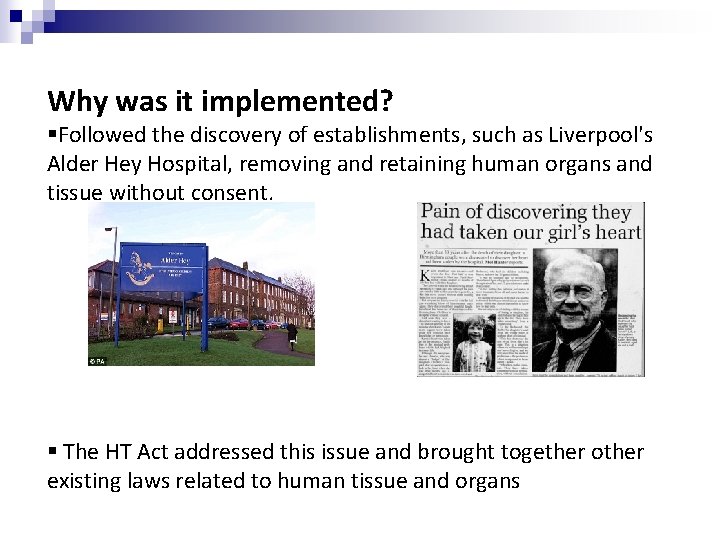
Why was it implemented? §Followed the discovery of establishments, such as Liverpool's Alder Hey Hospital, removing and retaining human organs and tissue without consent. § The HT Act addressed this issue and brought together other existing laws related to human tissue and organs
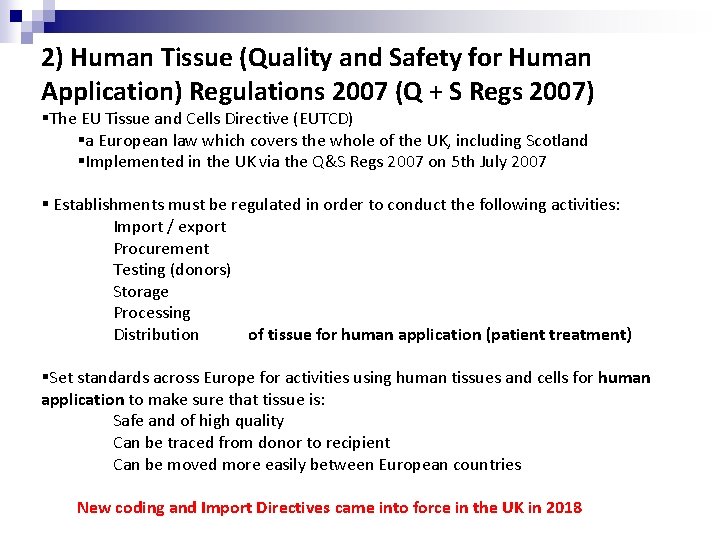
2) Human Tissue (Quality and Safety for Human Application) Regulations 2007 (Q + S Regs 2007) §The EU Tissue and Cells Directive (EUTCD) §a European law which covers the whole of the UK, including Scotland §Implemented in the UK via the Q&S Regs 2007 on 5 th July 2007 § Establishments must be regulated in order to conduct the following activities: Import / export Procurement Testing (donors) Storage Processing Distribution of tissue for human application (patient treatment) §Set standards across Europe for activities using human tissues and cells for human application to make sure that tissue is: Safe and of high quality Can be traced from donor to recipient Can be moved more easily between European countries New coding and Import Directives came into force in the UK in 2018
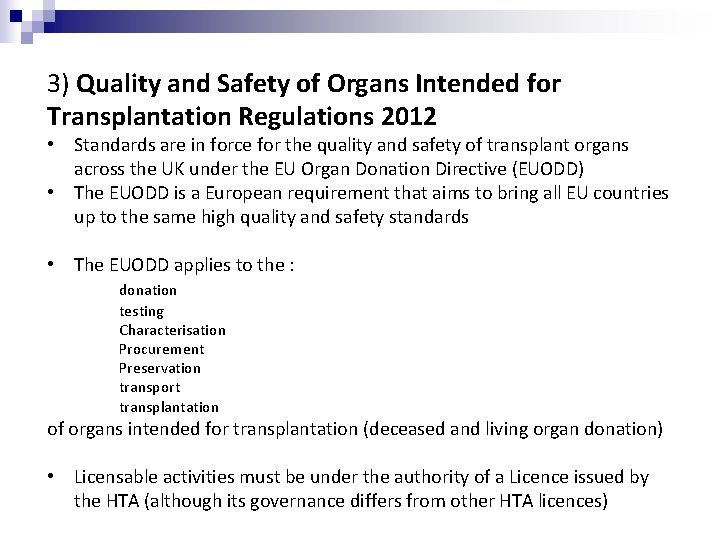
3) Quality and Safety of Organs Intended for Transplantation Regulations 2012 • Standards are in force for the quality and safety of transplant organs across the UK under the EU Organ Donation Directive (EUODD) • The EUODD is a European requirement that aims to bring all EU countries up to the same high quality and safety standards • The EUODD applies to the : donation testing Characterisation Procurement Preservation transport transplantation of organs intended for transplantation (deceased and living organ donation) • Licensable activities must be under the authority of a Licence issued by the HTA (although its governance differs from other HTA licences)
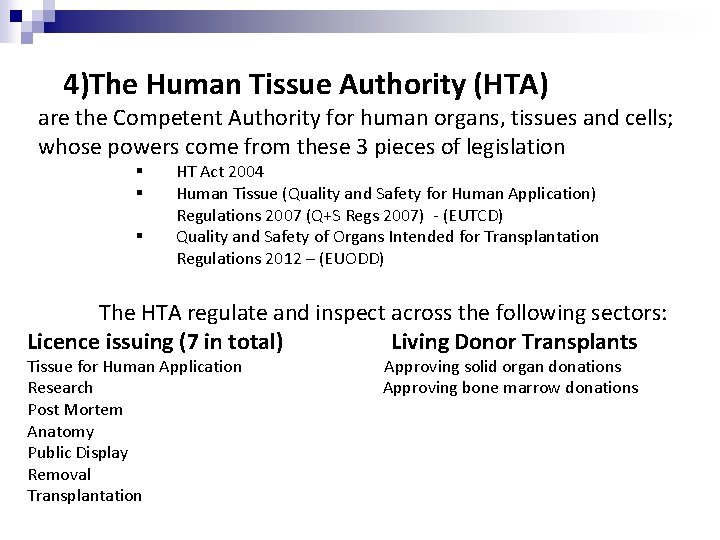
4)The Human Tissue Authority (HTA) are the Competent Authority for human organs, tissues and cells; whose powers come from these 3 pieces of legislation § § § HT Act 2004 Human Tissue (Quality and Safety for Human Application) Regulations 2007 (Q+S Regs 2007) - (EUTCD) Quality and Safety of Organs Intended for Transplantation Regulations 2012 – (EUODD) The HTA regulate and inspect across the following sectors: Licence issuing (7 in total) Living Donor Transplants Tissue for Human Application Research Post Mortem Anatomy Public Display Removal Transplantation Approving solid organ donations Approving bone marrow donations
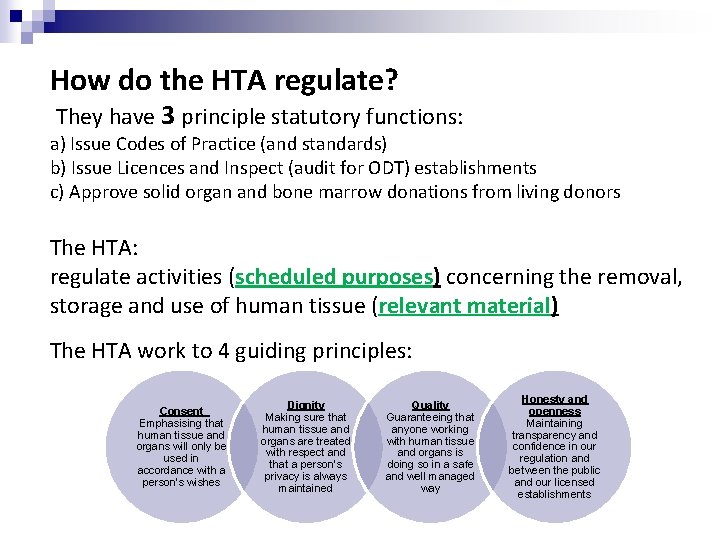
How do the HTA regulate? They have 3 principle statutory functions: a) Issue Codes of Practice (and standards) b) Issue Licences and Inspect (audit for ODT) establishments c) Approve solid organ and bone marrow donations from living donors The HTA: regulate activities (scheduled purposes) concerning the removal, storage and use of human tissue (relevant material) The HTA work to 4 guiding principles: Consent Emphasising that human tissue and organs will only be used in accordance with a person’s wishes Dignity Making sure that human tissue and organs are treated with respect and that a person’s privacy is always maintained Quality Guaranteeing that anyone working with human tissue and organs is doing so in a safe and well managed way Honesty and openness Maintaining transparency and confidence in our regulation and between the public and our licensed establishments
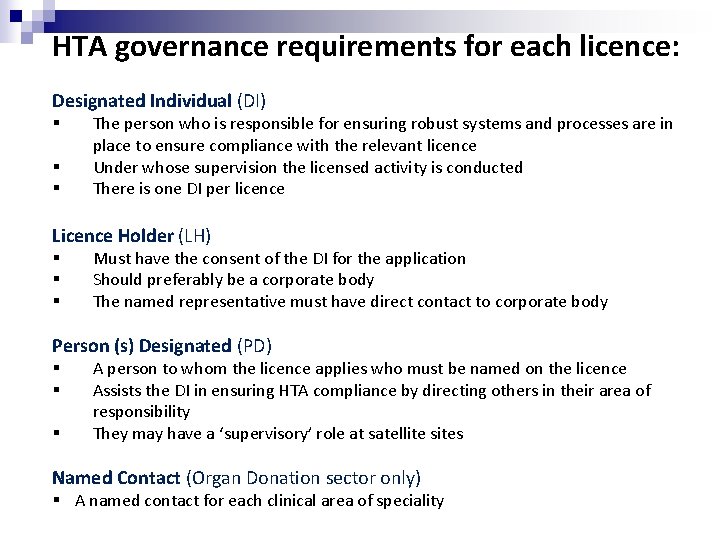
HTA governance requirements for each licence: Designated Individual (DI) § § § The person who is responsible for ensuring robust systems and processes are in place to ensure compliance with the relevant licence Under whose supervision the licensed activity is conducted There is one DI per licence Licence Holder (LH) § § § Must have the consent of the DI for the application Should preferably be a corporate body The named representative must have direct contact to corporate body Person (s) Designated (PD) § § § A person to whom the licence applies who must be named on the licence Assists the DI in ensuring HTA compliance by directing others in their area of responsibility They may have a ‘supervisory’ role at satellite sites Named Contact (Organ Donation sector only) § A named contact for each clinical area of speciality
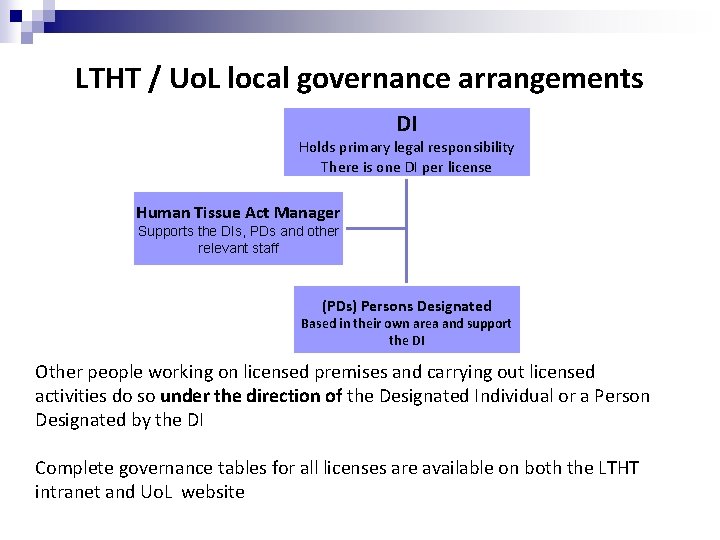
LTHT / Uo. L local governance arrangements DI Holds primary legal responsibility There is one DI per license Human Tissue Act Manager Supports the DIs, PDs and other relevant staff (PDs) Persons Designated Based in their own area and support the DI Other people working on licensed premises and carrying out licensed activities do so under the direction of the Designated Individual or a Person Designated by the DI Complete governance tables for all licenses are available on both the LTHT intranet and Uo. L website
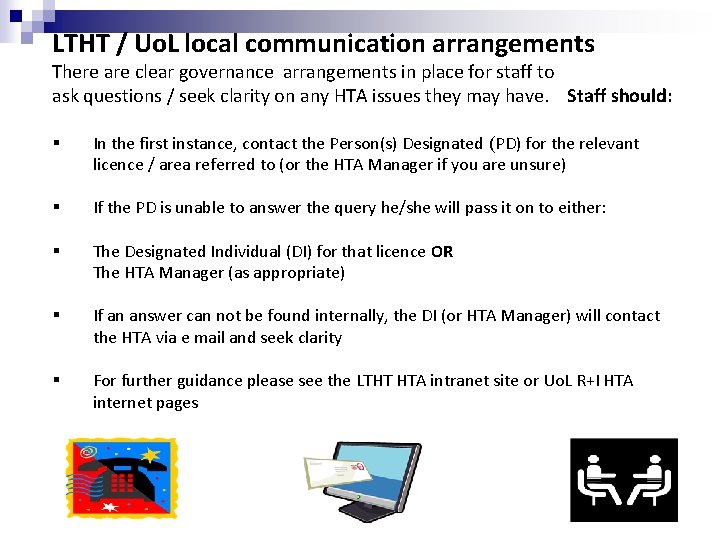
LTHT / Uo. L local communication arrangements There are clear governance arrangements in place for staff to ask questions / seek clarity on any HTA issues they may have. Staff should: § In the first instance, contact the Person(s) Designated (PD) for the relevant licence / area referred to (or the HTA Manager if you are unsure) § If the PD is unable to answer the query he/she will pass it on to either: § The Designated Individual (DI) for that licence OR The HTA Manager (as appropriate) § If an answer can not be found internally, the DI (or HTA Manager) will contact the HTA via e mail and seek clarity § For further guidance please see the LTHT HTA intranet site or Uo. L R+I HTA internet pages
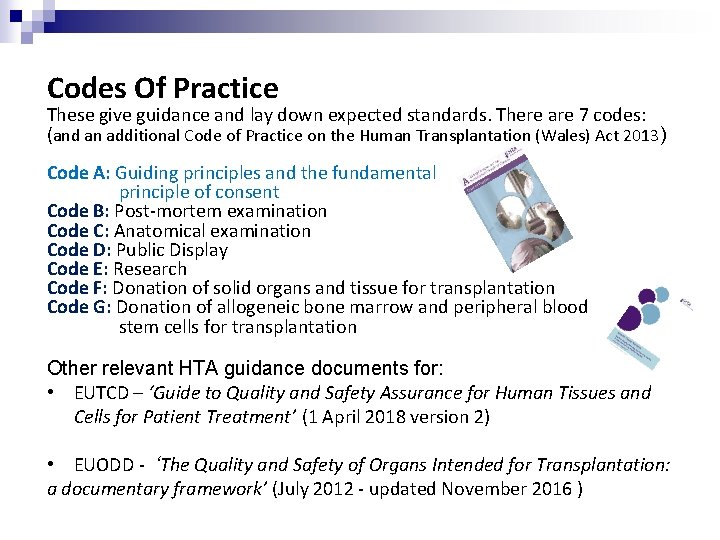
Codes Of Practice These give guidance and lay down expected standards. There are 7 codes: (and an additional Code of Practice on the Human Transplantation (Wales) Act 2013) Code A: Guiding principles and the fundamental principle of consent Code B: Post-mortem examination Code C: Anatomical examination Code D: Public Display Code E: Research Code F: Donation of solid organs and tissue for transplantation Code G: Donation of allogeneic bone marrow and peripheral blood stem cells for transplantation Other relevant HTA guidance documents for: • EUTCD – ‘Guide to Quality and Safety Assurance for Human Tissues and Cells for Patient Treatment’ (1 April 2018 version 2) • EUODD - ‘The Quality and Safety of Organs Intended for Transplantation: a documentary framework’ (July 2012 - updated November 2016 )
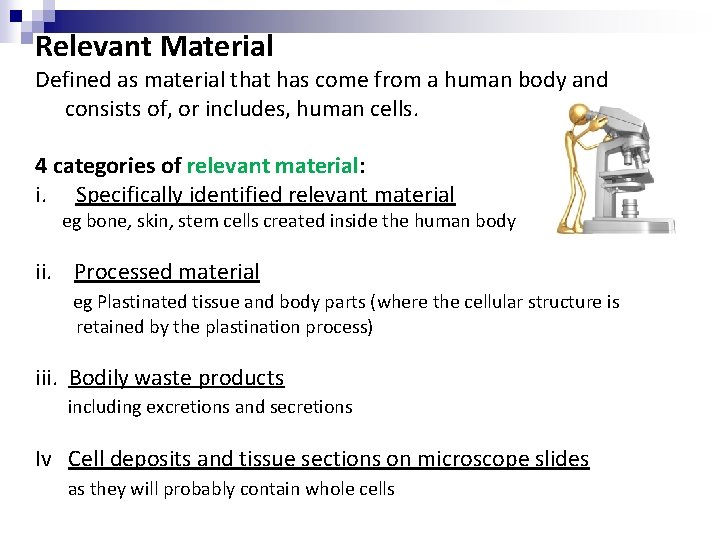
Relevant Material Defined as material that has come from a human body and consists of, or includes, human cells. 4 categories of relevant material: i. Specifically identified relevant material eg bone, skin, stem cells created inside the human body ii. Processed material eg Plastinated tissue and body parts (where the cellular structure is retained by the plastination process) iii. Bodily waste products including excretions and secretions Iv Cell deposits and tissue sections on microscope slides as they will probably contain whole cells
Relevant Material There are some exclusions; eg: hair and nail from living people Live gametes and embryos Extracted DNA Cultured cells which have derived outside the human body Note: Some materials are not relevant under the HT Act but are under the Q+S Regs, such as embryonic stem cells. The HTA website provides a comprehensive list of relevant material both under the HT Act and the Q+S Regs
Scheduled Purposes §The purposes for which consent are required are referred to as 'scheduled purposes‘ §The consent required under the HT Act is called 'appropriate consent’ - consent from the appropriate person, as identified in the Act §Penalties of up to three years' imprisonment or a fine, or both, are provided in the Act as a deterrent to failing to obtain or to misusing consent. The giving of consent is a positive, voluntary act. It should be a process and not a single action
Consent considerations The following are amongst the issues integral to the consideration of consent. They will be explored further in later slides § § § Is consent required? Is it appropriate consent? Is it valid consent? What is the Scope of the consent? What is the duration of the consent? Are processes in place for the possible withdrawal of consent?
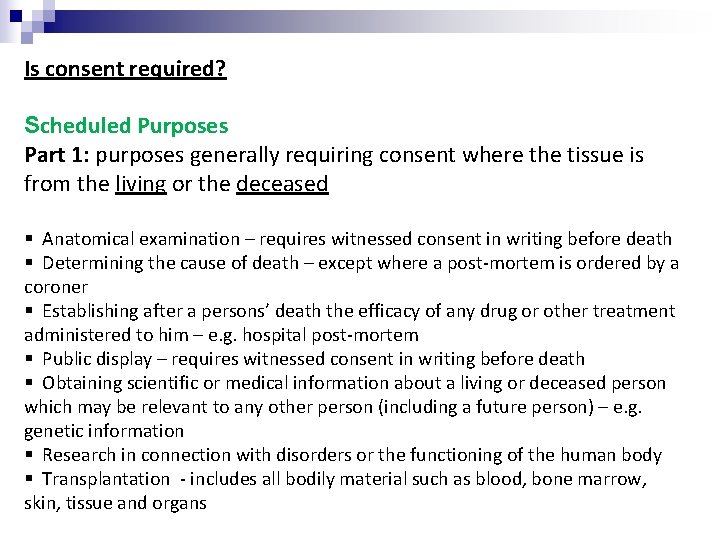
Is consent required? Scheduled Purposes Part 1: purposes generally requiring consent where the tissue is from the living or the deceased § Anatomical examination – requires witnessed consent in writing before death § Determining the cause of death – except where a post-mortem is ordered by a coroner § Establishing after a persons’ death the efficacy of any drug or other treatment administered to him – e. g. hospital post-mortem § Public display – requires witnessed consent in writing before death § Obtaining scientific or medical information about a living or deceased person which may be relevant to any other person (including a future person) – e. g. genetic information § Research in connection with disorders or the functioning of the human body § Transplantation - includes all bodily material such as blood, bone marrow, skin, tissue and organs
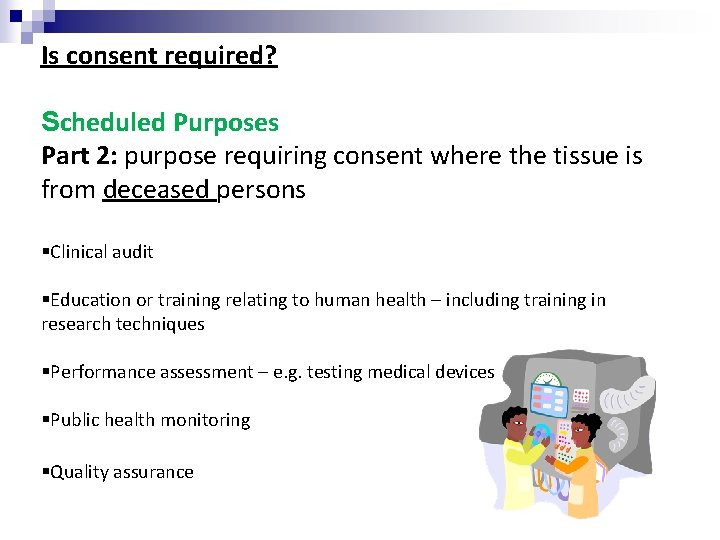
Is consent required? Scheduled Purposes Part 2: purpose requiring consent where the tissue is from deceased persons §Clinical audit §Education or training relating to human health – including training in research techniques §Performance assessment – e. g. testing medical devices §Public health monitoring §Quality assurance
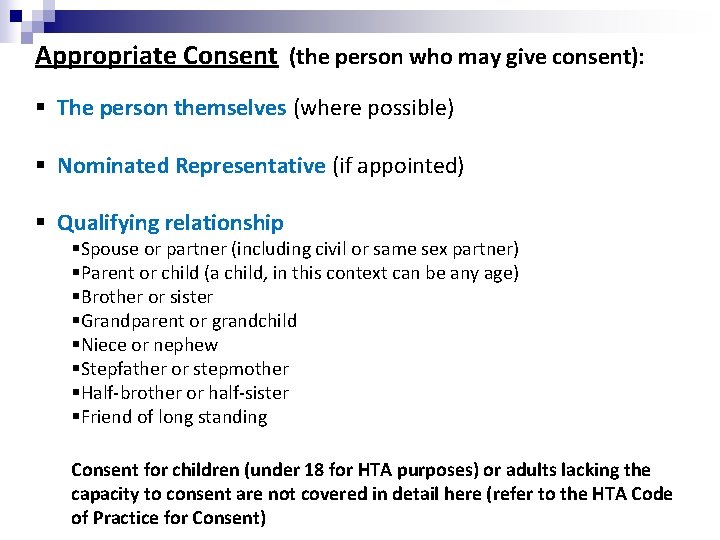
Appropriate Consent (the person who may give consent): § The person themselves (where possible) § Nominated Representative (if appointed) § Qualifying relationship §Spouse or partner (including civil or same sex partner) §Parent or child (a child, in this context can be any age) §Brother or sister §Grandparent or grandchild §Niece or nephew §Stepfather or stepmother §Half-brother or half-sister §Friend of long standing Consent for children (under 18 for HTA purposes) or adults lacking the capacity to consent are not covered in detail here (refer to the HTA Code of Practice for Consent)
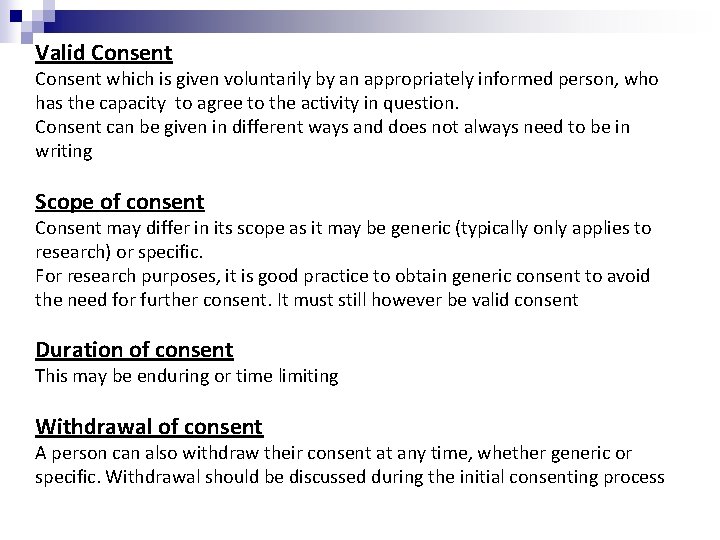
Valid Consent which is given voluntarily by an appropriately informed person, who has the capacity to agree to the activity in question. Consent can be given in different ways and does not always need to be in writing Scope of consent Consent may differ in its scope as it may be generic (typically only applies to research) or specific. For research purposes, it is good practice to obtain generic consent to avoid the need for further consent. It must still however be valid consent Duration of consent This may be enduring or time limiting Withdrawal of consent A person can also withdraw their consent at any time, whether generic or specific. Withdrawal should be discussed during the initial consenting process
Consent exceptions The Act provides a number of consent exceptions in order to store or use human tissue for scheduled purposes Note: Although exempt from consent provisions in the HT Act, the licensing requirements may still apply where material is used / stored for a scheduled purpose Existing holdings § Consent requirements of the HT Act are not retrospective. § Consent is not necessary for material that was held in storage for a scheduled purpose prior to the HT Act on 1 st September 2006. This, however, does not mean such tissues can be used freely without regard for consent or ethical considerations The consent provisions of the HT Act do not apply to imported material. The HTA do consider it good practice however, to obtain assurance that valid consent has been sought
Tissue from the living Consent exceptions § Consent is not needed for the use of surplus or 'residual' tissue, from the living, left over from diagnostic or surgical procedures for the purposes set out in Part 2 of the scheduled purposes slide (eg public health monitoring) § Consent is not needed for the use of 'residual' tissue in research, provided that: § the research project has recognised* research ethics approval §the researcher cannot identify the tissue donor and is not likely to be able to do so in the future. (allows linking with medical records, provided patient -identifying information is not obtained) * A University REC is not, for consent exemption purposes, a recognised REC. A REC established and working by UK Health Depts. OR UKECA is a recognised committee
Consent exceptions Tissue from the deceased §Consent is not required for a Coroner’s post mortem. § However, it is required for the continued use / storage of tissue, for a scheduled purpose, once the coroner’s purposes are completed Licensing exemptions §Storage of material from the body of a deceased person: if at least 100 years has passed since the date of death §The licensing requirements for storage do not include storage which is incidental to transportation (no longer than one week)
recent HTA initiatives / advances Review of Codes of Practice and Standards • The substantially updated Codes of Practice and Standards went live on 4 th April 2017 • This was the first major review which resulted in the removal from use of 2 codes altogether: • Import / Export of human bodies/body parts and tissue • Disposal of human tissue Information from these codes has been subsumed into the remaining 7 new codes and standards • Further work is required for the Human Application standards review. New public information • 2017 saw the introduction of public guides to the HTA Codes of Practice
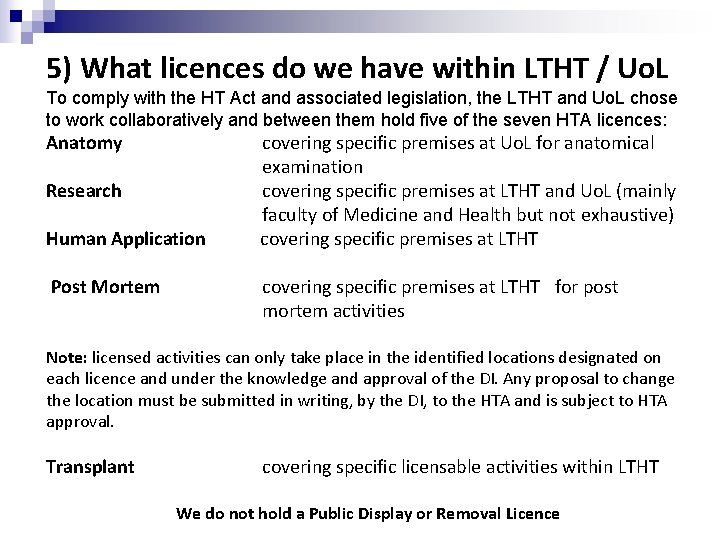
5) What licences do we have within LTHT / Uo. L To comply with the HT Act and associated legislation, the LTHT and Uo. L chose to work collaboratively and between them hold five of the seven HTA licences: Anatomy Research Human Application Post Mortem covering specific premises at Uo. L for anatomical examination covering specific premises at LTHT and Uo. L (mainly faculty of Medicine and Health but not exhaustive) covering specific premises at LTHT for post mortem activities Note: licensed activities can only take place in the identified locations designated on each licence and under the knowledge and approval of the DI. Any proposal to change the location must be submitted in writing, by the DI, to the HTA and is subject to HTA approval. Transplant covering specific licensable activities within LTHT We do not hold a Public Display or Removal Licence
This presentation is only a generic overview. For further, licence specific info you should contact: §The PD for the relevant licence §The DI for the relevant licence §Debby Gibson HTA Manager LTHT / Uo. L Tel: 0113 206 7126 Mob: 07826858764 E mail: debbie. gibson 1@nhs. net
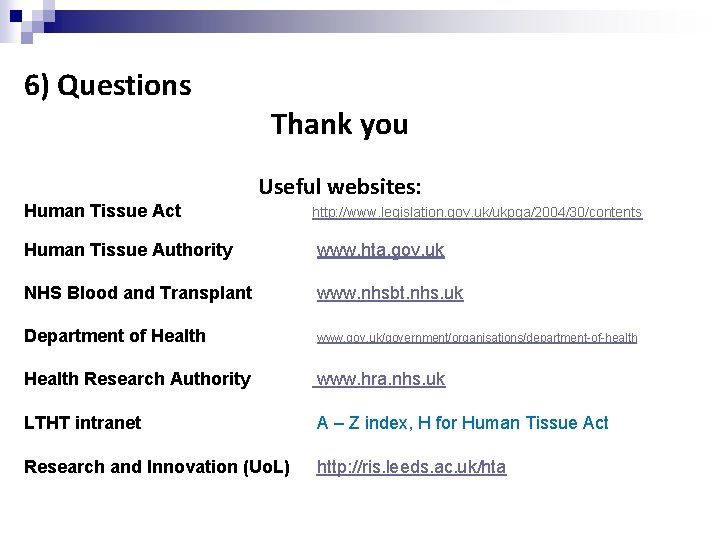
6) Questions Thank you Useful websites: Human Tissue Act http: //www. legislation. gov. uk/ukpga/2004/30/contents Human Tissue Authority www. hta. gov. uk NHS Blood and Transplant www. nhsbt. nhs. uk Department of Health www. gov. uk/government/organisations/department-of-health Health Research Authority www. hra. nhs. uk LTHT intranet A – Z index, H for Human Tissue Act Research and Innovation (Uo. L) http: //ris. leeds. ac. uk/hta