
The Human Side of HCI Human Factors Psychology

- Slides: 24
The “Human” Side of HCI: Human Factors Psychology and Assistive Technology Margaret Jelinek Lewis, Ph. D
Presentation Overview Three Parts 1. Overview of Human Factors Psychology 2. Primer in Cognitive Psychology 3. Introduction to Computer Access and Assistive Technology 6/6/2021 2
What is Human Factors? • The application of psychological principles to the design of human-machine systems. • Human factors professionals develop models of human performance that can aid designers of human-machine systems. 6/6/2021 3
What is Human Factors? 2 • Meister (1989): “The study of how humans accomplish work-related tasks in the context of human-machine system operation, and how behavioral and non-behavioral variables affect that accomplishment” 6/6/2021 4
What is Human Factors? 3 • Meister (1989): – “behavioral” refers to psychological constraints how do humans process information? – “non-behavioral” refers to physical constraints can a human physically work a control? • Emphasis in Human Factors is on design how should a system be designed to accommodate a human operator? 6/6/2021 5
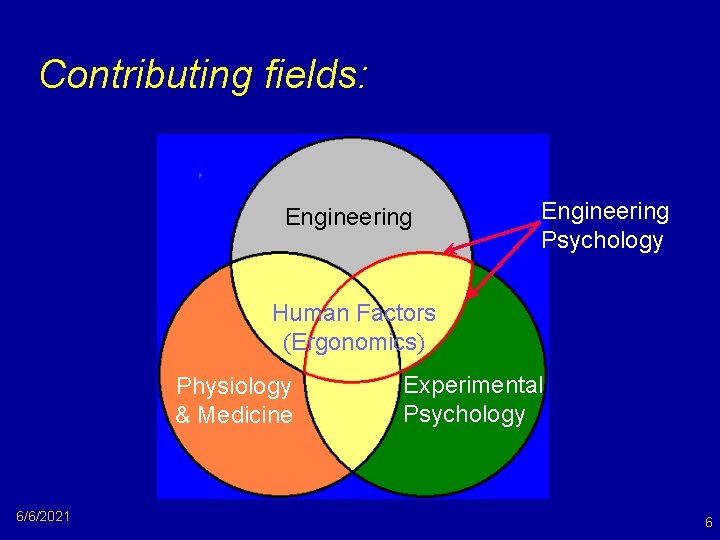
Contributing fields: Engineering Psychology Human Factors (Ergonomics) Physiology & Medicine 6/6/2021 Experimental Psychology 6
How does Human Factors differ from Experimental Psychology? • Experimental Psychology is the scientific study of mind, brain, and behavior – Why do humans think and behave the way they do? • Human factors is the study of human behavior in the context of technological systems – How should we design a system to accommodate the way humans think and behave? 6/6/2021 7
History of Human Factors • WWI – Personnel Selection: psychometricians • WWII and the genesis of Human Factors (or Engineering) Psychology – Personnel Selection continued to be emphasized “fit the man to the job” – Human Performance: experimental psychologists “fit the job to the man” 6/6/2021 8
History of Human Factors 2 • Post WWII: Formal Human Factors research laboratories established – 1945: Air Force establishes the Aero Medical Research Laboratory - “engineering psychology” – 1945: Navy establishes psychological research units 6/6/2021 9
History of Human Factors 3 • Post WWII: Formal Human Factors research laboratories established – 1951: US army establishes the Human Engineering Laboratory – Many military and civilian scientists return to universities and continue human factors research 6/6/2021 10
History of Human Factors 4 • Applications emphasized during 1950 s - 1970 s – – – 6/6/2021 Military Systems Civilian aviation and manned spacecraft Transportation systems Process control and nuclear power Safety 11
History of Human Factors 5 • Other applications emphasized since the mid-70 s – Human-computer interaction (HCI) – Virtual Environments – Medical Systems 6/6/2021 12
Why is Human Factors important to Computer Science? • Human Factors psychology examines the capabilities of humans and how these constraints and abilities affect design. 6/6/2021 13
Why is Human Factors important to Computer Science? 2 • Therefore, it is concerned with cognitive issues and research concerning humans’ interpretation of stimuli and our abilities to deal with certain situations. • The goal is to design systems with these capabilities and limitations in mind. 6/6/2021 14
Human Factors applies principles of Cognitive Psychology: • Cognitive issues that must be considered: – – – 6/6/2021 Memory (span, retrieval, storage capacity) Visual and auditory capabilities/interpretations Attention capacity (selective, focused, divided) Judgment of tones, size, loudness, brightness Interpretation of coding (traffic lights) 15
Human Factors applies principles of Cognitive Psychology 2: • Cognitive issues that must be considered: – – – 6/6/2021 Response time to stimuli Problem solving abilities Decision making Language comprehension Disabilities Cognitive load 16
Applied Cognitive Psychology: Design Issues • • 6/6/2021 Screen/font color Menus Form fill-ins Special needs of users 17
Assistive Technology • A. T. is any device or piece of equipment that helps us as we go about our daily lives. • In some cases, computers can provide (or be) assistive technology, in other cases, users need assistive technology for their computers to increase usability. 6/6/2021 18
Computer Access and Assistive Technology • Goal is to fit the machine to the person (not vice versa!) • Particularly relevant for people with disabilities – computers must be adapted for the use and needs of specific individuals 6/6/2021 19
Human Considerations in Software Design Consider 5 different users: 1. A University of Utah student trying to do research for an HCI paper on the Web. 2. An adult on April 13 using tax preparation software (such as Turbo Tax) at home. 6/6/2021 20
Human Considerations in Software Design 2 Consider 5 different users: 3. A young woman with Cerebral Palsy who is typing a paper for a class. 4. A child playing a computer-video game. 5. An octogenarian grandparent sending email to faraway grandchildren. 6/6/2021 21
For More Information Check out the WEB! • Human Factors and Ergonomics Society: www. hfes. org • Computer-Human Interaction (SIGCHI): www. sigchi. org • Bobby: http: //www. cast. org/bobby/ 6/6/2021 22
For More Information 2 Check out the WEB! • Accessibility: www. w 3. org/WAI (Web Accessibility Initiative) • Kids & Computers: www. hcibib. org/kids • Microsoft Accessibility: www. microsoft. com/enable 6/6/2021 23
Questions…. 6/6/2021 24