
The Human Respiratory System SBI 3 U 1
The Human Respiratory System SBI 3 U 1
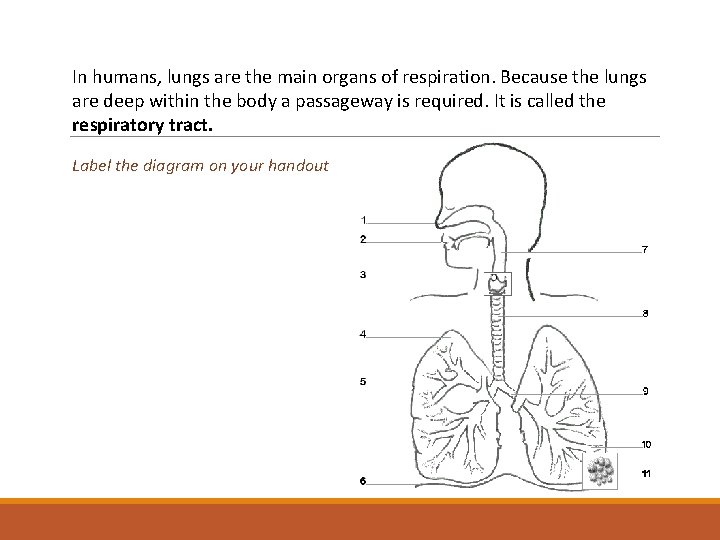
In humans, lungs are the main organs of respiration. Because the lungs are deep within the body a passageway is required. It is called the respiratory tract. Label the diagram on your handout
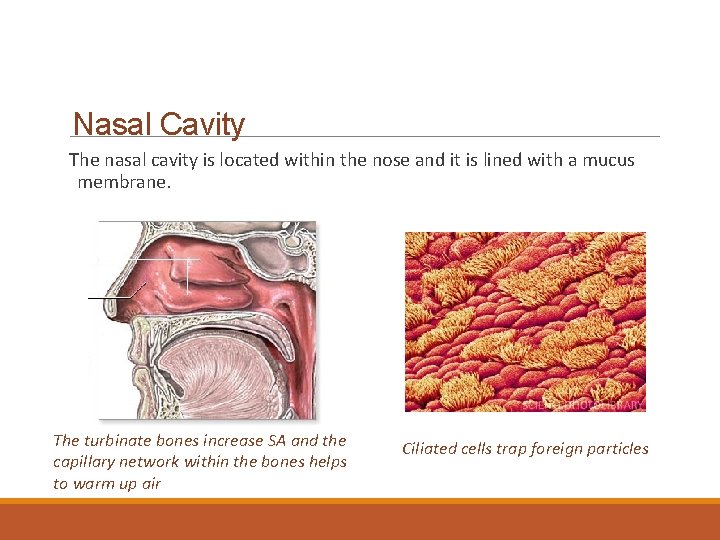
Nasal Cavity The nasal cavity is located within the nose and it is lined with a mucus membrane. The turbinate bones increase SA and the capillary network within the bones helps to warm up air Ciliated cells trap foreign particles
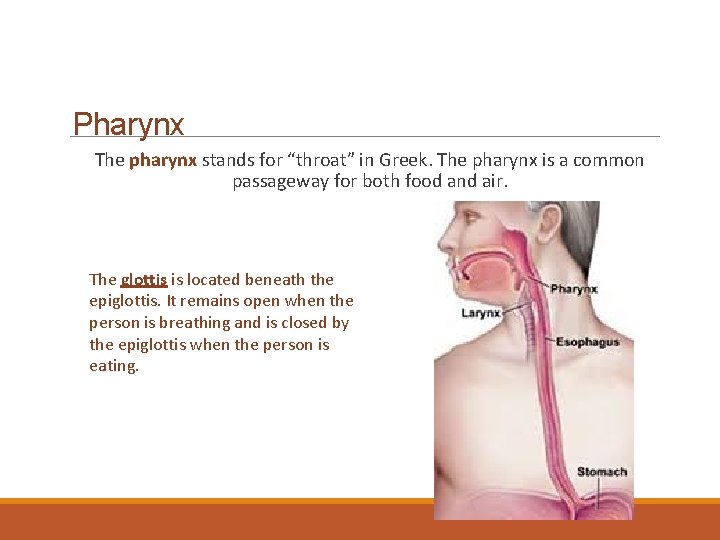
Pharynx The pharynx stands for “throat” in Greek. The pharynx is a common passageway for both food and air. The glottis is located beneath the epiglottis. It remains open when the person is breathing and is closed by the epiglottis when the person is eating.
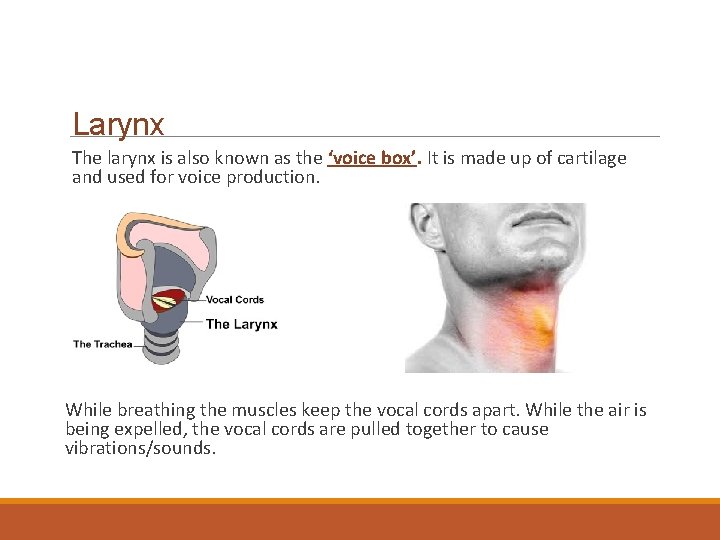
Larynx The larynx is also known as the ‘voice box’. It is made up of cartilage and used for voice production. While breathing the muscles keep the vocal cords apart. While the air is being expelled, the vocal cords are pulled together to cause vibrations/sounds.

Trachea The trachea is a long flexible tube made of semicircular loops of cartilage. It is approximately 10 12 cm in length and splits into two branches
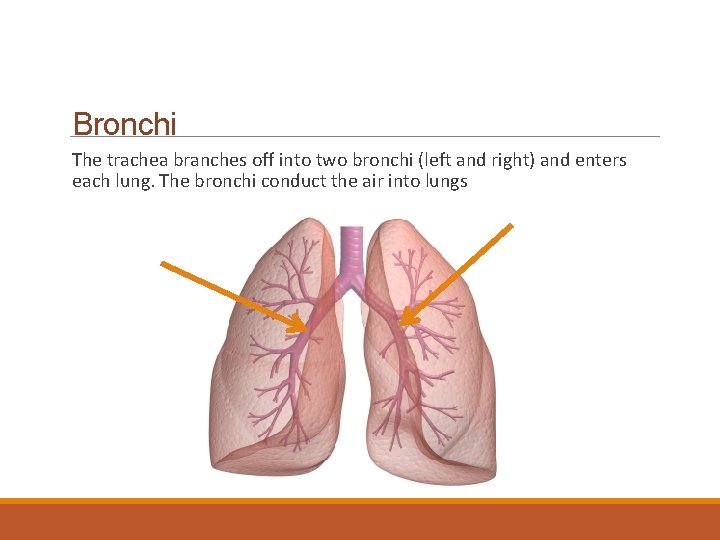
Bronchi The trachea branches off into two bronchi (left and right) and enters each lung. The bronchi conduct the air into lungs
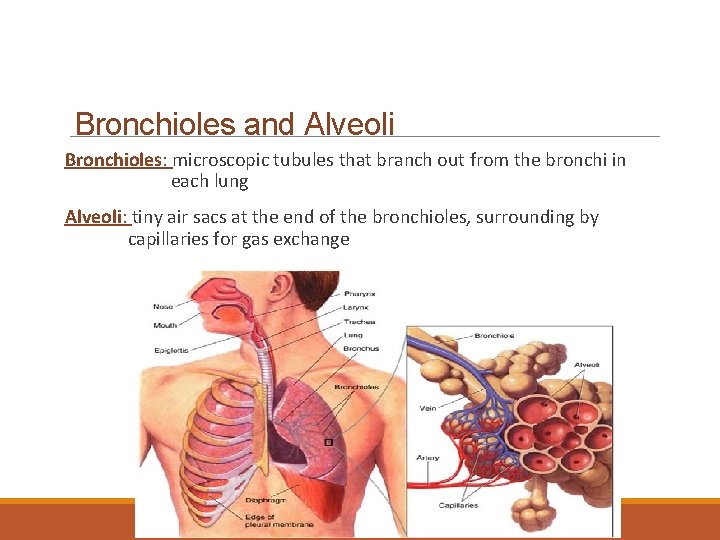
Bronchioles and Alveoli Bronchioles: microscopic tubules that branch out from the bronchi in each lung Alveoli: tiny air sacs at the end of the bronchioles, surrounding by capillaries for gas exchange

Lungs Pleural membrane : sac that surrounds each lung. The outer layer is attached to the chest wall and inner layer to the surface of the lung. Right lung: 3 lobes Left Lung : 2 lobes
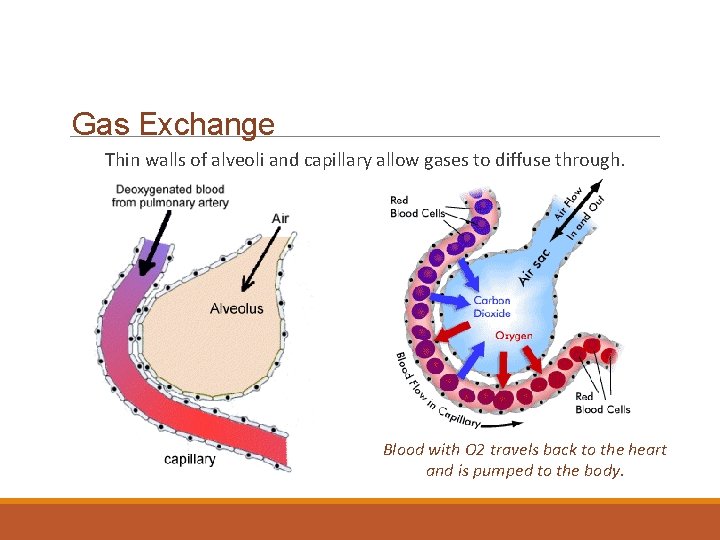
Gas Exchange Thin walls of alveoli and capillary allow gases to diffuse through. Blood with O 2 travels back to the heart and is pumped to the body.
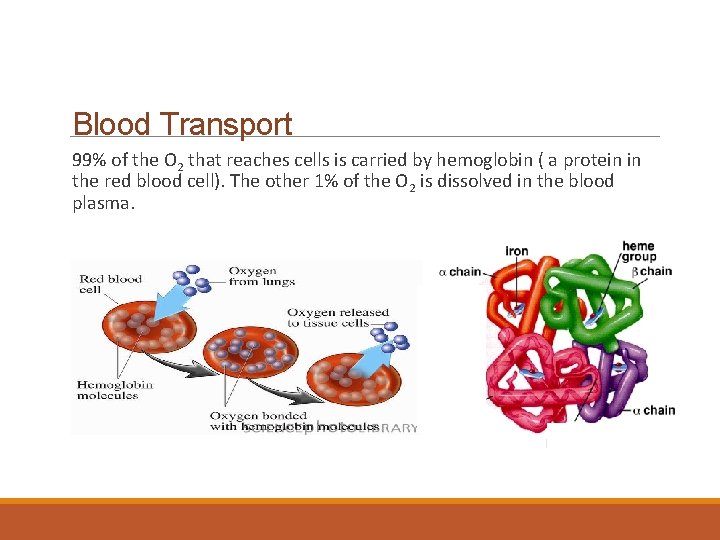
Blood Transport 99% of the O 2 that reaches cells is carried by hemoglobin ( a protein in the red blood cell). The other 1% of the O 2 is dissolved in the blood plasma.
Blood Transport 23% of CO 2 is carried by hemoglobin, the remaining 77% is carried by body fluids. Blood Transport Video: http: //www. youtube. com/watch? v=WXOBJEXx. NEo
Checking for Understanding 1. How and why is air warmed as it is inhaled through the nose? [2 marks) 1. In a medical emergency, a physician may insert a tube down a person’s trachea to help him or her breath. Infer why the patient would be unable to talk while they have a tube in their trachea. [2 marks]
Homework: pg. 454 # 1 -3, 5 -7, 9 -13
- Slides: 14