
The human experiment Welcome Parents I wanted to
- Slides: 14
The human experiment
Welcome Parents!!! I wanted to take the time to tell you a story about a special student I know about. My friend resembles a lot of your children and I want to see if any of you can make the connections.
Many years ago there were three mad psychologists that had an idea of creating the perfect human being, to their understanding.
Cognitive state The first man, Mr. P. , decided that the experiment should go through stages. There would be four to be exact. The stages would mirror those of a normal human being: sensorimotor, preoperational, concreteoperational, and formal-operational. Going throughout these stages determines where the experiment would be in their thinking process.
Social state The second man, Mr. E. , knew from his studying of humans that one achieves ridicule or fame for whatever actions they make. Mr. E. like Mr. P came up with different stages that their experiment would go through, eight stages to be exact.
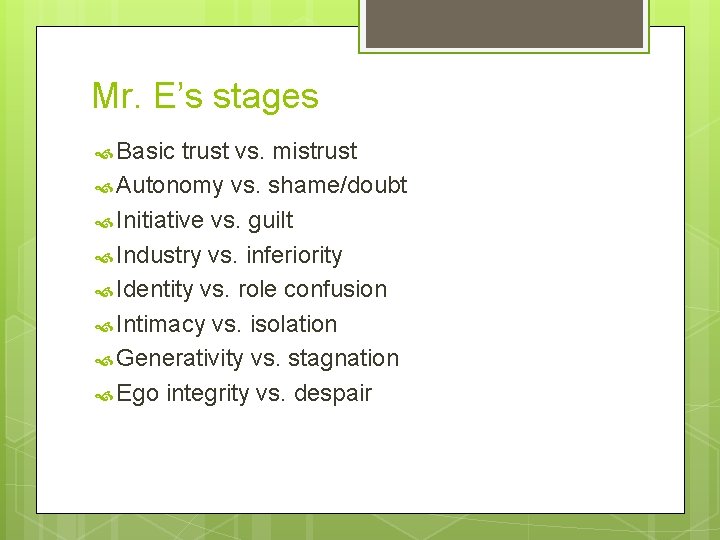
Mr. E’s stages Basic trust vs. mistrust Autonomy vs. shame/doubt Initiative vs. guilt Industry vs. inferiority Identity vs. role confusion Intimacy vs. isolation Generativity vs. stagnation Ego integrity vs. despair
Stages cont. The experiment had already gained the knowledge that it needed to know, because Mr. E. had equipped the experiment with the understanding of these stages without going through them, unlike an actual human.
Stages cont. In these stages the experiment would know how to walk, use the bathroom, and other physical activities as one would develop in the Autonomy vs. shame/doubt stage. The experiment would also learn independence, demands, and gender role; those especially that deal with school, relationships, love, and the complex of parenting; these skills would normally be developed throughout a human’s life but Mr. E. thought it would be necessary for their experiment to know them right away.
Moral state The third man, Mr. K. , also included three stages or levels to the experiment. These levels allowed for the experiment to base their judgment on their own interests (level one), others (level two), or bigger ideas (level three). Normally these levels would be known as the pre-conventional level, the conventional level, and the post conventional level.
Physical state Toward the end of the experiment the three men came together to develop the body. They wanted to make the experiment perfect, they knew that if their experiment had a difference or flaws the experiment would be mocked by others because differences stick out like a sore thumb in our society. The three men wanted the experiment to be able to perform all the tasks that its age required.
The experiment was finally complete and they decided to test him and put him in different social situations. They named him P. E. K. after the first letter of each psychologists last name. P. E. K went to school for the first time and performed admirably. The teacher was astonished because none of her students had ever been so on top of things.
P. E. K. knew how to do everything there was to know and the teacher. Mrs. Everdeen, the teacher tried advanced teachings: calculus, physics, etc. but she decided that there was nothing she could teach him. Mrs. Everdeen didn’t know what to do with P. E. K. because in a way he was just an empty seat and nothing could be done.
Mrs. Everdeen thought it best If P. E. K. became an instructor of some sort. It was a matter of months and finally P. E. K. found his place as an educator. The three men I spoke of: Mr. P. , Mr. E. , and Mr. K. are actually Jean Piaget, Erik Erickson, and Lawrence Kohlberg and these men did actually come up with these different stages that humans do go through, throughout their life.
Even someone with a perfect mind can find a place in the classroom, there is room for everyone. And I promise that your children will be my top priority throughout this year. THE END