
The Human Digestive System Food Getting Nutrient Use



- Slides: 29
The Human Digestive System
Food - Getting / Nutrient Use • All organisms need food, and all foods contain nutrients. Nutrients are the substances that provide the energy and the materials needed for growth, repair, regulation, and maintenance of the cells. • Therefore, food is what the organism consumes, and nutrients are substances within food that are needed by the cells to sustain life.
• • • Organisms Require Six Basic Nutrients: 1. Carbohydrates Source - plants Function - major source of energy in the body 2. Lipids (fats) Source - ingestion of animal and plant fats; conversion of carbohydrates into fats Function - storage of energy; component of cell membranes; cushion for delicate organs; carriers for certain vitamins; raw materials for important chemicals
• 3. Proteins • Source - meat, fish, poultry • Function - broken down into amino acids which are used in the construction of human proteins. Proteins are essential for the building, repair, and maintenance of cell structure. • The predominant part of muscles, nerves, skin, and hair is protein. • Things such as enzymes and antibodies are specialized proteins.
• 4. Water • Source - ingestion • Function - a variety of functions including its role as a solvent • 5. Vitamins • Source - the various vitamins are each ingested from a variety of foods • Function - various metabolic functions including enzymatic activity • 6. Minerals • Source - the various minerals are each ingested from a variety of foods • Function - a large variety of bodily functions
• Carbohydrates, lipids, and proteins require digestion. • Vitamins, water, and minerals do not.
Research Assignment • Construct a chart displaying the specific sources and functions of each of the following vitamins and minerals: • Vitamins - A, B 1, B 2, Niacin, B 12, C, D, E, and K • Minerals - calcium, phosphorous, sodium, chlorine, potassium, magnesium, iodine, iron
• Foods taken into the body consist of large complex organic compounds. Digestion must occur in order to release the nutrients contained within the food. • Digestion will reduce the large complex organic compounds into smaller, simpler units that can be absorbed and used by the cells of the organism. • This is accomplished through a digestive system. In such a system digestion occurs in two ways:
• (A) Mechanical - food is broken down into smaller pieces by the teeth. This prepares the food for faster chemical digestion by exposing more food surface to the action of the digestive enzymes. Mechanical digestion also includes the physical movement of food. • (B) Chemical - food is broken down into smaller, simpler organic units through the activity of the digestive enzymes. • *The human digestive system consists of a tract of organs and associated glands.
Digestive Tract / Alimentary Canal Organs Glands Mouth Pharynx Esophagus Salivary Stomach Small Intestine Gastric Large Intestine Rectum Anus Liver Intestinal Pancreatic
Mouth • Structure: • Teeth - 20 infant, followed by 32 adult • Tongue - location of taste buds, four types being salty, sweet, sour and bitter • Mechanical Digestion: • (1) teeth tear and grind food into smaller pieces • (2) tongue keeps the food between your teeth and pushes it into the pharynx
• Chemical Digestion: • Six salivary glands release saliva that contains salivary amylase (enzyme) and mucin. • (1) Salivary amylase (enzyme) starts the breakdown of starch (polysaccharide) into maltose (disaccharide). • (2) Mucin makes the food slippery and easy to swallow. The food particles stick together forming a food mass called a bolus which the tongue pushes into the pharynx.
Pharynx • Structure: Made up of muscular walls containing two openings: • trachea - leads to the lungs and is covered by the epiglottis. • esophagus - leads to the stomach • Mechanical Digestion - none • Chemical Digestion - none
Esophagus • Structure: It is a tube about 30 cm long through which food passes from the pharynx to the stomach. • Mechanical Digestion: There a series of muscle contractions called peristalsis that push food down the esophagus and into the stomach. • Chemical Digestion - none
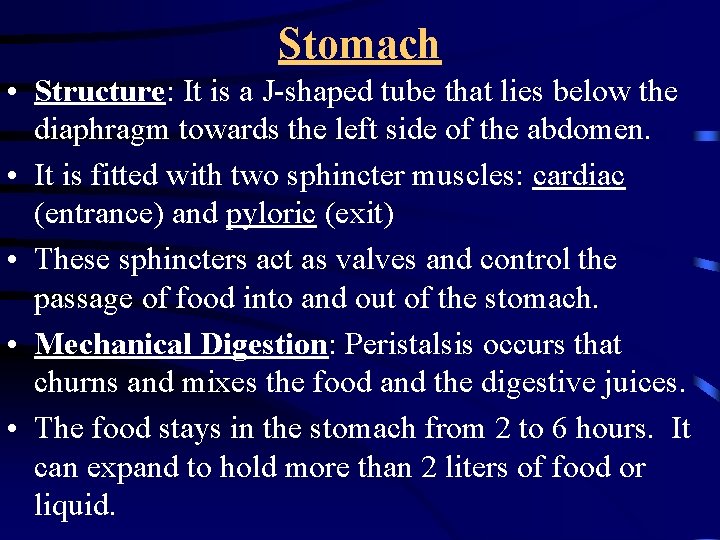
Stomach • Structure: It is a J-shaped tube that lies below the diaphragm towards the left side of the abdomen. • It is fitted with two sphincter muscles: cardiac (entrance) and pyloric (exit) • These sphincters act as valves and control the passage of food into and out of the stomach. • Mechanical Digestion: Peristalsis occurs that churns and mixes the food and the digestive juices. • The food stays in the stomach from 2 to 6 hours. It can expand to hold more than 2 liters of food or liquid.
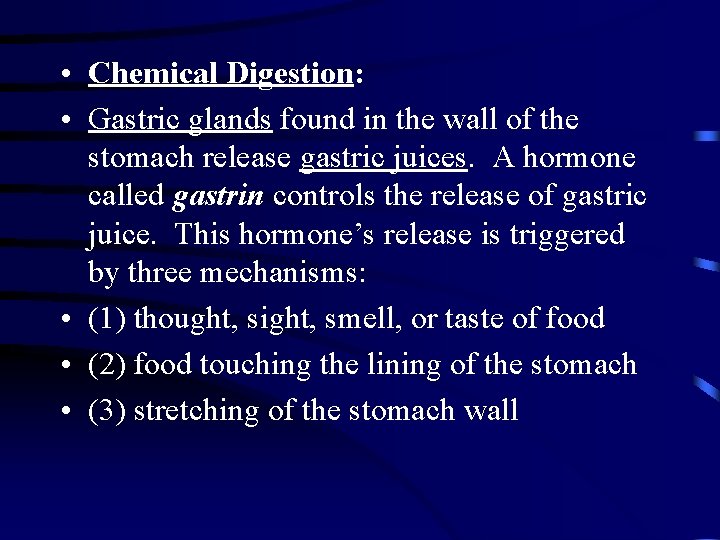
• Chemical Digestion: • Gastric glands found in the wall of the stomach release gastric juices. A hormone called gastrin controls the release of gastric juice. This hormone’s release is triggered by three mechanisms: • (1) thought, sight, smell, or taste of food • (2) food touching the lining of the stomach • (3) stretching of the stomach wall
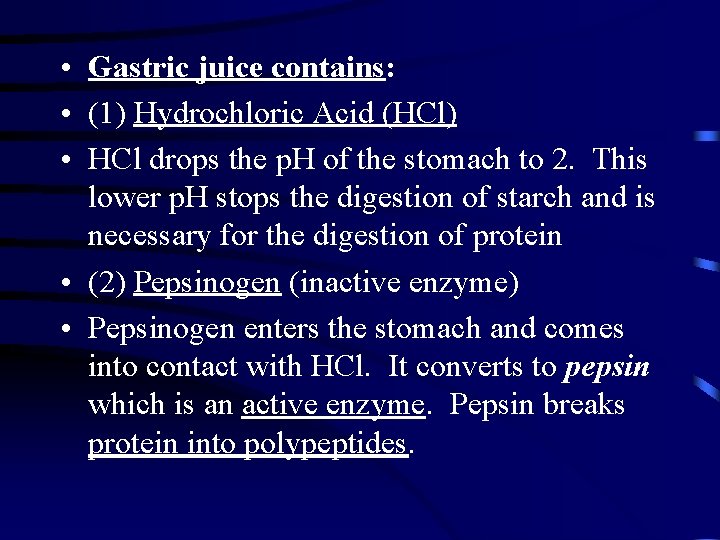
• Gastric juice contains: • (1) Hydrochloric Acid (HCl) • HCl drops the p. H of the stomach to 2. This lower p. H stops the digestion of starch and is necessary for the digestion of protein • (2) Pepsinogen (inactive enzyme) • Pepsinogen enters the stomach and comes into contact with HCl. It converts to pepsin which is an active enzyme. Pepsin breaks protein into polypeptides.
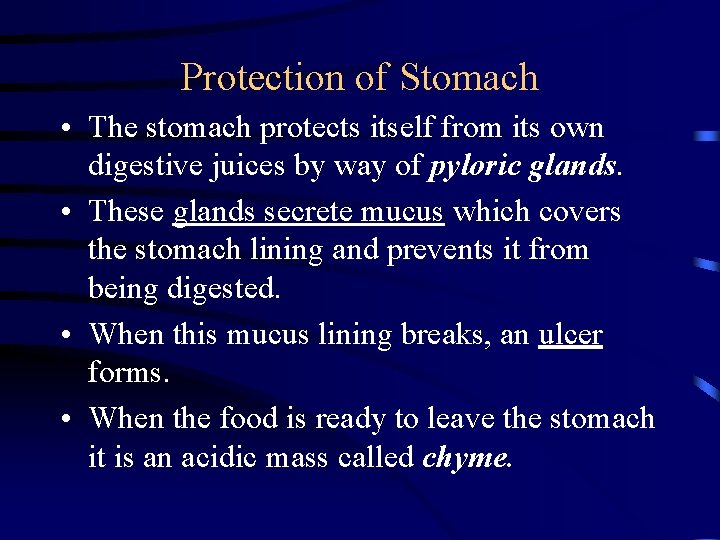
Protection of Stomach • The stomach protects itself from its own digestive juices by way of pyloric glands. • These glands secrete mucus which covers the stomach lining and prevents it from being digested. • When this mucus lining breaks, an ulcer forms. • When the food is ready to leave the stomach it is an acidic mass called chyme.
Small Intestine • Structure: • It is a tube 2. 5 cm in diameter and 7 m long. It is coiled inside the abdomen and consists of three sections: • (1) duodenum - 25 cm long • (2) jejunum - 2 m long • (3) ileum - 5 m long • * Digestion is completed here and nutrients are absorbed.
Mechanical Digestion: • (1) Peristalsis • (2) Fats are emulsified. The liver produces bile which is stored in the gall bladder. • The bile enters the intestine at the duodenum through a tube called the common bile duct. • The bile emulsifies fats. This means fats, oils, and waxes are broken down into very small droplets increasing the surface area for enzyme activity. • Bile is not an enzyme.
Chemical Digestion: • There are two important glands involved in digestion in the small intestine: • (A) Pancreas • (B) Intestinal
(A) Pancreas • It is located outside the small intestine and is attached to the wall of the abdomen. • It produces pancreatic juices which enter the small intestine at the duodenum through the pancreatic duct and into the common bile duct. • The pancreatic juices contain: • (1) Pancreatic amylase - an enzyme that converts remaining starch to maltose. • (2) Lipase - an enzyme that converts fats to fatty acids and glycerol.
• (3) Proteases / Trypsin - enzymes that convert the polypeptides produced in the stomach into simpler polypeptides. • (4) Erepsins - enzymes that convert simpler polypeptides into amino acids. This is the final stage in protein digestion. • (5) Sodium bicarbonate - raises the p. H to 8 (base) so the above enzymes can function. It does this by neutralizing the acidic chyme released from the stomach. Bile also aids in the process.
(B) Intestinal Glands • They are found in the wall of the small intestine. They produce and release intestinal juices which contain: • (1) Peptidases - enzymes that convert simpler polypeptides into amino acids. • (2) Lipase - enzyme that converts fats to fatty acids and glycerol • (3) A group of enzymes that convert disaccharides into glucose: • A. maltase - converts maltose to glucose • B. sucrase - converts sucrose to glucose • C. lactase - converts lactose to glucose
Absorption • The small intestine contains many fingerlike projections called villi. They increase the surface area of the small intestine by a factor of 10. To get the same surface area without the villi, your small intestine would have to be 70 m long. • The large surface area is ideal for nutrient absorption.
• • There are two major parts to each villus: (A) Lacteal - part of the lymph system, located in the center of the villus and absorbs fatty acids and glycerol. (B) Capillaries - part of the circulatory system, located around the lacteal and absorbs the following: (i) glucose (simple sugar) (ii) amino acids (iii) vitamins (iv) minerals (v) water
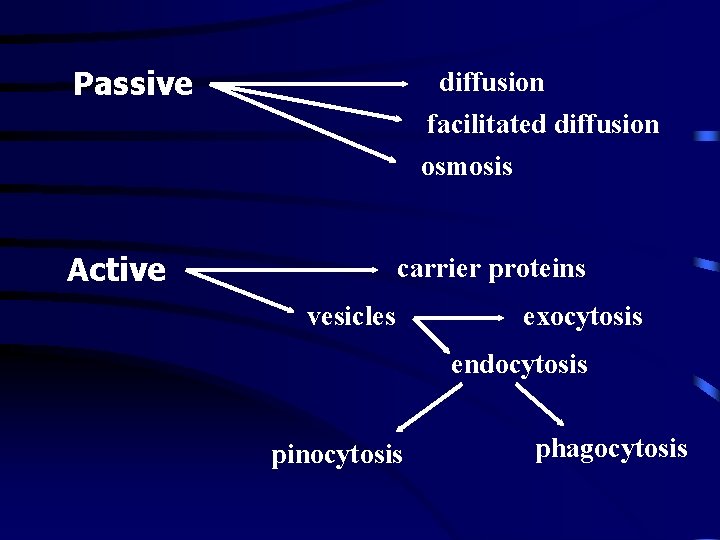
• The capillaries of all villi join together to form the hepatic portal vein that travels to the liver. • Once in the liver, glucose is converted into glycogen and stored. • The rest of the nutrients travel in the blood around the body to every individual cell. • The various nutrients enter the villus by the various forms of transport discussed earlier:
Passive diffusion facilitated diffusion osmosis Active carrier proteins vesicles exocytosis endocytosis pinocytosis phagocytosis