
The Human Default Mode Network A revelation of
- Slides: 6
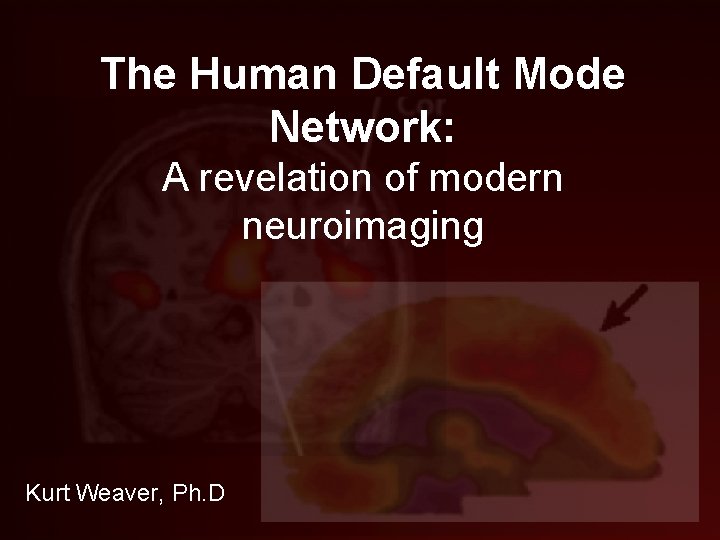
The Human Default Mode Network: A revelation of modern neuroimaging Kurt Weaver, Ph. D
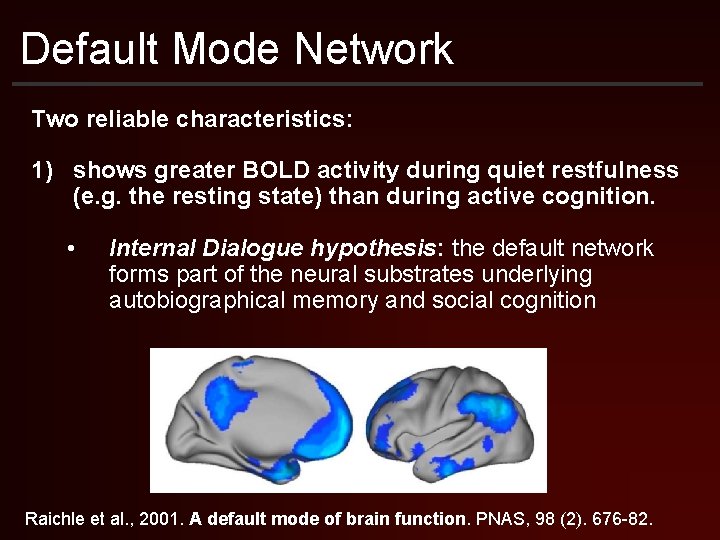
Default Mode Network Two reliable characteristics: 1) shows greater BOLD activity during quiet restfulness (e. g. the resting state) than during active cognition. • Internal Dialogue hypothesis: the default network forms part of the neural substrates underlying autobiographical memory and social cognition Raichle et al. , 2001. A default mode of brain function. PNAS, 98 (2). 676 -82.
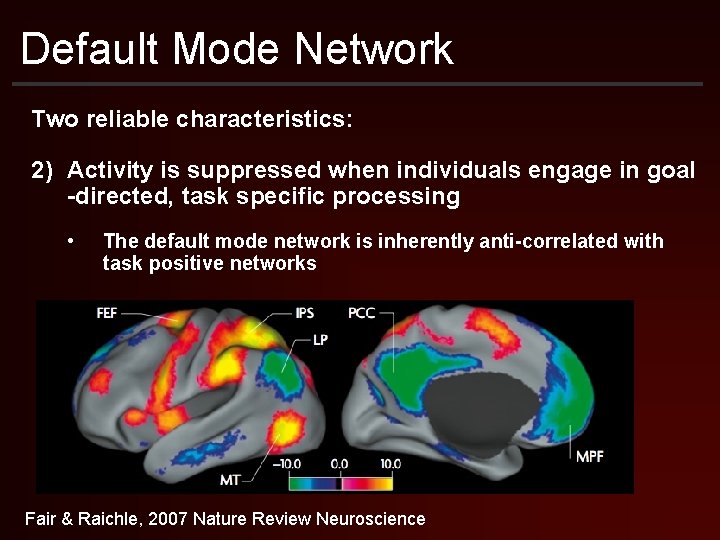
Default Mode Network Two reliable characteristics: 2) Activity is suppressed when individuals engage in goal -directed, task specific processing • The default mode network is inherently anti-correlated with task positive networks Fair & Raichle, 2007 Nature Review Neuroscience
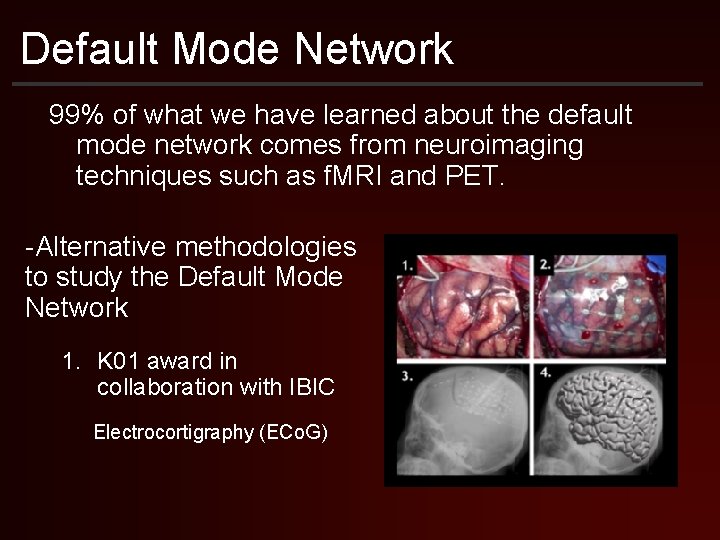
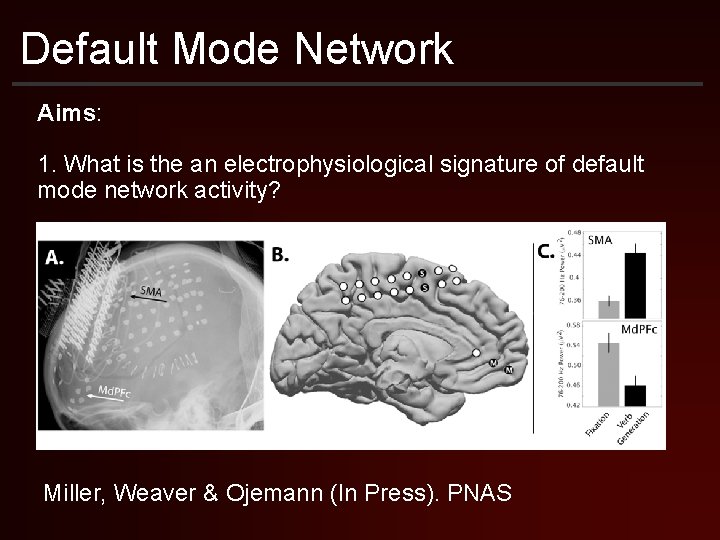
Default Mode Network 99% of what we have learned about the default mode network comes from neuroimaging techniques such as f. MRI and PET. -Alternative methodologies to study the Default Mode Network 1. K 01 award in collaboration with IBIC Electrocortigraphy (ECo. G)
Default Mode Network Aims: 1. What is the an electrophysiological signature of default mode network activity? Miller, Weaver & Ojemann (In Press). PNAS
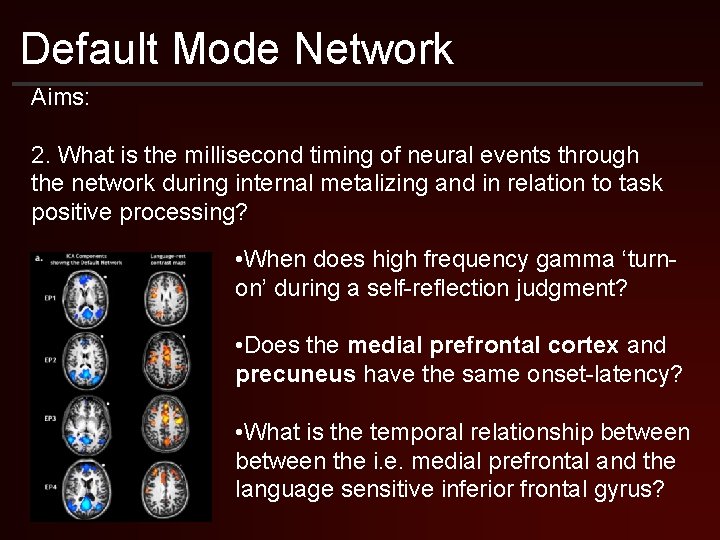
Default Mode Network Aims: 2. What is the millisecond timing of neural events through the network during internal metalizing and in relation to task positive processing? • When does high frequency gamma ‘turnon’ during a self-reflection judgment? • Does the medial prefrontal cortex and precuneus have the same onset-latency? • What is the temporal relationship between the i. e. medial prefrontal and the language sensitive inferior frontal gyrus?