
The human body is complex You can think
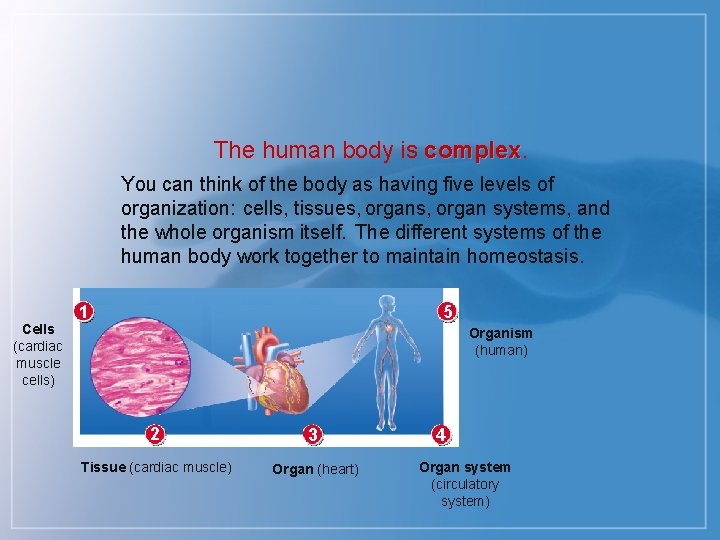
The human body is complex. You can think of the body as having five levels of organization: cells, tissues, organ systems, and the whole organism itself. The different systems of the human body work together to maintain homeostasis. 1 5 Cells (cardiac muscle cells) Organism (human) 2 3 Tissue (cardiac muscle) Organ (heart) 4 Organ system (circulatory system)
The human body is complex. Cells The smallest unit of life. tissue A group of similar cells that are organized to do a specific job. Types of tissue include cardiac and muscle tissue.
The human body is complex. organ A structure in a plant or an animal that is made up of different tissues working together to perform a particular function. Examples of organs include the heart, pancreas, and brain.
The human body is complex. organ system A group of organs that together perform a function that helps the body meet its needs for energy and materials. One example of a system is the skeletal system
The human body is complex. homeostasis A condition needed for health and functioning in which an organism or cell maintains a relatively stable internal environment.
The human body is complex. homeostasis A condition needed for health and functioning in which an organism or cell maintains a relatively stable internal environment.
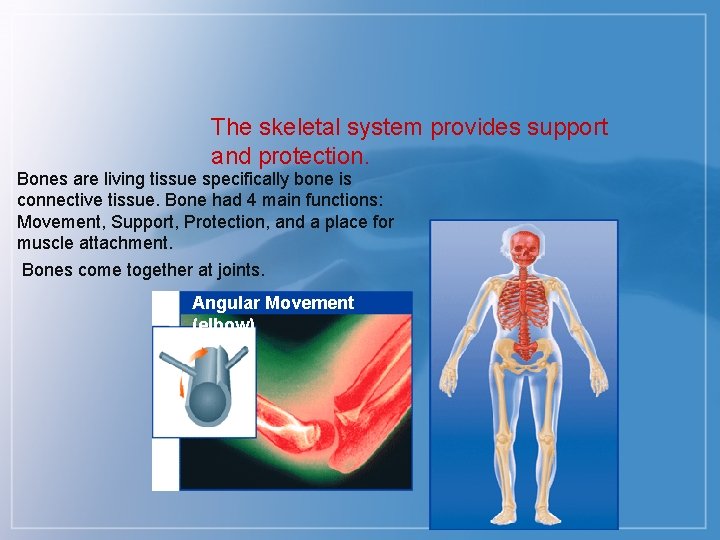
The skeletal system provides support and protection. Bones are living tissue specifically bone is connective tissue. Bone had 4 main functions: Movement, Support, Protection, and a place for muscle attachment. Bones come together at joints. Angular Movement (elbow)
Body Systems • We are going to study 10 body systems, and how the organs work to keep the system going and how the system works to keep the body going. SKELETAL MUSCULAR CIRCULATORY RESPIRATORY ENDOCRINE INTUGUMENTARY DIGESTIVE EXCRETORY REPRODUCTIVE NERVOUS
What they do • The skeletal system is responsible for structure and support The muscular system is responsible for movement The circulatory system is responsible for taking blood and oxygen through the body The respiratory system is responsible for helping us breathe, moving air in and out
• The endocrine system contains the glands and hormones to regulate conditions inside the body The intugumentary system protects us from infection and is a barrier. The digestive system works to break down the food and nutrients we take in. The excretory system is necessary to help us get rid of waste. The reproductive system works to continue the human race. The nervous systems tells our brain what to have our body do.
Types of Bones • There are 4 main types bones: • • Long bones – greater in length than in width. Contains more compact than spongy bone. Expands at the ends. Ex arm and leg bones Short bones - similar in length and width, cube like, contains more spongy bone than compact. Ex wrist Flat bones – generally thin and flat, composed of 2 more or less parallel plates of compact bone. Ex Sternum, Ribs, Skull Irregular bones – Complex shapes can’t be grouped into any other category. Ex vertebrae
The skeletal system provides support and protection. skeletal system The framework of bones that supports the body, protects internal organs, and anchors all the body’s movement.
The skeletal system provides support and protection. compact bone The tough, hard outer layer of a bone. It is a tightly packed tissue that is thicker in the center than at the ends. Surrounds the spongy bone. It is the basic supportive tissue that makes up the skeleton as we see it. Protects and supports skeleton.
The skeletal system provides support and protection. spongy bone Strong, lightweight tissue inside a bone. Contains many large spaces that store marrow and composes most of the bone tissue in short, flat, and irregular bones, also found at the end of long bones. Periosteum is the outer covering of the bone
Marrow – Marrow is the part of bone that produces red blood cells. (RBC). It is found in the spongy bone. New RBC’s travel from marrow into the blood vessels throughout the bone and bring nutrients and take waste.
The skeletal system provides support and protection. axial skeleton The central part of the skeleton, which includes the cranium, the vertebrae, pelvis, and the ribs. The main function of the axial skeleton is for protection and support.
1. 2 The skeletal system provides support and protection. appendicular skeleton The bones of the skeleton that function to allow movement, such as arm and leg bones. The main function of the appendicular skeleton is for movement and shape See picture pg 17
The Skeleton changes • In infancy the skull is not one solid bone • In childhood- bone growth occurs as you reach adolescence your growth plates close. Once your growth plates close you stop growing. • As an adult you lose bone density.
Periosteum – outer covering of bone , contains bone forming cells and blood vessels • Haversian canal – passage way in bones. • Marrow- red or yellow material found inside the bone
Joints • A joint is a place where 2 bones meet. – There are 3 types of joints found in the body.
Types of Joints • 1. Immoveable- locks bones together. Such as the skull. 2. Slightly moveable- they allow you to flex Such as the rib cage, sternum, and hip ( pelvic area) 3. Freely moveable- these joints allow you to bend and move. There are 4 types of moveable joints.
Types of moveable joints • • 1. Hinge- allows for angular movements, such as elbows and knees. 2. Pivot- allows for rotational movement, side to side, turning a doorknob for example. Examples include elbow, where skull and vertebrae meet. 3. Ball and Socket – Allows for rotational in a circle. Such as a pitcher would do. Examples include shoulder and hip. 4. Gliding – one bone slides back and forth over another. Examples are wrist or ankle and slightly in your vertebrae.
Ligaments connect bone to bone Tendons connect muscle to bone
1. 3 The muscular system makes movement possible. muscular system The muscles of the body that, together with the skeletal system, function to produce movement. Muscles are strong tissue made of long, thin cells called muscle fiber. That move body parts Muscles work in pairs. When one contracts the other relaxes KEY CONCEPT SUMMARY
4 types of body tissues • 1. Connective- provides support, protections and strength, padding and insulation. It connects other tissue, it has few cells, and is surrounded by nonliving material such as fat. It holds parts of the body together • 2. Muscle- can contract and relax, allows for movement, it can lengthen and shorten. • 3. Nerve- carries electrical signals from the brain to other parts of the body. It is the messaging center. • 4. Epithelial- tightly packed tissue to form the skin and houses internal organs.
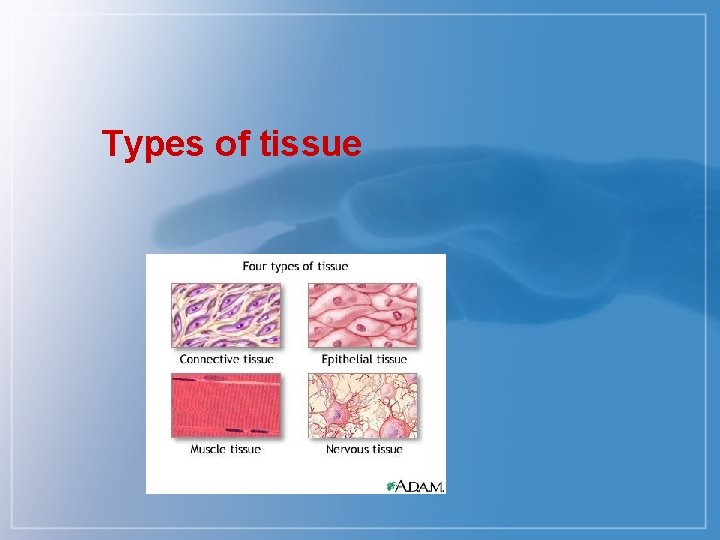
Types of tissue
The Muscular system • Body has over 600 muscles • Muscles make up 1/3 of body weight • All body movement requires the use of muscles, including digestion, blood circulation and waste excretion
Types of muscle • Voluntary muscle you can control consciously ( arm and leg) • Involuntary muscles you can not control consciously ( muscles in stomach or intestines) • Voluntary and involuntary combine ( eyelids and lungs)
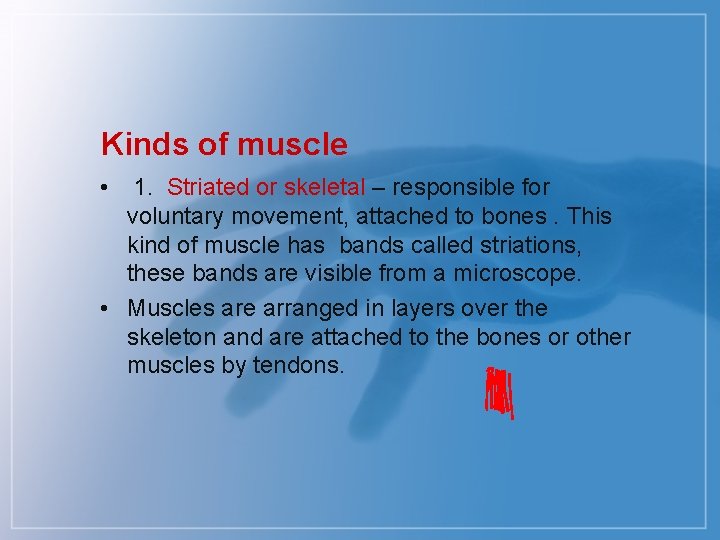
Kinds of muscle • 1. Striated or skeletal – responsible for voluntary movement, attached to bones. This kind of muscle has bands called striations, these bands are visible from a microscope. • Muscles are arranged in layers over the skeleton and are attached to the bones or other muscles by tendons.
• 2. smooth muscle or visceral – Involuntary muscle includes blood vessels and lungs and small intestines, walls of many organs
• 3. cardiac muscle – heart muscle. Cross between smooth and striated , involuntary muscle , but it has striations but is involuntary.
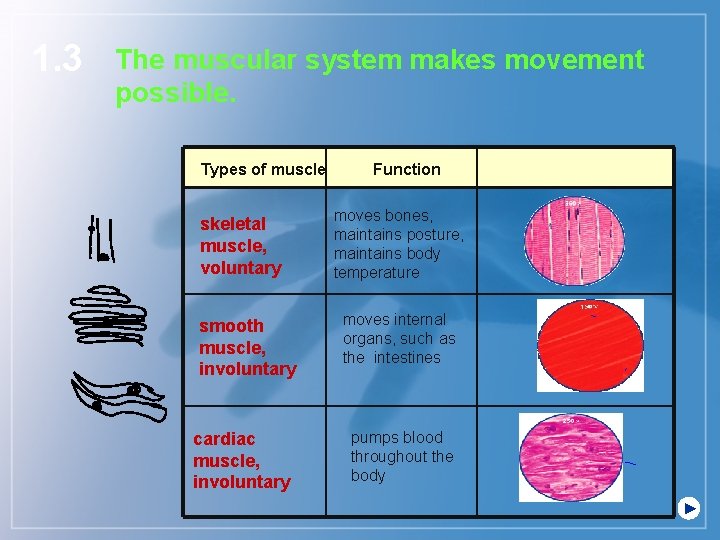
1. 3 The muscular system makes movement possible. Types of muscle skeletal muscle, voluntary smooth muscle, involuntary cardiac muscle, involuntary Function moves bones, maintains posture, maintains body temperature moves internal organs, such as the intestines pumps blood throughout the body
The muscular system makes movement possible. Muscles can be either Flexors or Extensors Flexors are muscles that pull limbs and bend joints. Extensors are muscles that straighten joints.
• Muscles develop and strengthen with use, as you exercise the cells reproduce more rapidly because of the increase in activity, the exercise also stimulates growth of individual existing cells causing them to grow larger.
• Tendons connect muscle to bone Ligaments hold bone to bone, Cartilage is the cushion between joints and bones. It also makes up the end of the nose, outside of ears and part of the rib cage.
Cartilage the cushion between joints and bones. Found at the end of nose and ear. There are 4 types of cartilage 1. 2. 3. 4. Morphological- this determines the shape of certain body parts. Articular- this is found in moveable joints and acts as a shock absorber and allows bones to move over one another. Fibrocartilage – this is found between the vertebrae, it absorbs pressure with out breaking Elastic – this allows the chest to expand contract repeatedly while breathing.
Last few things • Ossification is the hardening of bones • The fastest working muscle is the eyelid • The busiest muscle is the heart
- Slides: 37