
The Human Body in Health and Illness 4
The Human Body in Health and Illness, 4 th edition Barbara Herlihy Chapter 7: Integumentary System and Body Temperature
Lesson 7 -1 Objectives • List six functions of the skin. • Define stratum germinativum and stratum corneum. • Describe the two layers of the skin epidermis and dermis. • List the two major functions of the subcutaneous layer. Copyright © 2011, 2007 by Saunders, an imprint of Elsevier Inc. All rights reserved. 2
Functions of the Skin • • Serves as mechanical barrier Protects internal structures Participates in the immune response Acts as a gland for vitamin D synthesis Performs excretory function Performs sensory role Helps regulate body temperature Copyright © 2011, 2007 by Saunders, an imprint of Elsevier Inc. All rights reserved. 3
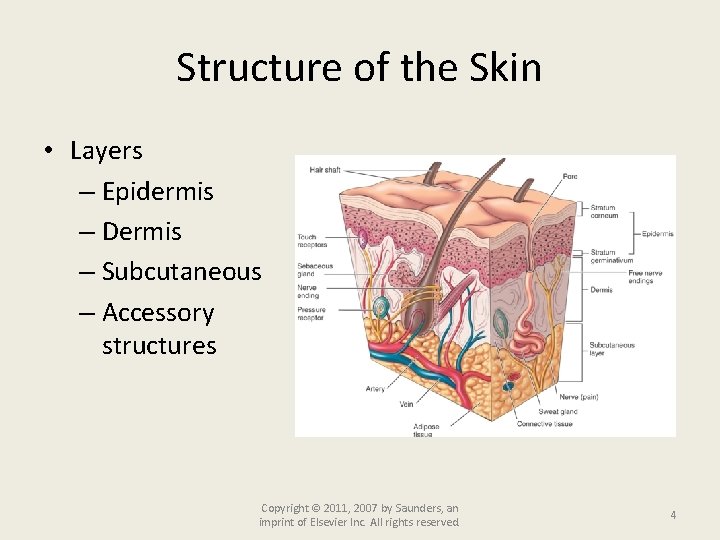
Structure of the Skin • Layers – Epidermis – Dermis – Subcutaneous – Accessory structures Copyright © 2011, 2007 by Saunders, an imprint of Elsevier Inc. All rights reserved. 4
Epidermis: Outer Layer • Layers of the epidermis – Stratum germinativum (deeper); cells continuously dividing and moving toward surface – Stratum corneum (surface layer); composed of dead, flattened cells that slough off • Keratinization: The protein keratin makes skin cells hard, flat, and water resistant. Copyright © 2011, 2007 by Saunders, an imprint of Elsevier Inc. All rights reserved. 5
Dermis • Lies under and supports the epidermis • Sits on the subcutaneous layer or hypodermis • Embedded with accessory structures – Includes blood vessels that nourish epidermis Copyright © 2011, 2007 by Saunders, an imprint of Elsevier Inc. All rights reserved. 6
Subcutaneous Layer: Hypodermis • Tissue that lies beneath skin • Highly vascularized • Two main roles: – Its fat insulates body from extreme temperature changes. – Its connective tissue anchors the skin to underlying structures. Copyright © 2011, 2007 by Saunders, an imprint of Elsevier Inc. All rights reserved. 7

Skin, Drugs, and Chemicals • Skin can absorb many chemicals. • Drug delivery systems: • Hypodermic injections • Transdermal patches • Intradermal injections (allergy testing) • Topical applications • Danger of absorption of toxins Copyright © 2011, 2007 by Saunders, an imprint of Elsevier Inc. All rights reserved. 8
Skin Color • Determined by genes, physiology, and sometimes pathology • Dark pigment: Melanin – Secreted by melanocytes in the epidermis – Melanocyte malfunctions: Albinism, vitiligo, moles • Yellow pigment: Carotene – Presence of melanin overshadows carotene’s tint in most people Copyright © 2011, 2007 by Saunders, an imprint of Elsevier Inc. All rights reserved. 9
Skin Color (cont’d. ) • Physiological changes: – Blushing: Blood vessel dilation – Pallor: Blood vessel constriction • Pathological changes: – Cyanosis or bluish tint: Poor oxygenation – Jaundice or yellowing: Bilirubin deposition – Bronzing: Melanin overproduction – Ecchymosis: Black and blue bruising Copyright © 2011, 2007 by Saunders, an imprint of Elsevier Inc. All rights reserved. 10
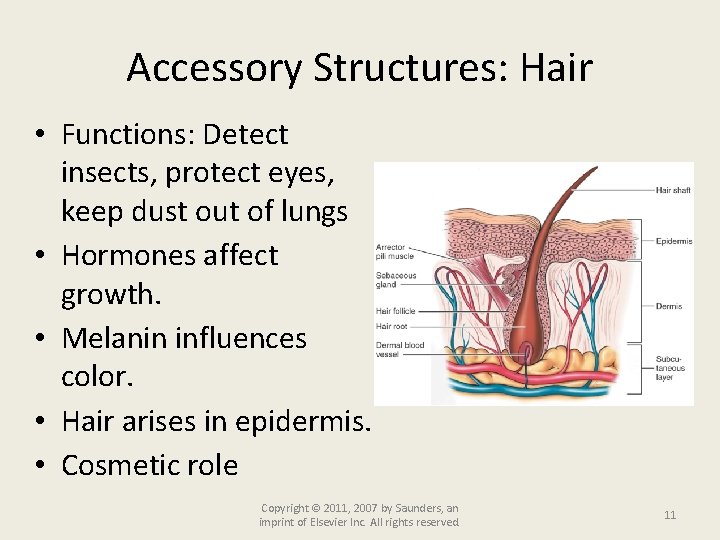
Accessory Structures: Hair • Functions: Detect insects, protect eyes, keep dust out of lungs • Hormones affect growth. • Melanin influences color. • Hair arises in epidermis. • Cosmetic role Copyright © 2011, 2007 by Saunders, an imprint of Elsevier Inc. All rights reserved. 11
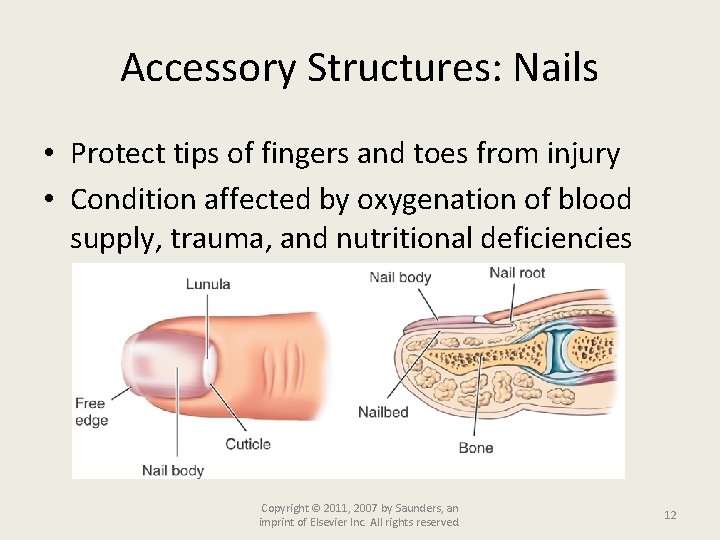
Accessory Structures: Nails • Protect tips of fingers and toes from injury • Condition affected by oxygenation of blood supply, trauma, and nutritional deficiencies Copyright © 2011, 2007 by Saunders, an imprint of Elsevier Inc. All rights reserved. 12

Accessory Structures: Glands • Sebaceous glands: – Oil glands – Secrete sebum and in fetus vernix caseosa • Sudoriferous – Sweat glands Copyright © 2011, 2007 by Saunders, an imprint of Elsevier Inc. All rights reserved. 13
Sudoriferous Glands • Apocrine glands: Usually associated with hair follicles; more active at puberty • Eccrine glands: Critical for temperature regulation • Types of modified sweat glands: – Mammary glands: Secrete milk – Ceruminous glands: Secrete ear wax (cerumen) Copyright © 2011, 2007 by Saunders, an imprint of Elsevier Inc. All rights reserved. 14
Lesson 7 -2 Objectives • Explain four processes by which the body loses heat. • Describe how the skin helps regulate temperature. Copyright © 2011, 2007 by Saunders, an imprint of Elsevier Inc. All rights reserved. 15
Body Temperature: Key Terms • Core temperature: The inner parts of the body • Shell temperature: The surface areas of the body • Thermoregulation: Balance of heat production and heat loss Copyright © 2011, 2007 by Saunders, an imprint of Elsevier Inc. All rights reserved. 16
Heat Production • Metabolism: basis of body temperature • Blood disperses heat throughout the body. • Most heat is produced by muscles, the liver, and endocrine glands. • Affected by food consumption, hormones, disease, and physical activity Copyright © 2011, 2007 by Saunders, an imprint of Elsevier Inc. All rights reserved. 17
Heat Loss • Sites: Skin (80%), lungs, and excretory products (20%) • Types: – Radiation – Conduction – Convection – Evaporation Copyright © 2011, 2007 by Saunders, an imprint of Elsevier Inc. All rights reserved. 18
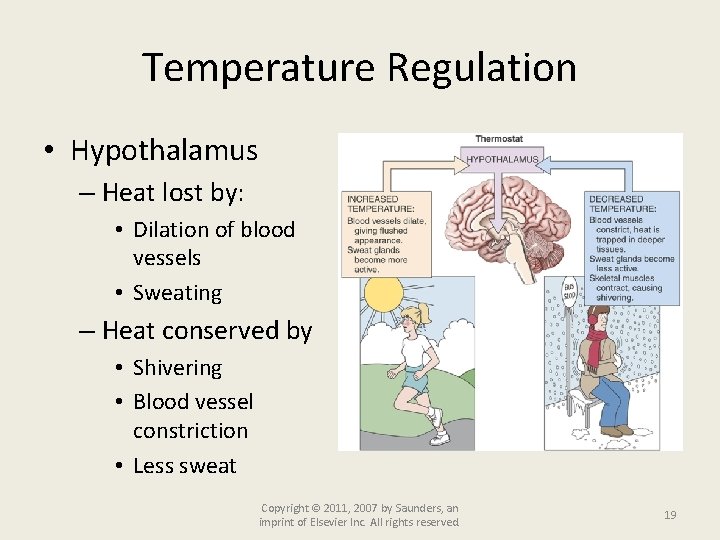
Temperature Regulation • Hypothalamus – Heat lost by: • Dilation of blood vessels • Sweating – Heat conserved by • Shivering • Blood vessel constriction • Less sweat Copyright © 2011, 2007 by Saunders, an imprint of Elsevier Inc. All rights reserved. 19
Temperature Regulation: Neonates • Lose more heat than they produce – Large surface area – Large bald head – Less insulation – Must rely on nonshivering thermogenesis: metabolism of brown adipose tissue (BAT) • Have limited capacity to dissipate heat Copyright © 2011, 2007 by Saunders, an imprint of Elsevier Inc. All rights reserved. 20
Issues in Temperature Regulation • Hyperthermia: Syncope, cramps, heat exhaustion, heat stroke • Hypothermia: Slowed metabolism, fibrillation Copyright © 2011, 2007 by Saunders, an imprint of Elsevier Inc. All rights reserved. 21
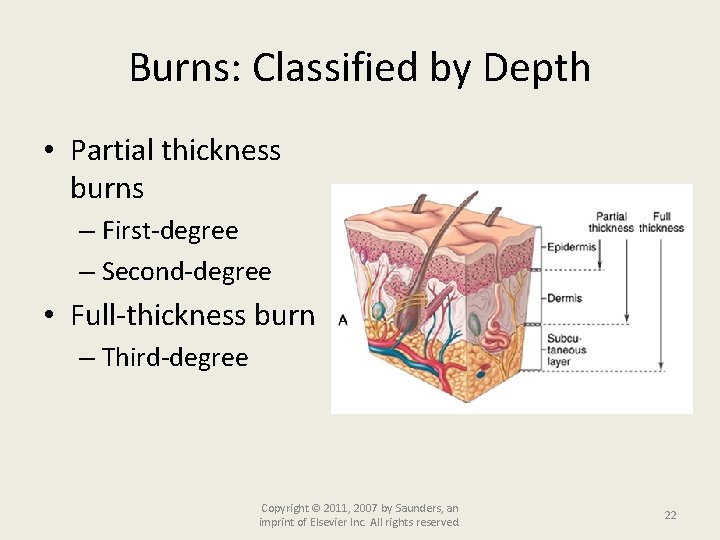
Burns: Classified by Depth • Partial thickness burns – First-degree – Second-degree • Full-thickness burn – Third-degree Copyright © 2011, 2007 by Saunders, an imprint of Elsevier Inc. All rights reserved. 22
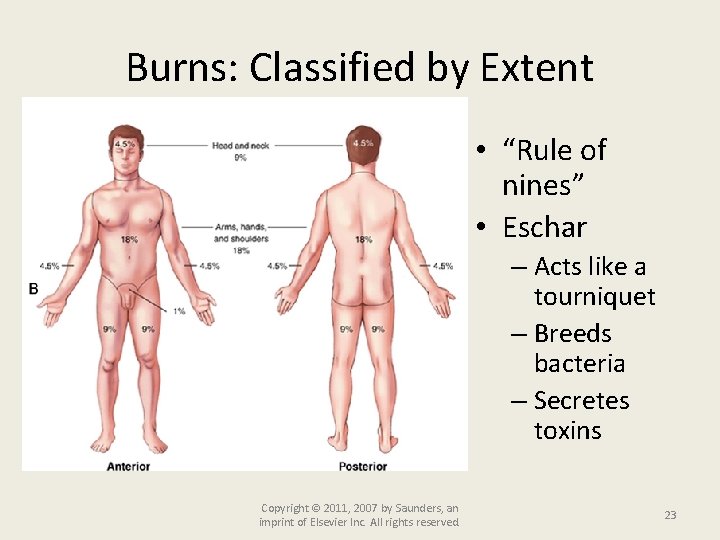
Burns: Classified by Extent • “Rule of nines” • Eschar – Acts like a tourniquet – Breeds bacteria – Secretes toxins Copyright © 2011, 2007 by Saunders, an imprint of Elsevier Inc. All rights reserved. 23
Skin Care • All ages: – Reduce exposure to UV radiation. • Especially in older adults: – Skin dries out more easily; retain moisture by limiting excessive bathing and use of soap. – Thinner skin bruises more easily and does not insulate as well. Copyright © 2011, 2007 by Saunders, an imprint of Elsevier Inc. All rights reserved. 24
- Slides: 24