
The Human Body in Health and Illness 4
The Human Body in Health and Illness, 4 th edition Barbara Herlihy Chapter 23: Digestive System 1
Lesson 23 -1 Objectives • List four functions of the digestive system. • Describe the four layers of the digestive tract. • Describe the structure and functions of the organs of the digestive tract. • Describe the structure and functions of the accessory organs of the digestive tract. Copyright © 2011, 2007 by Saunders, an imprint of Elsevier Inc. All rights reserved. 2
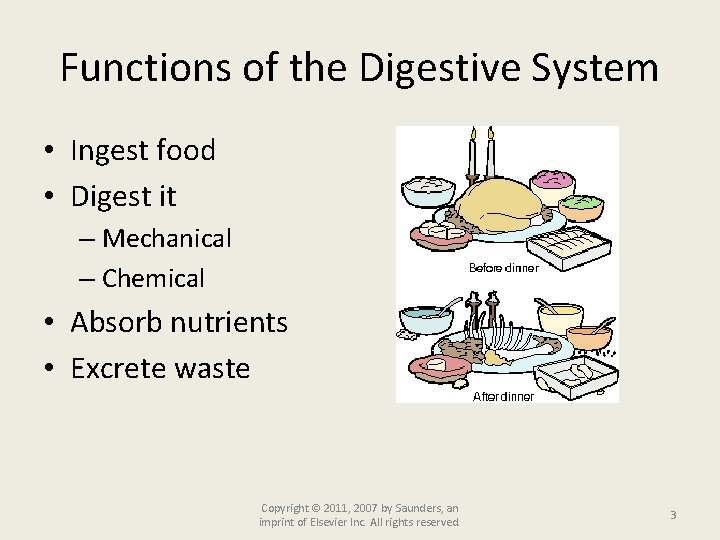
Functions of the Digestive System • Ingest food • Digest it – Mechanical – Chemical • Absorb nutrients • Excrete waste Copyright © 2011, 2007 by Saunders, an imprint of Elsevier Inc. All rights reserved. 3
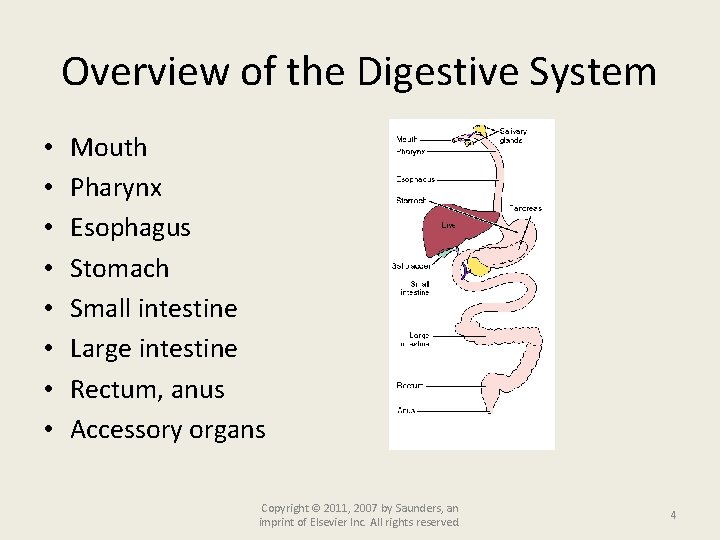
Overview of the Digestive System • • Mouth Pharynx Esophagus Stomach Small intestine Large intestine Rectum, anus Accessory organs Copyright © 2011, 2007 by Saunders, an imprint of Elsevier Inc. All rights reserved. 4

Four Layers of the Digestive Tract • Mucosal layer- glands secrete mucus, enzymes & hormones • Submucosal layer-loose connective tissue, contains blood vessels, nerves, gland, & lymphatic vessels • Muscle layer - Circular and longitudinal - Mixing, mashing action - Peristaltic action - Enteral nervous system • Serosal layer - Peritoneal membranes Copyright © 2011, 2007 by Saunders, an imprint of Elsevier Inc. All rights reserved. 5
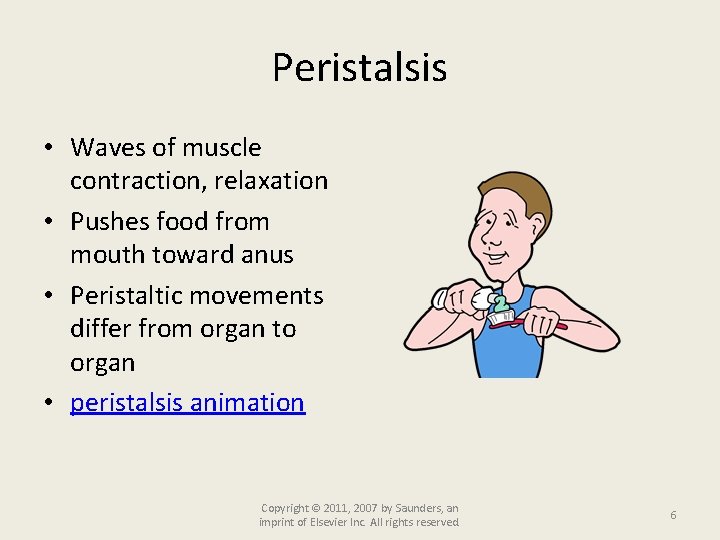
Peristalsis • Waves of muscle contraction, relaxation • Pushes food from mouth toward anus • Peristaltic movements differ from organ to organ • peristalsis animation Copyright © 2011, 2007 by Saunders, an imprint of Elsevier Inc. All rights reserved. 6
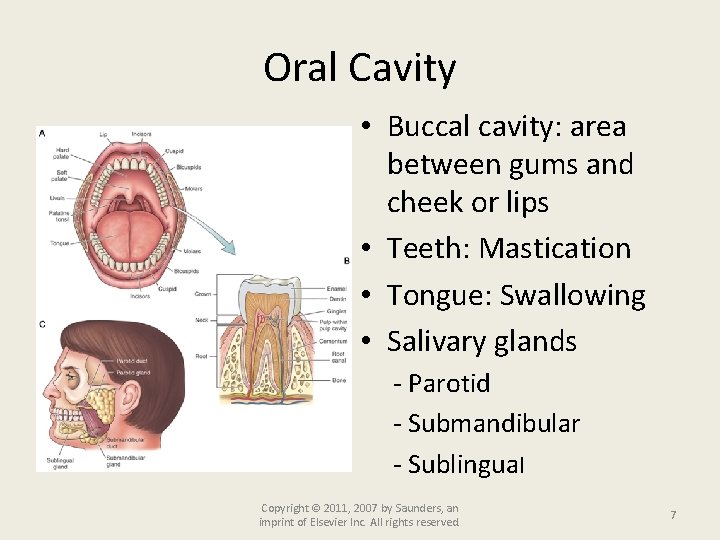
Oral Cavity • Buccal cavity: area between gums and cheek or lips • Teeth: Mastication • Tongue: Swallowing • Salivary glands - Parotid - Submandibular - Sublingual Copyright © 2011, 2007 by Saunders, an imprint of Elsevier Inc. All rights reserved. 7
Teeth • Deciduous teeth/baby teeth: 20 • baby teeth chart Permanent teeth: 32 • chart Copyright © 2011, 2007 by Saunders, an imprint of Elsevier Inc. All rights reserved. 8
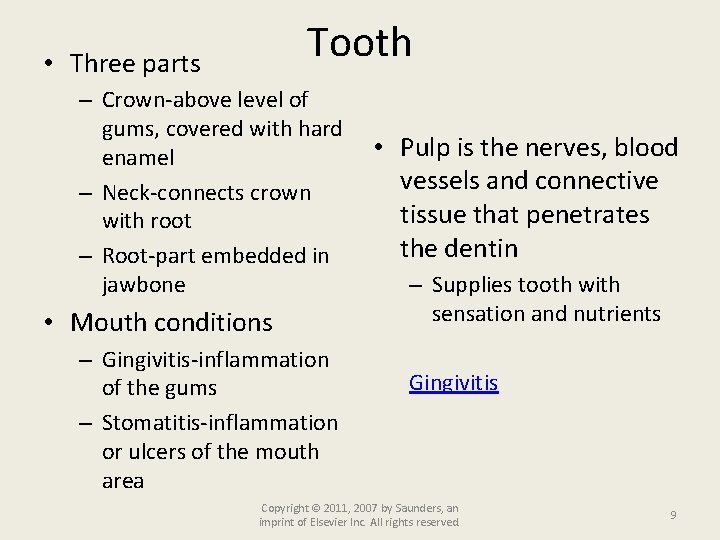
Tooth • Three parts – Crown-above level of gums, covered with hard enamel – Neck-connects crown with root – Root-part embedded in jawbone • Mouth conditions – Gingivitis-inflammation of the gums – Stomatitis-inflammation or ulcers of the mouth area • Pulp is the nerves, blood vessels and connective tissue that penetrates the dentin – Supplies tooth with sensation and nutrients Gingivitis Copyright © 2011, 2007 by Saunders, an imprint of Elsevier Inc. All rights reserved. 9
Tongue • Bolus-ball-like mass of food • Frenulum-membrane that attaches tongue to floor of mouth • Extensive capillary network-under tongue • Under tongue – sublingual – substances absorbed quickly into blood stream here. Copyright © 2011, 2007 by Saunders, an imprint of Elsevier Inc. All rights reserved. 10
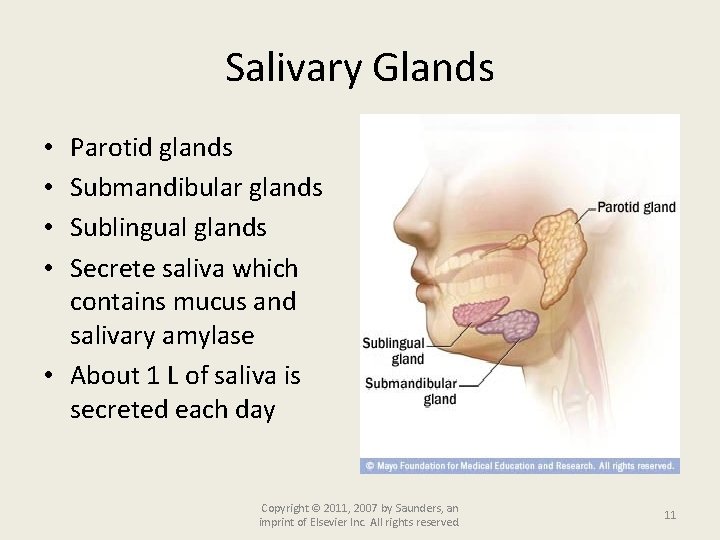
Salivary Glands Parotid glands Submandibular glands Sublingual glands Secrete saliva which contains mucus and salivary amylase • About 1 L of saliva is secreted each day • • Copyright © 2011, 2007 by Saunders, an imprint of Elsevier Inc. All rights reserved. 11
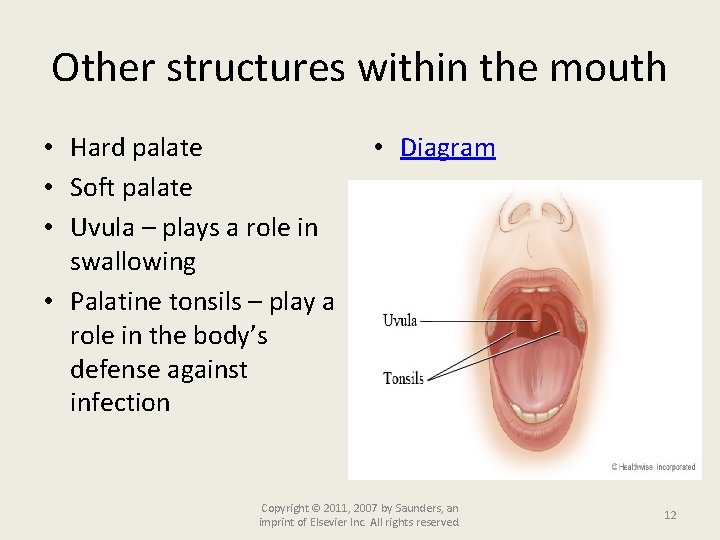
Other structures within the mouth • Hard palate • Soft palate • Uvula – plays a role in swallowing • Palatine tonsils – play a role in the body’s defense against infection • Diagram Copyright © 2011, 2007 by Saunders, an imprint of Elsevier Inc. All rights reserved. 12
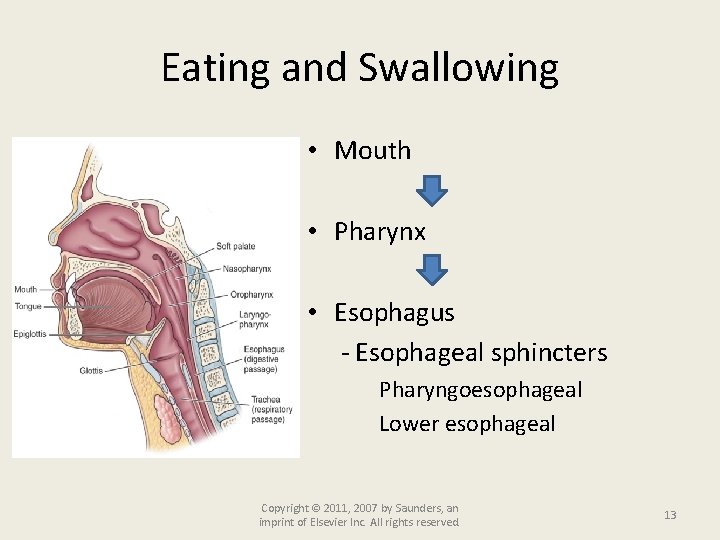
Eating and Swallowing • Mouth • Pharynx • Esophagus - Esophageal sphincters Pharyngoesophageal Lower esophageal Copyright © 2011, 2007 by Saunders, an imprint of Elsevier Inc. All rights reserved. 13
Pharynx and Esophagus • Three parts – nasopharynx, oropharynx, and laryngopharynx (only naso and oro part of digestive system) • Esophagus – is the tube connecting the pharynx to the stomach • Swallowing (deglutition) – Soft palate moves toward opening of nasopharynx – Epiglottis covers the opening to the trachea deglutition Copyright © 2011, 2007 by Saunders, an imprint of Elsevier Inc. All rights reserved. 14
Functions of the Stomach • Regulates rate of gastric emptying into the small intestine • Secretes gastric juice, contains digestive enzymes and HCl • Secretes gastric hormones and intrinsic factor • Digests limited amount of food • Absorbs limited substances, absorbs alcohol efficiently Copyright © 2011, 2007 by Saunders, an imprint of Elsevier Inc. All rights reserved. 15
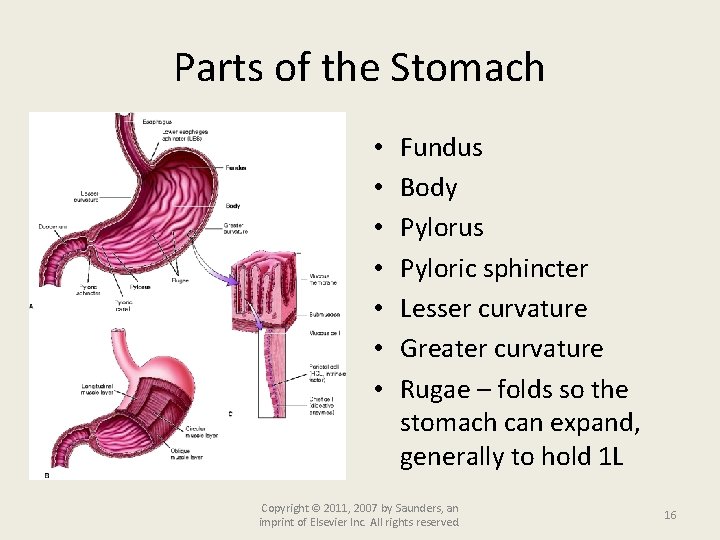
Parts of the Stomach • • Fundus Body Pylorus Pyloric sphincter Lesser curvature Greater curvature Rugae – folds so the stomach can expand, generally to hold 1 L Copyright © 2011, 2007 by Saunders, an imprint of Elsevier Inc. All rights reserved. 16
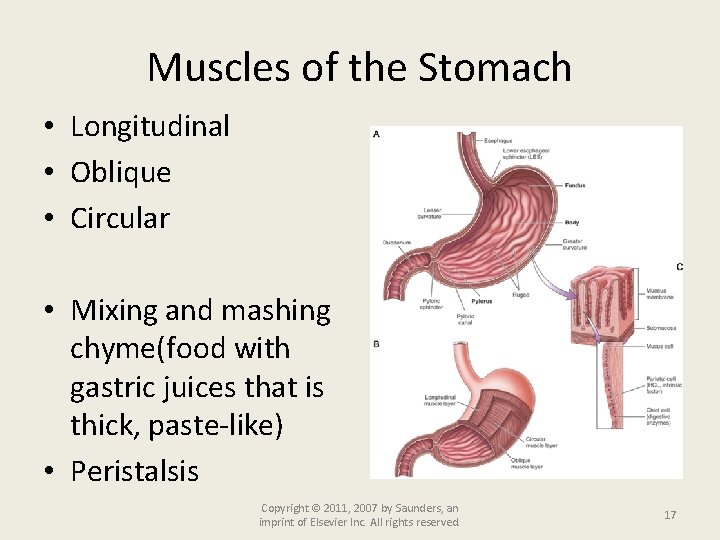
Muscles of the Stomach • Longitudinal • Oblique • Circular • Mixing and mashing chyme(food with gastric juices that is thick, paste-like) • Peristalsis Copyright © 2011, 2007 by Saunders, an imprint of Elsevier Inc. All rights reserved. 17
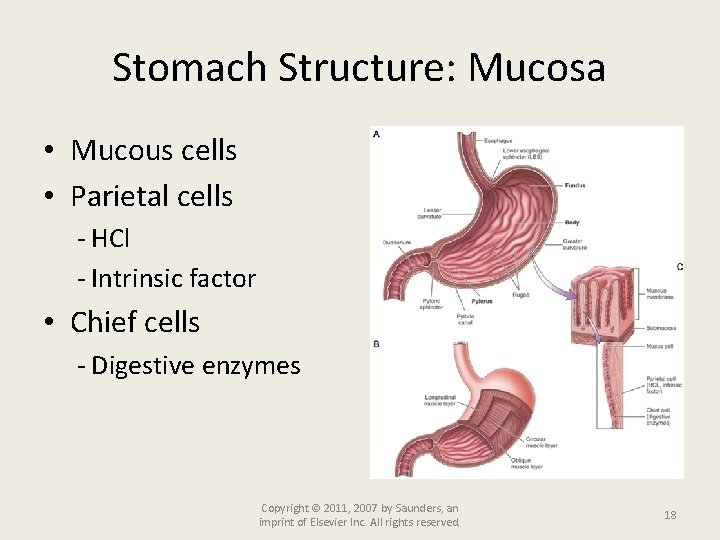
Stomach Structure: Mucosa • Mucous cells • Parietal cells - HCl - Intrinsic factor • Chief cells - Digestive enzymes Copyright © 2011, 2007 by Saunders, an imprint of Elsevier Inc. All rights reserved. 18
Stomach • The HCl in gastric juice is strong enough to eat the varnish off furniture. • Some cells secrete thick mucus and bicarbonate which adhere to the stomach lining and protect it. Copyright © 2011, 2007 by Saunders, an imprint of Elsevier Inc. All rights reserved. 19
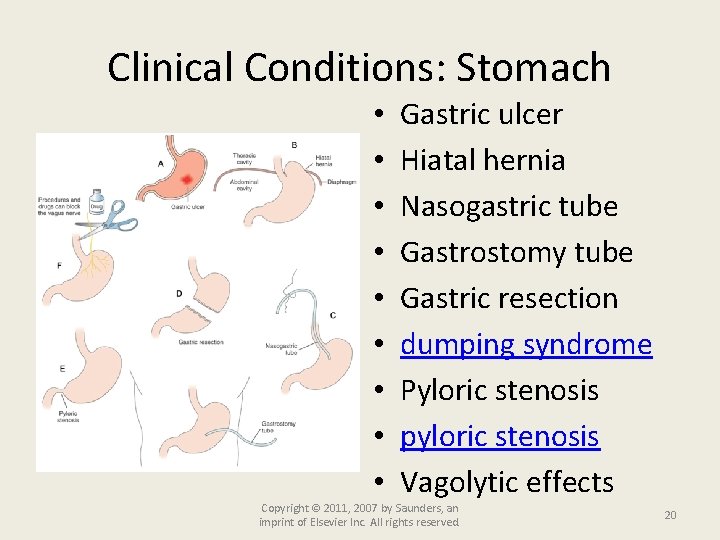
Clinical Conditions: Stomach • • • Gastric ulcer Hiatal hernia Nasogastric tube Gastrostomy tube Gastric resection dumping syndrome Pyloric stenosis pyloric stenosis Vagolytic effects Copyright © 2011, 2007 by Saunders, an imprint of Elsevier Inc. All rights reserved. 20
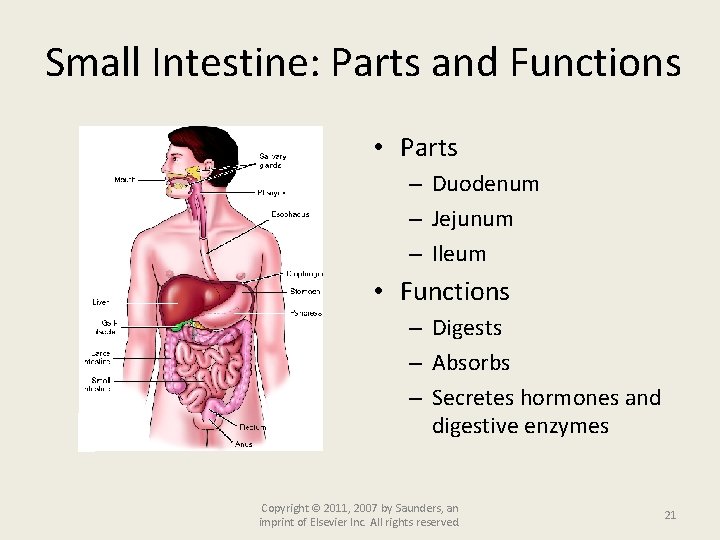
Small Intestine: Parts and Functions • Parts – Duodenum – Jejunum – Ileum • Functions – Digests – Absorbs – Secretes hormones and digestive enzymes Copyright © 2011, 2007 by Saunders, an imprint of Elsevier Inc. All rights reserved. 21
Small Intestine • Called small due the diameter not length • Most digestion and absorption takes place in the duodenum and first third of the jejunum • Material not digested and absorbed moves to the large intestine • Dow Jones Industrials – mnemonic Copyright © 2011, 2007 by Saunders, an imprint of Elsevier Inc. All rights reserved. 22
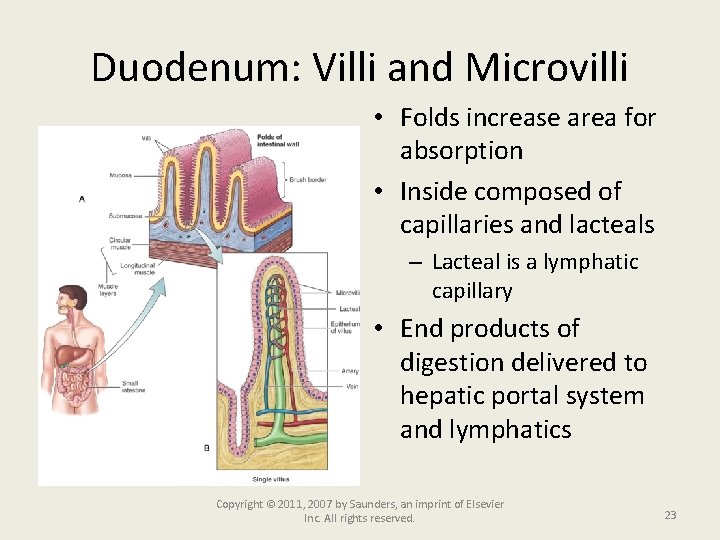
Duodenum: Villi and Microvilli • Folds increase area for absorption • Inside composed of capillaries and lacteals – Lacteal is a lymphatic capillary • End products of digestion delivered to hepatic portal system and lymphatics Copyright © 2011, 2007 by Saunders, an imprint of Elsevier Inc. All rights reserved. 23
Small intestine digestion • End products of • Duodenum receives carbohydrate and secretions from the protein digestion go to liver, gallbladder, and the liver for processing pancreas. before being distributed • Cells of the intestinal • End products of fat wall secrete digestive digestion enter the enzymes and two lacteal, forming a milkyimportant hormones, white lymph called secretin and chyle; goes in the cholecystokinin (CCK) lymphatic system • Ileocecal valve Copyright © 2011, 2007 by Saunders, an imprint of Elsevier Inc. All rights reserved. 24
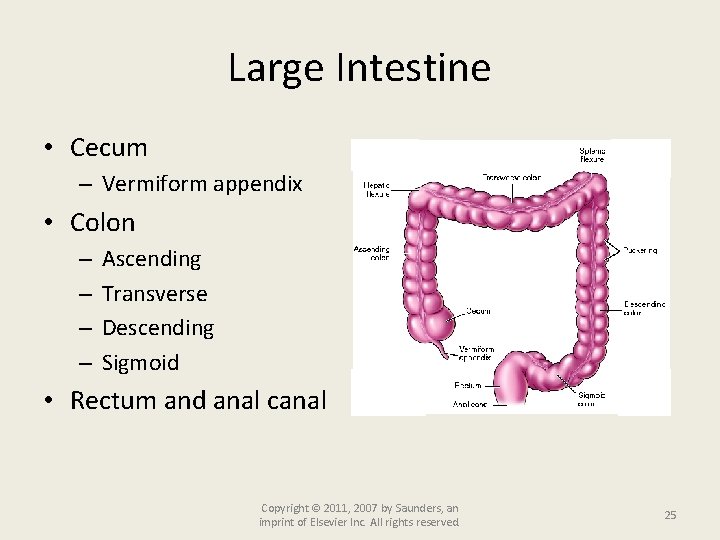
Large Intestine • Cecum – Vermiform appendix • Colon – – Ascending Transverse Descending Sigmoid • Rectum and anal canal Copyright © 2011, 2007 by Saunders, an imprint of Elsevier Inc. All rights reserved. 25

Functions of the Large Intestine • Absorption of water and electrolytes • Synthesis of vitamins by intestinal bacteria – Vitamin K – Some B vitamins • Temporary storage of waste • Elimination of waste (feces) and gas (flatus) Copyright © 2011, 2007 by Saunders, an imprint of Elsevier Inc. All rights reserved. 26
Large intestine • Appendix – attached to cecum • Anus consists of internal sphincter and external sphincter • Constipation – feces remain for a long time removing most of the water • Diarrhea – feces move quickly through so not much water is reabsorbed • Normal flora - 30% of fecal content is bacteria • Read first paragraph p. 429 Copyright © 2011, 2007 by Saunders, an imprint of Elsevier Inc. All rights reserved. 27
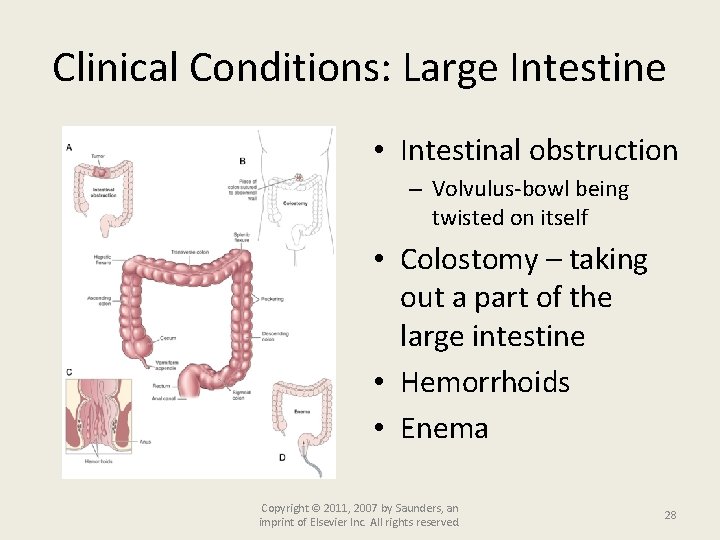
Clinical Conditions: Large Intestine • Intestinal obstruction – Volvulus-bowl being twisted on itself • Colostomy – taking out a part of the large intestine • Hemorrhoids • Enema Copyright © 2011, 2007 by Saunders, an imprint of Elsevier Inc. All rights reserved. 28
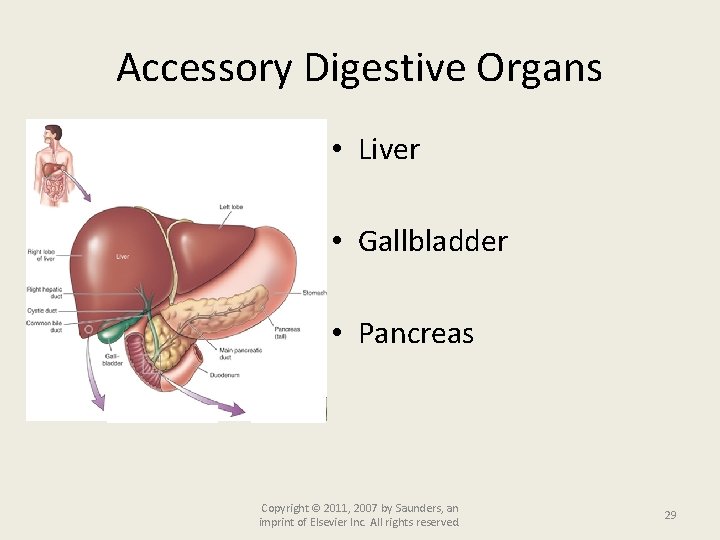
Accessory Digestive Organs • Liver • Gallbladder • Pancreas Copyright © 2011, 2007 by Saunders, an imprint of Elsevier Inc. All rights reserved. 29
Liver Functions • Synthesis of bile salts and secretion of bile – Bile salts: fat digestion and fat-soluble vitamin absorption – Bile: breaks down fats • Synthesis of plasma proteins: maintain blood volume and control blood coagulation • Storage of glucose, fat-soluble vitamins • Detoxification – Main organ for drug detoxification Copyright © 2011, 2007 by Saunders, an imprint of Elsevier Inc. All rights reserved. 30
Liver Functions Continued • Excretion of bilirubin, cholesterol, drugs • Metabolism of carbohydrates, protein, fats • Phagocytosis (Kupffer cells, macrophages) – Kupffer cells – can phagocytose bacteria and other substances Copyright © 2011, 2007 by Saunders, an imprint of Elsevier Inc. All rights reserved. 31
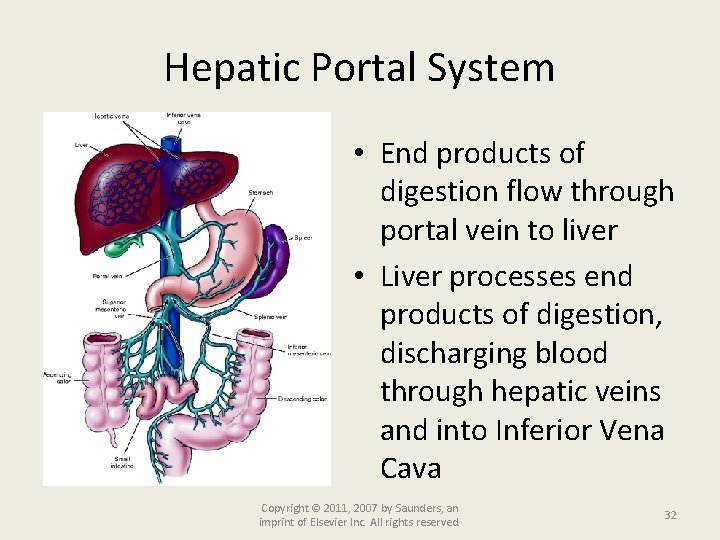
Hepatic Portal System • End products of digestion flow through portal vein to liver • Liver processes end products of digestion, discharging blood through hepatic veins and into Inferior Vena Cava Copyright © 2011, 2007 by Saunders, an imprint of Elsevier Inc. All rights reserved. 32
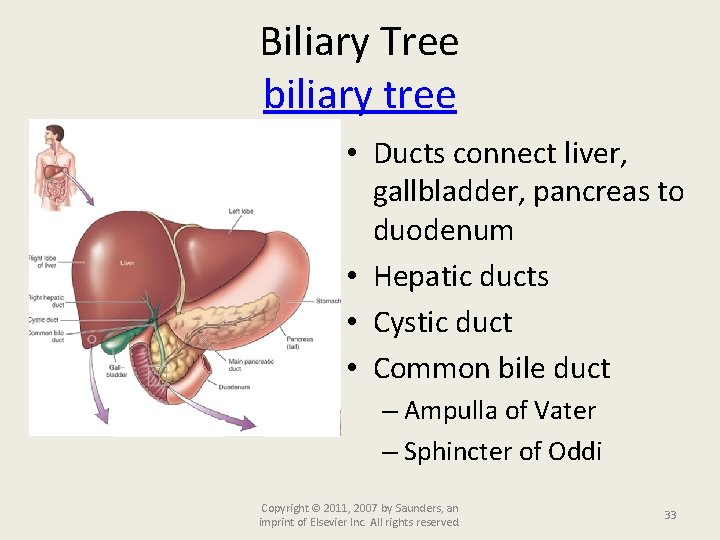
Biliary Tree biliary tree • Ducts connect liver, gallbladder, pancreas to duodenum • Hepatic ducts • Cystic duct • Common bile duct – Ampulla of Vater – Sphincter of Oddi Copyright © 2011, 2007 by Saunders, an imprint of Elsevier Inc. All rights reserved. 33
Liver factory • part 1 • part 2 • part 3 Copyright © 2011, 2007 by Saunders, an imprint of Elsevier Inc. All rights reserved. 34
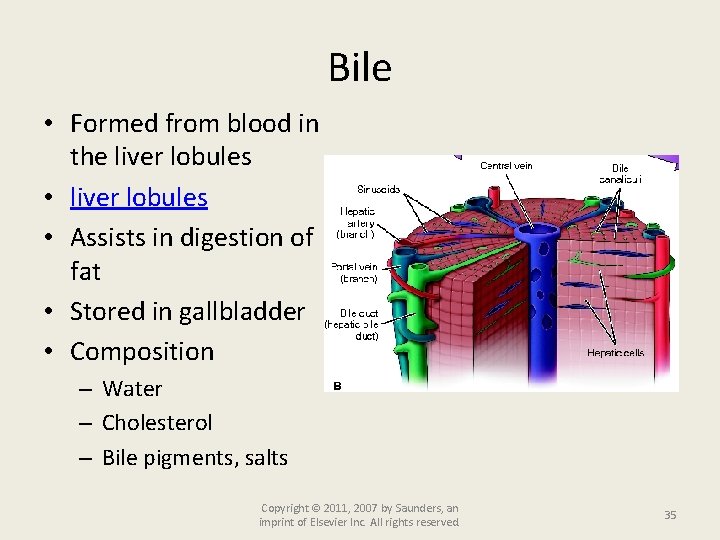
Bile • Formed from blood in the liver lobules • Assists in digestion of fat • Stored in gallbladder • Composition – Water – Cholesterol – Bile pigments, salts Copyright © 2011, 2007 by Saunders, an imprint of Elsevier Inc. All rights reserved. 35
Gallbladder • Pear-shaped sac on the underside of the liver – Concentrates and stores bile • Attached to common bile duct by cystic duct • Fat in the duodenum stimulates release of the hormone cholecystokinin (CCK) – CCK causes gallbladder to contract, eject bile into common bile duct and duodenum – gallstones – pancreatitis by gallstones – ERCP Copyright © 2011, 2007 by Saunders, an imprint of Elsevier Inc. All rights reserved. 36
Path of Pancreatic Digestive Enzymes Pancreatic acinar cells Main pancreatic duct Base of common bile duct Duodenum Copyright © 2011, 2007 by Saunders, an imprint of Elsevier Inc. All rights reserved. 37
Pancreas • Pancreatic enzymes are the most important of all the digestive enzymes. • Enzymes become activated by the duodenum • Secretes a bicarbonate solution because the enzymes in the small intestine work best in alkaline environment Copyright © 2011, 2007 by Saunders, an imprint of Elsevier Inc. All rights reserved. 38
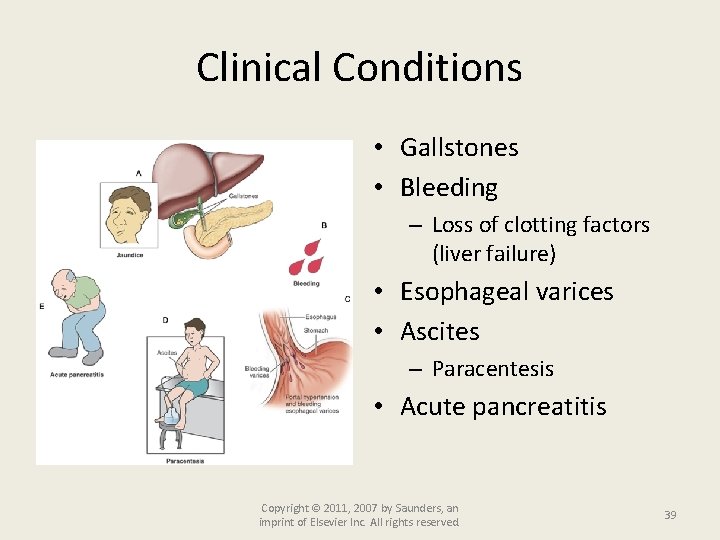
Clinical Conditions • Gallstones • Bleeding – Loss of clotting factors (liver failure) • Esophageal varices • Ascites – Paracentesis • Acute pancreatitis Copyright © 2011, 2007 by Saunders, an imprint of Elsevier Inc. All rights reserved. 39
Lesson 23 -2 Objectives • Explain the physiology of digestion and absorption. • Describe the effects of amylases, proteases, and lipases. • Describe the role of bile in the digestion of fats. • Describe five categories of nutrients. Copyright © 2011, 2007 by Saunders, an imprint of Elsevier Inc. All rights reserved. 40
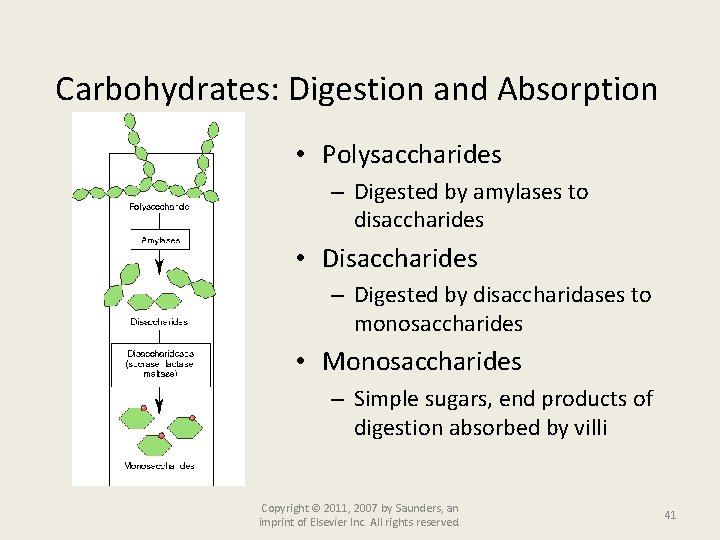
Carbohydrates: Digestion and Absorption • Polysaccharides – Digested by amylases to disaccharides • Disaccharides – Digested by disaccharidases to monosaccharides • Monosaccharides – Simple sugars, end products of digestion absorbed by villi Copyright © 2011, 2007 by Saunders, an imprint of Elsevier Inc. All rights reserved. 41
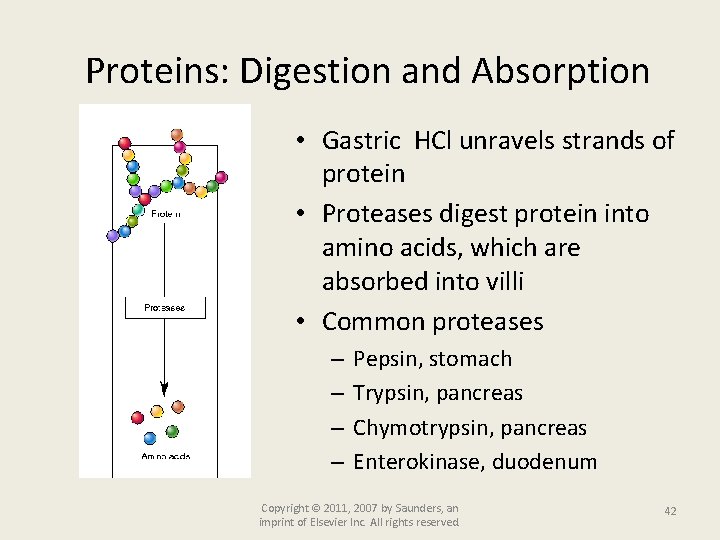
Proteins: Digestion and Absorption • Gastric HCl unravels strands of protein • Proteases digest protein into amino acids, which are absorbed into villi • Common proteases – – Pepsin, stomach Trypsin, pancreas Chymotrypsin, pancreas Enterokinase, duodenum Copyright © 2011, 2007 by Saunders, an imprint of Elsevier Inc. All rights reserved. 42
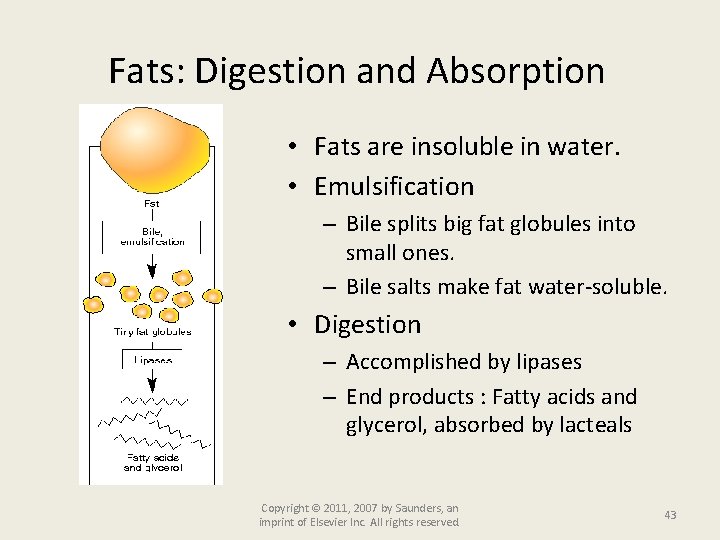
Fats: Digestion and Absorption • Fats are insoluble in water. • Emulsification – Bile splits big fat globules into small ones. – Bile salts make fat water-soluble. • Digestion – Accomplished by lipases – End products : Fatty acids and glycerol, absorbed by lacteals Copyright © 2011, 2007 by Saunders, an imprint of Elsevier Inc. All rights reserved. 43
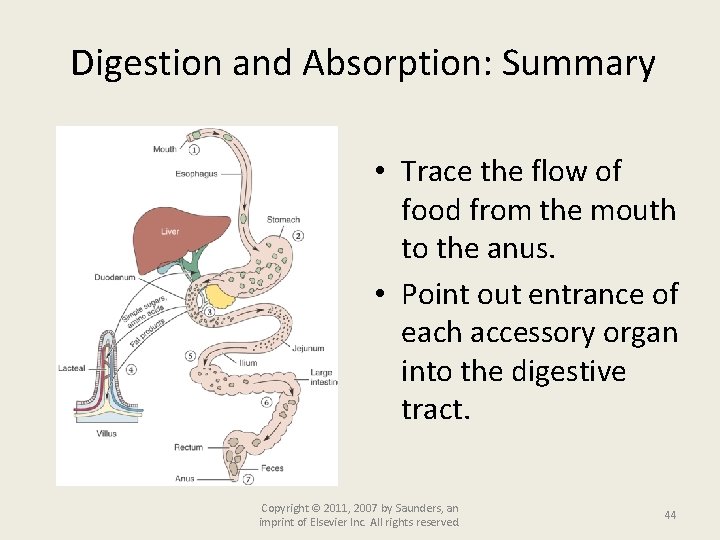
Digestion and Absorption: Summary • Trace the flow of food from the mouth to the anus. • Point out entrance of each accessory organ into the digestive tract. Copyright © 2011, 2007 by Saunders, an imprint of Elsevier Inc. All rights reserved. 44
Nutrition: Concepts to Know • Nutrition: Study of the relationship of food to body function • Five categories of nutrients – Carbohydrates – Proteins – Lipids – Vitamins – Minerals Copyright © 2011, 2007 by Saunders, an imprint of Elsevier Inc. All rights reserved. 45
Nutrition Concepts: Carbohydrates Simple Sugars Complex Carbohydrates • Monosaccharides • Disaccharides • Polysaccharides • Consist primarily of starch and fiber • Most carbohydrate consumption should be in this form. Copyright © 2011, 2007 by Saunders, an imprint of Elsevier Inc. All rights reserved. 46
Nutrition Concepts: Proteins • Essential amino acid: Not synthesized by the body; must be consumed • Nonessential amino acid: Synthesized in the body; not essential to consume • Complete protein: Contains all the essential amino acids • Incomplete protein: Does not contain all essential amino acids Copyright © 2011, 2007 by Saunders, an imprint of Elsevier Inc. All rights reserved. 47
Nutrition Concepts: Fats • Saturated fatty acid: Solid at room temperature • Unsaturated fatty acid: Oil; liquid at room temperature • Essential fatty acid: Not synthesized by the body and must be consumed; linoleic acid is an important component of cell membranes Copyright © 2011, 2007 by Saunders, an imprint of Elsevier Inc. All rights reserved. 48
Nutrition Concepts: Vitamins • Small organic molecules that help regulate cell metabolism • Fat-soluble vitamins – Vitamins A, D, E, and K – Can be stored in the body • Water-soluble vitamins – Vitamins B and C – Most are not stored by the body Copyright © 2011, 2007 by Saunders, an imprint of Elsevier Inc. All rights reserved. 49
Nutrition Concepts: Minerals • Inorganic substances needed for normal body function • Sodium, chloride • Potassium • Calcium, phosphorus, magnesium • Iron • Iodine • Trace elements Copyright © 2011, 2007 by Saunders, an imprint of Elsevier Inc. All rights reserved. 50
Appetite Control • Hypothalamus – Feeding center – Satiety center • Theories of satiety – Glucostat hypothesis – Lipostat hypothesis Copyright © 2011, 2007 by Saunders, an imprint of Elsevier Inc. All rights reserved. 51
- Slides: 51