
The Human Body BY Melissa Roberts Skeletal System
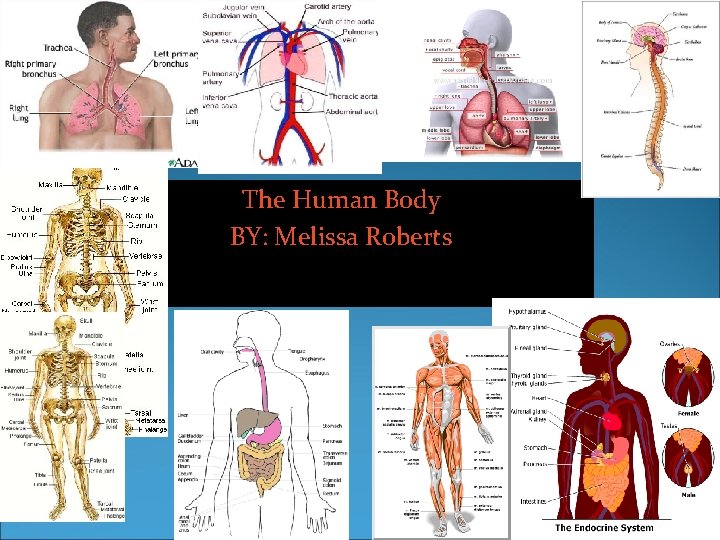
The Human Body BY: Melissa Roberts
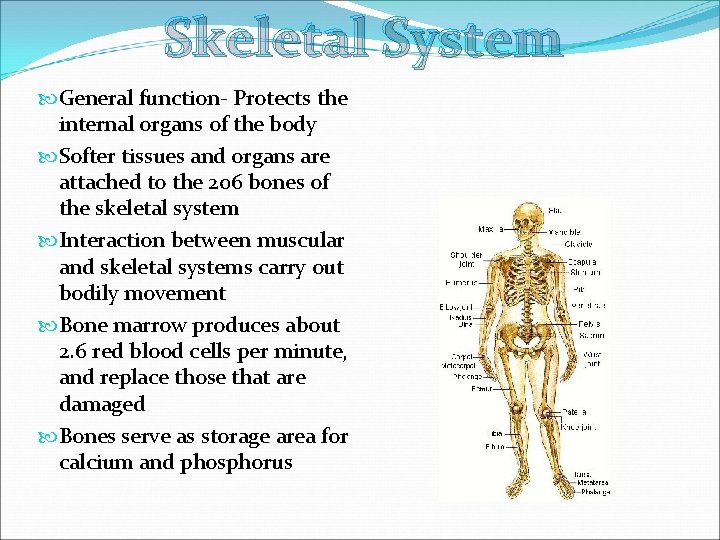
Skeletal System General function- Protects the internal organs of the body Softer tissues and organs are attached to the 206 bones of the skeletal system Interaction between muscular and skeletal systems carry out bodily movement Bone marrow produces about 2. 6 red blood cells per minute, and replace those that are damaged Bones serve as storage area for calcium and phosphorus
the 2 Divisions of the Skeletal System AXIAL SUPPORTS AND PROTECTS ORGANS OF THE HEAD, NECK, AND TRUNK(BONES FORMING AXIS OF BODYTHE AXIS IS A LINE ABOUT WHICH THE BODY ROTATES) (E. G. SKULL, STERNUM, VERTEBRAL COLUMN) APPENDICULAR: Consists of bones anchoring the appendages to the axial skeleton (e. g. shoulder, upper and lower extremities, and the pelvic girdle) Primarily serves purpose of anchoring arms and legs.
Types of Bones Skeletal system consists of short, long, irregular, and flat bones Short bones- short and cubed-shaped, found in wrist and ankles Long bones- Have more length than width, work as levers (e. g. Bones of the upper and lower extremities) Flat bones- Located on broad surfaces Protects internal organs and allows the attachment of muscles Irregular bones- all remaining bones not fitting into the other three categories E. g. bones of the skull and vertebrae Found in all shapes, sizes, and surface feature.
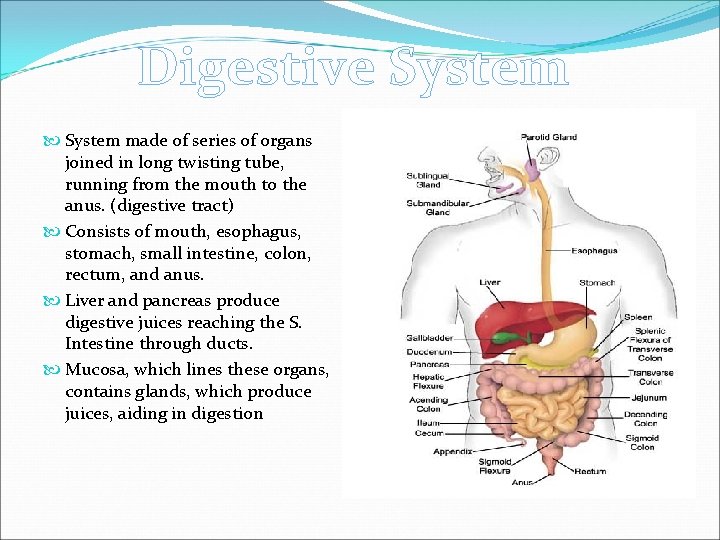
Digestive System made of series of organs joined in long twisting tube, running from the mouth to the anus. (digestive tract) Consists of mouth, esophagus, stomach, small intestine, colon, rectum, and anus. Liver and pancreas produce digestive juices reaching the S. Intestine through ducts. Mucosa, which lines these organs, contains glands, which produce juices, aiding in digestion
How Digestion Occurs Gallbladder stores liver’s digestive juices until needed in the intestine Mechanical digestion initiated in the mouth. Digestion is completed in the small intestine Swallowed food is pushed into the esophagus. At lower esophageal sphincter, food is passed to stomach Stomach stores swallowed food and liquid, mixes food, liquid, and digestive juices, and empties contents into the small intestine. Contents of the intestine are pushed forward for further digestion, as the food dissolves into juices from the liver, pancreas, and intestine.
INTEGUMENTARY SYSTEM: PRIMARY FUNCTIONS Characteristics: Protects and encloses all internal organs and structures of the human Body Helps body maintain homeostasis Largest system of the Human Body Consists of hair, skin (Epidermis), and nails. Has several strata containing four cell types: Keratinocytes- produce keratin, which provides strength and flexibility, as well as waterproofs surface of skin.
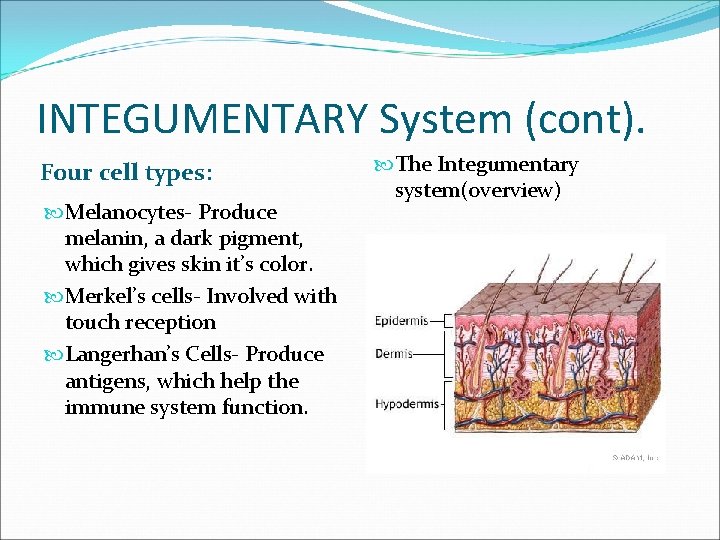
INTEGUMENTARY System (cont). Four cell types: Melanocytes- Produce melanin, a dark pigment, which gives skin it’s color. Merkel’s cells- Involved with touch reception Langerhan’s Cells- Produce antigens, which help the immune system function. The Integumentary system(overview)
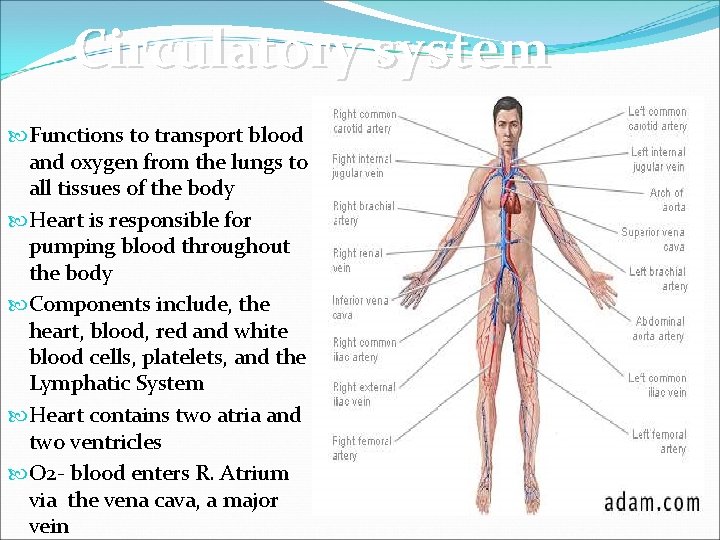
Circulatory system Functions to transport blood and oxygen from the lungs to all tissues of the body Heart is responsible for pumping blood throughout the body Components include, the heart, blood, red and white blood cells, platelets, and the Lymphatic System Heart contains two atria and two ventricles O 2 - blood enters R. Atrium via the vena cava, a major vein
How Circulation occurs (Cont. ) Blood passes through tricusid valve into the R. ventricle Blood is then pumped through Pulmonary Artery, then proceeds to the lungs for gas exchange O 2 rich blood returns to the L. atrium via the pulmonary vein O 2 rich blood flows through bicuspid valve into L. ventricle. Blood is pumped from the Aorta, a major artery
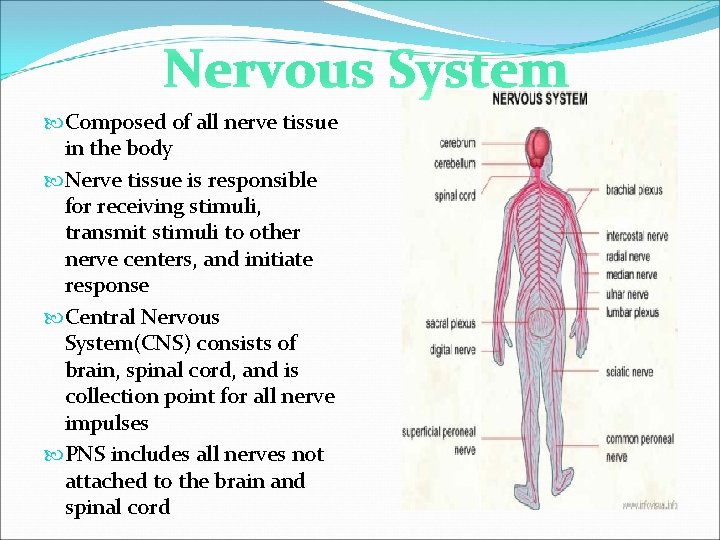
Nervous System Composed of all nerve tissue in the body Nerve tissue is responsible for receiving stimuli, transmit stimuli to other nerve centers, and initiate response Central Nervous System(CNS) consists of brain, spinal cord, and is collection point for all nerve impulses PNS includes all nerves not attached to the brain and spinal cord
NERVOUS SYSTEM(Cont. ) Overview: In Peripheral NS, a chemical neurotransmitter carries nerve impulses between neurons across a synapse Somatic NS controls functions actions under conscious voluntary control(e. g. skeletal muscles) Automatic NS- Controls functions of involuntary smooth muscles, cardiac Overview: (cont. ) Muscles and glands Para Sympathetic NS- Lowers activity, conserves energy, and permits digestion sympathetic NS- Activates and prepares body for vigorous muscular activity, and stress
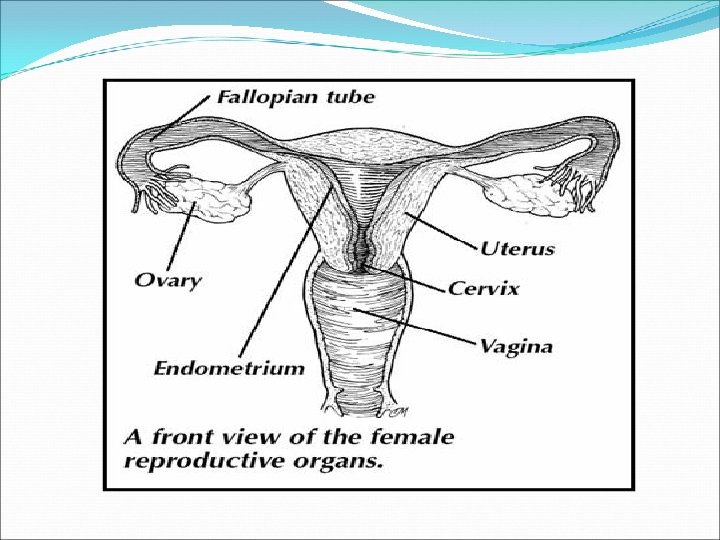
REPRODUCTIVE SYSTEM: female Reproductive anatomy (Cont. ) Vagina- muscular, rigid sheath connecting external genitals to Uterus, where embryo develops into a fetus, during pregnancy Cervix- Point where vagina ends After intercourse, sperm is ejaculated into the vagina through the cervix Cervix is lined with mucus, and quantity of mucus is determined by progesterone, and estrogen levels Ovaries- Act as storehouse of the egg
MALE REPRODUCTIVE SYSTEM Overview: Unlike female reproductive system, organs are external, rather than internal Functions to produce, maintain, and transport sperm, discharge sperm into female reproductive tract, and secrete male sex hormones(e. g. Testosterone) Penis- organ used during intercourse through which Overview(male reproductive system) Sperm is ejaculated to fertilize the ovum (egg) of the female Scrotum- Loose pouch- like sac of skin, containing the testicles as well as nerves and blood vessels Acts as “climate control”, for testicles, for normal sperm development.
















- Slides: 31