
The Human Body An Orientation Anatomy study of
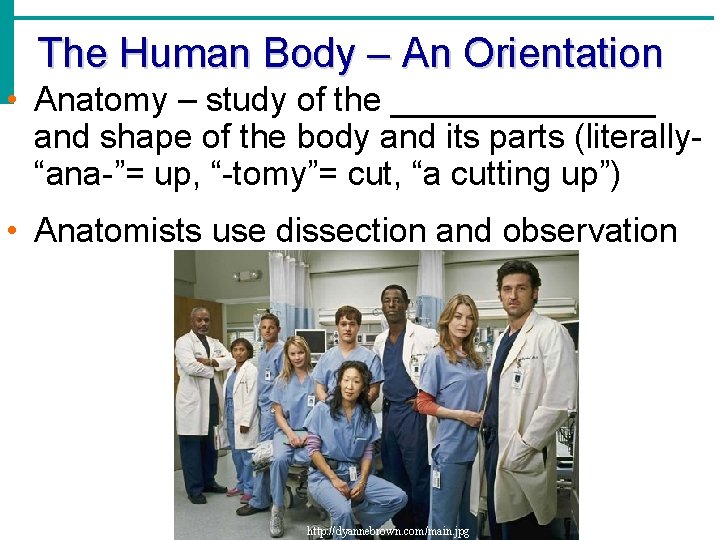
The Human Body – An Orientation • Anatomy – study of the _______ and shape of the body and its parts (literally“ana-”= up, “-tomy”= cut, “a cutting up”) • Anatomists use dissection and observation http: //dyannebrown. com/main. jpg

The Human Body – An Orientation • Examples of anatomy: • Naming structures • Describing the appearance of structures • Describing the location of structure • Describing the make-up of structures • Dissecting to look at structures http: //dyannebrown. com/main. jpg
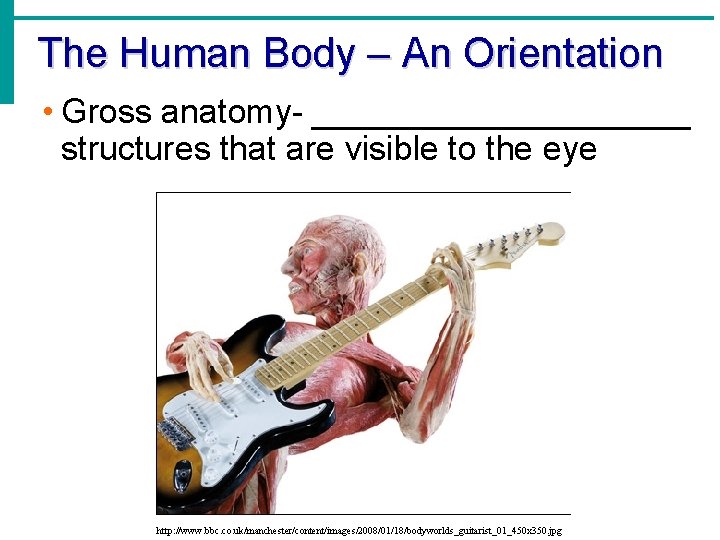
The Human Body – An Orientation • Gross anatomy- __________ structures that are visible to the eye http: //www. bbc. co. uk/manchester/content/images/2008/01/18/bodyworlds_guitarist_01_450 x 350. jpg
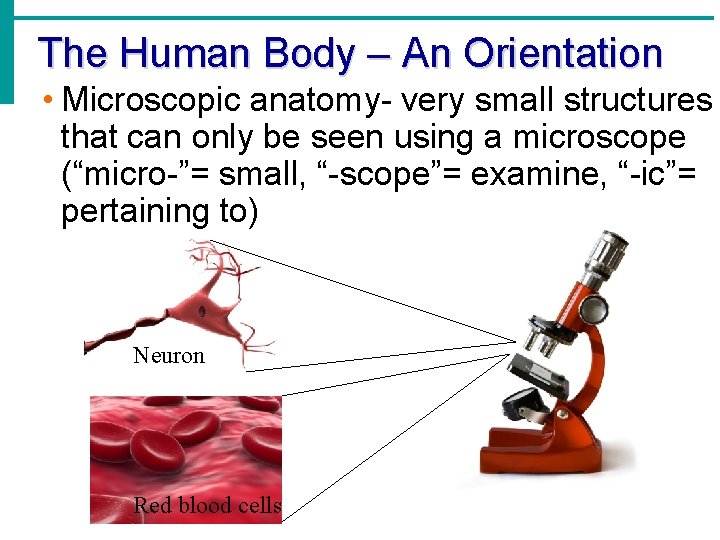
The Human Body – An Orientation • Microscopic anatomy- very small structures that can only be seen using a microscope (“micro-”= small, “-scope”= examine, “-ic”= pertaining to) Neuron Red blood cells
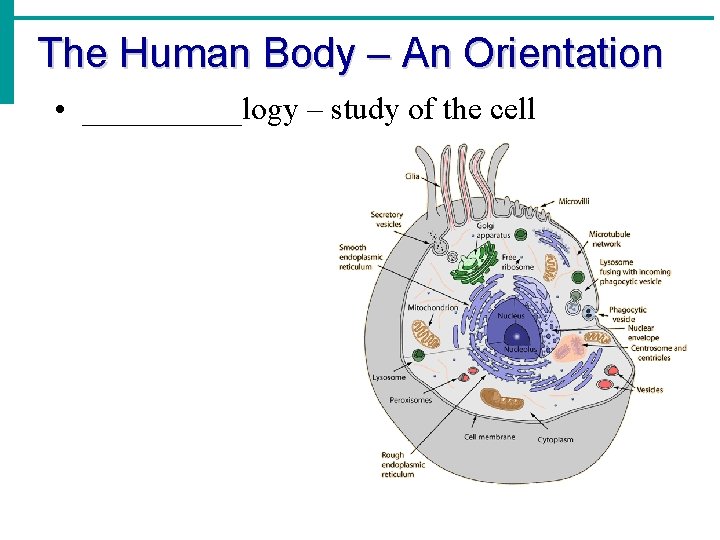
The Human Body – An Orientation • _____logy – study of the cell
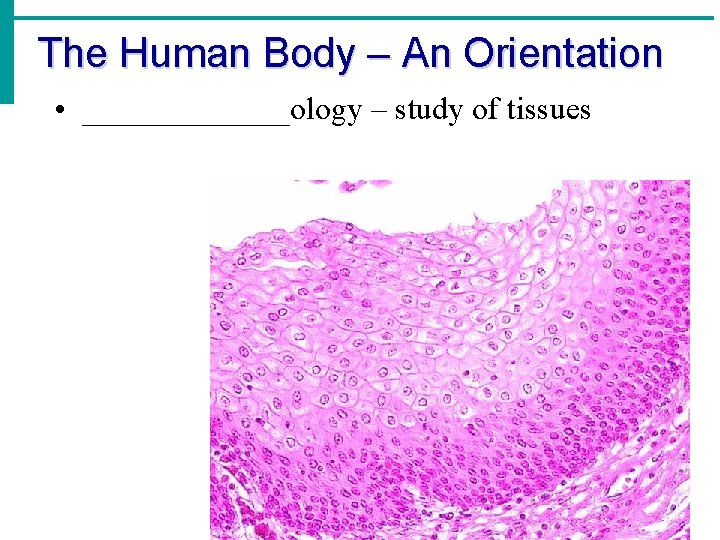
The Human Body – An Orientation • _______ology – study of tissues
The Human Body – An Orientation • Physiology – study of how the body and its parts work or _________(“physio”= bodily activity, “-ology”= the study of) • Physiologists use experimentation http: //www. bodyfitnt. com. au/assets/template/header-physiology. jpg
The Human Body – An Orientation • Examples of physiology: • Describing how something works, a process • Describing any kind of change in the body • Muscle contraction (movement), chemical processes of digestion…
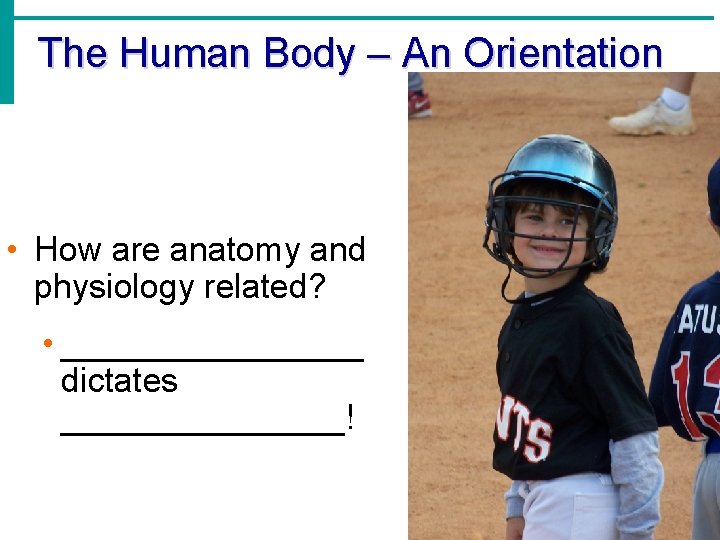
The Human Body – An Orientation • How are anatomy and physiology related? • ________ dictates ________!

The Language of Anatomy • Special terminology is used to prevent misunderstanding Nasal (nose) Oral (mouth) • Exact terms are used for: • Position • Direction • Regions • Structures Cervical (neck) Acromial (point of shoulder) Axillary (armpit) Abdominal (abdomen) Brachial (arm) Antecubital (front of elbow) Antebrachial (forearm) Pelvic (pelvis) Carpal (wrist) Pollex (thumb) Palmar (palm) Digital (fingers- phalanges!) Pubic (genital region) Copyright © 2003 Pearson Education, Inc. publishing as Benjamin Cummings Umbilical (navel) Coxal (hip) Inguinal (groin) Femoral (thigh) Patellar (anterior knee) Crural (leg) Tarsal (ankle) Pedal (foot) Digital (toes) Frontal (forehead) Orbital (eye) Buccal (cheek) Mental (chin) Sternal (breastbone) Pectoral (chest) Mammary (breast) Fibular (side of leg) Hallux (great toe) (a) Anterior Slide 1. 21
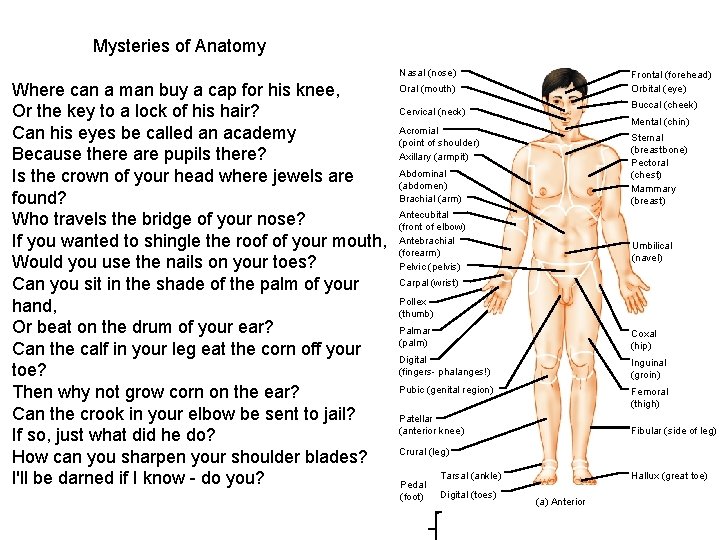
Mysteries of Anatomy Nasal (nose) Where can a man buy a cap for his knee, Or the key to a lock of his hair? Can his eyes be called an academy Because there are pupils there? Is the crown of your head where jewels are found? Who travels the bridge of your nose? If you wanted to shingle the roof of your mouth, Would you use the nails on your toes? Can you sit in the shade of the palm of your hand, Or beat on the drum of your ear? Can the calf in your leg eat the corn off your toe? Then why not grow corn on the ear? Can the crook in your elbow be sent to jail? If so, just what did he do? How can you sharpen your shoulder blades? I'll be darned if I know - do you? Frontal (forehead) Orbital (eye) Oral (mouth) Buccal (cheek) Cervical (neck) Mental (chin) Acromial (point of shoulder) Axillary (armpit) Sternal (breastbone) Pectoral (chest) Mammary (breast) Abdominal (abdomen) Brachial (arm) Antecubital (front of elbow) Antebrachial (forearm) Pelvic (pelvis) Umbilical (navel) Carpal (wrist) Pollex (thumb) Palmar (palm) Coxal (hip) Digital (fingers- phalanges!) Inguinal (groin) Pubic (genital region) Femoral (thigh) Patellar (anterior knee) Fibular (side of leg) Crural (leg) Pedal (foot) Tarsal (ankle) Digital (toes) Hallux (great toe) (a) Anterior
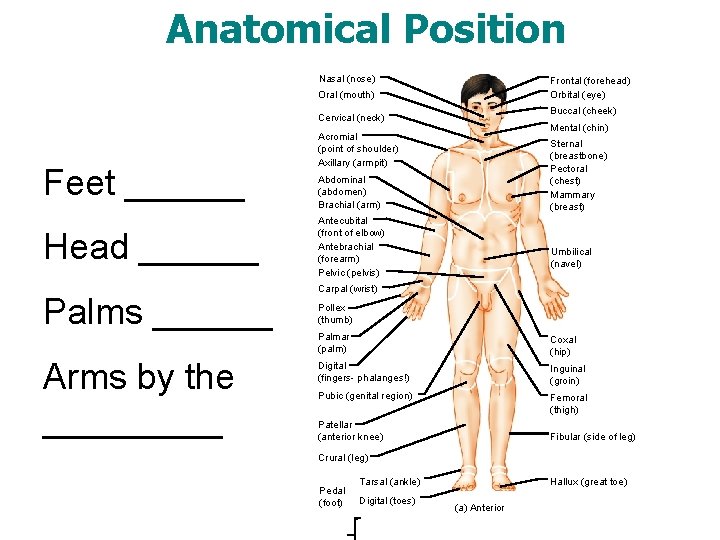
Anatomical Position Nasal (nose) Frontal (forehead) Orbital (eye) Oral (mouth) Buccal (cheek) Cervical (neck) Feet ______ Head ______ Palms ______ Arms by the _____ Mental (chin) Acromial (point of shoulder) Axillary (armpit) Sternal (breastbone) Pectoral (chest) Mammary (breast) Abdominal (abdomen) Brachial (arm) Antecubital (front of elbow) Antebrachial (forearm) Pelvic (pelvis) Umbilical (navel) Carpal (wrist) Pollex (thumb) Palmar (palm) Coxal (hip) Digital (fingers- phalanges!) Inguinal (groin) Pubic (genital region) Femoral (thigh) Patellar (anterior knee) Fibular (side of leg) Crural (leg) Pedal (foot) Tarsal (ankle) Digital (toes) Hallux (great toe) (a) Anterior
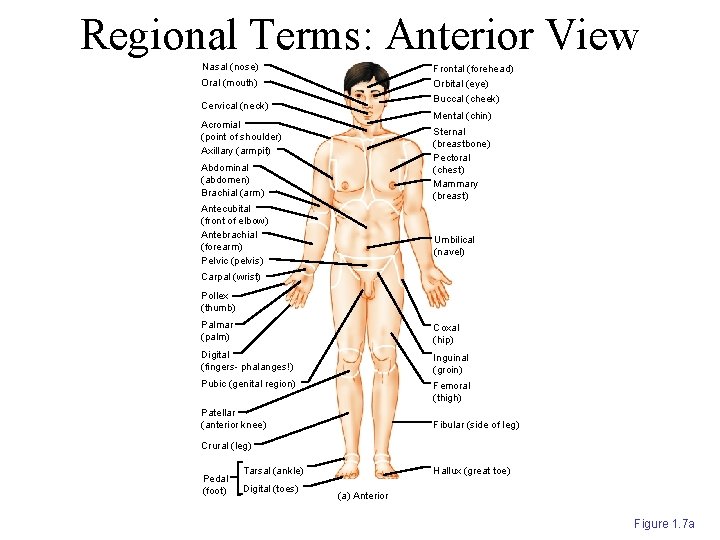
Regional Terms: Anterior View Nasal (nose) Frontal (forehead) Orbital (eye) Oral (mouth) Buccal (cheek) Cervical (neck) Mental (chin) Acromial (point of shoulder) Axillary (armpit) Sternal (breastbone) Pectoral (chest) Mammary (breast) Abdominal (abdomen) Brachial (arm) Antecubital (front of elbow) Antebrachial (forearm) Pelvic (pelvis) Umbilical (navel) Carpal (wrist) Pollex (thumb) Palmar (palm) Coxal (hip) Digital (fingers- phalanges!) Inguinal (groin) Pubic (genital region) Femoral (thigh) Patellar (anterior knee) Fibular (side of leg) Crural (leg) Pedal (foot) Tarsal (ankle) Digital (toes) Hallux (great toe) (a) Anterior Figure 1. 7 a
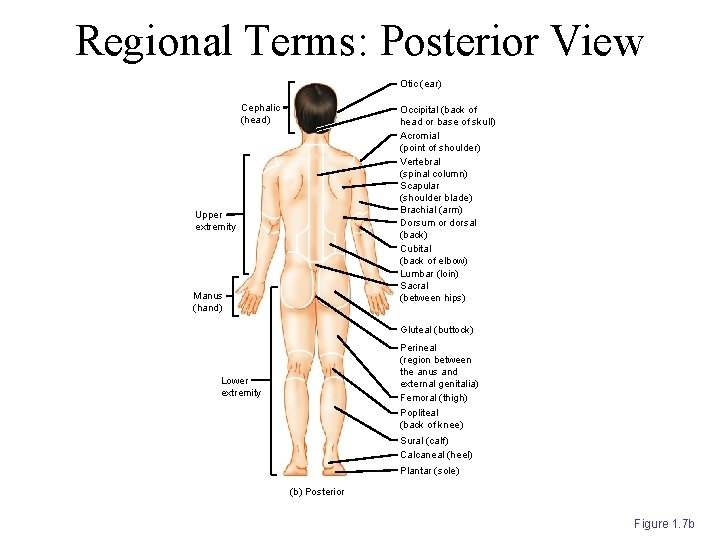
Regional Terms: Posterior View Otic (ear) Cephalic (head) Occipital (back of head or base of skull) Acromial (point of shoulder) Vertebral (spinal column) Scapular (shoulder blade) Brachial (arm) Dorsum or dorsal (back) Cubital (back of elbow) Lumbar (loin) Sacral (between hips) Upper extremity Manus (hand) Gluteal (buttock) Perineal (region between the anus and external genitalia) Femoral (thigh) Popliteal (back of knee) Lower extremity Sural (calf) Calcaneal (heel) Plantar (sole) (b) Posterior Figure 1. 7 b
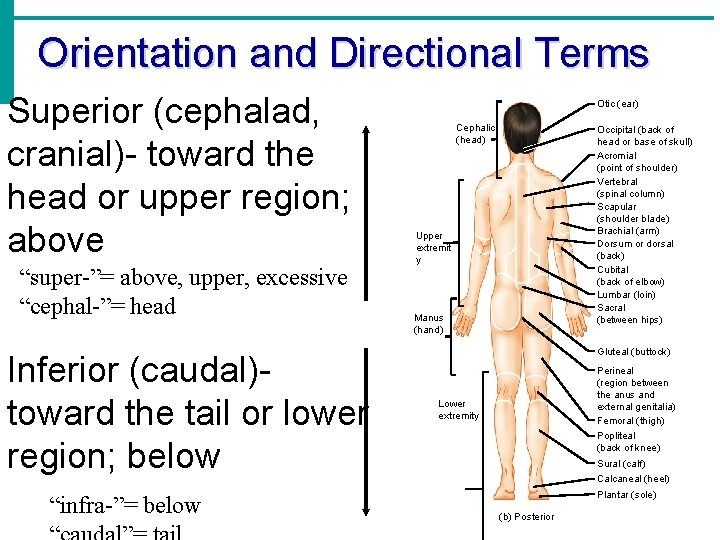
Orientation and Directional Terms Superior (cephalad, cranial)- toward the head or upper region; above “super-”= above, upper, excessive “cephal-”= head Inferior (caudal)toward the tail or lower region; below “infra-”= below Otic (ear) Cephalic (head) Occipital (back of head or base of skull) Acromial (point of shoulder) Vertebral (spinal column) Scapular (shoulder blade) Brachial (arm) Dorsum or dorsal (back) Cubital (back of elbow) Lumbar (loin) Sacral (between hips) Upper extremit y Manus (hand) Gluteal (buttock) Perineal (region between the anus and external genitalia) Femoral (thigh) Lower extremity Popliteal (back of knee) Sural (calf) Calcaneal (heel) Plantar (sole) (b) Posterior

Orientation and Directional Terms “ante-”= before, forward Anterior (ventral)front Nasal (nose) Oral (mouth) Frontal (forehead) Orbital (eye) Buccal (cheek) Mental (chin) Sternal (breastbone) Pectoral (chest) Mammary (breast) Cervical (neck) Acromial (point of shoulder) Axillary (armpit) Abdominal (abdomen) Brachial (arm) Antecubital (front of elbow) Antebrachial (forearm) Pelvic (pelvis) Carpal (wrist) Umbilical (navel) “post-”= after, behind Posterior (dorsal)back Otic (ear) Cephalic (head) Occipital (back of head or base of skull) Acromial (point of shoulder) Vertebral (spinal column) Scapular (shoulder blade) Brachial (arm) Dorsum or dorsal (back) Cubital (back of elbow) Lumbar (loin) Sacral (between hips) Upper extremit y Manus (hand) Pollex (thumb) Palmar (palm) Digital (fingers- phalanges!) Pubic (genital region) Coxal (hip) Inguinal (groin) Femoral (thigh) Patellar (anterior knee) Gluteal (buttock) Perineal (region between the anus and external genitalia) Femoral (thigh) Popliteal (back of knee) Sural (calf) Calcaneal (heel) Plantar (sole) Lower extremity Fibular (side of leg) Crural (leg) Tarsal (ankle) Pedal (foot) Digital (toes) Hallux (great toe) (a) Anterior (b) Posterior
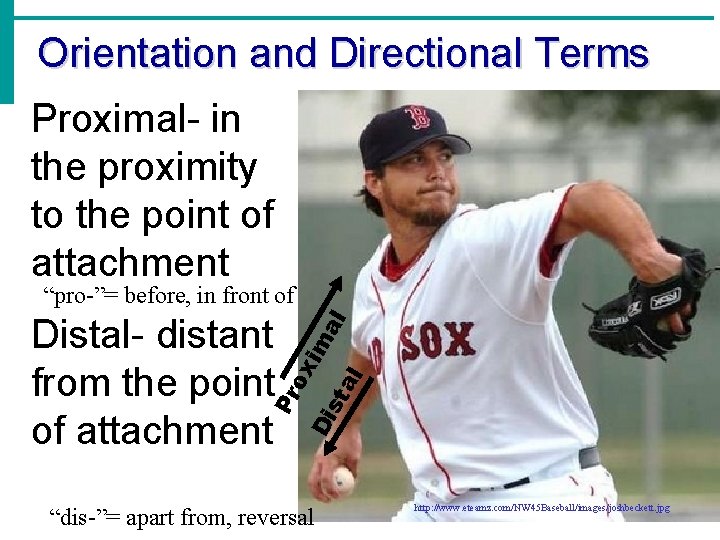
Orientation and Directional Terms Proximal- in the proximity to the point of attachment Di st al im ox Pr Distal- distant from the point of attachment al “pro-”= before, in front of “dis-”= apart from, reversal http: //www. eteamz. com/NW 45 Baseball/images/joshbeckett. jpg
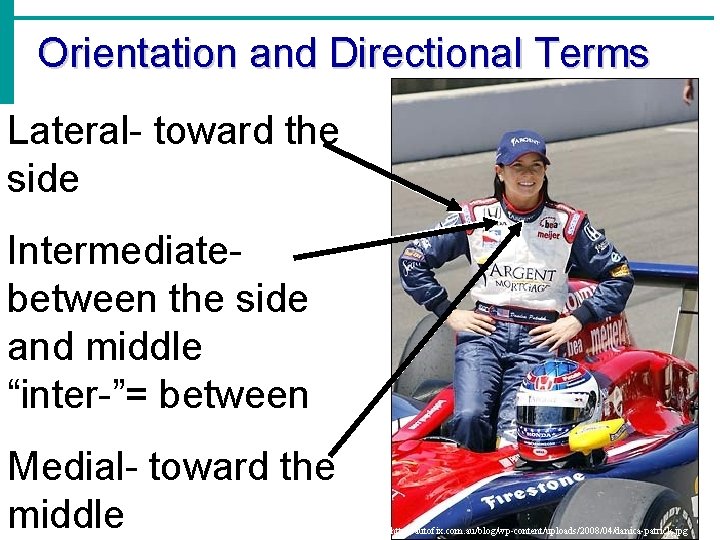
Orientation and Directional Terms Lateral- toward the side Intermediatebetween the side and middle “inter-”= between Medial- toward the middle http: //autofix. com. au/blog/wp-content/uploads/2008/04/danica-patrick. jpg
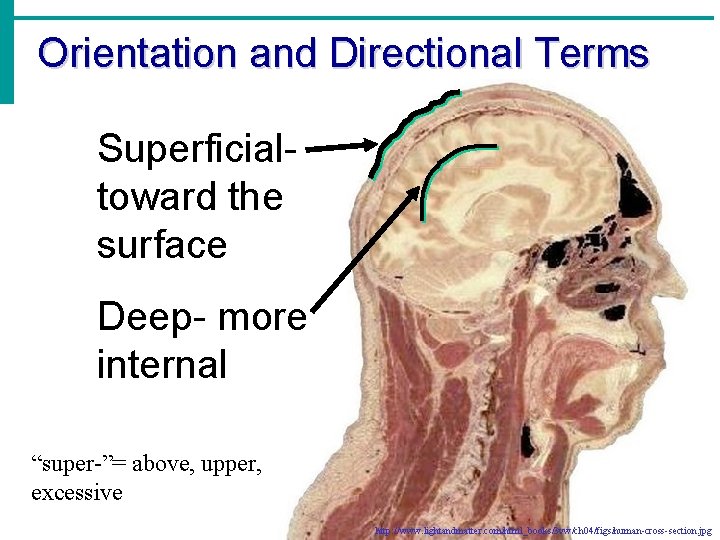
Orientation and Directional Terms Superficialtoward the surface Deep- more internal “super-”= above, upper, excessive http: //www. lightandmatter. com/html_books/3 vw/ch 04/figs/human-cross-section. jpg

Body Planes Body Sections: A sagittal section divides the body into right and left portions. A transverse section divides the body into superior and inferior portions. It is often called a “cross section”. “trans-”= across A coronal section divides the body into anterior and posterior sections. Figure 1. 6 Copyright © 2003 Pearson Education, Inc. publishing as Benjamin Cummings Slide 1. 26
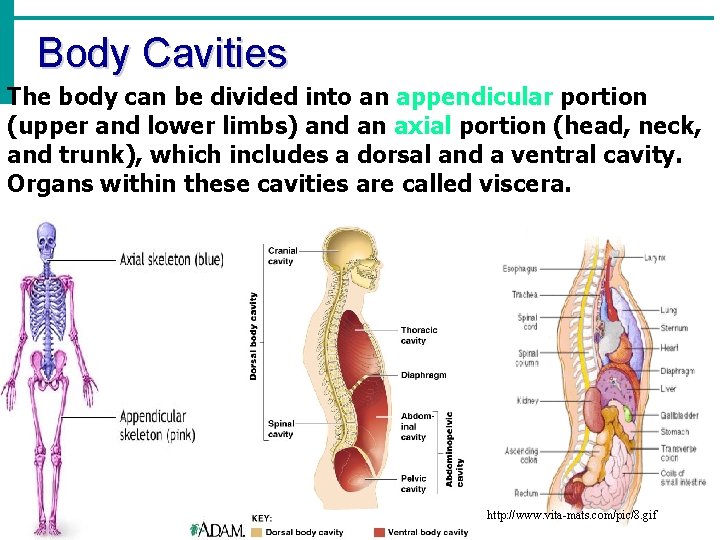
Body Cavities The body can be divided into an appendicular portion (upper and lower limbs) and an axial portion (head, neck, and trunk), which includes a dorsal and a ventral cavity. Organs within these cavities are called viscera. http: //www. vita-mats. com/pic/8. gif

The dorsal cavity can be divided into the cranial cavity and vertebral canal. The ventral cavity is made up of a thoracic cavity and an abdominopelvic cavity, separated by the diaphragm. The mediastinum divides the thorax into right and left halves. The abdominopelvic cavity can be divided into the abdominal cavity and the pelvic cavity. Smaller cavities within the head include the oral cavity, nasal cavity, orbital cavities, and middle ear cavities.
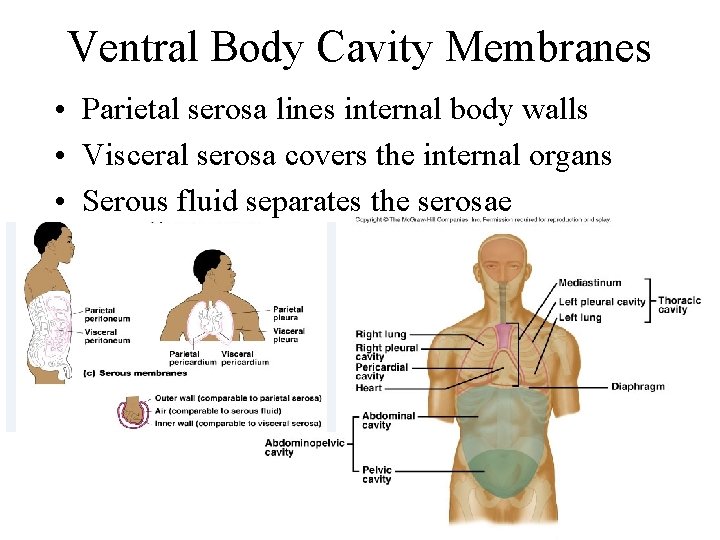
Ventral Body Cavity Membranes • Parietal serosa lines internal body walls • Visceral serosa covers the internal organs • Serous fluid separates the serosae

Thoracic and Abdominopelvic Membranes The thoracic cavity is lined with _________ The parietal pleura lines the cavities The visceral pleura covers the lungs. A thin layer of serous fluid separates the two layers.
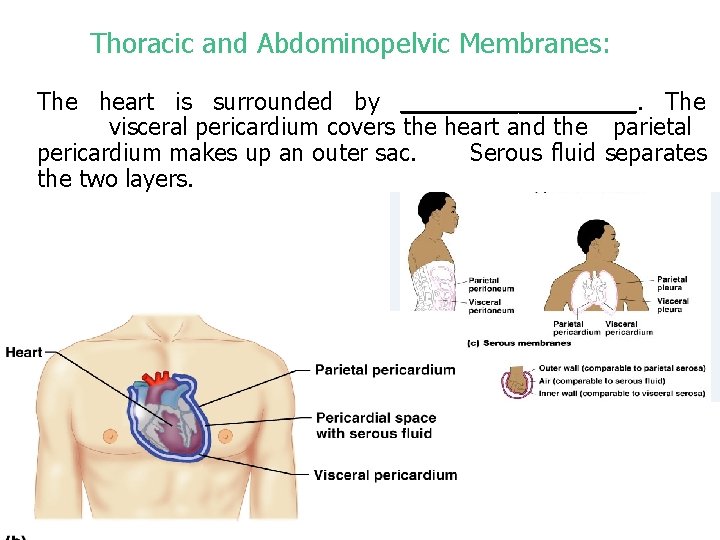
Thoracic and Abdominopelvic Membranes: The heart is surrounded by _________. The visceral pericardium covers the heart and the parietal pericardium makes up an outer sac. Serous fluid separates the two layers.
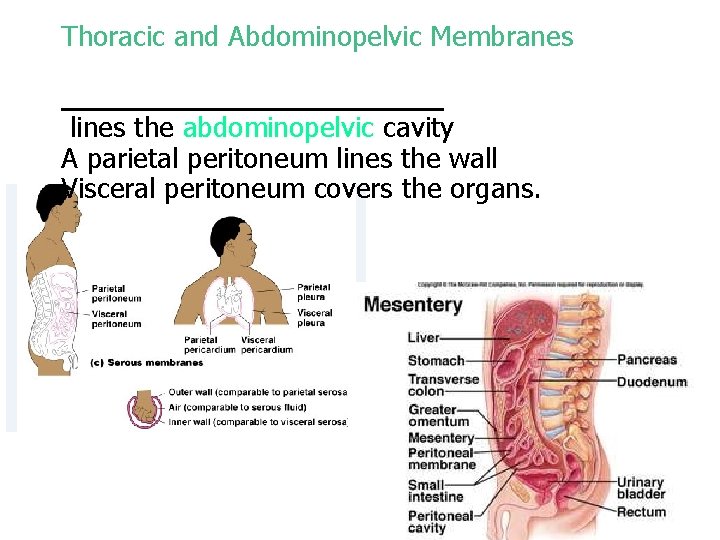
Thoracic and Abdominopelvic Membranes _____________ lines the abdominopelvic cavity A parietal peritoneum lines the wall Visceral peritoneum covers the organs.
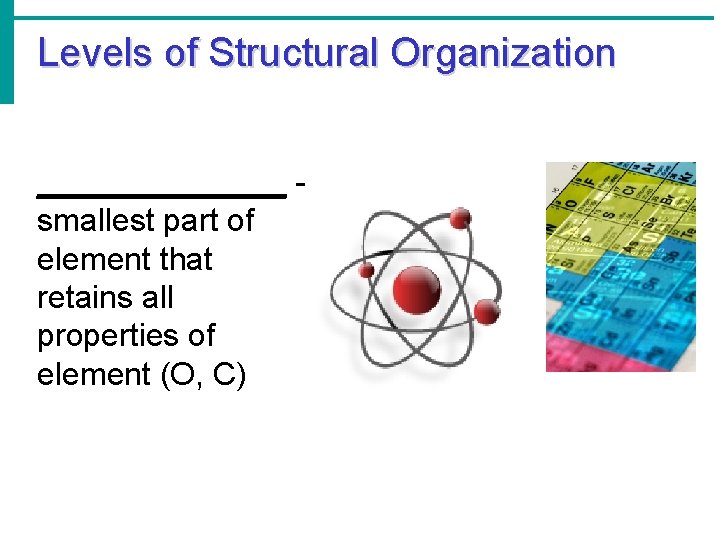
Levels of Structural Organization _______ smallest part of element that retains all properties of element (O, C)
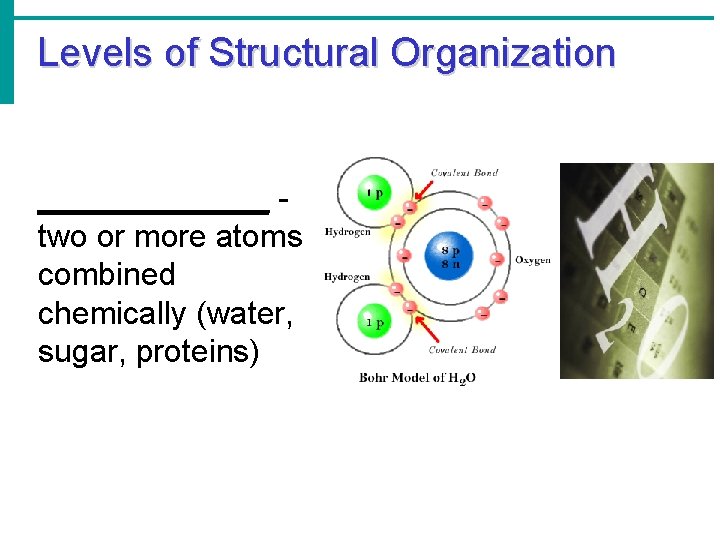
Levels of Structural Organization _______ two or more atoms combined chemically (water, sugar, proteins)
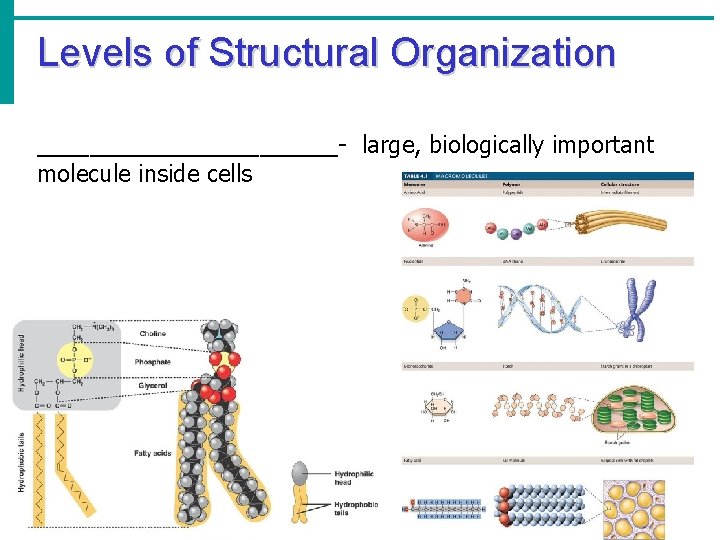
Levels of Structural Organization ____________- large, biologically important molecule inside cells
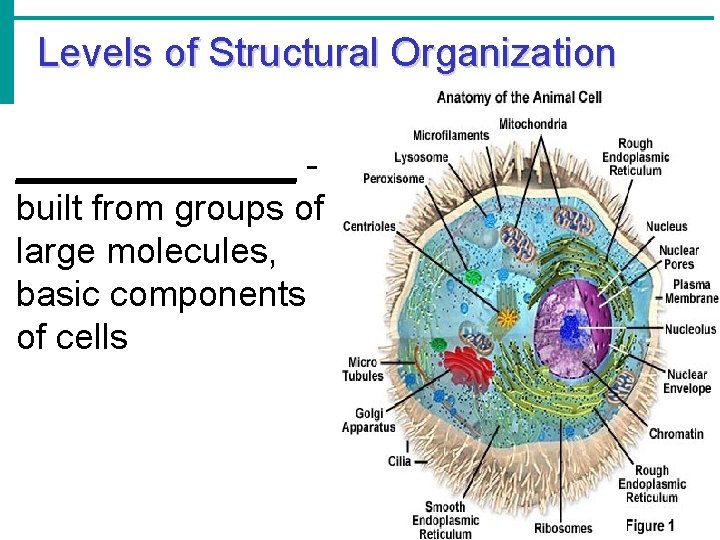
Levels of Structural Organization _______ built from groups of large molecules, basic components of cells
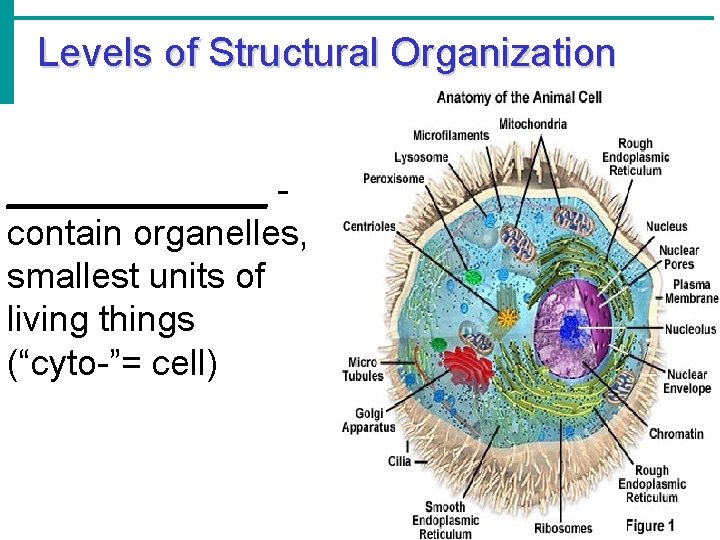
Levels of Structural Organization _______ contain organelles, smallest units of living things (“cyto-”= cell)
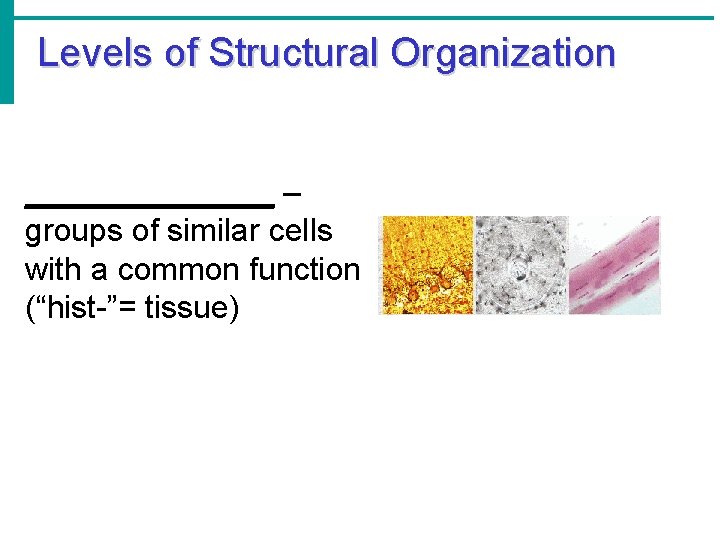
Levels of Structural Organization _______ – groups of similar cells with a common function (“hist-”= tissue)
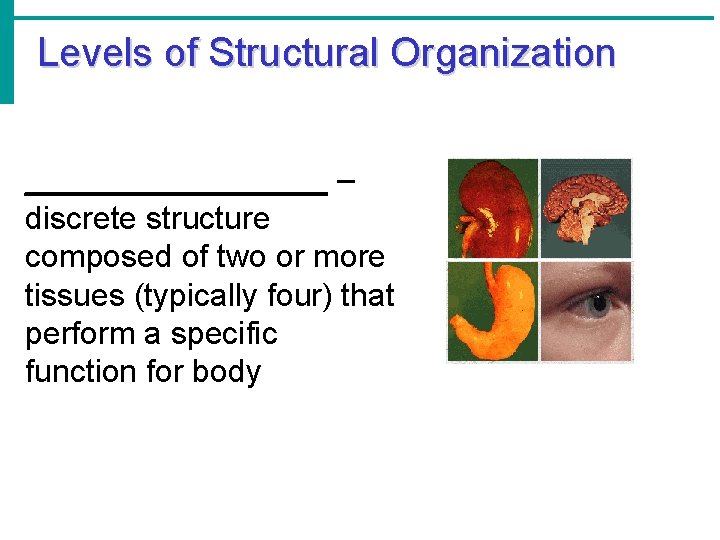
Levels of Structural Organization _________ – discrete structure composed of two or more tissues (typically four) that perform a specific function for body

Levels of Structural Organization _____________– organs that work closely for a common purpose http: //trc. ucdavis. edu/biosci 10 v/bis 10 v/week 10/systems 1. gif
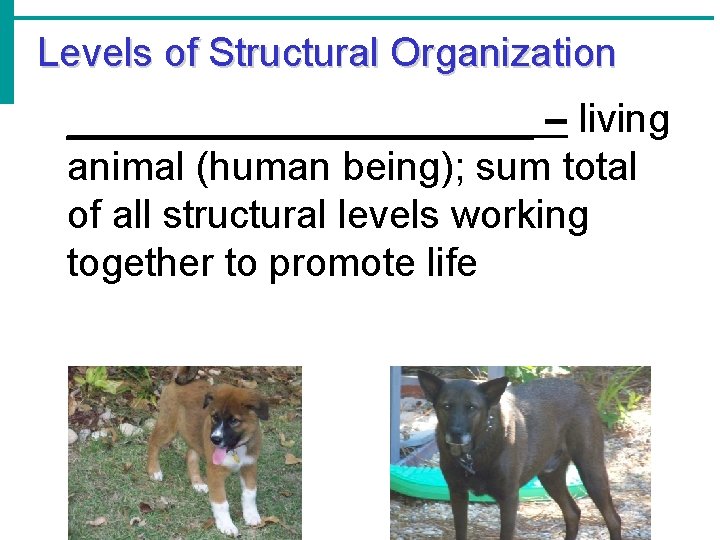
Levels of Structural Organization ___________ – living animal (human being); sum total of all structural levels working together to promote life
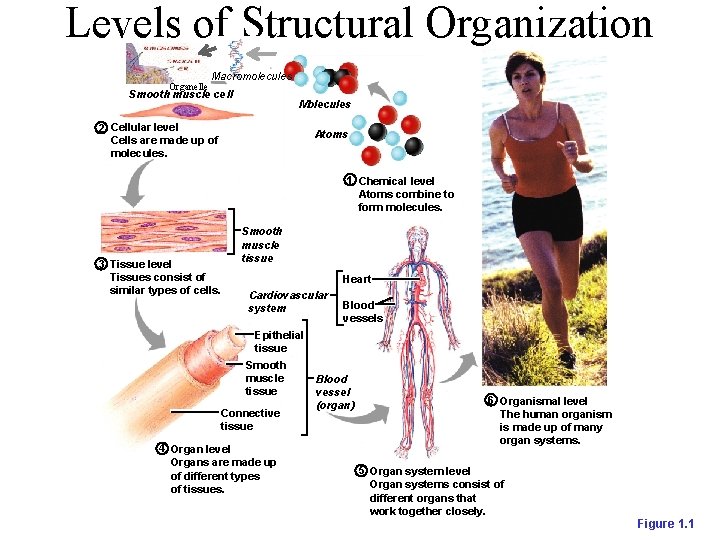
Levels of Structural Organization Organelle Macromolecules Smooth muscle cell Molecules 2 Cellular level Cells are made up of molecules. Atoms 1 Chemical level Atoms combine to form molecules. 3 Tissue level Tissues consist of similar types of cells. Smooth muscle tissue Heart Cardiovascular system Blood vessels Epithelial tissue Smooth muscle tissue Connective tissue 4 Organ level Organs are made up of different types of tissues. Blood vessel (organ) 6 Organismal level The human organism is made up of many organ systems. 5 Organ system level Organ systems consist of different organs that work together closely. Figure 1. 1
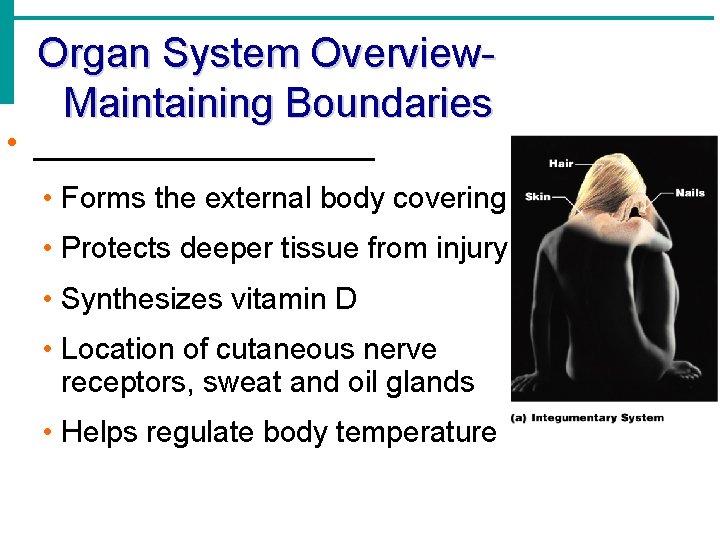
Organ System Overview. Maintaining Boundaries • _________ • Forms the external body covering • Protects deeper tissue from injury • Synthesizes vitamin D • Location of cutaneous nerve receptors, sweat and oil glands • Helps regulate body temperature
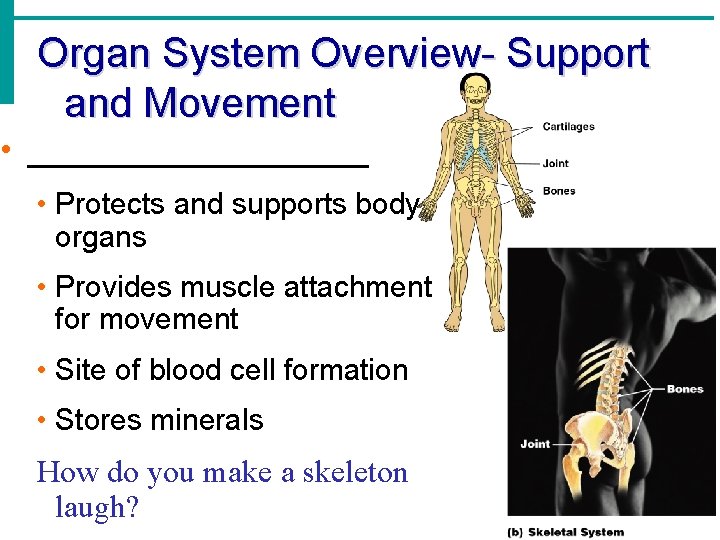
Organ System Overview- Support and Movement • _________ • Protects and supports body organs • Provides muscle attachment for movement • Site of blood cell formation • Stores minerals How do you make a skeleton laugh?
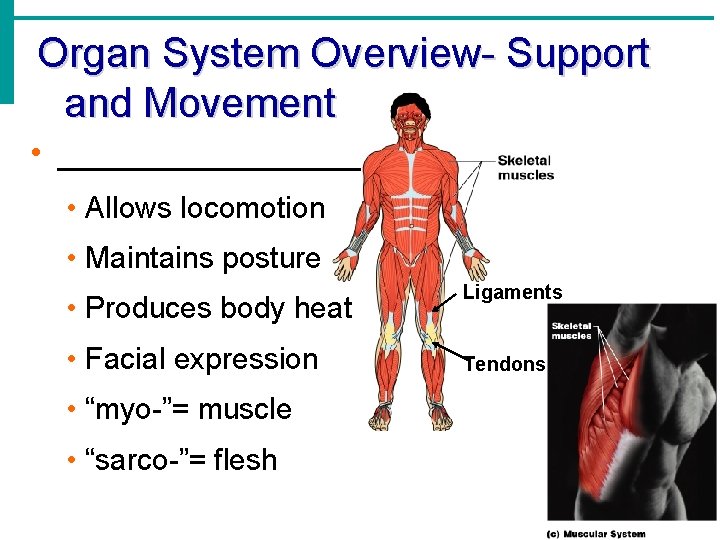
Organ System Overview- Support and Movement • ________ • Allows locomotion • Maintains posture • Produces body heat • Facial expression • “myo-”= muscle • “sarco-”= flesh Ligaments Tendons
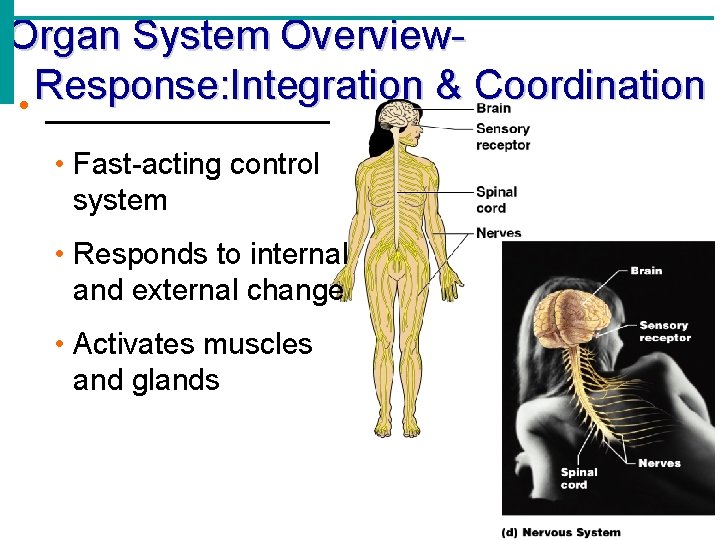
Organ System Overview. Response: Integration & Coordination • ________ • Fast-acting control system • Responds to internal and external change • Activates muscles and glands
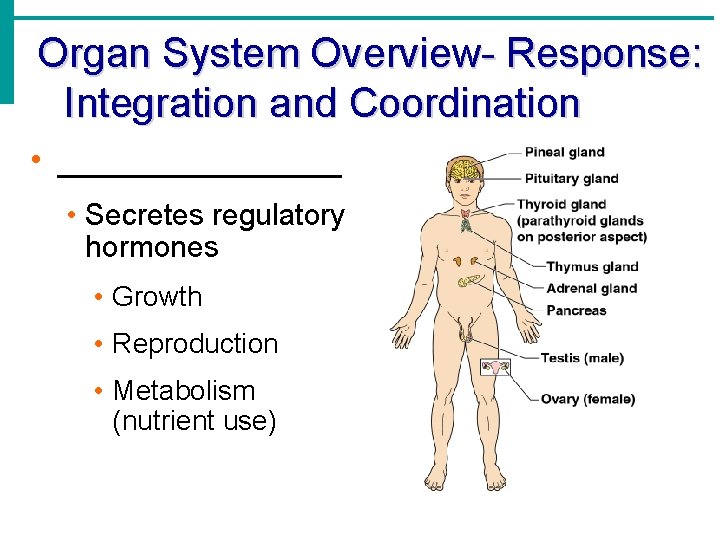
Organ System Overview- Response: Integration and Coordination • ________ • Secretes regulatory hormones • Growth • Reproduction • Metabolism (nutrient use)
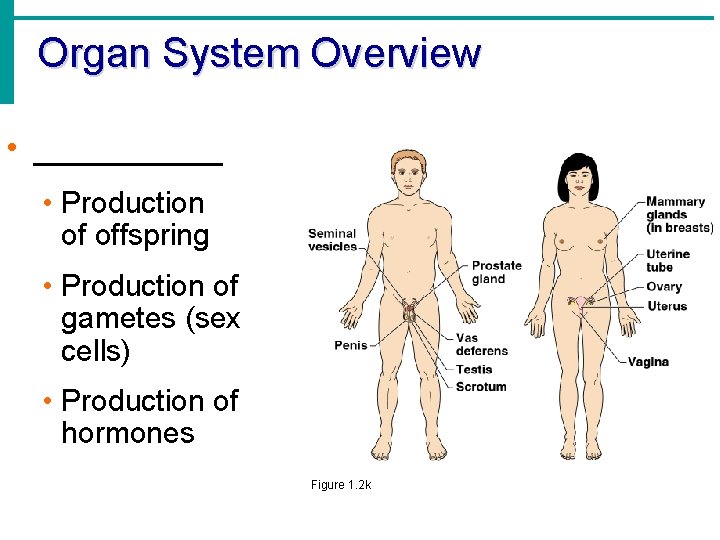
Organ System Overview • _____ • Production of offspring • Production of gametes (sex cells) • Production of hormones Figure 1. 2 k

Organ System Overview • Reproductive______ • Production of eggs and female sex hormones • Sites of fertilization and development of the fetus • Mammary glands to produce milk
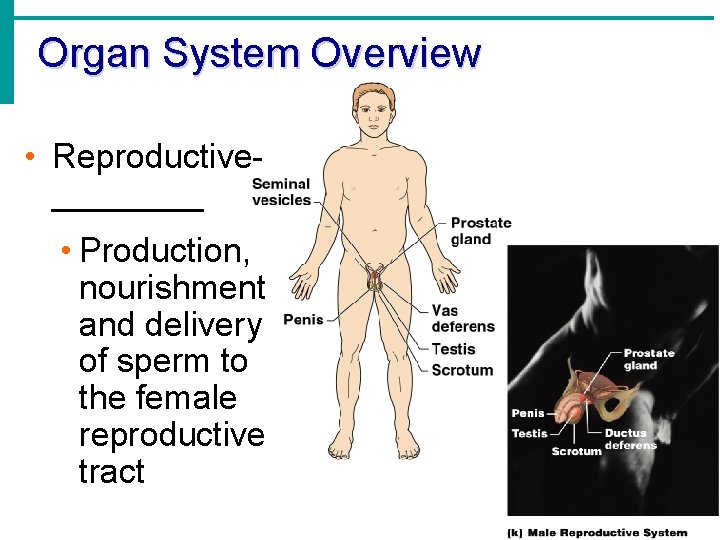
Organ System Overview • Reproductive____ • Production, nourishment and delivery of sperm to the female reproductive tract
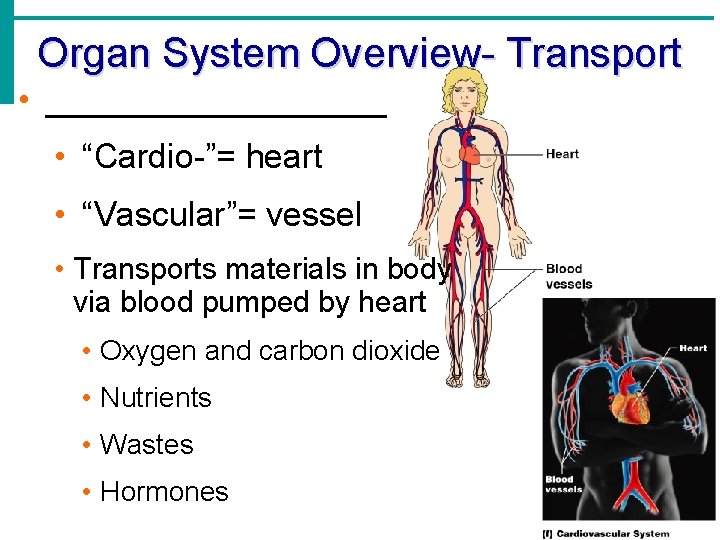
Organ System Overview- Transport • _________ • “Cardio-”= heart • “Vascular”= vessel • Transports materials in body via blood pumped by heart • Oxygen and carbon dioxide • Nutrients • Wastes • Hormones
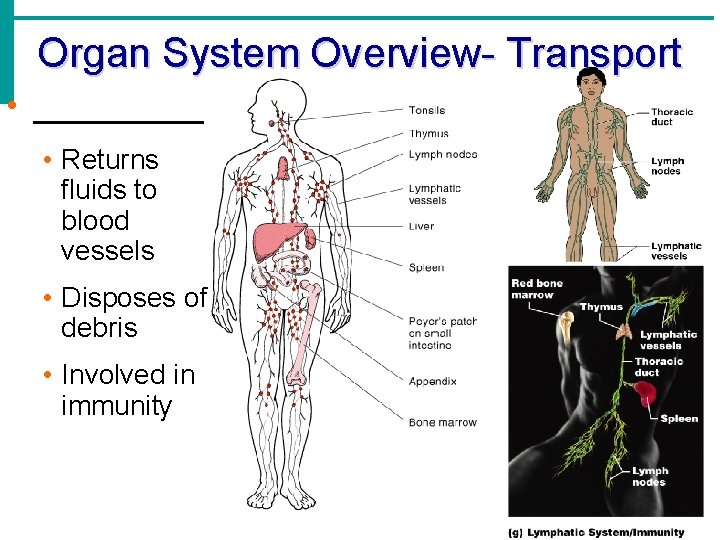
Organ System Overview- Transport • _____ • Returns fluids to blood vessels • Disposes of debris • Involved in immunity

Organ System Overview- Absorption and Excretion • ________ • Breaks down food • Allows for nutrient absorption into blood • Eliminates indigestible material
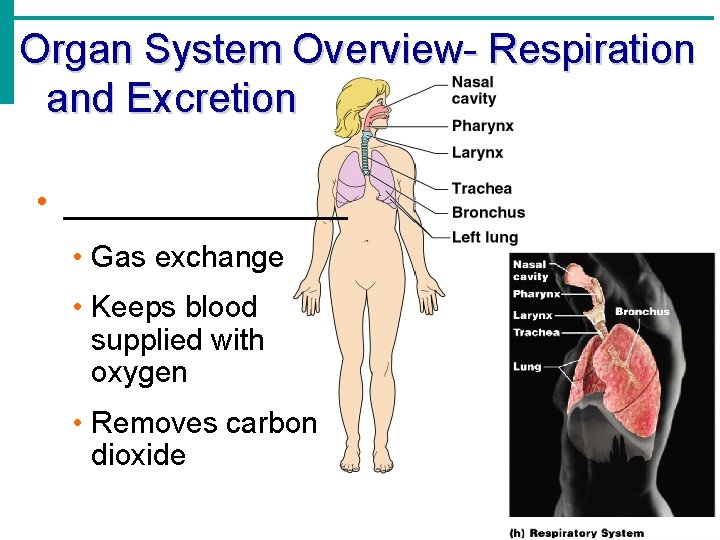
Organ System Overview- Respiration and Excretion • ________ • Gas exchange • Keeps blood supplied with oxygen • Removes carbon dioxide

Organ System Overview- Excretion • ________ • Eliminates nitrogenous wastes • Maintains acid – base balance • Regulation of materials • Water • Electrolytes
Ways to remember body systems? I C MR. NERDLUS I Can Make Really Long Useless, Run-on Sentences Every Day Now.
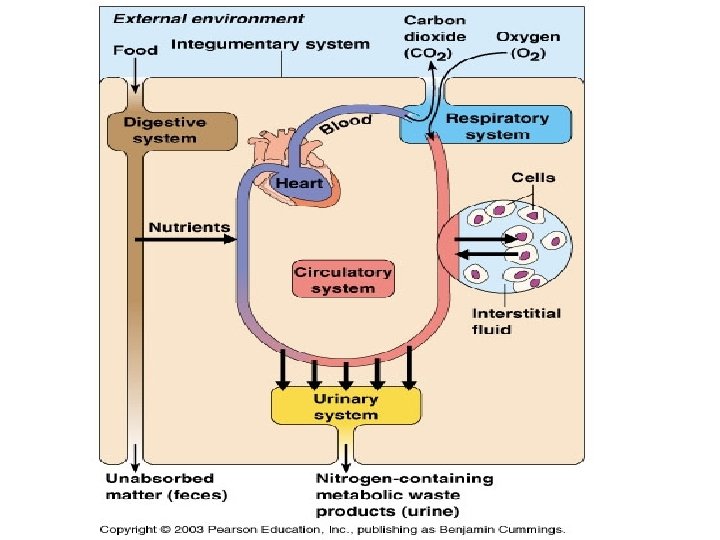

Necessary Life Functions All the things something must do to be considered a living thing. • Maintain Boundaries • Inside stays separate from outside Cells have plasma membrane (skin) http: //www. the-aps. org/education/lot/cell. JPG Body has integumentary system
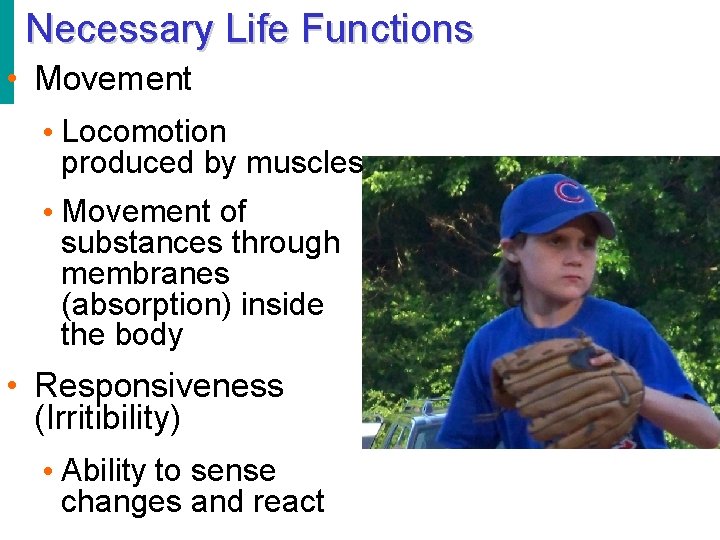
Necessary Life Functions • Movement • Locomotion produced by muscles • Movement of substances through membranes (absorption) inside the body • Responsiveness (Irritibility) • Ability to sense changes and react
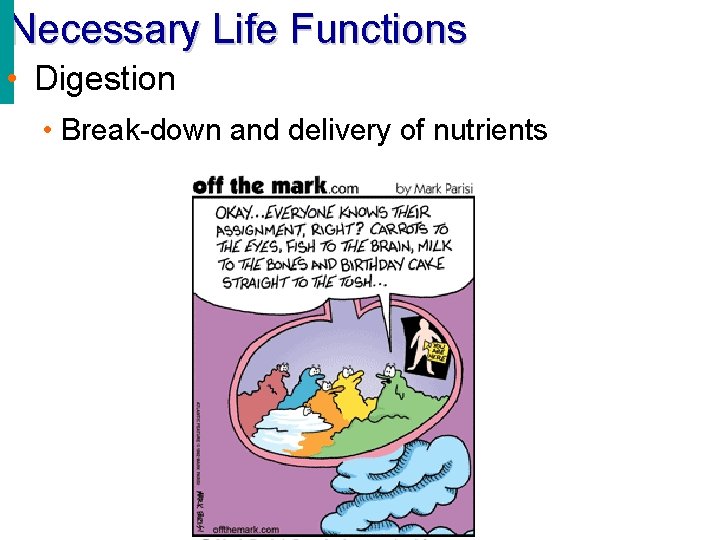
Necessary Life Functions • Digestion • Break-down and delivery of nutrients
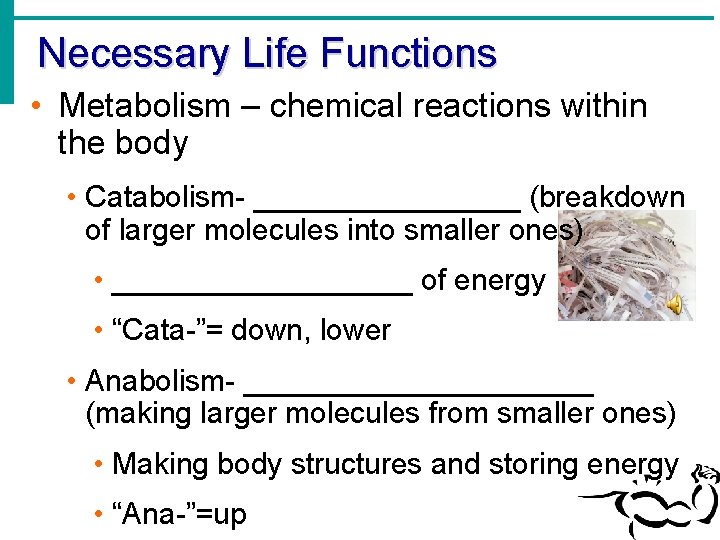
Necessary Life Functions • Metabolism – chemical reactions within the body • Catabolism- ________ (breakdown of larger molecules into smaller ones) • _________ of energy • “Cata-”= down, lower • Anabolism- ___________ (making larger molecules from smaller ones) • Making body structures and storing energy • “Ana-”=up
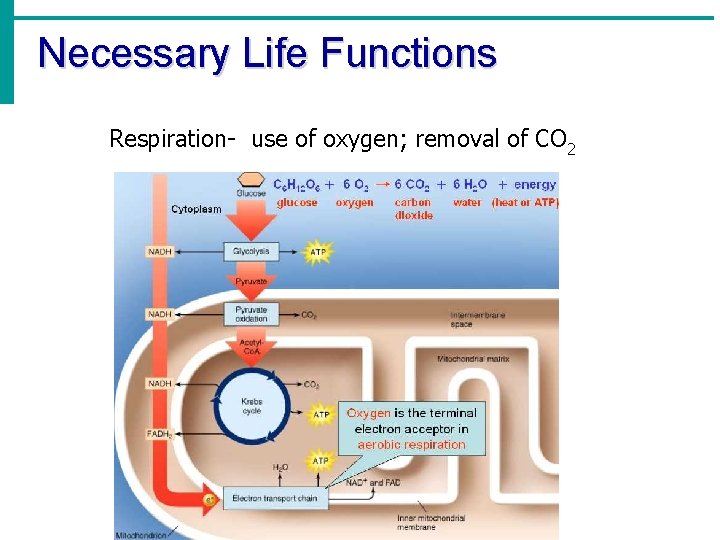
Necessary Life Functions Respiration- use of oxygen; removal of CO 2
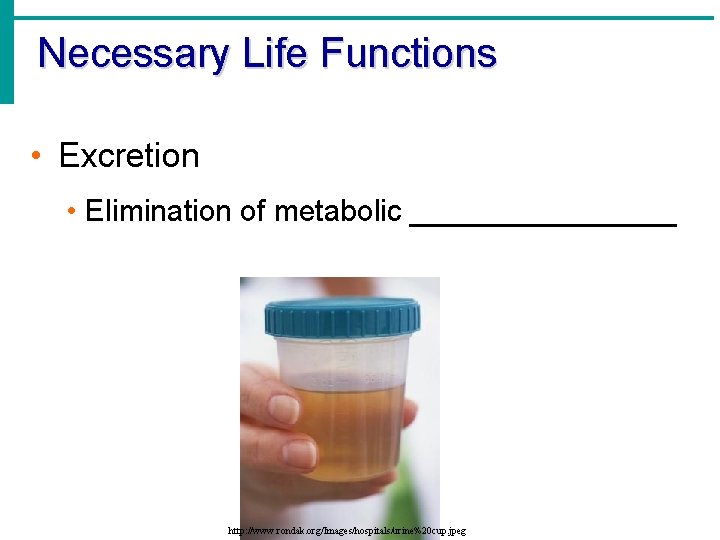
Necessary Life Functions • Excretion • Elimination of metabolic ________ http: //www. rondak. org/Images/hospitals/urine%20 cup. jpeg
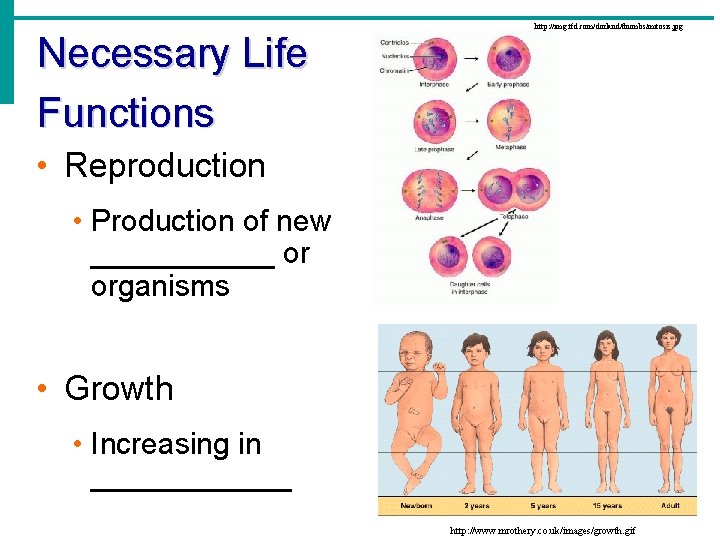
Necessary Life Functions http: //img. tfd. com/dorland/thumbs/mitosis. jpg • Reproduction • Production of new ______ or organisms • Growth • Increasing in ______ http: //www. mrothery. co. uk/images/growth. gif

Ways to remember necessary life functions: MR. BERG M. D. My Grandma Makes Really Delicious Blueberry Raisin Eclairs.
Survival Needs Things an organism needs to continue living • _________ • Chemicals for energy and cell building • Includes carbohydrates, proteins, lipids, vitamins, and minerals • _________ • Required for chemical reactions Copyright © 2003 Pearson Education, Inc. publishing as Benjamin Cummings Slide 1. 17 a

Survival Needs • _________ • 60– 80% of body weight • Provides base for metabolic reaction • Stable body _________(37°C or 98. 6°F) • Maintain constant reaction rate • Atmospheric _________ must be appropriate • Breathing and gas exchange depend on this
Way to remember survival needs: Needs One Will Take Promptly P. TOWN
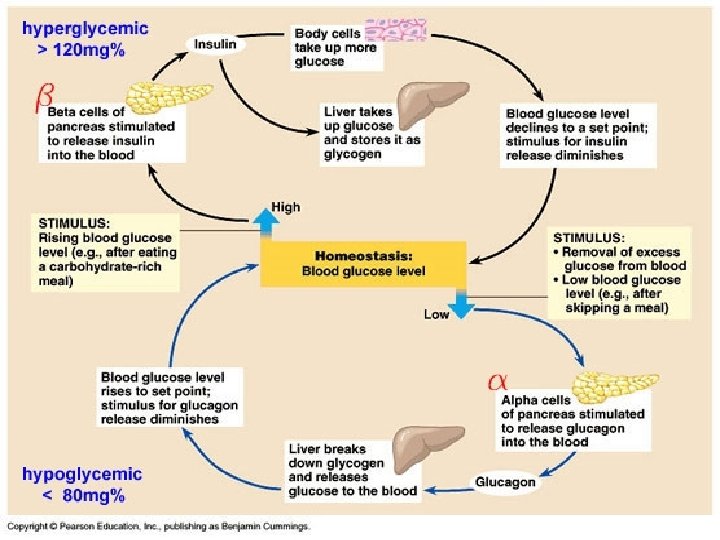
Homeostasis • “Homeo”= same • “Stasis”= stop, stand still • Maintenance of a _____ internal environment = a dynamic state of equilibrium (balance) • Conditions ______, but not far from “normal” • Homeostasis must be maintained for normal body functioning and to sustain life • Homeostatic imbalance – a __________ in homeostasis resulting in sickness or disease
Maintaining Homeostasis • The body communicates through neural and hormonal control systems • Receptor / Sensor • ______to changes in the environment (stimuli) • Sends information to control center (Afferent pathway- _______. “A-”= without, lack of, “-ferent”= carry) Copyright © 2003 Pearson Education, Inc. publishing as Benjamin Cummings Slide 1. 19 a
Maintaining Homeostasis • Control center / Integration center • Determines ____________ • __________ information • Determines appropriate response • Efferent pathway- _______from • Effector (“e-”= out or away from) • Provides a means for_________to the stimulus • Muscle or gland Copyright © 2003 Pearson Education, Inc. publishing as Benjamin Cummings Slide 1. 19 b
Feedback Mechanisms • Negative feedback • Includes most homeostatic control mechanisms • ____________the original stimulus, or reduces its intensity • Works like a household thermostat Copyright © 2003 Pearson Education, Inc. publishing as Benjamin Cummings Slide 1. 20 a
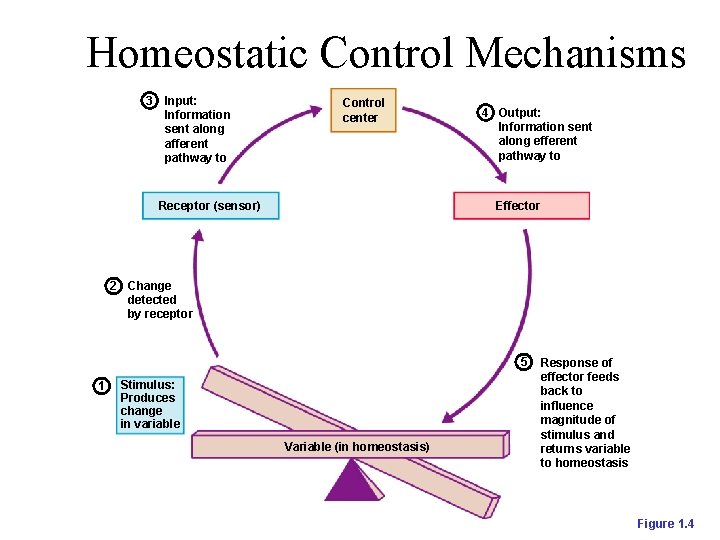
Homeostatic Control Mechanisms 3 Input: Information sent along afferent pathway to Control center Receptor (sensor) 4 Output: Information sent along efferent pathway to Effector 2 Change detected by receptor 5 1 Stimulus: Produces change in variable Variable (in homeostasis) Response of effector feeds back to influence magnitude of stimulus and returns variable to homeostasis Figure 1. 4
Negative Feedback • In negative feedback systems, the output shuts off the original stimulus • Example: Regulation of room temperature

Signal wire turns heater off Set point Control center (thermostat) Stimulus: dropping room temperature Receptor-sensor (thermometer In thermostat) Heater off Effector (heater) Stimulus: rising room temperature Response; temperature drops Balance Figure 1. 5

Balance Response; temperature rises Stimulus: dropping room temperature Heater on Set point Effector (heater) Receptor-sensor (thermometer in Thermostat) Signal wire turns heater on Control center (thermostat) Figure 1. 5
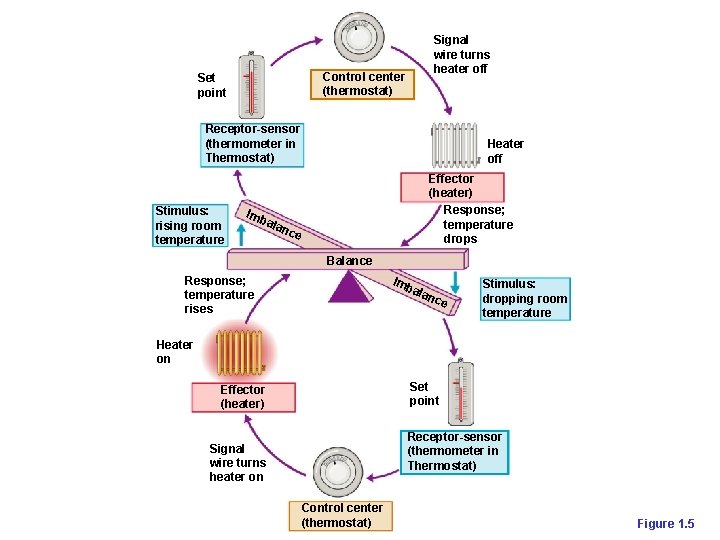
Signal wire turns heater off Control center (thermostat) Set point Receptor-sensor (thermometer in Thermostat) Stimulus: rising room temperature Imb Heater off Effector (heater) Response; temperature drops ala nce Balance Response; temperature rises Imb ala nce Stimulus: dropping room temperature Heater on Set point Effector (heater) Receptor-sensor (thermometer in Thermostat) Signal wire turns heater on Control center (thermostat) Figure 1. 5
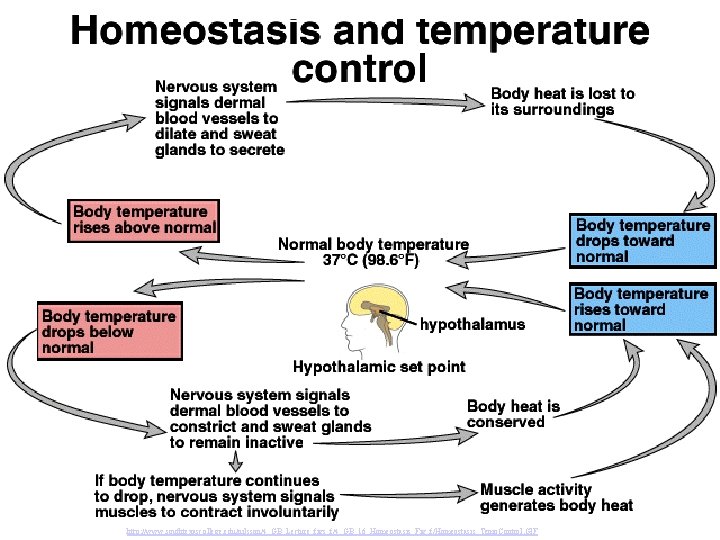
http: //www. southtexascollege. edu/nilsson/4_GB_Lecture_figs_f/4_GB_16_Homeostasis_Fig_f/Homeostasis_Temp. Control. GIF
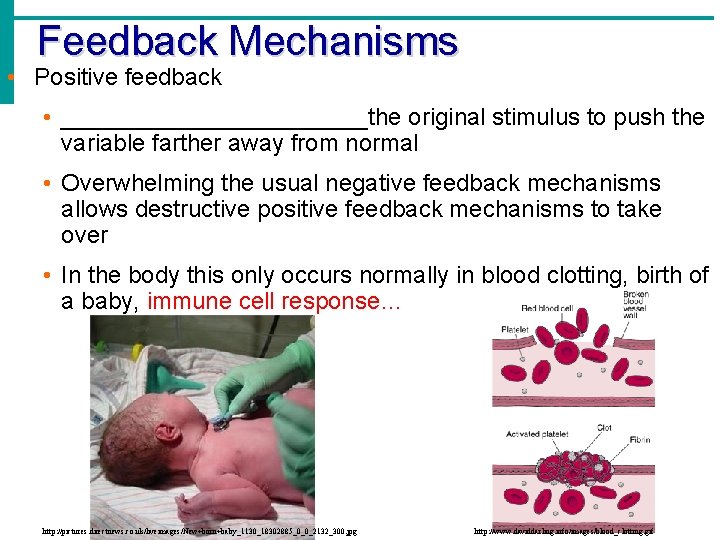
Feedback Mechanisms • Positive feedback • ____________the original stimulus to push the variable farther away from normal • Overwhelming the usual negative feedback mechanisms allows destructive positive feedback mechanisms to take over • In the body this only occurs normally in blood clotting, birth of a baby, immune cell response… http: //pictures. directnews. co. uk/liveimages/New+born+baby_1130_18302885_0_0_2132_300. jpg http: //www. daviddarling. info/images/blood_clotting. gif
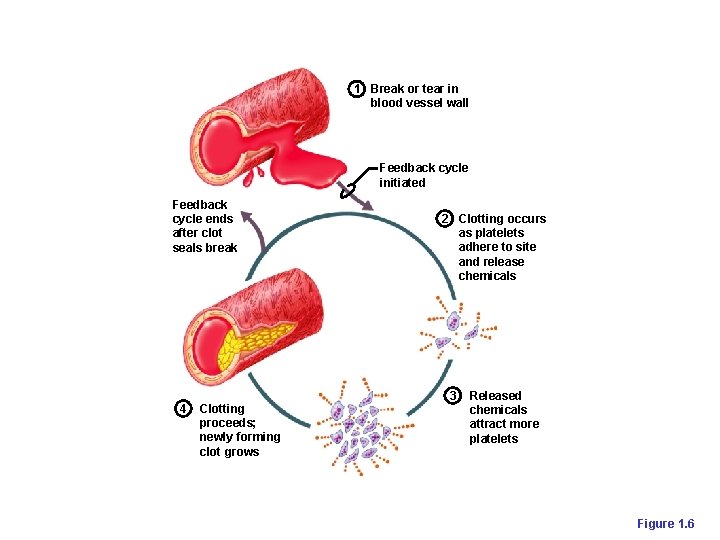
1 Break or tear in blood vessel wall Feedback cycle initiated Feedback cycle ends after clot seals break 4 Clotting proceeds; newly forming clot grows 2 Clotting occurs as platelets adhere to site and release chemicals 3 Released chemicals attract more platelets Figure 1. 6
- Slides: 75