
The Hubble Flow www schoolsobservatory org Hubble Flow

The Hubble Flow www. schoolsobservatory. org
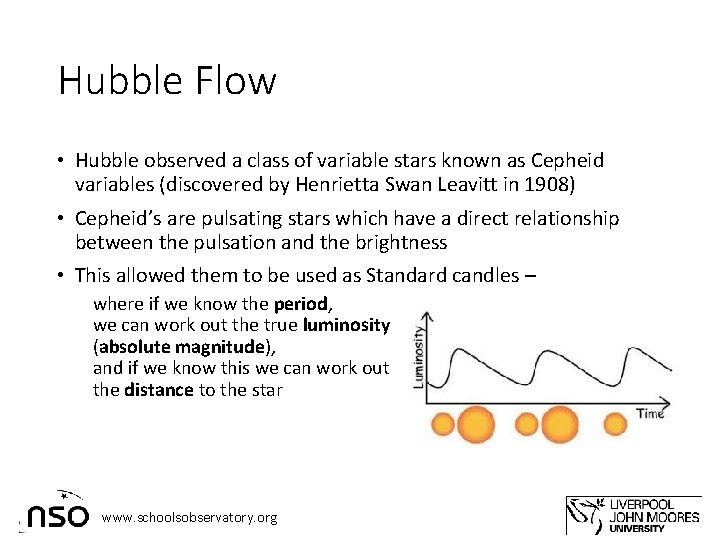
Hubble Flow • Hubble observed a class of variable stars known as Cepheid variables (discovered by Henrietta Swan Leavitt in 1908) • Cepheid’s are pulsating stars which have a direct relationship between the pulsation and the brightness • This allowed them to be used as Standard candles – where if we know the period, we can work out the true luminosity (absolute magnitude), and if we know this we can work out the distance to the star www. schoolsobservatory. org
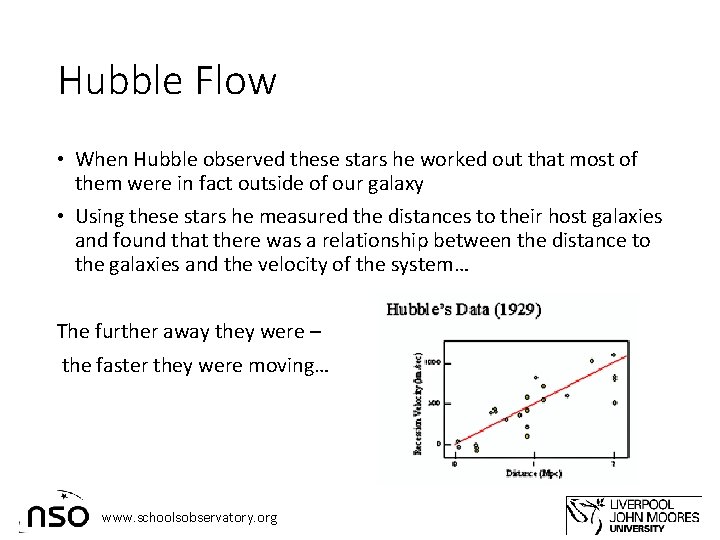
Hubble Flow • When Hubble observed these stars he worked out that most of them were in fact outside of our galaxy • Using these stars he measured the distances to their host galaxies and found that there was a relationship between the distance to the galaxies and the velocity of the system… The further away they were – the faster they were moving… www. schoolsobservatory. org

Universal Expansion Despite the fact that Hubble himself was not in favour of the idea that his discovery ‘proved’ universal expansion, it is the widely accepted piece of evidence that is strongly in favour of it. The expansion of the Universe is quite a tricky one to imagine, the best way to envisage it is through the ‘Balloon Model’: Not only does the distance between two galaxies increase, but all of the intermediate space in between expands. This is just like the balloon universe image to the right; the distance between each galaxy increases but the balloon material itself also expands as it inflates. www. schoolsobservatory. org TAKE 27 LTD/SPL

Universal Expansion • Recession velocity www. schoolsobservatory. org per unit of space
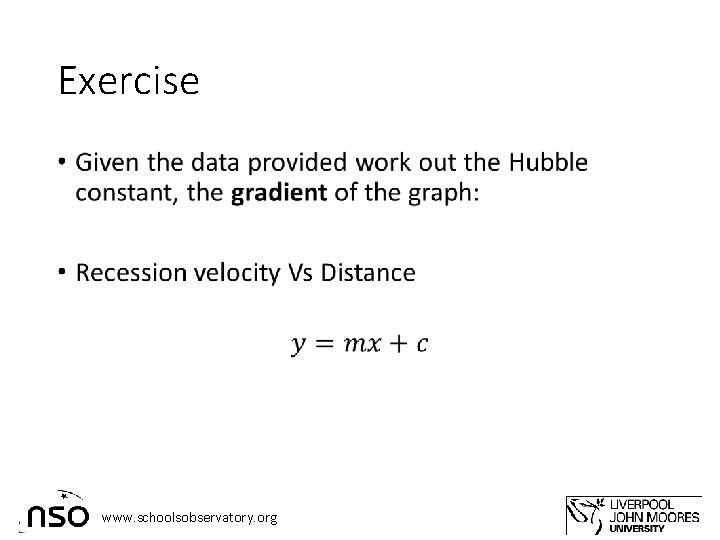
Exercise • www. schoolsobservatory. org
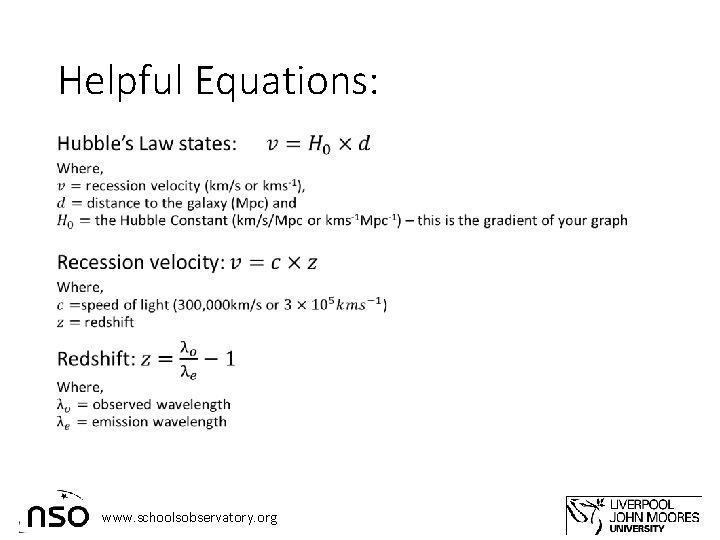
Helpful Equations: • www. schoolsobservatory. org

Redshift • When an object is moving away the light increases in wavelength • Hot objects, like stars also emit radiation (light) at specific wavelengths, known as emission lines; and obstruct light at specific wavelengths, known as absorption lines • These lines also move to the longer wavelength part of the spectrum – they shift to the red www. schoolsobservatory. org
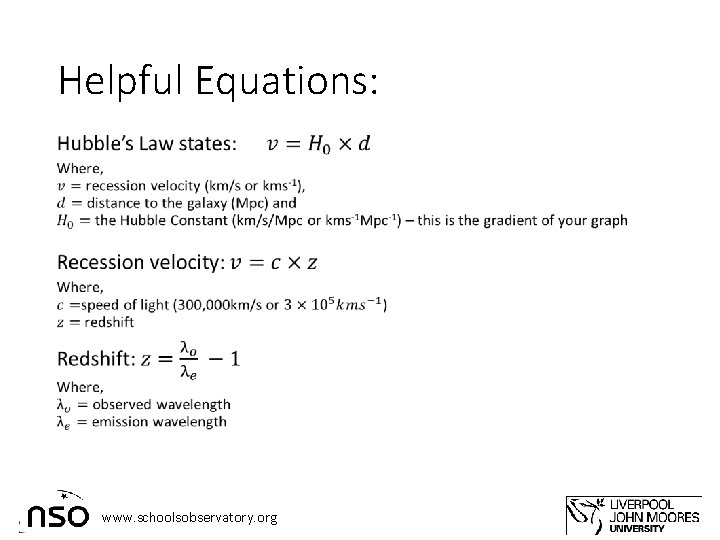
Helpful Equations: • www. schoolsobservatory. org
- Slides: 9