
The How Why of Formative Assessment How to
- Slides: 12
The How & Why of Formative Assessment How to use it and why it helps you and your students to learn “better”!
In the old days… • Teachers taught, students learned. • Teachers could ‘eyeball’ their students and knew who needed help and who ‘got it’ • Most students were motivated to “get it” to; a. Please their teacher b. Please their parents c. Get a good grade
Pit Falls – Teacher Self-Thinking “I taught it, we discussed it in class, we did the review sheet and they STILL failed the test. ” (That test would have been the SUMMATIVE assessment) Unfortunately, discussing in class usually leads to the kids that get it, doing the talking and the ones that don’t sliding deeper into their chairs, using the bathroom, or act out. Review sheets “get lost” or not done or copied from a kid who knows the answers.
But Today…. • Students’ attention is divided by many outside stimuli • In many cases, family structures are not as supportive of education. (time, meals etc. ) • Students are not as motivated to ‘get it’ due to outside interests (electronics, digital media etc. ) Achievement is not intrinsically present as a goal in their lives.
Add to that…. • The burden of accountability has fallen to YOU as the teacher in the classroom. • You need newer, better tools to manage the learning for each of your students. • One of those tools needs to be strategies that keep students focused and engaged. • The need for students to reflect on what they understand what they don’t is key to getting them to ‘buy in’ to their learning
The Role of FORMATIVE ASSESSMENT • What is it? It is a quick tally of how students are internalizing what you are teaching every time you present new material or re-visiting what you taught yesterday. • What does it look like? It has many different faces (known as strategies)
Common Formative Assessment Strategies • Thumbs up/down • Ticket out the door (or variations) • Moving to identified places in the room labeled “got it” or ‘still getting it” • *Use of fingers (1, 2, 3 ) to indicate level of understanding (This also involves the students’ reflection on their learning holding them accountable to be paying attention)
What do you do with that information? • Design, or redesign the next day’s lesson based on what you found out. • Celebrate with the students! (if they all got it) • Change the way you presented the lesson. (do they need more concrete instruction? )
The use of TARGET Statements • Useful because they focus YOUR teaching goal • Useful because they focus the students’ learning goal. • Can be used to determine successfulness of that day’s learning objective. (Example: As you leave, you have to tell me ___”) Success is determined by students’ reflection and teacher observation/data)
Looks and Sounds like… • “Have you ever wondered why ducks’ feet don’t freeze when they swim in cold water? ” • (Maybe for anticipatory set, you could have pictures of ducks in the water) • By the end of today’s lesson, I’ll be asking each of you to explain to me how ducks keep their feet from freezing”.
It’s Just Good Teaching! • To consistently monitor the level of learning AS you teach as well as finding out which students need help and which ones are ready to move on. • As lack of focus becomes more of an issue with many students, and class sizes increase, having a planned strategy is vital for all students to be successful.
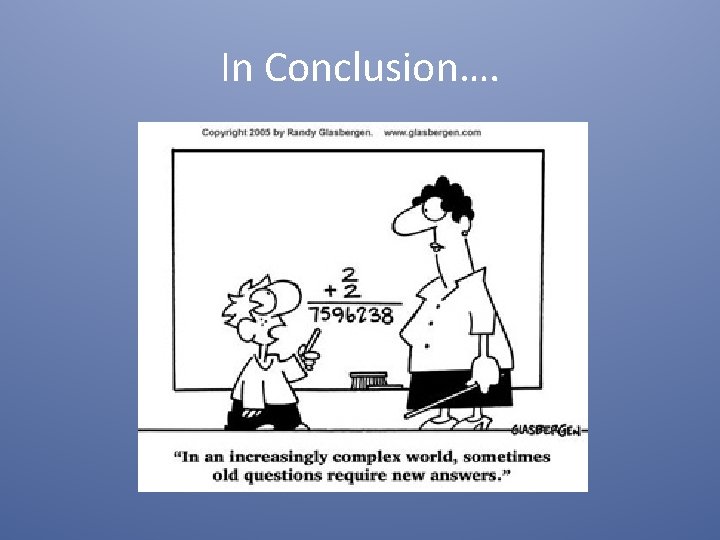
In Conclusion….