
The House of Saud 112022 1 Overview Saud
![The House of Saud (Arabic: آﻞ ﺳﻌﻮﺩ romanized: ʾĀl Suʿūd IPA: [ʔaːl sʊʕuːd]) is](https://slidetodoc.com/presentation_image_h2/478c8f49145d0f5e4dda82f8db823777/image-6.jpg "The House of Saud (Arabic: آﻞ ﺳﻌﻮﺩ romanized: ʾĀl Suʿūd IPA: [ʔaːl sʊʕuːd]) is")
![Origins and early history[edit] 1/1/2022 The earliest recorded ancestor of the Al Saud was](https://slidetodoc.com/presentation_image_h2/478c8f49145d0f5e4dda82f8db823777/image-10.jpg "Origins and early history[edit] 1/1/2022 The earliest recorded ancestor of the Al Saud was")
![The Emirate of Diriyah was the first Saudi state. [1] It was established in](https://slidetodoc.com/presentation_image_h2/478c8f49145d0f5e4dda82f8db823777/image-11.jpg "The Emirate of Diriyah was the first Saudi state. [1] It was established in")
![First Saudi state[edit] Main article: Emirate of Diriyah The First Saudi State was founded](https://slidetodoc.com/presentation_image_h2/478c8f49145d0f5e4dda82f8db823777/image-12.jpg "First Saudi state[edit] Main article: Emirate of Diriyah The First Saudi State was founded")
![Second Saudi state[edit] Main article: Emirate of Nejd A few years after the fall](https://slidetodoc.com/presentation_image_h2/478c8f49145d0f5e4dda82f8db823777/image-13.jpg "Second Saudi state[edit] Main article: Emirate of Nejd A few years after the fall")
![Opposition Since May 2017 in response to protests against the government, [disputed – discuss]](https://slidetodoc.com/presentation_image_h2/478c8f49145d0f5e4dda82f8db823777/image-20.jpg "Opposition Since May 2017 in response to protests against the government, [disputed – discuss]")
- Slides: 44
The House of Saud 1/1/2022 1
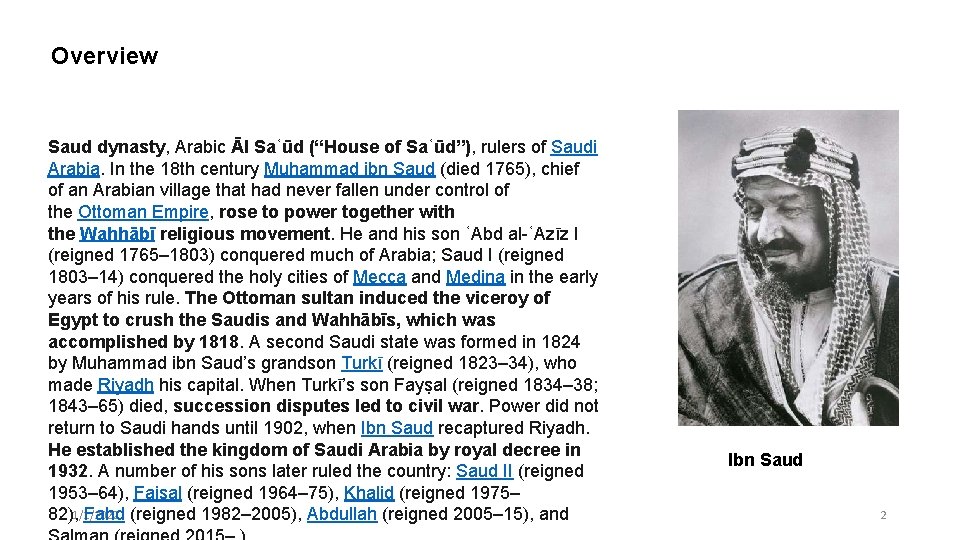
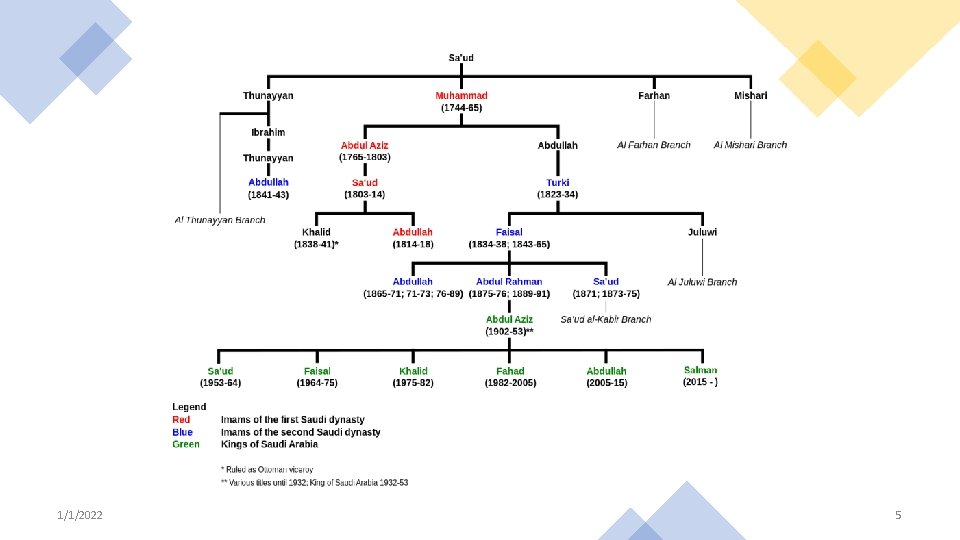
Overview Saud dynasty, Arabic Āl Saʿūd (“House of Saʿūd”), rulers of Saudi Arabia. In the 18 th century Muhammad ibn Saud (died 1765), chief of an Arabian village that had never fallen under control of the Ottoman Empire, rose to power together with the Wahhābī religious movement. He and his son ʿAbd al-ʿAzīz I (reigned 1765– 1803) conquered much of Arabia; Saud I (reigned 1803– 14) conquered the holy cities of Mecca and Medina in the early years of his rule. The Ottoman sultan induced the viceroy of Egypt to crush the Saudis and Wahhābīs, which was accomplished by 1818. A second Saudi state was formed in 1824 by Muhammad ibn Saud’s grandson Turkī (reigned 1823– 34), who made Riyadh his capital. When Turkī’s son Fayṣal (reigned 1834– 38; 1843– 65) died, succession disputes led to civil war. Power did not return to Saudi hands until 1902, when Ibn Saud recaptured Riyadh. He established the kingdom of Saudi Arabia by royal decree in 1932. A number of his sons later ruled the country: Saud II (reigned 1953– 64), Faisal (reigned 1964– 75), Khalid (reigned 1975– 82), 1/1/2022 Fahd (reigned 1982– 2005), Abdullah (reigned 2005– 15), and Ibn Saud 2
Parent family Al-Muqrin of the Diriyah house of Al-Muraydi of Banu Hanifa Country Saudi Arabia Founded 1720 Founder Saud I (died 1725) Current head Salman bin Abdulaziz Titles • King of Saudi Arabia • Custodian of the Two Holy Mosques • Crown Prince of Saudi Arabia • King of Nejd and Hejaz • Sultan of Nejd King of Hejaz • Imam of Nejd • Imam of Diriyah • Amir of Nejd and Hasa Traditions Sunni Religion Islam 1/1/2022 Emblem of Saudi Arabia, adopted in 1950 3
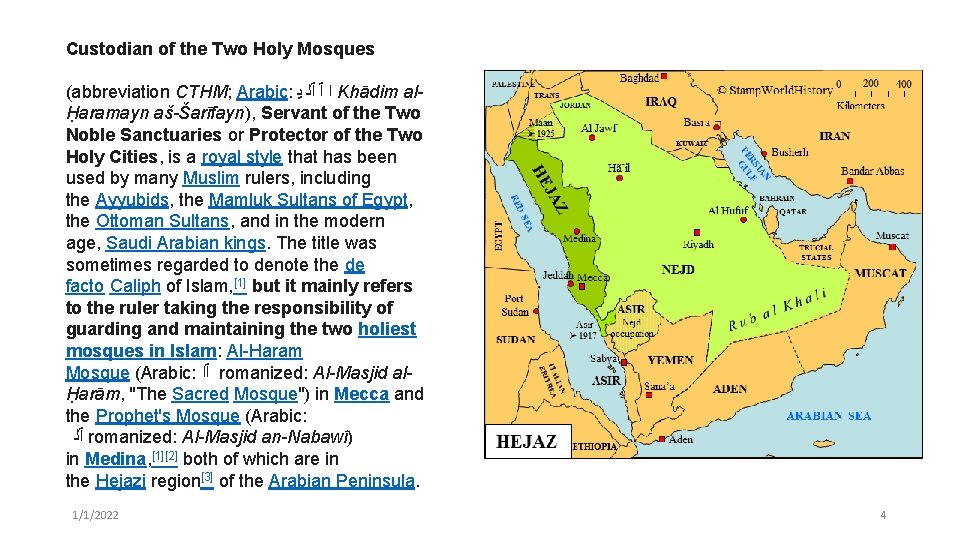
Custodian of the Two Holy Mosques (abbreviation CTHM; Arabic: ﺍ ٱ ٱﻠ ﻳ Khādim alḤaramayn aš-Šarīfayn), Servant of the Two Noble Sanctuaries or Protector of the Two Holy Cities, is a royal style that has been used by many Muslim rulers, including the Ayyubids, the Mamluk Sultans of Egypt, the Ottoman Sultans, and in the modern age, Saudi Arabian kings. The title was sometimes regarded to denote the de facto Caliph of Islam, [1] but it mainly refers to the ruler taking the responsibility of guarding and maintaining the two holiest mosques in Islam: Al-Haram Mosque (Arabic: ٱﺍ romanized: Al-Masjid alḤarām, "The Sacred Mosque") in Mecca and the Prophet's Mosque (Arabic: ٱﻠ romanized: Al-Masjid an-Nabawī) in Medina, [1][2] both of which are in the Hejazi region[3] of the Arabian Peninsula. 1/1/2022 4
1/1/2022 5
The House of Saud (Arabic: آﻞ ﺳﻌﻮﺩ romanized: ʾĀl Suʿūd IPA: [ʔaːl sʊʕuːd]) is the ruling royal family of Saudi Arabia. It is composed of the descendants of Muhammad bin Saud, founder of the Emirate of Diriyah, known as the First Saudi state (1744– 1818), and his brothers, though the ruling faction of the family is primarily led by the descendants of Ibn Saud, the modern founder of Saudi Arabia. [1] The most influential position of the royal family is the King of Saudi Arabia. The family in total is estimated to comprise some 15, 000 members, however the majority of power, influence and wealth is possessed by a group of about 2, 000 of them. [2][3] The House of Saud has had three phases: the Emirate of Diriyah, the First Saudi State (1744– 1818), marked by the expansion of Wahhabism; the Emirate of Nejd, the Second Saudi State (1824– 1891), marked with continuous infighting; and the Third Saudi State (1902–present), which evolved into Saudi Arabia in 1932 and now wields considerable influence in the Middle East. The family has had conflicts with the Ottoman Empire, the Sharif of Mecca, the Al Rashid family of Ha'il and their vassal houses in Najd, numerous Islamist groups both inside and outside Saudi Arabia and Shia minority in Saudi Arabia. The succession to the Saudi Arabian throne was designed to pass from one son of the first king, Ibn Saud, to another. King Salman, who reigns currently, first replaced the next crown prince, his brother Muqrin, with his nephew Muhammad bin Nayef. In 2017, Muhammad bin Nayef was replaced by Mohammad bin Salman, King Salman's son, as the crown prince after an approval by the Allegiance Council with 31 out of 34 votes. [4][5][6][7][8][9] The monarchy was hereditary by agnatic seniority until 2006, when a royal decree provided that future Saudi kings are to be elected by a committee of Saudi princes. [10] The king-appointed cabinet includes more members of the royal family. 1/1/2022 6
Saud I • Sheikh Saud I ibn Muhammad ibn Muqrin (Arabic: ﺳﻌﻮﺩ ﺍﻷﻮﻝ ﺑﻦ ﻣﺤﻤﺪ آﻞ ﻣﻘﺮﻥ 1640 1725)[1] was the eponymous ancestor of the House of Saud, otherwise known as the Al-Saud. • He was from the family of Al Muqrin, a family that traces its origin to the Arabian tribe of 'Amir ibn Saasaa. [2] He was the leader of the oasis of Dariya from 1720 to 1725. [3] • The Al-Saud originated as a leading family in a town called Diriyah, close to the modern city of Riyadh, near the center of Najd. Sometime in the early 16 th century, ancestors of Saud bin Muhammad took over some date groves, one of the few forms of agriculture the area could support, and settled there. Over time, the groves grew into a small town, and the clan came to be recognized as its leaders. [4] • Two decades after his death, Saud's son Muhammad ibn Saud (died 1765) made historic pact with Muhammad ibn Abd al-Wahhab (died 1792), leading to their conquest of Arabia and the First Saudi State. Sheikh Muhammad's patronymic "ibn Saud" eventually gave the clan its name of "Al-Saud". • He also had sons called Thunayyan, Mishari, and Farhan. [5] 1/1/2022 7
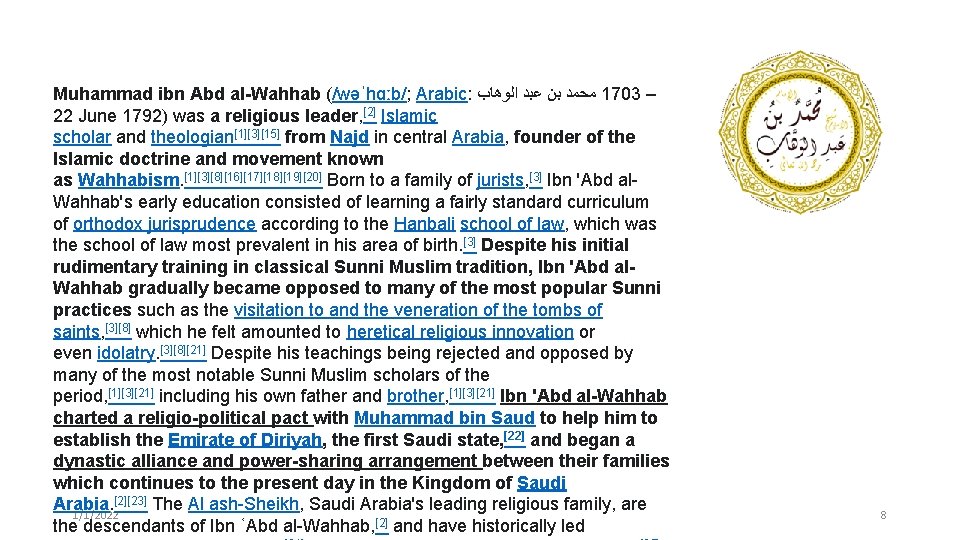
Muhammad ibn Abd al-Wahhab (/wəˈhɑːb/; Arabic: ﻣﺤﻤﺪ ﺑﻦ ﻋﺒﺪ ﺍﻟﻮﻫﺎﺏ 1703 – 22 June 1792) was a religious leader, [2] Islamic scholar and theologian[1][3][15] from Najd in central Arabia, founder of the Islamic doctrine and movement known as Wahhabism. [1][3][8][16][17][18][19][20] Born to a family of jurists, [3] Ibn 'Abd al. Wahhab's early education consisted of learning a fairly standard curriculum of orthodox jurisprudence according to the Hanbali school of law, which was the school of law most prevalent in his area of birth. [3] Despite his initial rudimentary training in classical Sunni Muslim tradition, Ibn 'Abd al. Wahhab gradually became opposed to many of the most popular Sunni practices such as the visitation to and the veneration of the tombs of saints, [3][8] which he felt amounted to heretical religious innovation or even idolatry. [3][8][21] Despite his teachings being rejected and opposed by many of the most notable Sunni Muslim scholars of the period, [1][3][21] including his own father and brother, [1][3][21] Ibn 'Abd al-Wahhab charted a religio-political pact with Muhammad bin Saud to help him to establish the Emirate of Diriyah, the first Saudi state, [22] and began a dynastic alliance and power-sharing arrangement between their families which continues to the present day in the Kingdom of Saudi [2][23] The Al ash-Sheikh, Saudi Arabia's leading religious family, are Arabia. 1/1/2022 the descendants of Ibn ʿAbd al-Wahhab, [2] and have historically led 8
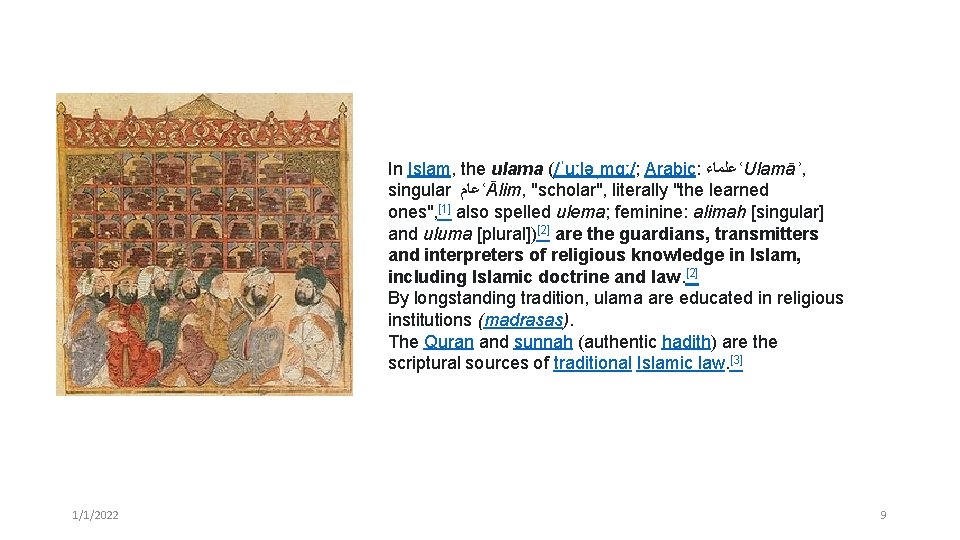
In Islam, the ulama (/ˈuːləˌmɑː/; Arabic: ﻋﻠﻤﺎﺀ ʿUlamāʾ, singular ﻋﺎﻡ ʿĀlim, "scholar", literally "the learned ones", [1] also spelled ulema; feminine: alimah [singular] and uluma [plural])[2] are the guardians, transmitters and interpreters of religious knowledge in Islam, including Islamic doctrine and law. [2] By longstanding tradition, ulama are educated in religious institutions (madrasas). The Quran and sunnah (authentic hadith) are the scriptural sources of traditional Islamic law. [3] 1/1/2022 9
Origins and early history[edit] 1/1/2022 The earliest recorded ancestor of the Al Saud was Mani' ibn Rabiah Al. Muraydi who settled in Diriyah in 1446– 1447 with his clan, the Mrudah. [16] Although the Mrudah are believed to be descended from the Rabi'ah tribal confederation, the 'Anizza branches of the Rabi'ah. [16] Mani was invited by a relative named Ibn Dir was the ruler of a set of villages and estates that make up modernday Riyadh. [17][18][19] Mani's clan had been on a sojourn in east Arabia, near al-Qatif, from an unknown point in time. Ibn Dir handed Mani two estates called al-Mulaybeed and Ghusayba. Mani and his family settled and renamed the region "al. Diriyah", after their benefactor Ibn The Mrudah became rulers of al-Diriyah, which prospered along the banks of Wadi Hanifa and became an important Najdi settlement. As the clan grew larger, power struggles ensued, with one branch leaving for nearby Dhruma, while another branch (the "Al Watban") left for the town of az-Zubayr in southern Iraq. The Al Muqrin became the ruling family among the Mrudah in Diriyah. The name of the clan comes from Sheikh Saud ibn Muhammad ibn Muqrin who died in 1725. [22] 10
The Emirate of Diriyah was the first Saudi state. [1] It was established in the year 1744 (1157 AH) when Muhammad ibn Abd al-Wahhab and Prince Muhammad bin Saud formed an alliance to found a socioreligious reform movement to unify the many states of the Arabian Peninsula and free it from Ottoman rule. [2][3] In 1744, both Muhammed bin Abd Al Wahhab and Muhammad bin Saud took an oath to achieve their goal. [4] Marriage between Muhammad bin Saud's son, Abdul-Aziz bin Muhammad, and the daughter of Muhammad ibn Abd al-Wahhab helped to seal the pact between their families which has lasted through the centuries to the present day. 1/1/2022 By Xristoph, CC BY-SA 3. 0, https: //commons. wikimedia. org/w/index. php? curid= 6443249 The Destruction of Diriyah took place in late 1818 at the end of the Wahhabi War of 1811– 18 during the Nejd Expedition. When the forces of Ibrahim Pasha had reached Diriyah, Abdullah I tried to defend his capital with an outnumbered army. After a siege of several months Abdullah surrendered to the Ottomans on September 9 with the promise of the safety of the civilian population of Diriyah which was breached by Ibrahim Pasha and the town was destroyed. Abdullah was imprisoned and with his treasurer and secretary was taken to Cairo where he met Mohammed Ali. Later Abdullah was sent to Istanbul, where, in spite of Ibrahim's promise of safety and of Mohammad Ali's intercession in his favor, he was put to death after a show trial. At the end of the year 1819 Ibrahim returned to Cairo, having subdued all opposition in the Arabian Peninsula, ending 11 the First Saudi state.
First Saudi state[edit] Main article: Emirate of Diriyah The First Saudi State was founded in 1744. This period was marked by conquest of neighboring areas and by religious zeal. At its height, the First Saudi State included most of the territory of modern-day Saudi Arabia, and raids by Al Saud's allies and followers reached into Yemen, Oman, Syria, and Iraq. Islamic Scholars, particularly Muhammad ibn Abdul Wahhab and his descendants, are believed to have played a significant role in Saudi rule during this period. The Saudis and their allies referred to themselves during this period as the Muwahhidun or Ahl al-Tawhid ("the monotheists"). Later they were referred to as the Wahhabis, a group of particularly strict, puritanical Sunni sect, named for its founder. Leadership of the Al Saud during the time of their first state passed from father to son without incident. The first imam, Muhammad ibn Saud, was succeeded by his eldest son Abdulaziz in 1765. In 1802, Abdulaziz led ten thousand Wahhabi soldiers into an attack on the Shi'ite holy city of Karbala, in what is now southern Iraq and where Hussein ibn Ali, the grandson of the prophet Muhammad is buried. [23] Led by Abdulaziz, the Wahhabi soldiers killed more than two thousand people, including women and children. [23] The soldiers plundered the city, demolishing the massive golden dome above Hussein's tomb and loaded hundreds of camels with weapons, jewelry, coins and other valuable goods. [23] The attack on Karbala convinced the Ottomans and the Egyptians that the Saudis were a threat to regional peace. [24] Abdulaziz was killed in 1803 by an assassin, believed by some to have been a Shi'ite seeking revenge over the sacking of Karbala the year before. Abdul-Aziz was in turn succeeded by his son, Saud, under whose rule the Saudi state reached its greatest extent. By the time Saud died in 1814, his son and successor Abdullah ibn Saud had to contend with an Ottoman-Egyptian invasion in the Ottoman– Wahhabi War seeking to retake lost Ottoman Empire territory. The mainly Egyptian force succeeded in defeating Abdullah's forces, taking over the Saudi capital of Diriyyah in 1818. Abdullah was taken prisoner and 1/1/2022 was soon beheaded by the Ottomans in Constantinople, putting an end to the First Saudi State. The Egyptians 12 sent many members of the Al Saud clan and other members of the local nobility as prisoners
Second Saudi state[edit] Main article: Emirate of Nejd A few years after the fall of Diriyah in 1818, the Saudis were able to re-establish their authority in Najd, establishing the Emirate of Nejd, commonly known as the Second Saudi State, with its capital in Riyadh. Compared to the First Saudi State, the second Saudi period was marked by less territorial expansion (it never reconquered the Hijaz or 'Asir, for example) and less religious zeal, although the Saudi leaders continued to go by the title of imam and still employed Salafi religious scholars. The second state was also marked by severe internal conflicts within the Saudi family, eventually leading to the dynasty's downfall. In all but one instance, succession occurred by assassination or civil war, the exception being the passage of authority from Faisal ibn Turki to his son Abdullah ibn The. Turki. Emirate of Nejd was the second Saudi state, existing between 1824 and 1891[2] in Nejd, the Faisal ibn regions of Riyadh and Ha'il of what is now Saudi Arabia. Saudi rule was restored to central and eastern Arabia after the Emirate of Diriyah, the First Saudi State, having previously been brought down by the Ottoman Empire's Egypt Eyalet in the Ottoman–Wahhabi War (1811– 1818). The second Saudi period was marked by less territorial expansion and less religious zeal, although the Saudi leaders continued to be called Imam and still employed Wahhabist religious scholars. Turki bin Abdullah bin Muhammad's reconquest of Riyadh from Egyptian forces in 1824 is generally regarded as the beginning of the Second Saudi State. Severe internal conflicts within the House of Saud eventually led to the dynasty's downfall at the Battle of Mulayda in 1891, between the forces loyal to the last Saudi imam, Abdul Rahman ibn Faisal ibn Turki, and the Rashidi dynasty of Ha'il. 1/1/2022 13
1/1/2022 14
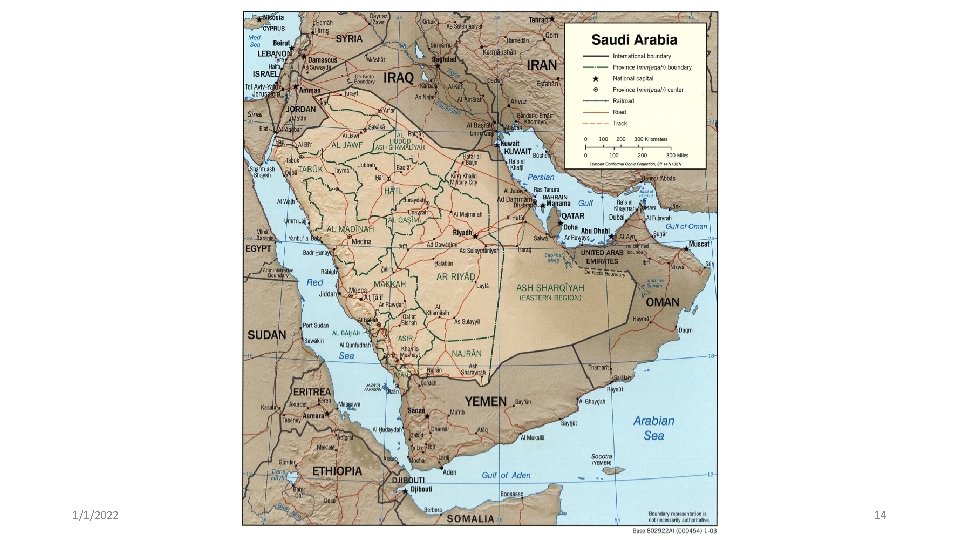
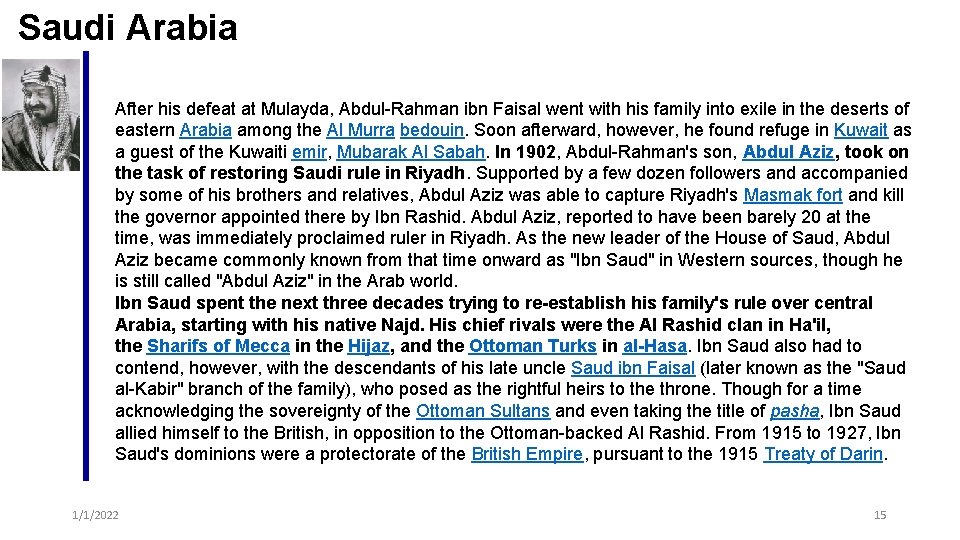
Saudi Arabia After his defeat at Mulayda, Abdul-Rahman ibn Faisal went with his family into exile in the deserts of eastern Arabia among the Al Murra bedouin. Soon afterward, however, he found refuge in Kuwait as a guest of the Kuwaiti emir, Mubarak Al Sabah. In 1902, Abdul-Rahman's son, Abdul Aziz, took on the task of restoring Saudi rule in Riyadh. Supported by a few dozen followers and accompanied by some of his brothers and relatives, Abdul Aziz was able to capture Riyadh's Masmak fort and kill the governor appointed there by Ibn Rashid. Abdul Aziz, reported to have been barely 20 at the time, was immediately proclaimed ruler in Riyadh. As the new leader of the House of Saud, Abdul Aziz became commonly known from that time onward as "Ibn Saud" in Western sources, though he is still called "Abdul Aziz" in the Arab world. Ibn Saud spent the next three decades trying to re-establish his family's rule over central Arabia, starting with his native Najd. His chief rivals were the Al Rashid clan in Ha'il, the Sharifs of Mecca in the Hijaz, and the Ottoman Turks in al-Hasa. Ibn Saud also had to contend, however, with the descendants of his late uncle Saud ibn Faisal (later known as the "Saud al-Kabir" branch of the family), who posed as the rightful heirs to the throne. Though for a time acknowledging the sovereignty of the Ottoman Sultans and even taking the title of pasha, Ibn Saud allied himself to the British, in opposition to the Ottoman-backed Al Rashid. From 1915 to 1927, Ibn Saud's dominions were a protectorate of the British Empire, pursuant to the 1915 Treaty of Darin. 1/1/2022 15
Saudi Arabia Ibn Saud won final victory over the Rashidis in 1921, making him the ruler of most of central Arabia. He consolidated his dominions as the Sultanate of Nejd. He then turned his attention to the Hijaz, finally conquering it in 1926, just months before the British protectorate ended. For the next five and a half years, he administered the two parts of his dual realm, the Kingdom of Hejaz and Nejd, as separate units. By 1932, Ibn Saud had disposed of all his main rivals and consolidated his rule over much of the Arabian Peninsula. He united his dominions into the Kingdom of Saudi Arabia that year. Ibn Saud's father, Abdul Rahman retained the honorary title of "imam. " In 1937 near Dammam, American surveyors discovered what later proved to be Saudi Arabia's vast oil reserves. Before the discovery of oil, many family members were destitute. [25] 1/1/2022 16
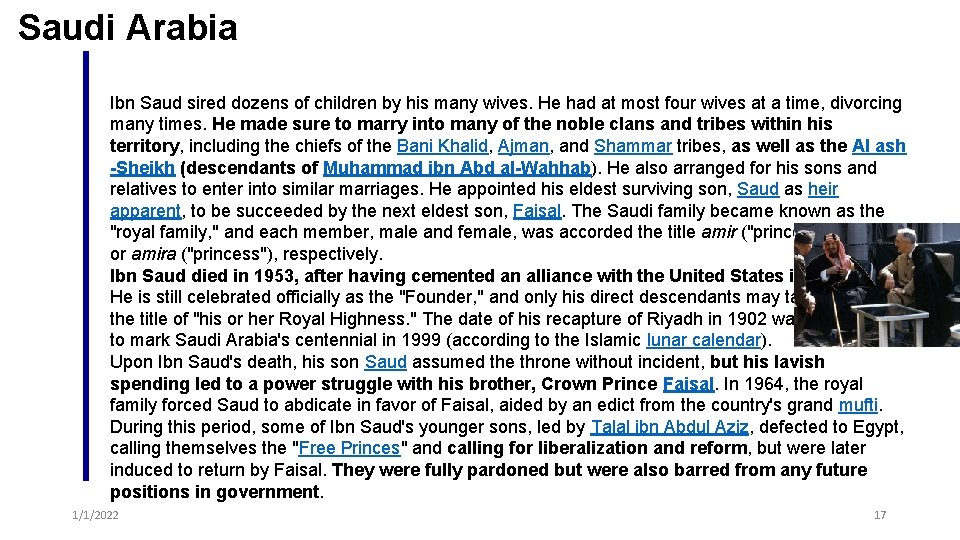
Saudi Arabia Ibn Saud sired dozens of children by his many wives. He had at most four wives at a time, divorcing many times. He made sure to marry into many of the noble clans and tribes within his territory, including the chiefs of the Bani Khalid, Ajman, and Shammar tribes, as well as the Al ash -Sheikh (descendants of Muhammad ibn Abd al-Wahhab). He also arranged for his sons and relatives to enter into similar marriages. He appointed his eldest surviving son, Saud as heir apparent, to be succeeded by the next eldest son, Faisal. The Saudi family became known as the "royal family, " and each member, male and female, was accorded the title amir ("prince") or amira ("princess"), respectively. Ibn Saud died in 1953, after having cemented an alliance with the United States in 1945. He is still celebrated officially as the "Founder, " and only his direct descendants may take on the title of "his or her Royal Highness. " The date of his recapture of Riyadh in 1902 was chosen to mark Saudi Arabia's centennial in 1999 (according to the Islamic lunar calendar). Upon Ibn Saud's death, his son Saud assumed the throne without incident, but his lavish spending led to a power struggle with his brother, Crown Prince Faisal. In 1964, the royal family forced Saud to abdicate in favor of Faisal, aided by an edict from the country's grand mufti. During this period, some of Ibn Saud's younger sons, led by Talal ibn Abdul Aziz, defected to Egypt, calling themselves the "Free Princes" and calling for liberalization and reform, but were later induced to return by Faisal. They were fully pardoned but were also barred from any future positions in government. 1/1/2022 17
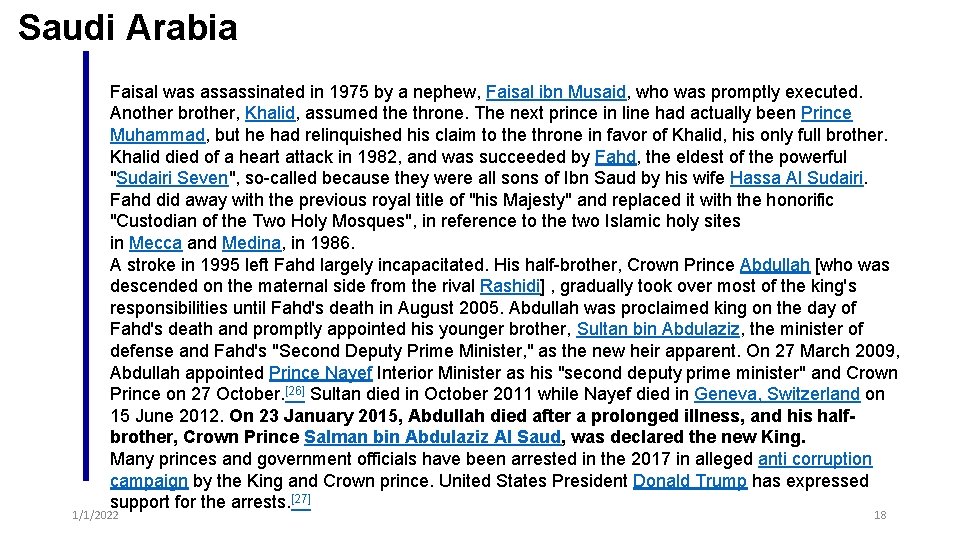
Saudi Arabia Faisal was assassinated in 1975 by a nephew, Faisal ibn Musaid, who was promptly executed. Another brother, Khalid, assumed the throne. The next prince in line had actually been Prince Muhammad, but he had relinquished his claim to the throne in favor of Khalid, his only full brother. Khalid died of a heart attack in 1982, and was succeeded by Fahd, the eldest of the powerful "Sudairi Seven", so-called because they were all sons of Ibn Saud by his wife Hassa Al Sudairi. Fahd did away with the previous royal title of "his Majesty" and replaced it with the honorific "Custodian of the Two Holy Mosques", in reference to the two Islamic holy sites in Mecca and Medina, in 1986. A stroke in 1995 left Fahd largely incapacitated. His half-brother, Crown Prince Abdullah [who was descended on the maternal side from the rival Rashidi] , gradually took over most of the king's responsibilities until Fahd's death in August 2005. Abdullah was proclaimed king on the day of Fahd's death and promptly appointed his younger brother, Sultan bin Abdulaziz, the minister of defense and Fahd's "Second Deputy Prime Minister, " as the new heir apparent. On 27 March 2009, Abdullah appointed Prince Nayef Interior Minister as his "second deputy prime minister" and Crown Prince on 27 October. [26] Sultan died in October 2011 while Nayef died in Geneva, Switzerland on 15 June 2012. On 23 January 2015, Abdullah died after a prolonged illness, and his halfbrother, Crown Prince Salman bin Abdulaziz Al Saud, was declared the new King. Many princes and government officials have been arrested in the 2017 in alleged anti corruption campaign by the King and Crown prince. United States President Donald Trump has expressed support for the arrests. [27] 1/1/2022 18
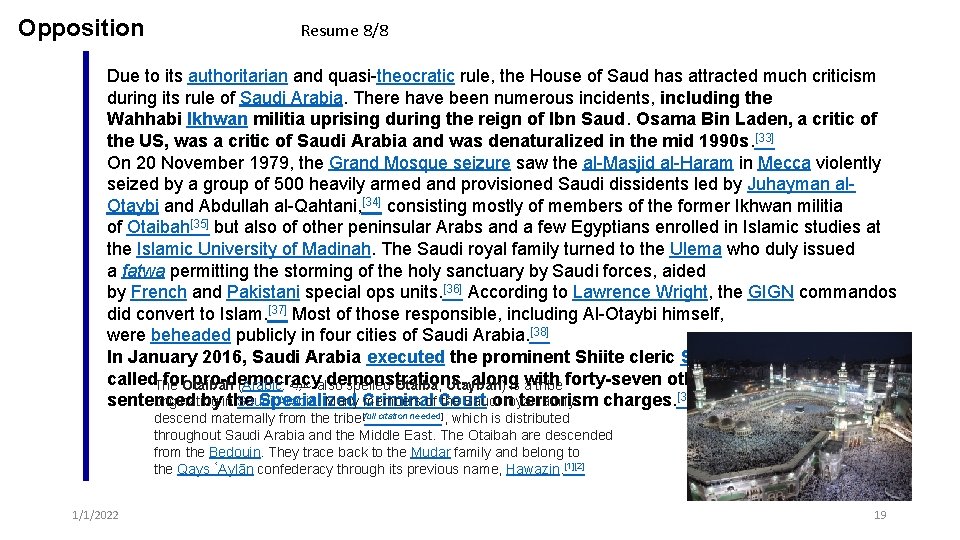
Opposition Resume 8/8 Due to its authoritarian and quasi-theocratic rule, the House of Saud has attracted much criticism during its rule of Saudi Arabia. There have been numerous incidents, including the Wahhabi Ikhwan militia uprising during the reign of Ibn Saud. Osama Bin Laden, a critic of the US, was a critic of Saudi Arabia and was denaturalized in the mid 1990 s. [33] On 20 November 1979, the Grand Mosque seizure saw the al-Masjid al-Haram in Mecca violently seized by a group of 500 heavily armed and provisioned Saudi dissidents led by Juhayman al. Otaybi and Abdullah al-Qahtani, [34] consisting mostly of members of the former Ikhwan militia of Otaibah[35] but also of other peninsular Arabs and a few Egyptians enrolled in Islamic studies at the Islamic University of Madinah. The Saudi royal family turned to the Ulema who duly issued a fatwa permitting the storming of the holy sanctuary by Saudi forces, aided by French and Pakistani special ops units. [36] According to Lawrence Wright, the GIGN commandos did convert to Islam. [37] Most of those responsible, including Al-Otaybi himself, were beheaded publicly in four cities of Saudi Arabia. [38] In January 2016, Saudi Arabia executed the prominent Shiite cleric Sheikh Nimr, who had called. The for. Otaibah pro-democracy demonstrations, along with (Arabic: ﻋﺘﻴﺒﺔ also spelled Otaiba, Utaybah) is a tribe forty-seven other Saudi Shia citizens sentenced by inthe Specialized on terrorism charges. [39] originating Saudi Arabia. Many Criminal members of Court the Saudi royal family descend maternally from the tribe[full citation needed], which is distributed throughout Saudi Arabia and the Middle East. The Otaibah are descended from the Bedouin. They trace back to the Mudar family and belong to the Qays ʿAylān confederacy through its previous name, Hawazin. [1][2] 1/1/2022 19
Opposition Since May 2017 in response to protests against the government, [disputed – discuss] the predominantly Shia town of Al-Awamiyah has been put under full siege by the Saudi military. Residents are not allowed to enter or leave, and military indiscriminately shells the neighborhoods with airstrikes, mortar[40] and artillery[41] fire along with snipers[42] shooting residents. [43][44][45][46] Dozens of Shia civilians were killed, including a three year old and[47] a two-year -old child. [48][49] The Saudi government claims it is fighting terrorists in al-Awamiyah. Crown Prince Mohammed bin Salman kept his own mother away from his father for more than two years, out of the fear that she would stop the king from giving the power to him. Princess Fahda bint Falah Al Hathleen, third wife of King Salman, was said to be in America for medical treatment. However, according to American intelligence this was refuted stating that she was not in the country. [50] Some Royals have been criticised for various Human Rights violations, including the death of Jamal Khashoggi, treatment of workers [51] and the Yemen war. The Reuters reported on 23 June, 2020, Saudi Crown Prince Mohammed bin Salman of allegedly threatening and intimidating a former intelligence officer, Saad al-Jabri along with his family of adult children, of returning to Saudi Arabia from exile in Canada. Saad was a long-time aide to the former crown prince, Prince Mohammed bin Nayef, who Prince Salman ousted in 2017. The official allegedly has access to documents containing information sensitive and pivotal for the crown prince’s leadership. [52] 1/1/2022 20
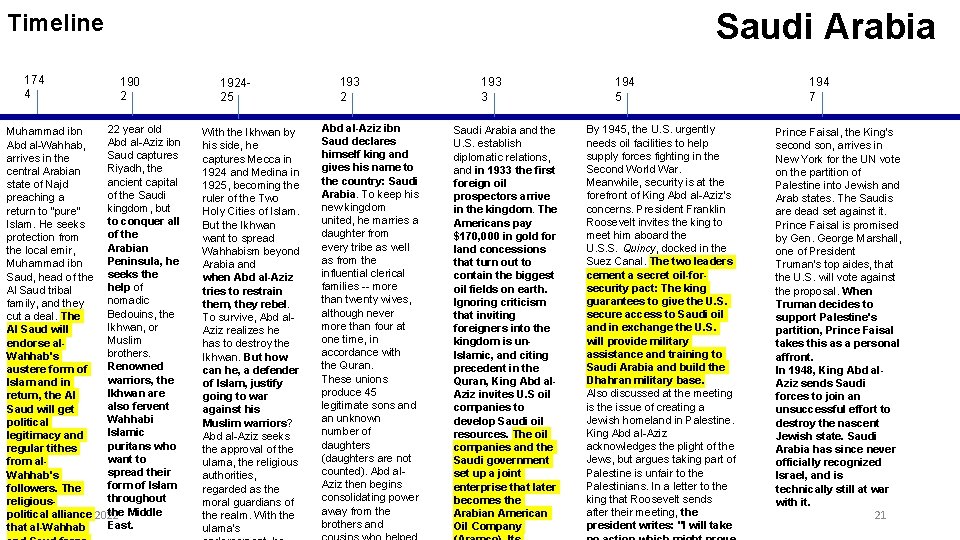
Saudi Arabia Timeline 174 4 190 2 22 year old Muhammad ibn Abd al-Aziz ibn Abd al-Wahhab, Saud captures arrives in the Riyadh, the central Arabian ancient capital state of Najd of the Saudi preaching a kingdom, but return to "pure" to conquer all Islam. He seeks of the protection from Arabian the local emir, Peninsula, he Muhammad ibn Saud, head of the seeks the help of Al Saud tribal nomadic family, and they Bedouins, the cut a deal. The Ikhwan, or Al Saud will Muslim endorse albrothers. Wahhab's Renowned austere form of warriors, the Islam and in Ikhwan are return, the Al also fervent Saud will get Wahhabi political Islamic legitimacy and puritans who regular tithes want to from alspread their Wahhab's form of Islam followers. The throughout religiousthe Middle political alliance 1/1/2022 East. that al-Wahhab 192425 With the Ikhwan by his side, he captures Mecca in 1924 and Medina in 1925, becoming the ruler of the Two Holy Cities of Islam. But the Ikhwan want to spread Wahhabism beyond Arabia and when Abd al-Aziz tries to restrain them, they rebel. To survive, Abd al. Aziz realizes he has to destroy the Ikhwan. But how can he, a defender of Islam, justify going to war against his Muslim warriors? Abd al-Aziz seeks the approval of the ulama, the religious authorities, regarded as the moral guardians of the realm. With the ulama's 193 2 Abd al-Aziz ibn Saud declares himself king and gives his name to the country: Saudi Arabia. To keep his new kingdom united, he marries a daughter from every tribe as well as from the influential clerical families -- more than twenty wives, although never more than four at one time, in accordance with the Quran. These unions produce 45 legitimate sons and an unknown number of daughters (daughters are not counted). Abd al. Aziz then begins consolidating power away from the brothers and 193 3 Saudi Arabia and the U. S. establish diplomatic relations, and in 1933 the first foreign oil prospectors arrive in the kingdom. The Americans pay $170, 000 in gold for land concessions that turn out to contain the biggest oil fields on earth. Ignoring criticism that inviting foreigners into the kingdom is un. Islamic, and citing precedent in the Quran, King Abd al. Aziz invites U. S oil companies to develop Saudi oil resources. The oil companies and the Saudi government set up a joint enterprise that later becomes the Arabian American Oil Company 194 5 By 1945, the U. S. urgently needs oil facilities to help supply forces fighting in the Second World War. Meanwhile, security is at the forefront of King Abd al-Aziz's concerns. President Franklin Roosevelt invites the king to meet him aboard the U. S. S. Quincy, docked in the Suez Canal. The two leaders cement a secret oil-forsecurity pact: The king guarantees to give the U. S. secure access to Saudi oil and in exchange the U. S. will provide military assistance and training to Saudi Arabia and build the Dhahran military base. Also discussed at the meeting is the issue of creating a Jewish homeland in Palestine. King Abd al-Aziz acknowledges the plight of the Jews, but argues taking part of Palestine is unfair to the Palestinians. In a letter to the king that Roosevelt sends after their meeting, the president writes: "I will take 194 7 Prince Faisal, the King's second son, arrives in New York for the UN vote on the partition of Palestine into Jewish and Arab states. The Saudis are dead set against it. Prince Faisal is promised by Gen. George Marshall, one of President Truman's top aides, that the U. S. will vote against the proposal. When Truman decides to support Palestine's partition, Prince Faisal takes this as a personal affront. In 1948, King Abd al. Aziz sends Saudi forces to join an unsuccessful effort to destroy the nascent Jewish state. Saudi Arabia has since never officially recognized Israel, and is technically still at war with it. 21
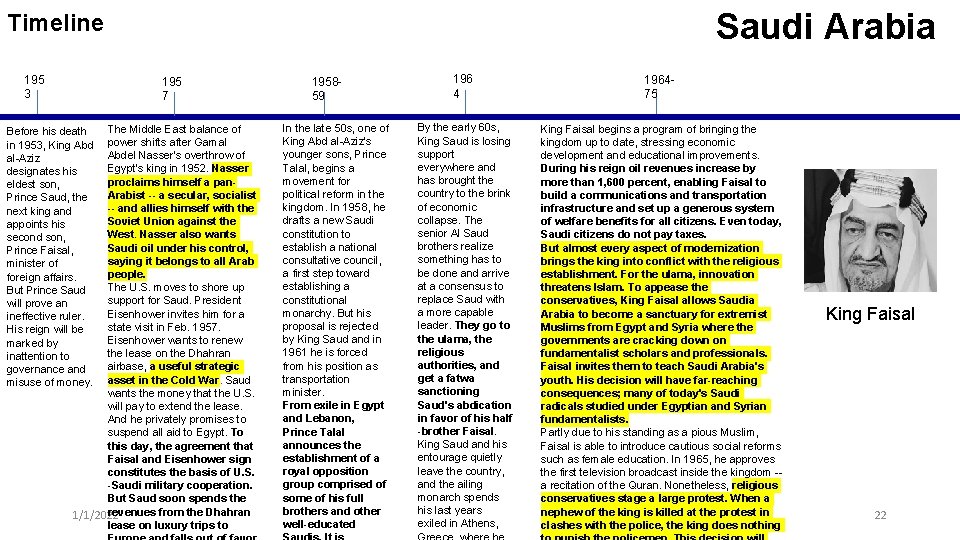
Saudi Arabia Timeline 195 3 195 7 The Middle East balance of power shifts after Gamal Abdel Nasser's overthrow of Egypt's king in 1952. Nasser proclaims himself a pan. Arabist -- a secular, socialist -- and allies himself with the Soviet Union against the West. Nasser also wants Saudi oil under his control, saying it belongs to all Arab people. The U. S. moves to shore up support for Saud. President Eisenhower invites him for a state visit in Feb. 1957. Eisenhower wants to renew the lease on the Dhahran airbase, a useful strategic asset in the Cold War. Saud wants the money that the U. S. will pay to extend the lease. And he privately promises to suspend all aid to Egypt. To this day, the agreement that Faisal and Eisenhower sign constitutes the basis of U. S. -Saudi military cooperation. But Saud soon spends the revenues from the Dhahran 1/1/2022 lease on luxury trips to Before his death in 1953, King Abd al-Aziz designates his eldest son, Prince Saud, the next king and appoints his second son, Prince Faisal, minister of foreign affairs. But Prince Saud will prove an ineffective ruler. His reign will be marked by inattention to governance and misuse of money. 195859 In the late 50 s, one of King Abd al-Aziz's younger sons, Prince Talal, begins a movement for political reform in the kingdom. In 1958, he drafts a new Saudi constitution to establish a national consultative council, a first step toward establishing a constitutional monarchy. But his proposal is rejected by King Saud and in 1961 he is forced from his position as transportation minister. From exile in Egypt and Lebanon, Prince Talal announces the establishment of a royal opposition group comprised of some of his full brothers and other well-educated 196 4 196475 By the early 60 s, King Saud is losing support everywhere and has brought the country to the brink of economic collapse. The senior Al Saud brothers realize something has to be done and arrive at a consensus to replace Saud with a more capable leader. They go to the ulama, the religious authorities, and get a fatwa sanctioning Saud's abdication in favor of his half -brother Faisal. King Saud and his entourage quietly leave the country, and the ailing monarch spends his last years exiled in Athens, King Faisal begins a program of bringing the kingdom up to date, stressing economic development and educational improvements. During his reign oil revenues increase by more than 1, 600 percent, enabling Faisal to build a communications and transportation infrastructure and set up a generous system of welfare benefits for all citizens. Even today, Saudi citizens do not pay taxes. But almost every aspect of modernization brings the king into conflict with the religious establishment. For the ulama, innovation threatens Islam. To appease the conservatives, King Faisal allows Saudia Arabia to become a sanctuary for extremist Muslims from Egypt and Syria where the governments are cracking down on fundamentalist scholars and professionals. Faisal invites them to teach Saudi Arabia's youth. His decision will have far-reaching consequences; many of today's Saudi radicals studied under Egyptian and Syrian fundamentalists. Partly due to his standing as a pious Muslim, Faisal is able to introduce cautious social reforms such as female education. In 1965, he approves the first television broadcast inside the kingdom -a recitation of the Quran. Nonetheless, religious conservatives stage a large protest. When a nephew of the king is killed at the protest in clashes with the police, the king does nothing King Faisal 22
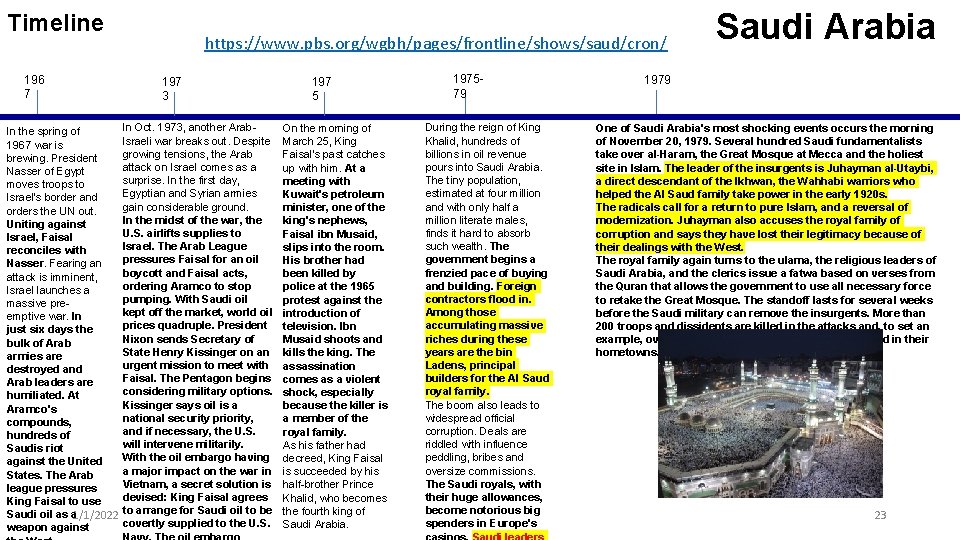
Timeline 196 7 In the spring of 1967 war is brewing. President Nasser of Egypt moves troops to Israel's border and orders the UN out. Uniting against Israel, Faisal reconciles with Nasser. Fearing an attack is imminent, Israel launches a massive preemptive war. In just six days the bulk of Arab armies are destroyed and Arab leaders are humiliated. At Aramco's compounds, hundreds of Saudis riot against the United States. The Arab league pressures King Faisal to use Saudi oil as a 1/1/2022 weapon against https: //www. pbs. org/wgbh/pages/frontline/shows/saud/cron/ 197 3 In Oct. 1973, another Arab. Israeli war breaks out. Despite growing tensions, the Arab attack on Israel comes as a surprise. In the first day, Egyptian and Syrian armies gain considerable ground. In the midst of the war, the U. S. airlifts supplies to Israel. The Arab League pressures Faisal for an oil boycott and Faisal acts, ordering Aramco to stop pumping. With Saudi oil kept off the market, world oil prices quadruple. President Nixon sends Secretary of State Henry Kissinger on an urgent mission to meet with Faisal. The Pentagon begins considering military options. Kissinger says oil is a national security priority, and if necessary, the U. S. will intervene militarily. With the oil embargo having a major impact on the war in Vietnam, a secret solution is devised: King Faisal agrees to arrange for Saudi oil to be covertly supplied to the U. S. 197 5 On the morning of March 25, King Faisal's past catches up with him. At a meeting with Kuwait's petroleum minister, one of the king's nephews, Faisal ibn Musaid, slips into the room. His brother had been killed by police at the 1965 protest against the introduction of television. Ibn Musaid shoots and kills the king. The assassination comes as a violent shock, especially because the killer is a member of the royal family. As his father had decreed, King Faisal is succeeded by his half-brother Prince Khalid, who becomes the fourth king of Saudi Arabia. 197579 During the reign of King Khalid, hundreds of billions in oil revenue pours into Saudi Arabia. The tiny population, estimated at four million and with only half a million literate males, finds it hard to absorb such wealth. The government begins a frenzied pace of buying and building. Foreign contractors flood in. Among those accumulating massive riches during these years are the bin Ladens, principal builders for the Al Saud royal family. The boom also leads to widespread official corruption. Deals are riddled with influence peddling, bribes and oversize commissions. The Saudi royals, with their huge allowances, become notorious big spenders in Europe's Saudi Arabia 1979 One of Saudi Arabia's most shocking events occurs the morning of November 20, 1979. Several hundred Saudi fundamentalists take over al-Haram, the Great Mosque at Mecca and the holiest site in Islam. The leader of the insurgents is Juhayman al-Utaybi, a direct descendant of the Ikhwan, the Wahhabi warriors who helped the Al Saud family take power in the early 1920 s. The radicals call for a return to pure Islam, and a reversal of modernization. Juhayman also accuses the royal family of corruption and says they have lost their legitimacy because of their dealings with the West. The royal family again turns to the ulama, the religious leaders of Saudi Arabia, and the clerics issue a fatwa based on verses from the Quran that allows the government to use all necessary force to retake the Great Mosque. The standoff lasts for several weeks before the Saudi military can remove the insurgents. More than 200 troops and dissidents are killed in the attacks and, to set an example, over sixty of the zealots are publicly beheaded in their hometowns. 23
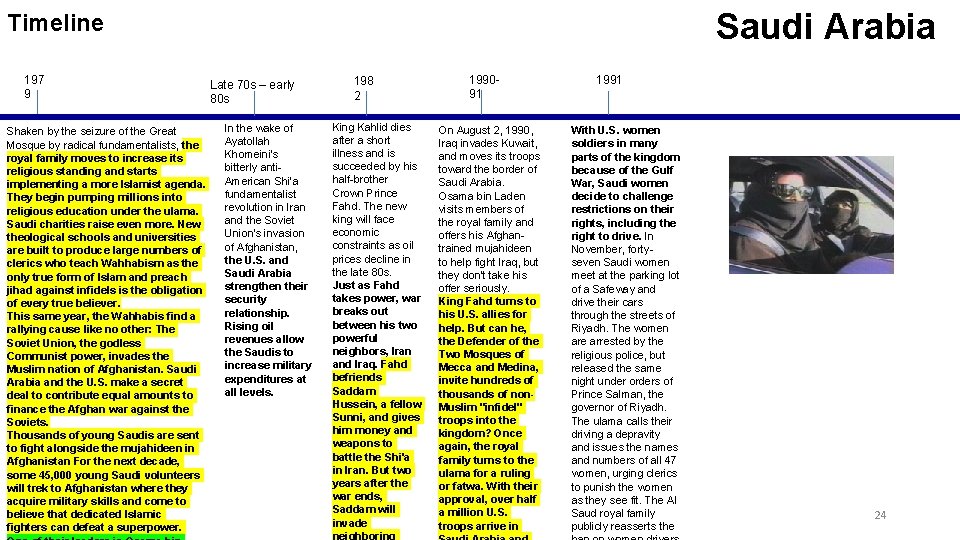
Saudi Arabia Timeline 197 9 Shaken by the seizure of the Great Mosque by radical fundamentalists, the royal family moves to increase its religious standing and starts implementing a more Islamist agenda. They begin pumping millions into religious education under the ulama. Saudi charities raise even more. New theological schools and universities are built to produce large numbers of clerics who teach Wahhabism as the only true form of Islam and preach jihad against infidels is the obligation of every true believer. This same year, the Wahhabis find a rallying cause like no other: The Soviet Union, the godless Communist power, invades the Muslim nation of Afghanistan. Saudi Arabia and the U. S. make a secret deal to contribute equal amounts to finance the Afghan war against the Soviets. Thousands of young Saudis are sent to fight alongside the mujahideen in Afghanistan For the next decade, some 45, 000 young Saudi volunteers will trek to Afghanistan where they acquire military skills and come to believe that dedicated 1/1/2022 Islamic fighters can defeat a superpower. Late 70 s – early 80 s In the wake of Ayatollah Khomeini's bitterly anti. American Shi'a fundamentalist revolution in Iran and the Soviet Union's invasion of Afghanistan, the U. S. and Saudi Arabia strengthen their security relationship. Rising oil revenues allow the Saudis to increase military expenditures at all levels. 198 2 King Kahlid dies after a short illness and is succeeded by his half-brother Crown Prince Fahd. The new king will face economic constraints as oil prices decline in the late 80 s. Just as Fahd takes power, war breaks out between his two powerful neighbors, Iran and Iraq. Fahd befriends Saddam Hussein, a fellow Sunni, and gives him money and weapons to battle the Shi'a in Iran. But two years after the war ends, Saddam will invade neighboring 199091 On August 2, 1990, Iraq invades Kuwait, and moves its troops toward the border of Saudi Arabia. Osama bin Laden visits members of the royal family and offers his Afghantrained mujahideen to help fight Iraq, but they don't take his offer seriously. King Fahd turns to his U. S. allies for help. But can he, the Defender of the Two Mosques of Mecca and Medina, invite hundreds of thousands of non. Muslim "infidel" troops into the kingdom? Once again, the royal family turns to the ulama for a ruling or fatwa. With their approval, over half a million U. S. troops arrive in 1991 With U. S. women soldiers in many parts of the kingdom because of the Gulf War, Saudi women decide to challenge restrictions on their rights, including the right to drive. In November, fortyseven Saudi women meet at the parking lot of a Safeway and drive their cars through the streets of Riyadh. The women are arrested by the religious police, but released the same night under orders of Prince Salman, the governor of Riyadh. The ulama calls their driving a depravity and issues the names and numbers of all 47 women, urging clerics to punish the women as they see fit. The Al Saud royal family publicly reasserts the 24
Saudi Arabia Timeline 199 2 A group of 107 Wahhabi religious figures sends a 46 -page "Memorandum of Advice" to King Fahd criticizing the government for corruption and human rights abuses and for allowing U. S. troops on Saudi soil. The document calls on the government to more strictly follow shari'a, or Islamic law, and end relations with Western governments. King Fahd dismisses seven of the 17 members of the ulama for refusing to denounce the memorandum. Amid calls for democratic reform, King Fahd introduces the "Basic Law of Government, " essentially the country's first written constitution. The first of the laws specifies that Saudi Arabia is a sovereign Arab Islamic state with a monarchy headed by the House of Saud. The Al Saud's control of government remains tight, but the new laws make some concessions to reformers. For example, a Consultative Council of 60 members appointed by the king is created to interpret laws and make 1/1/2022 recommendations on matters of 199 4 Following the government's arrest of two Wahhabi clerics for antigovernment preaching, several thousand protestors stage demonstrations in the town of Buraida. The clerics accuse the monarchy of corruption and betraying Islam by allowing U. S. troops on the Arabian Peninsula. The government admits to arresting over a hundred protestors; opposition groups claim thousands were seized. The incident ends up forcing the government to cede more control to the Wahhabi clerics, but only if the clerics promise 199 5 Four years after the Gulf War, U. S. troops are still in the kingdom. Osama bin Laden seizes on the issue and his followers go on the offensive. On the morning of November 13, 1995 a massive bomb shakes the U. S. operated Saudi National Guard training center in Riyadh. Five American military contractors and one U. S. soldier are killed. Those arrested say they are inspired by bin Laden. 199596 Following a series of strokes in 1995 and 1996, King Fahd is no longer able to run the government and Crown Prince Abdullah, Fahd's half brother, becomes the kingdom's de facto ruler. 1996 On the morning of June 25, 1996 a large truck bomb explodes at the U. S. military residence in Dhahran called Khobar Towers, killing 19 U. S. servicemen. U. S. law enforcement efforts to investigate the bombing are met with resistance by Saudi officials. Five years later, a federal grand jury will indict 13 Saudis and one Lebanese man for the attack. 1996 In his 1996 declarati on of war against the Americans occupying the lands of the Two Holy Places, Osama bin Laden calls on Muslims everywhere to fight the Jews and crusaders. He also accuses the Saudi royal family of pocketing the national wealth. 1996 Arab satellite television begins broadcasting throughout the region, beyond the control of the Saudi monarchy. For the first time, Saudi citizens see for themselves reports of their country's shortcomings: the lack of civil rights, political freedoms, royal corruption. Disturbing images of the Arab-Israeli conflict become part of Saudis' daily viewing. Throughout the 90 s, U. S. efforts to forge a lasting peace in the Israeli-Palestinian conflict are unsuccessful. When the Saudis sense that the new U. S. president, George W. Bush, might abandon the peace process, 25
Saudi Arabia Timeline August 2001 Frustrated by what he sees as a continuing pro. Israeli bias by the Bush administration and its predecessors, Crown Prince Abdullah sends an angry letter to President Bush on August 29, stating that if the U. S. does not behave in a more equitable manner toward the Palestinians, the Saudis will have to reconsider their long-standing alliance with the U. S. But before any measurable action can be taken on his complaint, the terrorist attacks of Sept. 11 occur. 1/1/2022 Sept. 11, 2001 At the official level, the Saudi government is appalled by the terrorist attacks in the U. S. and publishes a statement calling them "regrettable" and "inhuman. " Although it is known almost immediately that 15 of the 19 hijackers in the Al Qaeda plot are Saudi citizens, months pass before the Saudi government will admit it. America's subsequent war on terror in Afghanistan against Al Qaeda deeply divides Saudis. But Saudi leaders quietly allow the U. S. military to use Saudi air bases for command control operations. April 2003 Just days after Baghdad falls to U. S. forces in Iraq, U. S. Secretary of Defense Donald Rumsfeld arrives in Riyadh to announce that U. S. troops will pull out of Saudi air bases. For more than ten years, the American presence in the Land of the Two Holy Mosques has been a rallying cry for Al Qaeda. May 2003 The fact that U. S. troops are withdrawing from the kingdom makes no difference to Al Qaeda. On May 12, 2003 Al Qaeda militants attack three compounds in Riyadh that house hundreds of foreign workers. Thirty-five people are killed, including nine Americans. Over one hundred are wounded. Shocked, Saudi society and the royal family begin to look inward and to question how their own citizens could have been behind the attacks. 2004 In early 2004, a group of prominent Saudi citizens, including attorney Bassim Alim, petition the government for constitutional reforms. Prince Nayef, the minister of the interior, meets with them and insists that the petitions stop. Shortly after, many of the petitioners are arrested. Nov. 2004 At Friday prayers on November 5, 2004, twentysix prominent Saudi clerics, including Sheik h Nasser al. Omar, sign a fatwa saying that Iraqis should rise up and oppose the Americans in Iraq. Many interpret the fatwa as encouraging all Muslims to go fight the Americans. In Dec. 2004, a young Saudi medical student travels to Mosul, Iraq and detonates a bomb that kills 22 U. S. soldiers. To date, an unknown 2003 -05 From May 2003 to December 2004, some 100 people are killed in attacks by Al Qaeda in Saudi Arabia. Westerners are a prime target. In the summer of 2004, a BBC cameraman is gunned down while filming in a Riyadh street. Two days later, a U. S. defense contractor is shot to death in his garage. A week later, another U. S. defense worker is killed outside his home in Riyadh, and U. S. engineer Paul Johnson is abducted by terrorists and is seen being beheaded in a video that is put on the Internet. In December 2004 an assault on the U. S. consulate in Jeddah leaves five foreign staff dead. Two weeks later, the Saudi Ministry of the Interior is car bombed. As of February 2005, thousands of Americans have pulled out of the kingdom and British Airways has suspended flights to the country. On Aug. 1, 2005, King Fahd dies at the age of 82, and his half-brother Abdullah is officially named monarch. Today, King Abdullah and the Saudi royal family face the most severe challenge in its one hundred-year history and straining its oilfor-security alliance with the U. S. Ultimately, the Saudis believe an oil dependent America cannot afford 26 Saudi Arabia's demise. The House of
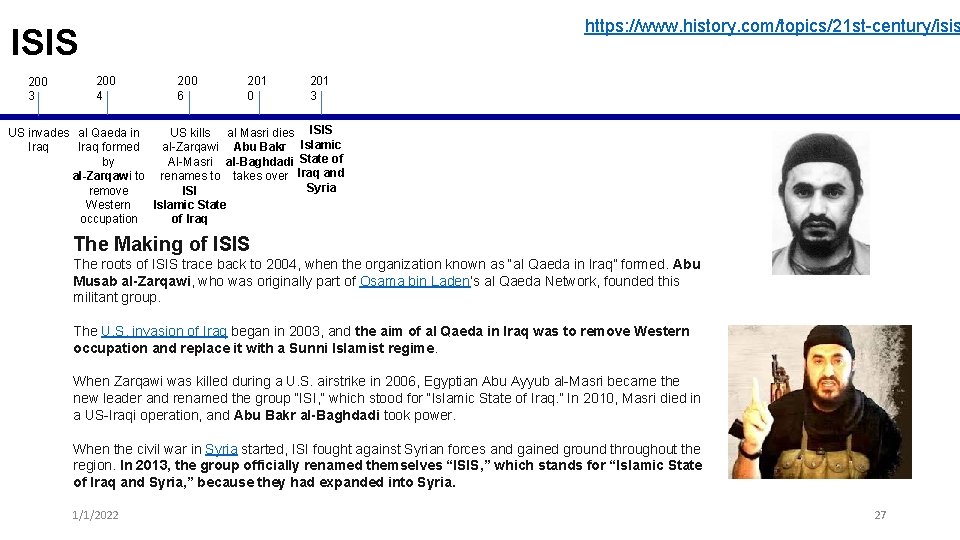
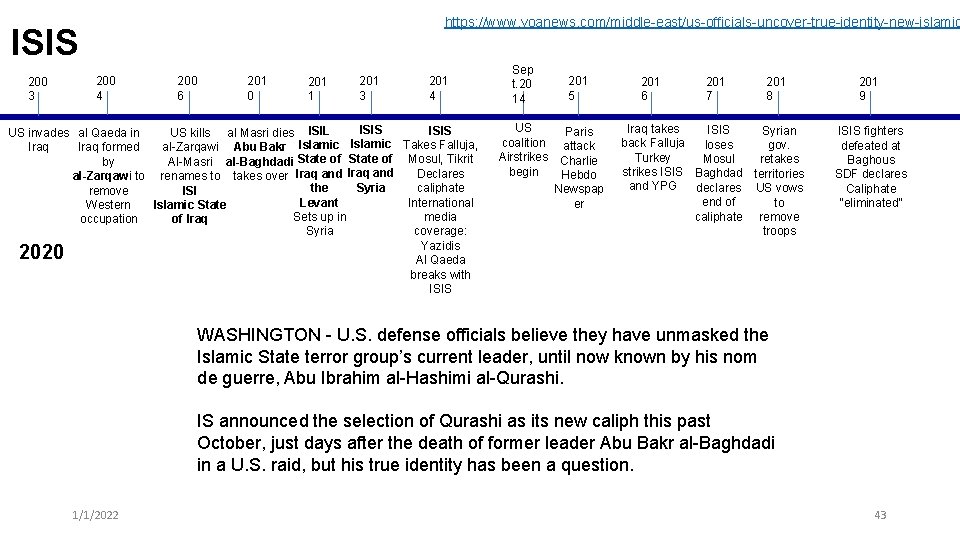
https: //www. history. com/topics/21 st-century/isis ISIS 200 3 200 4 200 6 201 0 201 3 US invades al Qaeda in US kills al Masri dies ISIS Iraq al-Zarqawi Abu Bakr Islamic Iraq formed Al-Masri al-Baghdadi State of by al-Zarqawi to renames to takes over Iraq and Syria ISI remove Islamic State Western of Iraq occupation The Making of ISIS The roots of ISIS trace back to 2004, when the organization known as “al Qaeda in Iraq” formed. Abu Musab al-Zarqawi, who was originally part of Osama bin Laden’s al Qaeda Network, founded this militant group. The U. S. invasion of Iraq began in 2003, and the aim of al Qaeda in Iraq was to remove Western occupation and replace it with a Sunni Islamist regime. When Zarqawi was killed during a U. S. airstrike in 2006, Egyptian Abu Ayyub al-Masri became the new leader and renamed the group “ISI, ” which stood for “Islamic State of Iraq. ” In 2010, Masri died in a US-Iraqi operation, and Abu Bakr al-Baghdadi took power. When the civil war in Syria started, ISI fought against Syrian forces and gained ground throughout the region. In 2013, the group officially renamed themselves “ISIS, ” which stands for “Islamic State of Iraq and Syria, ” because they had expanded into Syria. 1/1/2022 27
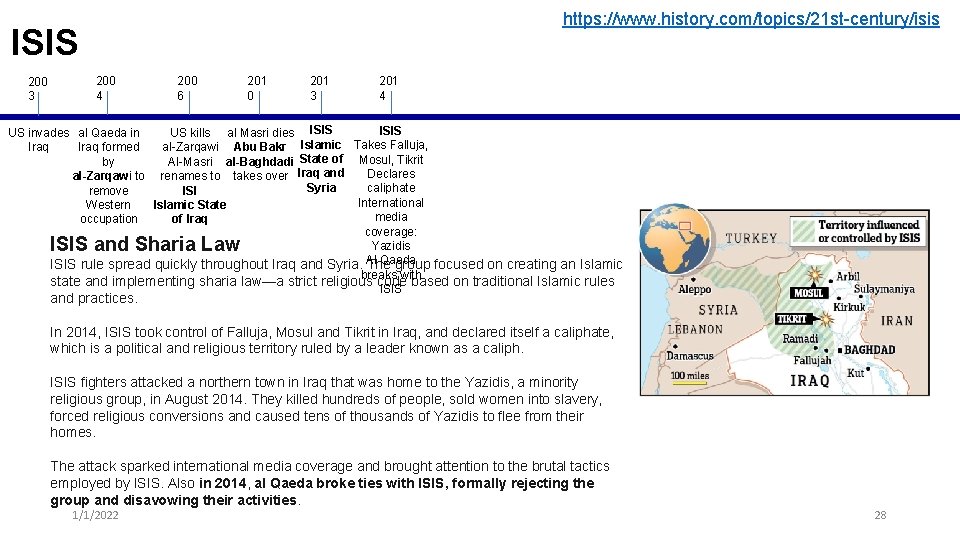
https: //www. history. com/topics/21 st-century/isis ISIS 200 3 200 4 200 6 201 0 201 3 201 4 ISIS US invades al Qaeda in US kills al Masri dies ISIS Iraq al-Zarqawi Abu Bakr Islamic Takes Falluja, Iraq formed Al-Masri al-Baghdadi State of Mosul, Tikrit by Declares al-Zarqawi to renames to takes over Iraq and Syria caliphate ISI remove International Islamic State Western media of Iraq occupation coverage: Yazidis Qaeda ISIS rule spread quickly throughout Iraq and Syria. Al The group focused on creating an Islamic breaks with state and implementing sharia law—a strict religious code based on traditional Islamic rules ISIS and Sharia Law and practices. In 2014, ISIS took control of Falluja, Mosul and Tikrit in Iraq, and declared itself a caliphate, which is a political and religious territory ruled by a leader known as a caliph. ISIS fighters attacked a northern town in Iraq that was home to the Yazidis, a minority religious group, in August 2014. They killed hundreds of people, sold women into slavery, forced religious conversions and caused tens of thousands of Yazidis to flee from their homes. The attack sparked international media coverage and brought attention to the brutal tactics employed by ISIS. Also in 2014, al Qaeda broke ties with ISIS, formally rejecting the group and disavowing their activities. 1/1/2022 28
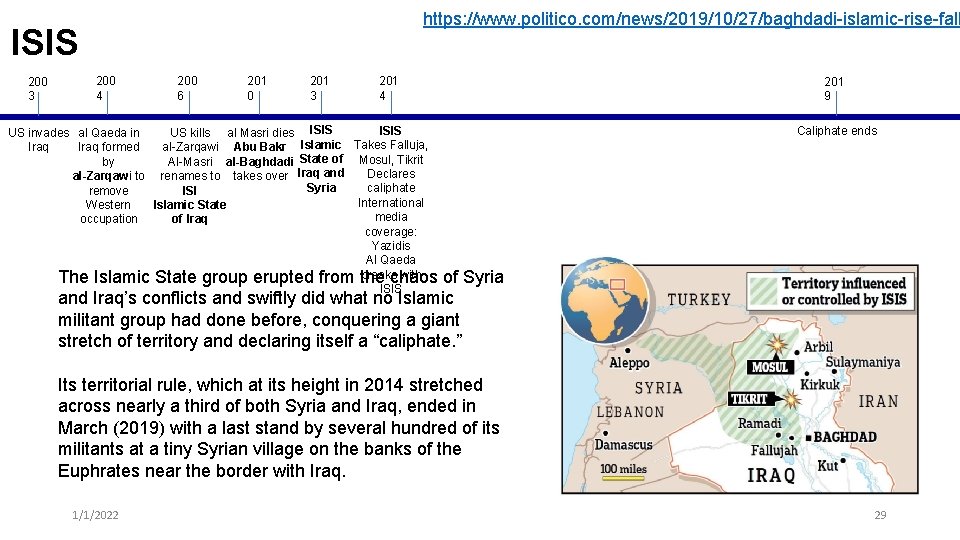
https: //www. politico. com/news/2019/10/27/baghdadi-islamic-rise-fall ISIS 200 3 200 4 200 6 201 0 201 3 201 4 ISIS US invades al Qaeda in US kills al Masri dies ISIS Iraq al-Zarqawi Abu Bakr Islamic Takes Falluja, Iraq formed Al-Masri al-Baghdadi State of Mosul, Tikrit by Declares al-Zarqawi to renames to takes over Iraq and Syria caliphate ISI remove International Islamic State Western media of Iraq occupation coverage: Yazidis Al Qaeda breaks with The Islamic State group erupted from the chaos ISIS 201 9 Caliphate ends of Syria and Iraq’s conflicts and swiftly did what no Islamic militant group had done before, conquering a giant stretch of territory and declaring itself a “caliphate. ” Its territorial rule, which at its height in 2014 stretched across nearly a third of both Syria and Iraq, ended in March (2019) with a last stand by several hundred of its militants at a tiny Syrian village on the banks of the Euphrates near the border with Iraq. 1/1/2022 29
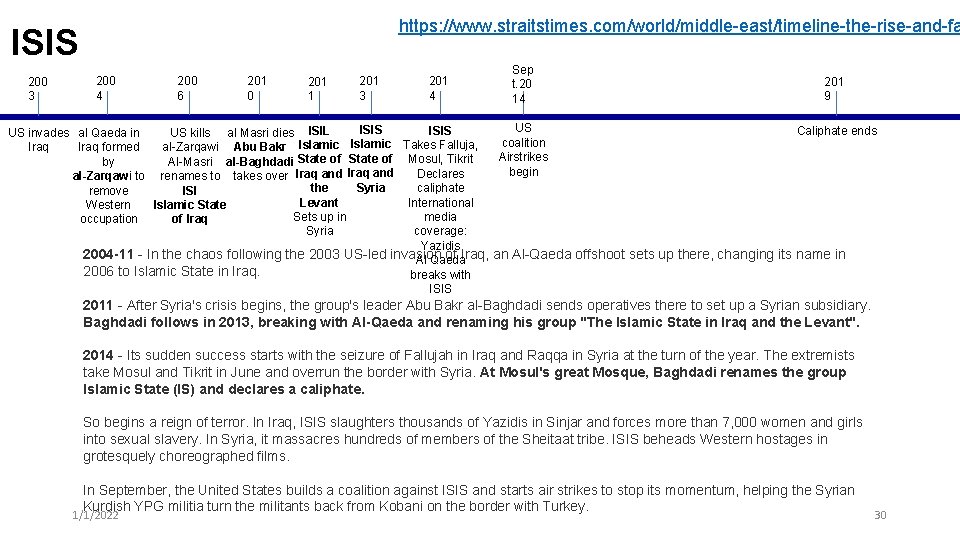
https: //www. straitstimes. com/world/middle-east/timeline-the-rise-and-fa ISIS 200 3 200 4 200 6 201 0 201 1 201 3 201 4 Sep t. 20 14 201 9 US ISIS Caliphate ends US invades al Qaeda in US kills al Masri dies ISIL coalition Iraq al-Zarqawi Abu Bakr Islamic Takes Falluja, Iraq formed Airstrikes Al-Masri al-Baghdadi State of Mosul, Tikrit by begin Declares al-Zarqawi to renames to takes over Iraq and Syria caliphate the ISI remove International Levant Islamic State Western media Sets up in of Iraq occupation coverage: Syria Yazidis 2004 -11 - In the chaos following the 2003 US-led invasion of Iraq, an Al-Qaeda offshoot sets up there, changing its name in Al Qaeda 2006 to Islamic State in Iraq. breaks with ISIS 2011 - After Syria's crisis begins, the group's leader Abu Bakr al-Baghdadi sends operatives there to set up a Syrian subsidiary. Baghdadi follows in 2013, breaking with Al-Qaeda and renaming his group "The Islamic State in Iraq and the Levant". 2014 - Its sudden success starts with the seizure of Fallujah in Iraq and Raqqa in Syria at the turn of the year. The extremists take Mosul and Tikrit in June and overrun the border with Syria. At Mosul's great Mosque, Baghdadi renames the group Islamic State (IS) and declares a caliphate. So begins a reign of terror. In Iraq, ISIS slaughters thousands of Yazidis in Sinjar and forces more than 7, 000 women and girls into sexual slavery. In Syria, it massacres hundreds of members of the Sheitaat tribe. ISIS beheads Western hostages in grotesquely choreographed films. In September, the United States builds a coalition against ISIS and starts air strikes to stop its momentum, helping the Syrian Kurdish YPG militia turn the militants back from Kobani on the border with Turkey. 1/1/2022 30
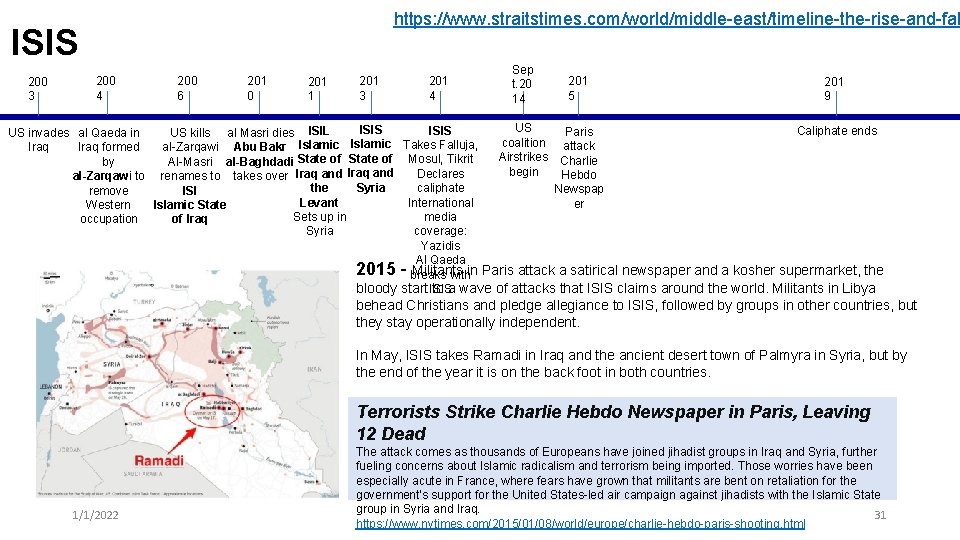
https: //www. straitstimes. com/world/middle-east/timeline-the-rise-and-fal ISIS 200 3 200 4 200 6 201 0 201 1 201 3 201 4 Sep t. 20 14 201 5 201 9 US ISIS Caliphate ends Paris US invades al Qaeda in US kills al Masri dies ISIL coalition attack Iraq al-Zarqawi Abu Bakr Islamic Takes Falluja, Iraq formed Airstrikes State of Mosul, Tikrit State of Charlie Al-Masri al-Baghdadi by begin Iraq and Declares Iraq and Hebdo al-Zarqawi to renames to takes over Syria caliphate the Newspap ISI remove International Levant er Islamic State Western media Sets up in of Iraq occupation coverage: Syria Yazidis Al Qaeda 2015 - breaks Militants within Paris attack a satirical newspaper and a kosher supermarket, the bloody start ISIS to a wave of attacks that ISIS claims around the world. Militants in Libya behead Christians and pledge allegiance to ISIS, followed by groups in other countries, but they stay operationally independent. In May, ISIS takes Ramadi in Iraq and the ancient desert town of Palmyra in Syria, but by the end of the year it is on the back foot in both countries. Terrorists Strike Charlie Hebdo Newspaper in Paris, Leaving 12 Dead 1/1/2022 The attack comes as thousands of Europeans have joined jihadist groups in Iraq and Syria, further fueling concerns about Islamic radicalism and terrorism being imported. Those worries have been especially acute in France, where fears have grown that militants are bent on retaliation for the government’s support for the United States-led air campaign against jihadists with the Islamic State group in Syria and Iraq. 31 https: //www. nytimes. com/2015/01/08/world/europe/charlie-hebdo-paris-shooting. html
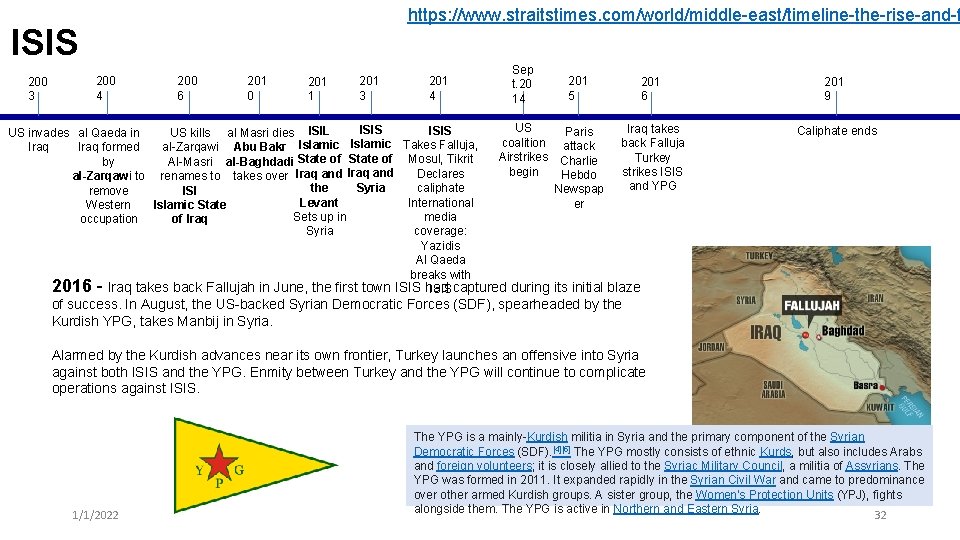
https: //www. straitstimes. com/world/middle-east/timeline-the-rise-and-f ISIS 200 3 200 4 200 6 201 0 201 1 201 3 201 4 Sep t. 20 14 US ISIS US invades al Qaeda in US kills al Masri dies ISIL coalition Iraq al-Zarqawi Abu Bakr Islamic Takes Falluja, Iraq formed Airstrikes Al-Masri al-Baghdadi State of Mosul, Tikrit by begin Declares al-Zarqawi to renames to takes over Iraq and Syria caliphate the ISI remove International Levant Islamic State Western media Sets up in of Iraq occupation coverage: Syria Yazidis Al Qaeda breaks with 2016 - Iraq takes back Fallujah in June, the first town ISIS had ISIS captured during 201 5 201 6 201 9 Paris attack Charlie Hebdo Newspap er Iraq takes back Falluja Turkey strikes ISIS and YPG Caliphate ends its initial blaze of success. In August, the US-backed Syrian Democratic Forces (SDF), spearheaded by the Kurdish YPG, takes Manbij in Syria. Alarmed by the Kurdish advances near its own frontier, Turkey launches an offensive into Syria against both ISIS and the YPG. Enmity between Turkey and the YPG will continue to complicate operations against ISIS. 1/1/2022 The YPG is a mainly-Kurdish militia in Syria and the primary component of the Syrian Democratic Forces (SDF). [4][5] The YPG mostly consists of ethnic Kurds, but also includes Arabs and foreign volunteers; it is closely allied to the Syriac Military Council, a militia of Assyrians. The YPG was formed in 2011. It expanded rapidly in the Syrian Civil War and came to predominance over other armed Kurdish groups. A sister group, the Women's Protection Units (YPJ), fights alongside them. The YPG is active in Northern and Eastern Syria. 32
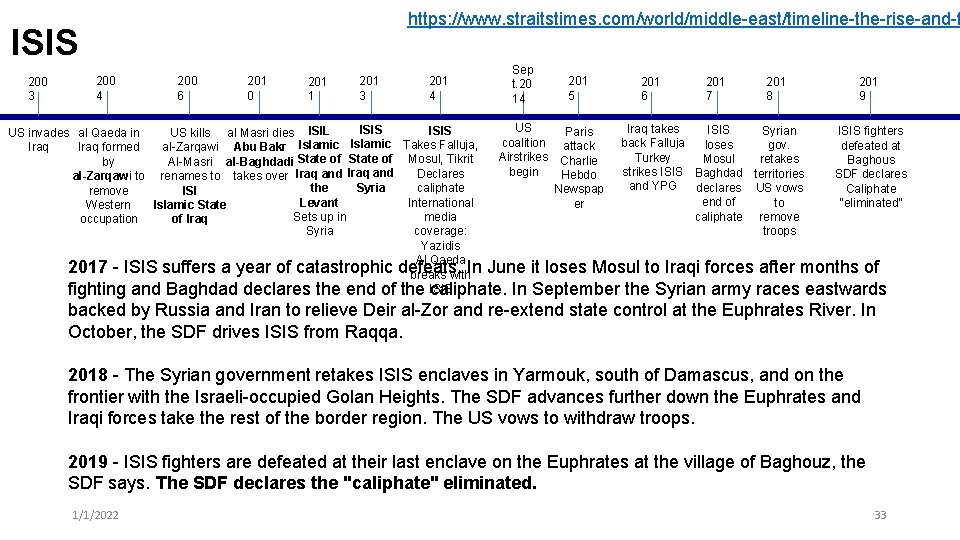
https: //www. straitstimes. com/world/middle-east/timeline-the-rise-and-f ISIS 200 3 200 4 200 6 201 0 201 1 201 3 201 4 Sep t. 20 14 201 5 201 6 201 7 201 8 201 9 US Iraq takes ISIS Syrian ISIS fighters Paris US invades al Qaeda in US kills al Masri dies ISIL coalition back Falluja loses gov. defeated at attack Iraq al-Zarqawi Abu Bakr Islamic Takes Falluja, Iraq formed Airstrikes Turkey State of Mosul retakes Mosul, Tikrit State of Baghous Charlie Al-Masri al-Baghdadi by begin strikes ISIS Baghdad territories Declares SDF declares Hebdo al-Zarqawi to renames to takes over Iraq and and YPG Syria declares US vows caliphate the Caliphate Newspap ISI remove end of to International Levant “eliminated” er Islamic State Western caliphate remove media Sets up in of Iraq occupation troops coverage: Syria Yazidis Al Qaeda 2017 - ISIS suffers a year of catastrophic defeats. breaks with. In June it loses Mosul to Iraqi forces after months of fighting and Baghdad declares the end of the ISIS caliphate. In September the Syrian army races eastwards backed by Russia and Iran to relieve Deir al-Zor and re-extend state control at the Euphrates River. In October, the SDF drives ISIS from Raqqa. 2018 - The Syrian government retakes ISIS enclaves in Yarmouk, south of Damascus, and on the frontier with the Israeli-occupied Golan Heights. The SDF advances further down the Euphrates and Iraqi forces take the rest of the border region. The US vows to withdraw troops. 2019 - ISIS fighters are defeated at their last enclave on the Euphrates at the village of Baghouz, the SDF says. The SDF declares the "caliphate" eliminated. 1/1/2022 33
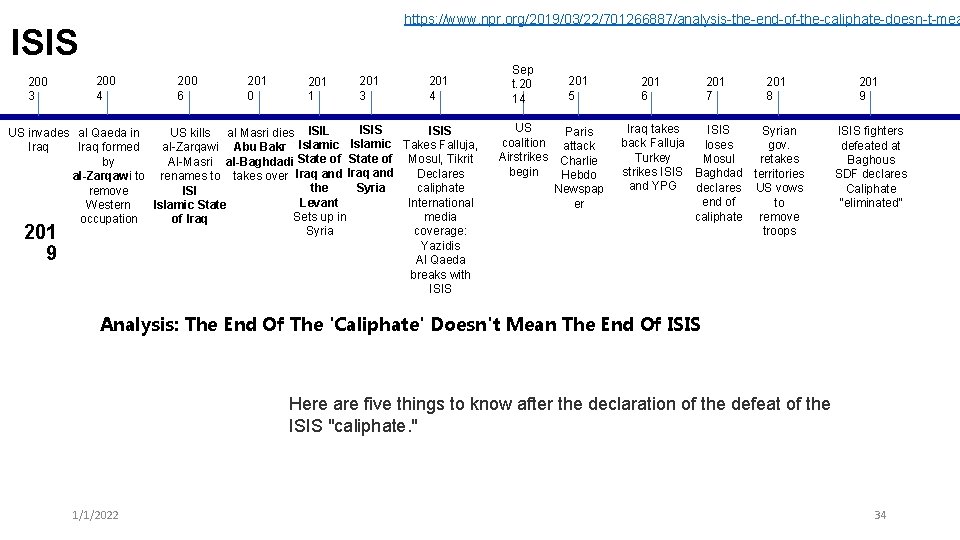
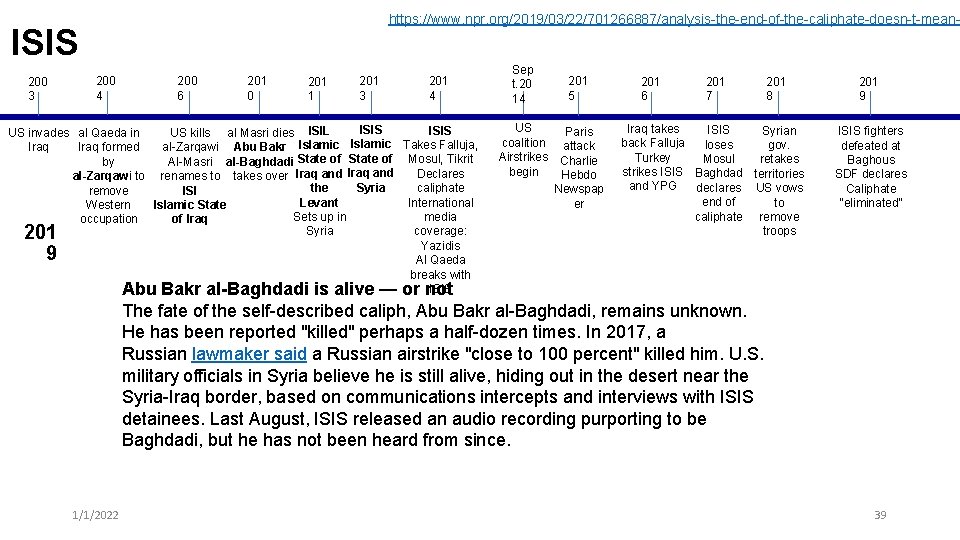
https: //www. npr. org/2019/03/22/701266887/analysis-the-end-of-the-caliphate-doesn-t-mea ISIS 200 3 200 4 200 6 201 0 201 1 201 3 201 4 ISIS US invades al Qaeda in US kills al Masri dies ISIL Iraq al-Zarqawi Abu Bakr Islamic Takes Falluja, Iraq formed Al-Masri al-Baghdadi State of Mosul, Tikrit by Declares al-Zarqawi to renames to takes over Iraq and Syria caliphate the ISI remove International Levant Islamic State Western media Sets up in of Iraq occupation coverage: Syria Yazidis Al Qaeda breaks with ISIS 201 9 Sep t. 20 14 201 5 US Paris coalition attack Airstrikes Charlie begin Hebdo Newspap er 201 6 201 7 201 8 Iraq takes ISIS Syrian back Falluja loses gov. Turkey Mosul retakes strikes ISIS Baghdad territories and YPG declares US vows end of to caliphate remove troops 201 9 ISIS fighters defeated at Baghous SDF declares Caliphate “eliminated” Analysis: The End Of The 'Caliphate' Doesn't Mean The End Of ISIS Here are five things to know after the declaration of the defeat of the ISIS "caliphate. " 1/1/2022 34
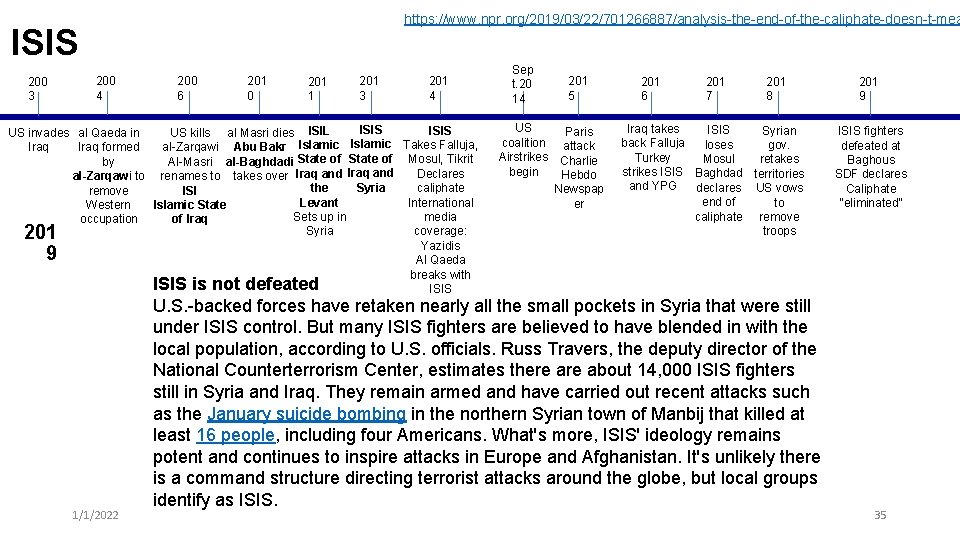
https: //www. npr. org/2019/03/22/701266887/analysis-the-end-of-the-caliphate-doesn-t-mea ISIS 200 3 200 4 200 6 201 0 201 1 201 3 201 4 ISIS US invades al Qaeda in US kills al Masri dies ISIL Iraq al-Zarqawi Abu Bakr Islamic Takes Falluja, Iraq formed Al-Masri al-Baghdadi State of Mosul, Tikrit by Declares al-Zarqawi to renames to takes over Iraq and Syria caliphate the ISI remove International Levant Islamic State Western media Sets up in of Iraq occupation coverage: Syria Yazidis Al Qaeda breaks with ISIS is not defeated ISIS 201 9 1/1/2022 Sep t. 20 14 201 5 US Paris coalition attack Airstrikes Charlie begin Hebdo Newspap er 201 6 201 7 201 8 Iraq takes ISIS Syrian back Falluja loses gov. Turkey Mosul retakes strikes ISIS Baghdad territories and YPG declares US vows end of to caliphate remove troops U. S. -backed forces have retaken nearly all the small pockets in Syria that were still under ISIS control. But many ISIS fighters are believed to have blended in with the local population, according to U. S. officials. Russ Travers, the deputy director of the National Counterterrorism Center, estimates there about 14, 000 ISIS fighters still in Syria and Iraq. They remain armed and have carried out recent attacks such as the January suicide bombing in the northern Syrian town of Manbij that killed at least 16 people, including four Americans. What's more, ISIS' ideology remains potent and continues to inspire attacks in Europe and Afghanistan. It's unlikely there is a command structure directing terrorist attacks around the globe, but local groups identify as ISIS. 201 9 ISIS fighters defeated at Baghous SDF declares Caliphate “eliminated” 35
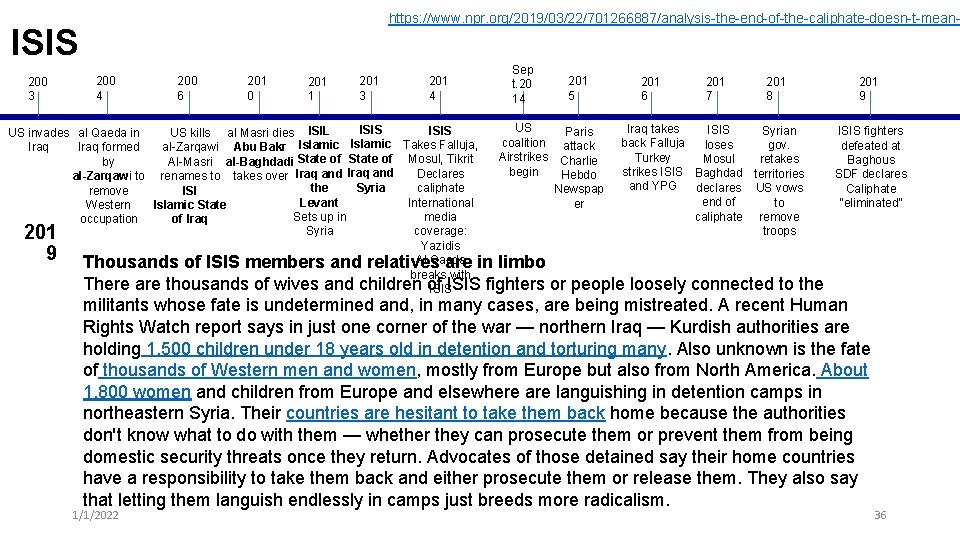
https: //www. npr. org/2019/03/22/701266887/analysis-the-end-of-the-caliphate-doesn-t-mean- ISIS 200 3 200 4 200 6 201 0 201 1 201 3 201 4 Sep t. 20 14 201 5 201 6 201 7 201 8 201 9 US Iraq takes ISIS Syrian ISIS fighters Paris US invades al Qaeda in US kills al Masri dies ISIL coalition back Falluja loses gov. defeated at attack Iraq al-Zarqawi Abu Bakr Islamic Takes Falluja, Iraq formed Airstrikes Turkey State of Mosul retakes Mosul, Tikrit State of Baghous Charlie Al-Masri al-Baghdadi by begin strikes ISIS Baghdad territories Declares SDF declares Hebdo al-Zarqawi to renames to takes over Iraq and and YPG Syria declares US vows caliphate the Caliphate Newspap ISI remove end of to International Levant “eliminated” er Islamic State Western caliphate remove media Sets up in of Iraq occupation troops coverage: Syria Yazidis Al Qaeda Thousands of ISIS members and relatives are in limbo breaks with There are thousands of wives and children of ISIS fighters or people loosely connected to the 201 9 militants whose fate is undetermined and, in many cases, are being mistreated. A recent Human Rights Watch report says in just one corner of the war — northern Iraq — Kurdish authorities are holding 1, 500 children under 18 years old in detention and torturing many. Also unknown is the fate of thousands of Western men and women, mostly from Europe but also from North America. About 1, 800 women and children from Europe and elsewhere are languishing in detention camps in northeastern Syria. Their countries are hesitant to take them back home because the authorities don't know what to do with them — whether they can prosecute them or prevent them from being domestic security threats once they return. Advocates of those detained say their home countries have a responsibility to take them back and either prosecute them or release them. They also say that letting them languish endlessly in camps just breeds more radicalism. 1/1/2022 36
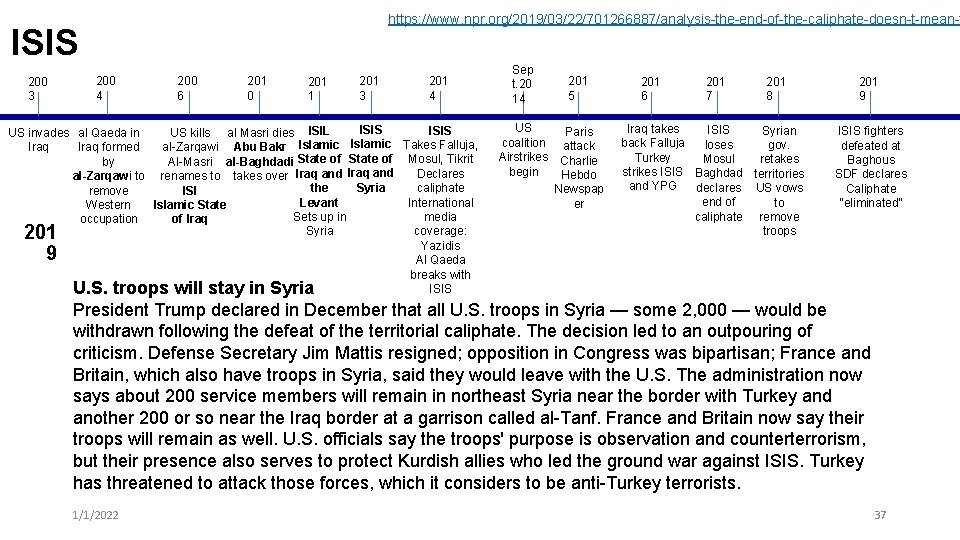
https: //www. npr. org/2019/03/22/701266887/analysis-the-end-of-the-caliphate-doesn-t-mean-t ISIS 200 3 200 4 200 6 201 0 201 1 201 3 201 4 ISIS US invades al Qaeda in US kills al Masri dies ISIL Iraq al-Zarqawi Abu Bakr Islamic Takes Falluja, Iraq formed Al-Masri al-Baghdadi State of Mosul, Tikrit by Declares al-Zarqawi to renames to takes over Iraq and Syria caliphate the ISI remove International Levant Islamic State Western media Sets up in of Iraq occupation coverage: Syria Yazidis Al Qaeda breaks with ISIS U. S. troops will stay in Syria 201 9 Sep t. 20 14 201 5 US Paris coalition attack Airstrikes Charlie begin Hebdo Newspap er 201 6 201 7 201 8 Iraq takes ISIS Syrian back Falluja loses gov. Turkey Mosul retakes strikes ISIS Baghdad territories and YPG declares US vows end of to caliphate remove troops 201 9 ISIS fighters defeated at Baghous SDF declares Caliphate “eliminated” President Trump declared in December that all U. S. troops in Syria — some 2, 000 — would be withdrawn following the defeat of the territorial caliphate. The decision led to an outpouring of criticism. Defense Secretary Jim Mattis resigned; opposition in Congress was bipartisan; France and Britain, which also have troops in Syria, said they would leave with the U. S. The administration now says about 200 service members will remain in northeast Syria near the border with Turkey and another 200 or so near the Iraq border at a garrison called al-Tanf. France and Britain now say their troops will remain as well. U. S. officials say the troops' purpose is observation and counterterrorism, but their presence also serves to protect Kurdish allies who led the ground war against ISIS. Turkey has threatened to attack those forces, which it considers to be anti-Turkey terrorists. 1/1/2022 37
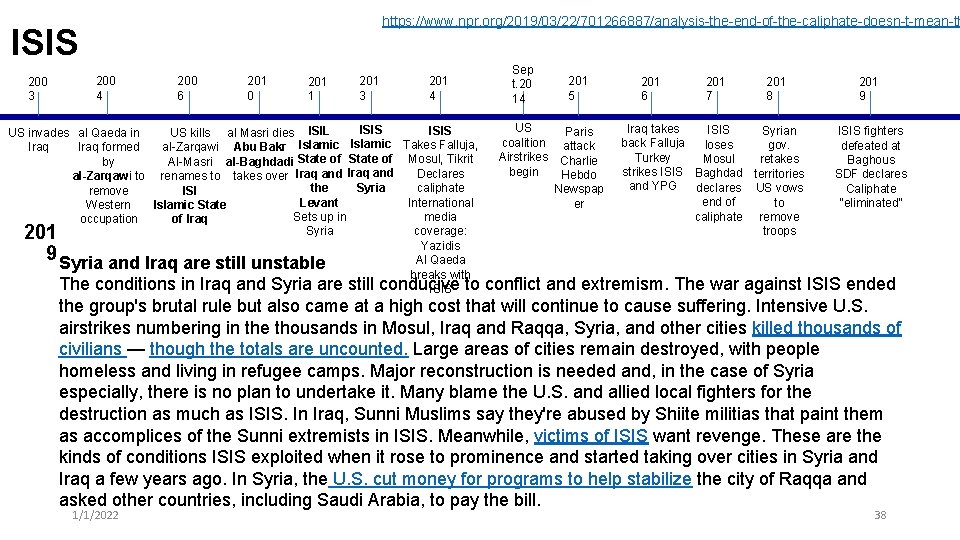
https: //www. npr. org/2019/03/22/701266887/analysis-the-end-of-the-caliphate-doesn-t-mean-th ISIS 200 3 200 4 200 6 201 0 201 1 201 3 201 4 ISIS US invades al Qaeda in US kills al Masri dies ISIL Iraq al-Zarqawi Abu Bakr Islamic Takes Falluja, Iraq formed Al-Masri al-Baghdadi State of Mosul, Tikrit by Declares al-Zarqawi to renames to takes over Iraq and Syria caliphate the ISI remove International Levant Islamic State Western media Sets up in of Iraq occupation coverage: Syria Yazidis Al Qaeda Syria and Iraq are still unstable breaks with The conditions in Iraq and Syria are still conducive ISIS to 201 9 Sep t. 20 14 201 5 US Paris coalition attack Airstrikes Charlie begin Hebdo Newspap er 201 6 201 7 201 8 Iraq takes ISIS Syrian back Falluja loses gov. Turkey Mosul retakes strikes ISIS Baghdad territories and YPG declares US vows end of to caliphate remove troops 201 9 ISIS fighters defeated at Baghous SDF declares Caliphate “eliminated” conflict and extremism. The war against ISIS ended the group's brutal rule but also came at a high cost that will continue to cause suffering. Intensive U. S. airstrikes numbering in the thousands in Mosul, Iraq and Raqqa, Syria, and other cities killed thousands of civilians — though the totals are uncounted. Large areas of cities remain destroyed, with people homeless and living in refugee camps. Major reconstruction is needed and, in the case of Syria especially, there is no plan to undertake it. Many blame the U. S. and allied local fighters for the destruction as much as ISIS. In Iraq, Sunni Muslims say they're abused by Shiite militias that paint them as accomplices of the Sunni extremists in ISIS. Meanwhile, victims of ISIS want revenge. These are the kinds of conditions ISIS exploited when it rose to prominence and started taking over cities in Syria and Iraq a few years ago. In Syria, the U. S. cut money for programs to help stabilize the city of Raqqa and asked other countries, including Saudi Arabia, to pay the bill. 1/1/2022 38
https: //www. npr. org/2019/03/22/701266887/analysis-the-end-of-the-caliphate-doesn-t-mean- ISIS 200 3 200 4 200 6 201 0 201 1 201 3 201 4 ISIS US invades al Qaeda in US kills al Masri dies ISIL Iraq al-Zarqawi Abu Bakr Islamic Takes Falluja, Iraq formed Al-Masri al-Baghdadi State of Mosul, Tikrit by Declares al-Zarqawi to renames to takes over Iraq and Syria caliphate the ISI remove International Levant Islamic State Western media Sets up in of Iraq occupation coverage: Syria Yazidis Al Qaeda breaks with ISIS Abu Bakr al-Baghdadi is alive — or not 201 9 Sep t. 20 14 201 5 US Paris coalition attack Airstrikes Charlie begin Hebdo Newspap er 201 6 201 7 201 8 Iraq takes ISIS Syrian back Falluja loses gov. Turkey Mosul retakes strikes ISIS Baghdad territories and YPG declares US vows end of to caliphate remove troops 201 9 ISIS fighters defeated at Baghous SDF declares Caliphate “eliminated” The fate of the self-described caliph, Abu Bakr al-Baghdadi, remains unknown. He has been reported "killed" perhaps a half-dozen times. In 2017, a Russian lawmaker said a Russian airstrike "close to 100 percent" killed him. U. S. military officials in Syria believe he is still alive, hiding out in the desert near the Syria-Iraq border, based on communications intercepts and interviews with ISIS detainees. Last August, ISIS released an audio recording purporting to be Baghdadi, but he has not been heard from since. 1/1/2022 39
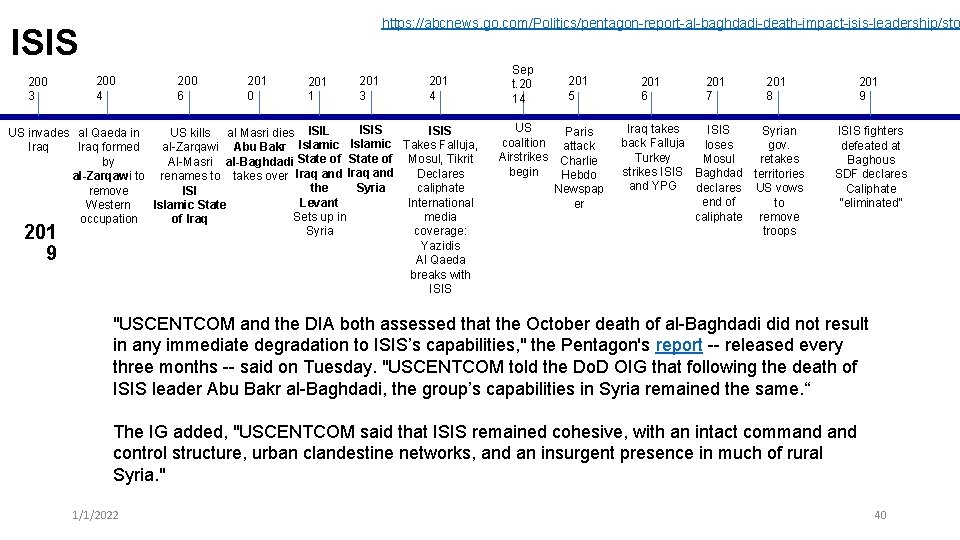
https: //abcnews. go. com/Politics/pentagon-report-al-baghdadi-death-impact-isis-leadership/sto ISIS 200 3 200 4 200 6 201 0 201 1 201 3 201 4 ISIS US invades al Qaeda in US kills al Masri dies ISIL Iraq al-Zarqawi Abu Bakr Islamic Takes Falluja, Iraq formed Al-Masri al-Baghdadi State of Mosul, Tikrit by Declares al-Zarqawi to renames to takes over Iraq and Syria caliphate the ISI remove International Levant Islamic State Western media Sets up in of Iraq occupation coverage: Syria Yazidis Al Qaeda breaks with ISIS 201 9 Sep t. 20 14 201 5 US Paris coalition attack Airstrikes Charlie begin Hebdo Newspap er 201 6 201 7 201 9 201 8 Iraq takes ISIS Syrian back Falluja loses gov. Turkey Mosul retakes strikes ISIS Baghdad territories and YPG declares US vows end of to caliphate remove troops ISIS fighters defeated at Baghous SDF declares Caliphate “eliminated” "USCENTCOM and the DIA both assessed that the October death of al-Baghdadi did not result in any immediate degradation to ISIS’s capabilities, " the Pentagon's report -- released every three months -- said on Tuesday. "USCENTCOM told the Do. D OIG that following the death of ISIS leader Abu Bakr al-Baghdadi, the group’s capabilities in Syria remained the same. “ The IG added, "USCENTCOM said that ISIS remained cohesive, with an intact command control structure, urban clandestine networks, and an insurgent presence in much of rural Syria. " 1/1/2022 40
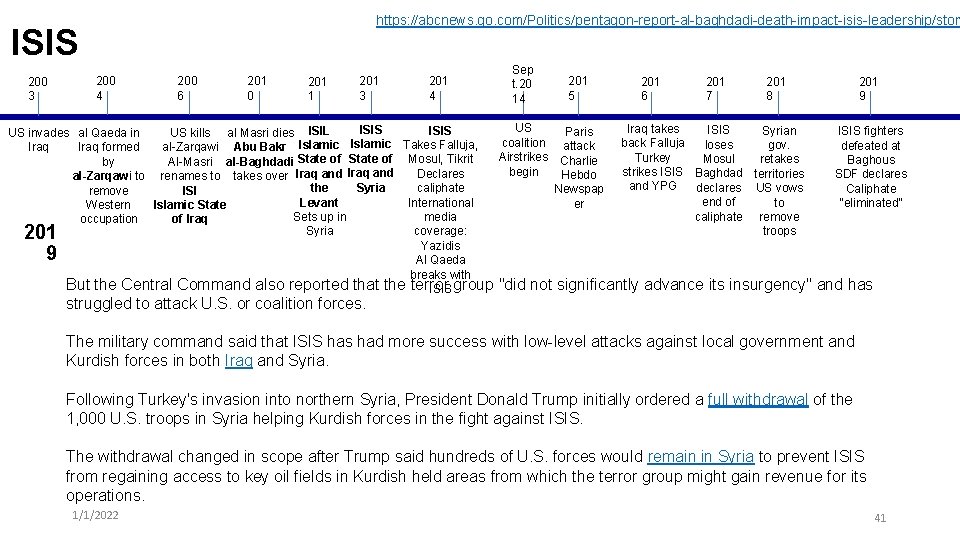
https: //abcnews. go. com/Politics/pentagon-report-al-baghdadi-death-impact-isis-leadership/story ISIS 200 3 200 4 200 6 201 0 201 1 201 3 201 4 Sep t. 20 14 201 5 201 6 201 7 201 9 201 8 US Iraq takes ISIS Syrian ISIS Paris US invades al Qaeda in US kills al Masri dies ISIL coalition back Falluja loses gov. attack Iraq al-Zarqawi Abu Bakr Islamic Takes Falluja, Iraq formed Airstrikes Turkey State of Mosul retakes Mosul, Tikrit State of Charlie Al-Masri al-Baghdadi by begin strikes ISIS Baghdad territories Iraq and Declares Iraq and Hebdo al-Zarqawi to renames to takes over and YPG Syria declares US vows caliphate the Newspap ISI remove end of to International Levant er Islamic State Western caliphate remove media Sets up in of Iraq occupation troops coverage: Syria Yazidis Al Qaeda breaks with But the Central Command also reported that the terror ISIS group "did not significantly advance its insurgency" ISIS fighters defeated at Baghous SDF declares Caliphate “eliminated” 201 9 and has struggled to attack U. S. or coalition forces. The military command said that ISIS has had more success with low-level attacks against local government and Kurdish forces in both Iraq and Syria. Following Turkey's invasion into northern Syria, President Donald Trump initially ordered a full withdrawal of the 1, 000 U. S. troops in Syria helping Kurdish forces in the fight against ISIS. The withdrawal changed in scope after Trump said hundreds of U. S. forces would remain in Syria to prevent ISIS from regaining access to key oil fields in Kurdish held areas from which the terror group might gain revenue for its operations. 1/1/2022 41
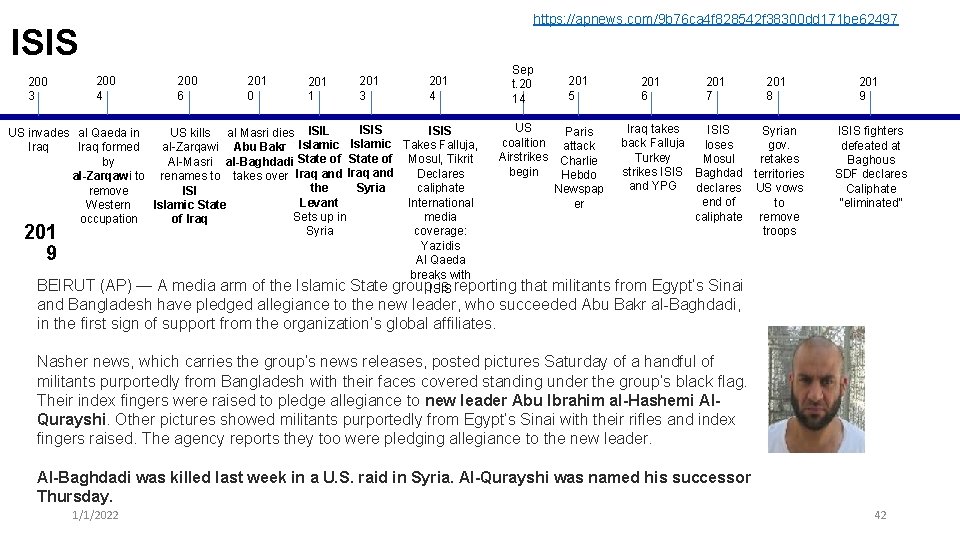
https: //apnews. com/9 b 76 ca 4 f 828542 f 38300 dd 171 be 62497 ISIS 200 3 200 4 200 6 201 0 201 1 201 3 201 4 Sep t. 20 14 201 5 201 6 201 7 201 8 US Iraq takes ISIS Syrian ISIS Paris US invades al Qaeda in US kills al Masri dies ISIL coalition back Falluja loses gov. attack Iraq al-Zarqawi Abu Bakr Islamic Takes Falluja, Iraq formed Airstrikes Turkey State of Mosul retakes Mosul, Tikrit State of Charlie Al-Masri al-Baghdadi by begin strikes ISIS Baghdad territories Iraq and Declares Iraq and Hebdo al-Zarqawi to renames to takes over and YPG Syria declares US vows caliphate the Newspap ISI remove end of to International Levant er Islamic State Western caliphate remove media Sets up in of Iraq occupation troops coverage: Syria Yazidis Al Qaeda breaks with BEIRUT (AP) — A media arm of the Islamic State group. ISIS is reporting that militants from Egypt’s Sinai 201 9 ISIS fighters defeated at Baghous SDF declares Caliphate “eliminated” 201 9 and Bangladesh have pledged allegiance to the new leader, who succeeded Abu Bakr al-Baghdadi, in the first sign of support from the organization’s global affiliates. Nasher news, which carries the group’s news releases, posted pictures Saturday of a handful of militants purportedly from Bangladesh with their faces covered standing under the group’s black flag. Their index fingers were raised to pledge allegiance to new leader Abu Ibrahim al-Hashemi Al. Qurayshi. Other pictures showed militants purportedly from Egypt’s Sinai with their rifles and index fingers raised. The agency reports they too were pledging allegiance to the new leader. Al-Baghdadi was killed last week in a U. S. raid in Syria. Al-Qurayshi was named his successor Thursday. 1/1/2022 42
https: //www. voanews. com/middle-east/us-officials-uncover-true-identity-new-islamic ISIS 200 3 200 4 200 6 201 0 201 1 201 3 201 4 ISIS US invades al Qaeda in US kills al Masri dies ISIL Iraq al-Zarqawi Abu Bakr Islamic Takes Falluja, Iraq formed Al-Masri al-Baghdadi State of Mosul, Tikrit by Declares al-Zarqawi to renames to takes over Iraq and Syria caliphate the ISI remove International Levant Islamic State Western media Sets up in of Iraq occupation coverage: Syria Yazidis Al Qaeda breaks with ISIS Sep t. 20 14 201 5 US Paris coalition attack Airstrikes Charlie begin Hebdo Newspap er 201 6 201 7 201 8 Iraq takes ISIS Syrian back Falluja loses gov. Turkey Mosul retakes strikes ISIS Baghdad territories and YPG declares US vows end of to caliphate remove troops 201 9 ISIS fighters defeated at Baghous SDF declares Caliphate “eliminated” 2020 WASHINGTON - U. S. defense officials believe they have unmasked the Islamic State terror group’s current leader, until now known by his nom de guerre, Abu Ibrahim al-Hashimi al-Qurashi. IS announced the selection of Qurashi as its new caliph this past October, just days after the death of former leader Abu Bakr al-Baghdadi in a U. S. raid, but his true identity has been a question. 1/1/2022 43
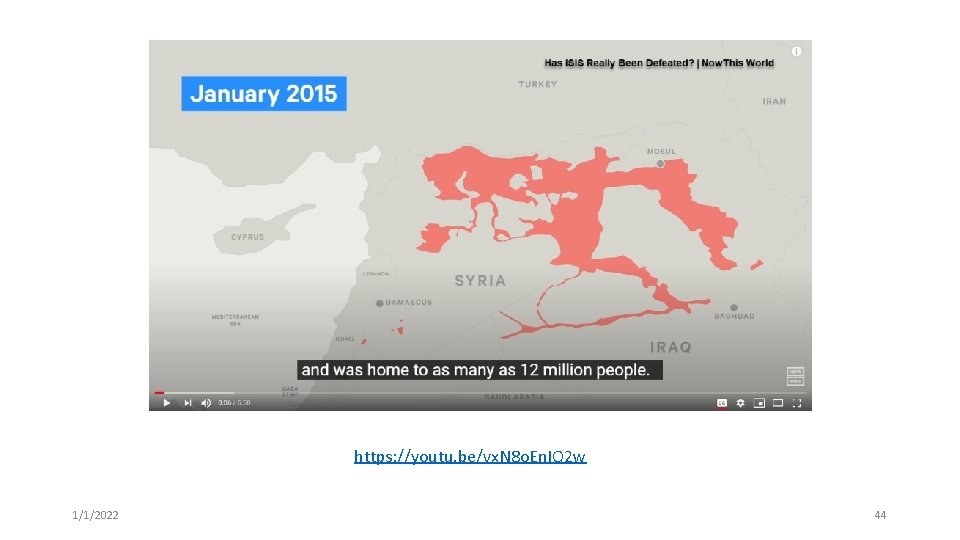
https: //youtu. be/vx. N 8 o. En. IQ 2 w 1/1/2022 44