
The Hot Desert Climate What affects the climate


- Slides: 10
The Hot Desert Climate What affects the climate of hot deserts?
Hot Desert Climates Very hot in summer and hot in the winter although there is a large daily range Less temperature variation at coastal locations Very low rainfall – less than 250 mm in general Often strong and constant winds Sunny almost all day every day
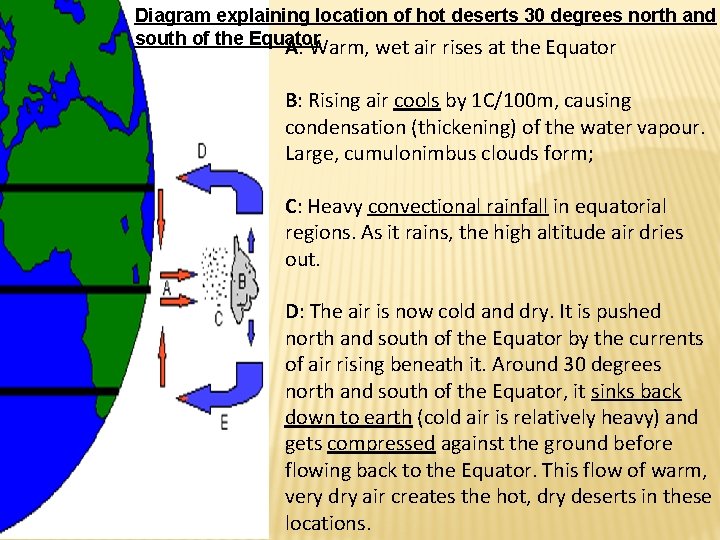
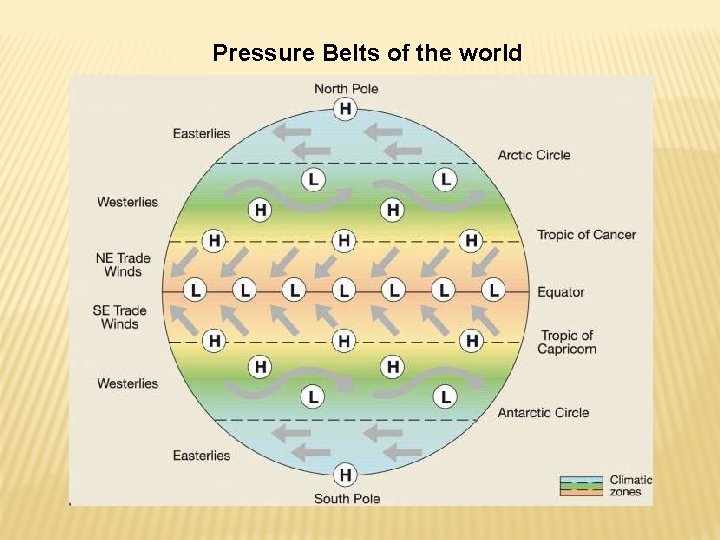
Diagram explaining location of hot deserts 30 degrees north and south of the Equator A: Warm, wet air rises at the Equator B: Rising air cools by 1 C/100 m, causing condensation (thickening) of the water vapour. Large, cumulonimbus clouds form; C: Heavy convectional rainfall in equatorial regions. As it rains, the high altitude air dries out. D: The air is now cold and dry. It is pushed north and south of the Equator by the currents of air rising beneath it. Around 30 degrees north and south of the Equator, it sinks back down to earth (cold air is relatively heavy) and gets compressed against the ground before flowing back to the Equator. This flow of warm, very dry air creates the hot, dry deserts in these locations.
What causes deserts to be so hot ? In summer the latitude (Cancer or Capricorn) faces the sun so these days have longer hours of sunlight As such the midday sun is stronger and the ground heats up very quickly. The hottest month is usually January in the southern hemisphere and July in the northern hemisphere as it may take a month for the ground to reach it’s hottest during this summer period Deserts are even hotter at low altitudes as the temperature is not affected by altitude (temperature usually decrease by 0. 6ºC with every 100 m of height) If deserts are inland then they may be even hotter as the land heats up and cools down much quicker than the sea (this also explains why deserts can get very cold at night. . especially in winter) The lack of cloud cover (due to high pressure and low humidity) means that desert skies have hardly any cloud. Therefore, more solar energy reaches the ground during the day making them very hot. However, lack of clouds also mean that the Earth’s heat is often lost at night making deserts very cold (therefore a high temperature
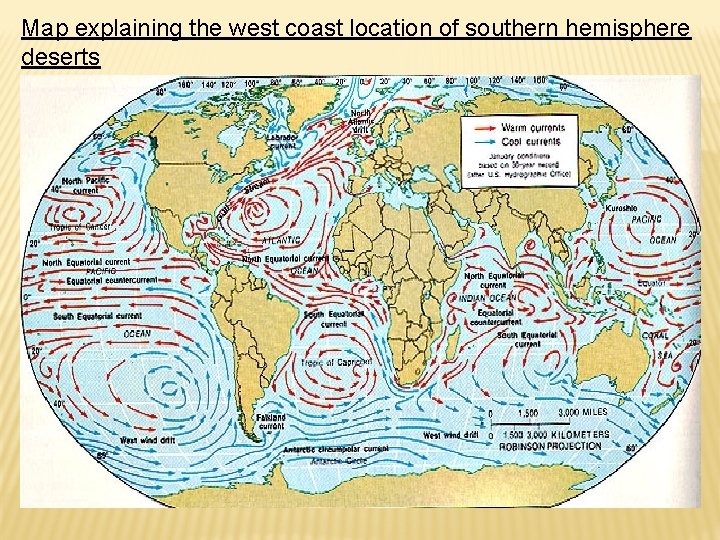
Map explaining the west coast location of southern hemisphere deserts
Pressure Belts of the world
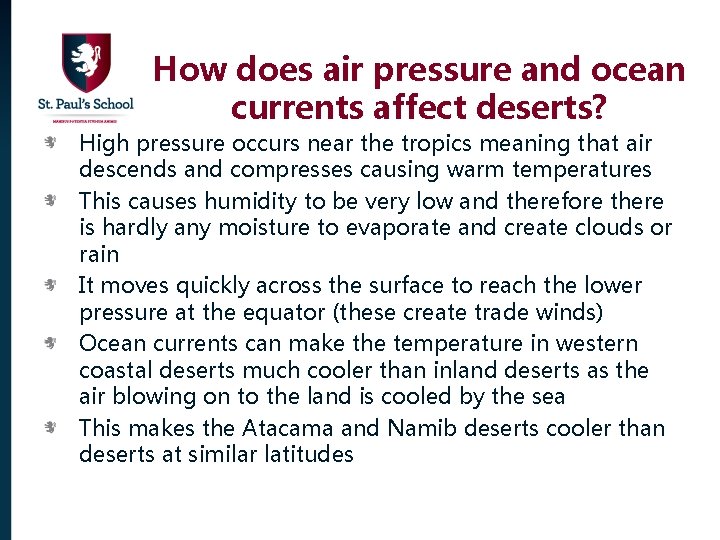
How does air pressure and ocean currents affect deserts? High pressure occurs near the tropics meaning that air descends and compresses causing warm temperatures This causes humidity to be very low and therefore there is hardly any moisture to evaporate and create clouds or rain It moves quickly across the surface to reach the lower pressure at the equator (these create trade winds) Ocean currents can make the temperature in western coastal deserts much cooler than inland deserts as the air blowing on to the land is cooled by the sea This makes the Atacama and Namib deserts cooler than deserts at similar latitudes
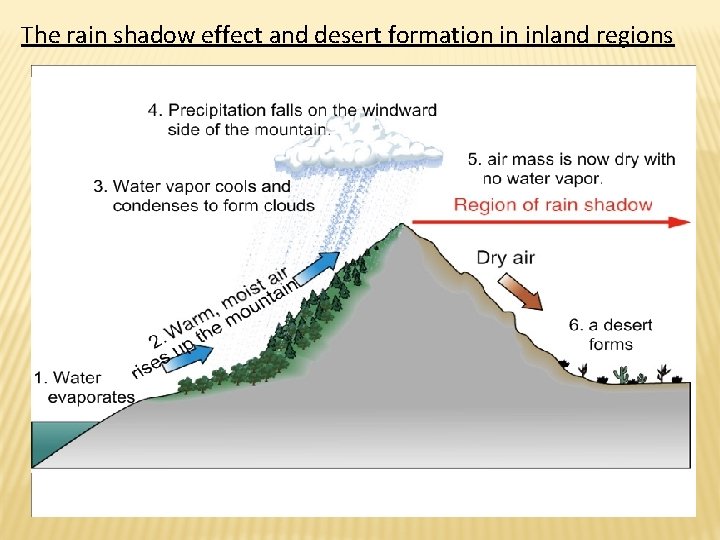
The rain shadow effect and desert formation in inland regions