
The Holy Roman Empire and the Church With
- Slides: 19
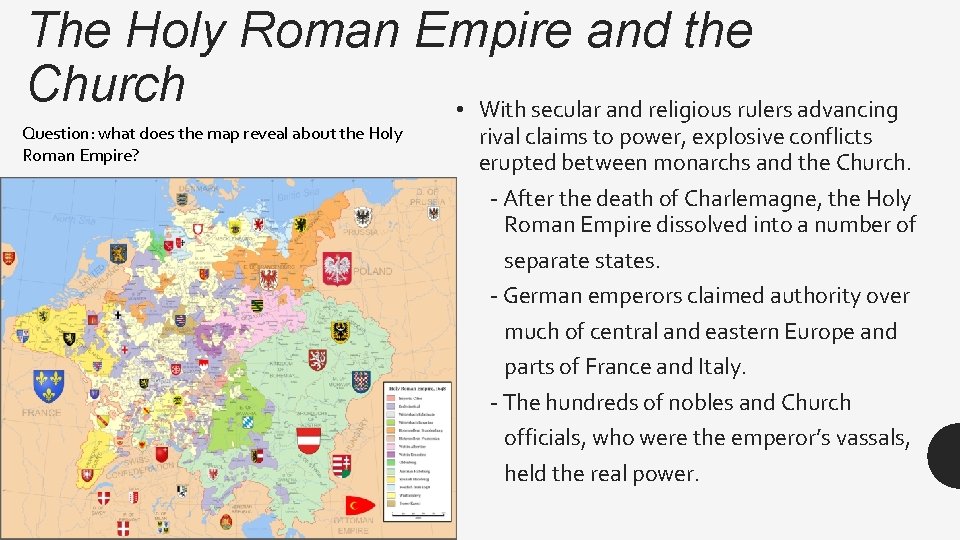
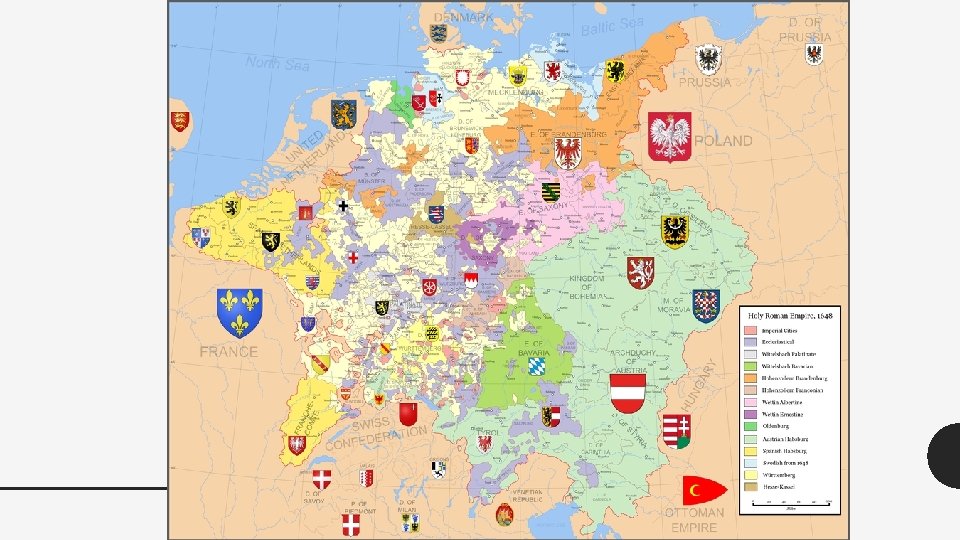
The Holy Roman Empire and the Church • With secular and religious rulers advancing Question: what does the map reveal about the Holy Roman Empire? rival claims to power, explosive conflicts erupted between monarchs and the Church. - After the death of Charlemagne, the Holy Roman Empire dissolved into a number of separate states. - German emperors claimed authority over much of central and eastern Europe and parts of France and Italy. - The hundreds of nobles and Church officials, who were the emperor’s vassals, held the real power.
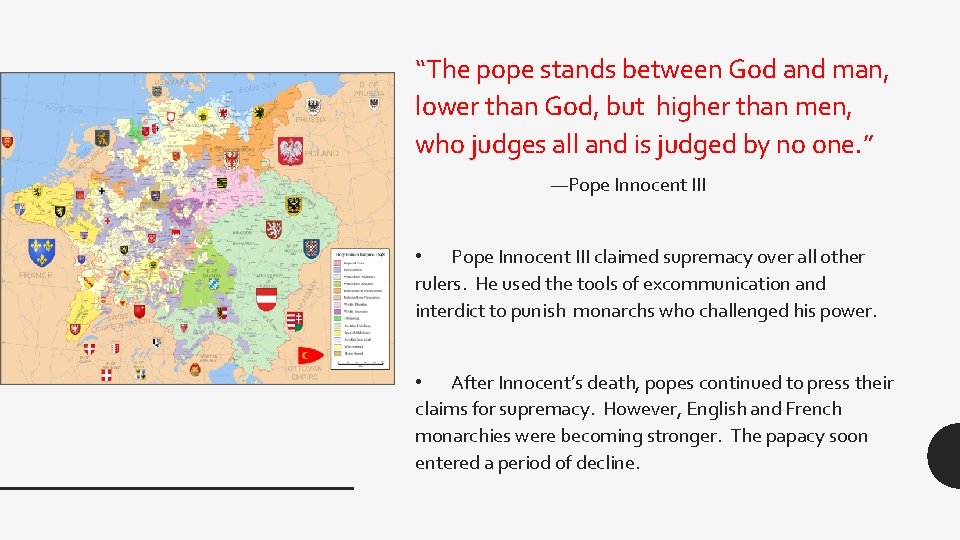
“The pope stands between God and man, lower than God, but higher than men, who judges all and is judged by no one. ” —Pope Innocent III • Pope Innocent III claimed supremacy over all other rulers. He used the tools of excommunication and interdict to punish monarchs who challenged his power. • After Innocent’s death, popes continued to press their claims for supremacy. However, English and French monarchies were becoming stronger. The papacy soon entered a period of decline.
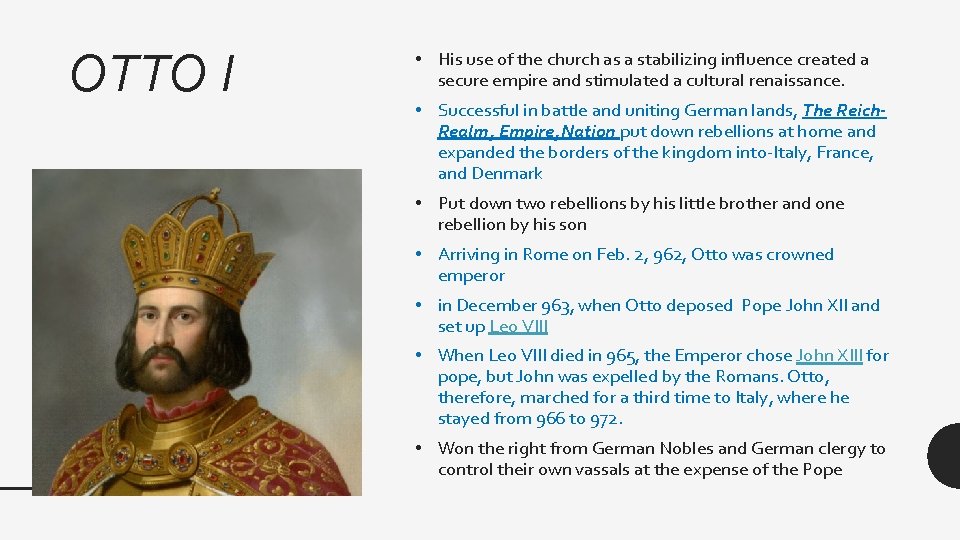
OTTO I • His use of the church as a stabilizing influence created a secure empire and stimulated a cultural renaissance. • Successful in battle and uniting German lands, The Reich. Realm, Empire, Nation put down rebellions at home and expanded the borders of the kingdom into-Italy, France, and Denmark • Put down two rebellions by his little brother and one rebellion by his son • Arriving in Rome on Feb. 2, 962, Otto was crowned emperor • in December 963, when Otto deposed Pope John XII and set up Leo VIII • When Leo VIII died in 965, the Emperor chose John XIII for pope, but John was expelled by the Romans. Otto, therefore, marched for a third time to Italy, where he stayed from 966 to 972. • Won the right from German Nobles and German clergy to control their own vassals at the expense of the Pope
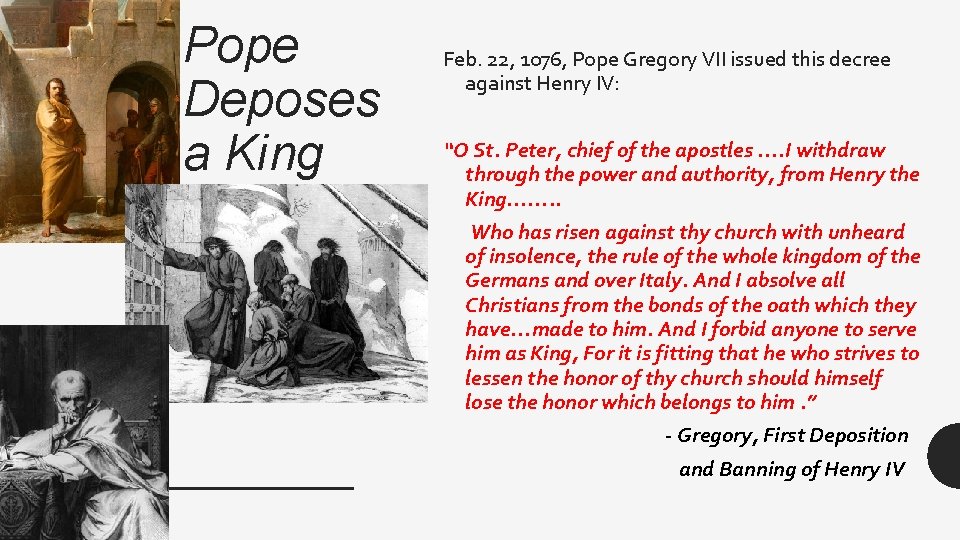
Pope Deposes a King Feb. 22, 1076, Pope Gregory VII issued this decree against Henry IV: “O St. Peter, chief of the apostles …. I withdraw through the power and authority, from Henry the King……. . Who has risen against thy church with unheard of insolence, the rule of the whole kingdom of the Germans and over Italy. And I absolve all Christians from the bonds of the oath which they have…made to him. And I forbid anyone to serve him as King, For it is fitting that he who strives to lessen the honor of thy church should himself lose the honor which belongs to him. ” - Gregory, First Deposition and Banning of Henry IV
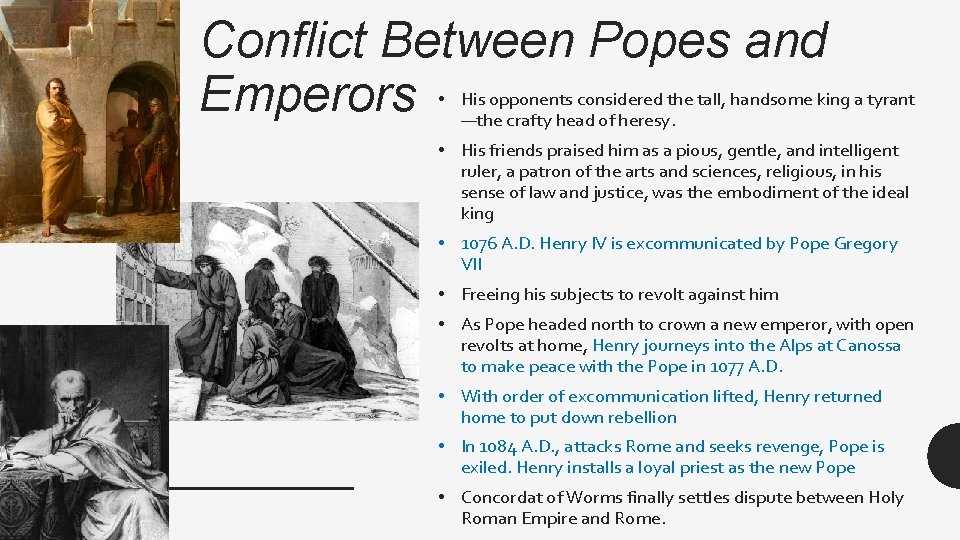
Conflict Between Popes and Emperors • His opponents considered the tall, handsome king a tyrant —the crafty head of heresy. • His friends praised him as a pious, gentle, and intelligent ruler, a patron of the arts and sciences, religious, in his sense of law and justice, was the embodiment of the ideal king • 1076 A. D. Henry IV is excommunicated by Pope Gregory VII • Freeing his subjects to revolt against him • As Pope headed north to crown a new emperor, with open revolts at home, Henry journeys into the Alps at Canossa to make peace with the Pope in 1077 A. D. • With order of excommunication lifted, Henry returned home to put down rebellion • In 1084 A. D. , attacks Rome and seeks revenge, Pope is exiled. Henry installs a loyal priest as the new Pope • Concordat of Worms finally settles dispute between Holy Roman Empire and Rome.
Conflict Between Popes and Emperors The Holy Roman emperors and other monarchs often appointed the Church officials within their realm. This practice was known as lay investiture. Popes, such as Gregory VII, tried to end lay investiture, which they saw as outside interference from secular rulers. The struggle over investiture dragged on for almost 50 years. Finally, in 1122, both sides accepted a treaty known as the Concordat of Worms. It stated that only the Church could appoint bishops, but that the emperor had the right to invest them with fiefs.
The Struggle for Italy During the 1100 s and 1200 s, ambitious German emperors struggled with powerful popes as they tried to gain control of Italy. While the emperors were involved in Italy, German nobles grew more independent. As a result, Germany did not achieve unity for another 600 years. In Italy, the popes asked the French to help them overthrow the German emperors. Power struggles in Italy and Sicily led to 200 years of chaos in that region.
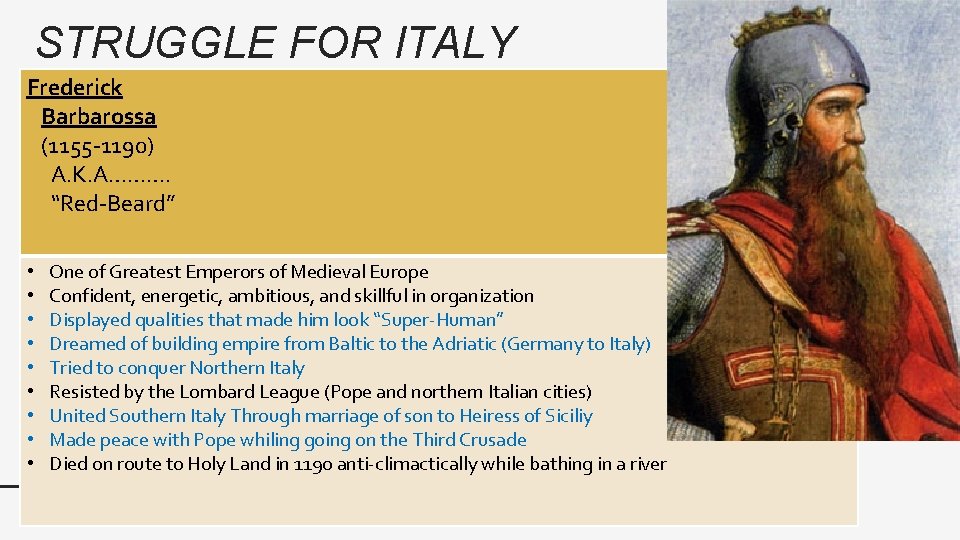
STRUGGLE FOR ITALY Frederick Barbarossa (1155 -1190) A. K. A………. “Red-Beard” • • • One of Greatest Emperors of Medieval Europe Confident, energetic, ambitious, and skillful in organization Displayed qualities that made him look “Super-Human” Dreamed of building empire from Baltic to the Adriatic (Germany to Italy) Tried to conquer Northern Italy Resisted by the Lombard League (Pope and northern Italian cities) United Southern Italy Through marriage of son to Heiress of Siciliy Made peace with Pope whiling going on the Third Crusade Died on route to Holy Land in 1190 anti-climactically while bathing in a river
STRUGGLES FOR ITALY Frederick II (1194 -1250) • One of the most controversial rulers of his time • Known for grand ambitions in the political and cultural arena. • Embroiled in a life-long clash with the papacy, which found itself between the Emperor’s lands in northern Italy and his Kingdom of Sicily in the south • Spent little time in Germany and neglected his kingdom there • Excommunicated twice for ambitions and his disregard for Papal opinion • Married at least three times, fathered eight legitimate children and had many mistresses and illegitimate children • Known to have little interest in religion and studied human and animal anatomy • Frederick was guilty of performing a series of atrocious experiments on his fellow human beings during his reign • Frederick had his good points, he was known to be charming and intelligent, well-mannered and hard working. • Although he could be charming, the lecherous, cunning, greedy side of the Emperor was more often than not at the fore, the man was quick to temper and slow to forget
Frederick II “Emperor Frankenstein” • In 1200 s Emperor Frederick II reputedly had carried out experiments on infants. The origins of human language was something that fascinated the emperor greatly, and he embarked upon an experiment that, he hoped, would prove what was the original language of mankind. In his eagerness to determine what language had been given to Adam and Eve in the garden of Eden, Frederick gave a group of babies over into the care of nurses who were given strict instructions on how to raise them. The nurses were ordered not to interact with the children other than when strictly necessary; the infants could be fed and bathed, but no more, and they were not to be spoken to or cooed over under any circumstances. The children, starved of any form of affection, warmth and basic interaction, died, quite simply, of a lack of love. • Frederick ordered that two prisoners be given dinner, each man to be fed the same food as the other. After eating, one of the men was then sent out hunting, while the other was told to go to bed and sleep off the meal he had just ingested. Unknown to the two men, Frederick intended to investigate the different effects that exercise and sleep might have on the digestion process. This was achieved in a most brutal manner: a few hours afterwards, Frederick had both men killed and disembowelled for the purpose of comparing the state of the contents of their stomachs, to see what had a greater effect.
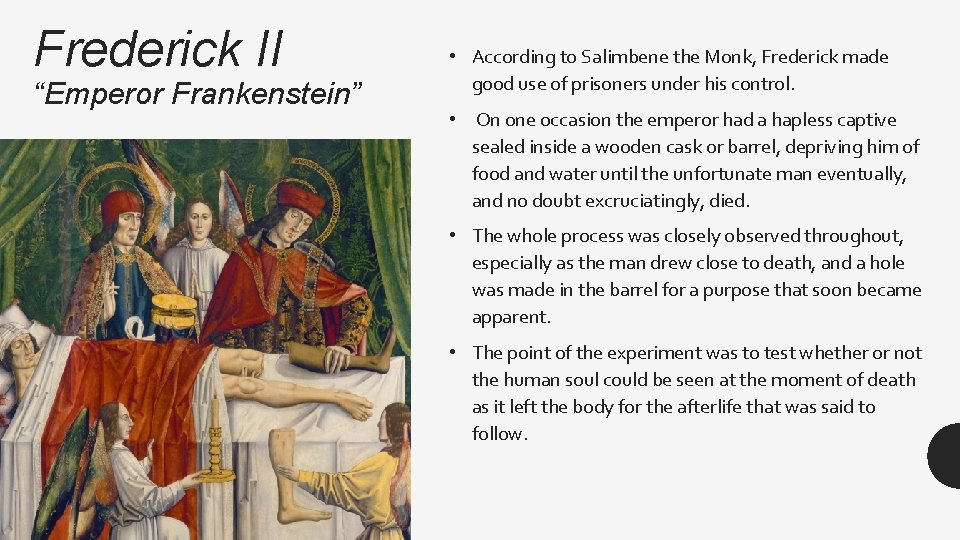
Frederick II “Emperor Frankenstein” • According to Salimbene the Monk, Frederick made good use of prisoners under his control. • On one occasion the emperor had a hapless captive sealed inside a wooden cask or barrel, depriving him of food and water until the unfortunate man eventually, and no doubt excruciatingly, died. • The whole process was closely observed throughout, especially as the man drew close to death, and a hole was made in the barrel for a purpose that soon became apparent. • The point of the experiment was to test whether or not the human soul could be seen at the moment of death as it left the body for the afterlife that was said to follow.
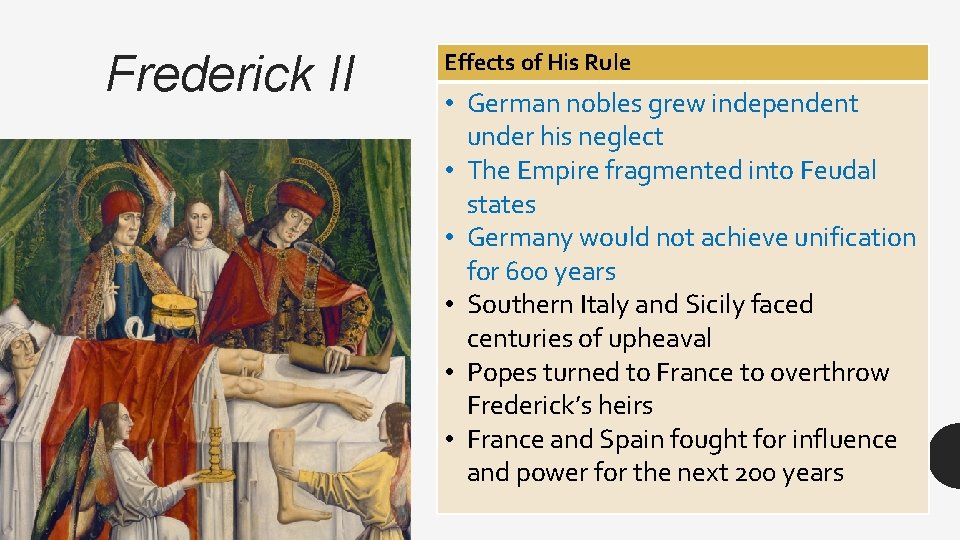
Frederick II Effects of His Rule • German nobles grew independent under his neglect • The Empire fragmented into Feudal states • Germany would not achieve unification for 600 years • Southern Italy and Sicily faced centuries of upheaval • Popes turned to France to overthrow Frederick’s heirs • France and Spain fought for influence and power for the next 200 years
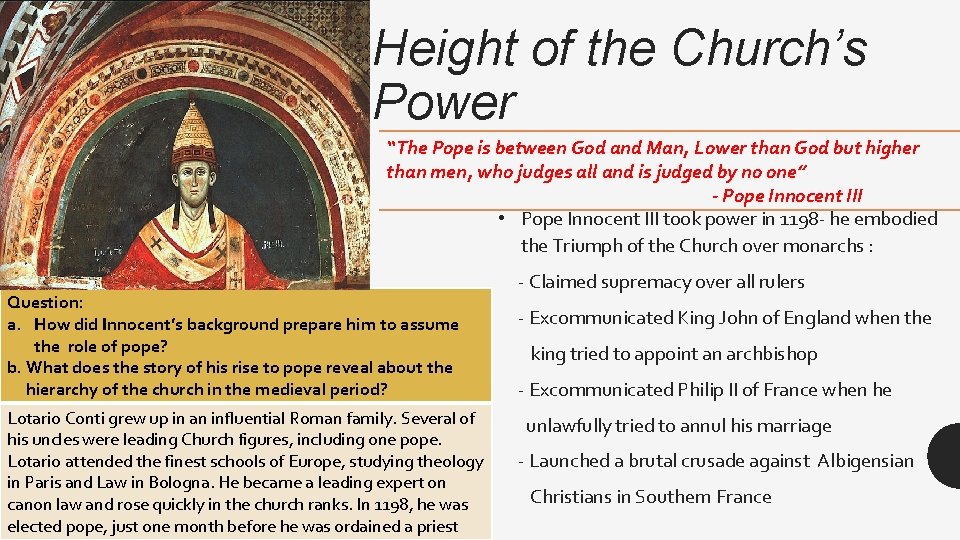
Height of the Church’s Power “The Pope is between God and Man, Lower than God but higher than men, who judges all and is judged by no one” - Pope Innocent III • Pope Innocent III took power in 1198 - he embodied the Triumph of the Church over monarchs : Question: a. How did Innocent’s background prepare him to assume the role of pope? b. What does the story of his rise to pope reveal about the hierarchy of the church in the medieval period? Lotario Conti grew up in an influential Roman family. Several of his uncles were leading Church figures, including one pope. Lotario attended the finest schools of Europe, studying theology in Paris and Law in Bologna. He became a leading expert on canon law and rose quickly in the church ranks. In 1198, he was elected pope, just one month before he was ordained a priest - Claimed supremacy over all rulers - Excommunicated King John of England when the king tried to appoint an archbishop - Excommunicated Philip II of France when he unlawfully tried to annul his marriage - Launched a brutal crusade against Albigensian Christians in Southern France
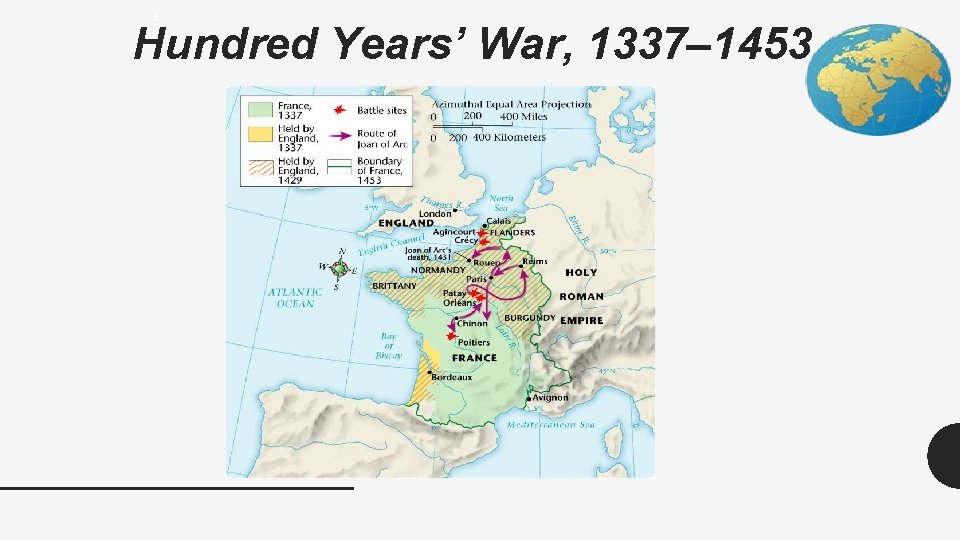
5 Hundred Years’ War, 1337– 1453
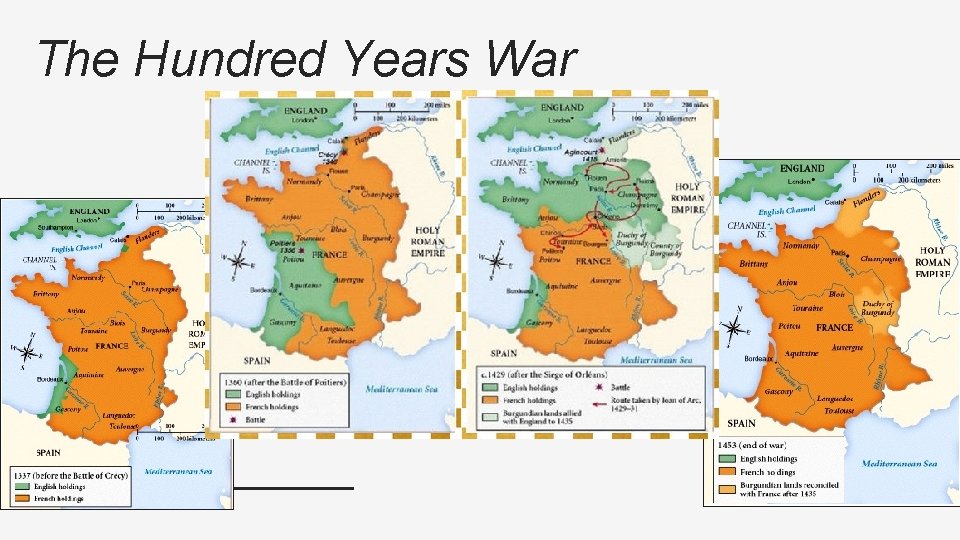
The Hundred Years War
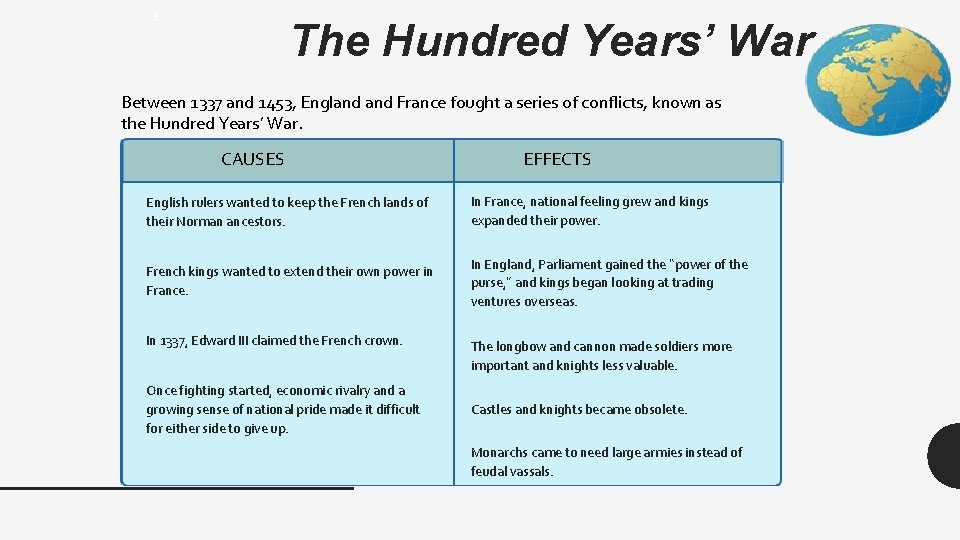
5 The Hundred Years’ War Between 1337 and 1453, England France fought a series of conflicts, known as the Hundred Years’ War. CAUSES EFFECTS English rulers wanted to keep the French lands of their Norman ancestors. In France, national feeling grew and kings expanded their power. French kings wanted to extend their own power in France. In England, Parliament gained the “power of the purse, ” and kings began looking at trading ventures overseas. In 1337, Edward III claimed the French crown. Once fighting started, economic rivalry and a growing sense of national pride made it difficult for either side to give up. The longbow and cannon made soldiers more important and knights less valuable. Castles and knights became obsolete. Monarchs came to need large armies instead of feudal vassals.
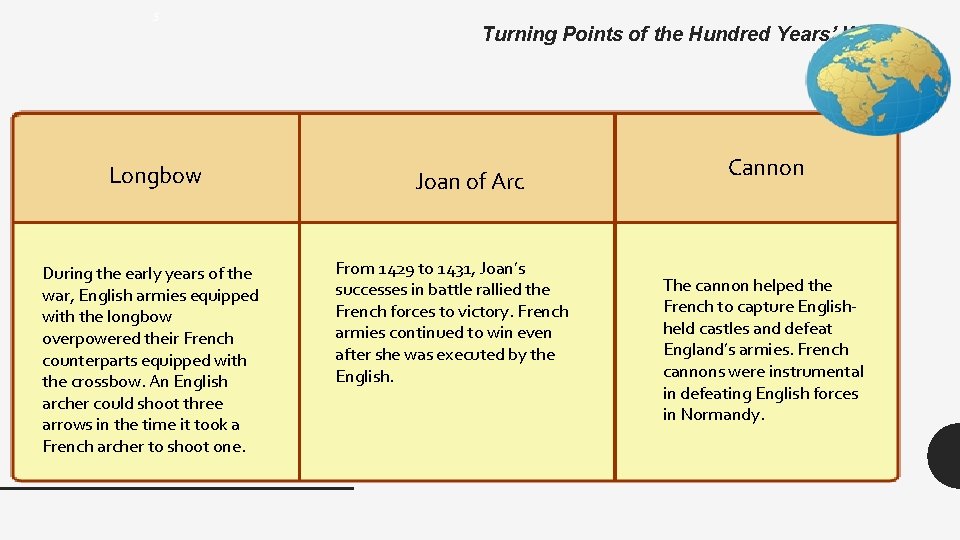
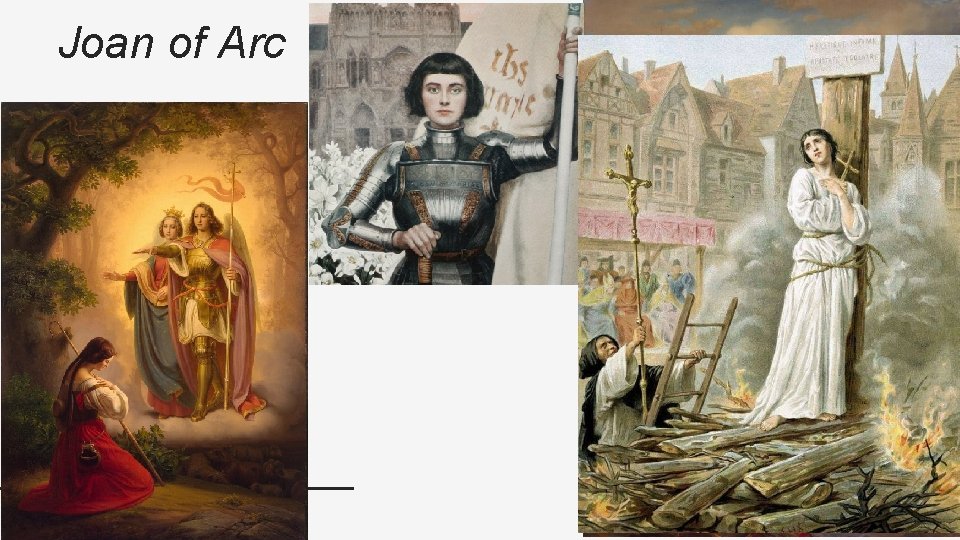
5 Turning Points of the Hundred Years’ War Longbow During the early years of the war, English armies equipped with the longbow overpowered their French counterparts equipped with the crossbow. An English archer could shoot three arrows in the time it took a French archer to shoot one. Joan of Arc From 1429 to 1431, Joan’s successes in battle rallied the French forces to victory. French armies continued to win even after she was executed by the English. Cannon The cannon helped the French to capture Englishheld castles and defeat England’s armies. French cannons were instrumental in defeating English forces in Normandy.
Joan of Arc