
The History of Wine The very first records

- Slides: 12
The History of Wine �The very first records about wine making date back about 7, 000 years �The Greeks received the vine from the Egyptians, and later the Romans contributed to the popularization of wine in Europe �The wines of yesteryear were drunk when they were young and likely to be acidic and crude �The most important winemaking grape variety is the vitis vinifera.
Making Wine �Wine is made in 6 steps: Crushing, fermenting, racking, maturing, filtering (fining and clarifying), and bottling �Red wine gains its color during the fermentation process from the coloring pigments of the red grape skins
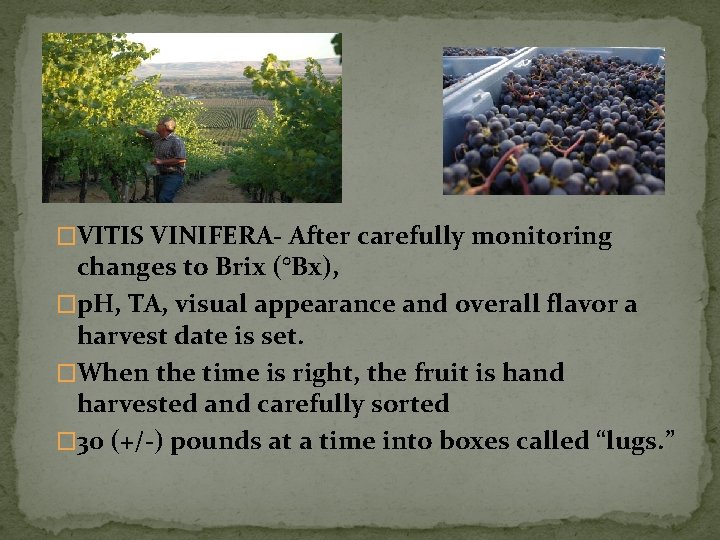
�VITIS VINIFERA- After carefully monitoring changes to Brix (°Bx), �p. H, TA, visual appearance and overall flavor a harvest date is set. �When the time is right, the fruit is hand harvested and carefully sorted � 30 (+/-) pounds at a time into boxes called “lugs. ”
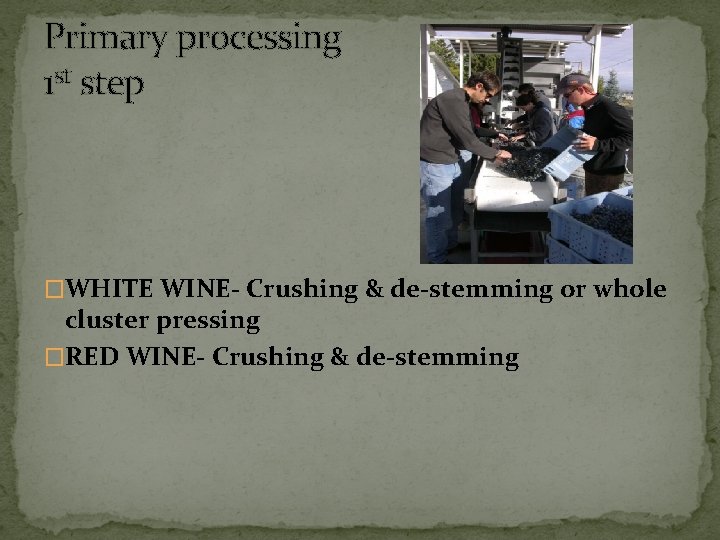
Primary processing 1 st step �WHITE WINE- Crushing & de-stemming or whole cluster pressing �RED WINE- Crushing & de-stemming
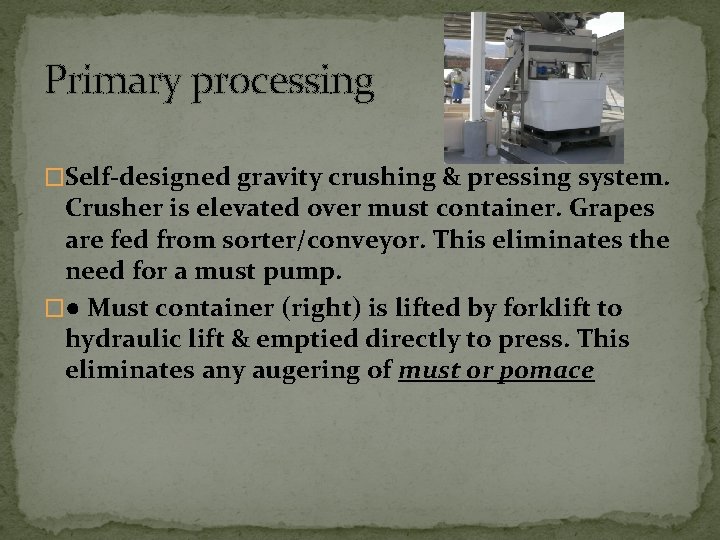
Primary processing �Self-designed gravity crushing & pressing system. Crusher is elevated over must container. Grapes are fed from sorter/conveyor. This eliminates the need for a must pump. �● Must container (right) is lifted by forklift to hydraulic lift & emptied directly to press. This eliminates any augering of must or pomace
Must or pomace �Must (from the Latin vinum mustum, “young wine”) is freshly pressed fruit juice (usually grape juice) that contains the skins, seeds, and stems of the fruit. The solid portion of the must is called pomace; it typically makes up 7%– 23% of the total weight of the must.
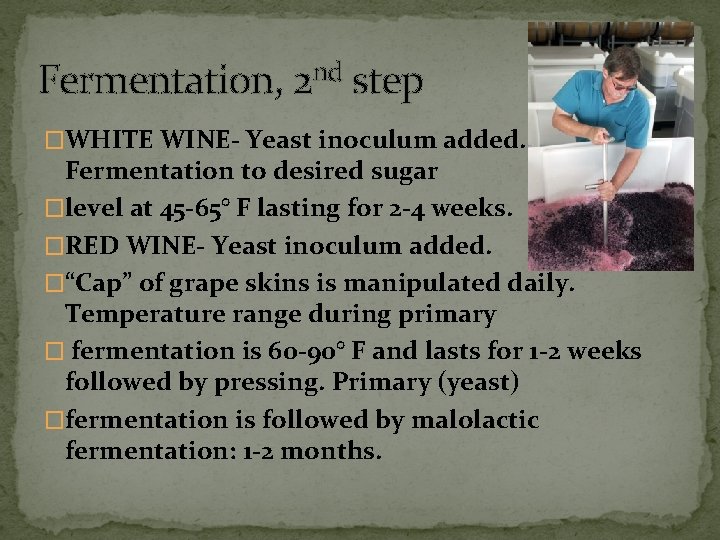
Fermentation, 2 nd step �WHITE WINE- Yeast inoculum added. Fermentation to desired sugar �level at 45 -65° F lasting for 2 -4 weeks. �RED WINE- Yeast inoculum added. �“Cap” of grape skins is manipulated daily. Temperature range during primary � fermentation is 60 -90° F and lasts for 1 -2 weeks followed by pressing. Primary (yeast) �fermentation is followed by malolactic fermentation: 1 -2 months.
Malolactic Fermentation �Basically, malolactic fermentation is a secondary fermentation. It is the process of taking the harsher malic acid in a wine and converting it to a softer lactic acid. Malic acid is the tart acid found in a Granny Smith apple, while lactic acid is the more subtle acid found in milk, butter, cheese and yogurt (and it is the diacetyl derivative of the lactic acid, that shows up as "buttery" in a Chardonnay that has undergone malolactic fermentation).
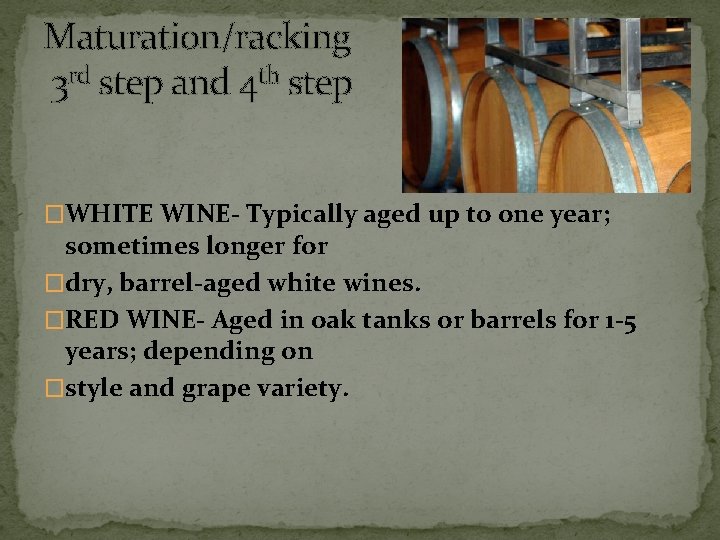
Maturation/racking 3 rd step and 4 th step �WHITE WINE- Typically aged up to one year; sometimes longer for �dry, barrel-aged white wines. �RED WINE- Aged in oak tanks or barrels for 1 -5 years; depending on �style and grape variety.
Fining and filtration 5 th step �WHITE WINE� 1) Blending. � 2) Gravity settling. � 3) Bentonite is added for �protein stabilization. � 4) Wine is held at 25 -35° F to �cold stabilize (tartaric acid �precipitation). � 5) Wine is racked & filtered.
Fining and filtration �RED WINE� 1) Blending. � 2) Gravity settling. � 3) Fining to reduce tannin �content (optional). � 4) Filtration to clarify.
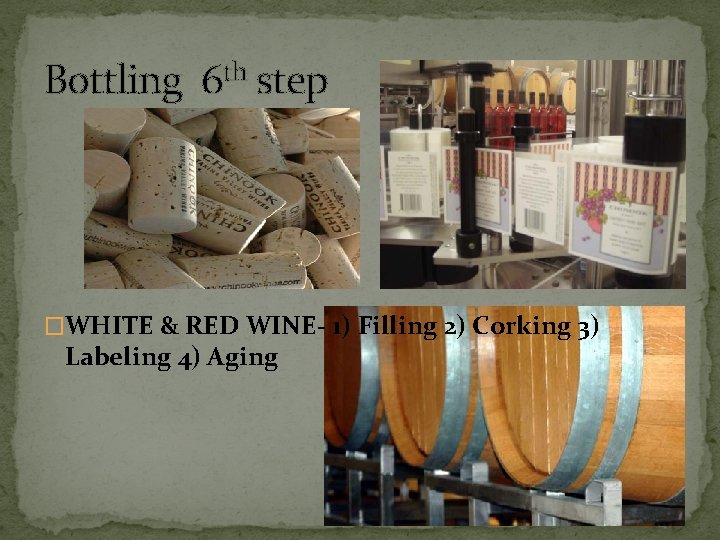
Bottling 6 th step �WHITE & RED WINE- 1) Filling 2) Corking 3) Labeling 4) Aging