
The History of the Modern Periodic Table Homework
The History of the Modern Periodic Table Homework Notes: November 6 th, 2015
During the nineteenth century, chemists began to categorize the elements according to similarities in their physical and chemical properties. The end result of these studies was our modern periodic table.
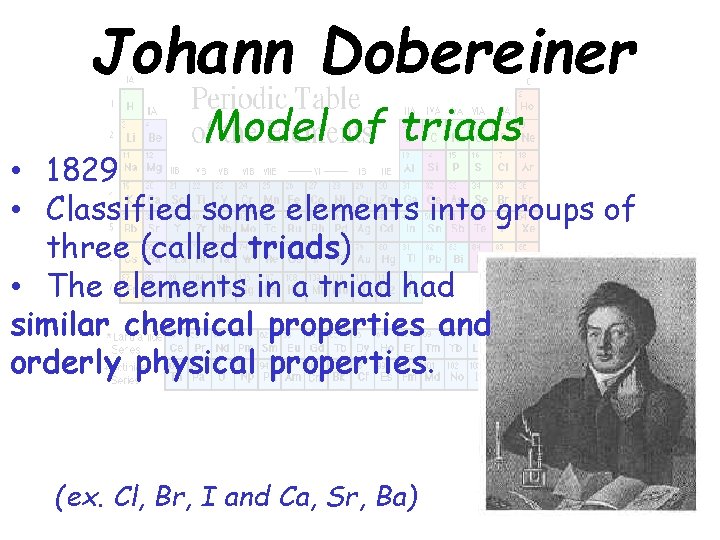
Johann Dobereiner Model of triads • 1829 • Classified some elements into groups of three (called triads) • The elements in a triad had similar chemical properties and orderly physical properties. (ex. Cl, Br, I and Ca, Sr, Ba)
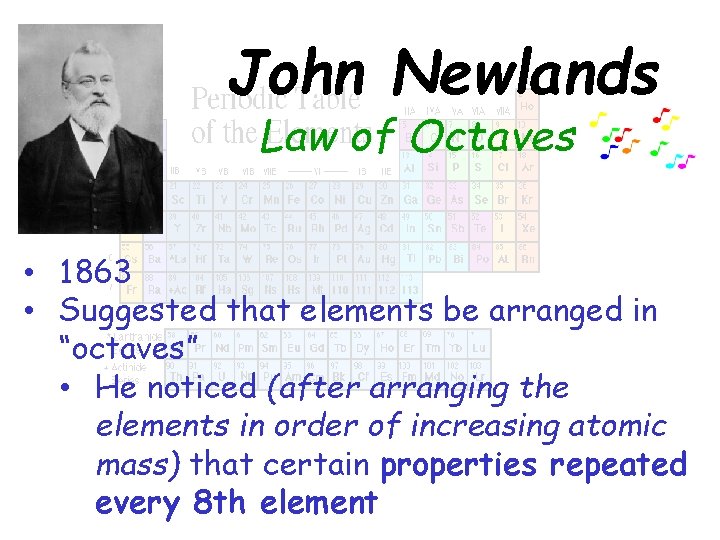
John Newlands Law of Octaves • 1863 • Suggested that elements be arranged in “octaves” • He noticed (after arranging the elements in order of increasing atomic mass) that certain properties repeated every 8 th element

Dmitri Mendeleev In 1869 he published a table of the elements organized by increasing atomic mass.
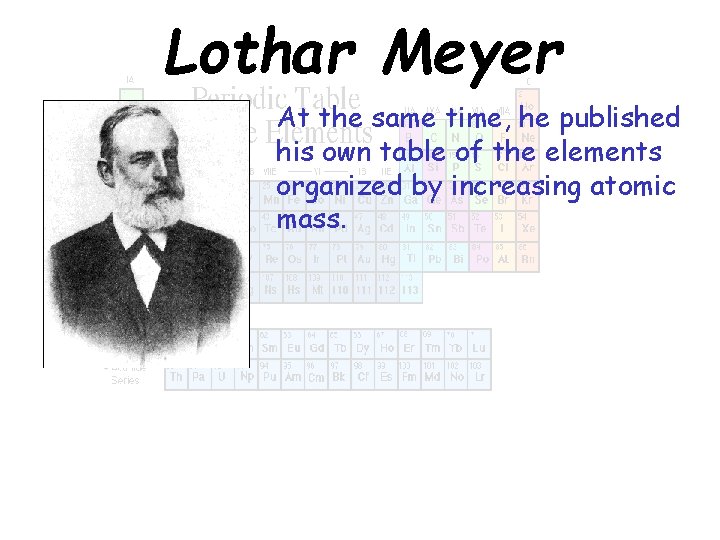
Lothar Meyer At the same time, he published his own table of the elements organized by increasing atomic mass.
• Both Mendeleev and Meyer arranged the elements in order of increasing atomic mass. • Both left vacant spaces where unknown elements should fit. So why is Mendeleev called the “father of the modern periodic table” and not Meyer, or both?
Mendeleev. . . • stated that if the atomic weight of an element caused it to be placed in the wrong group, then the weight must be wrong. (He corrected the atomic masses of Be, In, and U) • was so confident in his table that he used it to predict the physical properties of three elements that were yet unknown.
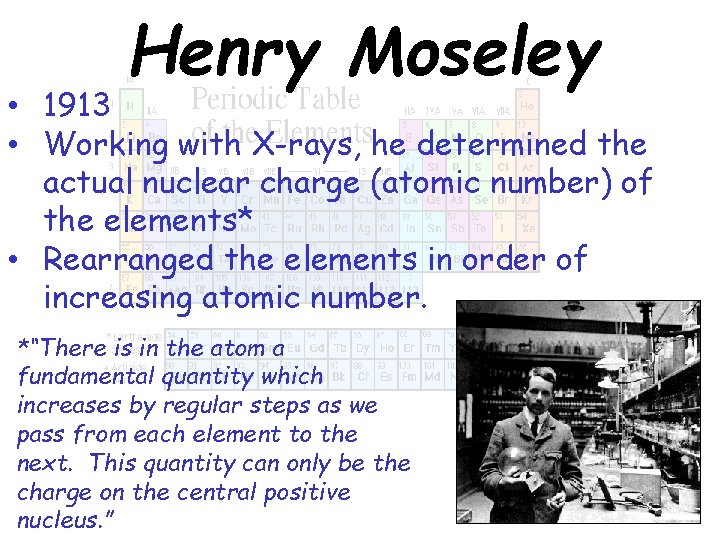
Henry Moseley • 1913 • Working with X-rays, he determined the actual nuclear charge (atomic number) of the elements* • Rearranged the elements in order of increasing atomic number. *“There is in the atom a fundamental quantity which increases by regular steps as we pass from each element to the next. This quantity can only be the charge on the central positive nucleus. ”

The Periodic Law When elements are arranged in order of increasing atomic number, there is a periodic repetition of their physical and chemical properties. …. That’s why it’s called the periodic table.
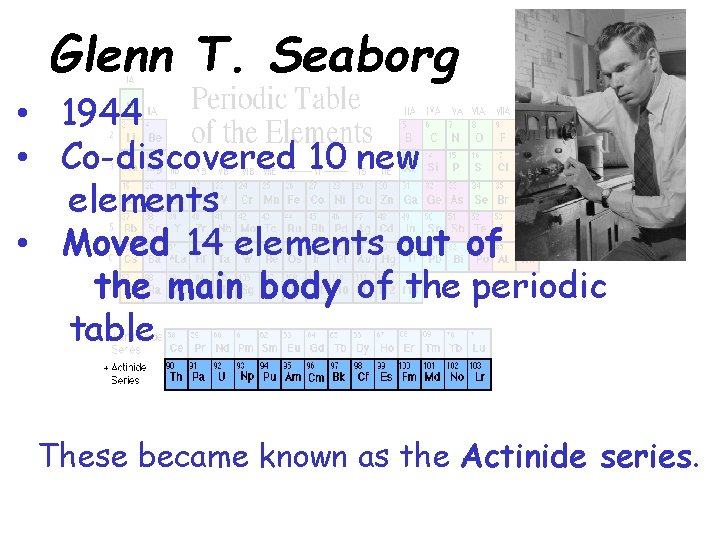
Glenn T. Seaborg • 1944 • Co-discovered 10 new elements • Moved 14 elements out of the main body of the periodic table These became known as the Actinide series.
The Remaining Questions • Why could most of the elements be arranged in order of increasing atomic mass but a few could not? • What was the reason for chemical periodicity?
The Reason is Valence Electrons • The number of electrons in the outermost energy level • • Determines the chemical behavior of an element Elements in the same vertical column (family) have similar properties because they have the same number of electrons in their outer shell
- Slides: 13